Ventilation:  Basic Principles Jamie Ranse Registered Nurse Emergency Department The Canberra Hospital
Introduction to Ventilation Principles Respiratory Anatomy and Physiology Indications for Ventilation Modes of Ventilation Patient Management Complications Questions Overview
Ventilation is the movement of air into and out of the alveoli. Introduction Hudak, et al, 1997,  Critical Care Nursing: A Holistic Approach (7th Edn) , Lippincott, Philadelphia, USA
Mechanics of Ventilation: Elasticity Compliance Resistance Pressure Gravity Introduction Hudak, et al, 1997,  Critical Care Nursing: A Holistic Approach (7th Edn) , Lippincott, Philadelphia, USA
Respiratory Structures Respiratory Zones Partitioning of Respiratory Pressures Boyles Law Respiratory Volumes and Capacity  Ventilation and Perfusion Anatomy and Physiology
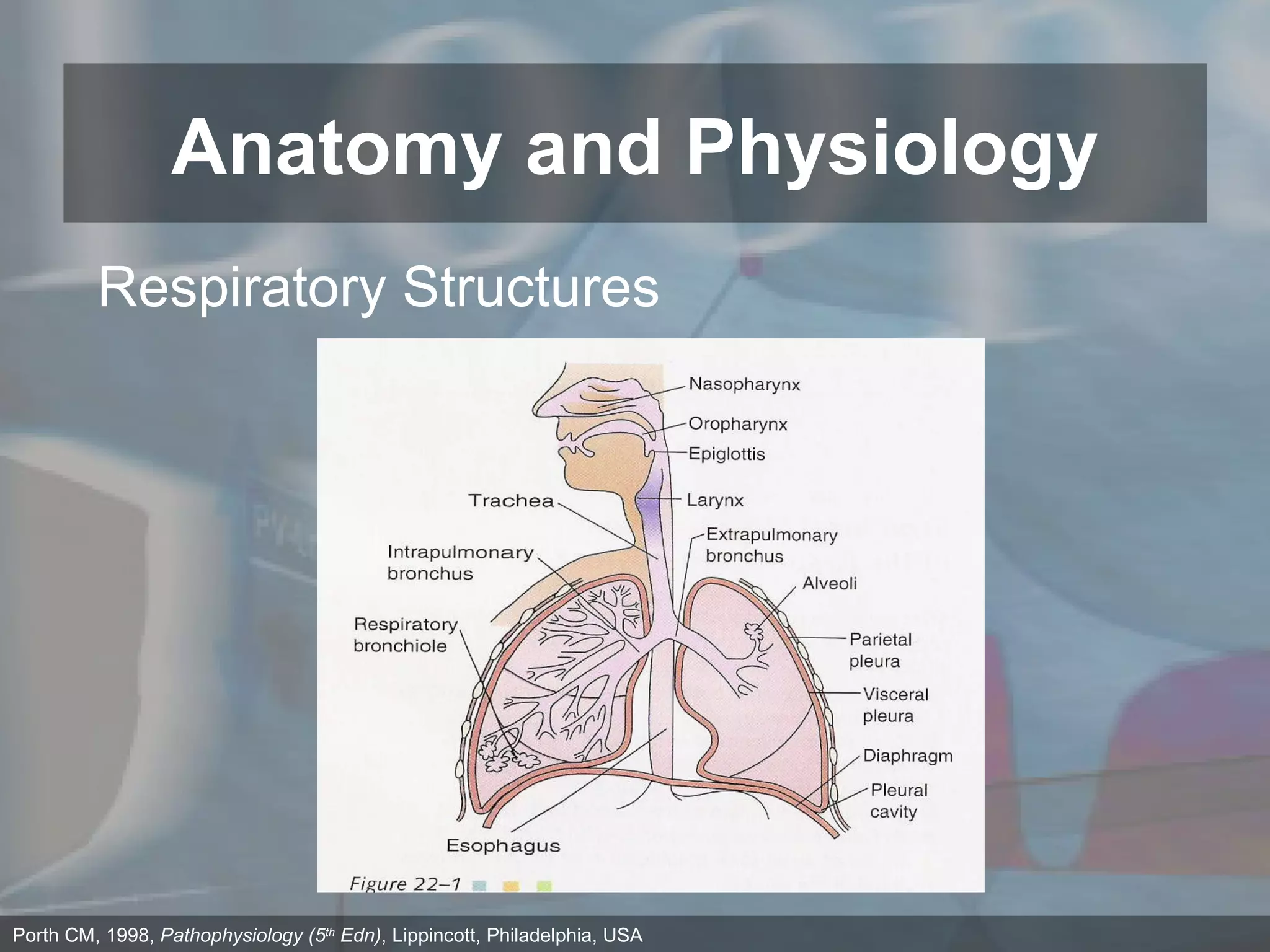
Anatomy and Physiology Porth CM, 1998,  Pathophysiology (5 th  Edn) , Lippincott, Philadelphia, USA Respiratory Structures
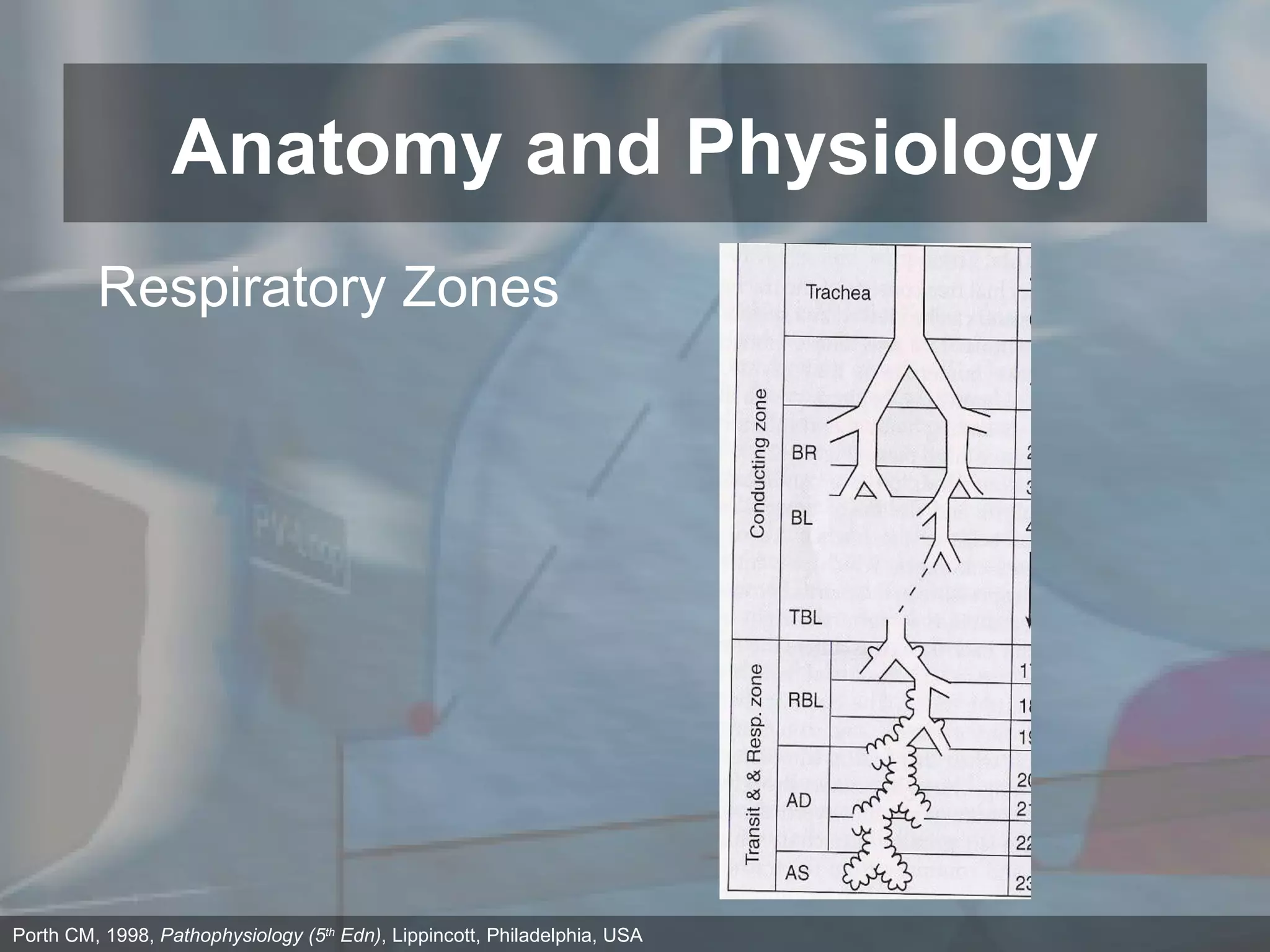
Anatomy and Physiology Porth CM, 1998,  Pathophysiology (5 th  Edn) , Lippincott, Philadelphia, USA Respiratory Zones
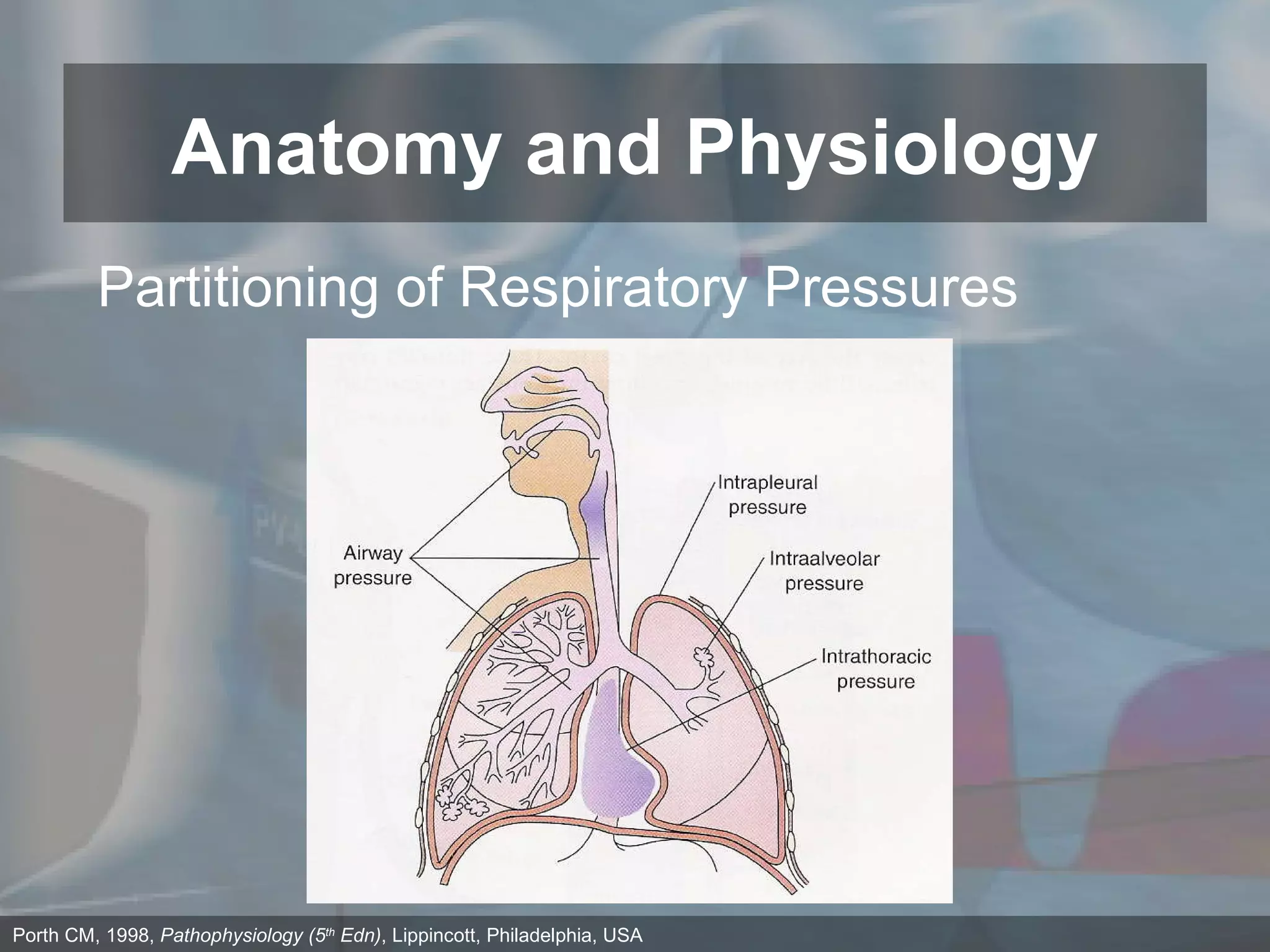
Anatomy and Physiology Porth CM, 1998,  Pathophysiology (5 th  Edn) , Lippincott, Philadelphia, USA Partitioning of Respiratory Pressures
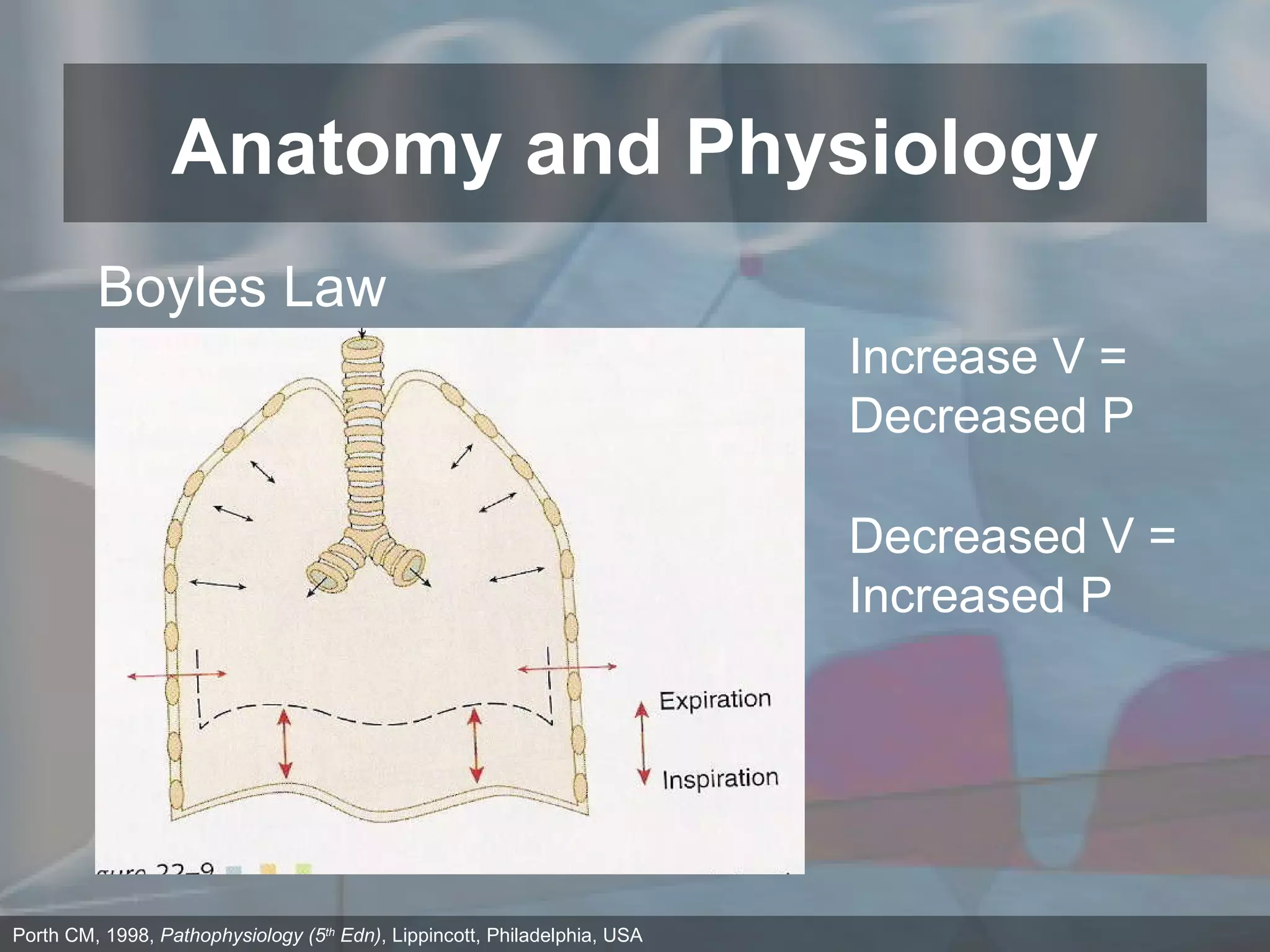
Anatomy and Physiology Porth CM, 1998,  Pathophysiology (5 th  Edn) , Lippincott, Philadelphia, USA Boyles Law Increase V = Decreased P Decreased V = Increased P
Anatomy and Physiology Porth CM, 1998,  Pathophysiology (5 th  Edn) , Lippincott, Philadelphia, USA Boyles Law Air flows from a region of higher pressure to a region of lower pressure. To initiate a breath, airflow into the lungs must be precipitated by a drop in alveolar pressures.
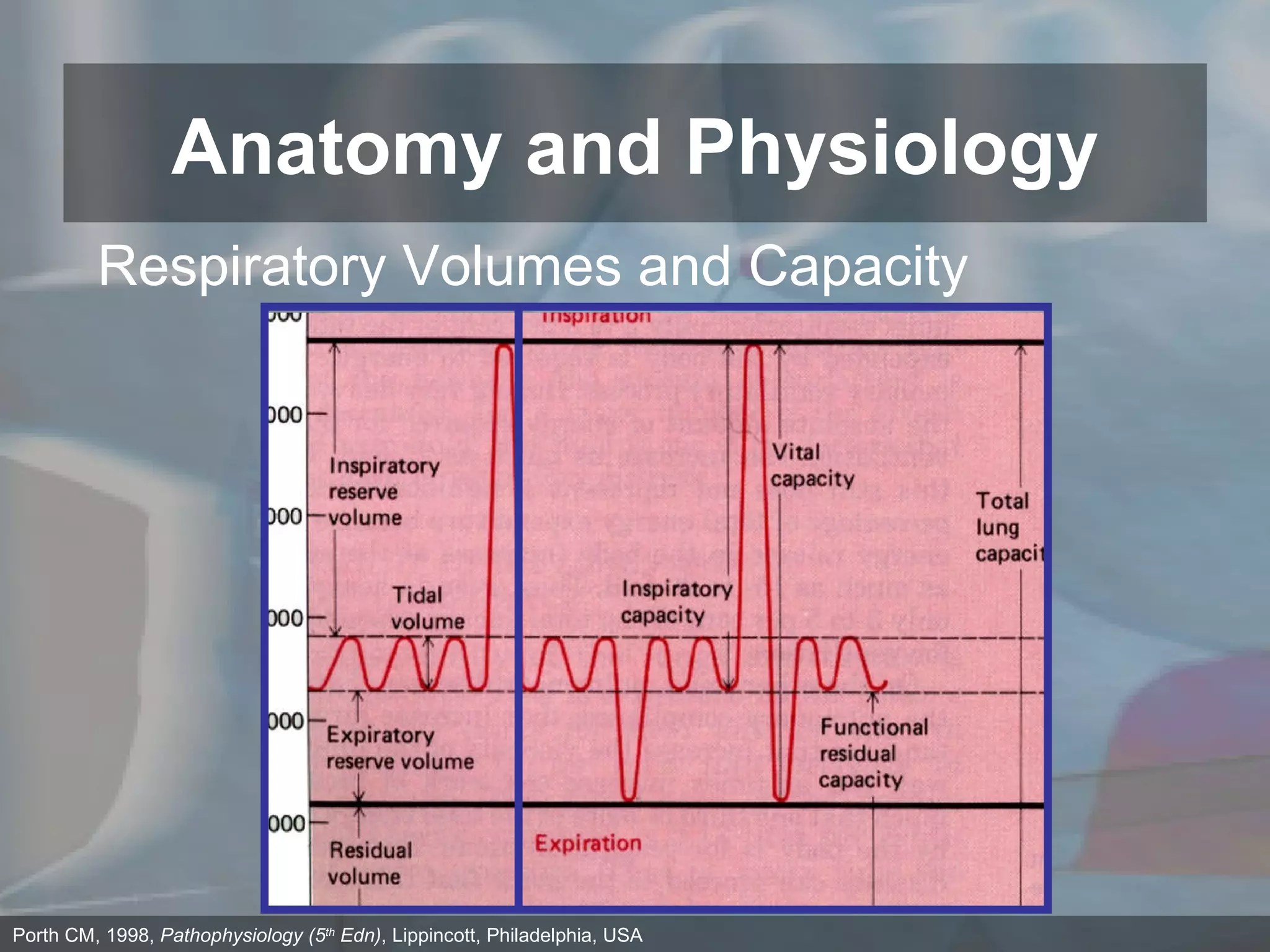
Anatomy and Physiology Porth CM, 1998,  Pathophysiology (5 th  Edn) , Lippincott, Philadelphia, USA Respiratory Volumes and Capacity
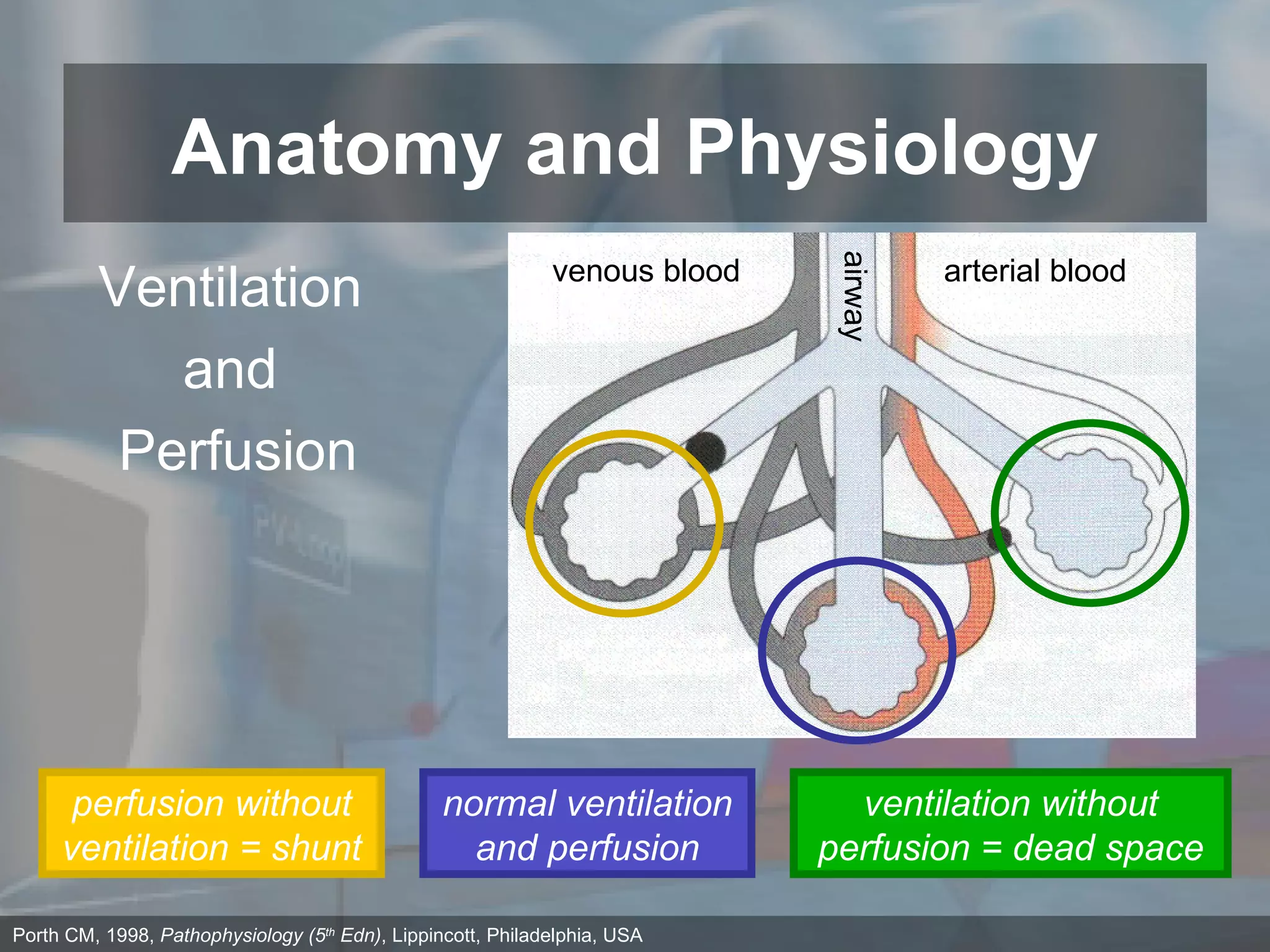
Anatomy and Physiology perfusion without ventilation = shunt normal ventilation and perfusion ventilation without perfusion = dead space airway venous blood arterial blood Porth CM, 1998,  Pathophysiology (5 th  Edn) , Lippincott, Philadelphia, USA Ventilation  and  Perfusion
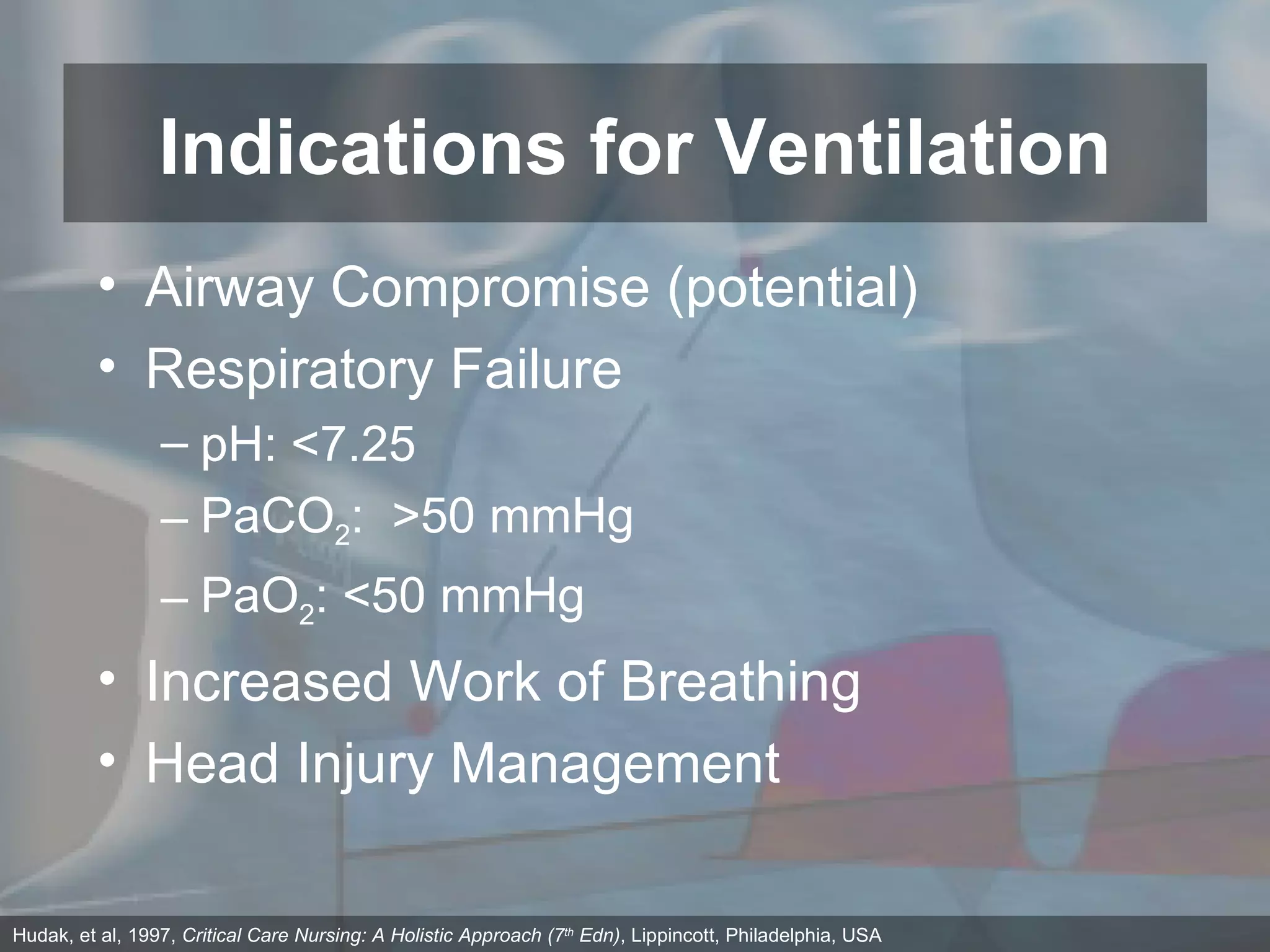
Airway Compromise (potential) Respiratory Failure pH: <7.25 PaCO 2 :  >50 mmHg PaO 2 : <50 mmHg Increased Work of Breathing Head Injury Management Indications for Ventilation Hudak, et al, 1997,  Critical Care Nursing: A Holistic Approach (7 th  Edn) , Lippincott, Philadelphia, USA
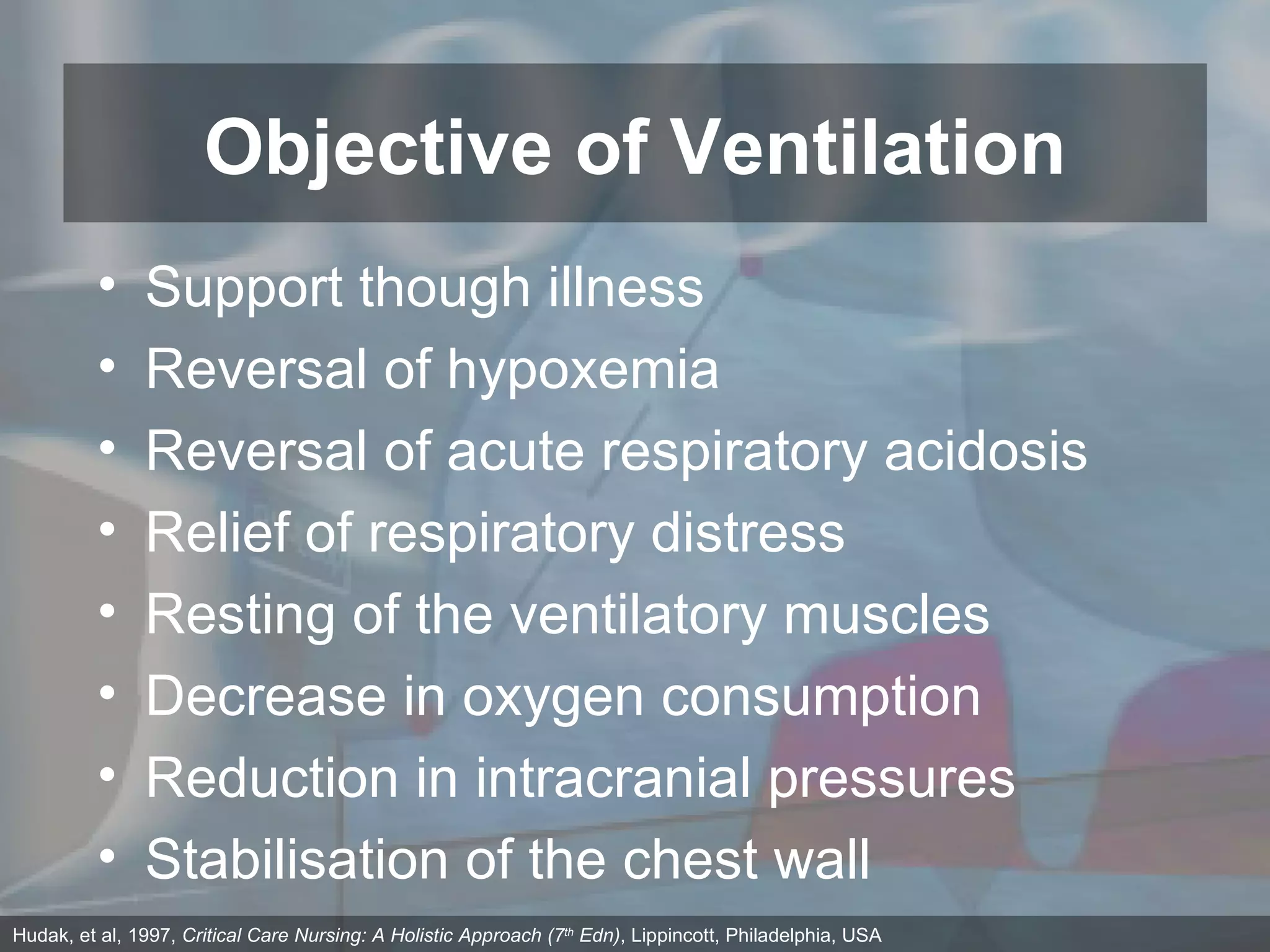
Support though illness Reversal of hypoxemia Reversal of acute respiratory acidosis Relief of respiratory distress Resting of the ventilatory muscles Decrease in oxygen consumption Reduction in intracranial pressures Stabilisation of the chest wall Objective of Ventilation Hudak, et al, 1997,  Critical Care Nursing: A Holistic Approach (7 th  Edn) , Lippincott, Philadelphia, USA
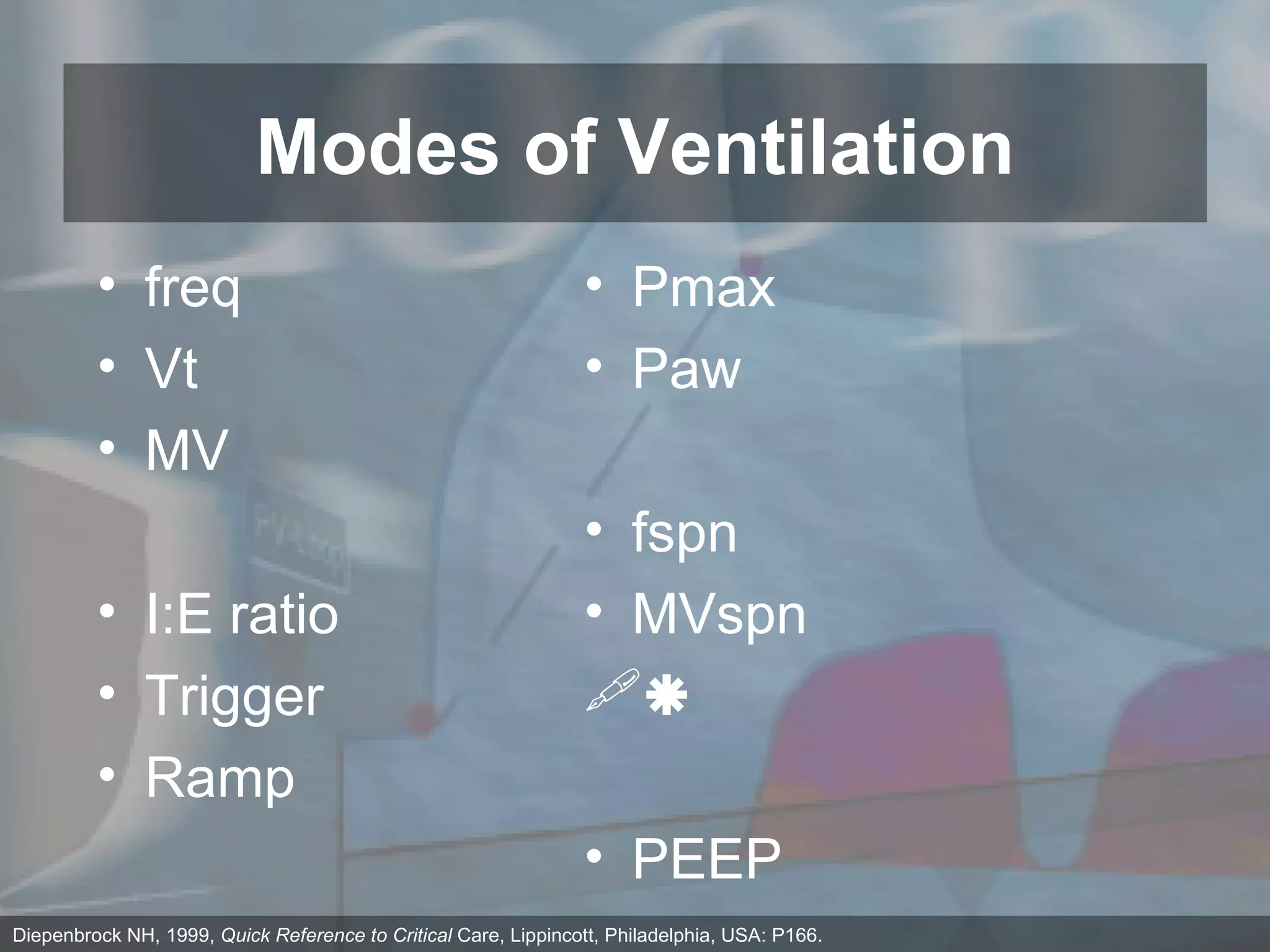
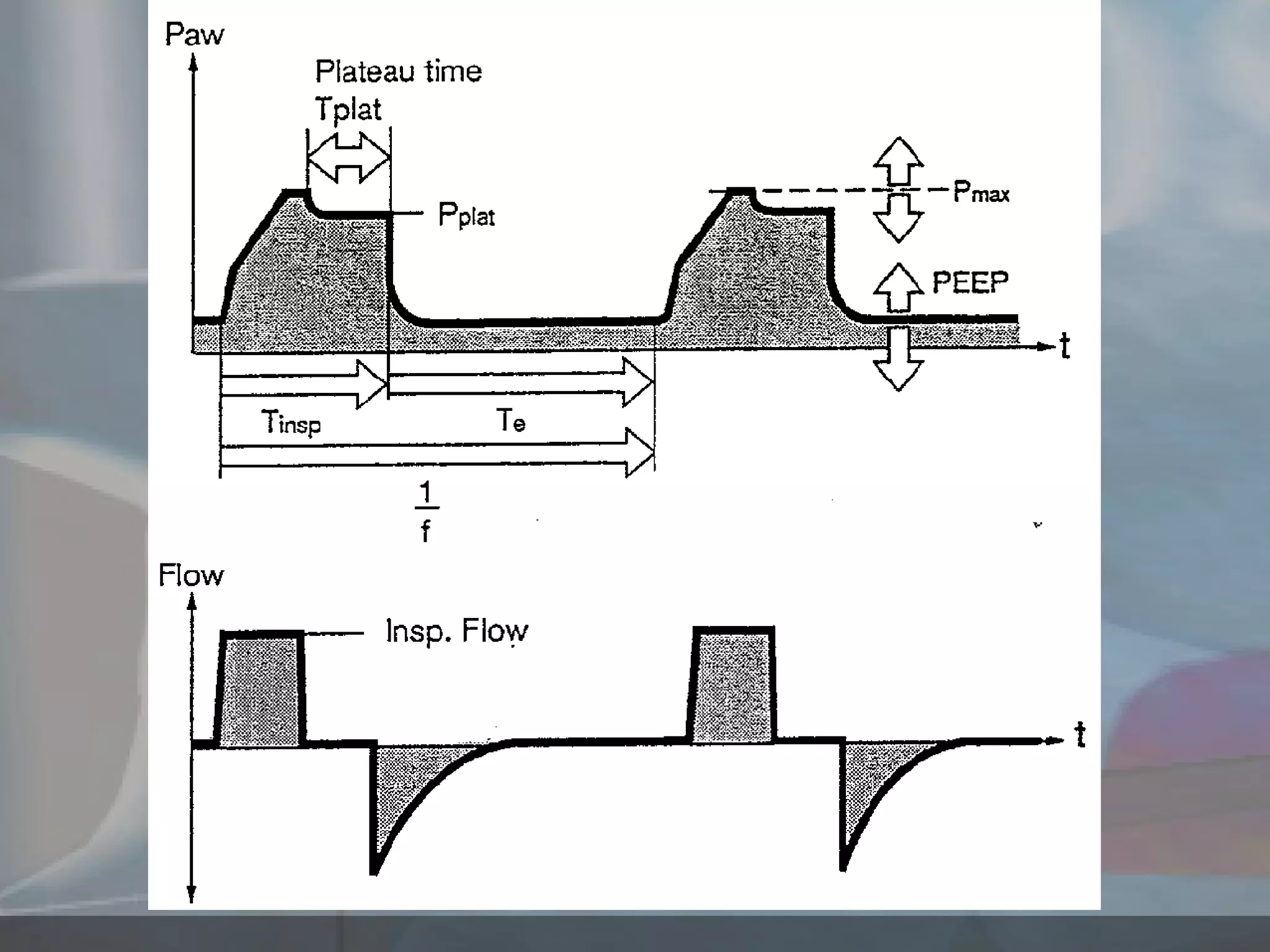
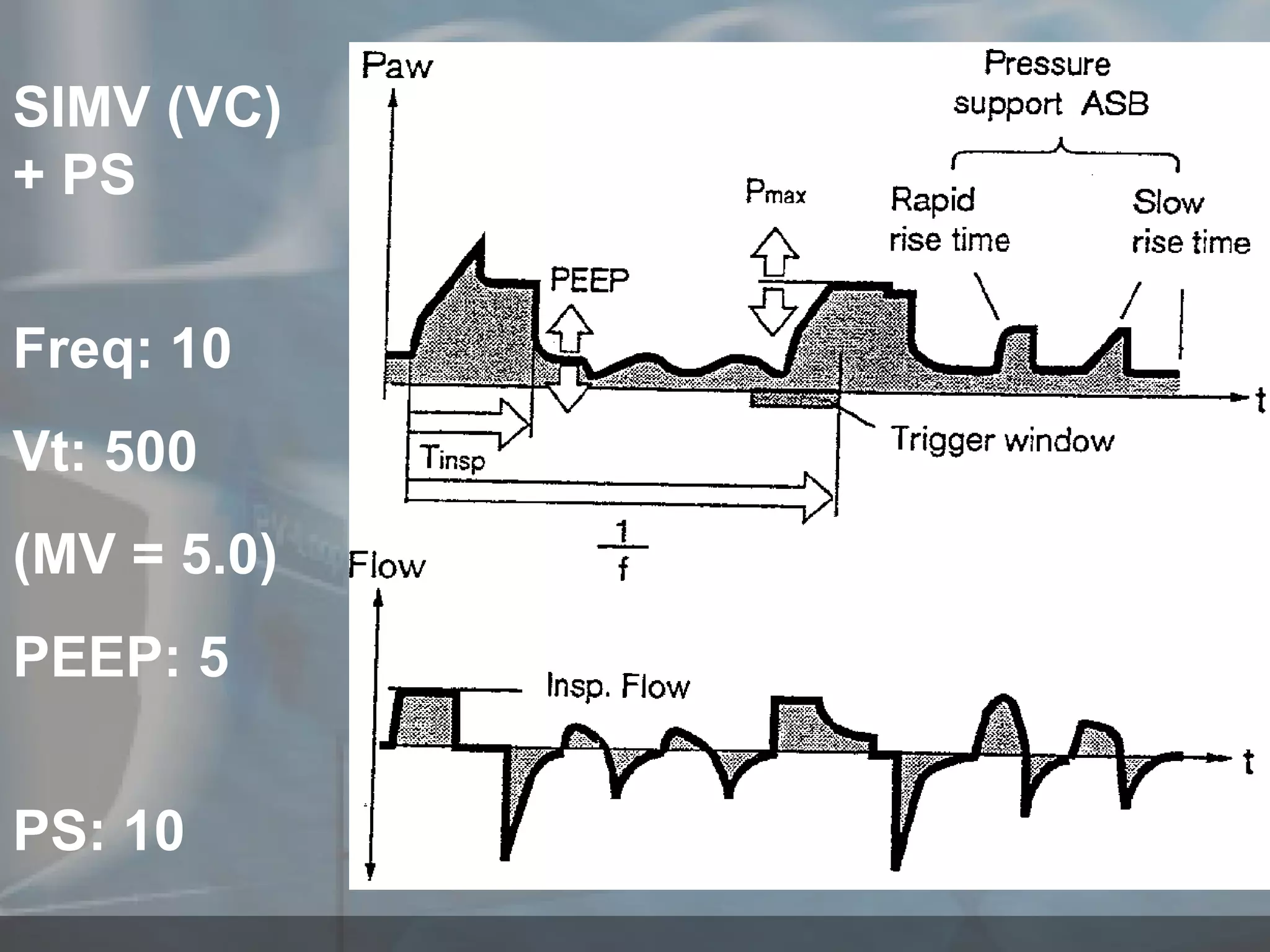
freq Vt MV I:E ratio Trigger Ramp Modes of Ventilation Diepenbrock NH, 1999,  Quick Reference to Critical  Care, Lippincott, Philadelphia, USA: P166. Pmax Paw fspn MVspn  PEEP
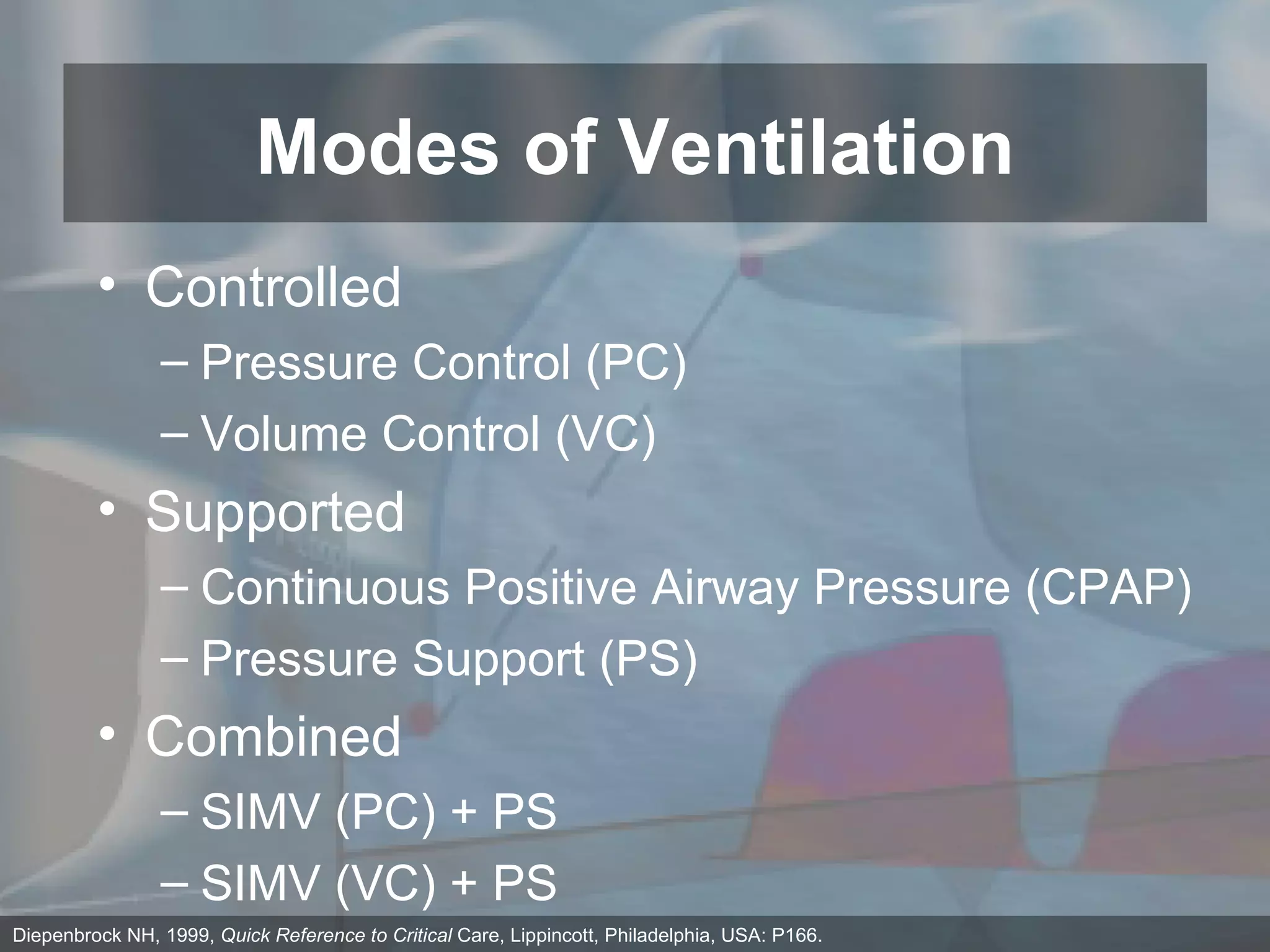
Controlled  Pressure Control (PC) Volume Control (VC) Supported Continuous Positive Airway Pressure (CPAP)  Pressure Support (PS) Combined SIMV (PC) + PS SIMV (VC) + PS Modes of Ventilation Diepenbrock NH, 1999,  Quick Reference to Critical  Care, Lippincott, Philadelphia, USA: P166.
Modes of Ventilation:  Control C ontrolled  M echanical  V entilation: The Minute Volume is determined by the ventilator  The patient has no option to override the ventilator
 
Modes of Ventilation:  Control P ressure  C ontrol: A preset  peak inspiratory pressure  is delivered to the patient at a preset respiratory rate Volume is not preset and is determined by the mechanics of ventilation.  (elasticity, compliance, resistance, pressure, gravity)
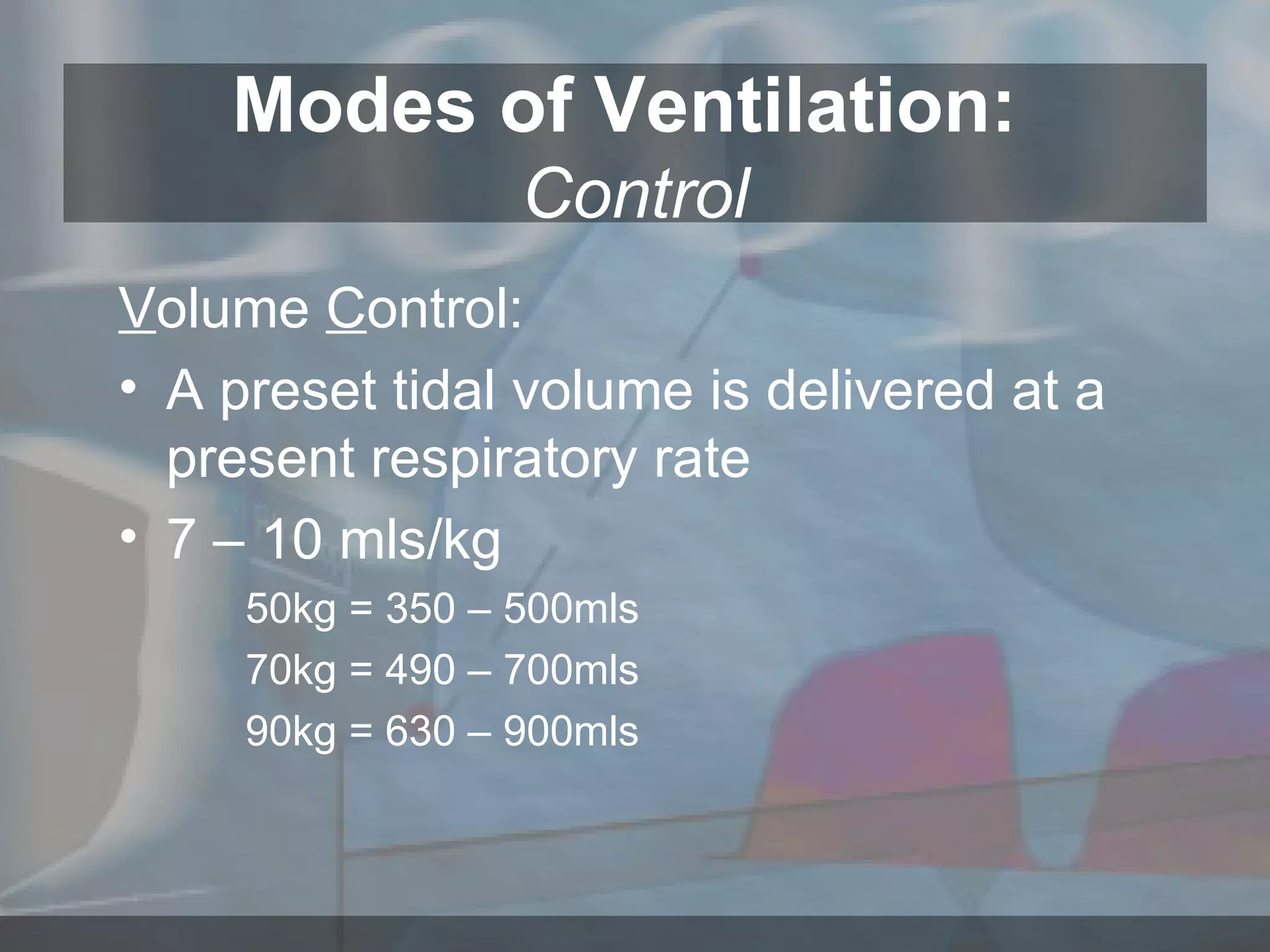
Modes of Ventilation:  Control V olume  C ontrol: A preset tidal volume is delivered at a present respiratory rate  7 – 10 mls/kg  50kg = 350 – 500mls 70kg = 490 – 700mls 90kg = 630 – 900mls
Modes of Ventilation:  Support C ontinuous  P ositive  A irway  P ressure: A spontaneous breathing mode, where the patient generates their own breath The ventilator maintains a constant positive pressure on expiration (PEEP) Aims to increase Functional Residual Capacity
Modes of Ventilation:  Support P ressure  S upport: A spontaneous breathing mode Need for additional support to achieve optimal tidal volumes Ventilator delivers a constant preset pressure on inspiration CPAP + PS = BiPAP
Modes of Ventilation:  Combined S ynchronised  I ntermitted  M andatory  V entilation: Similar to IMV If the patient initiates a breath and the ventilator synchronises so the ventilator doesn’t deliver a breath at the same time
Modes of Ventilation:  Combined SIMV (PC)  +  PS :   Pressure controlled ventilation with pressure support on spontaneous breaths SIMV (VC)  +  PS : Volume controlled ventilation with pressure support on spontaneous breaths
SIMV (VC) + PS Freq: 10 Vt: 500 (MV = 5.0) PEEP: 5 PS: 10
Monitoring Suctioning Other Sedation Positioning Oral and Eye Care Patient Management
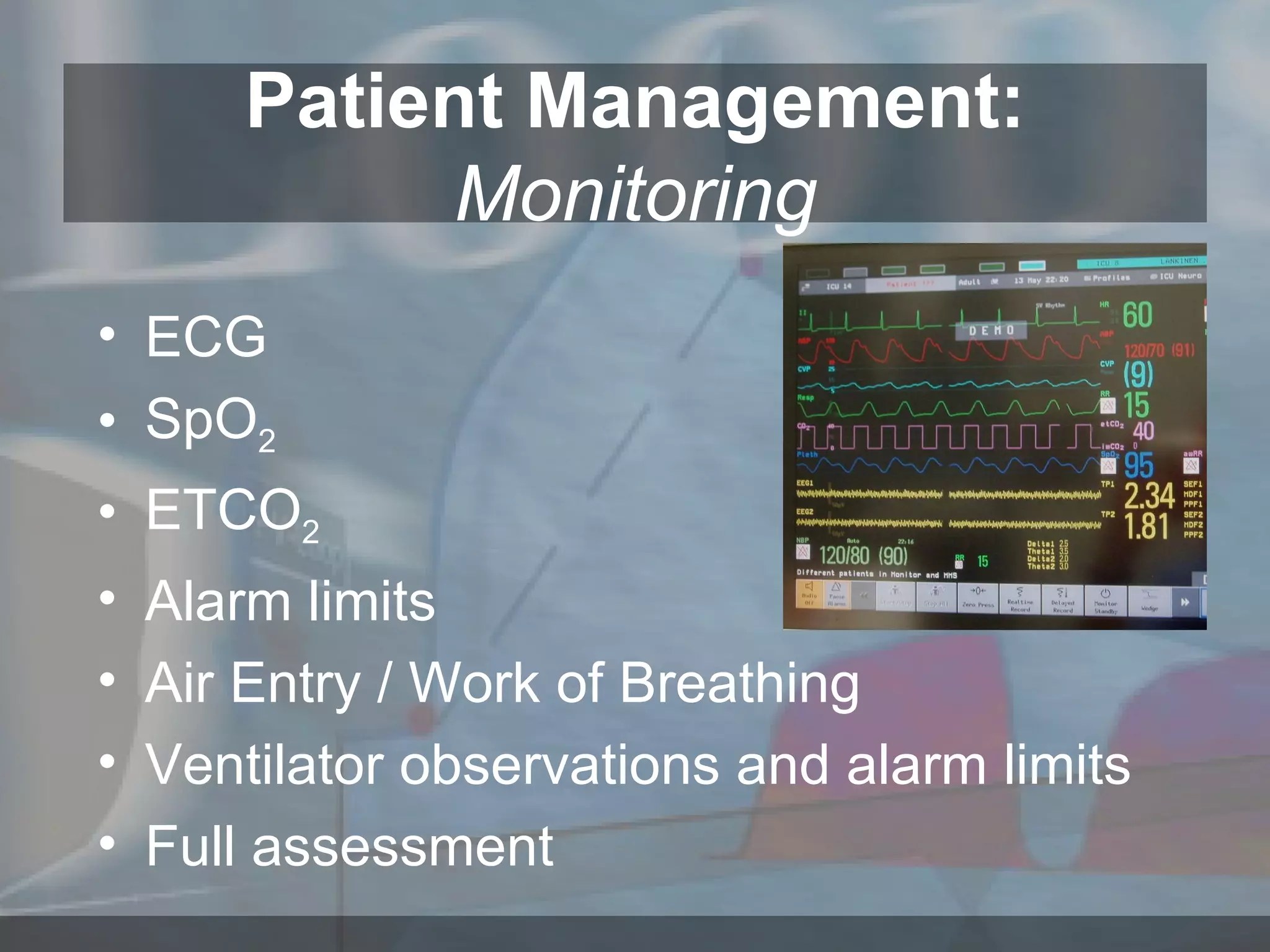
ECG SpO 2 ETCO 2 Alarm limits Air Entry / Work of Breathing Ventilator observations and alarm limits Full assessment Patient Management: Monitoring
PRN Increasing airway pressures Decreasing SpO 2 Increased work of breathing Pre-oxygenate (100% oxygen) Less than 15 Seconds Patient Management: Suctioning
Patient Management: Other Sedation Propofol, Morphine and Midazolam Positioning 2/24 Oral and eye care 2/24
Airway Aspiration, decreased clearance of secretions, predisposition to infection Endotracheal Tube Tube kinking, sputum plug, right main bronchus intubation, tube migration, cuff failure, laryngeal oedema Mechanical Ventilator malfunction, hypoventilation, hyperventilation, barotrauma, pneumothorax  Complications
Questions
Ventilation:  Basic Principles Jamie Ranse Registered Nurse Emergency Department The Canberra Hospital

Ventilation: Basic Principles

  • 1.
    Ventilation: BasicPrinciples Jamie Ranse Registered Nurse Emergency Department The Canberra Hospital
  • 2.
    Introduction to VentilationPrinciples Respiratory Anatomy and Physiology Indications for Ventilation Modes of Ventilation Patient Management Complications Questions Overview
  • 3.
    Ventilation is themovement of air into and out of the alveoli. Introduction Hudak, et al, 1997, Critical Care Nursing: A Holistic Approach (7th Edn) , Lippincott, Philadelphia, USA
  • 4.
    Mechanics of Ventilation:Elasticity Compliance Resistance Pressure Gravity Introduction Hudak, et al, 1997, Critical Care Nursing: A Holistic Approach (7th Edn) , Lippincott, Philadelphia, USA
  • 5.
    Respiratory Structures RespiratoryZones Partitioning of Respiratory Pressures Boyles Law Respiratory Volumes and Capacity Ventilation and Perfusion Anatomy and Physiology
  • 6.
    Anatomy and PhysiologyPorth CM, 1998, Pathophysiology (5 th Edn) , Lippincott, Philadelphia, USA Respiratory Structures
  • 7.
    Anatomy and PhysiologyPorth CM, 1998, Pathophysiology (5 th Edn) , Lippincott, Philadelphia, USA Respiratory Zones
  • 8.
    Anatomy and PhysiologyPorth CM, 1998, Pathophysiology (5 th Edn) , Lippincott, Philadelphia, USA Partitioning of Respiratory Pressures
  • 9.
    Anatomy and PhysiologyPorth CM, 1998, Pathophysiology (5 th Edn) , Lippincott, Philadelphia, USA Boyles Law Increase V = Decreased P Decreased V = Increased P
  • 10.
    Anatomy and PhysiologyPorth CM, 1998, Pathophysiology (5 th Edn) , Lippincott, Philadelphia, USA Boyles Law Air flows from a region of higher pressure to a region of lower pressure. To initiate a breath, airflow into the lungs must be precipitated by a drop in alveolar pressures.
  • 11.
    Anatomy and PhysiologyPorth CM, 1998, Pathophysiology (5 th Edn) , Lippincott, Philadelphia, USA Respiratory Volumes and Capacity
  • 12.
    Anatomy and Physiologyperfusion without ventilation = shunt normal ventilation and perfusion ventilation without perfusion = dead space airway venous blood arterial blood Porth CM, 1998, Pathophysiology (5 th Edn) , Lippincott, Philadelphia, USA Ventilation and Perfusion
  • 13.
    Airway Compromise (potential)Respiratory Failure pH: <7.25 PaCO 2 : >50 mmHg PaO 2 : <50 mmHg Increased Work of Breathing Head Injury Management Indications for Ventilation Hudak, et al, 1997, Critical Care Nursing: A Holistic Approach (7 th Edn) , Lippincott, Philadelphia, USA
  • 14.
    Support though illnessReversal of hypoxemia Reversal of acute respiratory acidosis Relief of respiratory distress Resting of the ventilatory muscles Decrease in oxygen consumption Reduction in intracranial pressures Stabilisation of the chest wall Objective of Ventilation Hudak, et al, 1997, Critical Care Nursing: A Holistic Approach (7 th Edn) , Lippincott, Philadelphia, USA
  • 15.
    freq Vt MVI:E ratio Trigger Ramp Modes of Ventilation Diepenbrock NH, 1999, Quick Reference to Critical Care, Lippincott, Philadelphia, USA: P166. Pmax Paw fspn MVspn  PEEP
  • 16.
    Controlled PressureControl (PC) Volume Control (VC) Supported Continuous Positive Airway Pressure (CPAP) Pressure Support (PS) Combined SIMV (PC) + PS SIMV (VC) + PS Modes of Ventilation Diepenbrock NH, 1999, Quick Reference to Critical Care, Lippincott, Philadelphia, USA: P166.
  • 17.
    Modes of Ventilation: Control C ontrolled M echanical V entilation: The Minute Volume is determined by the ventilator The patient has no option to override the ventilator
  • 18.
  • 19.
    Modes of Ventilation: Control P ressure C ontrol: A preset peak inspiratory pressure is delivered to the patient at a preset respiratory rate Volume is not preset and is determined by the mechanics of ventilation. (elasticity, compliance, resistance, pressure, gravity)
  • 20.
    Modes of Ventilation: Control V olume C ontrol: A preset tidal volume is delivered at a present respiratory rate 7 – 10 mls/kg 50kg = 350 – 500mls 70kg = 490 – 700mls 90kg = 630 – 900mls
  • 21.
    Modes of Ventilation: Support C ontinuous P ositive A irway P ressure: A spontaneous breathing mode, where the patient generates their own breath The ventilator maintains a constant positive pressure on expiration (PEEP) Aims to increase Functional Residual Capacity
  • 22.
    Modes of Ventilation: Support P ressure S upport: A spontaneous breathing mode Need for additional support to achieve optimal tidal volumes Ventilator delivers a constant preset pressure on inspiration CPAP + PS = BiPAP
  • 23.
    Modes of Ventilation: Combined S ynchronised I ntermitted M andatory V entilation: Similar to IMV If the patient initiates a breath and the ventilator synchronises so the ventilator doesn’t deliver a breath at the same time
  • 24.
    Modes of Ventilation: Combined SIMV (PC) + PS : Pressure controlled ventilation with pressure support on spontaneous breaths SIMV (VC) + PS : Volume controlled ventilation with pressure support on spontaneous breaths
  • 25.
    SIMV (VC) +PS Freq: 10 Vt: 500 (MV = 5.0) PEEP: 5 PS: 10
  • 26.
    Monitoring Suctioning OtherSedation Positioning Oral and Eye Care Patient Management
  • 27.
    ECG SpO 2ETCO 2 Alarm limits Air Entry / Work of Breathing Ventilator observations and alarm limits Full assessment Patient Management: Monitoring
  • 28.
    PRN Increasing airwaypressures Decreasing SpO 2 Increased work of breathing Pre-oxygenate (100% oxygen) Less than 15 Seconds Patient Management: Suctioning
  • 29.
    Patient Management: OtherSedation Propofol, Morphine and Midazolam Positioning 2/24 Oral and eye care 2/24
  • 30.
    Airway Aspiration, decreasedclearance of secretions, predisposition to infection Endotracheal Tube Tube kinking, sputum plug, right main bronchus intubation, tube migration, cuff failure, laryngeal oedema Mechanical Ventilator malfunction, hypoventilation, hyperventilation, barotrauma, pneumothorax Complications
  • 31.
  • 32.
    Ventilation: BasicPrinciples Jamie Ranse Registered Nurse Emergency Department The Canberra Hospital

Editor's Notes

  • #5 Elasticity: is the return of the original shape of matter after the alteration by an outside force Compliance: is how easily a tissue is stretched, and therefore inflation of the lungs Resistance: is determined by the radius of the airway, therefore an decrease is diameter of the airway will result in an increase in resistance and therefore the amount of effort required to ventilate the patient will be increased. Pressure: the total volume of gases exert pressure against the walls of the alveoli (such as O2, NO, CO2 and other gases) Gravity: gravity effects ventilation depending on the position of patient, position of insult or injury
  • #8 The conducting airways consist of the nasal passages, mouth, pharynx, larynx, trachea, bronchi, and bronchioles. Conducting Zones: the first 16 generations of branching make up the conducting airways, and the last 7 constitute the respiratory zone (or respiratory and transitional zone). BR, bronchus; BL, bronchiole; TBL, terminal bronchiole; RBL, respiratory bronchiole; AD, alveolar duct; AS, alveolar sacs.
  • #11 Therefore, when there is no movement of air into or out of the lungs, alveolar and atmospheric pressures have reached an equilibrium.
  • #12 Lung Volumes: Tidal Volume: volume of air inhaled and exhaled with each breath Inspiratory Reserve Volume: Maximum volume of air that can be inhaled after a normal breath Expiratory Reserve Volume: Maximum volume of air that can be exhaled after a normal breath Residual Volume: Volume of air remaining in the lungs after maximum exhalation Lung Capacities: Vital Capacity: Maximum volume of air exhaled from the point of maximum inspiration Inspiratory Capacity: Maximum volume of air inhaled after normal expiration Functional Residual Capacity: Volume of air remaining in the lungs after normal expiration Total Lung Capacity: Volume of air in the lungs after a maximum inspiration and equal to the sum of all four volumes.
  • #18 Uncomfortable for the patient who is awake. Therefore not appropriate for the patient who is being weaned from the ventilator
  • #22 Ventilator maintains a constant PEEP Supported ventilation is used only on spontaneously breathing patients with their own respiratory drive and therefore the ability to generate their own breath such as: pneumonia, cardiogenic pulmonary oedema, post-operative hypoxia, lung collapse, asthma ,etc…