Ventilator
Graphics
FAY A L B U A I N A I N
Objectives:
• Introduction
• Why We Need To Know About The Ventilator Graphics ?
• Types Of Waveforms
• Types Of Breath
• Normal And Abnormal Waveforms
Introduction:
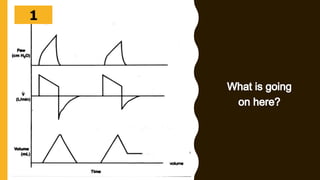
Monitoring and analysis of graphic display of curves and
loops during mechanical ventilation has become critical to
determine how patient is being ventilated to assess
problems occurring during ventilation.
Mode
function
Auto PEEP
Synchrony
TriggerWOB
Over distension
PEEP
Ti
Leak
Flow
cycle
Time
rise
Active
exhalation
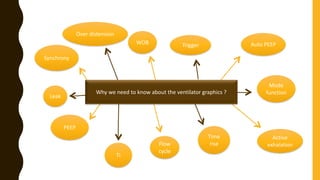
Why we need to know about the ventilator graphics ?
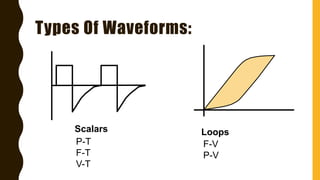
Types Of Waveforms:
Scalars
P-T
F-T
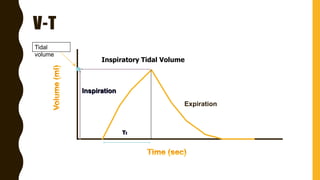
V-T
Loops
F-V
P-V
Scalars
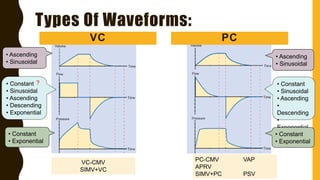
Types Of Waveforms:
VC-CMV
SIMV+VC
PC-CMV VAP
APRV
SIMV+PC PSV
• Constant
• Sinusoidal
• Ascending
• Descending
• Exponential
• Ascending
• Sinusoidal
• Constant
• Exponential
• Constant
• Sinusoidal
• Ascending
•
Descending
•
Exponential
• Ascending
• Sinusoidal
• Constant
• Exponential
VC PC
?
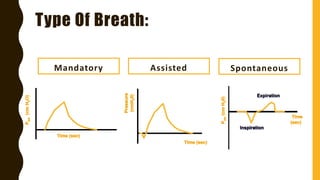
Type Of Breath:
Mandatory Assisted Spontaneous
Inspiration
Expiration
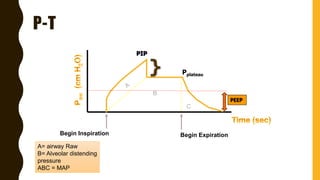
P-T
PIP
Transairway Pressure (PTA)
Pplateau
PEEP
Begin Inspiration Begin Expiration
B
C
A= airway Raw
B= Alveolar distending
pressure
ABC = MAP
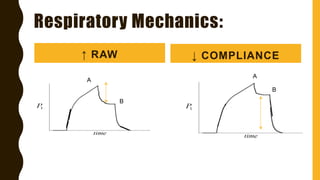
Respiratory Mechanics:
↑ RAW ↓ COMPLIANCE
A
B
A
B
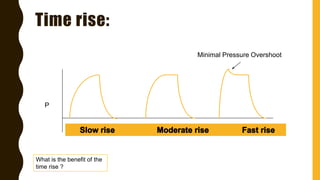
Time rise:
Minimal Pressure Overshoot
P
What is the benefit of the
time rise ?
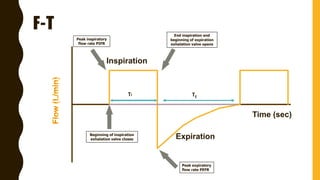
Inspiration
Expiration
Time (sec)
TI TE
F-T
Beginning of inspiration
exhalation valve closes
Peak inspiratory
flow rate PIFR
End inspiration and
beginning of expiration
exhalation valve opens
Peak expiratory
flow rate PEFR
Inspiration
Expiration
Inspiratory Tidal Volume
TI
V-T
Tidal
volume
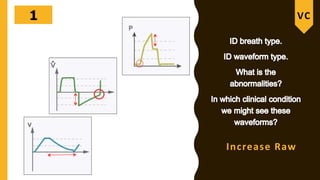
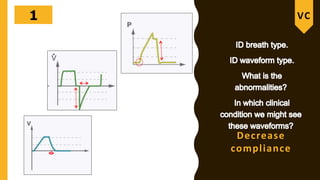
Abnormalities
VC302928272625242322212019181716151413121110987654321
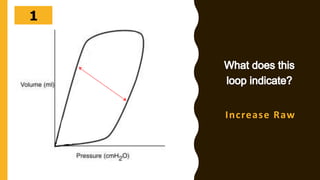
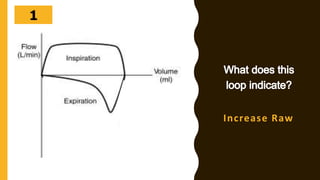
Increase Raw
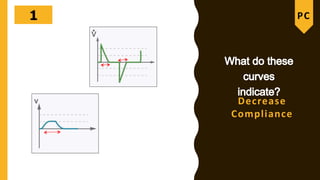
PC302928272625242322212019181716151413121110987654321
Decrease
Compliance
VC302928272625242322212019181716151413121110987654321
Decrease
compliance
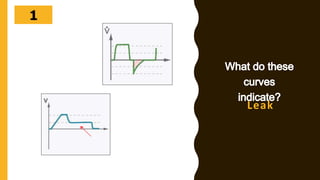
302928272625242322212019181716151413121110987654321
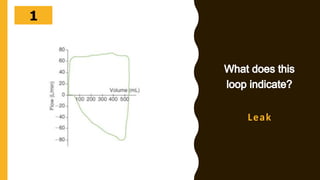
Leak
302928272625242322212019181716151413121110987654321
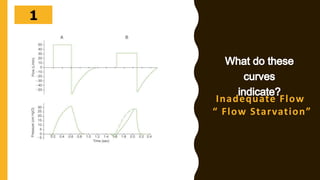
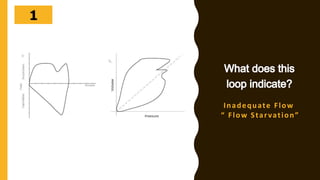
Inadequate Flow
“ Flow Starvation”
302928272625242322212019181716151413121110987654321
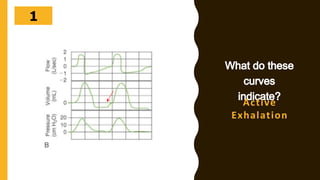
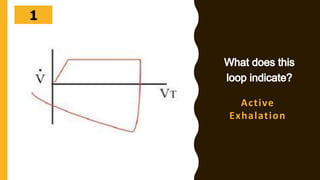
Active
Exhalation
Loops
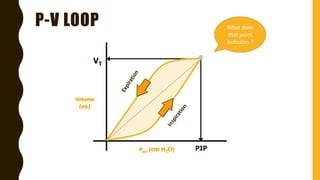
P-V LOOP
PIP
VT
What does
that point
indicates ?
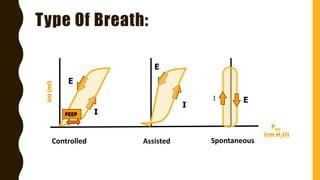
Type Of Breath:
Controlled Assisted Spontaneous
I
E
E
E
I
IPEEP
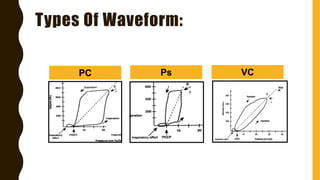
Types Of Waveform:
PC Ps VC
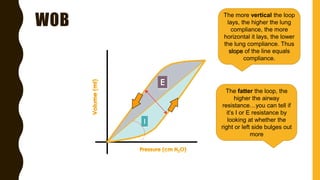
WOB
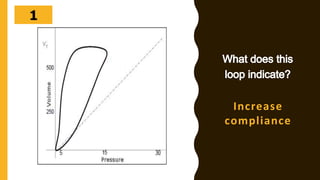
The more vertical the loop
lays, the higher the lung
compliance, the more
horizontal it lays, the lower
the lung compliance. Thus
slope of the line equals
compliance.
The fatter the loop, the
higher the airway
resistance…you can tell if
it’s I or E resistance by
looking at whether the
right or left side bulges out
more
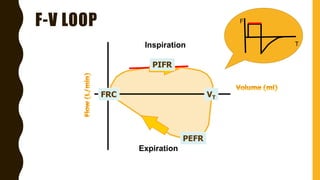
F-V LOOP
PEFR
FRC
Inspiration
Expiration
VT
F
T
PIFR
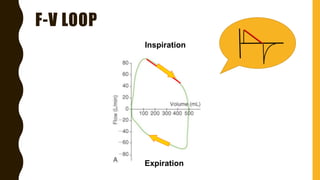
F-V LOOP
Inspiration
Expiration
Abnormalities
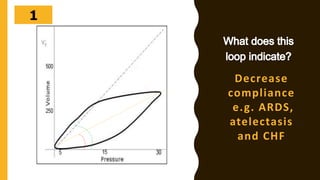
302928272625242322212019181716151413121110987654321
Decrease
compliance
e.g. ARDS,
atelectasis
and CHF
302928272625242322212019181716151413121110987654321
Increase
compliance
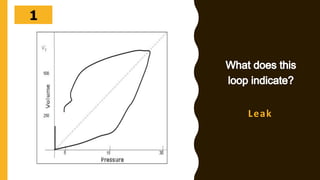
Leak
302928272625242322212019181716151413121110987654321
302928272625242322212019181716151413121110987654321
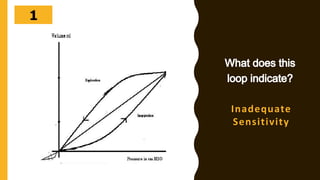
Inadequate
Sensitivity
302928272625242322212019181716151413121110987654321
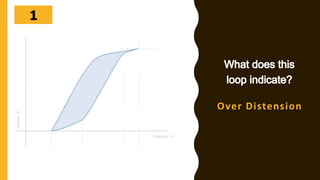
Over Distension
302928272625242322212019181716151413121110987654321
Increase Raw
302928272625242322212019181716151413121110987654321
Leak
302928272625242322212019181716151413121110987654321
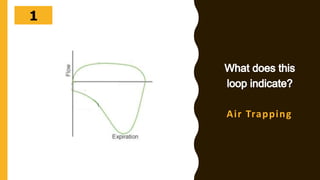
Air Trapping
302928272625242322212019181716151413121110987654321
Inadequate Flow
“ Flow Starvation”
302928272625242322212019181716151413121110987654321
Active
Exhalation
302928272625242322212019181716151413121110987654321
Increase Raw
302928272625242322212019181716151413121110987654321
Assessment of pressure, flow and
volume waveforms is a critical tool in
the management of the mechanically
ventilated patient.
References:
• Pilbeam’s Mechanical Ventilation, 5th edition.
• Curves and Loops in Mechanical Ventilation, dragger booklet.
• Handbook of Mechanical Ventilation, Kumar B Umesh, 2011.
• Maquet pocket guide,
• Ventilator Graphics and Respiratory Mechanics in the Patient With Obstructive Lung
Disease, 2005.
Ventilator graphics

Ventilator graphics