VENTILATOR
GRAPHICS
Dr.Gunasekaran
Dr.Dhatchinamoorthy
Definitions
Ventilation - Movement of air into and out of the lungs
Respiration - Exchange of oxygen and carbon dioxide between an
organism and its environment
Internal and external respiration
Compliance
The relative ease with which the structure
distends.
It can be defined as the opposite, or
inverse, of elastance
Elastance is the tendency of a structure to
return to its original form after being
stretched or acted on by an outside force
C = ΔV/ΔP
Compliance of the respiratory system is
the sum of the compliances of both the
lung parenchyma and the surrounding
thoracic structures
Normal= 100ml/cm H2O(50-170)
• Resistance is a measurement of the
frictional forces that must be
overcome during breathing.
• The anatomical structure of the
airways and the tissue viscous
resistance offered by the lungs and
adjacent tissues and organs
• Raw = (PIP Pplateau)/flow (where
−
PIP is peak inspiratory pressure); or
Raw = PTA/flow
Resistance
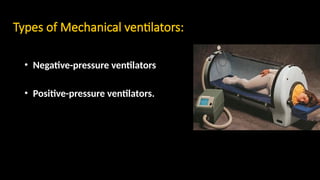
Types of Mechanical ventilators:
• Negative-pressure ventilators
• Positive-pressure ventilators.
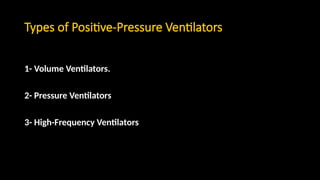
Types of Positive-Pressure Ventilators
1- Volume Ventilators.
2- Pressure Ventilators
3- High-Frequency Ventilators
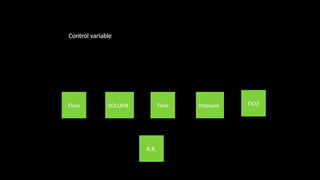
Flow VOLUME Pressure
Time FiO2
R.R.
Control variable
Inspiration
Expiration
Time (sec)
Flow
(L/min)
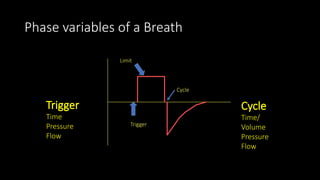
Phase variables of a Breath
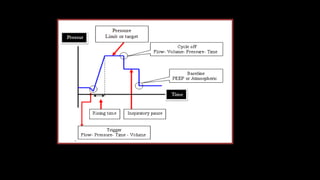
Trigger
Limit
Cycle
Trigger
Time
Pressure
Flow
Cycle
Time/
Volume
Pressure
Flow
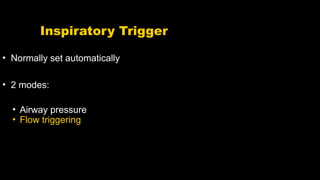
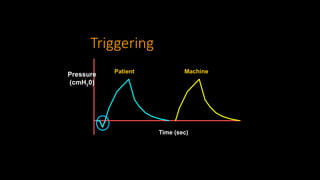
Inspiratory Trigger
• Normally set automatically
• 2 modes:
• Airway pressure
• Flow triggering
Triggering
Time (sec)
Patient Machine
Pressure
(cmH20)
● Sensitivity(trigger Sensitivity)
• The sensitivity function controls the amount of
patient effort needed to initiate an inspiration
• Increasing the sensitivity (requiring less negative
force) decreases the amount of work the patient
must do to initiate a ventilator breath.
• Decreasing the sensitivity increases the amount of
negative pressure that the patient needs to initiate
inspiration and increases the work of breathing.
Types of Waveforms
•Scalars and Loops:
• Scalars: Plot pressure, volume, or flow against time. Time is the x-axis
• Loops: Plot pressure or flow against volume. (P/V or F/V). There is no
time component.
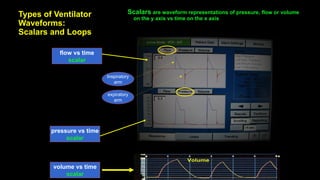
Types of Ventilator
Waveforms:
Scalars and Loops
Scalars are waveform representations of pressure, flow or volume
on the y axis vs time on the x axis
pressure vs time
scalar
flow vs time
scalar
volume vs time
scalar
Inspiratory
arm
expiratory
arm
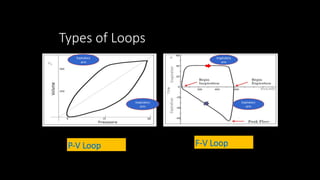
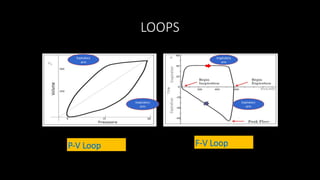
Types of Loops
P-V Loop F-V Loop
Expiratory
arm
Inspiratory
arm
Inspiratory
arm
Expiratory
arm
Understanding the flow-time waveform
• There are two components to the flow-time
waveform
– The inspiratory arm:
• Active in nature
• The character is determined by the ventilatory flow settings.
– The expiratory arm:
• Passive in nature
• The character is determined mainly by elastic recoil of the patients
lungs and airway resistance.
• Also affected by patient respiratory effort (if any)
• There are two commonly used types of flow
patterns available on most ventilators
– The ‘square wave’ or ‘constant flow’ pattern
– The ‘ramp’ (decelerating) type pattern
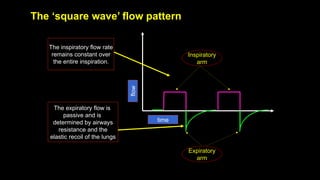
The ‘square wave’ flow pattern
The inspiratory flow rate
remains constant over
the entire inspiration.
time
flow
Inspiratory
arm
Expiratory
arm
The expiratory flow is
passive and is
determined by airways
resistance and the
elastic recoil of the lungs
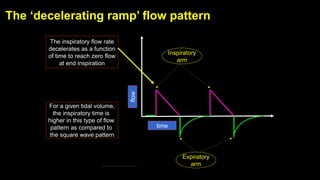
The ‘decelerating ramp’ flow pattern
The inspiratory flow rate
decelerates as a function
of time to reach zero flow
at end inspiration
For a given tidal volume,
the inspiratory time is
higher in this type of flow
pattern as compared to
the square wave pattern
time
flow
Inspiratory
arm
Expiratory
arm
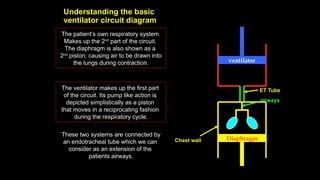
Understanding the basic
ventilator circuit diagram
ventilator
Diaphragm
These two systems are connected by
an endotracheal tube which we can
consider as an extension of the
patients airways.
The ventilator makes up the first part
of the circuit. Its pump like action is
depicted simplistically as a piston
that moves in a reciprocating fashion
during the respiratory cycle.
The patient’s own respiratory system
Makes up the 2nd
part of the circuit.
The diaphragm is also shown as a
2nd
piston; causing air to be drawn into
the lungs during contraction.
ET Tube
airways
Chest wall
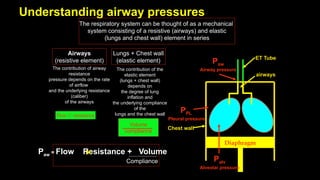
Understanding airway pressures
The respiratory system can be thought of as a mechanical
system consisting of a resistive (airways) and elastic
(lungs and chest wall) element in series
Diaphragm
ET Tube
airways
Chest wall
PPL
Pleural pressure
Paw
Airway pressure
Palv
Alveolar pressure
Lungs + Chest wall
(elastic element)
Airways
(resistive element)
The contribution of airway
resistance
pressure depends on the rate
of airflow
and the underlying resistance
(caliber)
of the airways
Flow resistance
The contribution of the
elastic element
(lungs + chest wall)
depends on
the degree of lung
inflation and
the underlying compliance
of the
lungs and the chest wall
Volume
compliance
Paw = Flow Resistance + Volume
Compliance
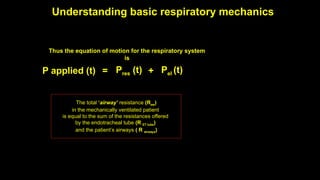
Understanding basic respiratory mechanics
The total ‘airway’ resistance (Raw)
in the mechanically ventilated patient
is equal to the sum of the resistances offered
by the endotracheal tube (R ET tube)
and the patient’s airways ( R airways)
Thus the equation of motion for the respiratory system
is
P applied (t) = Pres (t) + Pel (t)
ventilator
Diaphragm
Ppeak
Pres
RET tube
Rairways
Pres
Pplat
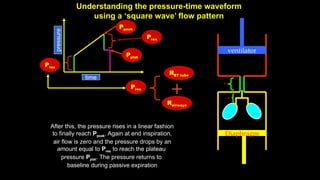
Understanding the pressure-time waveform
using a ‘square wave’ flow pattern
time
pressure
After this, the pressure rises in a linear fashion
to finally reach Ppeak. Again at end inspiration,
air flow is zero and the pressure drops by an
amount equal to Pres to reach the plateau
pressure Pplat. The pressure returns to
baseline during passive expiration
Pres
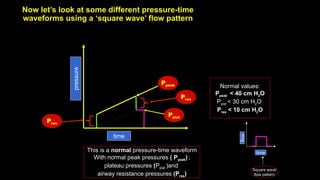
Now let’s look at some different pressure-time
waveforms using a ‘square wave’ flow pattern
This is a normal pressure-time waveform
With normal peak pressures ( Ppeak) ;
plateau pressures (Pplat )and
airway resistance pressures (Pres)
time
pressure
Ppeak
Pres
Pplat
Pres
time
flow
‘Square wave’
flow pattern
Normal values:
Ppeak < 40 cm H2O
Pplat < 30 cm H2O
Pres < 10 cm H2O
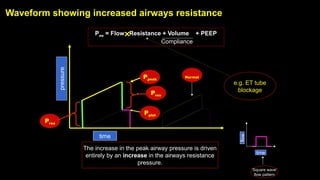
Waveform showing increased airways resistance
time
pressure
Ppeak
Pres
Pplat
Pres
The increase in the peak airway pressure is driven
entirely by an increase in the airways resistance
pressure.
e.g. ET tube
blockage
Paw = Flow Resistance + Volume + PEEP
Compliance
time
flow
‘Square wave’
flow pattern
Normal
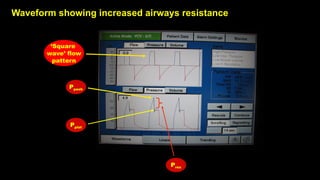
Waveform showing increased airways resistance
Ppeak
Pplat
Pres
‘Square
wave’ flow
pattern
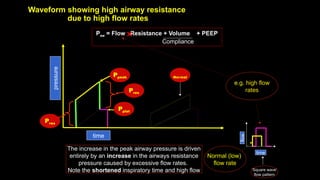
Waveform showing high airway resistance
due to high flow rates
time
pressure
Ppeak
Pres
Pplat
Pres
The increase in the peak airway pressure is driven
entirely by an increase in the airways resistance
pressure caused by excessive flow rates.
Note the shortened inspiratory time and high flow
e.g. high flow
rates
Paw = Flow Resistance + Volume + PEEP
Compliance
time
flow
‘Square wave’
flow pattern
Normal
Normal (low)
flow rate
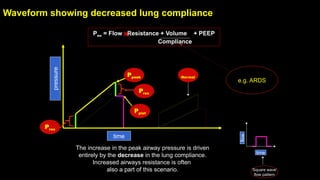
Waveform showing decreased lung compliance
The increase in the peak airway pressure is driven
entirely by the decrease in the lung compliance.
Increased airways resistance is often
also a part of this scenario.
time
pressure
Ppeak
Pres
Pplat
Pres
e.g. ARDS
Paw = Flow Resistance + Volume + PEEP
Compliance
Normal
time
flow
‘Square wave’
flow pattern
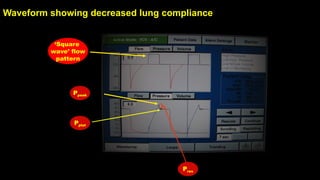
Waveform showing decreased lung compliance
Ppeak
Pplat
Pres
‘Square
wave’ flow
pattern
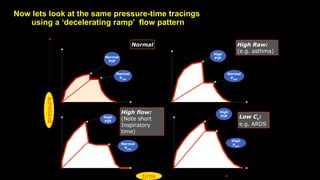
Now lets look at the same pressure-time tracings
using a ‘decelerating ramp’ flow pattern
High Raw:
(e.g. asthma)
Normal
High flow:
(Note short
Inspiratory
time)
Low CL:
e.g. ARDS
Normal
PIP
Normal
Pplat
High
PIP
High
PIP
High
Pplat
Normal
Pplat
Normal
Pplat
High
PIP
pressure
time
LOOPS
P-V Loop F-V Loop
Expiratory
arm
Inspiratory
arm
Inspiratory
arm
Expiratory
arm
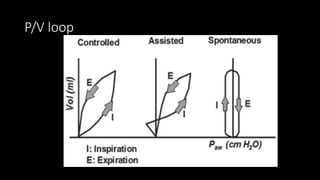
P/V loop
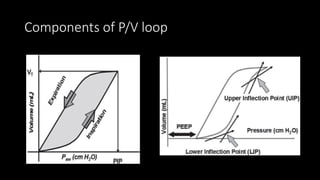
Components of P/V loop
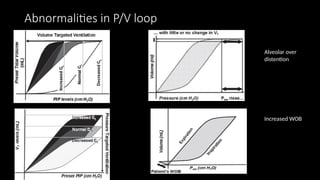
Abnormalities in P/V loop
Alveolar over
distention
Increased WOB
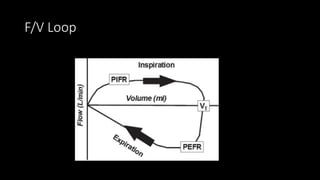
F/V Loop
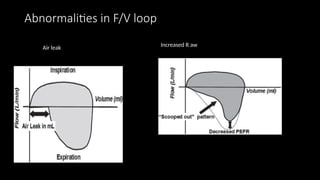
Abnormalities in F/V loop
Increased R aw
Air leak
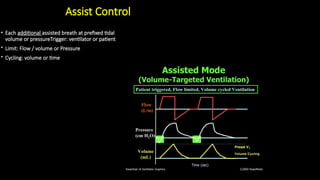
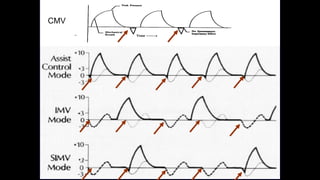
• Each additional assisted breath at prefixed tidal
volume or pressureTrigger: ventilator or patient
• Limit: Flow / volume or Pressure
• Cycling: volume or time
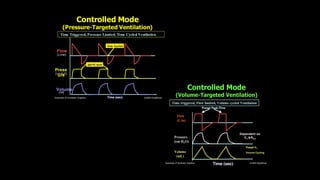
Assist Control
Pressur
e
Flow
Volume
(L/min)
(cm H2O)
(ml)
Time (sec)
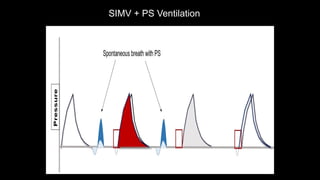
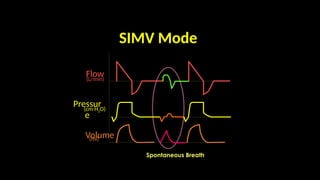
SIMV Mode
Spontaneous Breath
SIMV + PS Ventilation
CMV
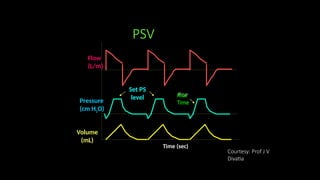
PSV
Time (sec)
Pressure
(cm H2O)
Volume
(mL)
Flow
(L/m)
Set PS
level
Rise
Rise
Time
Courtesy: Prof J V
Divatia
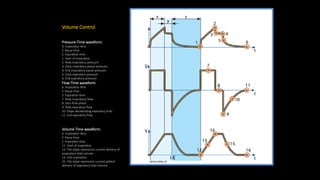
Volume Control
Pressure-Time waveform.
X. Inspiration time
Y. Pause time
Z. Expiration time
1. Start of Inspiration
2. Peak inspiratory pressure
3. Early inspiratory pause pressure
4. End inspiratory pause pressure
5. Early expiratory pressure
6. End expiratory pressure
Flow-Time waveform.
X. Inspiration time
Y. Pause time
Z: Expiration time
7. Peak inspiratory flow
8. Zero flow phase
9. Peak expiratory flow
10. Slope decelerating expiratory limb
11. End expiratory flow
Volume-Time waveform.
X. Inspiration time
Y. Pause time
Z. Expiration time
12. Start of inspiration
13. The slope represents current delivery of
inspiratory tidal volume
14. End inspiration
15. The slope represents current patient
delivery of expiratory tidal volume
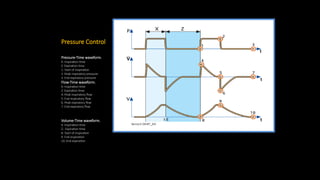
Pressure Control
Pressure-Time waveform.
X. Inspiration time
Z. Expiration time
1. Start of Inspiration
2. Peak inspiratory pressure
3. End expiratory pressure
Flow-Time waveform.
X. Inspiration time
Z. Expiration time
4. Peak inspiratory flow
5. End inspiratory flow
6. Peak expiratory flow
7. End expiratory flow
Volume-Time waveform.
X. Inspiration time
Z.: Expiration time
8. Start of inspiration
9. End inspiration
10. End expiration
Thanks

ventilator graphics in anesthesia machinepptx

  • 1.
  • 2.
    Definitions Ventilation - Movementof air into and out of the lungs Respiration - Exchange of oxygen and carbon dioxide between an organism and its environment Internal and external respiration
  • 3.
    Compliance The relative easewith which the structure distends. It can be defined as the opposite, or inverse, of elastance Elastance is the tendency of a structure to return to its original form after being stretched or acted on by an outside force C = ΔV/ΔP Compliance of the respiratory system is the sum of the compliances of both the lung parenchyma and the surrounding thoracic structures Normal= 100ml/cm H2O(50-170) • Resistance is a measurement of the frictional forces that must be overcome during breathing. • The anatomical structure of the airways and the tissue viscous resistance offered by the lungs and adjacent tissues and organs • Raw = (PIP Pplateau)/flow (where − PIP is peak inspiratory pressure); or Raw = PTA/flow Resistance
  • 4.
    Types of Mechanicalventilators: • Negative-pressure ventilators • Positive-pressure ventilators.
  • 5.
    Types of Positive-PressureVentilators 1- Volume Ventilators. 2- Pressure Ventilators 3- High-Frequency Ventilators
  • 6.
    Flow VOLUME Pressure TimeFiO2 R.R. Control variable
  • 7.
    Inspiration Expiration Time (sec) Flow (L/min) Phase variablesof a Breath Trigger Limit Cycle Trigger Time Pressure Flow Cycle Time/ Volume Pressure Flow
  • 8.
    Inspiratory Trigger • Normallyset automatically • 2 modes: • Airway pressure • Flow triggering
  • 9.
  • 10.
    ● Sensitivity(trigger Sensitivity) •The sensitivity function controls the amount of patient effort needed to initiate an inspiration • Increasing the sensitivity (requiring less negative force) decreases the amount of work the patient must do to initiate a ventilator breath. • Decreasing the sensitivity increases the amount of negative pressure that the patient needs to initiate inspiration and increases the work of breathing.
  • 12.
    Types of Waveforms •Scalarsand Loops: • Scalars: Plot pressure, volume, or flow against time. Time is the x-axis • Loops: Plot pressure or flow against volume. (P/V or F/V). There is no time component.
  • 13.
    Types of Ventilator Waveforms: Scalarsand Loops Scalars are waveform representations of pressure, flow or volume on the y axis vs time on the x axis pressure vs time scalar flow vs time scalar volume vs time scalar Inspiratory arm expiratory arm
  • 14.
    Types of Loops P-VLoop F-V Loop Expiratory arm Inspiratory arm Inspiratory arm Expiratory arm
  • 15.
    Understanding the flow-timewaveform • There are two components to the flow-time waveform – The inspiratory arm: • Active in nature • The character is determined by the ventilatory flow settings. – The expiratory arm: • Passive in nature • The character is determined mainly by elastic recoil of the patients lungs and airway resistance. • Also affected by patient respiratory effort (if any) • There are two commonly used types of flow patterns available on most ventilators – The ‘square wave’ or ‘constant flow’ pattern – The ‘ramp’ (decelerating) type pattern
  • 16.
    The ‘square wave’flow pattern The inspiratory flow rate remains constant over the entire inspiration. time flow Inspiratory arm Expiratory arm The expiratory flow is passive and is determined by airways resistance and the elastic recoil of the lungs
  • 17.
    The ‘decelerating ramp’flow pattern The inspiratory flow rate decelerates as a function of time to reach zero flow at end inspiration For a given tidal volume, the inspiratory time is higher in this type of flow pattern as compared to the square wave pattern time flow Inspiratory arm Expiratory arm
  • 19.
    Understanding the basic ventilatorcircuit diagram ventilator Diaphragm These two systems are connected by an endotracheal tube which we can consider as an extension of the patients airways. The ventilator makes up the first part of the circuit. Its pump like action is depicted simplistically as a piston that moves in a reciprocating fashion during the respiratory cycle. The patient’s own respiratory system Makes up the 2nd part of the circuit. The diaphragm is also shown as a 2nd piston; causing air to be drawn into the lungs during contraction. ET Tube airways Chest wall
  • 20.
    Understanding airway pressures Therespiratory system can be thought of as a mechanical system consisting of a resistive (airways) and elastic (lungs and chest wall) element in series Diaphragm ET Tube airways Chest wall PPL Pleural pressure Paw Airway pressure Palv Alveolar pressure Lungs + Chest wall (elastic element) Airways (resistive element) The contribution of airway resistance pressure depends on the rate of airflow and the underlying resistance (caliber) of the airways Flow resistance The contribution of the elastic element (lungs + chest wall) depends on the degree of lung inflation and the underlying compliance of the lungs and the chest wall Volume compliance Paw = Flow Resistance + Volume Compliance
  • 21.
    Understanding basic respiratorymechanics The total ‘airway’ resistance (Raw) in the mechanically ventilated patient is equal to the sum of the resistances offered by the endotracheal tube (R ET tube) and the patient’s airways ( R airways) Thus the equation of motion for the respiratory system is P applied (t) = Pres (t) + Pel (t)
  • 22.
    ventilator Diaphragm Ppeak Pres RET tube Rairways Pres Pplat Understanding thepressure-time waveform using a ‘square wave’ flow pattern time pressure After this, the pressure rises in a linear fashion to finally reach Ppeak. Again at end inspiration, air flow is zero and the pressure drops by an amount equal to Pres to reach the plateau pressure Pplat. The pressure returns to baseline during passive expiration Pres
  • 23.
    Now let’s lookat some different pressure-time waveforms using a ‘square wave’ flow pattern This is a normal pressure-time waveform With normal peak pressures ( Ppeak) ; plateau pressures (Pplat )and airway resistance pressures (Pres) time pressure Ppeak Pres Pplat Pres time flow ‘Square wave’ flow pattern Normal values: Ppeak < 40 cm H2O Pplat < 30 cm H2O Pres < 10 cm H2O
  • 24.
    Waveform showing increasedairways resistance time pressure Ppeak Pres Pplat Pres The increase in the peak airway pressure is driven entirely by an increase in the airways resistance pressure. e.g. ET tube blockage Paw = Flow Resistance + Volume + PEEP Compliance time flow ‘Square wave’ flow pattern Normal
  • 25.
    Waveform showing increasedairways resistance Ppeak Pplat Pres ‘Square wave’ flow pattern
  • 26.
    Waveform showing highairway resistance due to high flow rates time pressure Ppeak Pres Pplat Pres The increase in the peak airway pressure is driven entirely by an increase in the airways resistance pressure caused by excessive flow rates. Note the shortened inspiratory time and high flow e.g. high flow rates Paw = Flow Resistance + Volume + PEEP Compliance time flow ‘Square wave’ flow pattern Normal Normal (low) flow rate
  • 27.
    Waveform showing decreasedlung compliance The increase in the peak airway pressure is driven entirely by the decrease in the lung compliance. Increased airways resistance is often also a part of this scenario. time pressure Ppeak Pres Pplat Pres e.g. ARDS Paw = Flow Resistance + Volume + PEEP Compliance Normal time flow ‘Square wave’ flow pattern
  • 28.
    Waveform showing decreasedlung compliance Ppeak Pplat Pres ‘Square wave’ flow pattern
  • 29.
    Now lets lookat the same pressure-time tracings using a ‘decelerating ramp’ flow pattern High Raw: (e.g. asthma) Normal High flow: (Note short Inspiratory time) Low CL: e.g. ARDS Normal PIP Normal Pplat High PIP High PIP High Pplat Normal Pplat Normal Pplat High PIP pressure time
  • 30.
    LOOPS P-V Loop F-VLoop Expiratory arm Inspiratory arm Inspiratory arm Expiratory arm
  • 31.
  • 32.
  • 33.
    Abnormalities in P/Vloop Alveolar over distention Increased WOB
  • 34.
  • 35.
    Abnormalities in F/Vloop Increased R aw Air leak
  • 36.
    • Each additionalassisted breath at prefixed tidal volume or pressureTrigger: ventilator or patient • Limit: Flow / volume or Pressure • Cycling: volume or time Assist Control
  • 38.
  • 39.
    SIMV + PSVentilation
  • 40.
  • 41.
    PSV Time (sec) Pressure (cm H2O) Volume (mL) Flow (L/m) SetPS level Rise Rise Time Courtesy: Prof J V Divatia
  • 42.
    Volume Control Pressure-Time waveform. X.Inspiration time Y. Pause time Z. Expiration time 1. Start of Inspiration 2. Peak inspiratory pressure 3. Early inspiratory pause pressure 4. End inspiratory pause pressure 5. Early expiratory pressure 6. End expiratory pressure Flow-Time waveform. X. Inspiration time Y. Pause time Z: Expiration time 7. Peak inspiratory flow 8. Zero flow phase 9. Peak expiratory flow 10. Slope decelerating expiratory limb 11. End expiratory flow Volume-Time waveform. X. Inspiration time Y. Pause time Z. Expiration time 12. Start of inspiration 13. The slope represents current delivery of inspiratory tidal volume 14. End inspiration 15. The slope represents current patient delivery of expiratory tidal volume
  • 43.
    Pressure Control Pressure-Time waveform. X.Inspiration time Z. Expiration time 1. Start of Inspiration 2. Peak inspiratory pressure 3. End expiratory pressure Flow-Time waveform. X. Inspiration time Z. Expiration time 4. Peak inspiratory flow 5. End inspiratory flow 6. Peak expiratory flow 7. End expiratory flow Volume-Time waveform. X. Inspiration time Z.: Expiration time 8. Start of inspiration 9. End inspiration 10. End expiration
  • 44.

Editor's Notes

  • #40 Control Mode Pt receives a set number of breaths and cannot breathe between ventilator breaths Similar to Pressure Control Assist Mode Pt initiates all breaths, but ventilator cycles in at initiation to give a preset tidal volume Pt controls rate but always receives a full machine breath Assist/Control Mode Assist mode unless pt’s respiratory rate falls below preset value Ventilator then switches to control mode Rapidly breathing pts can overventilate and induce severe respiratory alkalosis and hyperinflation (auto-PEEP)