The Basics of Ventilators Richard M. Ford BS RRT UCSD Respiratory Care
Why Important ? Managing the Patient/Ventilator system is less difficult with an understanding of the fundamentals of operation, alarms, and capabilities.
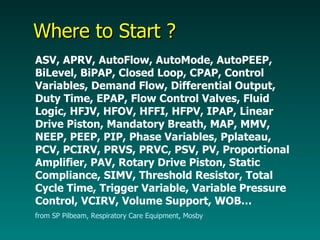
Where to Start ? ASV, APRV, AutoFlow, AutoMode, AutoPEEP, BiLevel, BiPAP, Closed Loop, CPAP, Control Variables, Demand Flow, Differential Output, Duty Time, EPAP, Flow Control Valves, Fluid Logic, HFJV, HFOV, HFFI, HFPV, IPAP, Linear Drive Piston, Mandatory Breath, MAP, MMV, NEEP, PEEP, PIP, Phase Variables, Pplateau, PCV, PCIRV, PRVS, PRVC, PSV, PV, Proportional Amplifier, PAV, Rotary Drive Piston, Static Compliance, SIMV, Threshold Resistor, Total Cycle Time, Trigger Variable, Variable Pressure Control, VCIRV, Volume Support, WOB… from SP Pilbeam, Respiratory Care Equipment, Mosby
Beyond Basic- Today's Technology BMTI - Bird and Bear Drager Medical Technologies Hamilton Medical Mallinckrodt Inc Newport NMI Pulmonetic Siemens
From the Manufacturers Smart Breath Delivery, Dual View, San Box, Smart Alert, Interactive Automode, Advanced Rules Based Strategic Modes, Virtual Controls GUI Interface, soft keys, configurable Safety, upgradability, portability
Objectives  Understand how ventilators control breath delivery - phase, type and control variables. Understand the basic adjuncts and modes of ventilation.
Basic Ventilator Parameters FiO 2 Fractional concentration of inspired oxygen delivered expressed as a % (21-100) Breath Rate (f) The number of times over a one minute period inspiration is initiated (bpm) Tidal volume (V T ) The amount of gas that is delivered during inspiration expressed in mls or Liters. Inspired or exhaled. Flow The velocity of gas flow or volume of gas per minute
Phase Variables Trigger (start)- begins inspiratory flow Cycling (end)- ends inspiratory flow Limiting (continue)- places a maximum value on a “control variable” pressure volume flow time
Breath Type… Only Two (for now)! Mandatory Ventilator does the work Ventilator controls start and stop Spontaneous Patient takes on work Patient controls start and stop
Trigger Variable-  Start of a Breath Time -  control ventilation Pressure -  patient assisted Flow -  patient assisted Volume -  patient assisted Manual -  operator control Impedance -  patient assisted
The Control Variable- Inspiratory Breath Delivery Flow (volume) controlled pressure may vary Pressure controlled flow and volume may vary Time controlled (HFOV) pressure, flow, volume may vary
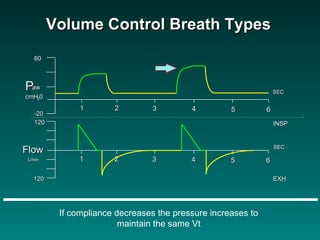
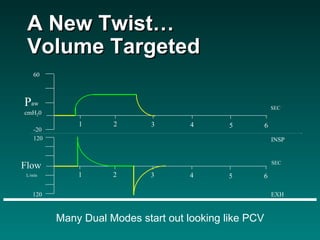
If compliance decreases the pressure increases to maintain the same Vt Volume Control Breath Types 1 2 3 4 5 6 SEC 1 2 3 4 5 6 P aw cmH 2 0 60 -20 120 120 SEC INSP EXH Flow L/min
Many Dual Modes start out looking like PCV A New Twist… Volume Targeted
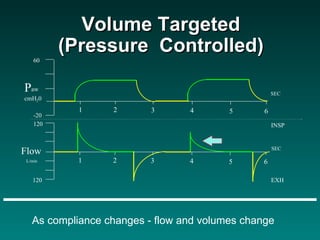
Volume Targeted (Pressure  Controlled) As compliance changes - flow and volumes change
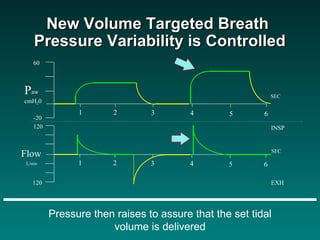
Pressure then raises to assure that the set tidal volume is delivered New Volume Targeted Breath  Pressure Variability is Controlled
Inspiratory - delivery limits Maximum value that can be reached but will not end the breath- Volume Flow Pressure
End of Insp…cycle mechanisms The phase variable used to terminate inspiration- Volume Pressure Flow Time
Expiratory - baseline P ositive  E nd  E xpiratory  P ressure Expiratory Retard N egative  E nd  E xpiratory  P ressure Expiratory Hold Time Limited Exhalation (APRV)
PEEP Definition Positive end expiratory pressure Application of a constant, positive pressure such that at end exhalation, airway pressure does not return to a 0 baseline Used with other mechanical ventilation modes such as A/C, SIMV, or PCV Referred to as CPAP when applied to spontaneous breaths
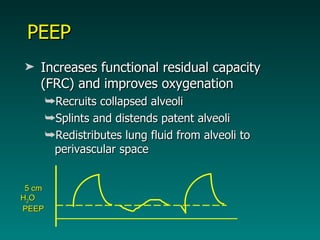
PEEP Increases functional residual capacity (FRC) and improves oxygenation Recruits collapsed alveoli Splints and distends patent alveoli Redistributes lung fluid from alveoli to perivascular space 5 cm H 2 O   PEEP
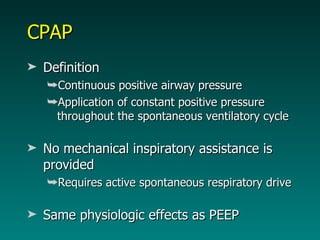
CPAP Definition Continuous positive airway pressure Application of constant positive pressure throughout the spontaneous ventilatory cycle No mechanical inspiratory assistance is provided  Requires active spontaneous respiratory drive Same physiologic effects as PEEP
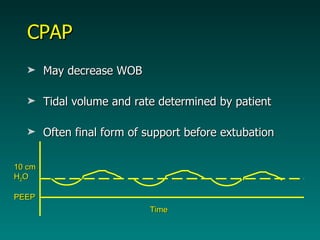
CPAP May decrease WOB Tidal volume and rate determined by patient Often final form of support before extubation 10 cm H 2 O  PEEP Time
Basic Modes of Ventilation Control  Assist, Assist/Control (S)IMV PCV PSV Servo
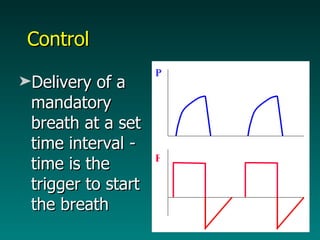
Control Delivery of a mandatory breath at a set time interval - time is the trigger to start the breath F P
Safety Issue - Control  Control mode should never be deliberately set as the ventilator should never be insensitive to a patients inspiratory efforts Control ventilation is a patient driven function and new ventilators do not even incorporate a pure “control” function
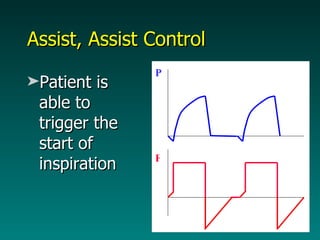
Assist, Assist Control Patient is able to trigger the start of inspiration F P
Safety Issue - Assist Control The control rate must be set high enough to insure that minute ventilation will be adequate Apnea ventilation will also serve as a back up  As rate increases expiratory time will shorten and gas trapping may occur
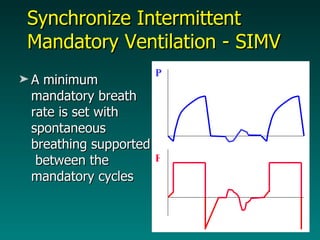
Synchronize Intermittent Mandatory Ventilation - SIMV A minimum mandatory breath rate is set with spontaneous breathing supported  between the mandatory cycles F P
SIMV Advantages Synchronized breaths may improve patient comfort Increase patient control/regulation Enhances blood flow Hyperventilation less of a concern compared to A/C
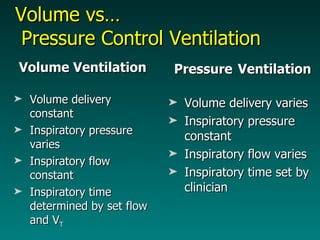
Volume vs…  Pressure Control Ventilation Volume Ventilation Volume delivery constant Inspiratory pressure varies Inspiratory flow constant Inspiratory time determined by set flow  and V T Pressure   Ventilation Volume delivery varies  Inspiratory pressure constant Inspiratory flow varies Inspiratory time set by clinician
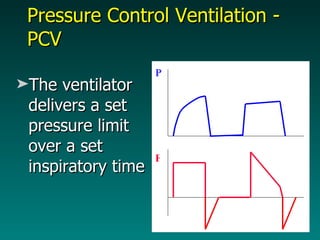
Pressure Control Ventilation - PCV The ventilator delivers a set pressure limit over a set inspiratory time F P
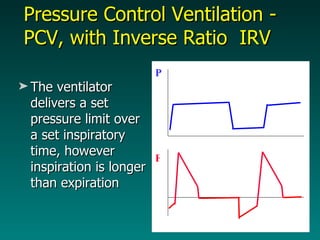
Pressure Control Ventilation - PCV, with Inverse Ratio  IRV The ventilator delivers a set pressure limit over a set inspiratory time, however inspiration is longer than expiration F P
Pressure Control Ventilation Advantages Limits risk of barotrauma May recruit collapsed alveoli Improved gas distribution Disadvantages Tidal volumes vary when patient compliance changes (i.e. ARDS, pulmonary edema) With increases in I-time, patient may require sedation and/or paralysis
Pressure Support Ventilation - PSV The ventilator delivers a set pressure limit with end inspiration driven by the patient F P
Safety Issue - PSV PSV is a spontaneous mode of ventilation, therefore the patient must demonstrate they can trigger the ventilator and that volumes are appropriate High and low rate, apnea, and high and low tidal volume alarms need to be assessed
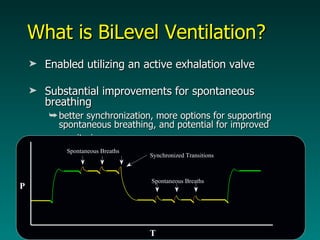
Bi Level Is a spontaneous breathing mode in which two levels of pressure and hi/low are set F P
What is BiLevel Ventilation? Enabled utilizing an active exhalation valve Substantial improvements for spontaneous breathing better synchronization, more options for supporting spontaneous breathing, and potential for improved monitoring
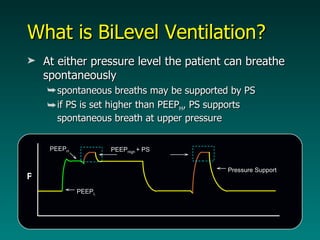
What is BiLevel Ventilation? At either pressure level the patient can breathe spontaneously spontaneous breaths may be supported by PS  if PS is set higher than PEEP H , PS supports spontaneous breath at upper pressure  T PEEP High  + PS  P PEEP L PEEP H Pressure Support
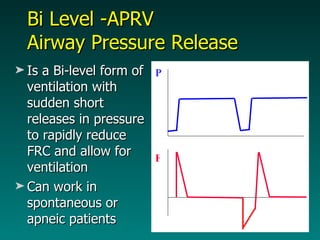
Bi Level -APRV  Airway Pressure Release Is a Bi-level form of ventilation with sudden short releases in pressure to rapidly reduce FRC and allow for ventilation Can work in spontaneous or apneic patients F P
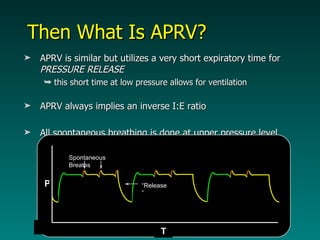
Then What Is APRV? APRV is similar but utilizes a very short expiratory time for  PRESSURE RELEASE this short time at low pressure allows for ventilation APRV always implies an inverse I:E ratio All spontaneous breathing is done at upper pressure level Spontaneous Breaths P T “ Release”
Safety Issue - IRV and APRV Pronged inspiratory times with pressure transmission to the surrounding chest structures may significantly reduced cardiac output Decrease in expiratory time may result in intrinsic PEEP which must be considered
Safety Issues - Alarms Alarms must be re-assessed with every primary ventilator change Alarm silence should only be used when the alarm condition is clear and attended to The most important back up is a skilled clinician with a resuc bag
Potential Complications of MV Ventilator malfunction Manually ventilate patient Barotrauma Alveolar rupture due to overdistention Monitor PIP, breath sounds Pulmonary Oxygen toxicity goal: FIO 2   <  .50 and PaO 2   >  70 Cardiovascular compromise/arrhythmias Monitor vital signs
Potential Complications of MV Infection ET tube bypasses natural airway defense mechanisms Nosocomial pneumonia, aspiration pneumonia Good handwashing, provide mouth and tube care Psychological Patients may be extremely anxious and/or agitated Give consistent, calming explanations, offer reassurance Sedation, anti-anxiety agents frequently indicated
From Basics to Advanced... Microprocessor controlled/GUI’s Proportional solenoid control of gas delivery  New exhalation valve technology Fast response times - low work of breathing Ability to compensate for leaks/ET tubes Broaden performance with pediatric and/or infant  capabilities New smart breathing algorithms/modes that automatically adjust to changing patient conditions
Servo Regulated Modes Mandatory Minute Ventilation  Pressure Regulated Volume Control Volume Support AutoFlow Proportional Assist Ventilation Adaptive Support Ventilation Volume Assured Pressure Support Proportional Pressure Support

Basic Of Mechanical Ventilation

  • 1.
    The Basics ofVentilators Richard M. Ford BS RRT UCSD Respiratory Care
  • 2.
    Why Important ?Managing the Patient/Ventilator system is less difficult with an understanding of the fundamentals of operation, alarms, and capabilities.
  • 3.
    Where to Start? ASV, APRV, AutoFlow, AutoMode, AutoPEEP, BiLevel, BiPAP, Closed Loop, CPAP, Control Variables, Demand Flow, Differential Output, Duty Time, EPAP, Flow Control Valves, Fluid Logic, HFJV, HFOV, HFFI, HFPV, IPAP, Linear Drive Piston, Mandatory Breath, MAP, MMV, NEEP, PEEP, PIP, Phase Variables, Pplateau, PCV, PCIRV, PRVS, PRVC, PSV, PV, Proportional Amplifier, PAV, Rotary Drive Piston, Static Compliance, SIMV, Threshold Resistor, Total Cycle Time, Trigger Variable, Variable Pressure Control, VCIRV, Volume Support, WOB… from SP Pilbeam, Respiratory Care Equipment, Mosby
  • 4.
    Beyond Basic- Today'sTechnology BMTI - Bird and Bear Drager Medical Technologies Hamilton Medical Mallinckrodt Inc Newport NMI Pulmonetic Siemens
  • 5.
    From the ManufacturersSmart Breath Delivery, Dual View, San Box, Smart Alert, Interactive Automode, Advanced Rules Based Strategic Modes, Virtual Controls GUI Interface, soft keys, configurable Safety, upgradability, portability
  • 6.
    Objectives Understandhow ventilators control breath delivery - phase, type and control variables. Understand the basic adjuncts and modes of ventilation.
  • 7.
    Basic Ventilator ParametersFiO 2 Fractional concentration of inspired oxygen delivered expressed as a % (21-100) Breath Rate (f) The number of times over a one minute period inspiration is initiated (bpm) Tidal volume (V T ) The amount of gas that is delivered during inspiration expressed in mls or Liters. Inspired or exhaled. Flow The velocity of gas flow or volume of gas per minute
  • 8.
    Phase Variables Trigger(start)- begins inspiratory flow Cycling (end)- ends inspiratory flow Limiting (continue)- places a maximum value on a “control variable” pressure volume flow time
  • 9.
    Breath Type… OnlyTwo (for now)! Mandatory Ventilator does the work Ventilator controls start and stop Spontaneous Patient takes on work Patient controls start and stop
  • 10.
    Trigger Variable- Start of a Breath Time - control ventilation Pressure - patient assisted Flow - patient assisted Volume - patient assisted Manual - operator control Impedance - patient assisted
  • 11.
    The Control Variable-Inspiratory Breath Delivery Flow (volume) controlled pressure may vary Pressure controlled flow and volume may vary Time controlled (HFOV) pressure, flow, volume may vary
  • 12.
    If compliance decreasesthe pressure increases to maintain the same Vt Volume Control Breath Types 1 2 3 4 5 6 SEC 1 2 3 4 5 6 P aw cmH 2 0 60 -20 120 120 SEC INSP EXH Flow L/min
  • 13.
    Many Dual Modesstart out looking like PCV A New Twist… Volume Targeted
  • 14.
    Volume Targeted (Pressure Controlled) As compliance changes - flow and volumes change
  • 15.
    Pressure then raisesto assure that the set tidal volume is delivered New Volume Targeted Breath Pressure Variability is Controlled
  • 16.
    Inspiratory - deliverylimits Maximum value that can be reached but will not end the breath- Volume Flow Pressure
  • 17.
    End of Insp…cyclemechanisms The phase variable used to terminate inspiration- Volume Pressure Flow Time
  • 18.
    Expiratory - baselineP ositive E nd E xpiratory P ressure Expiratory Retard N egative E nd E xpiratory P ressure Expiratory Hold Time Limited Exhalation (APRV)
  • 19.
    PEEP Definition Positiveend expiratory pressure Application of a constant, positive pressure such that at end exhalation, airway pressure does not return to a 0 baseline Used with other mechanical ventilation modes such as A/C, SIMV, or PCV Referred to as CPAP when applied to spontaneous breaths
  • 20.
    PEEP Increases functionalresidual capacity (FRC) and improves oxygenation Recruits collapsed alveoli Splints and distends patent alveoli Redistributes lung fluid from alveoli to perivascular space 5 cm H 2 O PEEP
  • 21.
    CPAP Definition Continuouspositive airway pressure Application of constant positive pressure throughout the spontaneous ventilatory cycle No mechanical inspiratory assistance is provided Requires active spontaneous respiratory drive Same physiologic effects as PEEP
  • 22.
    CPAP May decreaseWOB Tidal volume and rate determined by patient Often final form of support before extubation 10 cm H 2 O PEEP Time
  • 23.
    Basic Modes ofVentilation Control Assist, Assist/Control (S)IMV PCV PSV Servo
  • 24.
    Control Delivery ofa mandatory breath at a set time interval - time is the trigger to start the breath F P
  • 25.
    Safety Issue -Control Control mode should never be deliberately set as the ventilator should never be insensitive to a patients inspiratory efforts Control ventilation is a patient driven function and new ventilators do not even incorporate a pure “control” function
  • 26.
    Assist, Assist ControlPatient is able to trigger the start of inspiration F P
  • 27.
    Safety Issue -Assist Control The control rate must be set high enough to insure that minute ventilation will be adequate Apnea ventilation will also serve as a back up As rate increases expiratory time will shorten and gas trapping may occur
  • 28.
    Synchronize Intermittent MandatoryVentilation - SIMV A minimum mandatory breath rate is set with spontaneous breathing supported between the mandatory cycles F P
  • 29.
    SIMV Advantages Synchronizedbreaths may improve patient comfort Increase patient control/regulation Enhances blood flow Hyperventilation less of a concern compared to A/C
  • 30.
    Volume vs… Pressure Control Ventilation Volume Ventilation Volume delivery constant Inspiratory pressure varies Inspiratory flow constant Inspiratory time determined by set flow and V T Pressure Ventilation Volume delivery varies Inspiratory pressure constant Inspiratory flow varies Inspiratory time set by clinician
  • 31.
    Pressure Control Ventilation- PCV The ventilator delivers a set pressure limit over a set inspiratory time F P
  • 32.
    Pressure Control Ventilation- PCV, with Inverse Ratio IRV The ventilator delivers a set pressure limit over a set inspiratory time, however inspiration is longer than expiration F P
  • 33.
    Pressure Control VentilationAdvantages Limits risk of barotrauma May recruit collapsed alveoli Improved gas distribution Disadvantages Tidal volumes vary when patient compliance changes (i.e. ARDS, pulmonary edema) With increases in I-time, patient may require sedation and/or paralysis
  • 34.
    Pressure Support Ventilation- PSV The ventilator delivers a set pressure limit with end inspiration driven by the patient F P
  • 35.
    Safety Issue -PSV PSV is a spontaneous mode of ventilation, therefore the patient must demonstrate they can trigger the ventilator and that volumes are appropriate High and low rate, apnea, and high and low tidal volume alarms need to be assessed
  • 36.
    Bi Level Isa spontaneous breathing mode in which two levels of pressure and hi/low are set F P
  • 37.
    What is BiLevelVentilation? Enabled utilizing an active exhalation valve Substantial improvements for spontaneous breathing better synchronization, more options for supporting spontaneous breathing, and potential for improved monitoring
  • 38.
    What is BiLevelVentilation? At either pressure level the patient can breathe spontaneously spontaneous breaths may be supported by PS if PS is set higher than PEEP H , PS supports spontaneous breath at upper pressure T PEEP High + PS P PEEP L PEEP H Pressure Support
  • 39.
    Bi Level -APRV Airway Pressure Release Is a Bi-level form of ventilation with sudden short releases in pressure to rapidly reduce FRC and allow for ventilation Can work in spontaneous or apneic patients F P
  • 40.
    Then What IsAPRV? APRV is similar but utilizes a very short expiratory time for PRESSURE RELEASE this short time at low pressure allows for ventilation APRV always implies an inverse I:E ratio All spontaneous breathing is done at upper pressure level Spontaneous Breaths P T “ Release”
  • 41.
    Safety Issue -IRV and APRV Pronged inspiratory times with pressure transmission to the surrounding chest structures may significantly reduced cardiac output Decrease in expiratory time may result in intrinsic PEEP which must be considered
  • 42.
    Safety Issues -Alarms Alarms must be re-assessed with every primary ventilator change Alarm silence should only be used when the alarm condition is clear and attended to The most important back up is a skilled clinician with a resuc bag
  • 43.
    Potential Complications ofMV Ventilator malfunction Manually ventilate patient Barotrauma Alveolar rupture due to overdistention Monitor PIP, breath sounds Pulmonary Oxygen toxicity goal: FIO 2 < .50 and PaO 2 > 70 Cardiovascular compromise/arrhythmias Monitor vital signs
  • 44.
    Potential Complications ofMV Infection ET tube bypasses natural airway defense mechanisms Nosocomial pneumonia, aspiration pneumonia Good handwashing, provide mouth and tube care Psychological Patients may be extremely anxious and/or agitated Give consistent, calming explanations, offer reassurance Sedation, anti-anxiety agents frequently indicated
  • 45.
    From Basics toAdvanced... Microprocessor controlled/GUI’s Proportional solenoid control of gas delivery New exhalation valve technology Fast response times - low work of breathing Ability to compensate for leaks/ET tubes Broaden performance with pediatric and/or infant capabilities New smart breathing algorithms/modes that automatically adjust to changing patient conditions
  • 46.
    Servo Regulated ModesMandatory Minute Ventilation Pressure Regulated Volume Control Volume Support AutoFlow Proportional Assist Ventilation Adaptive Support Ventilation Volume Assured Pressure Support Proportional Pressure Support

Editor's Notes

  • #8 16 Some of these settings, such as FiO 2 , respiratory rate, tidal volume, inspiratory time or I:E ratio, and mode of ventilation, are specified primarily by the physician. Sensitivity, or how easily the patient can trigger the ventilator into the inspiratory phase, and peak flow are usually not physician ordered. The goal with the FiO 2 is to keep it below 50% if possible. Tidal volume is usually at 6-12 ml/kg, depending on the ventilation management strategy. In volume-based ventilation, delivery of the set tidal volume is what terminates inspiration. Peak flow determines how fast the tidal volume is delivered. In pressure-based ventilation, reaching the set inspiratory pressure and inspiratory time is what normally terminates inspiration. Let’s look more closely at the modes of ventilation.
  • #13 45 How do you know the problem is with the patient? Look at your flow curve.
  • #14 29 29
  • #15 28 28
  • #16 30 30
  • #20 35 Let’s begin with a definition of PEEP or positive end expiratory pressure. PEEP is the application of a clinician-set, positive pressure applied at end exhalation. This prevents pressure from returning to zero, or atmospheric, at the end of the breath. When positive pressure is applied at the end of a mechanical breath, it is referred to as PEEP. When positive pressure is applied throughout the spontaneous breathing cycle, it is referred to as CPAP, or continuous positive airway pressure. Let’s look at a graphic representation of PEEP.
  • #21 36 On this pressure-time graph, we know that the first breath is mechanically initiated since there is no negative deflection preceding that breath. Note the breath does not begin at the zero base line, but instead begins at 5 cm H 2 O pressure. The mechanical breath is delivered, but at end exhalation, pressure remains at 5 cm H 2 O. The next breath is spontaneous (note the inspiratory deflection). Here again, pressure throughout the breath cycle is elevated by 5 cm H 2 O. The final breath is a patient-initiated, mechanical breath, again showing that at end exhalation, pressure is maintained at 5 cm H 2 O. Why do we add PEEP? Once again, we’ll try to mimic this effect. Take a normal breath in, but do not exhale all the way, thus maintaining some positive pressure in your lungs. What could be the benefit of positive pressure at the end of exhalation? PEEP causes an increase in functional residual capacity or FRC. The FRC is the amount of air left in your lungs at the end of a normal exhalation. This increased volume can improve oxygenation; more air remains available to participate in gas exchange. In sick lungs, PEEP can also help recruit or open collapsed alveoli. Keep in mind that with many lung pathologies, alveoli have the tendency to collapse. PEEP can be applied at pressures sufficient to overcome this tendency to collapse, keeping the alveoli patent and functional. Finally, in cases of excess pulmonary fluid, PEEP can cause this unwanted lung fluid to move from the alveoli into the perivascular space.
  • #22 37 Now that you understand the physiologic effects of PEEP, you can apply the same knowledge to CPAP. The only difference is that CPAP is the application of positive pressure throughout the spontaneous ventilatory cycle. Since this is a totally spontaneous mode, the patient must have an intact respiratory center.
  • #23 38 This graphic depicts the CPAP mode set at 10 cm H 2 O. Similar to Pressure Support, the patient determines the respiratory rate and tidal volume. Keep in mind that CPAP and PSV are often used in conjunction. CPAP can prevent or minimize alveolar collapse, while Pressure Support helps overcome resistance and augments tidal volume. CPAP, either alone or in combination with Pressure Support, is often the final form of support prior to extubation.
  • #30 21 8 Synchronized breaths may improve patient comfort and reduce competition between the patient and ventilator. Because the patient is in full control of the spontaneous breaths, patient ventilator synchrony is enhanced. Hyperventilation is less of a concern compared to A/C. Let’s take a look at some concerns with SIMV.
  • #31 23 The delivered volume is constant in volume ventilation; in pressure ventilation, volume varies with changes in resistance and compliance. In volume ventilation, inspiratory pressure varies with changes in compliance and resistance; with pressure ventilation, the inspiratory pressure is set and remains constant. Inspiratory flow is constant in volume ventilation but varies in pressure ventilation. In volume ventilation, inspiratory time is determined by the set flow and tidal volume; in pressure ventilation the inspiratory time is set by the clinician. Let’s move on to our discussion of Pressure Control Ventilation.
  • #34 27 17 One advantage of Pressure Control Ventilation is a decreased risk of barotrauma caused by overdistention. Also, longer inspiratory time may recruit collapsed and flooded alveoli, improving gas distribution. One disadvantage is that tidal volumes vary when patient compliance changes, such as with ARDS or pulmonary edema. Setting a low tidal volume alarm or minute volume alarm alerts the clinician to this changing status so the patient can be re-evaluated. Another issue with increased inspiratory time is the potential need for heavy sedation or chemical paralysis. Newer ventilators incorporate an active exhalation valve. An active exhalation valve can open during the setinspiratory time in Pressure Contraol Ventilation, allowing the patient to breathe spontaneously during the inspiratory phase. It remains to be seen whether a decrease in the use of paralytics will result with the active exhalation valve.
  • #38 15 15 15 15 15
  • #41 17 17 17 17 17 65 65
  • #44 52
  • #45 53
  • #46 5 5