
Optimizing Critical Care
      Ventilation-
What Can We Learn from
 Ventilator Waveforms
             Luca Bigatello, MD
   Department of Anesthesia and Critical Care,
        Massachusetts General Hospital
       Associate Professor of Anesthesia,
           Harvard Medical School
Outline
  Understanding     the basic physiology of ventilation
  Breath   delivery:
     Basic choices
     Effects of patient’s changes

     Effects of ventilator changes

  Specific   situations:
     ALI   / ARDS
     Weaning
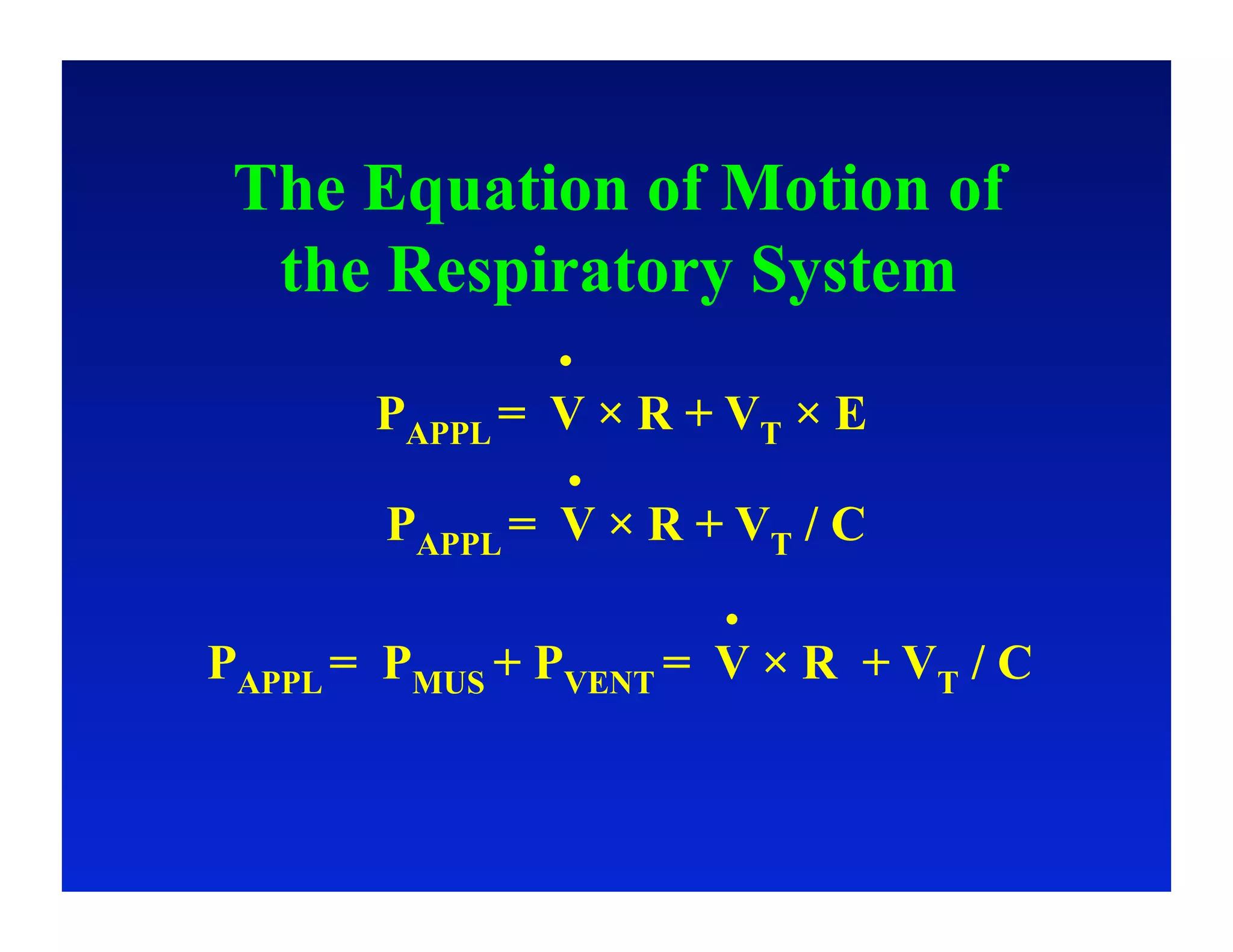
The Equation of Motion of
  the Respiratory System

       PAPPL = V × R + VT × E

        PAPPL = V × R + VT / C

PAPPL = PMUS + PVENT = V × R + VT / C
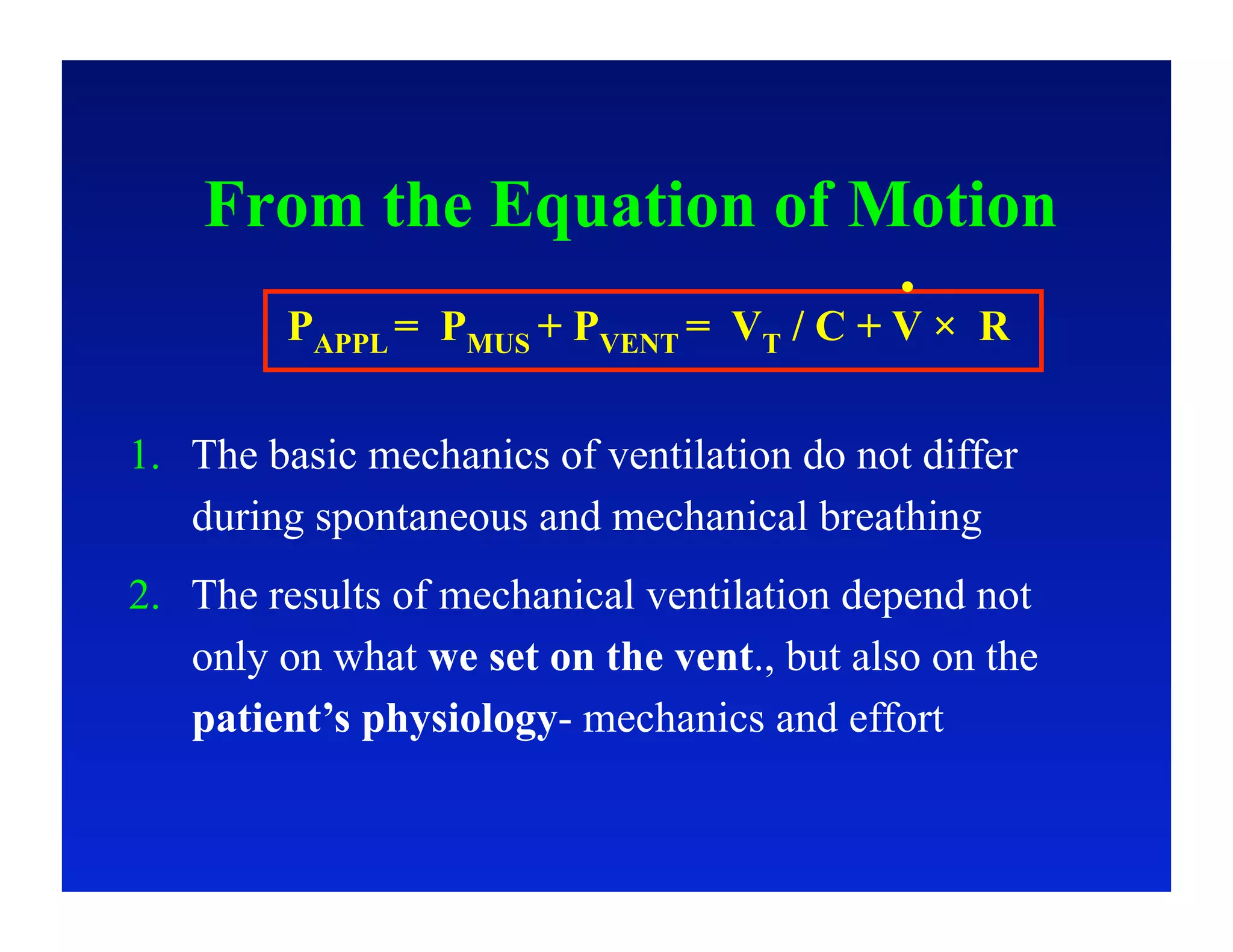
From the Equation of Motion
         PAPPL = PMUS + PVENT = VT / C + V × R

1.  The basic mechanics of ventilation do not differ
    during spontaneous and mechanical breathing
2.  The results of mechanical ventilation depend not
    only on what we set on the vent., but also on the
    patient’s physiology- mechanics and effort
From the Equation of Motion
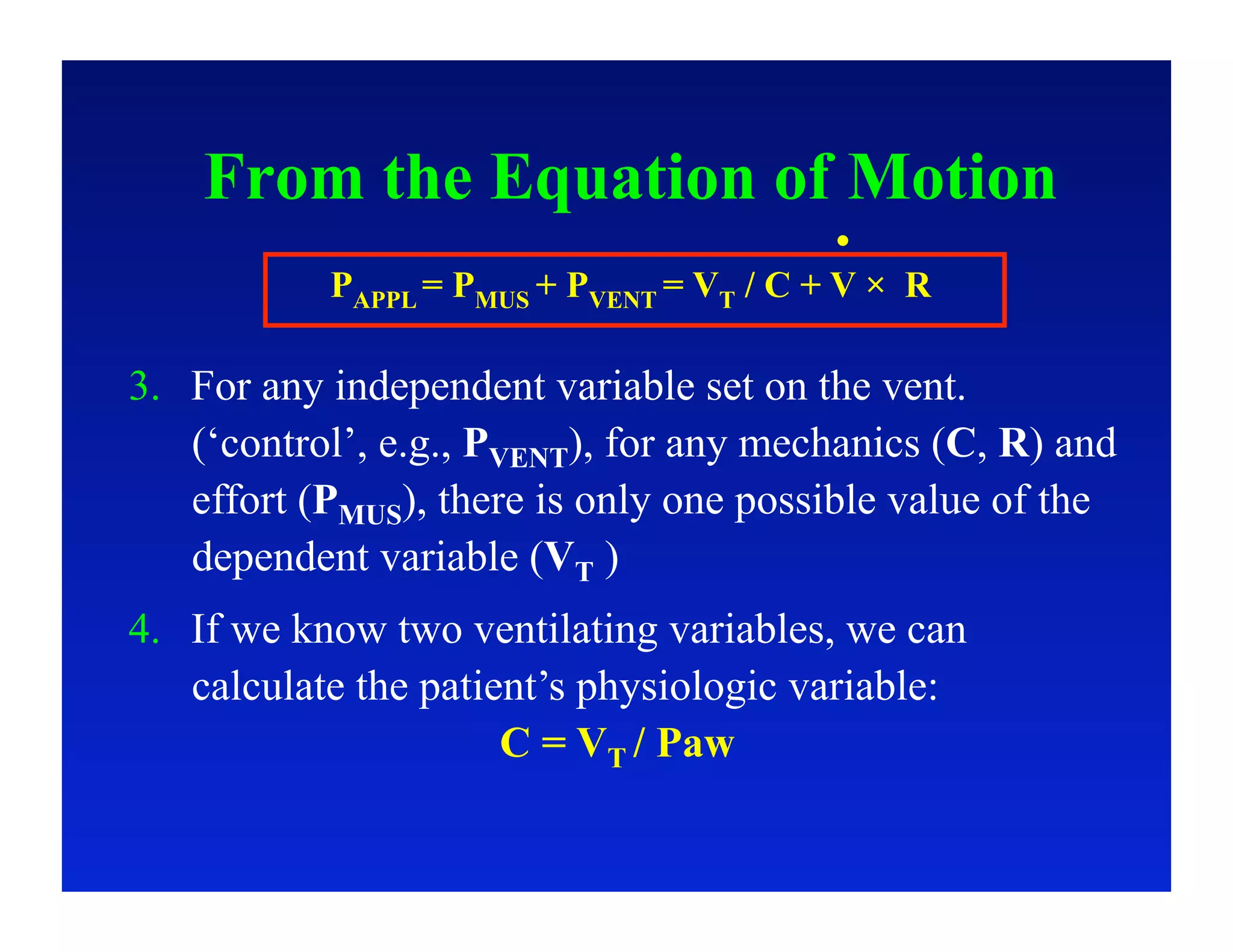
           PAPPL = PMUS + PVENT = VT / C + V × R

3.  For any independent variable set on the vent.
    (‘control’, e.g., PVENT), for any mechanics (C, R) and
    effort (PMUS), there is only one possible value of the
    dependent variable (VT )
4.  If we know two ventilating variables, we can
    calculate the patient’s physiologic variable:
                       C = VT / Paw
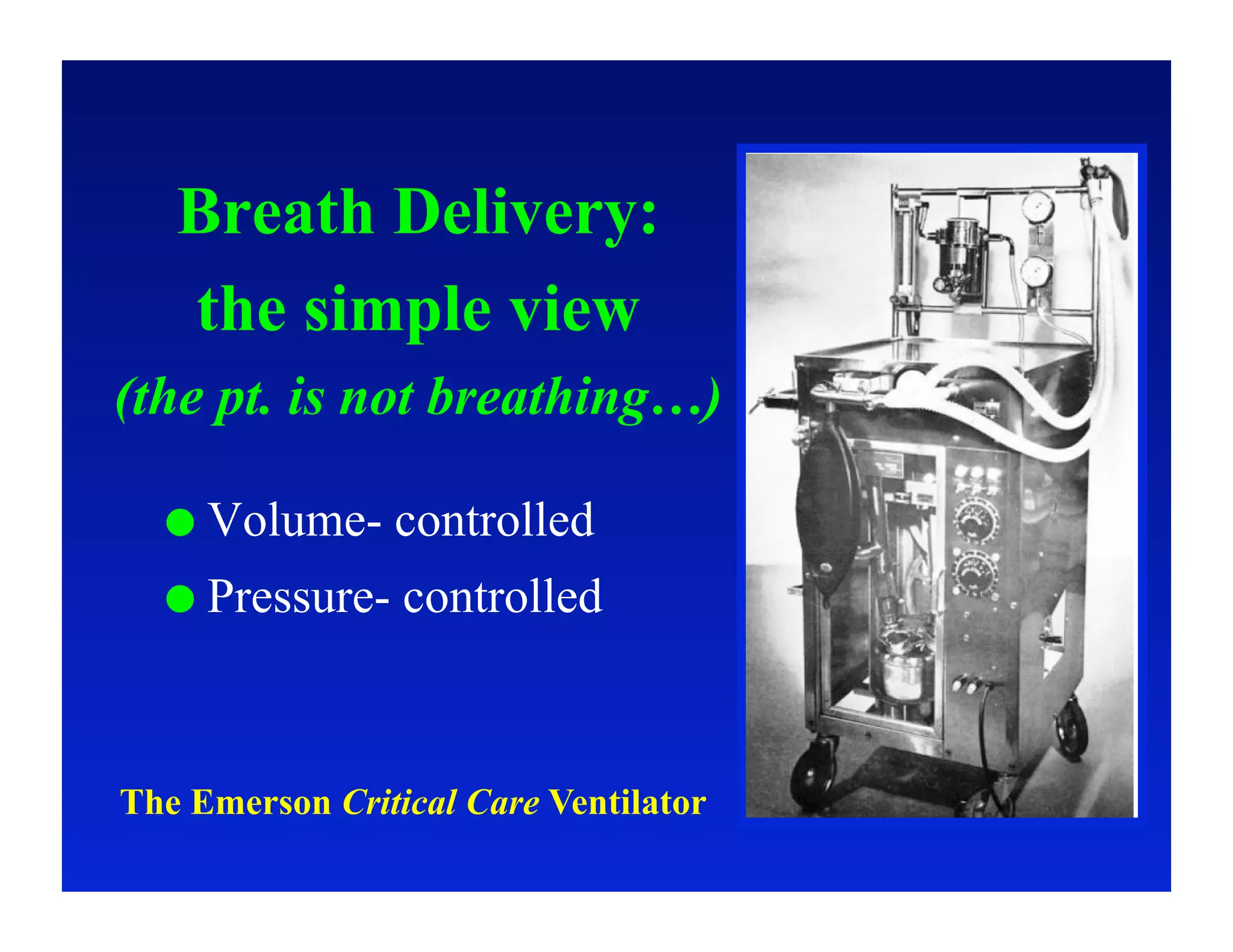
Breath Delivery:
   the simple view
(the pt. is not breathing…)

    Volume-     controlled
    Pressure-   controlled


The Emerson Critical Care Ventilator
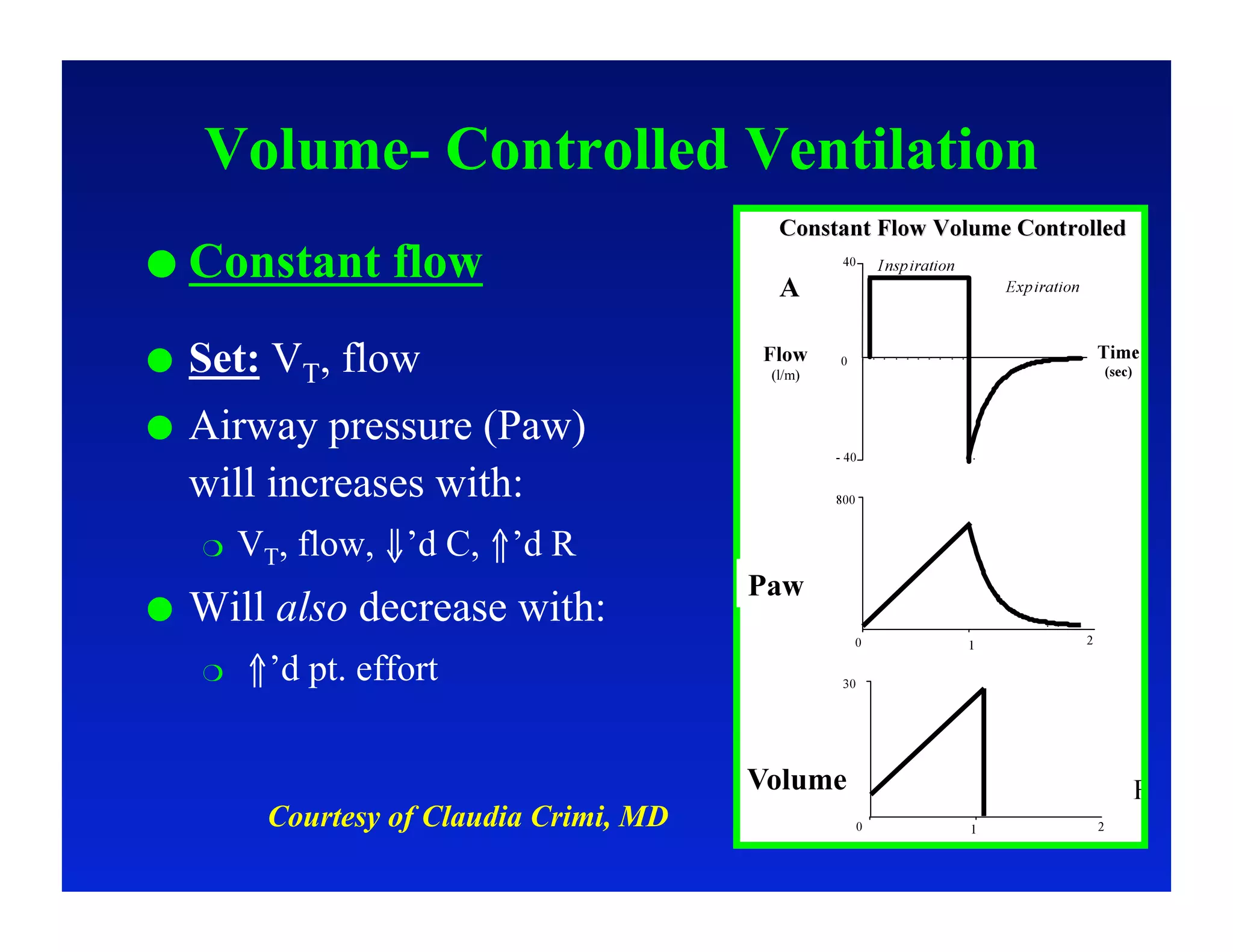
Volume- Controlled Ventilation
  Constant         flow
    Set: VT, flow
    Airway pressure (Paw)
     will increases with:
         VT, flow, ⇓’d C, ⇑’d R
                                           Paw
    Will also decrease with:
         ⇑’d pt. effort

                                           Volume
           Courtesy of Claudia Crimi, MD
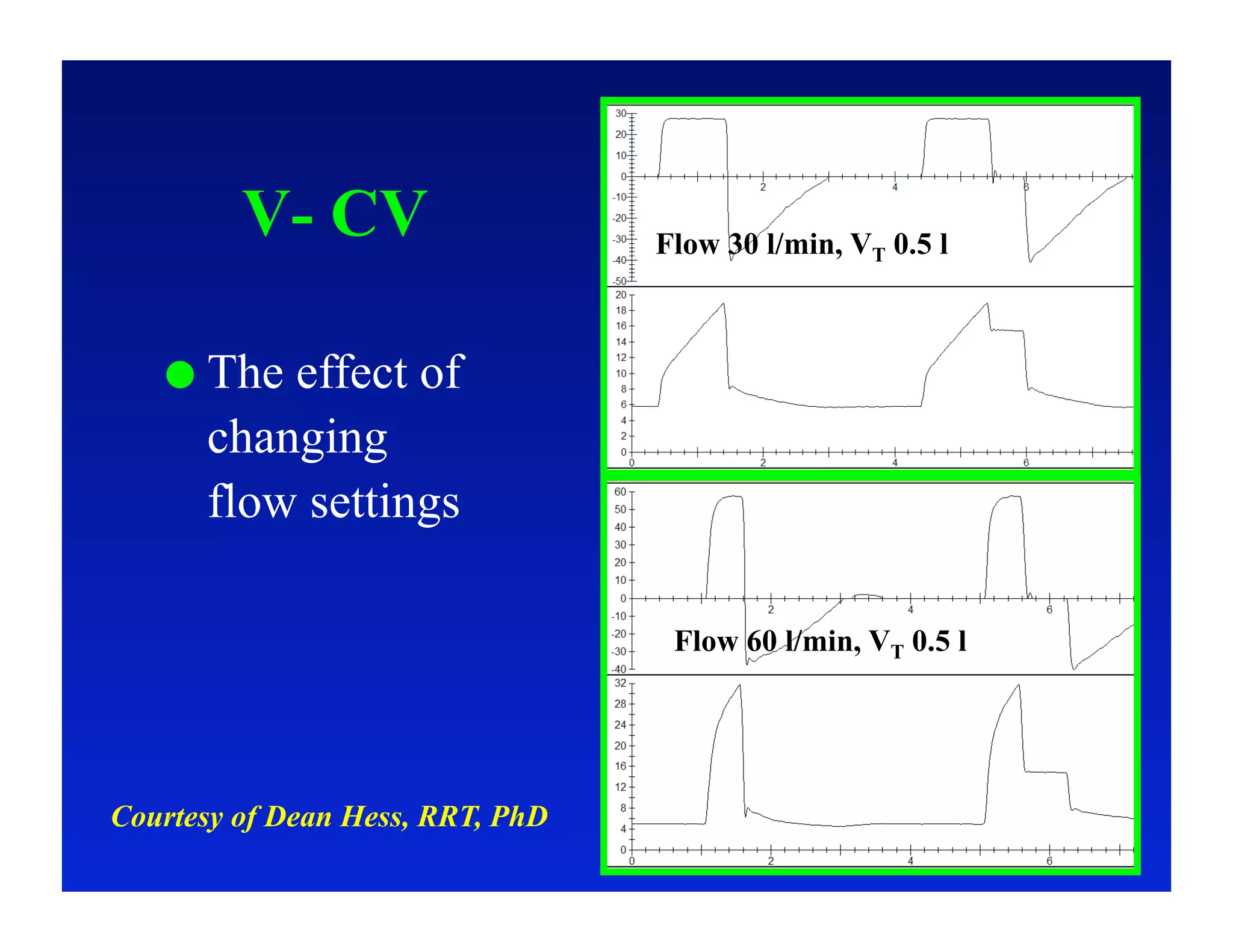
V- CV                    Flow 30 l/min, VT 0.5 l


     The effect of
      changing
      flow settings

                                   Flow 60 l/min, VT 0.5 l


Courtesy of Dean Hess, RRT, PhD
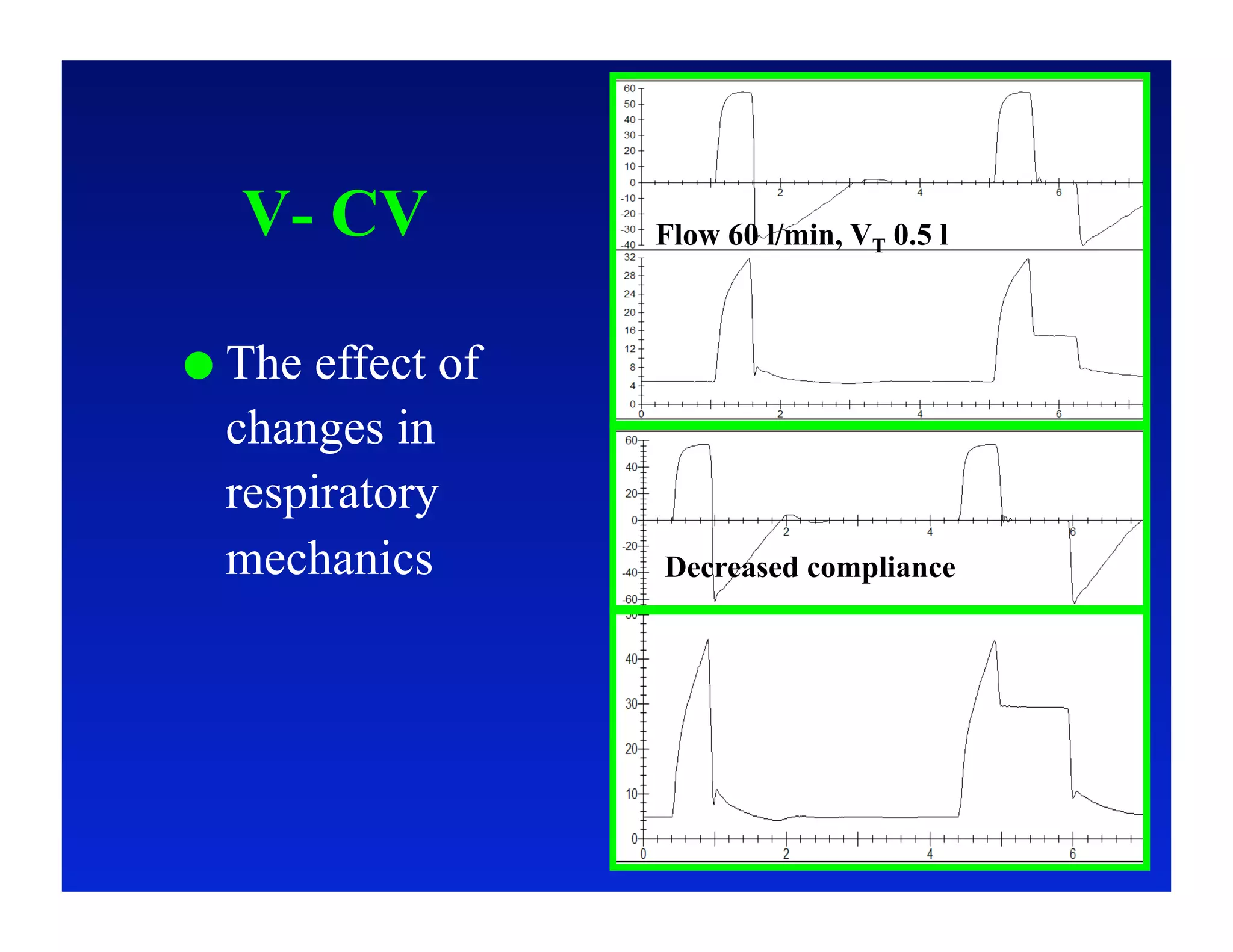
V- CV           Flow 60 l/min, VT 0.5 l


  Theeffect of
  changes in
  respiratory
  mechanics       Decreased compliance
Volume- Controlled Ventilation
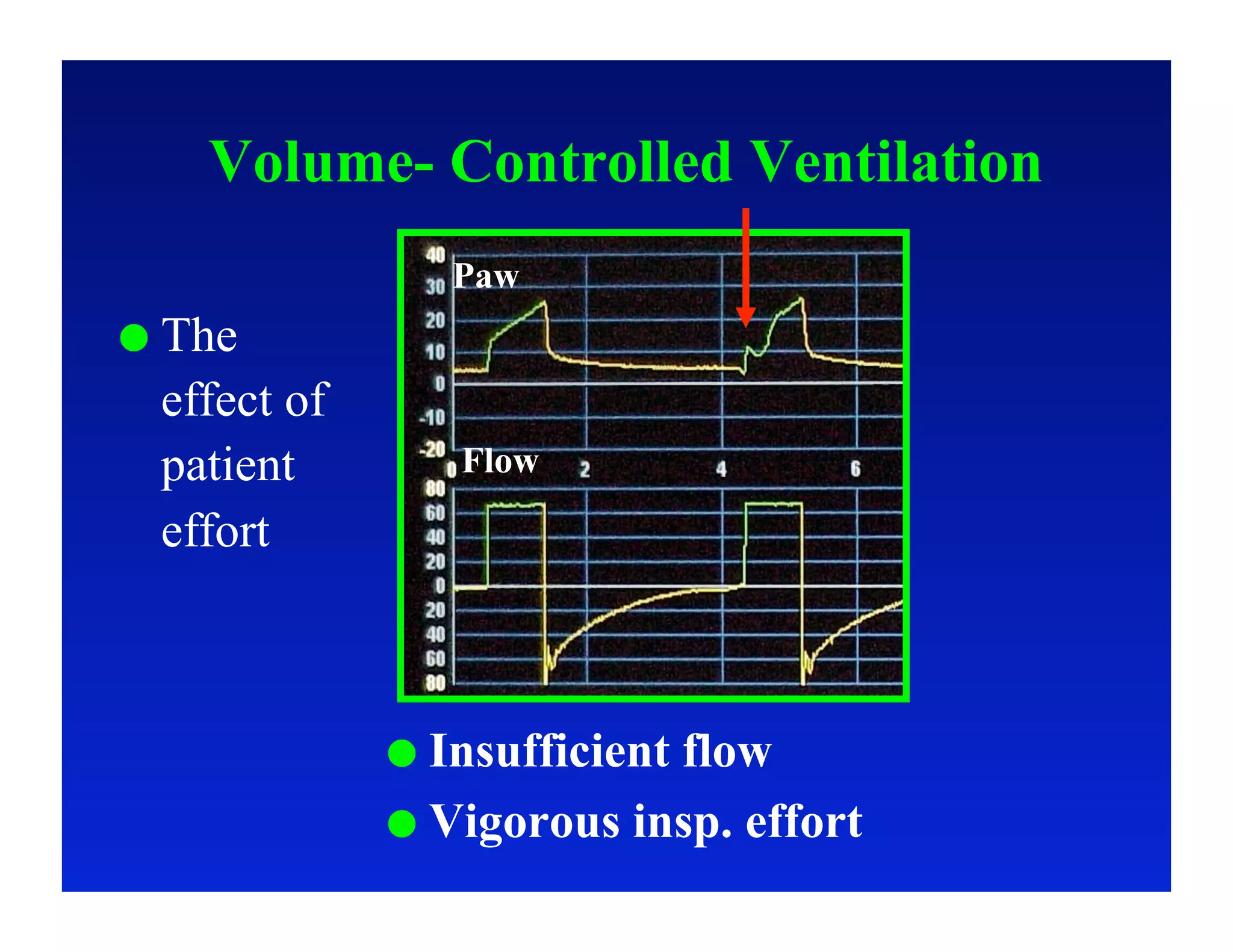
                 Paw
  The
  effect of
  patient        Flow

  effort


                Insufficient
                            flow
                Vigorous insp. effort
Volume- Controlled Ventilation
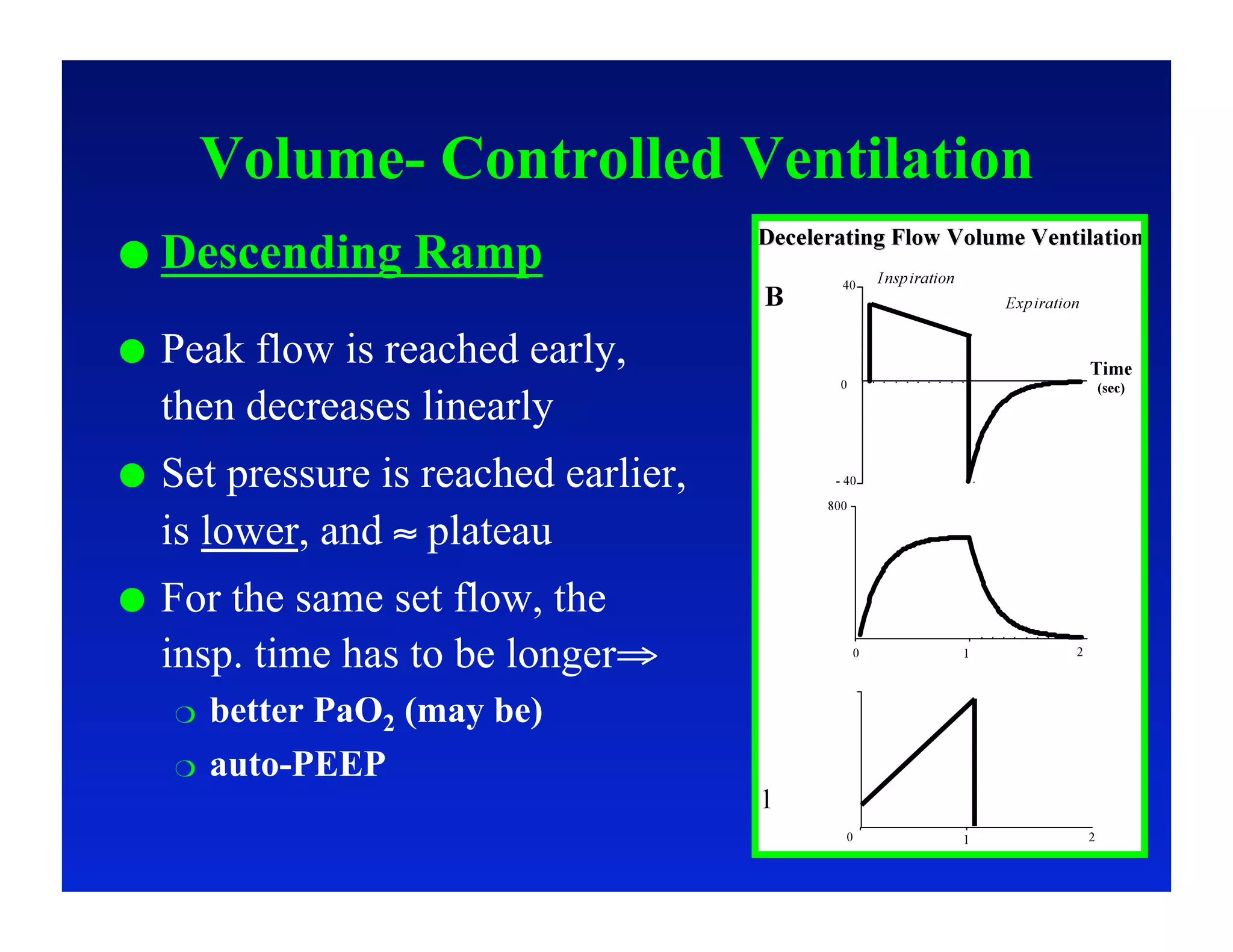
  Descending       Ramp
    Peak flow is reached early,
     then decreases linearly
    Set pressure is reached earlier,
     is lower, and ≈ plateau
    For the same set flow, the
     insp. time has to be longer⇒
       better PaO2 (may be)
       auto-PEEP
Volume- Controlled Ventilation

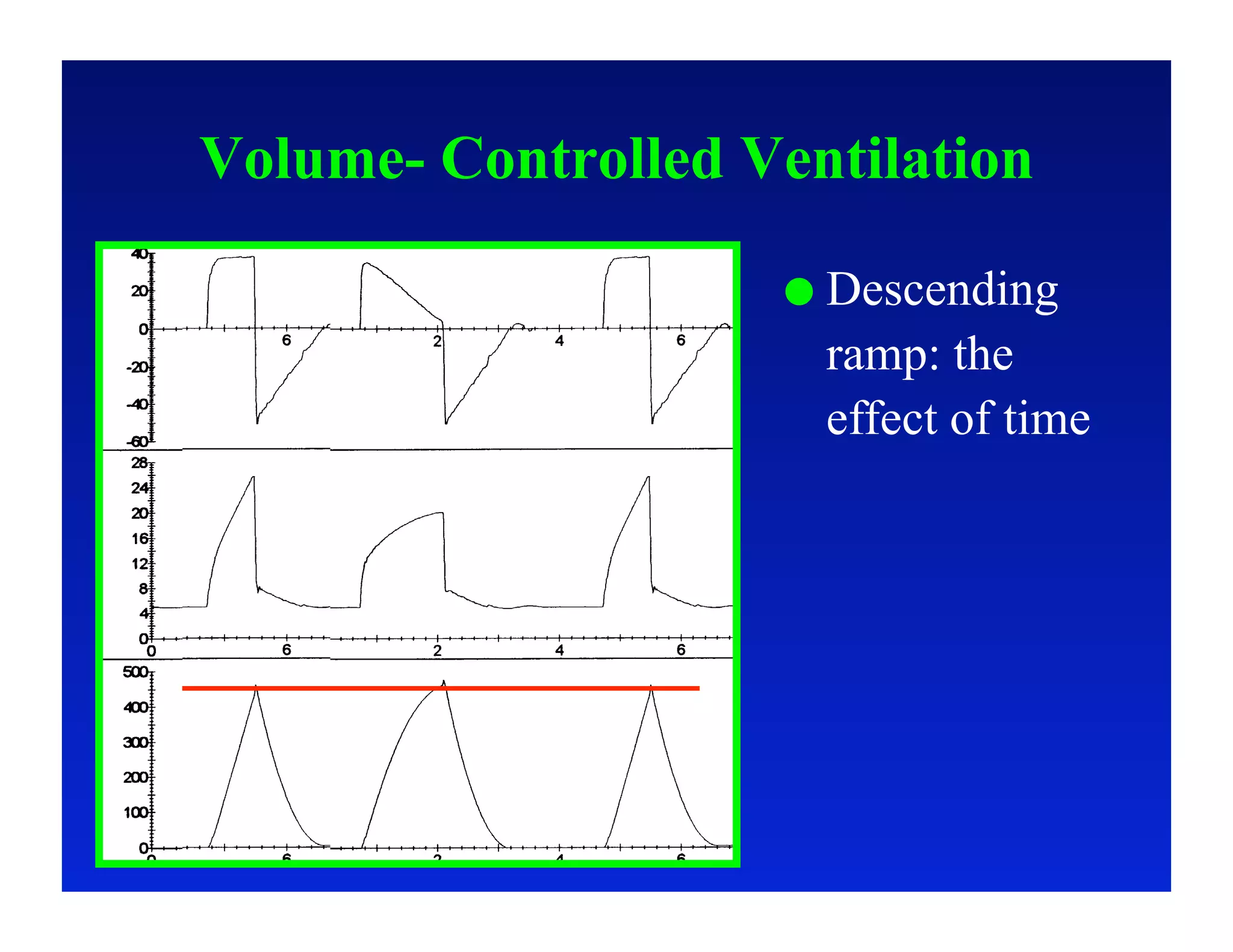
                       Descending
                      ramp: the
                      effect of time
Pressure- Controlled Ventilation


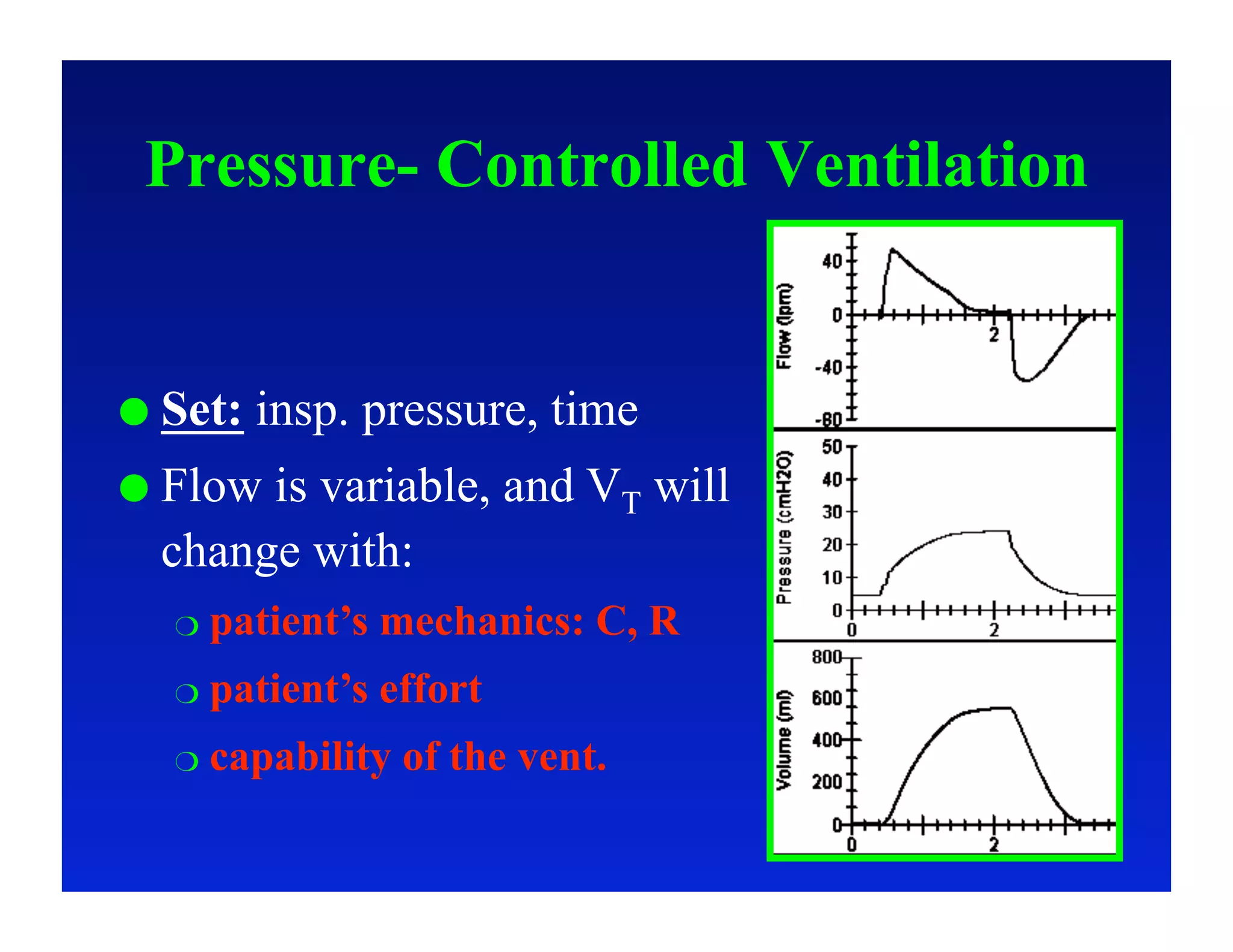
  Set:   insp. pressure, time
  Flowis variable, and VT will
  change with:
     patient’s   mechanics: C, R
     patient’s   effort
     capability   of the vent.
Pressure- Controlled Ventilation

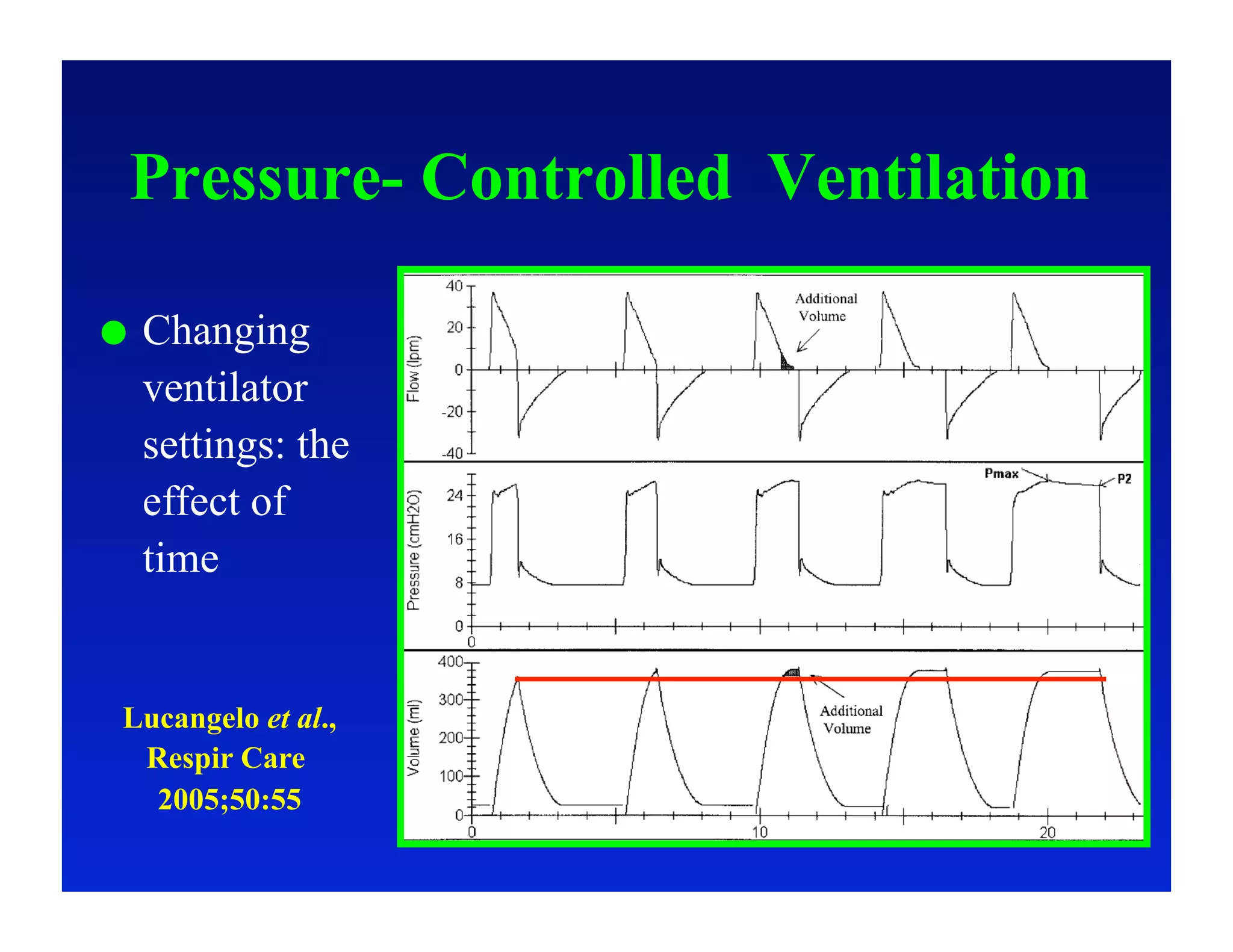
    Changing
     ventilator
     settings: the
     effect of
     time


 Lucangelo et al.,
  Respir Care
   2005;50:55
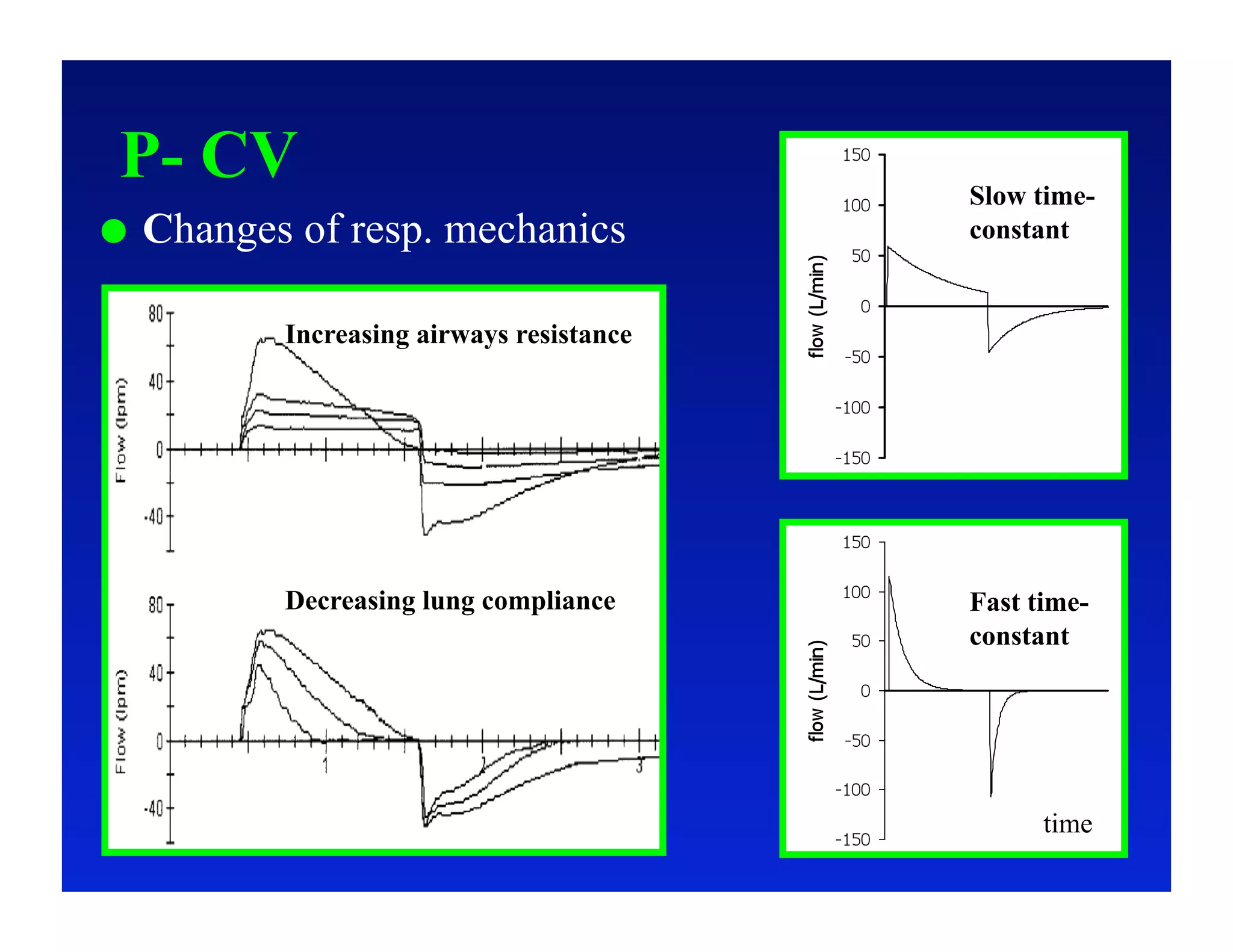
P- CV                                      Slow time-
    Changes of resp. mechanics             constant


            Increasing airways resistance


            Decreasing lung compliance      Fast time-
                                            constant


                                                  time
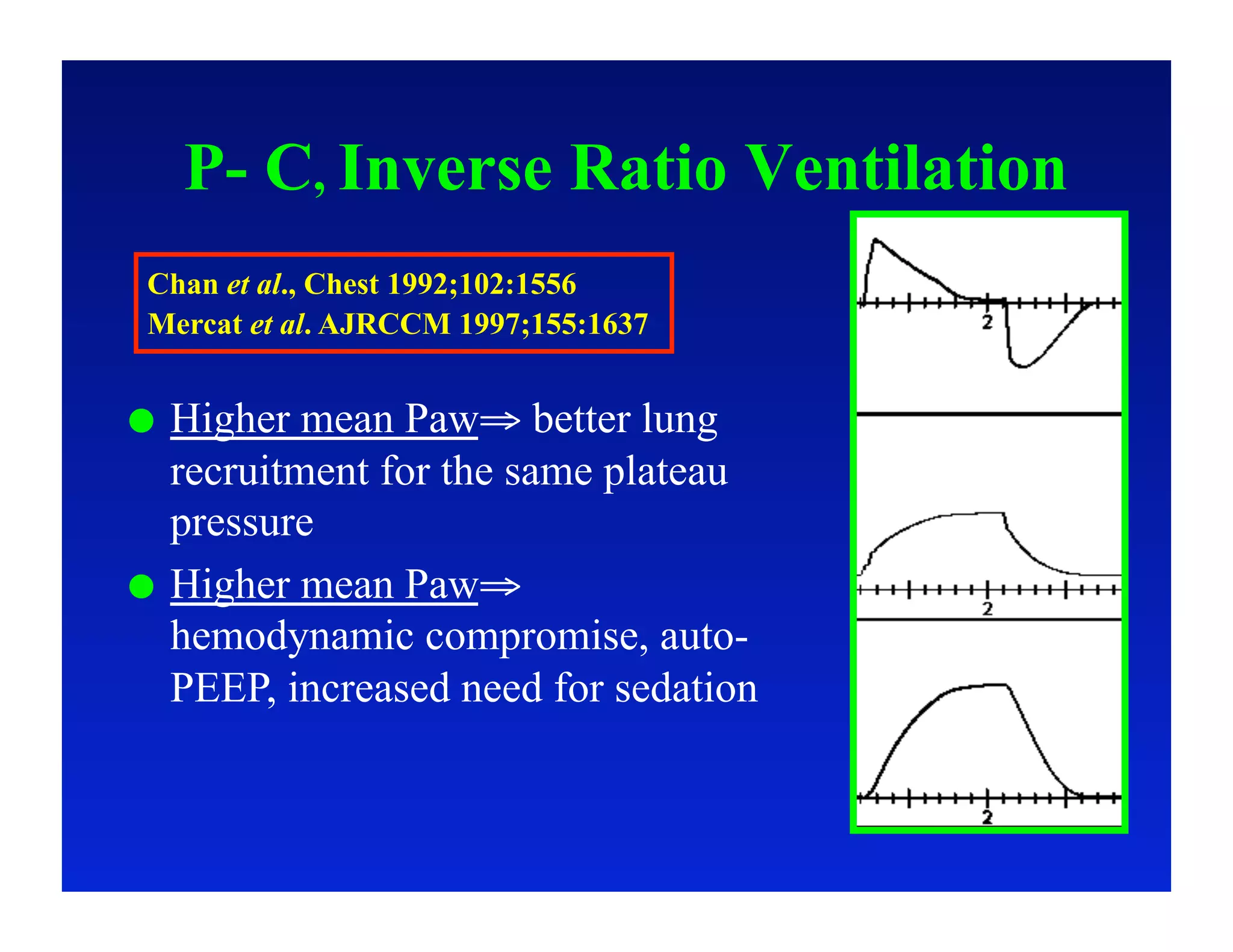
P- C, Inverse Ratio Ventilation
 Chan et al., Chest 1992;102:1556
 Mercat et al. AJRCCM 1997;155:1637


  Higher mean Paw⇒ better lung
   recruitment for the same plateau
   pressure
  Higher mean Paw⇒
   hemodynamic compromise, auto-
   PEEP, increased need for sedation
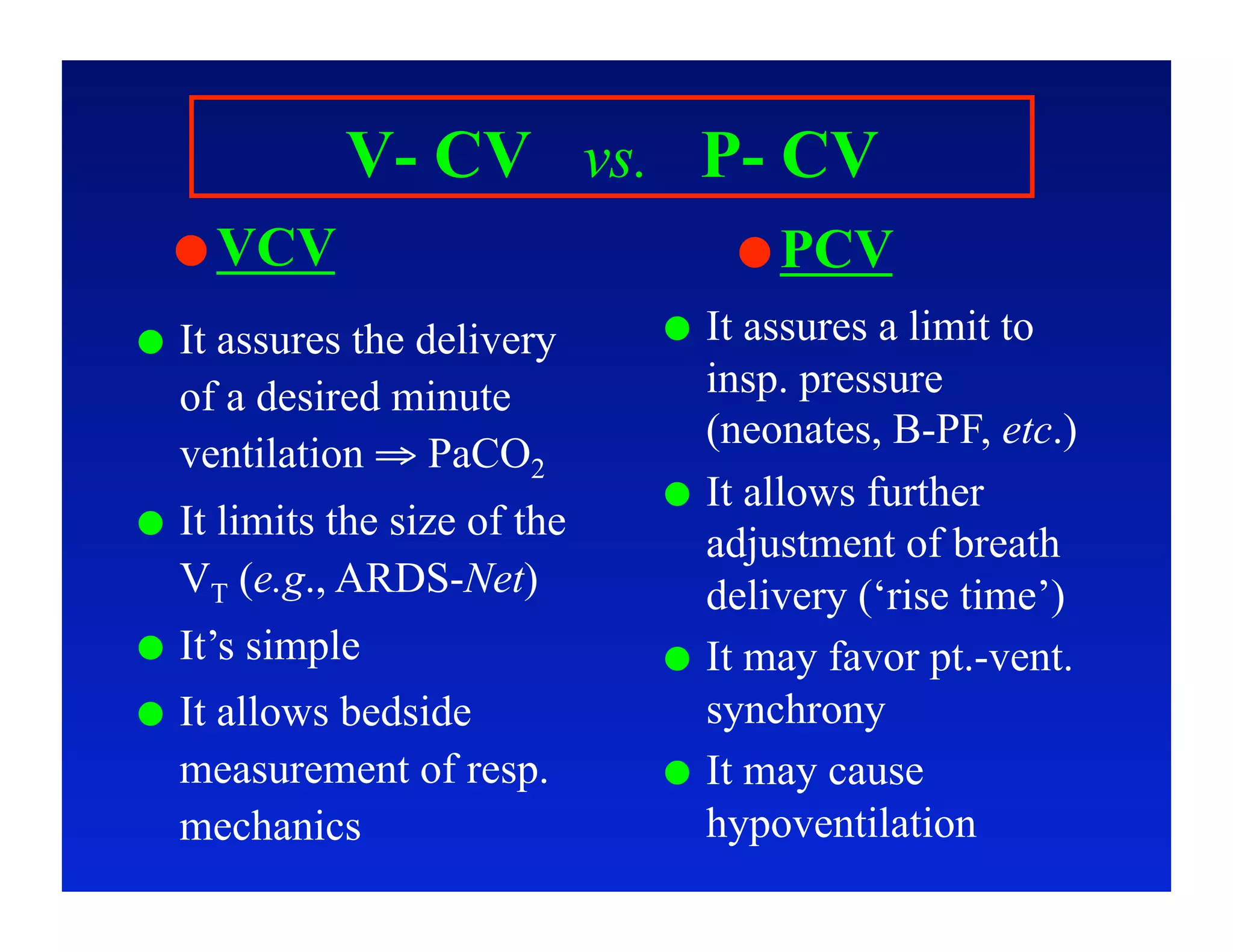
V- CV vs. P- CV
       VCV                             PCV

    It assures the delivery       It assures a limit to
     of a desired minute            insp. pressure
                                    (neonates, B-PF, etc.)
     ventilation ⇒ PaCO2
                                   It allows further
    It limits the size of the
                                    adjustment of breath
     VT (e.g., ARDS-Net)            delivery (‘rise time’)
    It’s simple                   It may favor pt.-vent.
    It allows bedside              synchrony
     measurement of resp.          It may cause
     mechanics                      hypoventilation
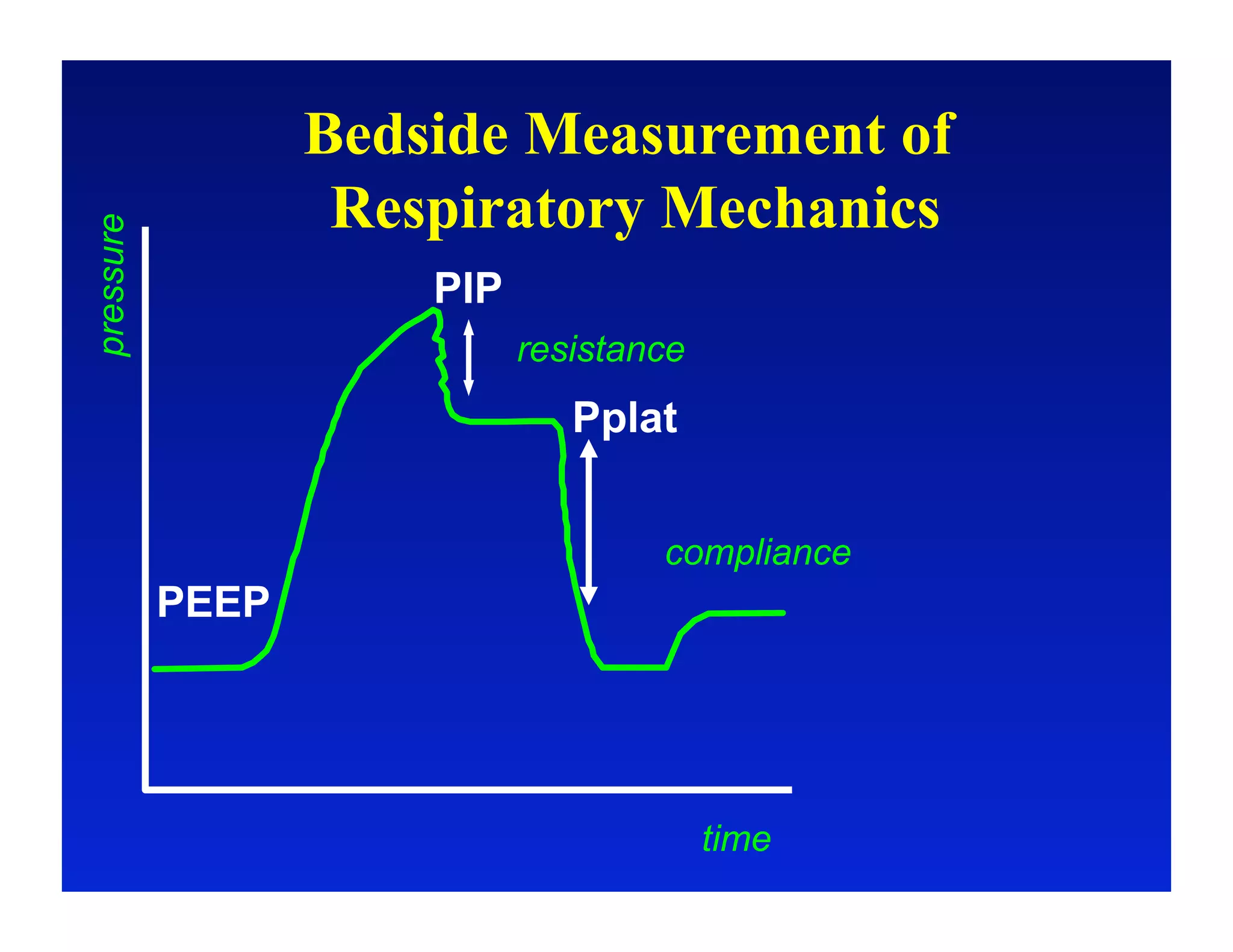
Bedside Measurement of
                   Respiratory Mechanics
pressure


                      PIP
                            resistance
                               Pplat


                                    compliance
           PEEP


                                         time
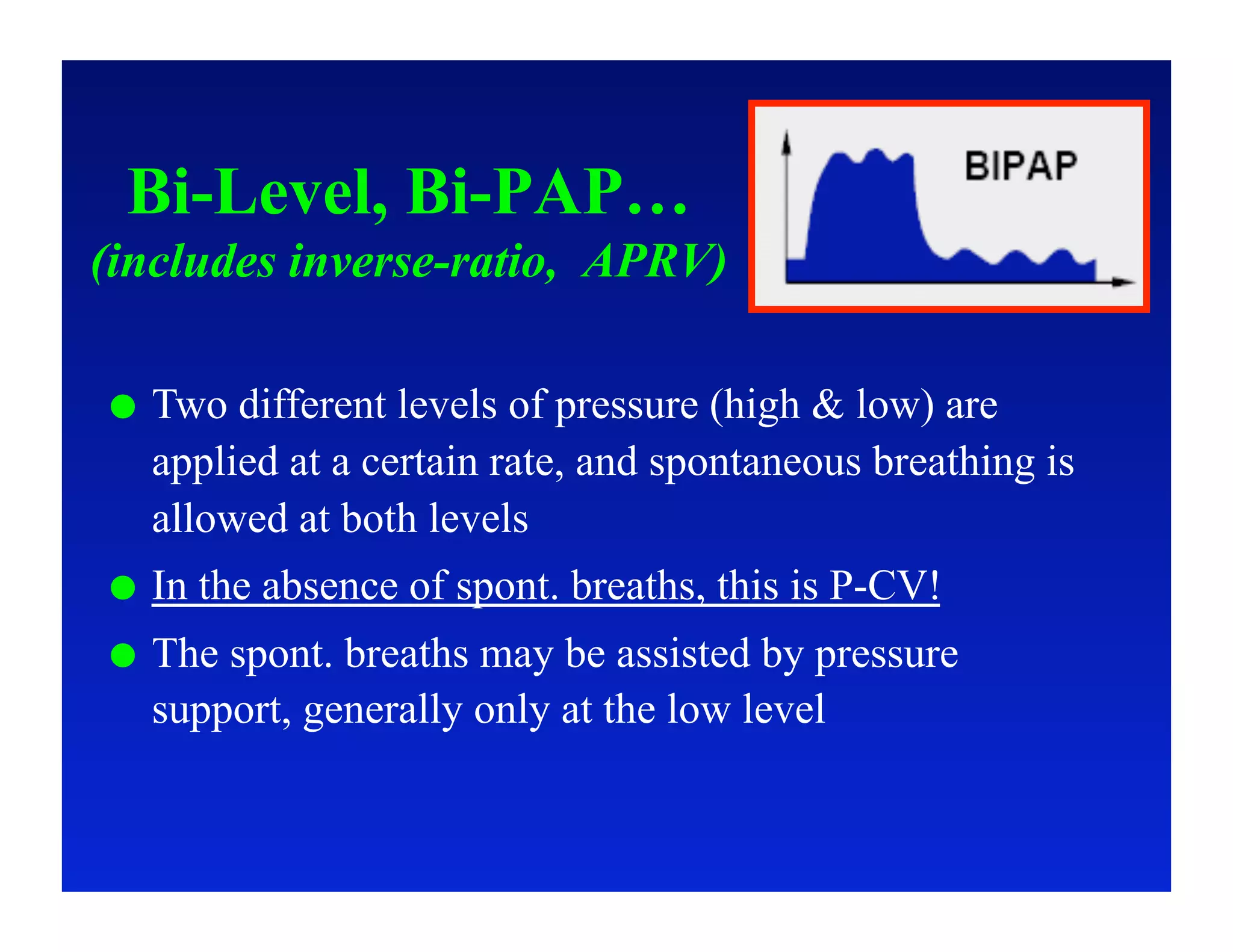
Bi-Level, Bi-PAP…
(includes inverse-ratio, APRV)

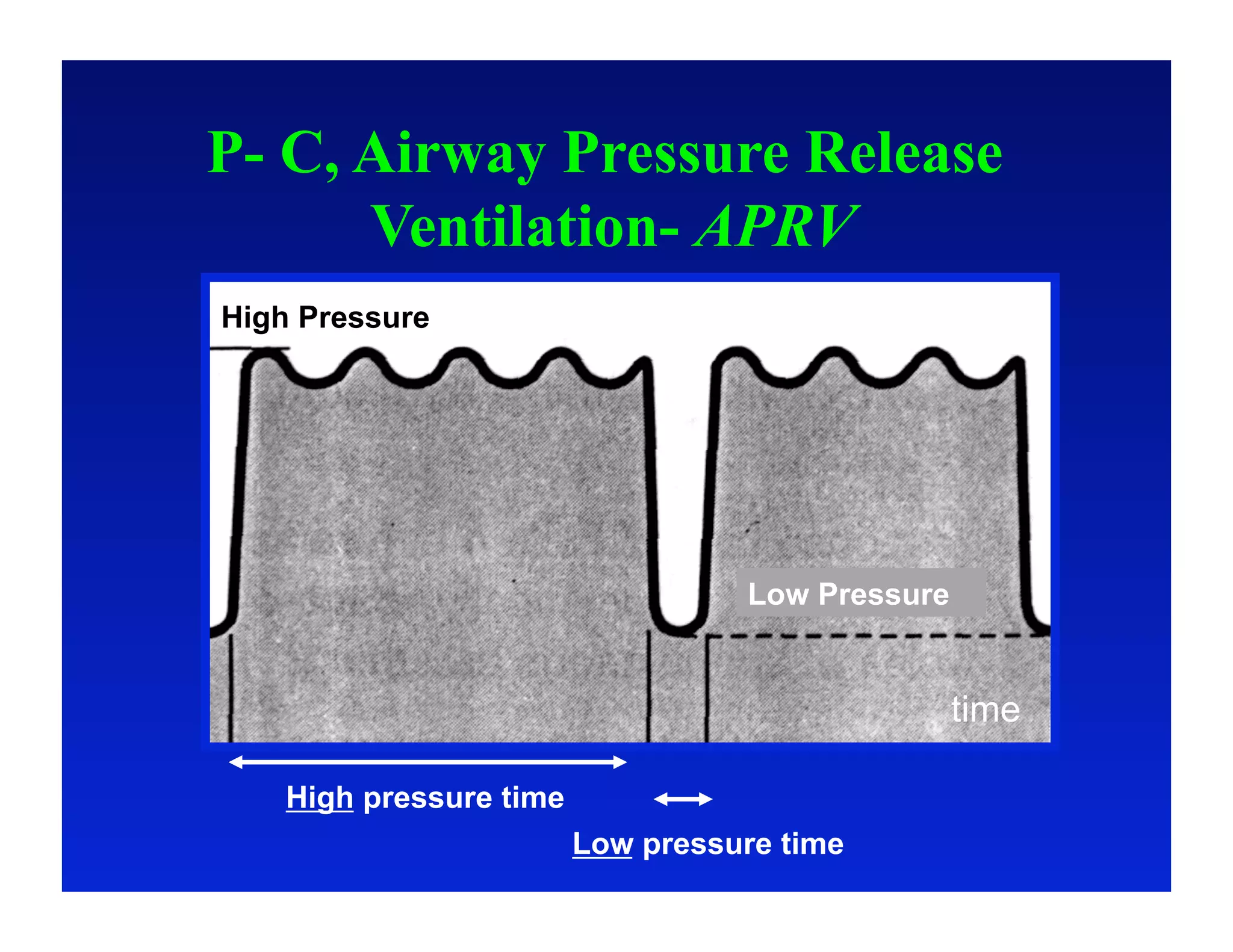
    Two different levels of pressure (high & low) are
     applied at a certain rate, and spontaneous breathing is
     allowed at both levels
    In the absence of spont. breaths, this is P-CV!
    The spont. breaths may be assisted by pressure
     support, generally only at the low level
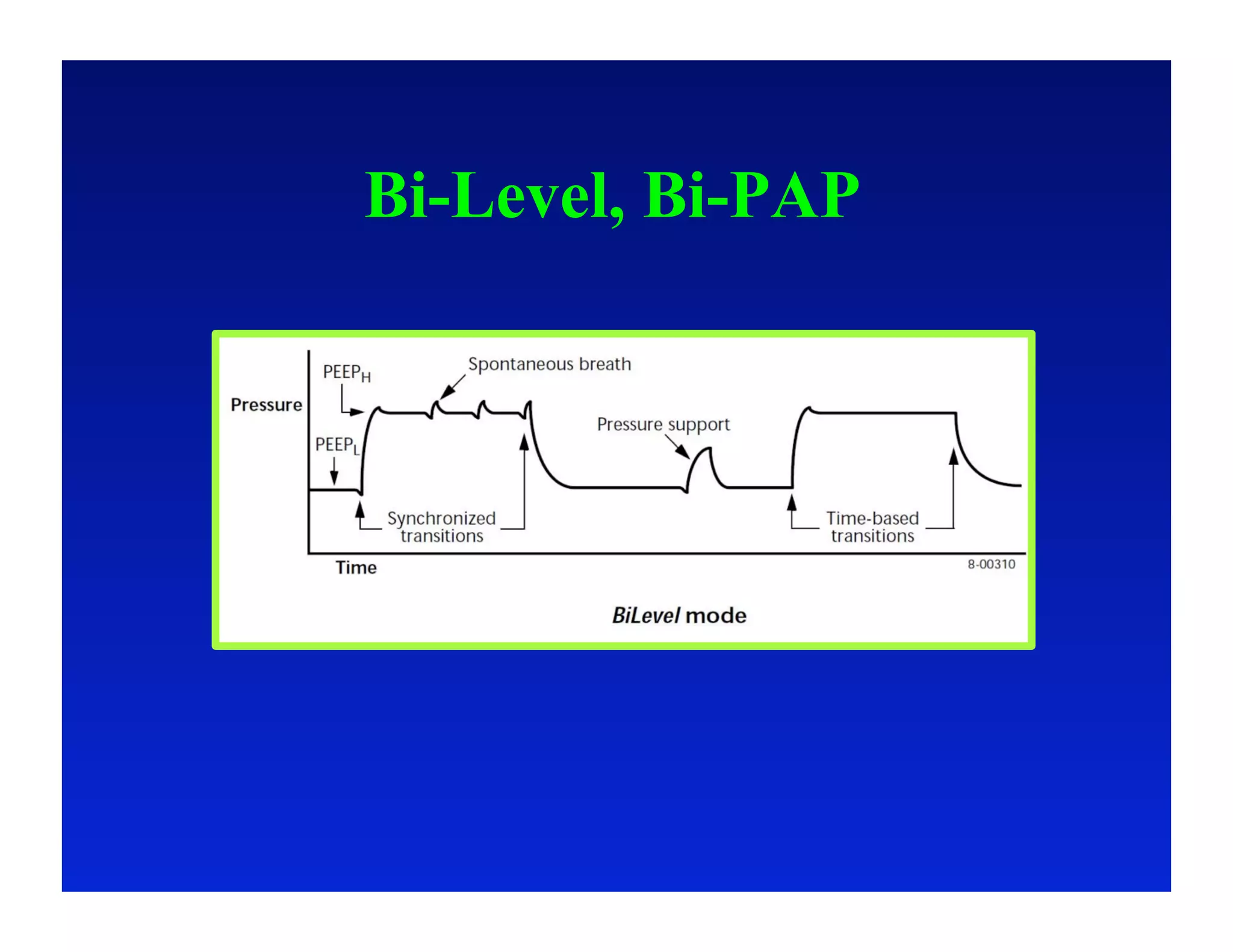
Bi-Level, Bi-PAP
P- C, Airway Pressure Release
      Ventilation- APRV
High Pressure


                                   Low Pressure


                                                  time

    High pressure time
                         Low pressure time
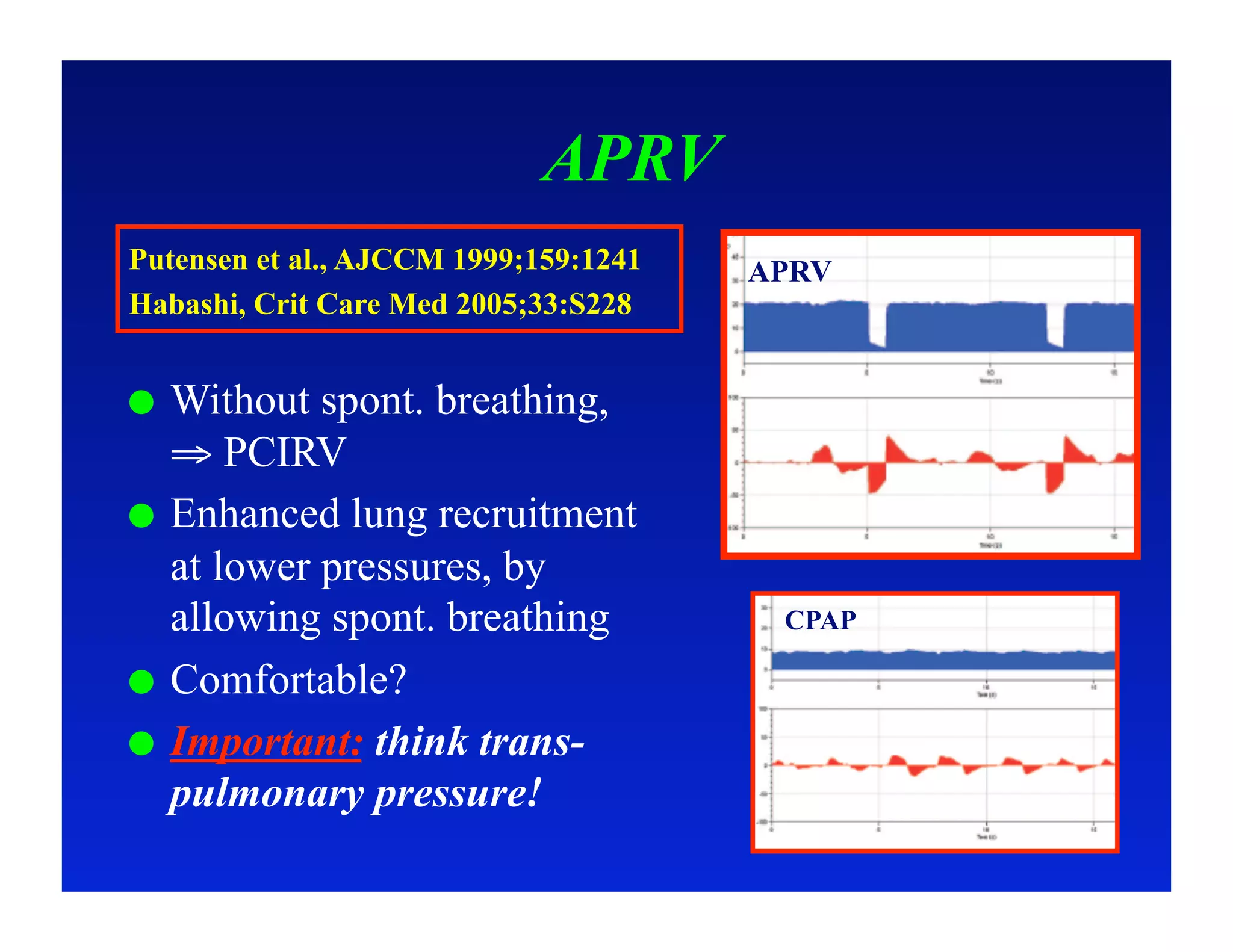
APRV
Putensen et al., AJCCM 1999;159:1241   APRV
Habashi, Crit Care Med 2005;33:S228


  Without spont. breathing,
   ⇒ PCIRV
  Enhanced lung recruitment
   at lower pressures, by
   allowing spont. breathing            CPAP

  Comfortable?
  Important: think trans-
   pulmonary pressure!
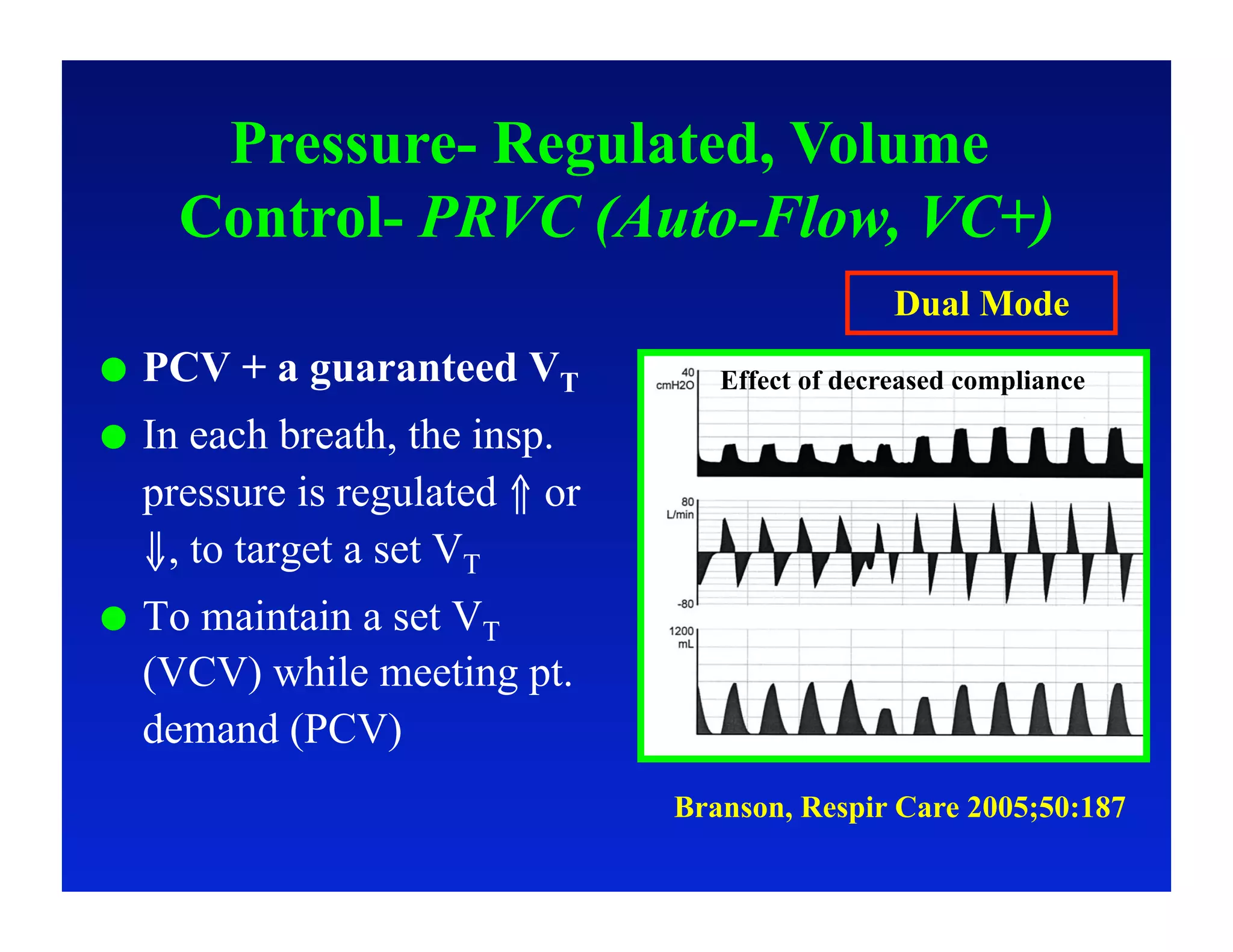
Pressure- Regulated, Volume
       Control- PRVC (Auto-Flow, VC+)
                                                   Dual Mode
    PCV + a guaranteed VT           Effect of decreased compliance

    In each breath, the insp.
     pressure is regulated ⇑ or
     ⇓, to target a set VT
    To maintain a set VT
     (VCV) while meeting pt.
     demand (PCV)
                                  Branson, Respir Care 2005;50:187
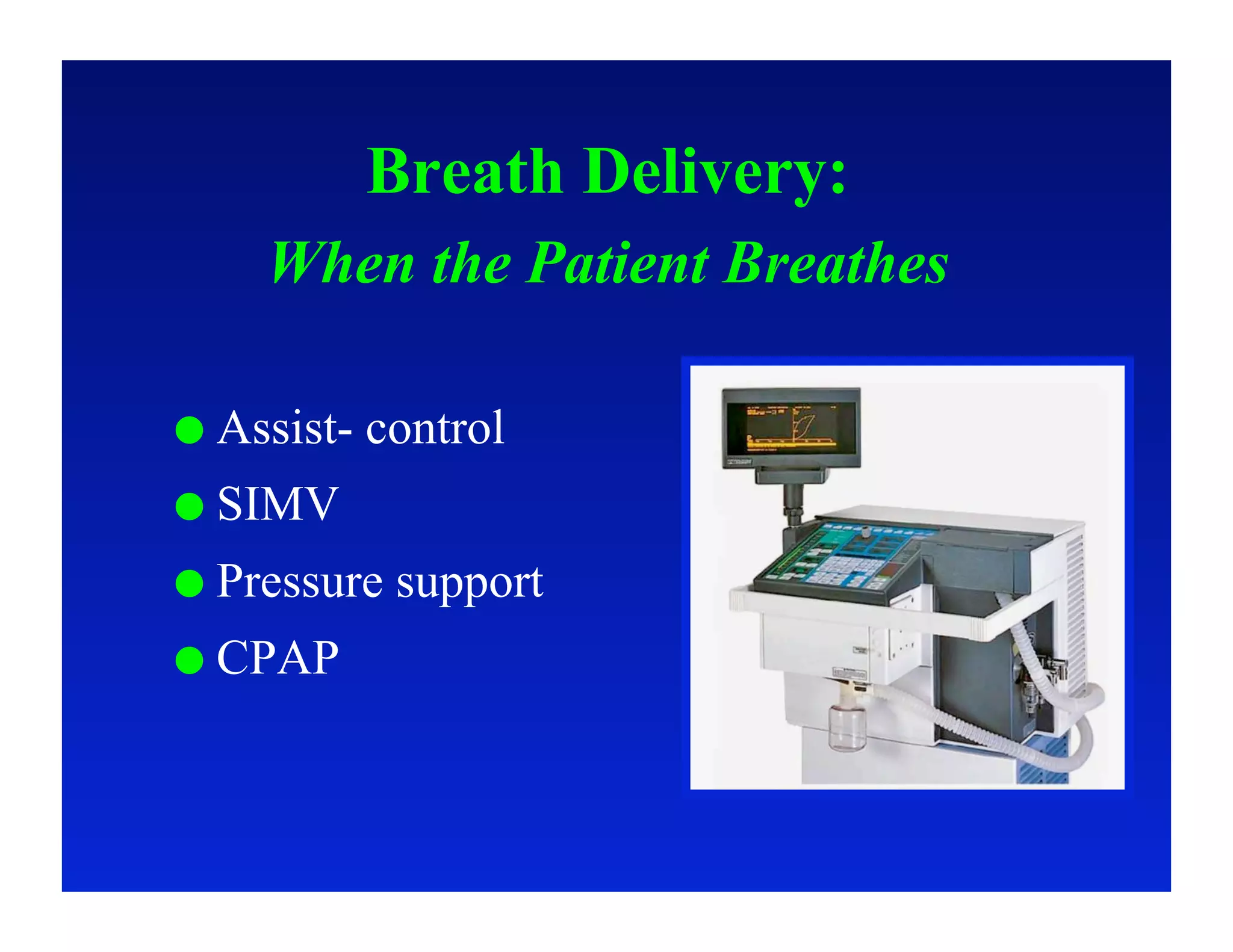
Breath Delivery:
     When the Patient Breathes

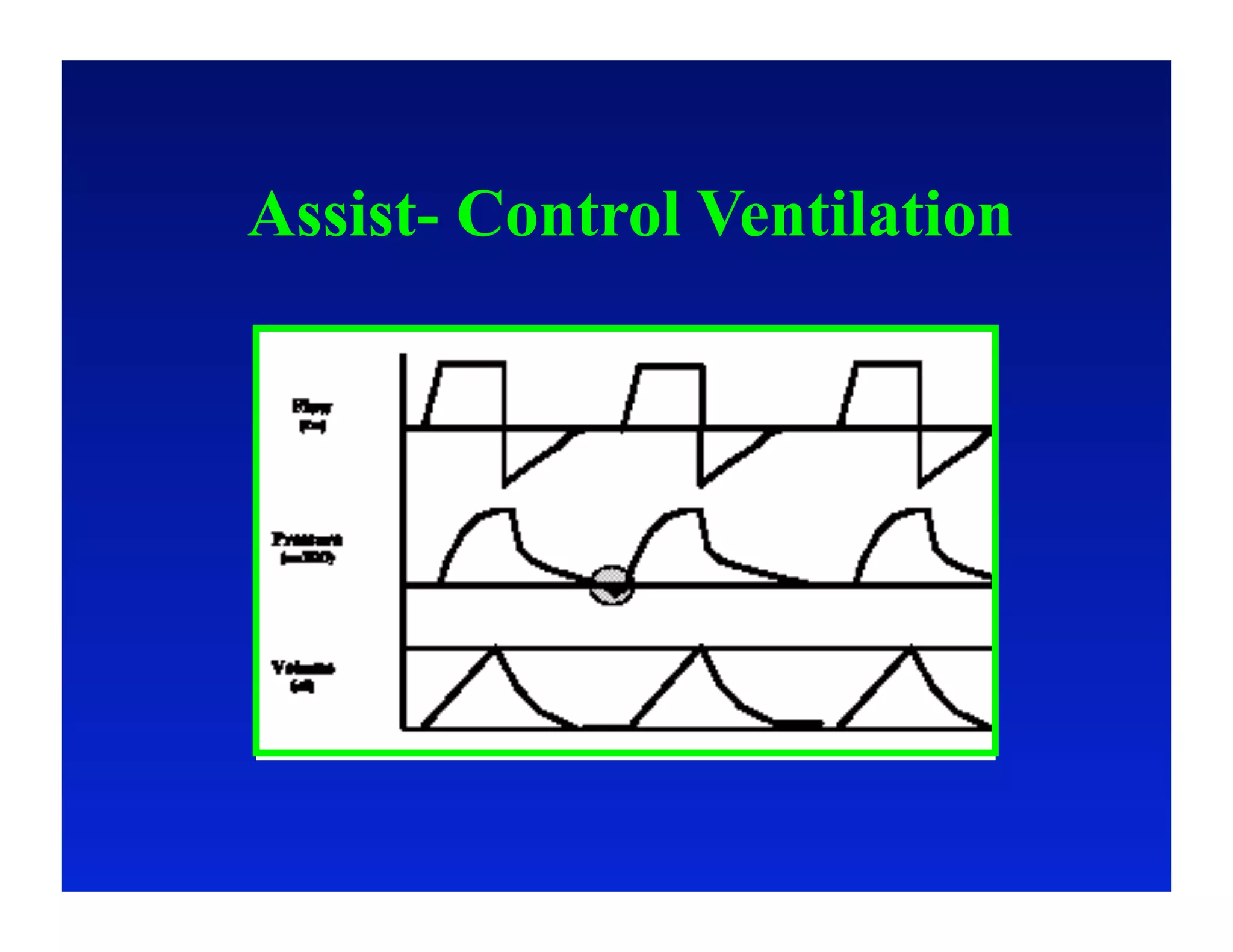
  Assist-   control
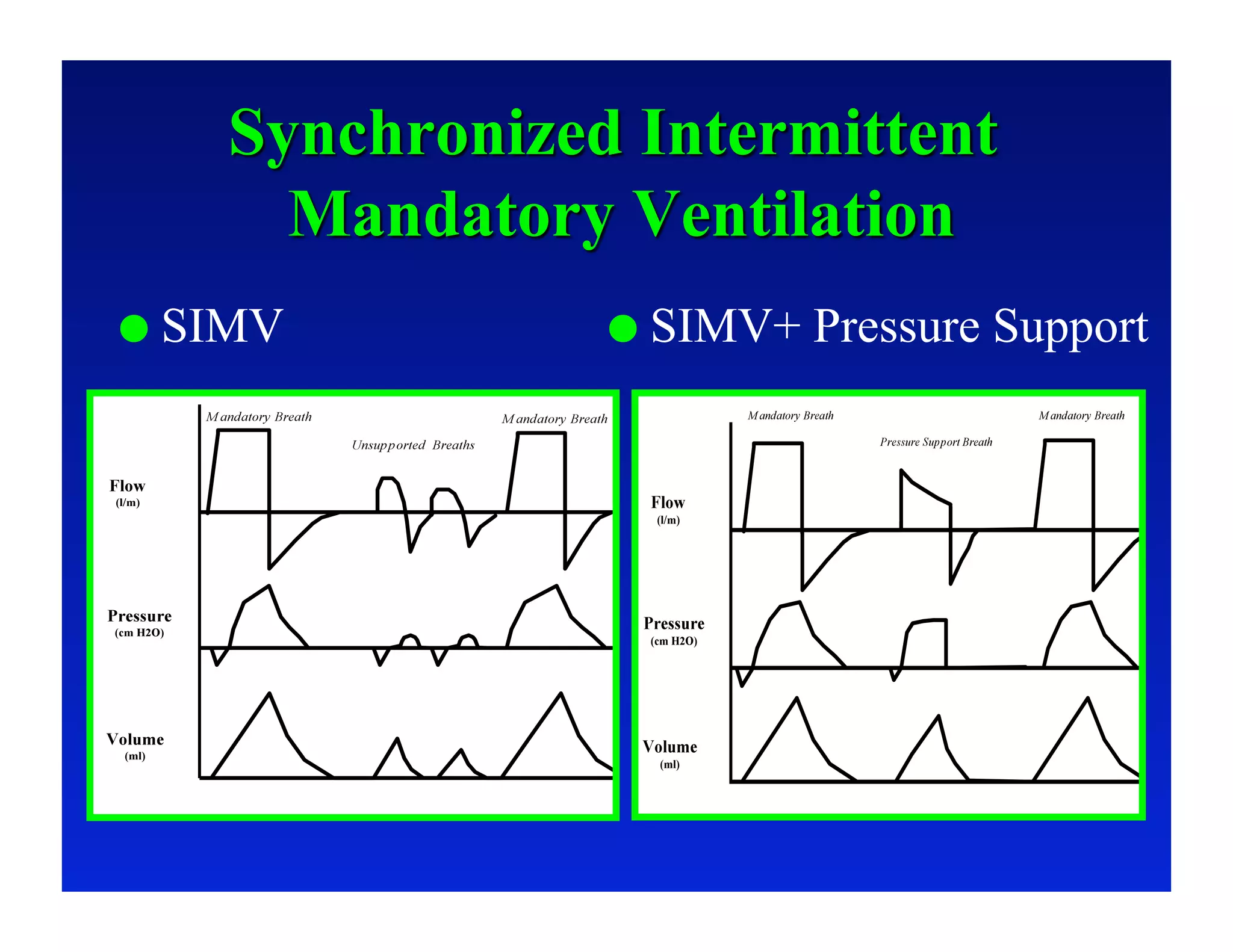
  SIMV

  Pressure   support
  CPAP
  SIMV     SIMV+   Pressure Support
Assist- Control Ventilation
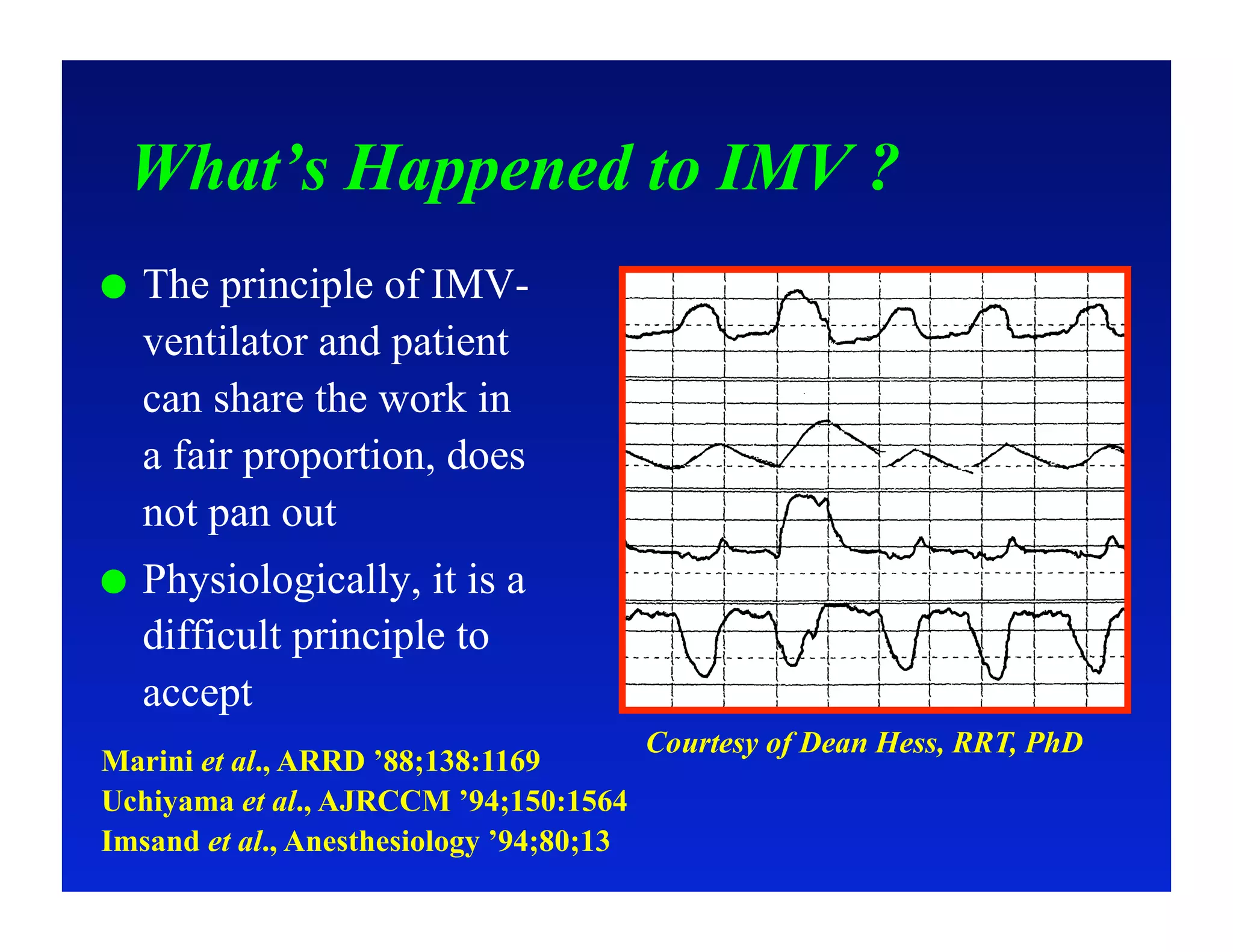
What’s Happened to IMV ?
    The principle of IMV-
     ventilator and patient
     can share the work in
     a fair proportion, does
     not pan out
    Physiologically, it is a
     difficult principle to
     accept
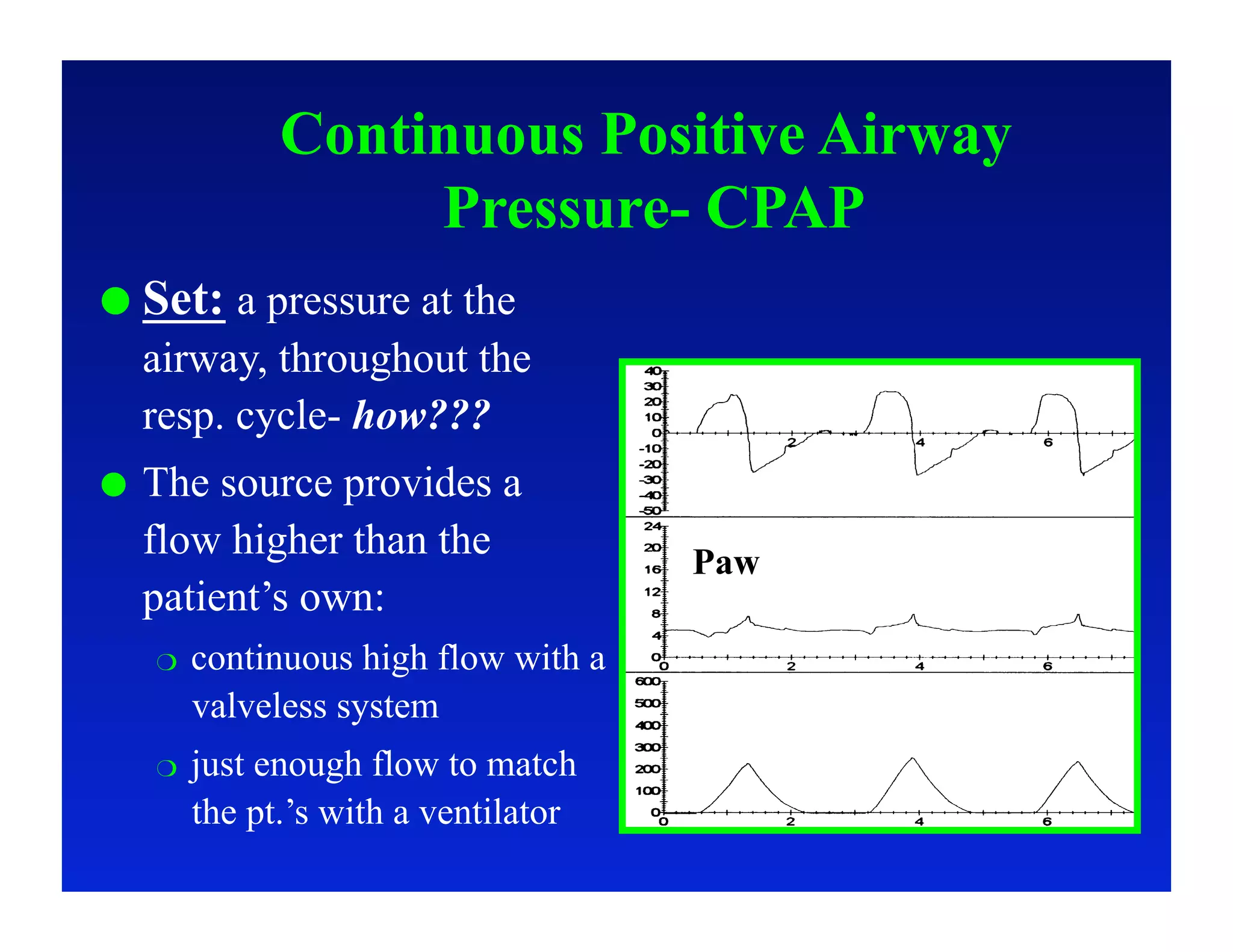
Continuous Positive Airway
                     Pressure- CPAP
  Set: a pressure at the
     airway, throughout the
     resp. cycle- how???
    The source provides a
     flow higher than the               Paw
     patient’s own:
         continuous high flow with a
          valveless system
         just enough flow to match
          the pt.’s with a ventilator
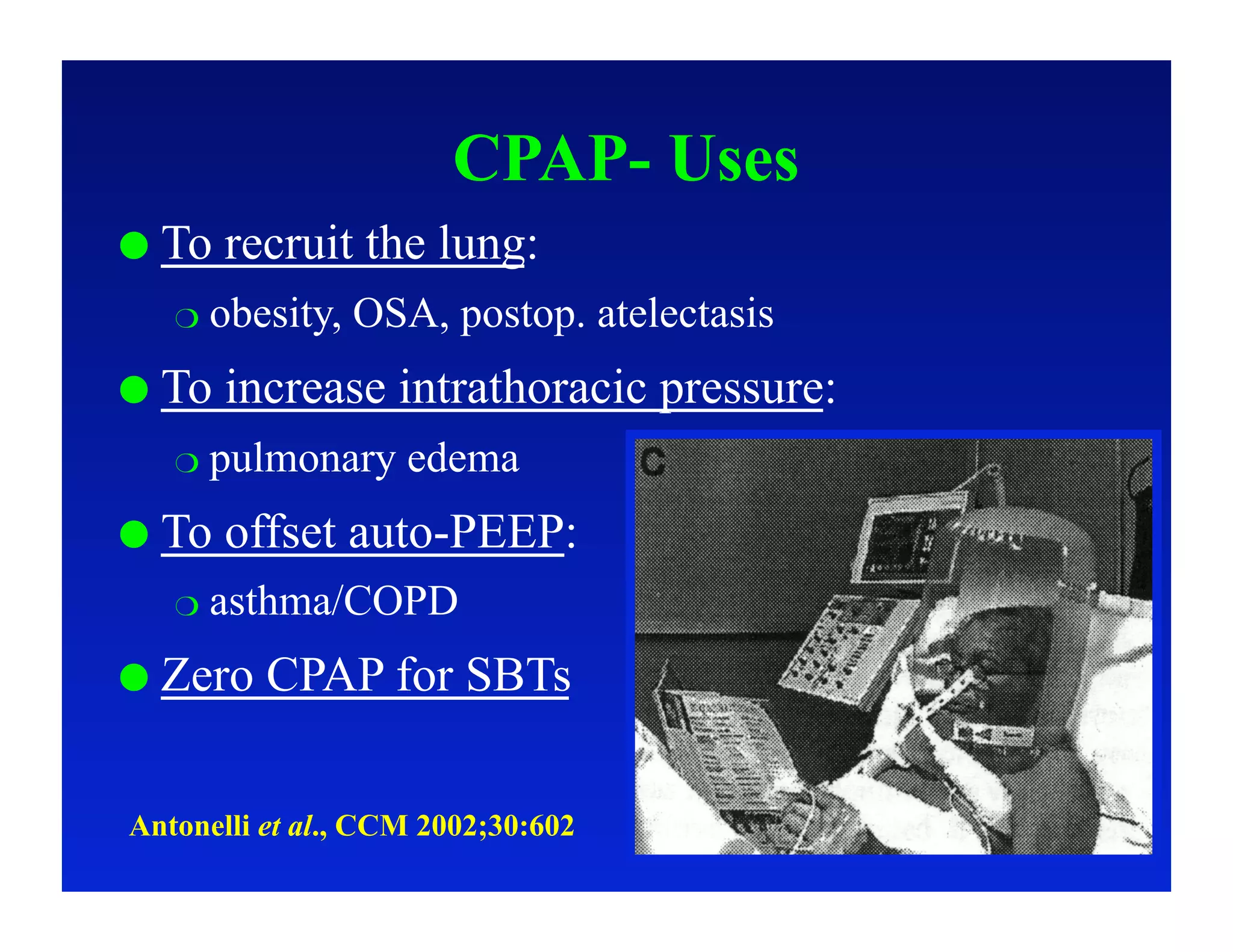
CPAP- Uses
  To   recruit the lung:
     obesity,   OSA, postop. atelectasis
  To   increase intrathoracic pressure:
     pulmonary     edema
  To   offset auto-PEEP:
     asthma/COPD

  Zero   CPAP for SBTs

Antonelli et al., CCM 2002;30:602
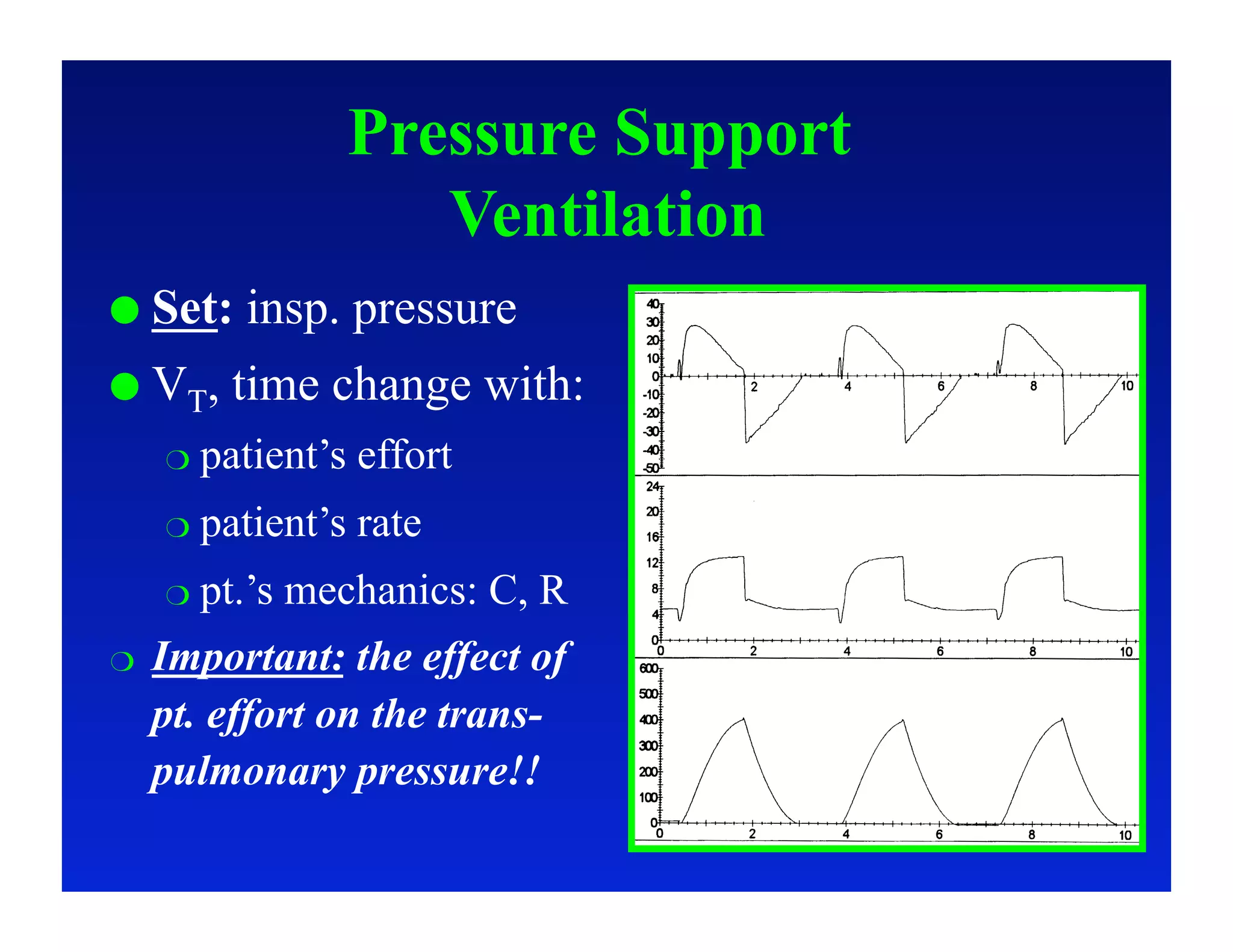
Pressure Support
                       Ventilation
  Set:   insp. pressure
  VT,   time change with:
       patient’s   effort
       patient’s   rate
       pt.’s   mechanics: C, R
    Important: the effect of
     pt. effort on the trans-
     pulmonary pressure!!
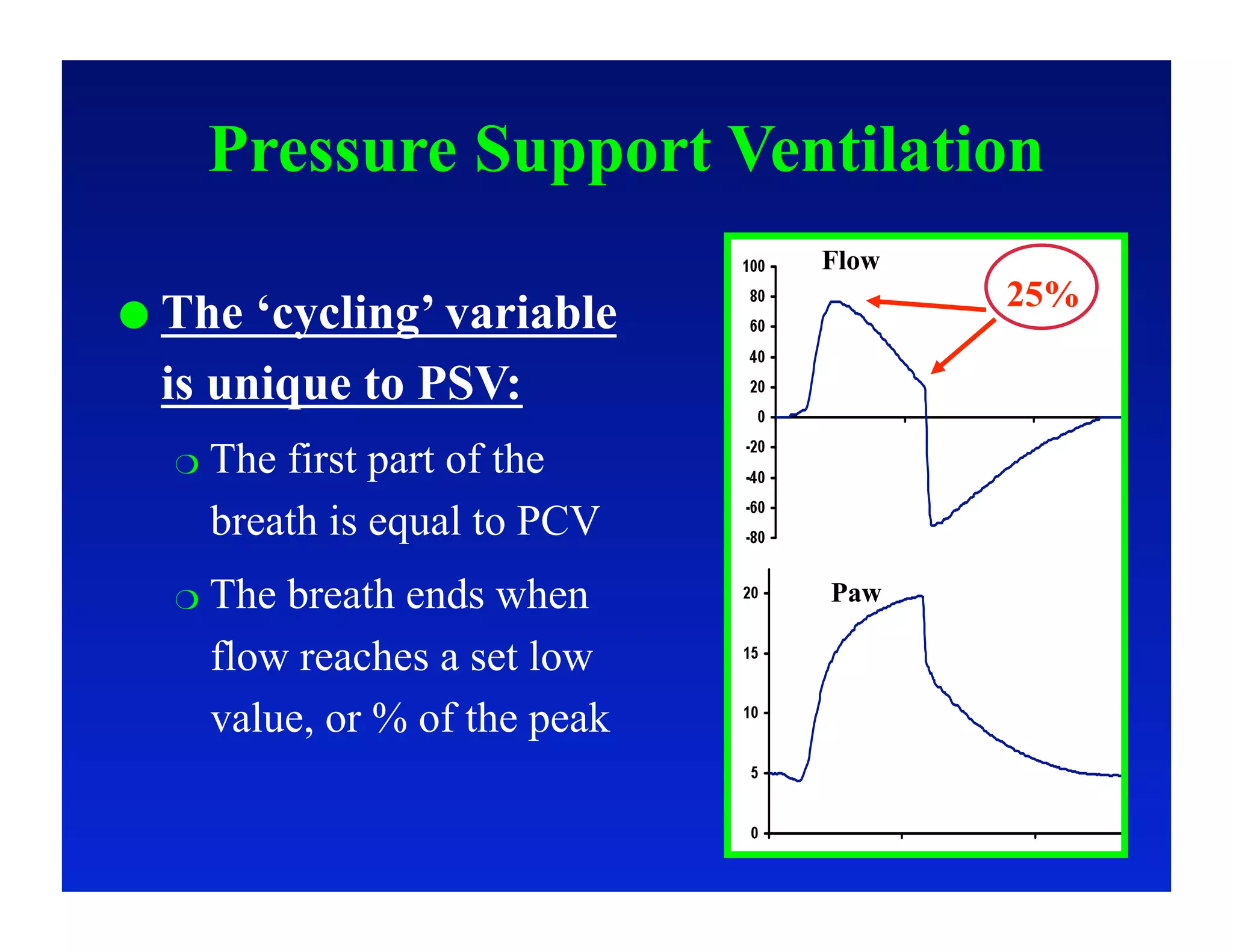
Pressure Support Ventilation
                              Flow
                                     25%
  The ‘cycling’ variable
  is unique to PSV:
    Thefirst part of the
    breath is equal to PCV
    Thebreath ends when      Paw

    flow reaches a set low
    value, or % of the peak
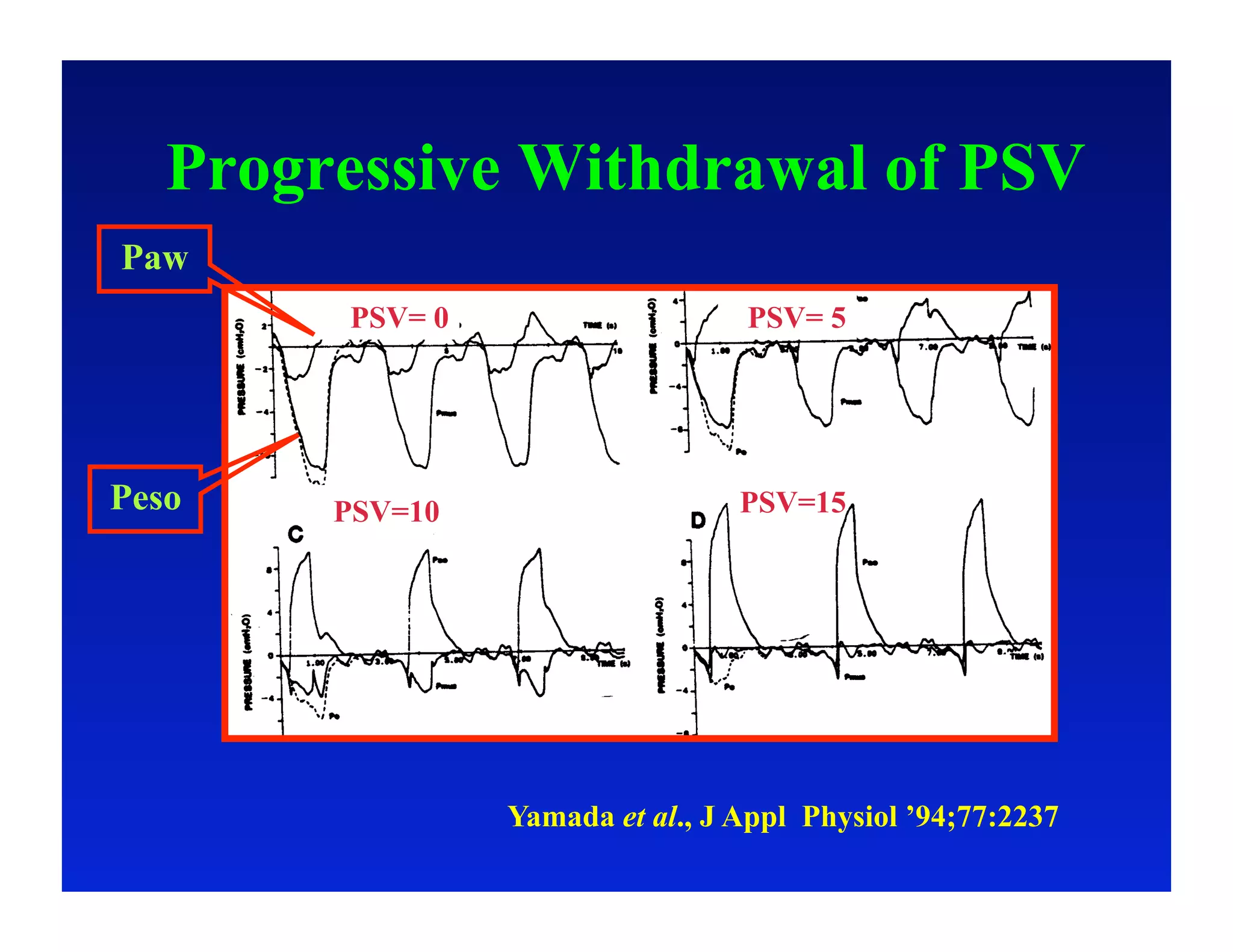
Progressive Withdrawal of PSV
Paw
        PSV= 0                    PSV= 5


Peso    PSV=10                    PSV=15


                 Yamada et al., J Appl Physiol ’94;77:2237
Pressure Support Ventilation
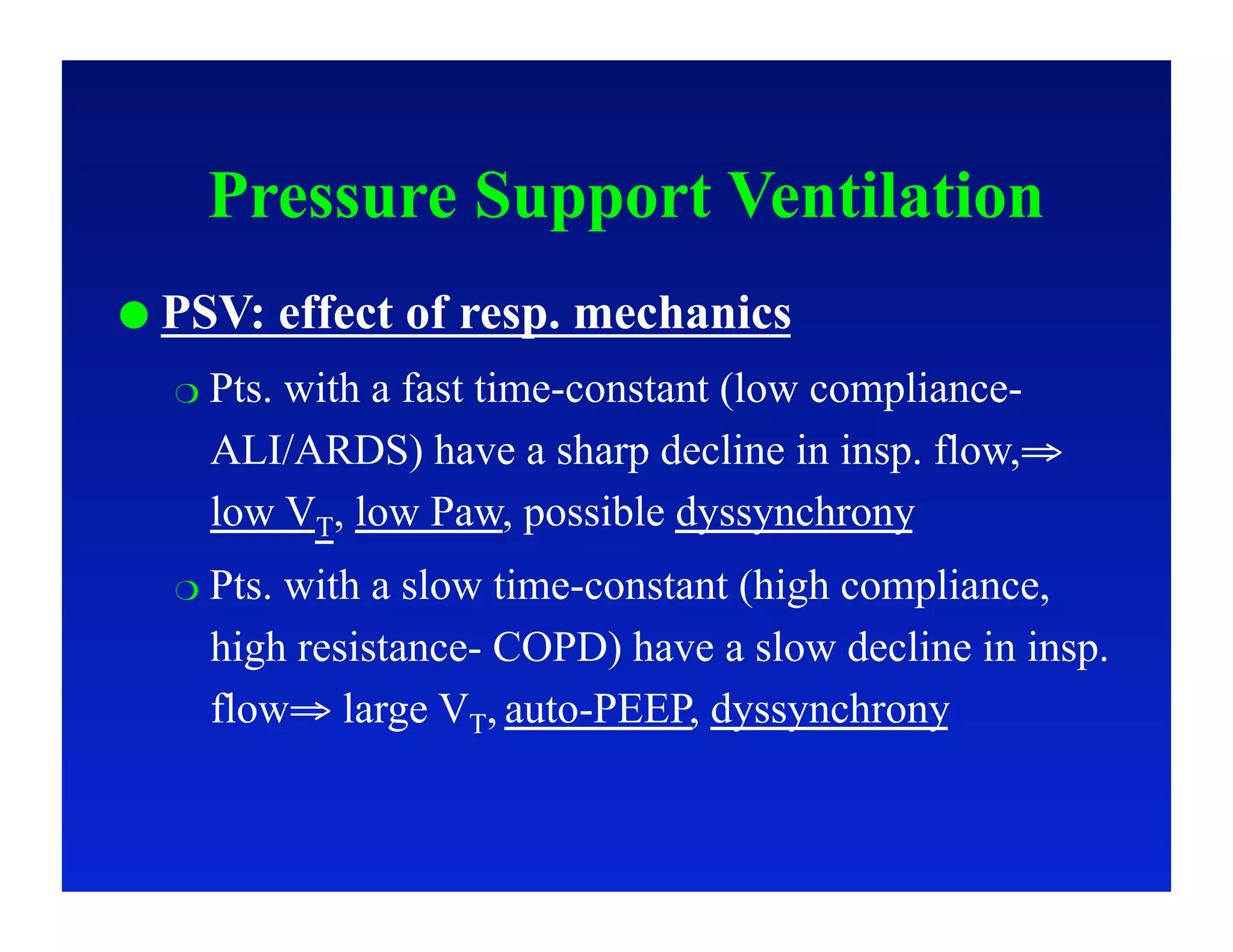
  PSV:     effect of resp. mechanics
    Pts.
        with a fast time-constant (low compliance-
    ALI/ARDS) have a sharp decline in insp. flow,⇒
    low VT, low Paw, possible dyssynchrony
    Pts.
        with a slow time-constant (high compliance,
    high resistance- COPD) have a slow decline in insp.
    flow⇒ large VT, auto-PEEP, dyssynchrony
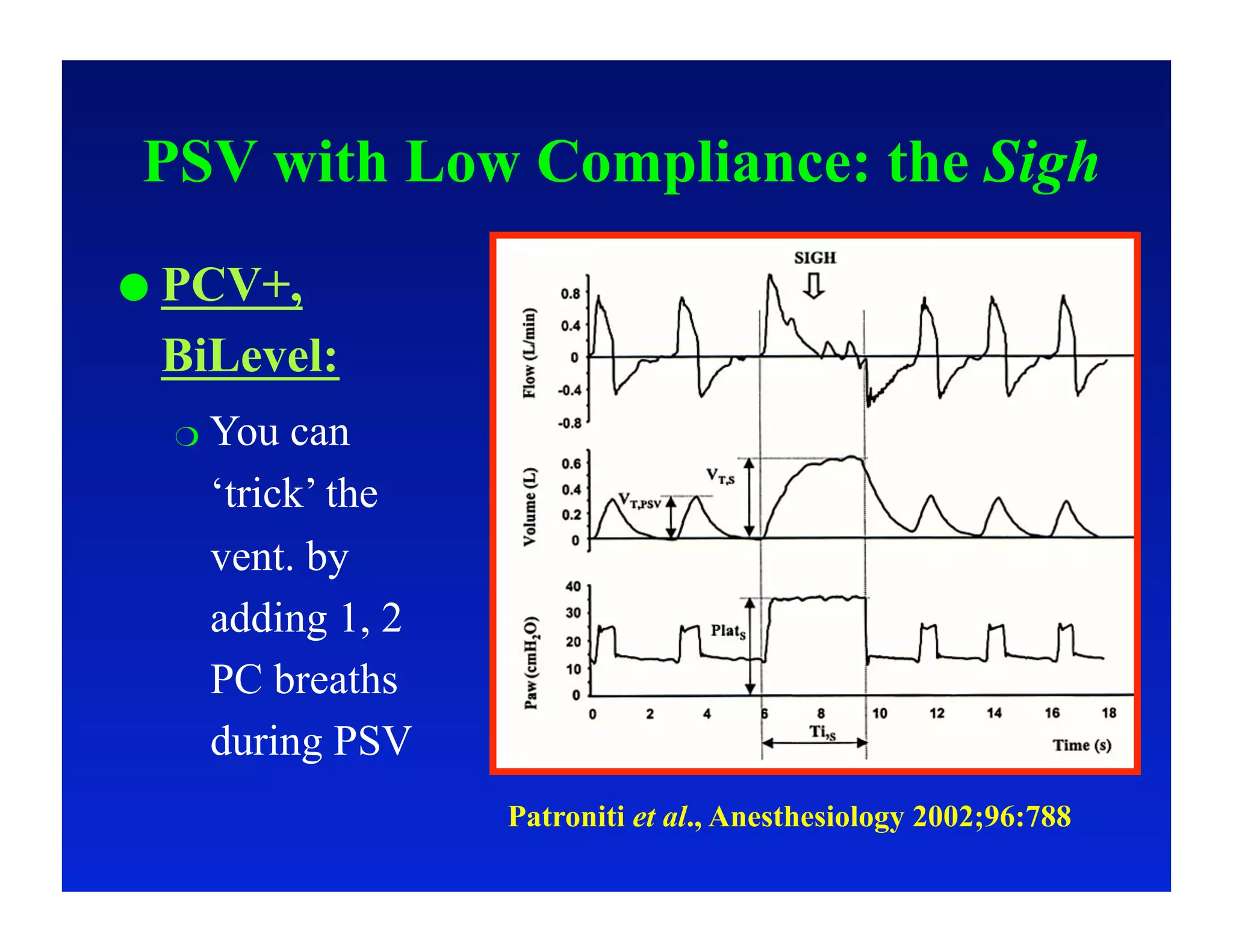
PSV with Low Compliance: the Sigh
  PCV+,
 BiLevel:
    You can
    ‘trick’ the
    vent. by
    adding 1, 2
    PC breaths
    during PSV
                  Patroniti et al., Anesthesiology 2002;96:788
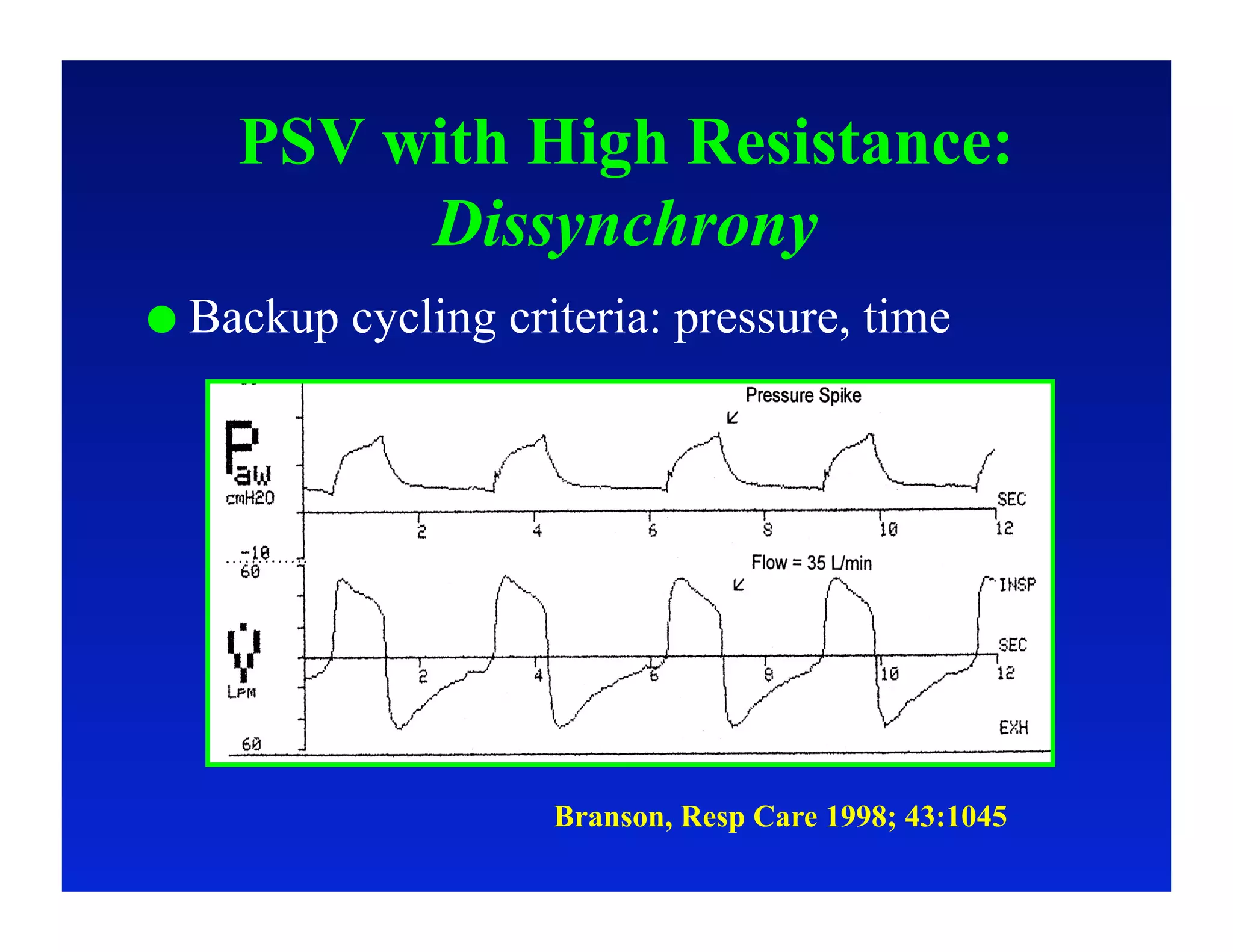
PSV with High Resistance:
         Dissynchrony
  Backup   cycling criteria: pressure, time


                      Branson, Resp Care 1998; 43:1045
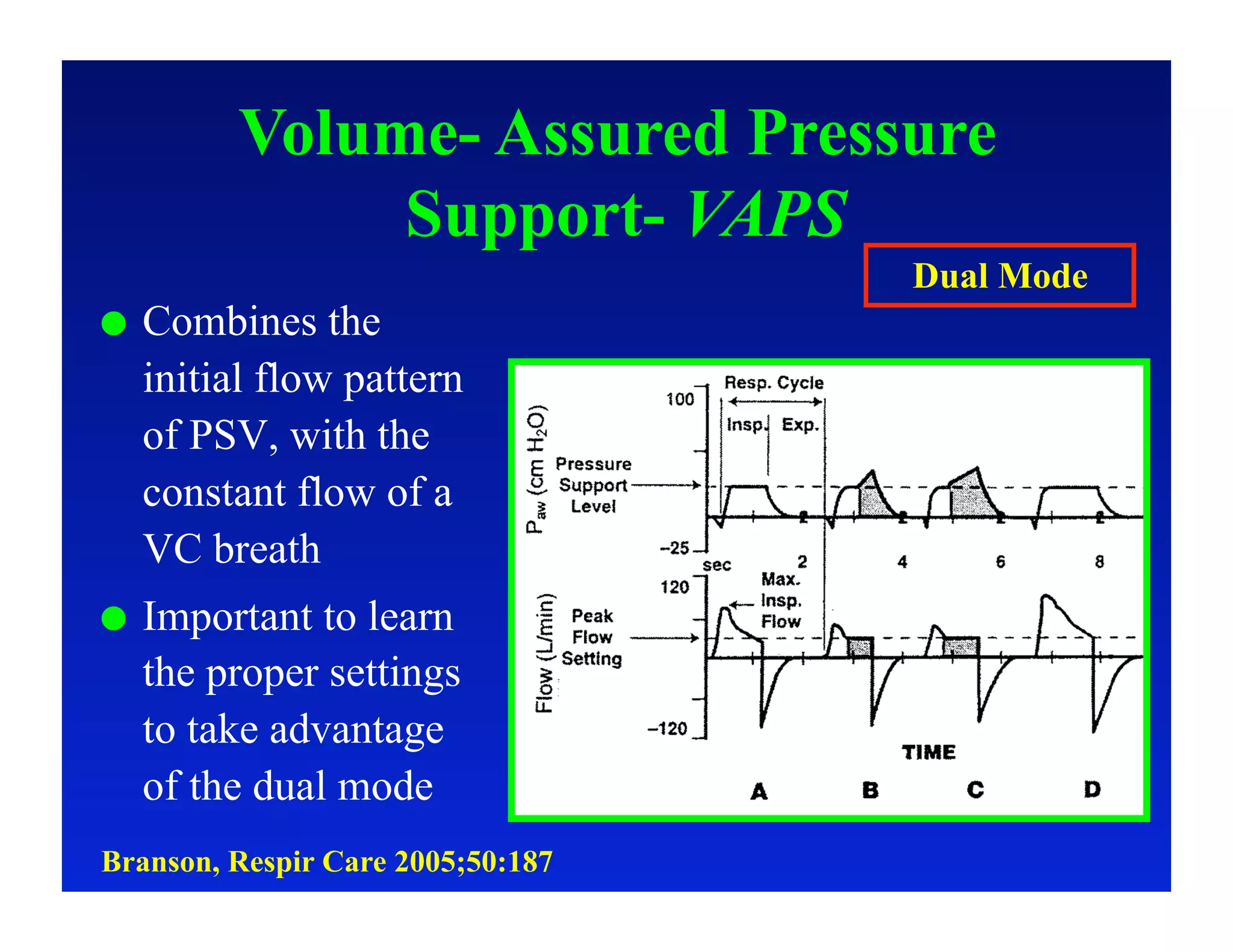
Volume- Assured Pressure
               Support- VAPS
                                   Dual Mode
    Combines the
     initial flow pattern
     of PSV, with the
     constant flow of a
     VC breath
    Important to learn
     the proper settings
     to take advantage
     of the dual mode
Branson, Respir Care 2005;50:187
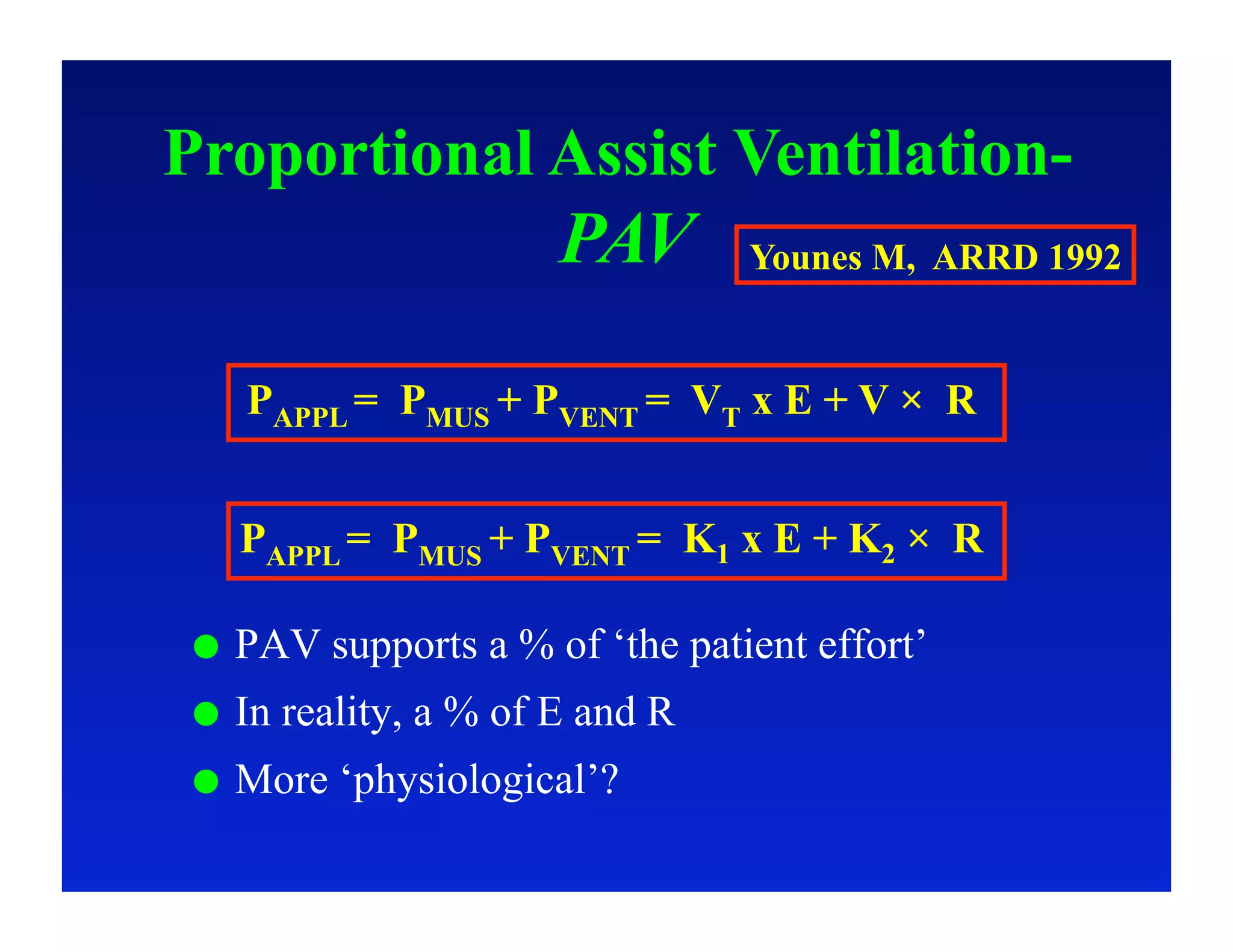
Proportional Assist Ventilation-
                         PAV       Younes M, ARRD 1992


      PAPPL = PMUS + PVENT = VT x E + V × R


      PAPPL = PMUS + PVENT = K1 x E + K2 × R

     PAV supports a % of ‘the patient effort’
     In reality, a % of E and R
     More ‘physiological’?
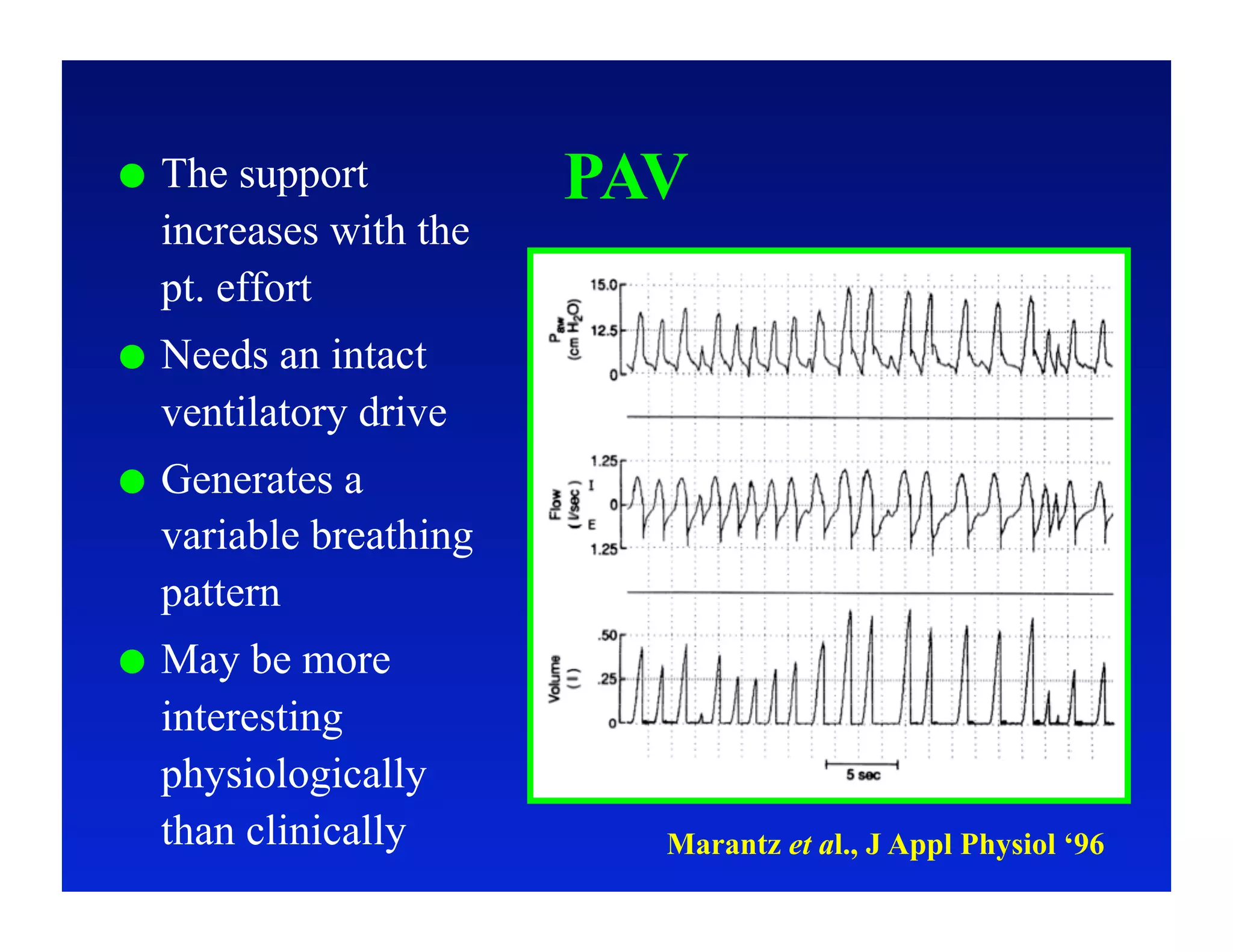
    The support          PAV
     increases with the
     pt. effort
    Needs an intact
     ventilatory drive
    Generates a
     variable breathing
     pattern
    May be more
     interesting
     physiologically
     than clinically        Marantz et al., J Appl Physiol ‘96
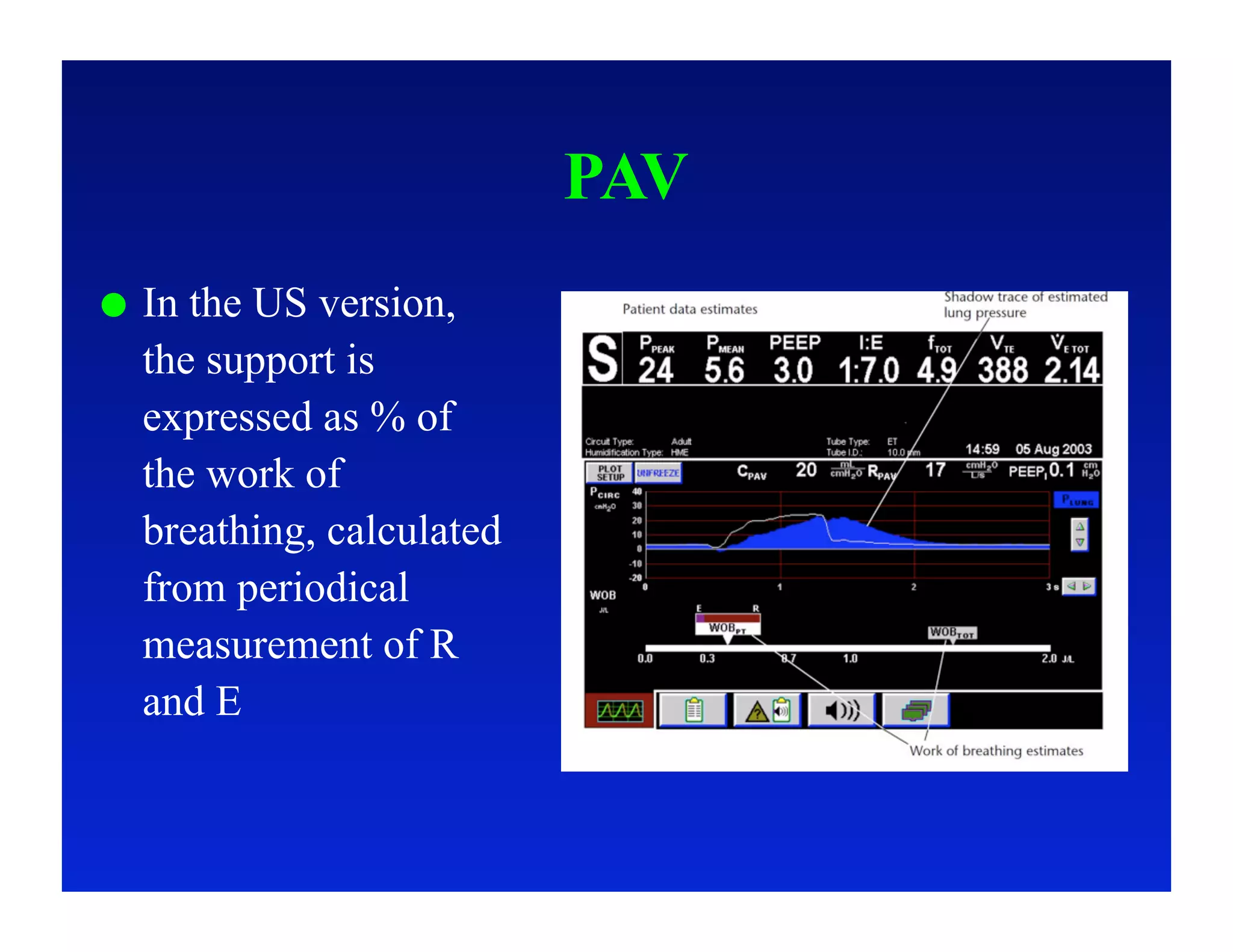
PAV
    In the US version,
     the support is
     expressed as % of
     the work of
     breathing, calculated
     from periodical
     measurement of R
     and E
What We Have NOT Discussed
  Bedside
         measurement of respiratory
  mechanics
  Loops
  Triggering
  Missed   triggering
  Tube
  compensation
  NAVA
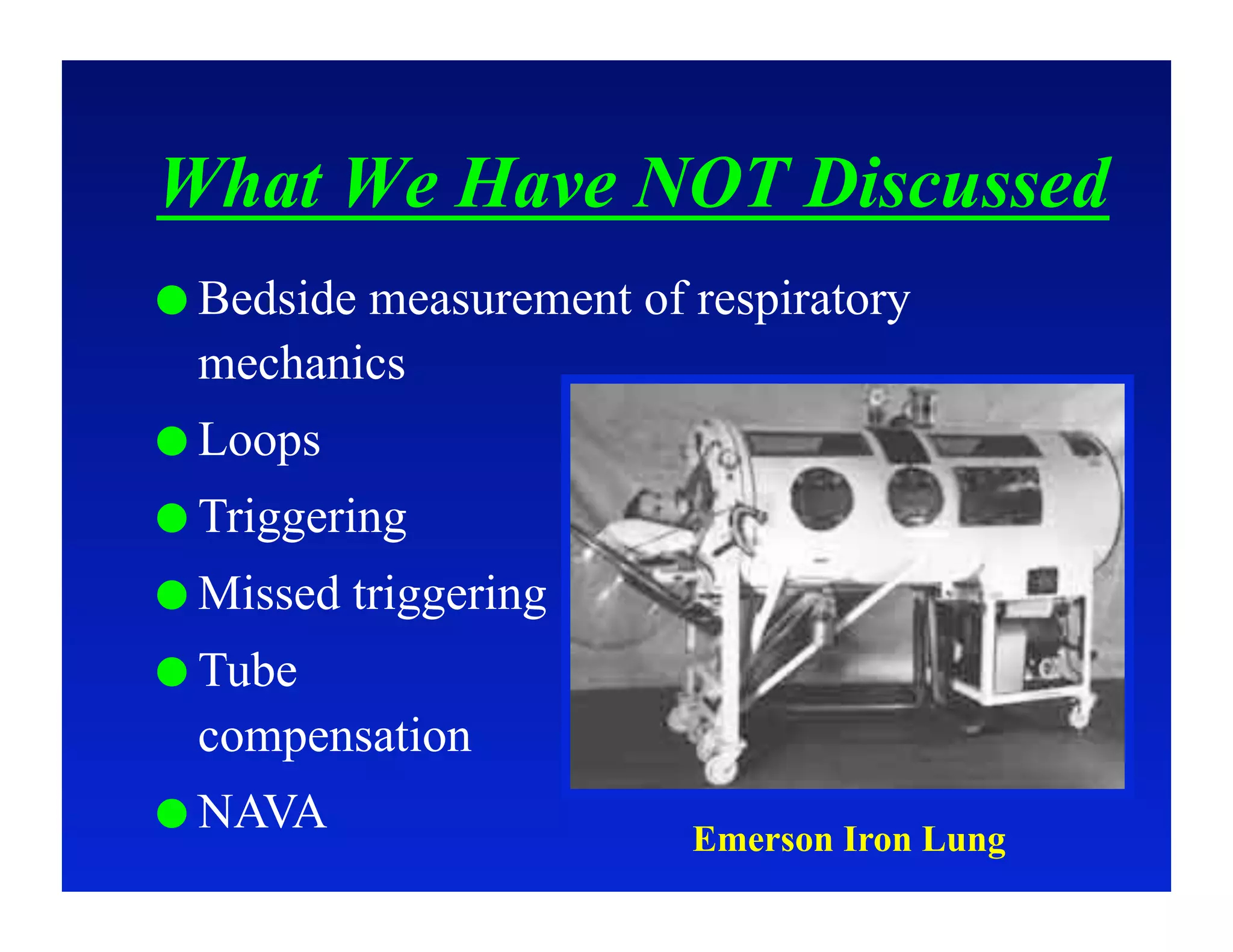
                         Emerson Iron Lung
Conclusions
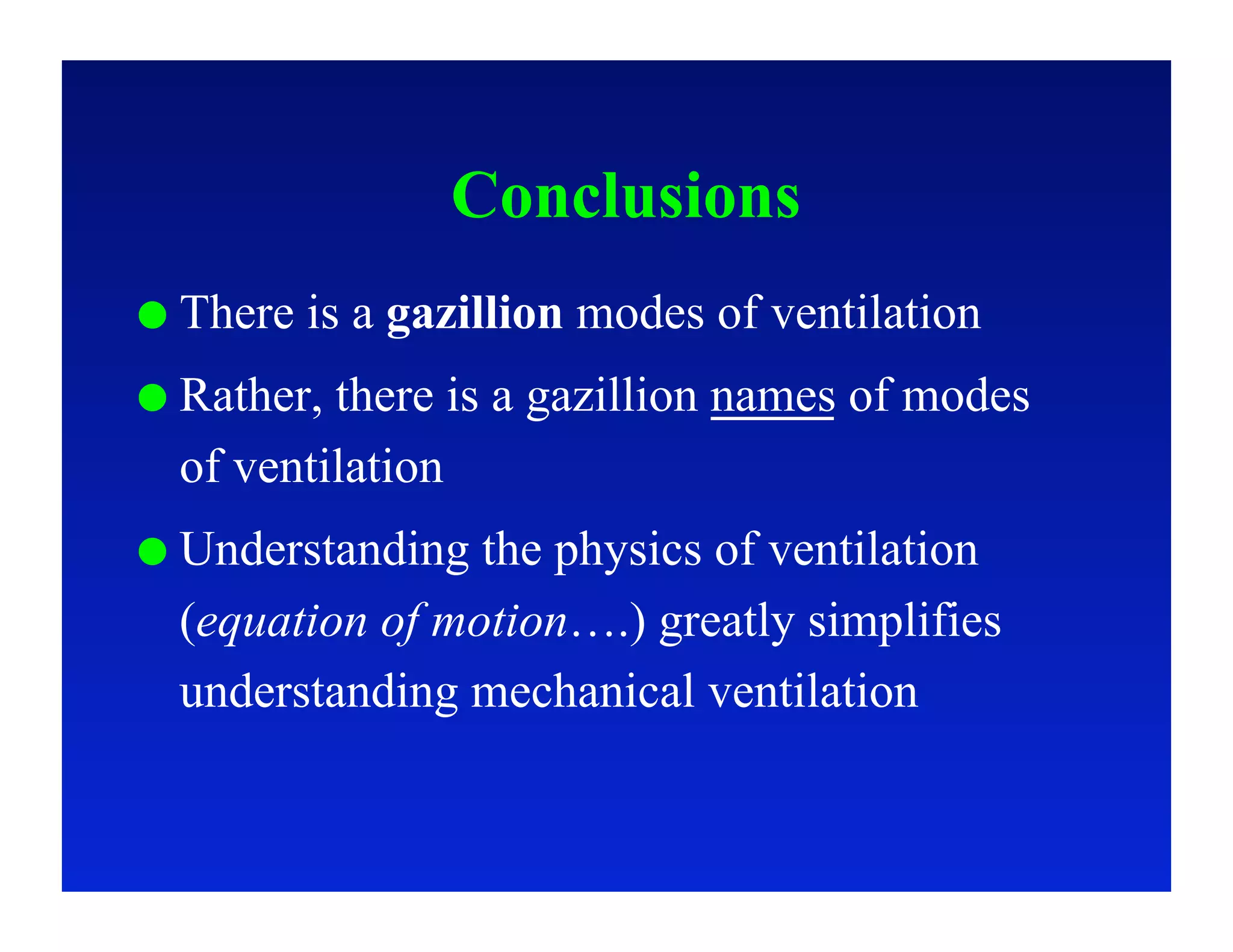
  There   is a gazillion modes of ventilation
  Rather,there is a gazillion names of modes
  of ventilation
  Understanding the physics of ventilation
  (equation of motion….) greatly simplifies
  understanding mechanical ventilation
Conclusions
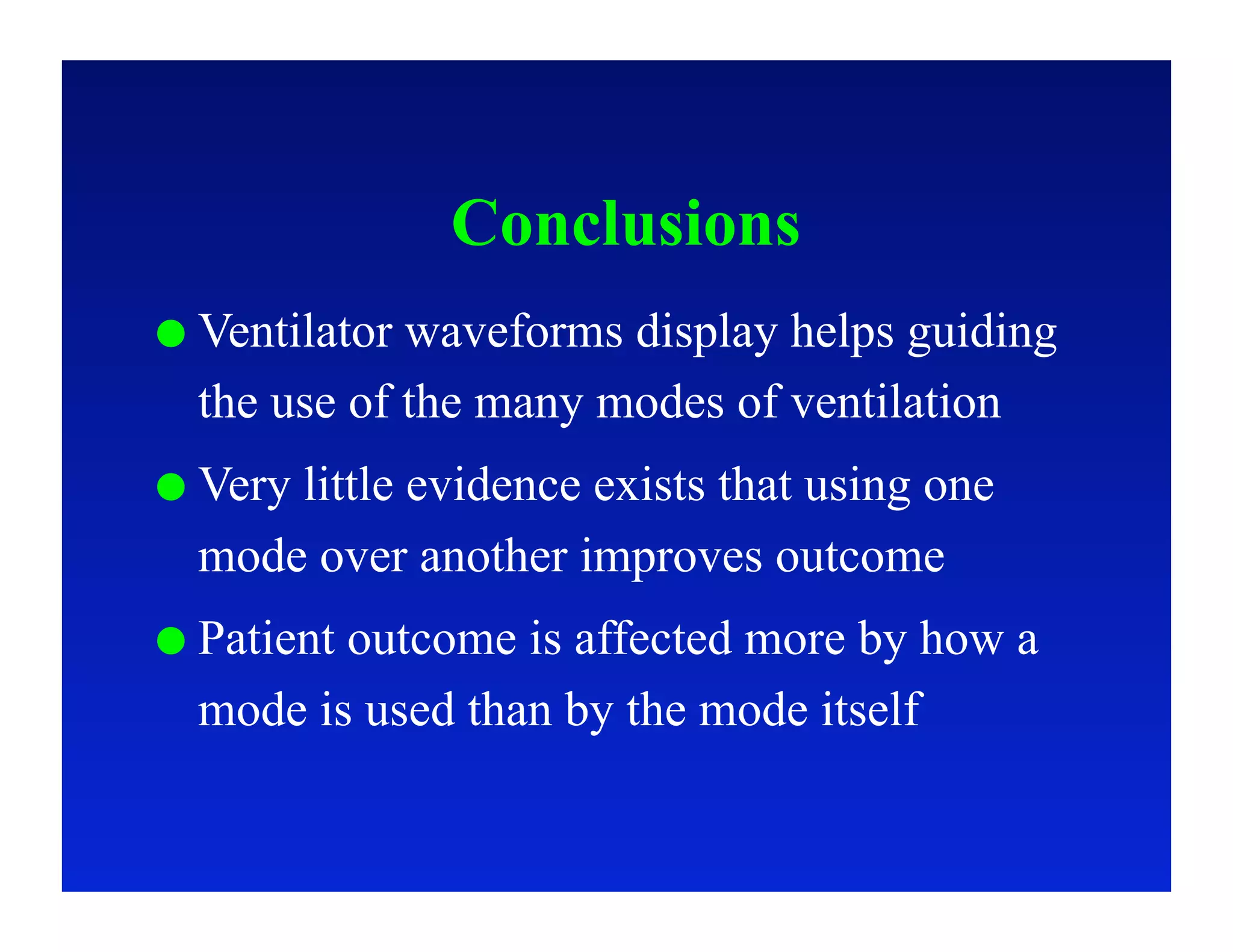
  Ventilatorwaveforms display helps guiding
  the use of the many modes of ventilation
  Very
      little evidence exists that using one
  mode over another improves outcome
  Patient
         outcome is affected more by how a
  mode is used than by the mode itself
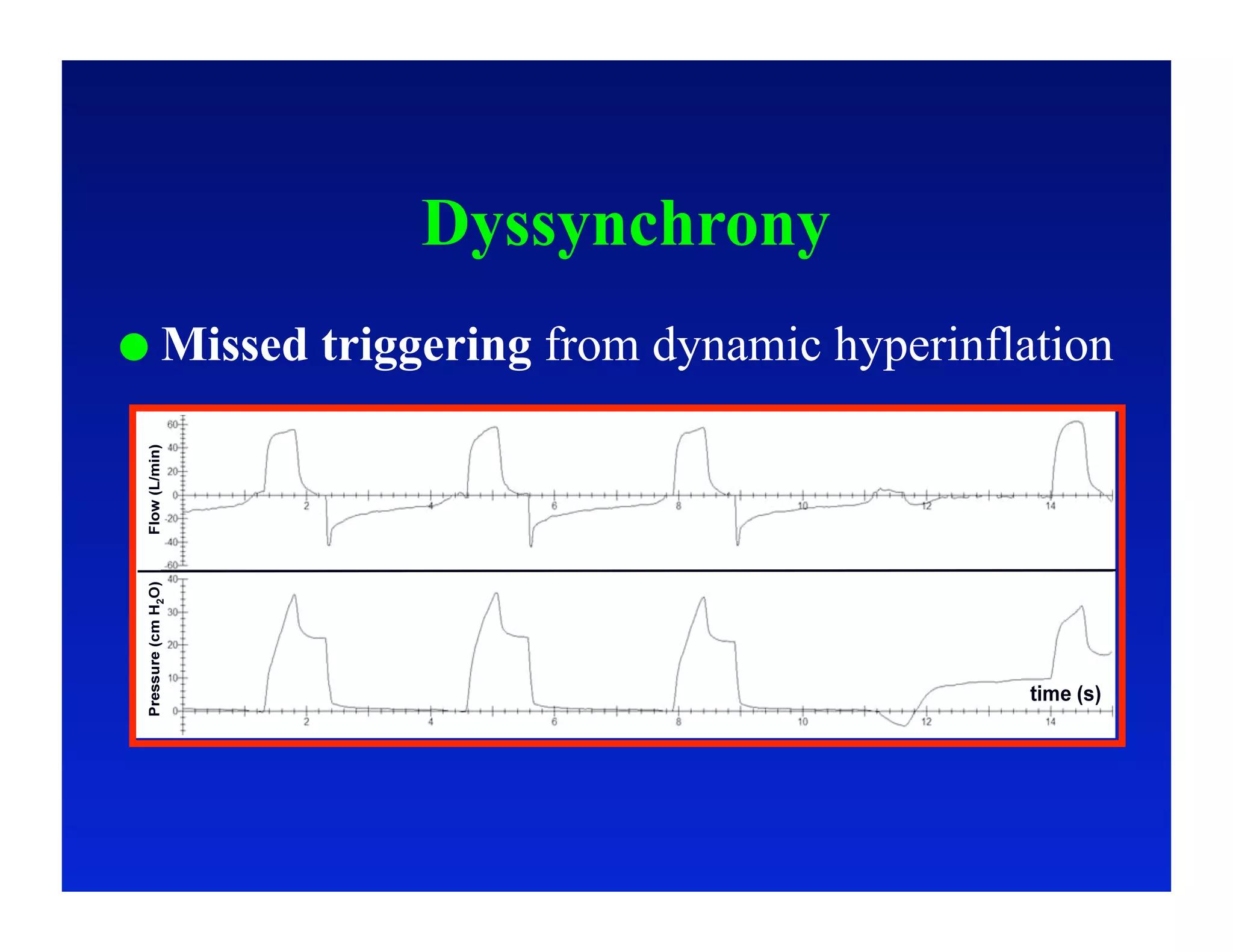
Dyssynchrony
  Missed   triggering from dynamic hyperinflation
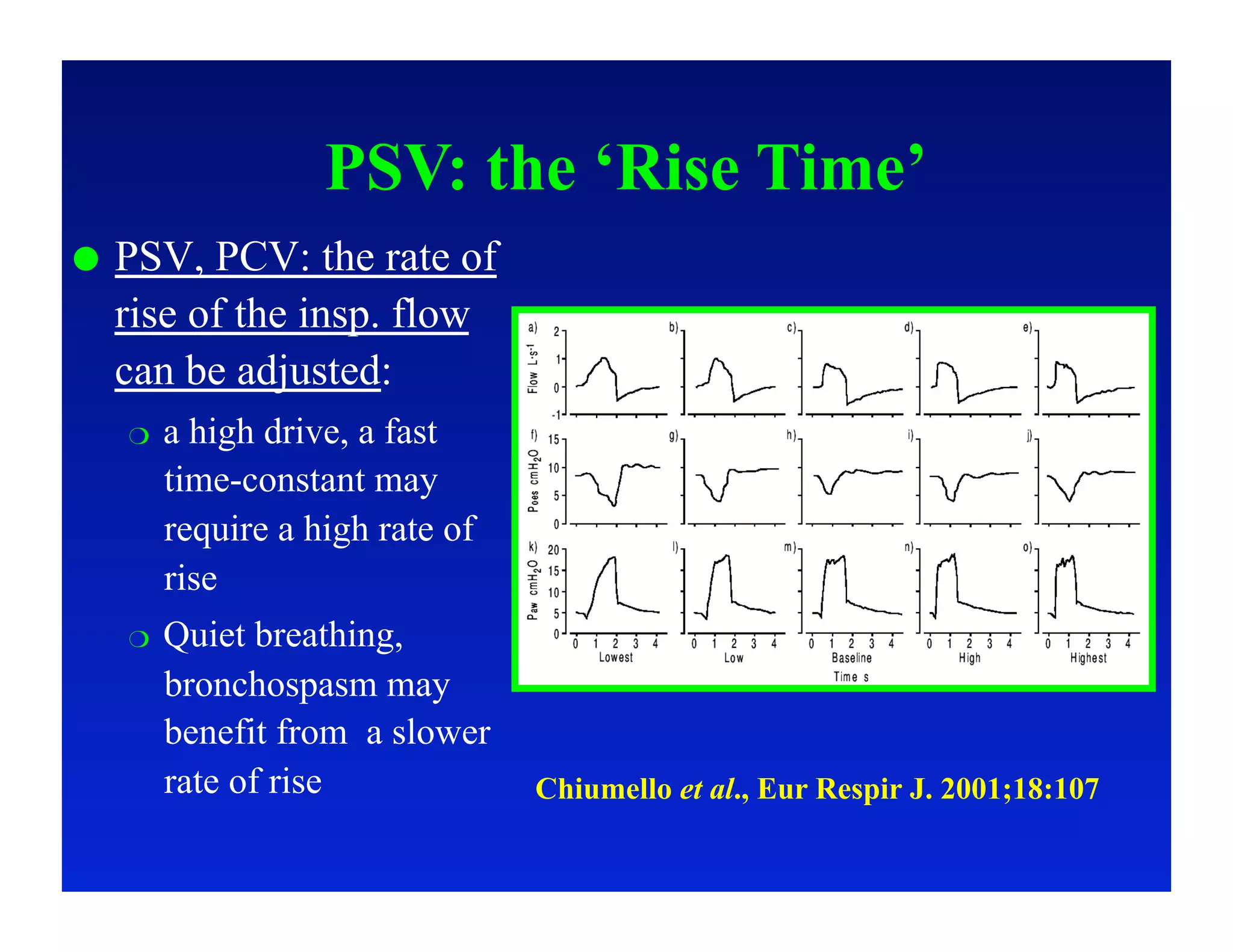
PSV: the ‘Rise Time’
    PSV, PCV: the rate of
     rise of the insp. flow
     can be adjusted:
         a high drive, a fast
          time-constant may
          require a high rate of
          rise
         Quiet breathing,
          bronchospasm may
          benefit from a slower
          rate of rise             Chiumello et al., Eur Respir J. 2001;18:107
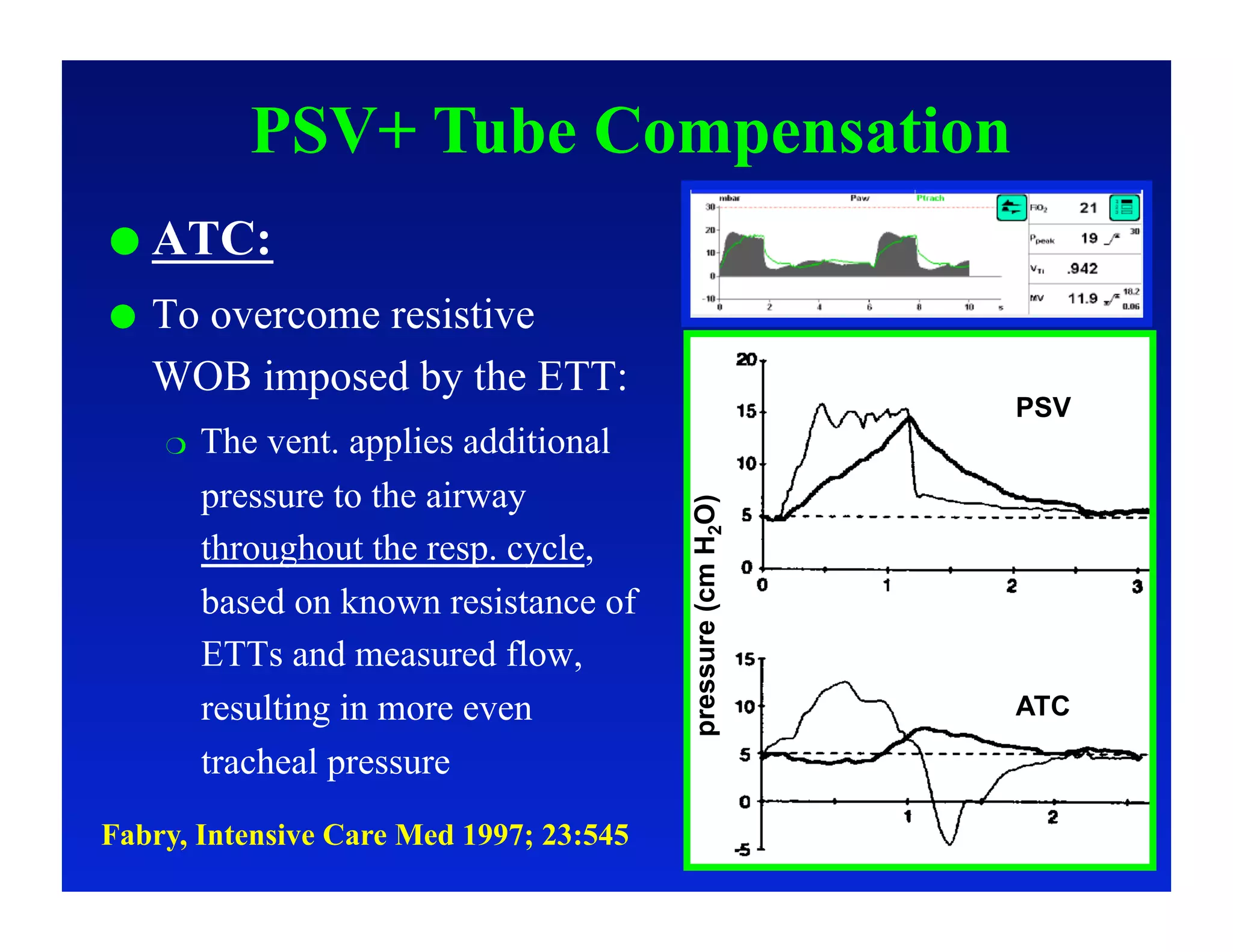
PSV+ Tube Compensation
  ATC:
    To overcome resistive
     WOB imposed by the ETT:
                                                             PSV
         The vent. applies additional
          pressure to the airway


                                         pressure (cm H2O)
          throughout the resp. cycle,
          based on known resistance of
          ETTs and measured flow,
          resulting in more even                             ATC

          tracheal pressure
Fabry, Intensive Care Med 1997; 23:545
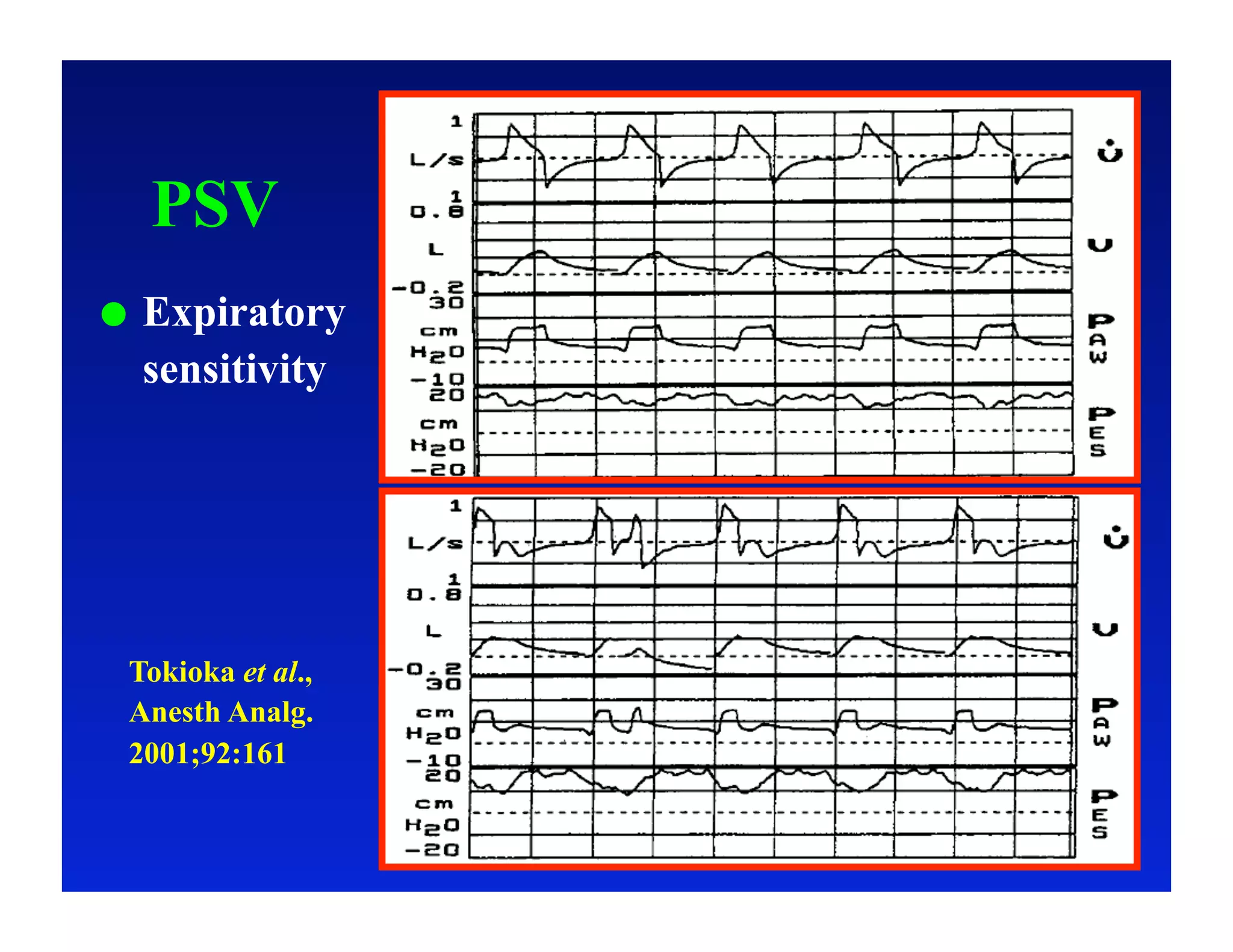
PSV
    Expiratory
     sensitivity


 Tokioka et al.,
 Anesth Analg.
 2001;92:161

Optimizing Critical Care Ventilation: What can we learn from Ventilator Waveforms?

  • 1.
    Optimizing Critical Care Ventilation- What Can We Learn from Ventilator Waveforms Luca Bigatello, MD Department of Anesthesia and Critical Care, Massachusetts General Hospital Associate Professor of Anesthesia, Harvard Medical School
  • 2.
    Outline   Understanding the basic physiology of ventilation   Breath delivery:   Basic choices   Effects of patient’s changes   Effects of ventilator changes   Specific situations:   ALI / ARDS   Weaning
  • 3.
    The Equation ofMotion of the Respiratory System PAPPL = V × R + VT × E PAPPL = V × R + VT / C PAPPL = PMUS + PVENT = V × R + VT / C
  • 4.
    From the Equationof Motion PAPPL = PMUS + PVENT = VT / C + V × R 1.  The basic mechanics of ventilation do not differ during spontaneous and mechanical breathing 2.  The results of mechanical ventilation depend not only on what we set on the vent., but also on the patient’s physiology- mechanics and effort
  • 5.
    From the Equationof Motion PAPPL = PMUS + PVENT = VT / C + V × R 3.  For any independent variable set on the vent. (‘control’, e.g., PVENT), for any mechanics (C, R) and effort (PMUS), there is only one possible value of the dependent variable (VT ) 4.  If we know two ventilating variables, we can calculate the patient’s physiologic variable: C = VT / Paw
  • 6.
    Breath Delivery: the simple view (the pt. is not breathing…)   Volume- controlled   Pressure- controlled The Emerson Critical Care Ventilator
  • 7.
    Volume- Controlled Ventilation  Constant flow   Set: VT, flow   Airway pressure (Paw) will increases with:   VT, flow, ⇓’d C, ⇑’d R Paw   Will also decrease with:   ⇑’d pt. effort Volume Courtesy of Claudia Crimi, MD
  • 8.
    V- CV Flow 30 l/min, VT 0.5 l   The effect of changing flow settings Flow 60 l/min, VT 0.5 l Courtesy of Dean Hess, RRT, PhD
  • 9.
    V- CV Flow 60 l/min, VT 0.5 l   Theeffect of changes in respiratory mechanics Decreased compliance
  • 10.
    Volume- Controlled Ventilation Paw   The effect of patient Flow effort   Insufficient flow   Vigorous insp. effort
  • 11.
    Volume- Controlled Ventilation  Descending Ramp   Peak flow is reached early, then decreases linearly   Set pressure is reached earlier, is lower, and ≈ plateau   For the same set flow, the insp. time has to be longer⇒   better PaO2 (may be)   auto-PEEP
  • 12.
    Volume- Controlled Ventilation   Descending ramp: the effect of time
  • 13.
    Pressure- Controlled Ventilation  Set: insp. pressure, time   Flowis variable, and VT will change with:   patient’s mechanics: C, R   patient’s effort   capability of the vent.
  • 14.
    Pressure- Controlled Ventilation   Changing ventilator settings: the effect of time Lucangelo et al., Respir Care 2005;50:55
  • 15.
    P- CV Slow time-   Changes of resp. mechanics constant Increasing airways resistance Decreasing lung compliance Fast time- constant time
  • 16.
    P- C, InverseRatio Ventilation Chan et al., Chest 1992;102:1556 Mercat et al. AJRCCM 1997;155:1637   Higher mean Paw⇒ better lung recruitment for the same plateau pressure   Higher mean Paw⇒ hemodynamic compromise, auto- PEEP, increased need for sedation
  • 17.
    V- CV vs.P- CV   VCV   PCV   It assures the delivery   It assures a limit to of a desired minute insp. pressure (neonates, B-PF, etc.) ventilation ⇒ PaCO2   It allows further   It limits the size of the adjustment of breath VT (e.g., ARDS-Net) delivery (‘rise time’)   It’s simple   It may favor pt.-vent.   It allows bedside synchrony measurement of resp.   It may cause mechanics hypoventilation
  • 18.
    Bedside Measurement of Respiratory Mechanics pressure PIP resistance Pplat compliance PEEP time
  • 19.
    Bi-Level, Bi-PAP… (includes inverse-ratio,APRV)   Two different levels of pressure (high & low) are applied at a certain rate, and spontaneous breathing is allowed at both levels   In the absence of spont. breaths, this is P-CV!   The spont. breaths may be assisted by pressure support, generally only at the low level
  • 20.
  • 21.
    P- C, AirwayPressure Release Ventilation- APRV High Pressure Low Pressure time High pressure time Low pressure time
  • 22.
    APRV Putensen et al.,AJCCM 1999;159:1241 APRV Habashi, Crit Care Med 2005;33:S228   Without spont. breathing, ⇒ PCIRV   Enhanced lung recruitment at lower pressures, by allowing spont. breathing CPAP   Comfortable?   Important: think trans- pulmonary pressure!
  • 23.
    Pressure- Regulated, Volume Control- PRVC (Auto-Flow, VC+) Dual Mode   PCV + a guaranteed VT Effect of decreased compliance   In each breath, the insp. pressure is regulated ⇑ or ⇓, to target a set VT   To maintain a set VT (VCV) while meeting pt. demand (PCV) Branson, Respir Care 2005;50:187
  • 24.
    Breath Delivery: When the Patient Breathes   Assist- control   SIMV   Pressure support   CPAP
  • 25.
      SIMV   SIMV+ Pressure Support
  • 26.
  • 27.
    What’s Happened toIMV ?   The principle of IMV- ventilator and patient can share the work in a fair proportion, does not pan out   Physiologically, it is a difficult principle to accept
  • 28.
    Continuous Positive Airway Pressure- CPAP   Set: a pressure at the airway, throughout the resp. cycle- how???   The source provides a flow higher than the Paw patient’s own:   continuous high flow with a valveless system   just enough flow to match the pt.’s with a ventilator
  • 29.
    CPAP- Uses   To recruit the lung:   obesity, OSA, postop. atelectasis   To increase intrathoracic pressure:   pulmonary edema   To offset auto-PEEP:   asthma/COPD   Zero CPAP for SBTs Antonelli et al., CCM 2002;30:602
  • 30.
    Pressure Support Ventilation   Set: insp. pressure   VT, time change with:   patient’s effort   patient’s rate   pt.’s mechanics: C, R   Important: the effect of pt. effort on the trans- pulmonary pressure!!
  • 31.
    Pressure Support Ventilation Flow 25%   The ‘cycling’ variable is unique to PSV:   Thefirst part of the breath is equal to PCV   Thebreath ends when Paw flow reaches a set low value, or % of the peak
  • 32.
    Progressive Withdrawal ofPSV Paw PSV= 0 PSV= 5 Peso PSV=10 PSV=15 Yamada et al., J Appl Physiol ’94;77:2237
  • 33.
    Pressure Support Ventilation  PSV: effect of resp. mechanics   Pts. with a fast time-constant (low compliance- ALI/ARDS) have a sharp decline in insp. flow,⇒ low VT, low Paw, possible dyssynchrony   Pts. with a slow time-constant (high compliance, high resistance- COPD) have a slow decline in insp. flow⇒ large VT, auto-PEEP, dyssynchrony
  • 34.
    PSV with LowCompliance: the Sigh   PCV+, BiLevel:   You can ‘trick’ the vent. by adding 1, 2 PC breaths during PSV Patroniti et al., Anesthesiology 2002;96:788
  • 35.
    PSV with HighResistance: Dissynchrony   Backup cycling criteria: pressure, time Branson, Resp Care 1998; 43:1045
  • 36.
    Volume- Assured Pressure Support- VAPS Dual Mode   Combines the initial flow pattern of PSV, with the constant flow of a VC breath   Important to learn the proper settings to take advantage of the dual mode Branson, Respir Care 2005;50:187
  • 37.
    Proportional Assist Ventilation- PAV Younes M, ARRD 1992 PAPPL = PMUS + PVENT = VT x E + V × R PAPPL = PMUS + PVENT = K1 x E + K2 × R   PAV supports a % of ‘the patient effort’   In reality, a % of E and R   More ‘physiological’?
  • 38.
      The support PAV increases with the pt. effort   Needs an intact ventilatory drive   Generates a variable breathing pattern   May be more interesting physiologically than clinically Marantz et al., J Appl Physiol ‘96
  • 39.
    PAV   In the US version, the support is expressed as % of the work of breathing, calculated from periodical measurement of R and E
  • 40.
    What We HaveNOT Discussed   Bedside measurement of respiratory mechanics   Loops   Triggering   Missed triggering   Tube compensation   NAVA Emerson Iron Lung
  • 41.
    Conclusions   There is a gazillion modes of ventilation   Rather,there is a gazillion names of modes of ventilation   Understanding the physics of ventilation (equation of motion….) greatly simplifies understanding mechanical ventilation
  • 42.
    Conclusions   Ventilatorwaveforms displayhelps guiding the use of the many modes of ventilation   Very little evidence exists that using one mode over another improves outcome   Patient outcome is affected more by how a mode is used than by the mode itself
  • 44.
    Dyssynchrony   Missed triggering from dynamic hyperinflation
  • 46.
    PSV: the ‘RiseTime’   PSV, PCV: the rate of rise of the insp. flow can be adjusted:   a high drive, a fast time-constant may require a high rate of rise   Quiet breathing, bronchospasm may benefit from a slower rate of rise Chiumello et al., Eur Respir J. 2001;18:107
  • 47.
    PSV+ Tube Compensation  ATC:   To overcome resistive WOB imposed by the ETT: PSV   The vent. applies additional pressure to the airway pressure (cm H2O) throughout the resp. cycle, based on known resistance of ETTs and measured flow, resulting in more even ATC tracheal pressure Fabry, Intensive Care Med 1997; 23:545
  • 48.
    PSV   Expiratory sensitivity Tokioka et al., Anesth Analg. 2001;92:161