Recruitment maneuvers in
ARDS
Berlin definition
• ARDS is defined as a syndrome characterized by
(1) onset within 1 week of a known clinical insult,
(2) bilateral radiographic opacities not fully explained by pleural effusions,
atelectasis, or nodules,
(3) respiratory failure not fully explained by cardiac failure or fluid overload,
(4) poor systemic oxygenation with a PaO2/FIO2 ≤300 and a PEEP or CPAP
≥5 cm H2O
• PaO2/FIO2 ≤300, but >200, are referred to as having mild ARDS, Moderate
ARDS is defined as PaO2/FIO2 ≤200, but >100, and severe ARDS is defined
as PaO2/FIO2 ≤100
Introduction
• To maintain oxygenation, FRC, and respiratory system elastance is the
application of recruitment maneuvers (RMs), which have become a
component of lung-protective ventilation strategies
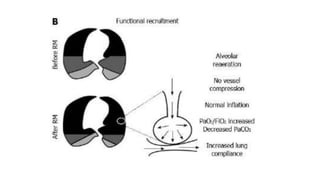
• Recruitment is the dynamic process of opening previously collapsed lung
units by increasing transpulmonary pressure
• These maneuvers expected to improve oxygenation, lung compliance,
facilitate alveolar fluid clearance and outcome
• Lung units can be kept open by airway pressures that are lower than those
required to open them, leading to the concept of recruitment using
periodic higher pressure maneuvers with application of PEEP to maintain
alveolar patency
• In a normal homeostatic condition: Sigh reflex maintains lung
compliance and decreases atelectasis.
• Alveolar recruitment maneuver is the intervention of intentional
transient application of high transpulmonary pressure to achieve
reopening of nonaerated collapsed peripheral airways and alveoli
• Mortality benefits are controversial.
• ART trial(alveolar recruitment for ARDS) shown these maneuvers are
harmful and lead to increase mortality
• Atelectasis results from increased interstitial pressure and weight of
the lung
• It can be enhanced by patient related factors obesity,
↑intraabdominal pressure, high levels of inspired oxygen in unstable
alveoli, patient disconnection from the ventilator, tracheal suctioning
• Lung in ARDS can be reaerated by increasing transpulmonary pressure
• Lung recruitability has been found to be quite low, averaging 9% of
total lung mass, between 5 and 45 cm of H2O
• Recruiting the lung is a ventilatory strategy that can decrease VILI:
– Increase in the aerated lung mass, which contributes to minimize the
lung heterogeneity and to increase the size of lung
– Prevention of repeated opening and closure of the terminal
respiratory units
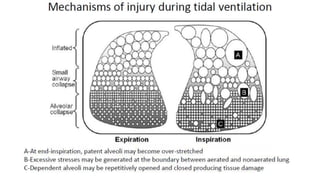
• Lung pathology in ARDS is not uniform. CT chest of these patients in supine
position shows three different lung areas with variable involvement.
• The most dorsal dependent area shows significant collapse due to
interstitial and alveolar edema. this aggravates lung injury during
mechanical ventilation by decreasing the size of the lung available for
ventilation and gas exchange.
• The most ventral region is the normal open lung which gets overinflated
causing volutrauma and barotrauma.
• The area at the interface between the normal open lung and the atelecatic
lung is partially collapsed and is subjected to shear stress by cyclical tidal
recruitment and derecruitment
Lung-Protective Mechanical Ventilation
• The goals of lung-protective ventilation are to avoid injury due to
overexpansion of alveoli during inspiration (“volu-trauma”) and injury
due to repetitive opening and closing of alveoli during inspiration and
expiration (“atelecta-trauma”)
• The injury can be prevented by application of sufficient PEEP
mechanical ventilation using limited tidal volumes should be less
injurious to the lungs of patients with ARDS and should result in
better outcomes
Recruitment Manoeuvres
1. Sigh
2. Sustained inflation
3. Extended sigh
4. Prone ventilation
Sigh Recruitment Manoeuvres
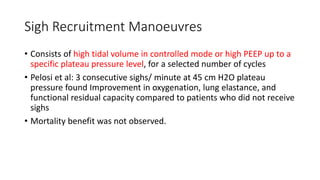
• Consists of high tidal volume in controlled mode or high PEEP up to a
specific plateau pressure level, for a selected number of cycles
• Pelosi et al: 3 consecutive sighs/ minute at 45 cm H2O plateau
pressure found Improvement in oxygenation, lung elastance, and
functional residual capacity compared to patients who did not receive
sighs
• Mortality benefit was not observed.
Sustained inflation Recruitment Manoeuvres
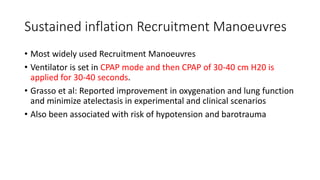
• Most widely used Recruitment Manoeuvres
• Ventilator is set in CPAP mode and then CPAP of 30-40 cm H20 is
applied for 30-40 seconds.
• Grasso et al: Reported improvement in oxygenation and lung function
and minimize atelectasis in experimental and clinical scenarios
• Also been associated with risk of hypotension and barotrauma
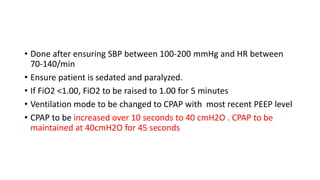
• Done after ensuring SBP between 100-200 mmHg and HR between
70-140/min
• Ensure patient is sedated and paralyzed.
• If FiO2 <1.00, FiO2 to be raised to 1.00 for 5 minutes
• Ventilation mode to be changed to CPAP with most recent PEEP level
• CPAP to be increased over 10 seconds to 40 cmH2O . CPAP to be
maintained at 40cmH2O for 45 seconds
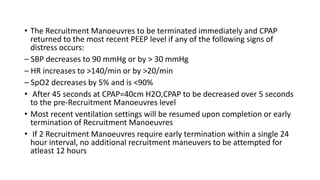
• The Recruitment Manoeuvres to be terminated immediately and CPAP
returned to the most recent PEEP level if any of the following signs of
distress occurs:
– SBP decreases to 90 mmHg or by > 30 mmHg
– HR increases to >140/min or by >20/min
– SpO2 decreases by 5% and is <90%
• After 45 seconds at CPAP=40cm H2O,CPAP to be decreased over 5 seconds
to the pre-Recruitment Manoeuvres level
• Most recent ventilation settings will be resumed upon completion or early
termination of Recruitment Manoeuvres
• If 2 Recruitment Manoeuvres require early termination within a single 24
hour interval, no additional recruitment maneuvers to be attempted for
atleast 12 hours
Stepwise Recruitment Manoeuvres
• Airway pressure and/or PFEP is increased for a specific time. this process
gradually increases transpulmonary pressure and time for recruitment.
1. Use stable Peak end inspiratory Pressure and incremental PEFP
2. Use a fixed driving pressure (like 15 cm) and a stepwise increase in PEFP
(25. 30. 35 cm H20) for 2minutes
3. Apply fixed tidal volume and stepwise increases in PEEP.
• Since stepwise RMs recruit lung units as effectively as sustained inflation
with a lower mean airway pressure, they may lead to less hemodynamic
compromise and hyperinflation
• In experimental endotoxin-induced mild ARDS, stepwise RM,
compared to sustained inflation, was associated with reduced type Ⅱ
epithelial cell damage and decreased expression of markers
associated with fibrosis and endothelial cell damage
Prone ventilation
• Prone positioning improves gas exchange via its effect on pleural
pressure and lung compression
• Increased functional residual capacity (FRC) has also been proposed,
but changes in FRC have not been a dominant finding in most studies
of prone ventilation
• In supine position, the dorsal pleural pressure is greater than ventral
pleural pressure
• So , the ventral trans pulmonary pressure exceeds the dorsal
transpulmonary pressure and greater expansion of the ventral alveoli
than the dorsal alveoli
• Exaggerated in supine patients with acute respiratory distress
syndrome (ARDS), probably because the difference between the
dorsal and ventral pleural pressures is increased by the excess lung
weight
• The result is a tendency towards overinflation of the ventral alveoli
and atelectasis of the dorsal alveoli
• Prone positioning reduces the difference between the dorsal and
ventral pleural pressures ,Making ventilation more homogeneous
• Leading to a decrease in alveolar over inflation and alveolar collapse.
• Minimize stress and strain on alveoli, limiting ventilator associated
lung injury from overdistention and cyclic atelectasis
Compression:
• In supine position: Heart compresses the medial posterior lung
parenchyma and the diaphragm compresses the posterior-caudal lung
parenchyma
• Compression by either the heart or the diaphragm may exaggerate
dependent lung collapse in the supine position, increasing hypoxemia and
ventilator-associated lung injury
• During prone ventilation, the heart becomes dependent, decreasing medial
posterior lung compression
• The diaphragm is displaced caudally (especially in non-obese patients and
when the abdomen is left unsupported), decreasing compression of the
posterior-caudal lung parenchyma Improve ventilation and oxygenation
• Cardiac output: Increase in lung recruitment and reduction in hypoxic
pulmonary vasoconstriction
• Increases in cardiac output by Increases in right ventricular preload,
and decreased right ventricular afterload
Predictor
• The best predictor of a sustained increase in PaO2 during prone
ventilation is 10 mmHg increase in PaO2 over the first 30 minutes of
prone ventilation predicted a sustained increase in PaO2 over the
next two hours
• Patients whose PaO2 did not increase during the first 30 minutes of
prone ventilation showed no subsequent improvement in their
oxygenation
• Patients with diffuse pulmonary edema and dependent alveolar
collapse appear more likely to improve their PaO2 during prone
ventilation than patients with predominantly anterior abnormalities,
marked consolidation, and/or fibrosis
• Extrapulmonary cause for their ARDS seem more likely to increase
their PaO2 during prone ventilation than patients with a pulmonary
cause
• Patients with elevated intraabdominal pressure appear more likely to
increase their PaO2 during prone ventilation than patients with
normal intraabdominal pressure
• Patients whose chest wall compliance decreases when moving from
the supine to the prone position are likely to improve their PaO2
during prone ventilation
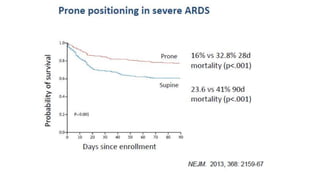
• Proning severe ARDS patients (PROSWA) trial has proved prone
position as an important rescue measure to improve outcome in
ARDS patient.
• In spite of the fact that a large number of studies have been
published, definitive guidelines for the best method has not been
recommended.
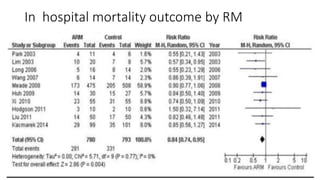
In hospital mortality outcome by RM
Alveolar recruitment for ARDS trial
• Multicenter RCT
• Conducted in 9 countries in 120 ICUs
• Control arm were on MV as per ARDS net protocol
• Intervention group received pressure control ventilation with fixed
driving pressure 15cm of h20.
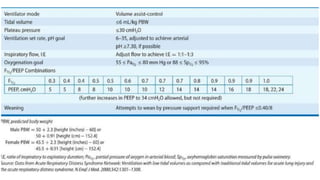
• PEEP was started from 25 to 45 each for 2 min after this patient was
shifted back to MV with 5ml/kg , RR 20, flow 30l/min and fio2 100.
• PEEP was titrated from 23 and static compliance was measured after
4 min.
• PEEP was decreased stepwise by 3cm and static compliance was
measured at each step.
• Optimum PEEP was the PEEP with max compliance +2 cm of H2O.
• after PEEP titration new RM with 45cm of H2O PEEP was applied for 1
minute and than setting changed back to optimum PEEP
• Recruitment stratergy group had 63.8% mortality , control group had
59.3% mortslity in hospital
• At 28days 55.3% and 49.3%
• RM can exacerbate inflammatory response by overdistension ,
bacterial translocation and reperfusion injury
• Limitation - Only 10% were on chosen for prone ventilation,
malignancy and other potential diseases were not excluded.
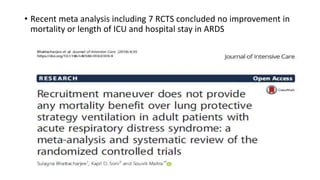
• Recent meta analysis including 7 RCTS concluded no improvement in
mortality or length of ICU and hospital stay in ARDS
Recruitability
• Every patient of ARDS does not respond to RM.
• these maneuvers can overdistend aerated lung units and worsen VILI
and hemodynamics.
• they should be used in a patient who has potential for responding to
such a maneuver.
• Lung recruitability could provide valuable information before RM
application to prevent possible deleterious effects
• Factors potentially involved in the variability of response to RM in
ARDS
• ARDS related -Focal vs nonfocal , Early vs late ,Severe vs moderate,
Associated vasoactive drugs
• RM-Related Type of RMs
oDistribution of lung perfusion
oTranspulmonary pressure
oTiming of application
oPatient positioning
• Post-RM strategy Post-RM PEEP
• The earlier or exudative phase of ARDS has better chance of RM
success compared with a later or fibrotic phase
• Patients with extrapulmonary etiology of ARDS have better response
to recruitment
• Those with diffuse changes on imaging studies have better chance of
RM success than those with focal changes
• Patients with severe ARDS respond better to RM and the high
respiratory system elastance is associated with better response to
recruitment in clinical trials
Indications for RM
• ARDS / Acute Lung Injury
(Patients with “secondary ARDS” (eg from abdominal sepsis) seem to
respond better than those with “primary” ARDS eg. from pneumonia)
• Bilateral pulmonary infiltrates
• PaO2/FiO2* <300 = ALI
• PaO2/FiO2 <200 = ARDS
• Atelectasis during general anaesthesia
• Desaturation After suctioning the ETT
Contraindications for RM
• Hemodynamic compromise: recruitment manoeuvres cause a
transient loss of venous return, compromising cardiac output.
• Existing barotrauma
• Increased intracranial pressure
• Predisposition to barotrauma:
• Apical bullous lung disease
• Focal lung pathology eg. lobar pneumonia
Complications of RMs
• Hemodynamic compromise
• Barotrauma
• Desaturation
Take home message.
• RMs in ARDS improve oxygenation in majority of patients
• Routine use of RMs cannot be recommended; it should be considered
for use on an individualized basis in patients with ARDS who have life
threatening hypoxemia
• Consider ECMO in the sickest patients
Thank you

Recruitment maneuvers in ards

  • 1.
  • 2.
    Berlin definition • ARDSis defined as a syndrome characterized by (1) onset within 1 week of a known clinical insult, (2) bilateral radiographic opacities not fully explained by pleural effusions, atelectasis, or nodules, (3) respiratory failure not fully explained by cardiac failure or fluid overload, (4) poor systemic oxygenation with a PaO2/FIO2 ≤300 and a PEEP or CPAP ≥5 cm H2O • PaO2/FIO2 ≤300, but >200, are referred to as having mild ARDS, Moderate ARDS is defined as PaO2/FIO2 ≤200, but >100, and severe ARDS is defined as PaO2/FIO2 ≤100
  • 3.
    Introduction • To maintainoxygenation, FRC, and respiratory system elastance is the application of recruitment maneuvers (RMs), which have become a component of lung-protective ventilation strategies • Recruitment is the dynamic process of opening previously collapsed lung units by increasing transpulmonary pressure • These maneuvers expected to improve oxygenation, lung compliance, facilitate alveolar fluid clearance and outcome • Lung units can be kept open by airway pressures that are lower than those required to open them, leading to the concept of recruitment using periodic higher pressure maneuvers with application of PEEP to maintain alveolar patency
  • 4.
    • In anormal homeostatic condition: Sigh reflex maintains lung compliance and decreases atelectasis. • Alveolar recruitment maneuver is the intervention of intentional transient application of high transpulmonary pressure to achieve reopening of nonaerated collapsed peripheral airways and alveoli • Mortality benefits are controversial. • ART trial(alveolar recruitment for ARDS) shown these maneuvers are harmful and lead to increase mortality
  • 5.
    • Atelectasis resultsfrom increased interstitial pressure and weight of the lung • It can be enhanced by patient related factors obesity, ↑intraabdominal pressure, high levels of inspired oxygen in unstable alveoli, patient disconnection from the ventilator, tracheal suctioning • Lung in ARDS can be reaerated by increasing transpulmonary pressure • Lung recruitability has been found to be quite low, averaging 9% of total lung mass, between 5 and 45 cm of H2O
  • 6.
    • Recruiting thelung is a ventilatory strategy that can decrease VILI: – Increase in the aerated lung mass, which contributes to minimize the lung heterogeneity and to increase the size of lung – Prevention of repeated opening and closure of the terminal respiratory units
  • 7.
    • Lung pathologyin ARDS is not uniform. CT chest of these patients in supine position shows three different lung areas with variable involvement. • The most dorsal dependent area shows significant collapse due to interstitial and alveolar edema. this aggravates lung injury during mechanical ventilation by decreasing the size of the lung available for ventilation and gas exchange. • The most ventral region is the normal open lung which gets overinflated causing volutrauma and barotrauma. • The area at the interface between the normal open lung and the atelecatic lung is partially collapsed and is subjected to shear stress by cyclical tidal recruitment and derecruitment
  • 11.
    Lung-Protective Mechanical Ventilation •The goals of lung-protective ventilation are to avoid injury due to overexpansion of alveoli during inspiration (“volu-trauma”) and injury due to repetitive opening and closing of alveoli during inspiration and expiration (“atelecta-trauma”) • The injury can be prevented by application of sufficient PEEP mechanical ventilation using limited tidal volumes should be less injurious to the lungs of patients with ARDS and should result in better outcomes
  • 13.
    Recruitment Manoeuvres 1. Sigh 2.Sustained inflation 3. Extended sigh 4. Prone ventilation
  • 14.
    Sigh Recruitment Manoeuvres •Consists of high tidal volume in controlled mode or high PEEP up to a specific plateau pressure level, for a selected number of cycles • Pelosi et al: 3 consecutive sighs/ minute at 45 cm H2O plateau pressure found Improvement in oxygenation, lung elastance, and functional residual capacity compared to patients who did not receive sighs • Mortality benefit was not observed.
  • 15.
    Sustained inflation RecruitmentManoeuvres • Most widely used Recruitment Manoeuvres • Ventilator is set in CPAP mode and then CPAP of 30-40 cm H20 is applied for 30-40 seconds. • Grasso et al: Reported improvement in oxygenation and lung function and minimize atelectasis in experimental and clinical scenarios • Also been associated with risk of hypotension and barotrauma
  • 16.
    • Done afterensuring SBP between 100-200 mmHg and HR between 70-140/min • Ensure patient is sedated and paralyzed. • If FiO2 <1.00, FiO2 to be raised to 1.00 for 5 minutes • Ventilation mode to be changed to CPAP with most recent PEEP level • CPAP to be increased over 10 seconds to 40 cmH2O . CPAP to be maintained at 40cmH2O for 45 seconds
  • 17.
    • The RecruitmentManoeuvres to be terminated immediately and CPAP returned to the most recent PEEP level if any of the following signs of distress occurs: – SBP decreases to 90 mmHg or by > 30 mmHg – HR increases to >140/min or by >20/min – SpO2 decreases by 5% and is <90% • After 45 seconds at CPAP=40cm H2O,CPAP to be decreased over 5 seconds to the pre-Recruitment Manoeuvres level • Most recent ventilation settings will be resumed upon completion or early termination of Recruitment Manoeuvres • If 2 Recruitment Manoeuvres require early termination within a single 24 hour interval, no additional recruitment maneuvers to be attempted for atleast 12 hours
  • 18.
    Stepwise Recruitment Manoeuvres •Airway pressure and/or PFEP is increased for a specific time. this process gradually increases transpulmonary pressure and time for recruitment. 1. Use stable Peak end inspiratory Pressure and incremental PEFP 2. Use a fixed driving pressure (like 15 cm) and a stepwise increase in PEFP (25. 30. 35 cm H20) for 2minutes 3. Apply fixed tidal volume and stepwise increases in PEEP. • Since stepwise RMs recruit lung units as effectively as sustained inflation with a lower mean airway pressure, they may lead to less hemodynamic compromise and hyperinflation
  • 19.
    • In experimentalendotoxin-induced mild ARDS, stepwise RM, compared to sustained inflation, was associated with reduced type Ⅱ epithelial cell damage and decreased expression of markers associated with fibrosis and endothelial cell damage
  • 20.
    Prone ventilation • Pronepositioning improves gas exchange via its effect on pleural pressure and lung compression • Increased functional residual capacity (FRC) has also been proposed, but changes in FRC have not been a dominant finding in most studies of prone ventilation • In supine position, the dorsal pleural pressure is greater than ventral pleural pressure • So , the ventral trans pulmonary pressure exceeds the dorsal transpulmonary pressure and greater expansion of the ventral alveoli than the dorsal alveoli
  • 21.
    • Exaggerated insupine patients with acute respiratory distress syndrome (ARDS), probably because the difference between the dorsal and ventral pleural pressures is increased by the excess lung weight • The result is a tendency towards overinflation of the ventral alveoli and atelectasis of the dorsal alveoli • Prone positioning reduces the difference between the dorsal and ventral pleural pressures ,Making ventilation more homogeneous • Leading to a decrease in alveolar over inflation and alveolar collapse. • Minimize stress and strain on alveoli, limiting ventilator associated lung injury from overdistention and cyclic atelectasis
  • 22.
    Compression: • In supineposition: Heart compresses the medial posterior lung parenchyma and the diaphragm compresses the posterior-caudal lung parenchyma • Compression by either the heart or the diaphragm may exaggerate dependent lung collapse in the supine position, increasing hypoxemia and ventilator-associated lung injury • During prone ventilation, the heart becomes dependent, decreasing medial posterior lung compression • The diaphragm is displaced caudally (especially in non-obese patients and when the abdomen is left unsupported), decreasing compression of the posterior-caudal lung parenchyma Improve ventilation and oxygenation
  • 23.
    • Cardiac output:Increase in lung recruitment and reduction in hypoxic pulmonary vasoconstriction • Increases in cardiac output by Increases in right ventricular preload, and decreased right ventricular afterload
  • 24.
    Predictor • The bestpredictor of a sustained increase in PaO2 during prone ventilation is 10 mmHg increase in PaO2 over the first 30 minutes of prone ventilation predicted a sustained increase in PaO2 over the next two hours • Patients whose PaO2 did not increase during the first 30 minutes of prone ventilation showed no subsequent improvement in their oxygenation
  • 25.
    • Patients withdiffuse pulmonary edema and dependent alveolar collapse appear more likely to improve their PaO2 during prone ventilation than patients with predominantly anterior abnormalities, marked consolidation, and/or fibrosis • Extrapulmonary cause for their ARDS seem more likely to increase their PaO2 during prone ventilation than patients with a pulmonary cause • Patients with elevated intraabdominal pressure appear more likely to increase their PaO2 during prone ventilation than patients with normal intraabdominal pressure • Patients whose chest wall compliance decreases when moving from the supine to the prone position are likely to improve their PaO2 during prone ventilation
  • 26.
    • Proning severeARDS patients (PROSWA) trial has proved prone position as an important rescue measure to improve outcome in ARDS patient. • In spite of the fact that a large number of studies have been published, definitive guidelines for the best method has not been recommended.
  • 28.
    In hospital mortalityoutcome by RM
  • 29.
    Alveolar recruitment forARDS trial • Multicenter RCT • Conducted in 9 countries in 120 ICUs • Control arm were on MV as per ARDS net protocol • Intervention group received pressure control ventilation with fixed driving pressure 15cm of h20. • PEEP was started from 25 to 45 each for 2 min after this patient was shifted back to MV with 5ml/kg , RR 20, flow 30l/min and fio2 100. • PEEP was titrated from 23 and static compliance was measured after 4 min.
  • 30.
    • PEEP wasdecreased stepwise by 3cm and static compliance was measured at each step. • Optimum PEEP was the PEEP with max compliance +2 cm of H2O. • after PEEP titration new RM with 45cm of H2O PEEP was applied for 1 minute and than setting changed back to optimum PEEP
  • 31.
    • Recruitment stratergygroup had 63.8% mortality , control group had 59.3% mortslity in hospital • At 28days 55.3% and 49.3% • RM can exacerbate inflammatory response by overdistension , bacterial translocation and reperfusion injury • Limitation - Only 10% were on chosen for prone ventilation, malignancy and other potential diseases were not excluded.
  • 32.
    • Recent metaanalysis including 7 RCTS concluded no improvement in mortality or length of ICU and hospital stay in ARDS
  • 33.
    Recruitability • Every patientof ARDS does not respond to RM. • these maneuvers can overdistend aerated lung units and worsen VILI and hemodynamics. • they should be used in a patient who has potential for responding to such a maneuver. • Lung recruitability could provide valuable information before RM application to prevent possible deleterious effects
  • 34.
    • Factors potentiallyinvolved in the variability of response to RM in ARDS • ARDS related -Focal vs nonfocal , Early vs late ,Severe vs moderate, Associated vasoactive drugs • RM-Related Type of RMs oDistribution of lung perfusion oTranspulmonary pressure oTiming of application oPatient positioning • Post-RM strategy Post-RM PEEP
  • 35.
    • The earlieror exudative phase of ARDS has better chance of RM success compared with a later or fibrotic phase • Patients with extrapulmonary etiology of ARDS have better response to recruitment • Those with diffuse changes on imaging studies have better chance of RM success than those with focal changes • Patients with severe ARDS respond better to RM and the high respiratory system elastance is associated with better response to recruitment in clinical trials
  • 36.
    Indications for RM •ARDS / Acute Lung Injury (Patients with “secondary ARDS” (eg from abdominal sepsis) seem to respond better than those with “primary” ARDS eg. from pneumonia) • Bilateral pulmonary infiltrates • PaO2/FiO2* <300 = ALI • PaO2/FiO2 <200 = ARDS • Atelectasis during general anaesthesia • Desaturation After suctioning the ETT
  • 37.
    Contraindications for RM •Hemodynamic compromise: recruitment manoeuvres cause a transient loss of venous return, compromising cardiac output. • Existing barotrauma • Increased intracranial pressure • Predisposition to barotrauma: • Apical bullous lung disease • Focal lung pathology eg. lobar pneumonia
  • 38.
    Complications of RMs •Hemodynamic compromise • Barotrauma • Desaturation
  • 39.
    Take home message. •RMs in ARDS improve oxygenation in majority of patients • Routine use of RMs cannot be recommended; it should be considered for use on an individualized basis in patients with ARDS who have life threatening hypoxemia • Consider ECMO in the sickest patients
  • 40.