RENAL ACIDIFICATION
H+ and HCo3-
• H+ ion , smallest ion
• Million fold lesser in concentration than HCo3-
• H+ play a major role in ETC- generation of ATP
• If their conc. exceeds a tight range, it can lead to
acidemia.
• Binding of H + to proteins ( functioning as
enzymes, transporters, contractile elements, and
structural compounds) can lead to their altered
function
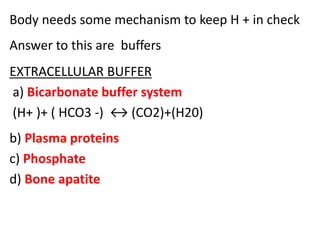
Body needs some mechanism to keep H + in check
Answer to this are buffers
EXTRACELLULAR BUFFER
a) Bicarbonate buffer system
(H+ )+ ( HCO3 -) ↔ (CO2)+(H20)
b) Plasma proteins
c) Phosphate
d) Bone apatite
INTRACELLULAR BUFFER
a) Hemoglobin
b) Cellular proteins
c) Organophosphate complexes
d) HCO3
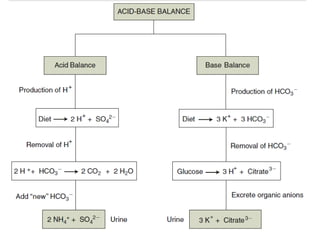
Excess acid or alkali generated needs to be
removed from body……
Portals – LUNG & KIDNEY
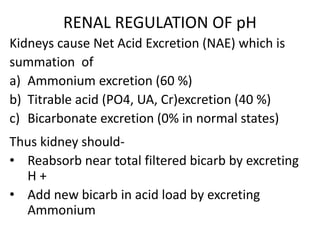
RENAL REGULATION OF pH
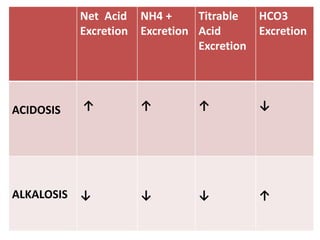
Kidneys cause Net Acid Excretion (NAE) which is
summation of
a) Ammonium excretion (60 %)
b) Titrable acid (PO4, UA, Cr)excretion (40 %)
c) Bicarbonate excretion (0% in normal states)
Thus kidney should-
• Reabsorb near total filtered bicarb by excreting
H +
• Add new bicarb in acid load by excreting
Ammonium
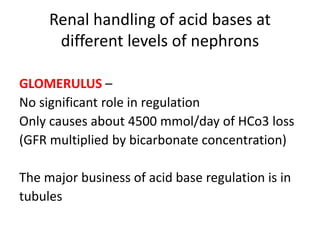
Renal handling of acid bases at
different levels of nephrons
GLOMERULUS –
No significant role in regulation
Only causes about 4500 mmol/day of HCo3 loss
(GFR multiplied by bicarbonate concentration)
The major business of acid base regulation is in
tubules
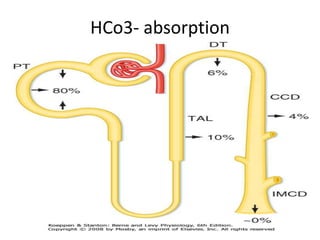
HCo3- absorption
Renal acid-base homeostasis may be broadly
divided into 2 processes
1. Proximal urinary acidification
i.e Proximal tubular absorption of HCO3
-
2. Distal urinary acidification.
 Reabsorption of remaining HCO3
- that escapes
proximally.
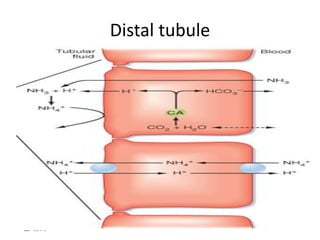
 Excretion of fixed acids through buffering &
Ammonia recycling and excretion of NH4
+.
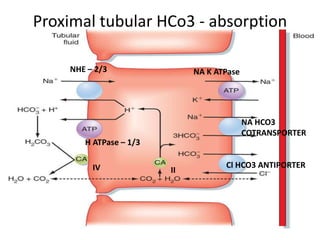
Proximal tubular HCo3 - absorption
NHE – 2/3
H ATPase – 1/3
IV II
NA K ATPase
NA HCO3
COTRANSPORTER
Cl HCO3 ANTIPORTER
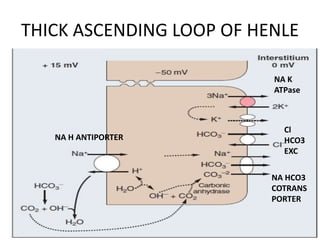
THICK ASCENDING LOOP OF HENLE
NA H ANTIPORTER
NA K
ATPase
NA HCO3
COTRANS
PORTER
Cl
HCO3
EXC
COLLECTING DUCT
The segments of the collecting duct include
A) Cortical collecting duct
B) Outer medullary collecting duct
C) Inner medullary collecting duct.
There are two distinct cell types in the cortical
collecting duct histologically:
a) The principal cell and
b) The intercalated cell.
Principal cell- Reabsorbs Na+ and
Secretes K+
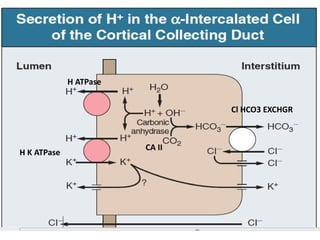
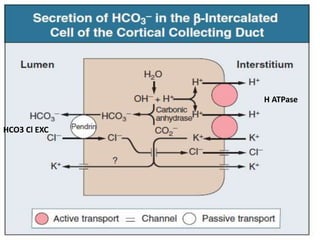
Intercalated cells- secrete acid - α cells
secrete base – β cells
H ATPase
H K ATPase
CA II
Cl HCO3 EXCHGR
H ATPase
HCO3 Cl EXC
Ammonia metabolism
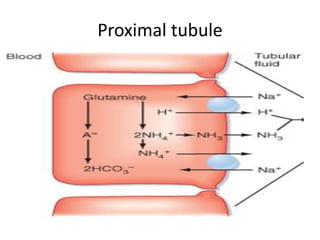
The proximal tubule is responsible for both
a) Ammonia production
(from glutamine metabolism resulting in
production of two NH4+ and two HCO3 ions from
each glutamine ion)
b ) Luminal secretion
(NH4 + transport by the apical Na+-H+ antiporter
NHE3)
Metabolic acidosis increases the mobilization of
glutamine from skeletal muscle and intestinal
cells.
Glutamine is preferentially taken up by the proximal
tubular cell through the Na+- and H+-dependent
glutamine transporter SNAT3.
SNAT3 expression increases several fold in metabolic
acidosis, and it is preferentially expressed on the cell’s
basolateral surface
Proximal tubule
Distal tubule
Net Acid
Excretion
NH4 +
Excretion
Titrable
Acid
Excretion
HCO3
Excretion
ACIDOSIS ↑ ↑ ↑ ↓
ALKALOSIS ↓ ↓ ↓ ↑
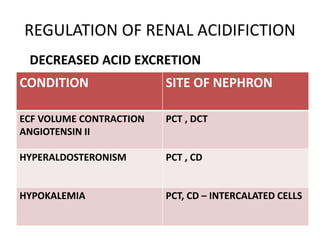
REGULATION OF RENAL ACIDIFICTION
CONDITION SITE OF NEPHRON
ECF VOLUME CONTRACTION
ANGIOTENSIN II
PCT , DCT
HYPERALDOSTERONISM PCT , CD
HYPOKALEMIA PCT, CD – INTERCALATED CELLS
DECREASED ACID EXCRETION
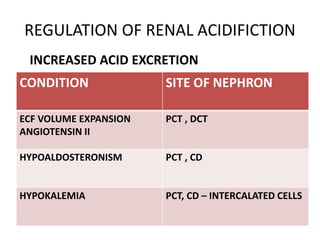
REGULATION OF RENAL ACIDIFICTION
CONDITION SITE OF NEPHRON
ECF VOLUME EXPANSION
ANGIOTENSIN II
PCT , DCT
HYPOALDOSTERONISM PCT , CD
HYPOKALEMIA PCT, CD – INTERCALATED CELLS
INCREASED ACID EXCRETION
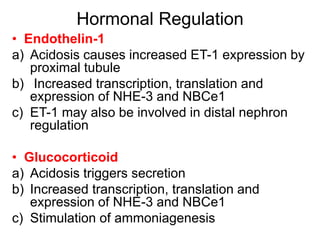
Hormonal Regulation
• Endothelin-1
a) Acidosis causes increased ET-1 expression by
proximal tubule
b) Increased transcription, translation and
expression of NHE-3 and NBCe1
c) ET-1 may also be involved in distal nephron
regulation
• Glucocorticoid
a) Acidosis triggers secretion
b) Increased transcription, translation and
expression of NHE-3 and NBCe1
c) Stimulation of ammoniagenesis
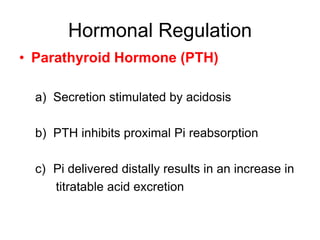
Hormonal Regulation
• Parathyroid Hormone (PTH)
a) Secretion stimulated by acidosis
b) PTH inhibits proximal Pi reabsorption
c) Pi delivered distally results in an increase in
titratable acid excretion

Renal acidification

  • 1.
  • 2.
    H+ and HCo3- •H+ ion , smallest ion • Million fold lesser in concentration than HCo3- • H+ play a major role in ETC- generation of ATP • If their conc. exceeds a tight range, it can lead to acidemia. • Binding of H + to proteins ( functioning as enzymes, transporters, contractile elements, and structural compounds) can lead to their altered function
  • 3.
    Body needs somemechanism to keep H + in check Answer to this are buffers EXTRACELLULAR BUFFER a) Bicarbonate buffer system (H+ )+ ( HCO3 -) ↔ (CO2)+(H20) b) Plasma proteins c) Phosphate d) Bone apatite
  • 4.
    INTRACELLULAR BUFFER a) Hemoglobin b)Cellular proteins c) Organophosphate complexes d) HCO3 Excess acid or alkali generated needs to be removed from body…… Portals – LUNG & KIDNEY
  • 5.
    RENAL REGULATION OFpH Kidneys cause Net Acid Excretion (NAE) which is summation of a) Ammonium excretion (60 %) b) Titrable acid (PO4, UA, Cr)excretion (40 %) c) Bicarbonate excretion (0% in normal states) Thus kidney should- • Reabsorb near total filtered bicarb by excreting H + • Add new bicarb in acid load by excreting Ammonium
  • 7.
    Renal handling ofacid bases at different levels of nephrons GLOMERULUS – No significant role in regulation Only causes about 4500 mmol/day of HCo3 loss (GFR multiplied by bicarbonate concentration) The major business of acid base regulation is in tubules
  • 8.
  • 9.
    Renal acid-base homeostasismay be broadly divided into 2 processes 1. Proximal urinary acidification i.e Proximal tubular absorption of HCO3 - 2. Distal urinary acidification.  Reabsorption of remaining HCO3 - that escapes proximally.  Excretion of fixed acids through buffering & Ammonia recycling and excretion of NH4 +.
  • 10.
    Proximal tubular HCo3- absorption NHE – 2/3 H ATPase – 1/3 IV II NA K ATPase NA HCO3 COTRANSPORTER Cl HCO3 ANTIPORTER
  • 11.
    THICK ASCENDING LOOPOF HENLE NA H ANTIPORTER NA K ATPase NA HCO3 COTRANS PORTER Cl HCO3 EXC
  • 12.
    COLLECTING DUCT The segmentsof the collecting duct include A) Cortical collecting duct B) Outer medullary collecting duct C) Inner medullary collecting duct. There are two distinct cell types in the cortical collecting duct histologically: a) The principal cell and b) The intercalated cell.
  • 13.
    Principal cell- ReabsorbsNa+ and Secretes K+ Intercalated cells- secrete acid - α cells secrete base – β cells
  • 14.
    H ATPase H KATPase CA II Cl HCO3 EXCHGR
  • 15.
  • 16.
    Ammonia metabolism The proximaltubule is responsible for both a) Ammonia production (from glutamine metabolism resulting in production of two NH4+ and two HCO3 ions from each glutamine ion) b ) Luminal secretion (NH4 + transport by the apical Na+-H+ antiporter NHE3)
  • 17.
    Metabolic acidosis increasesthe mobilization of glutamine from skeletal muscle and intestinal cells. Glutamine is preferentially taken up by the proximal tubular cell through the Na+- and H+-dependent glutamine transporter SNAT3. SNAT3 expression increases several fold in metabolic acidosis, and it is preferentially expressed on the cell’s basolateral surface
  • 18.
  • 19.
  • 20.
  • 21.
    REGULATION OF RENALACIDIFICTION CONDITION SITE OF NEPHRON ECF VOLUME CONTRACTION ANGIOTENSIN II PCT , DCT HYPERALDOSTERONISM PCT , CD HYPOKALEMIA PCT, CD – INTERCALATED CELLS DECREASED ACID EXCRETION
  • 22.
    REGULATION OF RENALACIDIFICTION CONDITION SITE OF NEPHRON ECF VOLUME EXPANSION ANGIOTENSIN II PCT , DCT HYPOALDOSTERONISM PCT , CD HYPOKALEMIA PCT, CD – INTERCALATED CELLS INCREASED ACID EXCRETION
  • 23.
    Hormonal Regulation • Endothelin-1 a)Acidosis causes increased ET-1 expression by proximal tubule b) Increased transcription, translation and expression of NHE-3 and NBCe1 c) ET-1 may also be involved in distal nephron regulation • Glucocorticoid a) Acidosis triggers secretion b) Increased transcription, translation and expression of NHE-3 and NBCe1 c) Stimulation of ammoniagenesis
  • 24.
    Hormonal Regulation • ParathyroidHormone (PTH) a) Secretion stimulated by acidosis b) PTH inhibits proximal Pi reabsorption c) Pi delivered distally results in an increase in titratable acid excretion