Kerry Gomes
 Inadequate alveolar oxygenation
◦ Low environmental oxygen pressure
◦ Alveolar hypoventilation
 Diffusion abnormalities
 Dead space
◦ High ventilation, low perfusion (V/Q)
 Low V/Q mismatch
 Shunt
 Low venous blood saturation
 Physiological shunt is the major cause of poor
oxygenation in ill ED patients.
 Areas of alveoli that are blocked from
conducting oxygen, but still have intact blood
vessels surrounding them.
 Causes
◦ Pneumonia
◦ Atelectasis
◦ Pulmonary oedema
◦ Mucus plugging
◦ ARDS
 In normal patients, Hb reaching lungs has a
saturation of 65-70%
 Only small amount of exposure to O2 needed
to rapidly bring saturation to 100%
 In shocked state, venous blood with lower
states reach the lungs, and will require more
exposure to O2 to reach 100%
◦ In injured lungs this may not occur
 Always consider the circulatory system when
evaluating respiratory status.
 Preoxygenation allows a safety buffer during
periods of hypoventilation and apnoea.
 Extends the period of safe apnoea, defined as
the time until a patient reaches a saturation
level of 88% - 90%, to allow for the placement
of a definitive airway.
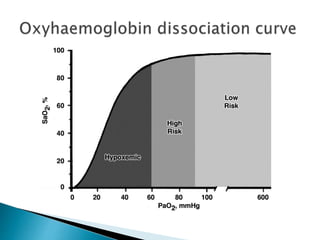
 Below this level, oxygen saturation can
decrease to critical levels <70% within
moments.
Weingart SD and Levitan RM: Ann Emerg Med 2011
 Patients breathing room air before RSI,
desaturation occurs in 45-60sec
 Heller et al. showed marked time to
desaturation if patients received
preoxygenation with 100% oxygen.
 Ideally preoxgenate for 3 minutes with high
FiO2 source.
◦ Can augment denitrogenation by asking patient to
take 8 large breathes
◦ Difficult in ED setting and paediatric patients
 1. Achieve 100% oxygenation saturation prior
to procedure
 2. Denitrogenate the residual capacity of the
lungs, maximizing oxygen storage
 3. Denitrogenate and maximally oxygenate
the bloodstream.
Weingart SD and Levitan RM: Ann Emerg Med 2011
 If patients do not achieve a saturation >93%-
95% pre intubation, they have a high
likelihood of desaturation during the apnoeic
and intubation periods.
 If patients do not achieve this with a high
flow source, it is likely they are exhibiting a
physiological shunt.
 In short term shunt can be partially overcome
by augmenting mean airway pressures.
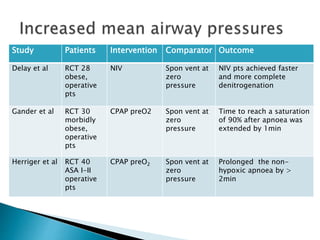
Study Patients Intervention Comparator Outcome
Delay et al RCT 28
obese,
operative
pts
NIV Spon vent at
zero
pressure
NIV pts achieved faster
and more complete
denitrogenation
Gander et al RCT 30
morbidly
obese,
operative
pts
CPAP preO2 Spon vent at
zero
pressure
Time to reach a saturation
of 90% after apnoea was
extended by 1min
Herriger et al RCT 40
ASA I-II
operative
pts
CPAP preO2 Spon vent at
zero
pressure
Prolonged the non-
hypoxic apnoea by >
2min
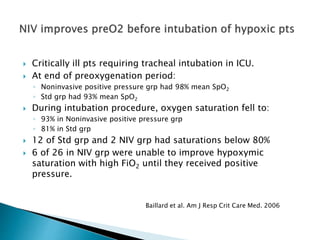
 Critically ill pts requiring tracheal intubation in ICU.
 At end of preoxygenation period:
◦ Noninvasive positive pressure grp had 98% mean SpO2
◦ Std grp had 93% mean SpO2
 During intubation procedure, oxygen saturation fell to:
◦ 93% in Noninvasive positive pressure grp
◦ 81% in Std grp
 12 of Std grp and 2 NIV grp had saturations below 80%
 6 of 26 in NIV grp were unable to improve hypoxymic
saturation with high FiO2 until they received positive
pressure.
Baillard et al. Am J Resp Crit Care Med. 2006
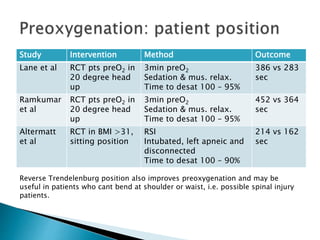
Study Intervention Method Outcome
Lane et al RCT pts preO2 in
20 degree head
up
3min preO2
Sedation & mus. relax.
Time to desat 100 – 95%
386 vs 283
sec
Ramkumar
et al
RCT pts preO2 in
20 degree head
up
3min preO2
Sedation & mus. relax.
Time to desat 100 – 95%
452 vs 364
sec
Altermatt
et al
RCT in BMI >31,
sitting position
RSI
Intubated, left apneic and
disconnected
Time to desat 100 – 90%
214 vs 162
sec
Reverse Trendelenburg position also improves preoxygenation and may be
useful in patients who cant bend at shoulder or waist, i.e. possible spinal injury
patients.
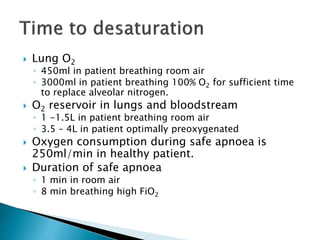
 Lung O2
◦ 450ml in patient breathing room air
◦ 3000ml in patient breathing 100% O2 for sufficient time
to replace alveolar nitrogen.
 O2 reservoir in lungs and bloodstream
◦ 1 -1.5L in patient breathing room air
◦ 3.5 – 4L in patient optimally preoxygenated
 Oxygen consumption during safe apnoea is
250ml/min in healthy patient.
 Duration of safe apnoea
◦ 1 min in room air
◦ 8 min breathing high FiO2
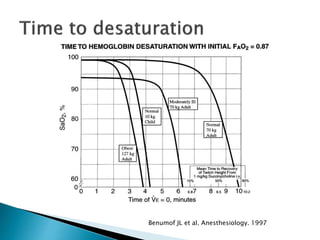
Benumof JL et al. Anesthesiology. 1997
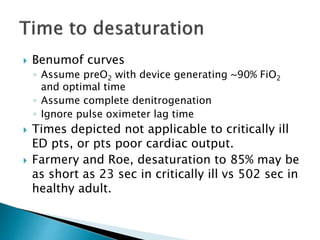
 Benumof curves
◦ Assume preO2 with device generating ~90% FiO2
and optimal time
◦ Assume complete denitrogenation
◦ Ignore pulse oximeter lag time
 Times depicted not applicable to critically ill
ED pts, or pts poor cardiac output.
 Farmery and Roe, desaturation to 85% may be
as short as 23 sec in critically ill vs 502 sec in
healthy adult.
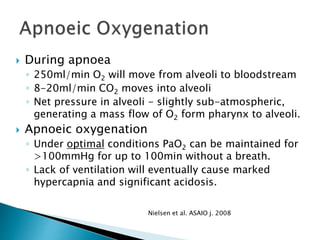
 During apnoea
◦ 250ml/min O2 will move from alveoli to bloodstream
◦ 8-20ml/min CO2 moves into alveoli
◦ Net pressure in alveoli - slightly sub-atmospheric,
generating a mass flow of O2 form pharynx to alveoli.
 Apnoeic oxygenation
◦ Under optimal conditions PaO2 can be maintained for
>100mmHg for up to 100min without a breath.
◦ Lack of ventilation will eventually cause marked
hypercapnia and significant acidosis.
Nielsen et al. ASAIO j. 2008
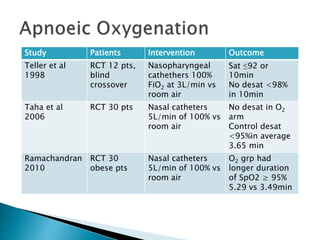
Study Patients Intervention Outcome
Teller et al
1998
RCT 12 pts,
blind
crossover
Nasopharyngeal
cathethers 100%
FiO2 at 3L/min vs
room air
Sat ≤92 or
10min
No desat <98%
in 10min
Taha et al
2006
RCT 30 pts Nasal catheters
5L/min of 100% vs
room air
No desat in O2
arm
Control desat
<95%in average
3.65 min
Ramachandran
2010
RCT 30
obese pts
Nasal catheters
5L/min of 100% vs
room air
O2 grp had
longer duration
of SpO2 ≥ 95%
5.29 vs 3.49min
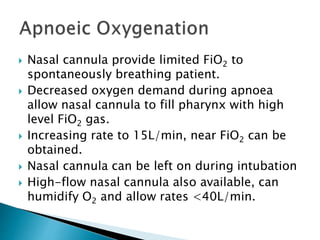
 Nasal cannula provide limited FiO2 to
spontaneously breathing patient.
 Decreased oxygen demand during apnoea
allow nasal cannula to fill pharynx with high
level FiO2 gas.
 Increasing rate to 15L/min, near FiO2 can be
obtained.
 Nasal cannula can be left on during intubation
 High-flow nasal cannula also available, can
humidify O2 and allow rates <40L/min.
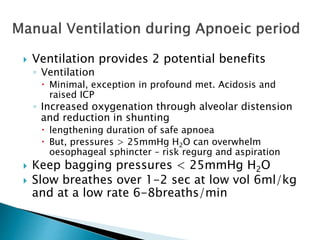
 Ventilation provides 2 potential benefits
◦ Ventilation
 Minimal, exception in profound met. Acidosis and
raised ICP
◦ Increased oxygenation through alveolar distension
and reduction in shunting
 lengthening duration of safe apnoea
 But, pressures > 25mmHg H2O can overwhelm
oesophageal sphincter – risk regurg and aspiration
 Keep bagging pressures < 25mmHg H2O
 Slow breathes over 1-2 sec at low vol 6ml/kg
and at a low rate 6-8breaths/min
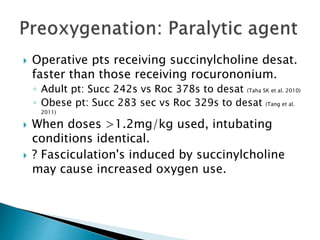
 Operative pts receiving succinylcholine desat.
faster than those receiving rocurononium.
◦ Adult pt: Succ 242s vs Roc 378s to desat (Taha SK et al. 2010)
◦ Obese pt: Succ 283 sec vs Roc 329s to desat (Tang et al.
2011)
 When doses >1.2mg/kg used, intubating
conditions identical.
 ? Fasciculation's induced by succinylcholine
may cause increased oxygen use.
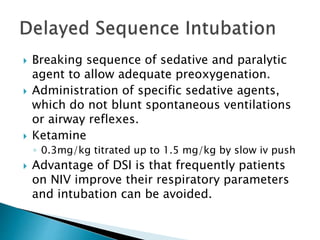
 Breaking sequence of sedative and paralytic
agent to allow adequate preoxygenation.
 Administration of specific sedative agents,
which do not blunt spontaneous ventilations
or airway reflexes.
 Ketamine
◦ 0.3mg/kg titrated up to 1.5 mg/kg by slow iv push
 Advantage of DSI is that frequently patients
on NIV improve their respiratory parameters
and intubation can be avoided.
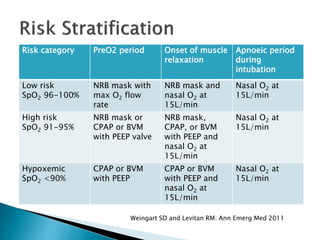
Risk category PreO2 period Onset of muscle
relaxation
Apnoeic period
during
intubation
Low risk
SpO2 96-100%
NRB mask with
max O2 flow
rate
NRB mask and
nasal O2 at
15L/min
Nasal O2 at
15L/min
High risk
SpO2 91-95%
NRB mask or
CPAP or BVM
with PEEP valve
NRB mask,
CPAP, or BVM
with PEEP and
nasal O2 at
15L/min
Nasal O2 at
15L/min
Hypoxemic
SpO2 <90%
CPAP or BVM
with PEEP
CPAP or BVM
with PEEP and
nasal O2 at
15L/min
Nasal O2 at
15L/min
Weingart SD and Levitan RM: Ann Emerg Med 2011
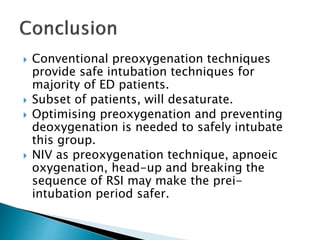
 Conventional preoxygenation techniques
provide safe intubation techniques for
majority of ED patients.
 Subset of patients, will desaturate.
 Optimising preoxygenation and preventing
deoxygenation is needed to safely intubate
this group.
 NIV as preoxygenation technique, apnoeic
oxygenation, head-up and breaking the
sequence of RSI may make the prei-
intubation period safer.

Pre-oxygenation

  • 1.
  • 2.
     Inadequate alveolaroxygenation ◦ Low environmental oxygen pressure ◦ Alveolar hypoventilation  Diffusion abnormalities  Dead space ◦ High ventilation, low perfusion (V/Q)  Low V/Q mismatch  Shunt  Low venous blood saturation
  • 3.
     Physiological shuntis the major cause of poor oxygenation in ill ED patients.  Areas of alveoli that are blocked from conducting oxygen, but still have intact blood vessels surrounding them.  Causes ◦ Pneumonia ◦ Atelectasis ◦ Pulmonary oedema ◦ Mucus plugging ◦ ARDS
  • 4.
     In normalpatients, Hb reaching lungs has a saturation of 65-70%  Only small amount of exposure to O2 needed to rapidly bring saturation to 100%  In shocked state, venous blood with lower states reach the lungs, and will require more exposure to O2 to reach 100% ◦ In injured lungs this may not occur  Always consider the circulatory system when evaluating respiratory status.
  • 5.
     Preoxygenation allowsa safety buffer during periods of hypoventilation and apnoea.  Extends the period of safe apnoea, defined as the time until a patient reaches a saturation level of 88% - 90%, to allow for the placement of a definitive airway.  Below this level, oxygen saturation can decrease to critical levels <70% within moments. Weingart SD and Levitan RM: Ann Emerg Med 2011
  • 7.
     Patients breathingroom air before RSI, desaturation occurs in 45-60sec  Heller et al. showed marked time to desaturation if patients received preoxygenation with 100% oxygen.  Ideally preoxgenate for 3 minutes with high FiO2 source. ◦ Can augment denitrogenation by asking patient to take 8 large breathes ◦ Difficult in ED setting and paediatric patients
  • 8.
     1. Achieve100% oxygenation saturation prior to procedure  2. Denitrogenate the residual capacity of the lungs, maximizing oxygen storage  3. Denitrogenate and maximally oxygenate the bloodstream. Weingart SD and Levitan RM: Ann Emerg Med 2011
  • 9.
     If patientsdo not achieve a saturation >93%- 95% pre intubation, they have a high likelihood of desaturation during the apnoeic and intubation periods.  If patients do not achieve this with a high flow source, it is likely they are exhibiting a physiological shunt.  In short term shunt can be partially overcome by augmenting mean airway pressures.
  • 10.
    Study Patients InterventionComparator Outcome Delay et al RCT 28 obese, operative pts NIV Spon vent at zero pressure NIV pts achieved faster and more complete denitrogenation Gander et al RCT 30 morbidly obese, operative pts CPAP preO2 Spon vent at zero pressure Time to reach a saturation of 90% after apnoea was extended by 1min Herriger et al RCT 40 ASA I-II operative pts CPAP preO2 Spon vent at zero pressure Prolonged the non- hypoxic apnoea by > 2min
  • 11.
     Critically illpts requiring tracheal intubation in ICU.  At end of preoxygenation period: ◦ Noninvasive positive pressure grp had 98% mean SpO2 ◦ Std grp had 93% mean SpO2  During intubation procedure, oxygen saturation fell to: ◦ 93% in Noninvasive positive pressure grp ◦ 81% in Std grp  12 of Std grp and 2 NIV grp had saturations below 80%  6 of 26 in NIV grp were unable to improve hypoxymic saturation with high FiO2 until they received positive pressure. Baillard et al. Am J Resp Crit Care Med. 2006
  • 12.
    Study Intervention MethodOutcome Lane et al RCT pts preO2 in 20 degree head up 3min preO2 Sedation & mus. relax. Time to desat 100 – 95% 386 vs 283 sec Ramkumar et al RCT pts preO2 in 20 degree head up 3min preO2 Sedation & mus. relax. Time to desat 100 – 95% 452 vs 364 sec Altermatt et al RCT in BMI >31, sitting position RSI Intubated, left apneic and disconnected Time to desat 100 – 90% 214 vs 162 sec Reverse Trendelenburg position also improves preoxygenation and may be useful in patients who cant bend at shoulder or waist, i.e. possible spinal injury patients.
  • 13.
     Lung O2 ◦450ml in patient breathing room air ◦ 3000ml in patient breathing 100% O2 for sufficient time to replace alveolar nitrogen.  O2 reservoir in lungs and bloodstream ◦ 1 -1.5L in patient breathing room air ◦ 3.5 – 4L in patient optimally preoxygenated  Oxygen consumption during safe apnoea is 250ml/min in healthy patient.  Duration of safe apnoea ◦ 1 min in room air ◦ 8 min breathing high FiO2
  • 14.
    Benumof JL etal. Anesthesiology. 1997
  • 15.
     Benumof curves ◦Assume preO2 with device generating ~90% FiO2 and optimal time ◦ Assume complete denitrogenation ◦ Ignore pulse oximeter lag time  Times depicted not applicable to critically ill ED pts, or pts poor cardiac output.  Farmery and Roe, desaturation to 85% may be as short as 23 sec in critically ill vs 502 sec in healthy adult.
  • 16.
     During apnoea ◦250ml/min O2 will move from alveoli to bloodstream ◦ 8-20ml/min CO2 moves into alveoli ◦ Net pressure in alveoli - slightly sub-atmospheric, generating a mass flow of O2 form pharynx to alveoli.  Apnoeic oxygenation ◦ Under optimal conditions PaO2 can be maintained for >100mmHg for up to 100min without a breath. ◦ Lack of ventilation will eventually cause marked hypercapnia and significant acidosis. Nielsen et al. ASAIO j. 2008
  • 17.
    Study Patients InterventionOutcome Teller et al 1998 RCT 12 pts, blind crossover Nasopharyngeal cathethers 100% FiO2 at 3L/min vs room air Sat ≤92 or 10min No desat <98% in 10min Taha et al 2006 RCT 30 pts Nasal catheters 5L/min of 100% vs room air No desat in O2 arm Control desat <95%in average 3.65 min Ramachandran 2010 RCT 30 obese pts Nasal catheters 5L/min of 100% vs room air O2 grp had longer duration of SpO2 ≥ 95% 5.29 vs 3.49min
  • 18.
     Nasal cannulaprovide limited FiO2 to spontaneously breathing patient.  Decreased oxygen demand during apnoea allow nasal cannula to fill pharynx with high level FiO2 gas.  Increasing rate to 15L/min, near FiO2 can be obtained.  Nasal cannula can be left on during intubation  High-flow nasal cannula also available, can humidify O2 and allow rates <40L/min.
  • 19.
     Ventilation provides2 potential benefits ◦ Ventilation  Minimal, exception in profound met. Acidosis and raised ICP ◦ Increased oxygenation through alveolar distension and reduction in shunting  lengthening duration of safe apnoea  But, pressures > 25mmHg H2O can overwhelm oesophageal sphincter – risk regurg and aspiration  Keep bagging pressures < 25mmHg H2O  Slow breathes over 1-2 sec at low vol 6ml/kg and at a low rate 6-8breaths/min
  • 20.
     Operative ptsreceiving succinylcholine desat. faster than those receiving rocurononium. ◦ Adult pt: Succ 242s vs Roc 378s to desat (Taha SK et al. 2010) ◦ Obese pt: Succ 283 sec vs Roc 329s to desat (Tang et al. 2011)  When doses >1.2mg/kg used, intubating conditions identical.  ? Fasciculation's induced by succinylcholine may cause increased oxygen use.
  • 21.
     Breaking sequenceof sedative and paralytic agent to allow adequate preoxygenation.  Administration of specific sedative agents, which do not blunt spontaneous ventilations or airway reflexes.  Ketamine ◦ 0.3mg/kg titrated up to 1.5 mg/kg by slow iv push  Advantage of DSI is that frequently patients on NIV improve their respiratory parameters and intubation can be avoided.
  • 22.
    Risk category PreO2period Onset of muscle relaxation Apnoeic period during intubation Low risk SpO2 96-100% NRB mask with max O2 flow rate NRB mask and nasal O2 at 15L/min Nasal O2 at 15L/min High risk SpO2 91-95% NRB mask or CPAP or BVM with PEEP valve NRB mask, CPAP, or BVM with PEEP and nasal O2 at 15L/min Nasal O2 at 15L/min Hypoxemic SpO2 <90% CPAP or BVM with PEEP CPAP or BVM with PEEP and nasal O2 at 15L/min Nasal O2 at 15L/min Weingart SD and Levitan RM: Ann Emerg Med 2011
  • 23.
     Conventional preoxygenationtechniques provide safe intubation techniques for majority of ED patients.  Subset of patients, will desaturate.  Optimising preoxygenation and preventing deoxygenation is needed to safely intubate this group.  NIV as preoxygenation technique, apnoeic oxygenation, head-up and breaking the sequence of RSI may make the prei- intubation period safer.