Research Methodology 
Qualitative & Quantitative 
By 
Dr.Shazia Zamir
Contents 
• USE OF EDUCATIONAL RESEARCH 
- Procedure of Educational Research 
- The Scientific Method
Research 
• Research is a cyclical process of steps that typically begins with 
identifying a research problem. It then involves reviewing the 
literature, specifying a purpose for the study, collecting and 
analyzing data, and forming an interpretation of the 
information. This process ends in a report, distributed to audiences, 
that is evaluated and used in the educational community.(Cresswell, 
2002)
Objectives Of Educational Research 
 Understanding: what? 
 Prediction: of what? and 
 Control: of what? 
Activity on identification of problems in Education 
 To write down the problem you would like to solve in your 
respective area.
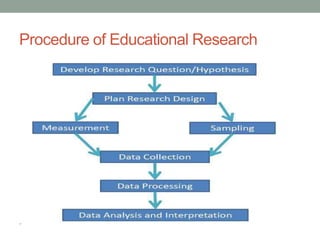
Procedure of Educational Research 
Chapter One 
Step one 
Identify a problem or issue 
One that needs to be resolved 
Step two 
How? 
 Specify the topic 
 Justify why it needs to be studied 
 Suggest the importance of this topic to a specific group 
Why Specify? 
 Specifying limits broad topics makes them easier to research. 
Introduction also call the Statement of the Problem
Procedure of Educational Research 
• Chapter Two 
Literature Review, Defined Discovering summaries, books, journals, and 
indexed publications on a topic, selectively choosing which literature 
is relevant, and then writing a report that summarizes that literature. 
Chapter Three 
Specifying A Purpose 
• Key Chapter Introduces the entire study, signals the procedures to be 
used (methodologies), and points to the results to be found. This chapter 
must be crafted carefully. 
Your explanation of how you are going to go about Collecting data so that 
others could replicate your study. 
• Collecting Data identifying and selecting individuals for a study obtaining 
their permission to be studied and gathering 
information by administering instruments, through asking people questions 
or observing their behavior.
Procedure of Educational Research 
• Chapter Four 
Analyzing and Interpreting the Data Analysis Means taking the data 
apart to see individual responses and putting it back together 
to summarize it. Presentation of findings, no explanation. Charts and 
Graphs Important to this chapter. 
• Chapter Five 
Reporting and Evaluating 
Research Determining the audience and structuring the report in a 
format that is acceptable to this audience. Explains what this research 
means.
Procedure of Educational Research
Procedure of Educational Research 
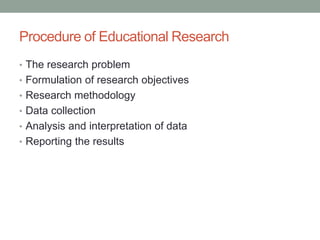
• The research problem 
• Formulation of research objectives 
• Research methodology 
• Data collection 
• Analysis and interpretation of data 
• Reporting the results
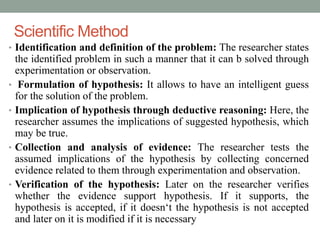
Scientific Method 
• Identification and definition of the problem: The researcher states 
the identified problem in such a manner that it can b solved through 
experimentation or observation. 
• Formulation of hypothesis: It allows to have an intelligent guess 
for the solution of the problem. 
• Implication of hypothesis through deductive reasoning: Here, the 
researcher assumes the implications of suggested hypothesis, which 
may be true. 
• Collection and analysis of evidence: The researcher tests the 
assumed implications of the hypothesis by collecting concerned 
evidence related to them through experimentation and observation. 
• Verification of the hypothesis: Later on the researcher verifies 
whether the evidence support hypothesis. If it supports, the 
hypothesis is accepted, if it doesn‘t the hypothesis is not accepted 
and later on it is modified if it is necessary
Class Activity 
Now select the area of your interest and do the following: 
1. Write down a research topic/problem. 
2. Write down the hypotheses. 
Discussion
Activity 
Choose a published journal article/thesis from library that relates 
to your area of research interest. Find the research problem, the 
literature review, the research questions, the data collection, the 
data analysis, and the interpretation of the study. Copy the article 
and label the six key components 
of the research process in the margins of the article.

USE OF EDUCATIONAL RESEARCH

  • 1.
    Research Methodology Qualitative& Quantitative By Dr.Shazia Zamir
  • 2.
    Contents • USEOF EDUCATIONAL RESEARCH - Procedure of Educational Research - The Scientific Method
  • 3.
    Research • Researchis a cyclical process of steps that typically begins with identifying a research problem. It then involves reviewing the literature, specifying a purpose for the study, collecting and analyzing data, and forming an interpretation of the information. This process ends in a report, distributed to audiences, that is evaluated and used in the educational community.(Cresswell, 2002)
  • 4.
    Objectives Of EducationalResearch  Understanding: what?  Prediction: of what? and  Control: of what? Activity on identification of problems in Education  To write down the problem you would like to solve in your respective area.
  • 5.
    Procedure of EducationalResearch Chapter One Step one Identify a problem or issue One that needs to be resolved Step two How?  Specify the topic  Justify why it needs to be studied  Suggest the importance of this topic to a specific group Why Specify?  Specifying limits broad topics makes them easier to research. Introduction also call the Statement of the Problem
  • 6.
    Procedure of EducationalResearch • Chapter Two Literature Review, Defined Discovering summaries, books, journals, and indexed publications on a topic, selectively choosing which literature is relevant, and then writing a report that summarizes that literature. Chapter Three Specifying A Purpose • Key Chapter Introduces the entire study, signals the procedures to be used (methodologies), and points to the results to be found. This chapter must be crafted carefully. Your explanation of how you are going to go about Collecting data so that others could replicate your study. • Collecting Data identifying and selecting individuals for a study obtaining their permission to be studied and gathering information by administering instruments, through asking people questions or observing their behavior.
  • 7.
    Procedure of EducationalResearch • Chapter Four Analyzing and Interpreting the Data Analysis Means taking the data apart to see individual responses and putting it back together to summarize it. Presentation of findings, no explanation. Charts and Graphs Important to this chapter. • Chapter Five Reporting and Evaluating Research Determining the audience and structuring the report in a format that is acceptable to this audience. Explains what this research means.
  • 8.
  • 9.
    Procedure of EducationalResearch • The research problem • Formulation of research objectives • Research methodology • Data collection • Analysis and interpretation of data • Reporting the results
  • 10.
    Scientific Method •Identification and definition of the problem: The researcher states the identified problem in such a manner that it can b solved through experimentation or observation. • Formulation of hypothesis: It allows to have an intelligent guess for the solution of the problem. • Implication of hypothesis through deductive reasoning: Here, the researcher assumes the implications of suggested hypothesis, which may be true. • Collection and analysis of evidence: The researcher tests the assumed implications of the hypothesis by collecting concerned evidence related to them through experimentation and observation. • Verification of the hypothesis: Later on the researcher verifies whether the evidence support hypothesis. If it supports, the hypothesis is accepted, if it doesn‘t the hypothesis is not accepted and later on it is modified if it is necessary
  • 11.
    Class Activity Nowselect the area of your interest and do the following: 1. Write down a research topic/problem. 2. Write down the hypotheses. Discussion
  • 12.
    Activity Choose apublished journal article/thesis from library that relates to your area of research interest. Find the research problem, the literature review, the research questions, the data collection, the data analysis, and the interpretation of the study. Copy the article and label the six key components of the research process in the margins of the article.