Human Development
By
Dr. Shazia Zamir
Human Development
 The process of growth and change that
takes place from birth till death.
Study of Human development seeks to
understand how and why the people of all
ages and circumstances change or remain
the same over time. Change in the child that
occurs over time. Changes follow an orderly
pattern that moves toward greater
complexity and enhances survival.
Periods of Human Development
Infancy from 0-3 years baby toddler We
learn to: walk, eat and talk
Childhood from 3-11 years child We learn
to: read, write and count
Adolescence from 12-20 years adolescent
Body changes and we study a lot
Adulthood from 20-70 years adults Finish
studies, work and some have a family
Old age from 70 years old
Domains of Development
Development is described in three domains, but growth
in one domain influences the other domains.
 Physical Domain:
body size, body proportions, appearance, brain
development, motor development, perception capacities,
physical health.
 Cognitive Domain:
thought processes and intellectual abilities including
attention, memory, problem solving, imagination, creativity,
academic and everyday knowledge, metacognition, and
language.
 Social/Emotional Domain:
self-knowledge (self-esteem, metacognition, sexual identity,
ethnic identity), moral reasoning, understanding and
expression of emotions, self-regulation, temperament,
understanding others, interpersonal skills, and friendships.
Theories
What is a theory?
Orderly set of ideas which describe, explain,
and predict behavior.
 Why are theories important?
To give meaning to what we observe.
As a basis for action -- finding ways to
improve the lives and education of children.
Development Theories
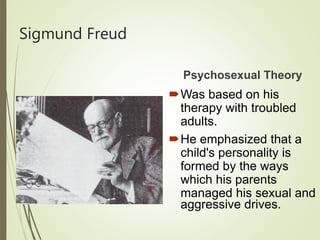
Sigmund Freud
Psychosexual Theory
Was based on his
therapy with troubled
adults.
He emphasized that a
child's personality is
formed by the ways
which his parents
managed his sexual and
aggressive drives.
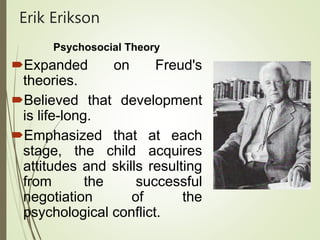
Erik Erikson
Psychosocial Theory
Expanded on Freud's
theories.
Believed that development
is life-long.
Emphasized that at each
stage, the child acquires
attitudes and skills resulting
from the successful
negotiation of the
psychological conflict.
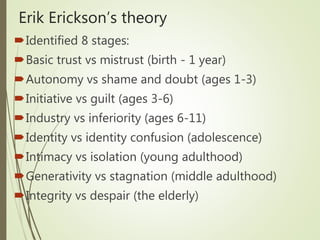
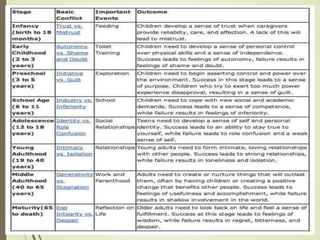
Erik Erickson’s theory
Identified 8 stages:
Basic trust vs mistrust (birth - 1 year)
Autonomy vs shame and doubt (ages 1-3)
Initiative vs guilt (ages 3-6)
Industry vs inferiority (ages 6-11)
Identity vs identity confusion (adolescence)
Intimacy vs isolation (young adulthood)
Generativity vs stagnation (middle adulthood)
Integrity vs despair (the elderly)
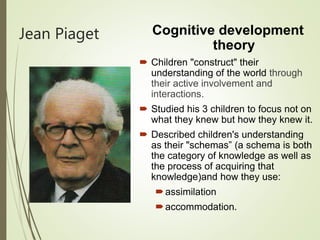
Jean Piaget Cognitive development
theory
 Children "construct" their
understanding of the world through
their active involvement and
interactions.
 Studied his 3 children to focus not on
what they knew but how they knew it.
 Described children's understanding
as their "schemas” (a schema is both
the category of knowledge as well as
the process of acquiring that
knowledge)and how they use:
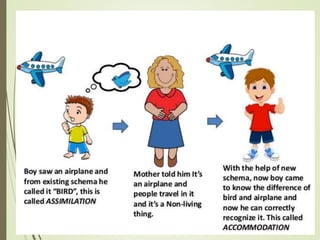
assimilation
accommodation.
Piaget’s Cognitive
Development Stages
 Sensori-motor
Ages birth - 2: the infant uses his senses and motor
abilities to understand the world
 Pre-operation
Ages 2-7: the child uses metal representations of objects
and is able to use symbolic thought and language
 Concrete operations
Ages 7-11; the child uses logical operations or principles
when solving problems
 Formal operations
Ages 12 up; the use of logical operations in a systematic
fashion and with the ability to use abstractions
Lev Vygotsky
Socio-Cultural Theory
 Agreed that children are active
learners, but their knowledge is
socially constructed.
 Cultural values and customs
dictate what is important to learn.
 Children learn from more expert
members of the society.
 Vygotsky described the "zone of
proximal development", where
learning occurs.

Human development slides

  • 1.
  • 2.
    Human Development  Theprocess of growth and change that takes place from birth till death. Study of Human development seeks to understand how and why the people of all ages and circumstances change or remain the same over time. Change in the child that occurs over time. Changes follow an orderly pattern that moves toward greater complexity and enhances survival.
  • 3.
    Periods of HumanDevelopment Infancy from 0-3 years baby toddler We learn to: walk, eat and talk Childhood from 3-11 years child We learn to: read, write and count Adolescence from 12-20 years adolescent Body changes and we study a lot Adulthood from 20-70 years adults Finish studies, work and some have a family Old age from 70 years old
  • 4.
    Domains of Development Developmentis described in three domains, but growth in one domain influences the other domains.  Physical Domain: body size, body proportions, appearance, brain development, motor development, perception capacities, physical health.  Cognitive Domain: thought processes and intellectual abilities including attention, memory, problem solving, imagination, creativity, academic and everyday knowledge, metacognition, and language.  Social/Emotional Domain: self-knowledge (self-esteem, metacognition, sexual identity, ethnic identity), moral reasoning, understanding and expression of emotions, self-regulation, temperament, understanding others, interpersonal skills, and friendships.
  • 5.
    Theories What is atheory? Orderly set of ideas which describe, explain, and predict behavior.  Why are theories important? To give meaning to what we observe. As a basis for action -- finding ways to improve the lives and education of children.
  • 6.
  • 7.
    Sigmund Freud Psychosexual Theory Wasbased on his therapy with troubled adults. He emphasized that a child's personality is formed by the ways which his parents managed his sexual and aggressive drives.
  • 8.
    Erik Erikson Psychosocial Theory Expandedon Freud's theories. Believed that development is life-long. Emphasized that at each stage, the child acquires attitudes and skills resulting from the successful negotiation of the psychological conflict.
  • 9.
    Erik Erickson’s theory Identified8 stages: Basic trust vs mistrust (birth - 1 year) Autonomy vs shame and doubt (ages 1-3) Initiative vs guilt (ages 3-6) Industry vs inferiority (ages 6-11) Identity vs identity confusion (adolescence) Intimacy vs isolation (young adulthood) Generativity vs stagnation (middle adulthood) Integrity vs despair (the elderly)
  • 11.
    Jean Piaget Cognitivedevelopment theory  Children "construct" their understanding of the world through their active involvement and interactions.  Studied his 3 children to focus not on what they knew but how they knew it.  Described children's understanding as their "schemas” (a schema is both the category of knowledge as well as the process of acquiring that knowledge)and how they use: assimilation accommodation.
  • 13.
    Piaget’s Cognitive Development Stages Sensori-motor Ages birth - 2: the infant uses his senses and motor abilities to understand the world  Pre-operation Ages 2-7: the child uses metal representations of objects and is able to use symbolic thought and language  Concrete operations Ages 7-11; the child uses logical operations or principles when solving problems  Formal operations Ages 12 up; the use of logical operations in a systematic fashion and with the ability to use abstractions
  • 14.
    Lev Vygotsky Socio-Cultural Theory Agreed that children are active learners, but their knowledge is socially constructed.  Cultural values and customs dictate what is important to learn.  Children learn from more expert members of the society.  Vygotsky described the "zone of proximal development", where learning occurs.