The Four Stages of Inquiry and Research:  A Student Guide 1.  Preparing for Research 2.  Accessing Resources 3.  Processing Information 4.  Transferring Learning
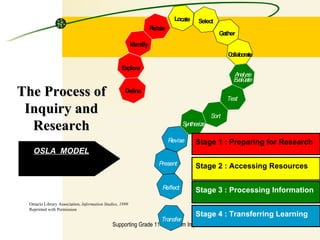
Stage 1 : Preparing for Research Stage 2 : Accessing Resources Stage 3 : Processing Information Stage 4 : Transferring Learning The Process of Inquiry and Research OSLA  MODEL Ontario Library Association,  Information Studies, 1999 Reprinted with Permission R e l a t e E x p l o r e I d e n t i f y D e f i n e L o c a t e G a t h e r S e l e c t C o l l a b o r a t e A n a l y s e E v a l u a t e T e s t S o r t S y n t h e s i z e R e v i s e P r e s e n t R e f l e c t T r a n s f e r
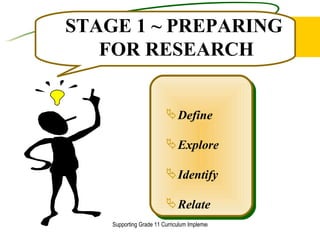
STAGE 1 ~ PREPARING  FOR RESEARCH Define Explore Identify Relate
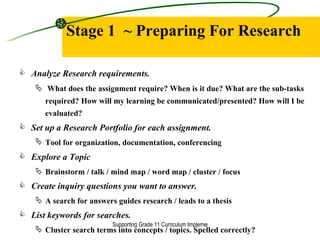
Stage 1  ~ Preparing For Research Analyze Research requirements. What does the assignment require? When is it due? What are the sub-tasks required? How will my learning be communicated/presented? How will I be evaluated?   Set up a Research Portfolio for each assignment. Tool for organization, documentation, conferencing   Explore a Topic Brainstorm / talk / mind map / word map / cluster / focus Create inquiry questions you want to answer.  A search for answers guides research / leads to a thesis List keywords for searches. Cluster search terms into concepts / topics. Spelled correctly?
STAGE 2 ~ ACCESSING RESOURCES Locate Select Gather Collaborate
Stage 2 ~ Accessing Resources Successfully access a wide variety of resources   What  keywords  string together for successful searches? What  tools  can be used to access resources? What information sources  match  your inquiry needs? What are the  best  and  most suitable resources ? Were you able to  use computers  to find resources?
STAGE 3 ~ PROCESSING INFORMATION Analyze /Evaluate Test Sort Synthesize
Stage  3  PROCESSING INFORMATION Key Questions 1)   How do I  identify information  that is  relevant ? 2)   How do I  extract relevant  information?  3)   What are the  qualities of good  notes?  4)   What is  honest  use of information? 5)   What is  dishonest  use of information?
Before you start processing Review your assignment again! Are you sure you know what the assignment requires?  Review the length and scope of the assignment. Review the due dates. Review how you will be evaluated. How will you  present the results  of your research?
Before you start processing Review the mission of your  task again! Review Stage 1:  Preparing What is your Focus -  topic  and  research question ? What did an  overview  tell you about your topic? How did you break your topic into  smaller parts ? Did you have to choose a  thesis  to research?
Before you gather information Review Stage 2:  Accessing Resources   Look over the list of possible resources.   -Books -Newspapers -Internet   -Online Databases -Experts -Places to visit What information sources  matched  your info needs? What were the  best  and  most suitable resources ? Were you able to  use computers  to find resources?
Stage 3 ~   Processing Information THINK CRITICALLY AS YOU LISTEN OBSERVE READ  VIEW REFLECT Question the  relevance  of the information. Question the  accuracy  of the information. Question the  authority   of the information. Question the  point-of-view  of the information. Question the  fairness  of the information. ACTIVELY INTERACT WITH THE INFORMATION
What is the mission for your information search? How do you decide what is relevant ? The information links directly to sub-topics. It fits into a note-gathering chart. Be prepared to skip what you don’t need. Decide what is critical to your mission. Every note  must be  related to your mission.
HOW TO RECORD INFORMATION Record from a selection of suitable resources: videos, paintings, field trips, books, interviews, surveys, internet, electronic databases Record information in different ways: quality jot notes, diagrams, graphs, charts, numbers, graphic organizers Record balanced views.  Record main ideas. Record reflections. RECORD ALL SOURCES! You may own a note but not the source!
EVERY NOTE MUST BE RELATED  TO YOUR  INFORMATION NEEDS. RECORD YOUR OWN IDEAS  AS YOU THINK OF THEM.
IMPOSE LIMITS There is a time to stop searching and recording. Review your progress and fill in any gaps. There is a time to start preparing your final product.   In this era of  Information  learn to sift through masses of information to meet your needs.
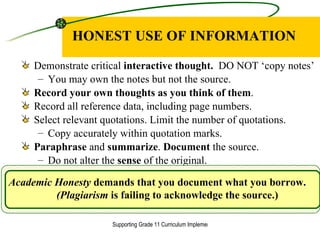
HONEST USE OF INFORMATION Demonstrate critical  interactive thought.  DO NOT ‘copy notes’ You may own the notes but not the source. Record your own thoughts as you think of them . Record all reference data, including page numbers. Select relevant quotations. Limit the number of quotations. Copy accurately within quotation marks. Paraphrase  and  summarize .  Document  the source. Do not alter the  sense  of the original. Academic Honesty  demands that you document what you borrow. (Plagiarism  is failing to acknowledge the source.)
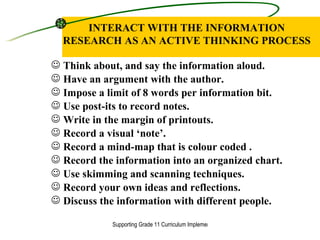
INTERACT WITH THE INFORMATION RESEARCH AS AN ACTIVE THINKING PROCESS Think about, and say the information aloud. Have an argument with the author. Impose a limit of 8 words per information bit. Use post-its to record notes. Write in the margin of printouts. Record a visual ‘note’. Record a mind-map that is colour coded . Record the information into an organized chart. Use skimming and scanning techniques.  Record your own ideas and reflections. Discuss the information with different people.
STAGE 4: TRANSFERRING LEARNING Revise Present Reflect Transfer
Transferring Learning   Consider Needs and Constraints of: The assignment: requirements/evaluation Time:  preparation/presentation Resources: equipment Format:  visuals, oral,written, electronic /combination) Audio-visual aids Software tools/ techniques Tap strengths and interests Organize presentation Practice  presentation skills:  voice, gestures, eye contact, Demonstrate knowledge of topic based on solid research and thought Demonstrate use of communications technologies STAGE 4 Audience is the Key
Reflection:   Building for Transfer How well did I organize my research and time? What were the main strengths of my inquiry? What were the problems? How did I solve them? Did I use all the resources I might have? How well did I use computers for learning? How well did I work with others? … on my own? Did I document my sources accurately and correctly? In what ways was this research important to me? What new topics would I like to explore? How will I apply what I learned to other inquiries?
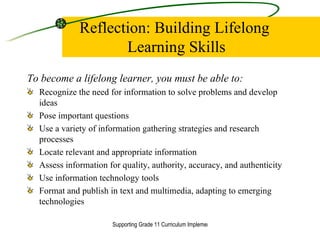
Reflection: Building Lifelong  Learning Skills To become a lifelong learner, you must be able to: Recognize the need for information to solve problems and develop ideas Pose important questions Use a variety of information gathering strategies and research processes Locate relevant and appropriate information Assess information for quality, authority, accuracy, and authenticity Use information technology tools Format and publish in text and multimedia, adapting to emerging technologies

Teaching Research Skills

  • 1.
    The Four Stagesof Inquiry and Research: A Student Guide 1. Preparing for Research 2. Accessing Resources 3. Processing Information 4. Transferring Learning
  • 2.
    Stage 1 :Preparing for Research Stage 2 : Accessing Resources Stage 3 : Processing Information Stage 4 : Transferring Learning The Process of Inquiry and Research OSLA MODEL Ontario Library Association, Information Studies, 1999 Reprinted with Permission R e l a t e E x p l o r e I d e n t i f y D e f i n e L o c a t e G a t h e r S e l e c t C o l l a b o r a t e A n a l y s e E v a l u a t e T e s t S o r t S y n t h e s i z e R e v i s e P r e s e n t R e f l e c t T r a n s f e r
  • 3.
    STAGE 1 ~PREPARING FOR RESEARCH Define Explore Identify Relate
  • 4.
    Stage 1 ~ Preparing For Research Analyze Research requirements. What does the assignment require? When is it due? What are the sub-tasks required? How will my learning be communicated/presented? How will I be evaluated? Set up a Research Portfolio for each assignment. Tool for organization, documentation, conferencing Explore a Topic Brainstorm / talk / mind map / word map / cluster / focus Create inquiry questions you want to answer. A search for answers guides research / leads to a thesis List keywords for searches. Cluster search terms into concepts / topics. Spelled correctly?
  • 5.
    STAGE 2 ~ACCESSING RESOURCES Locate Select Gather Collaborate
  • 6.
    Stage 2 ~Accessing Resources Successfully access a wide variety of resources What keywords string together for successful searches? What tools can be used to access resources? What information sources match your inquiry needs? What are the best and most suitable resources ? Were you able to use computers to find resources?
  • 7.
    STAGE 3 ~PROCESSING INFORMATION Analyze /Evaluate Test Sort Synthesize
  • 8.
    Stage 3 PROCESSING INFORMATION Key Questions 1) How do I identify information that is relevant ? 2) How do I extract relevant information? 3) What are the qualities of good notes? 4) What is honest use of information? 5) What is dishonest use of information?
  • 9.
    Before you startprocessing Review your assignment again! Are you sure you know what the assignment requires? Review the length and scope of the assignment. Review the due dates. Review how you will be evaluated. How will you present the results of your research?
  • 10.
    Before you startprocessing Review the mission of your task again! Review Stage 1: Preparing What is your Focus - topic and research question ? What did an overview tell you about your topic? How did you break your topic into smaller parts ? Did you have to choose a thesis to research?
  • 11.
    Before you gatherinformation Review Stage 2: Accessing Resources Look over the list of possible resources. -Books -Newspapers -Internet -Online Databases -Experts -Places to visit What information sources matched your info needs? What were the best and most suitable resources ? Were you able to use computers to find resources?
  • 12.
    Stage 3 ~ Processing Information THINK CRITICALLY AS YOU LISTEN OBSERVE READ VIEW REFLECT Question the relevance of the information. Question the accuracy of the information. Question the authority of the information. Question the point-of-view of the information. Question the fairness of the information. ACTIVELY INTERACT WITH THE INFORMATION
  • 13.
    What is themission for your information search? How do you decide what is relevant ? The information links directly to sub-topics. It fits into a note-gathering chart. Be prepared to skip what you don’t need. Decide what is critical to your mission. Every note must be related to your mission.
  • 14.
    HOW TO RECORDINFORMATION Record from a selection of suitable resources: videos, paintings, field trips, books, interviews, surveys, internet, electronic databases Record information in different ways: quality jot notes, diagrams, graphs, charts, numbers, graphic organizers Record balanced views. Record main ideas. Record reflections. RECORD ALL SOURCES! You may own a note but not the source!
  • 15.
    EVERY NOTE MUSTBE RELATED TO YOUR INFORMATION NEEDS. RECORD YOUR OWN IDEAS AS YOU THINK OF THEM.
  • 16.
    IMPOSE LIMITS Thereis a time to stop searching and recording. Review your progress and fill in any gaps. There is a time to start preparing your final product. In this era of Information learn to sift through masses of information to meet your needs.
  • 17.
    HONEST USE OFINFORMATION Demonstrate critical interactive thought. DO NOT ‘copy notes’ You may own the notes but not the source. Record your own thoughts as you think of them . Record all reference data, including page numbers. Select relevant quotations. Limit the number of quotations. Copy accurately within quotation marks. Paraphrase and summarize . Document the source. Do not alter the sense of the original. Academic Honesty demands that you document what you borrow. (Plagiarism is failing to acknowledge the source.)
  • 18.
    INTERACT WITH THEINFORMATION RESEARCH AS AN ACTIVE THINKING PROCESS Think about, and say the information aloud. Have an argument with the author. Impose a limit of 8 words per information bit. Use post-its to record notes. Write in the margin of printouts. Record a visual ‘note’. Record a mind-map that is colour coded . Record the information into an organized chart. Use skimming and scanning techniques. Record your own ideas and reflections. Discuss the information with different people.
  • 19.
    STAGE 4: TRANSFERRINGLEARNING Revise Present Reflect Transfer
  • 20.
    Transferring Learning Consider Needs and Constraints of: The assignment: requirements/evaluation Time: preparation/presentation Resources: equipment Format: visuals, oral,written, electronic /combination) Audio-visual aids Software tools/ techniques Tap strengths and interests Organize presentation Practice presentation skills: voice, gestures, eye contact, Demonstrate knowledge of topic based on solid research and thought Demonstrate use of communications technologies STAGE 4 Audience is the Key
  • 21.
    Reflection: Building for Transfer How well did I organize my research and time? What were the main strengths of my inquiry? What were the problems? How did I solve them? Did I use all the resources I might have? How well did I use computers for learning? How well did I work with others? … on my own? Did I document my sources accurately and correctly? In what ways was this research important to me? What new topics would I like to explore? How will I apply what I learned to other inquiries?
  • 22.
    Reflection: Building Lifelong Learning Skills To become a lifelong learner, you must be able to: Recognize the need for information to solve problems and develop ideas Pose important questions Use a variety of information gathering strategies and research processes Locate relevant and appropriate information Assess information for quality, authority, accuracy, and authenticity Use information technology tools Format and publish in text and multimedia, adapting to emerging technologies