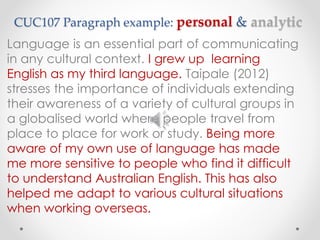
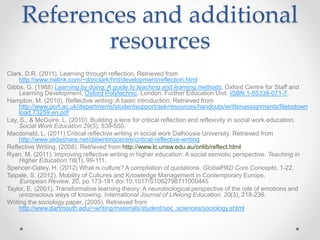
This document provides guidance on critical reflection and critical reflective writing. It defines critical reflection as analyzing one's thoughts, feelings and beliefs by considering social and cultural contexts. This enables transformative learning by linking reason and emotion. Critical reflection is important for developing effective thinking by encouraging assumption analysis, contextual awareness, imaginative speculation and reflective skepticism. The document then outlines the key components of critical reflective writing such as description, analysis and implications. It provides models for structuring reflective writing, including the DEAL model of describe, examine and articulate learning. Language use, expectations, and references are also discussed.