TYPES OF CURRICULUM
BY
DR.SHAZIA ZAMIR
DEPT OF EDUCATION
NUML
Curriculum
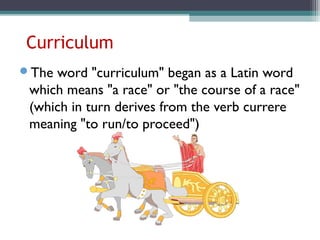
The word "curriculum" began as a Latin word
which means "a race" or "the course of a race"
(which in turn derives from the verb currere
meaning "to run/to proceed")
Components of a CurriculumComponents of a Curriculum
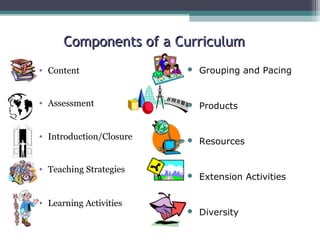
• Content
• Assessment
• Introduction/Closure
• Teaching Strategies
• Learning Activities
 Grouping and Pacing
 Products
 Resources
 Extension Activities
 Diversity
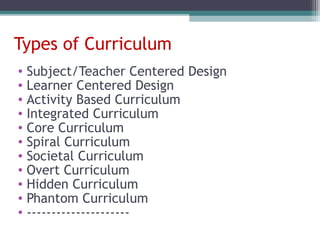
Types of Curriculum
• Subject/Teacher Centered Design
• Learner Centered Design
• Activity Based Curriculum
• Integrated Curriculum
• Core Curriculum
• Spiral Curriculum
• Societal Curriculum
• Overt Curriculum
• Hidden Curriculum
• Phantom Curriculum
• ---------------------
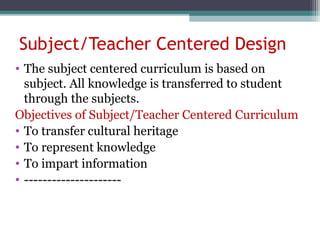
Subject/Teacher Centered Design
• The subject centered curriculum is based on
subject. All knowledge is transferred to student
through the subjects.
Objectives of Subject/Teacher Centered Curriculum
• To transfer cultural heritage
• To represent knowledge
• To impart information
• ---------------------
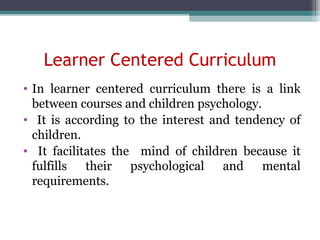
Learner Centered Curriculum
• In learner centered curriculum there is a link
between courses and children psychology.
• It is according to the interest and tendency of
children.
• It facilitates the mind of children because it
fulfills their psychological and mental
requirements.
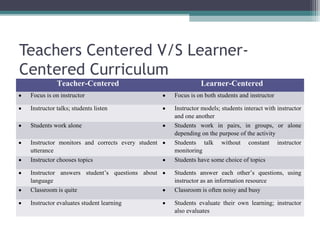
Teachers Centered V/S Learner-
Centered Curriculum
Teacher-Centered Learner-Centered
• Focus is on instructor • Focus is on both students and instructor
• Instructor talks; students listen • Instructor models; students interact with instructor
and one another
• Students work alone • Students work in pairs, in groups, or alone
depending on the purpose of the activity
• Instructor monitors and corrects every student
utterance
• Students talk without constant instructor
monitoring
• Instructor chooses topics • Students have some choice of topics
• Instructor answers student’s questions about
language
• Students answer each other’s questions, using
instructor as an information resource
• Classroom is quite • Classroom is often noisy and busy
• Instructor evaluates student learning • Students evaluate their own learning; instructor
also evaluates
Activity Based Curriculum
• Active Learning is, in short, anything that students do in
a classroom other than merely passively listening to an
instructor's lecture.
• This includes everything from listening practices which
help the students to absorb what they hear, to short
writing exercises in which students react to lecture
material, to complex group exercises in which students
apply course material to "real life" situations and/or to
new problems.
Integrated Curriculum
• Integrated curriculum refers to a non-
compartmentalized approach, e.g.
In general science learning, as opposed to separate
subjects such as
▫ Physics,
▫ Chemistry and
▫ Biology
Core Curriculum
• ‘Core’ refers to the ‘heart’ of experiences every
learner must go through. Or
• Fundamental knowledge that all students are
required to learn in school.
• A core curriculum is a curriculum which is
considered central and usually made mandatory for
all students of a school or school system.
e.g As in mathematics all pupils need to acquire
proficiency in addition, subtraction, multiplication,
and division.
Spiral Curriculum
Bruner (1960) wrote, “A curriculum as it develops
should revisit this basic ideas repeatedly,
building upon them until the student has
grasped the full formal apparatus that goes with
them”
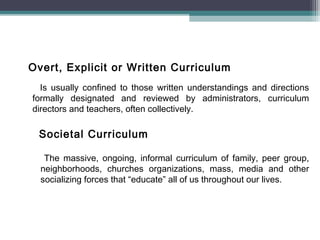
Overt, Explicit or Written Curriculum
Is usually confined to those written understandings and directions
formally designated and reviewed by administrators, curriculum
directors and teachers, often collectively.
Societal Curriculum
The massive, ongoing, informal curriculum of family, peer group,
neighborhoods, churches organizations, mass, media and other
socializing forces that “educate” all of us throughout our lives.
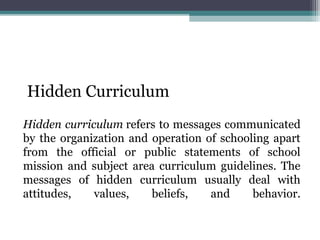
Hidden Curriculum
Hidden curriculum refers to messages communicated
by the organization and operation of schooling apart
from the official or public statements of school
mission and subject area curriculum guidelines. The
messages of hidden curriculum usually deal with
attitudes, values, beliefs, and behavior.
Phantom Curriculum
The messages prevalent in an through
exposure to any type of media. These
components and messages play a major
part in the enculturation of students into the
predominant meta-culture.

Types of curriculum lecture 4

  • 1.
    TYPES OF CURRICULUM BY DR.SHAZIAZAMIR DEPT OF EDUCATION NUML
  • 2.
    Curriculum The word "curriculum"began as a Latin word which means "a race" or "the course of a race" (which in turn derives from the verb currere meaning "to run/to proceed")
  • 3.
    Components of aCurriculumComponents of a Curriculum • Content • Assessment • Introduction/Closure • Teaching Strategies • Learning Activities  Grouping and Pacing  Products  Resources  Extension Activities  Diversity
  • 4.
    Types of Curriculum •Subject/Teacher Centered Design • Learner Centered Design • Activity Based Curriculum • Integrated Curriculum • Core Curriculum • Spiral Curriculum • Societal Curriculum • Overt Curriculum • Hidden Curriculum • Phantom Curriculum • ---------------------
  • 5.
    Subject/Teacher Centered Design •The subject centered curriculum is based on subject. All knowledge is transferred to student through the subjects. Objectives of Subject/Teacher Centered Curriculum • To transfer cultural heritage • To represent knowledge • To impart information • ---------------------
  • 6.
    Learner Centered Curriculum •In learner centered curriculum there is a link between courses and children psychology. • It is according to the interest and tendency of children. • It facilitates the mind of children because it fulfills their psychological and mental requirements.
  • 7.
    Teachers Centered V/SLearner- Centered Curriculum Teacher-Centered Learner-Centered • Focus is on instructor • Focus is on both students and instructor • Instructor talks; students listen • Instructor models; students interact with instructor and one another • Students work alone • Students work in pairs, in groups, or alone depending on the purpose of the activity • Instructor monitors and corrects every student utterance • Students talk without constant instructor monitoring • Instructor chooses topics • Students have some choice of topics • Instructor answers student’s questions about language • Students answer each other’s questions, using instructor as an information resource • Classroom is quite • Classroom is often noisy and busy • Instructor evaluates student learning • Students evaluate their own learning; instructor also evaluates
  • 8.
    Activity Based Curriculum •Active Learning is, in short, anything that students do in a classroom other than merely passively listening to an instructor's lecture. • This includes everything from listening practices which help the students to absorb what they hear, to short writing exercises in which students react to lecture material, to complex group exercises in which students apply course material to "real life" situations and/or to new problems.
  • 9.
    Integrated Curriculum • Integratedcurriculum refers to a non- compartmentalized approach, e.g. In general science learning, as opposed to separate subjects such as ▫ Physics, ▫ Chemistry and ▫ Biology
  • 10.
    Core Curriculum • ‘Core’refers to the ‘heart’ of experiences every learner must go through. Or • Fundamental knowledge that all students are required to learn in school. • A core curriculum is a curriculum which is considered central and usually made mandatory for all students of a school or school system. e.g As in mathematics all pupils need to acquire proficiency in addition, subtraction, multiplication, and division.
  • 11.
    Spiral Curriculum Bruner (1960)wrote, “A curriculum as it develops should revisit this basic ideas repeatedly, building upon them until the student has grasped the full formal apparatus that goes with them”
  • 12.
    Overt, Explicit orWritten Curriculum Is usually confined to those written understandings and directions formally designated and reviewed by administrators, curriculum directors and teachers, often collectively. Societal Curriculum The massive, ongoing, informal curriculum of family, peer group, neighborhoods, churches organizations, mass, media and other socializing forces that “educate” all of us throughout our lives.
  • 13.
    Hidden Curriculum Hidden curriculumrefers to messages communicated by the organization and operation of schooling apart from the official or public statements of school mission and subject area curriculum guidelines. The messages of hidden curriculum usually deal with attitudes, values, beliefs, and behavior.
  • 14.
    Phantom Curriculum The messagesprevalent in an through exposure to any type of media. These components and messages play a major part in the enculturation of students into the predominant meta-culture.

Editor's Notes

  • #3 Elapsed Time Content Objective Related Information Teaching Method Constructivist Learning Activity Examples Anecdote /Cartoon/Quotation/Joke
  • #4 Elapsed Time Content Objective Related Information Teaching Method Constructivist Learning Activity Examples Anecdote /Cartoon/Quotation/Joke