Powerpoint Templates Page 1
Data Collection
in
Qualitative Research
Prepared by:
Ladie M. Ballesteros, Ed.D.
Powerpoint Templates Page 2
Objectives
• Differentiate data collection in quantitative
and qualitative research
• Discuss the main techniques to collect
qualitative data
Powerpoint Templates Page 3
• technique for
physically
obtaining data to
be analyzed in a
research study
Powerpoint Templates Page 4
In qualitative research, the process of data
collection and analysis is a dauntingenterprise.
(Lichtman, 2010)
Powerpoint Templates Page 5
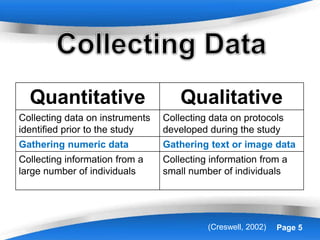
Quantitative Qualitative
Collecting data on instruments
identified prior to the study
Collecting data on protocols
developed during the study
Gathering numeric data Gathering text or image data
Collecting information from a
large number of individuals
Collecting information from a
small number of individuals
(Creswell, 2002)
Powerpoint Templates Page 6
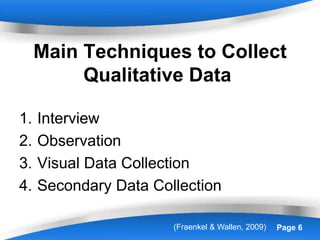
Main Techniques to Collect
Qualitative Data
1. Interview
2. Observation
3. Visual Data Collection
4. Secondary Data Collection
(Fraenkel & Wallen, 2009)
Powerpoint Templates Page 7
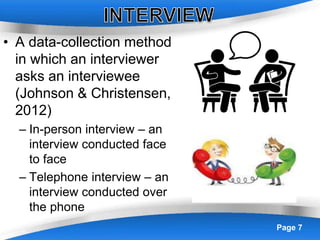
• A data-collection method
in which an interviewer
asks an interviewee
(Johnson & Christensen,
2012)
– In-person interview – an
interview conducted face
to face
– Telephone interview – an
interview conducted over
the phone
Powerpoint Templates Page 8
• a general term used to describe a group of
methods that permits the researcher to
engage in a dialogue or conversation with
the participant (Lichtman, 2010)
(Lichtman, 2010)
Powerpoint Templates Page 9
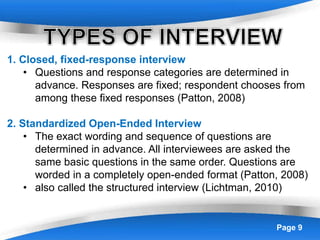
1. Closed, fixed-response interview
• Questions and response categories are determined in
advance. Responses are fixed; respondent chooses from
among these fixed responses (Patton, 2008)
2. Standardized Open-Ended Interview
• The exact wording and sequence of questions are
determined in advance. All interviewees are asked the
same basic questions in the same order. Questions are
worded in a completely open-ended format (Patton, 2008)
• also called the structured interview (Lichtman, 2010)
Powerpoint Templates Page 10
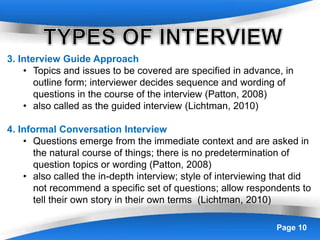
3. Interview Guide Approach
• Topics and issues to be covered are specified in advance, in
outline form; interviewer decides sequence and wording of
questions in the course of the interview (Patton, 2008)
• also called as the guided interview (Lichtman, 2010)
4. Informal Conversation Interview
• Questions emerge from the immediate context and are asked in
the natural course of things; there is no predetermination of
question topics or wording (Patton, 2008)
• also called the in-depth interview; style of interviewing that did
not recommend a specific set of questions; allow respondents to
tell their own story in their own terms (Lichtman, 2010)
Powerpoint Templates Page 11
• A type of qualitative interview that is being
described as a conversation between the
interviewer and participant in which the
interviewer hears what the participant has to
say in his own words, in his voice, with his
language and narrative.
(Lichtman, 2010)
Powerpoint Templates Page 12
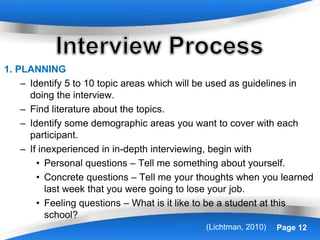
1. PLANNING
– Identify 5 to 10 topic areas which will be used as guidelines in
doing the interview.
– Find literature about the topics.
– Identify some demographic areas you want to cover with each
participant.
– If inexperienced in in-depth interviewing, begin with
• Personal questions – Tell me something about yourself.
• Concrete questions – Tell me your thoughts when you learned
last week that you were going to lose your job.
• Feeling questions – What is it like to be a student at this
school?
(Lichtman, 2010)
Powerpoint Templates Page 13
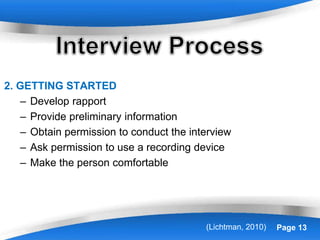
2. GETTING STARTED
– Develop rapport
– Provide preliminary information
– Obtain permission to conduct the interview
– Ask permission to use a recording device
– Make the person comfortable
(Lichtman, 2010)
Powerpoint Templates Page 14
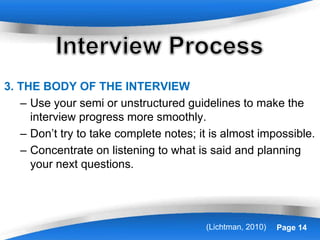
3. THE BODY OF THE INTERVIEW
– Use your semi or unstructured guidelines to make the
interview progress more smoothly.
– Don’t try to take complete notes; it is almost impossible.
– Concentrate on listening to what is said and planning
your next questions.
(Lichtman, 2010)
Powerpoint Templates Page 15
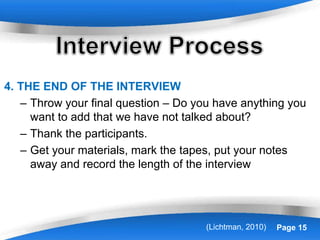
4. THE END OF THE INTERVIEW
– Throw your final question – Do you have anything you
want to add that we have not talked about?
– Thank the participants.
– Get your materials, mark the tapes, put your notes
away and record the length of the interview
(Lichtman, 2010)
Powerpoint Templates Page 16
1. Grand Tour Question – this type of question is very
general and is a good way to begin because it gets the
participants talking to you
– Tell me about yourself.
– Tell me what being in school is like for you.
– What can you say about going to ABC National High
School?
(Lichtman, 2010)
Powerpoint Templates Page 17
2. Specific or Concrete Example Question – this type of
questions gives the participant an opportunity to
provide relevant information because it is personal and
immediate
– What was something that happened last week that you
think contributes to your stress?
– Tell me something that happened at this school that
you think is a direct result of the new Site-Based
Management Plan
(Lichtman, 2010)
Powerpoint Templates Page 18
3. Comparison/Contrast Question – this type of question
challenges the participant to think about other times,
situations, places, events, or people and draw
comparisons between them
– How are things at this school now compared to when
Mr. X was principal?
– How could you compare what you are doing now to
what you did in the past?
(Lichtman, 2010)
Powerpoint Templates Page 19
4. New Elements/Topics Question – this type of
questions are used when shifting to a new topic
especially if the participant is “stuck” on a particular
things and keeps repeating information
– We’ve talked for a while about discipline in the schools.
Are there other aspects of working in school you would
like to discuss?
– Let’s look at some other areas we haven’t yet covered.
What do you think about ______?
(Lichtman, 2010)
Powerpoint Templates Page 20
5. Closing Question – this type of question provides a
chance for the participant to add anything else that has
not been mentioned.
– Can you think of anything else you would like to say
about working in a school?
– Is there anything else you would like to add to what you
have already said?
(Lichtman, 2010)
Powerpoint Templates Page 21
1. Elaboration – this strategy provides an opportunity
for the participant to say more, to clarify and elucidate
his/her responses, and allow additional input by the
participant
– You’ve talked about your frustration working with your
new principal. What else can you say about why you
feel frustrated?
– You said that you feel happy working with a new group
of classmates. What kinds of things made you happy?
(Lichtman, 2010)
Powerpoint Templates Page 22
2. Probing – this strategy provides the interviewer a chance
to try to get the underlying meaning of what is said; the
emphasis is on digging down deeper into the feelings
– Can you tell me some more about that?
– I see. What do you mean by _______?
– Hmm. What else can you say about?
– That’d good. I am not sure I understand when you say
________.Can you explain more fully?
– Let’s talk about that in more detail.
(Lichtman, 2010)
Powerpoint Templates Page 23
3. Non-directional – this strategy puts the interviewer in
a neutral position
– GOOD – We have talked about being a graduate
student. What is the experience like for you?
– AVOID – We have talked about being a graduate
student. Don’t you agree with me that it is frustrating
because you have so little time to do everything?
(Lichtman, 2010)
Powerpoint Templates Page 24
2. One Question at a Time – Ask one question at a time.
– GOOD – Let’s talk about being in graduate school. Tell
me about the experience.
– AVOID – Let’s talk some more about being in graduate
school. What courses are you taking? What is your
major? Why do you think you decided to return to
graduate school?
(Lichtman, 2010)
Powerpoint Templates Page 25
5. Special Areas of Concern
• Encourage the respondent to tell her story in her own
words. Be aware of when to cut the respondent off and
when not to cut the respondent off
(Lichtman, 2010)
Powerpoint Templates Page 26
1. Develop rapport
2. Use a recorder and have a note pad to jot down notes
3. Make eye contact
4. Ask open-ended questions
5. Provide an atmosphere for respondents to tell their own story in their own terms
6. Remain unobstrusive
7. Phrase questions in a general and non-directive manner.
8. Avoid leading questions
9. Use some questioning strategies, such as repeating the last word of the response
or lifting an eyebrow
10.Make sure you get specific and detailed information
11.Avoid jargon or situations that are too technical.
12.Make sure you have enough discussion about the key issues to use later for data
analysis
(Lichtman, 2010)
Powerpoint Templates Page 27
1. Don’t depend on your memory. Write it down.
2. Don’t answer questions for respondents.
3. Don’t ask 3 or 4 questions as the same time.
4. Don’t ask a question and then provide the answer (“I
agree that such and such is a good thing”)
5. Don’t stop the respondent in the middle of the
conversation
6. Don’t allow the respondent to spend too much time on
one topic
7. Don’t act nervous or uninterested
(Lichtman, 2010)
Powerpoint Templates Page 28
• A focus group interview is a type
of interview in which a moderator
leads a discussion with a small
group of individuals to examine, in
detail, how the group members
think and feel about a topic.
(Fraenkel & Wallen, 2009)
Powerpoint Templates Page 29(Lichtman, 2010)
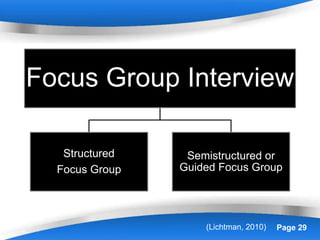
Focus Group Interview
Structured
Focus Group
Semistructured or
Guided Focus Group
Powerpoint Templates Page 30(Lichtman, 2010)
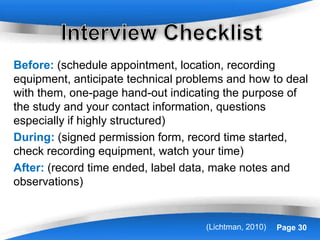
Before: (schedule appointment, location, recording
equipment, anticipate technical problems and how to deal
with them, one-page hand-out indicating the purpose of
the study and your contact information, questions
especially if highly structured)
During: (signed permission form, record time started,
check recording equipment, watch your time)
After: (record time ended, label data, make notes and
observations)
Powerpoint Templates Page 31(Creswell, 2002)
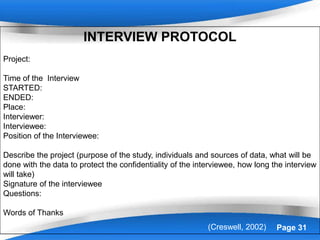
INTERVIEW PROTOCOL
Project:
Time of the Interview
STARTED:
ENDED:
Place:
Interviewer:
Interviewee:
Position of the Interviewee:
Describe the project (purpose of the study, individuals and sources of data, what will be
done with the data to protect the confidentiality of the interviewee, how long the interview
will take)
Signature of the interviewee
Questions:
Words of Thanks
Powerpoint Templates Page 32(Rosal, 2014)
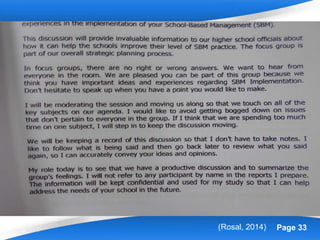
Powerpoint Templates Page 33(Rosal, 2014)
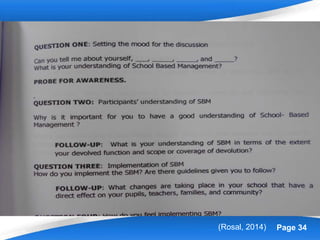
Powerpoint Templates Page 34(Rosal, 2014)
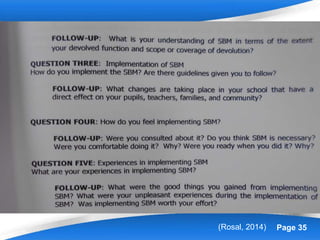
Powerpoint Templates Page 35(Rosal, 2014)
Powerpoint Templates Page 36
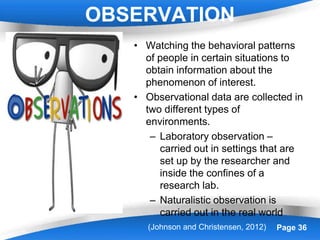
OBSERVATION
• Watching the behavioral patterns
of people in certain situations to
obtain information about the
phenomenon of interest.
• Observational data are collected in
two different types of
environments.
– Laboratory observation –
carried out in settings that are
set up by the researcher and
inside the confines of a
research lab.
– Naturalistic observation is
carried out in the real world
(Johnson and Christensen, 2012)
Powerpoint Templates Page 37
1. Formal Group– these same people come
together regulary
2. Informal Group – members are in contact with
each other, but members may move in and out
3. Occasional Group – people who might come
together once or a number of times but whose
membership is constantly shifting
(Lichthman, 2010)
Powerpoint Templates Page 38
1. Complete participant – researcher becomes member of
group being studied and does not tell members they are
being studied
2. Participant-as-observer – researcher spends extended
time with the group as an insider and tells members they
are being studied
3. Observer-as-participant – researcher spends a limited
amount of time of observing group members and tells
members they are being studied
4. Complete observer – researcher observes an outsider
and does not tell people they are being observed
(Johnson and Christensen, 2012)
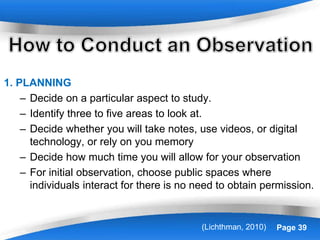
Powerpoint Templates Page 39
1. PLANNING
– Decide on a particular aspect to study.
– Identify three to five areas to look at.
– Decide whether you will take notes, use videos, or digital
technology, or rely on you memory
– Decide how much time you will allow for your observation
– For initial observation, choose public spaces where
individuals interact for there is no need to obtain permission.
(Lichthman, 2010)
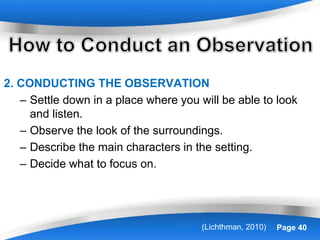
Powerpoint Templates Page 40
2. CONDUCTING THE OBSERVATION
– Settle down in a place where you will be able to look
and listen.
– Observe the look of the surroundings.
– Describe the main characters in the setting.
– Decide what to focus on.
(Lichthman, 2010)
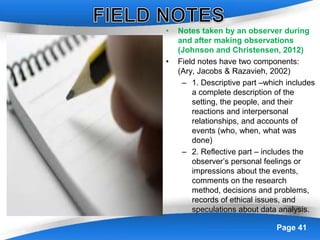
Powerpoint Templates Page 41
• Notes taken by an observer during
and after making observations
(Johnson and Christensen, 2012)
• Field notes have two components:
(Ary, Jacobs & Razavieh, 2002)
– 1. Descriptive part –which includes
a complete description of the
setting, the people, and their
reactions and interpersonal
relationships, and accounts of
events (who, when, what was
done)
– 2. Reflective part – includes the
observer’s personal feelings or
impressions about the events,
comments on the research
method, decisions and problems,
records of ethical issues, and
speculations about data analysis.
Powerpoint Templates Page 42From Qualitative Research for Education (3rd Ed. P.p 109-111)
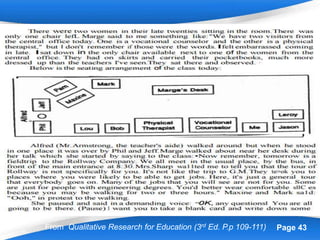
Powerpoint Templates Page 43From Qualitative Research for Education (3rd Ed. P.p 109-111)
Powerpoint Templates Page 44
 Reactivity – changes that occur in
people because they know they
are being observed (Johnson and
Christensen, 2012)
 Front stage behavior (what
people want or allow us to see)
rather than backstage behavior
(what people say and do only with
their closest friends) (Johnson
and Christensen, 2012)
 Observer bias – no matter how
hard observers try to be impartial,
their observations possess some
degree of bias (Fraenkel and
Wallen, 2009)
Powerpoint Templates Page 45
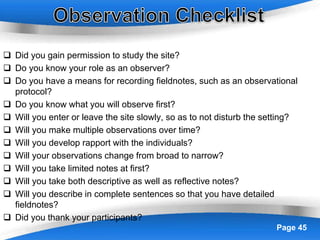
 Did you gain permission to study the site?
 Do you know your role as an observer?
 Do you have a means for recording fieldnotes, such as an observational
protocol?
 Do you know what you will observe first?
 Will you enter or leave the site slowly, so as to not disturb the setting?
 Will you make multiple observations over time?
 Will you develop rapport with the individuals?
 Will your observations change from broad to narrow?
 Will you take limited notes at first?
 Will you take both descriptive as well as reflective notes?
 Will you describe in complete sentences so that you have detailed
fieldnotes?
 Did you thank your participants?
Powerpoint Templates Page 46
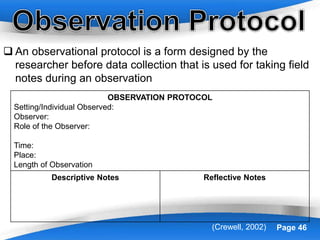
 An observational protocol is a form designed by the
researcher before data collection that is used for taking field
notes during an observation
OBSERVATION PROTOCOL
Setting/Individual Observed:
Observer:
Role of the Observer:
Time:
Place:
Length of Observation
Descriptive Notes Reflective Notes
(Crewell, 2002)
Powerpoint Templates Page 47
• Process of collecting data using visual sources, such as
photographs, drawings, graphics, paintings, film, and
video
(Johnson and Christensen, 2012)
Powerpoint Templates Page 48
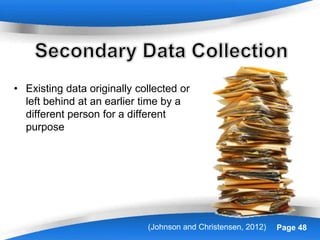
• Existing data originally collected or
left behind at an earlier time by a
different person for a different
purpose
(Johnson and Christensen, 2012)
Powerpoint Templates Page 49(Johnson and Christensen, 2012)
1. Personal Documents - Anything written, photographed, or recorded
for private purposes (letters, diaries, correspondence, family videos,
pictures)
2. Official Documents – anything written, photographed, or recorded
by an organization (newspapers, educational journals, magazines,
school curriculum guides, annual reports, minutes of school board
meetings, student records, student work, books, year books,
published articles, speeches, personnel files, news videos, program
videos, advertisement videos)
3. Physical Data – any material thing created or left by humans that
might provide information about a phenomenon of interest to a
researcher
4. Archived Research Data – data originally used for research
purposes and then stored (census data)
Powerpoint Templates Page 50
Suggested Methods of Data
Collection
1. Phenomenology – in-depth interview
2. Ethnography – observation
3. Case study – eclectic
4. Grounded Theory – interview and
observation
Powerpoint Templates Page 51
DATA COLLECTION AND DATA
ANALYSIS (Creswell, 2002)
Characteristics
• Simultaneous – data collection and analysis are
simultaneous activities
• Iterative – there is a cycle back and forth between
data collection and analysis
• Inductive in form – from particular – the detailed
data (transcriptions or typed notes from
interviews) – to the general – codes and themes
Powerpoint Templates Page 52
DATA COLLECTION AND DATA
ANALYSIS (Creswell, 2002)
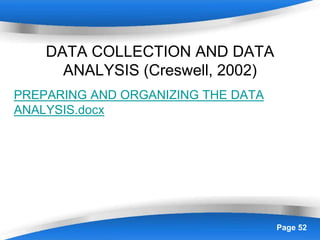
PREPARING AND ORGANIZING THE DATA
ANALYSIS.docx
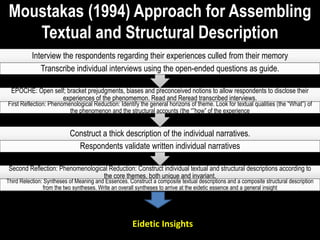
Moustakas (1994) Approach for Assembling
Textual and Structural Description
Second Reflection: Phenomenological Reduction: Construct individual textual and structural descriptions according to
the core themes, both unique and invariant.
Third Relection: Syntheses of Meaning and Essences. Construct a composite textual descriptions and a composite structural description
from the two syntheses. Write an overall syntheses to arrive at the eidetic essence and a general insight
Construct a thick description of the individual narratives.
Respondents validate written individual narratives
EPOCHE: Open self; bracket prejudgments, biases and preconceived notions to allow respondents to disclose their
experiences of the phenomemon. Read and Reread transcribed interviews.
First Reflection: Phenomenological Reduction: Identify the general horizons of theme. Look for textual qualities (the “What”) of
the phenomenon and the structural accounts (the “”how” of the experience
Interview the respondents regarding their experiences culled from their memory
Transcribe individual interviews using the open-ended questions as guide.
Eidetic Insights

Data Collection in Qualitative Research

  • 1.
    Powerpoint Templates Page1 Data Collection in Qualitative Research Prepared by: Ladie M. Ballesteros, Ed.D.
  • 2.
    Powerpoint Templates Page2 Objectives • Differentiate data collection in quantitative and qualitative research • Discuss the main techniques to collect qualitative data
  • 3.
    Powerpoint Templates Page3 • technique for physically obtaining data to be analyzed in a research study
  • 4.
    Powerpoint Templates Page4 In qualitative research, the process of data collection and analysis is a dauntingenterprise. (Lichtman, 2010)
  • 5.
    Powerpoint Templates Page5 Quantitative Qualitative Collecting data on instruments identified prior to the study Collecting data on protocols developed during the study Gathering numeric data Gathering text or image data Collecting information from a large number of individuals Collecting information from a small number of individuals (Creswell, 2002)
  • 6.
    Powerpoint Templates Page6 Main Techniques to Collect Qualitative Data 1. Interview 2. Observation 3. Visual Data Collection 4. Secondary Data Collection (Fraenkel & Wallen, 2009)
  • 7.
    Powerpoint Templates Page7 • A data-collection method in which an interviewer asks an interviewee (Johnson & Christensen, 2012) – In-person interview – an interview conducted face to face – Telephone interview – an interview conducted over the phone
  • 8.
    Powerpoint Templates Page8 • a general term used to describe a group of methods that permits the researcher to engage in a dialogue or conversation with the participant (Lichtman, 2010) (Lichtman, 2010)
  • 9.
    Powerpoint Templates Page9 1. Closed, fixed-response interview • Questions and response categories are determined in advance. Responses are fixed; respondent chooses from among these fixed responses (Patton, 2008) 2. Standardized Open-Ended Interview • The exact wording and sequence of questions are determined in advance. All interviewees are asked the same basic questions in the same order. Questions are worded in a completely open-ended format (Patton, 2008) • also called the structured interview (Lichtman, 2010)
  • 10.
    Powerpoint Templates Page10 3. Interview Guide Approach • Topics and issues to be covered are specified in advance, in outline form; interviewer decides sequence and wording of questions in the course of the interview (Patton, 2008) • also called as the guided interview (Lichtman, 2010) 4. Informal Conversation Interview • Questions emerge from the immediate context and are asked in the natural course of things; there is no predetermination of question topics or wording (Patton, 2008) • also called the in-depth interview; style of interviewing that did not recommend a specific set of questions; allow respondents to tell their own story in their own terms (Lichtman, 2010)
  • 11.
    Powerpoint Templates Page11 • A type of qualitative interview that is being described as a conversation between the interviewer and participant in which the interviewer hears what the participant has to say in his own words, in his voice, with his language and narrative. (Lichtman, 2010)
  • 12.
    Powerpoint Templates Page12 1. PLANNING – Identify 5 to 10 topic areas which will be used as guidelines in doing the interview. – Find literature about the topics. – Identify some demographic areas you want to cover with each participant. – If inexperienced in in-depth interviewing, begin with • Personal questions – Tell me something about yourself. • Concrete questions – Tell me your thoughts when you learned last week that you were going to lose your job. • Feeling questions – What is it like to be a student at this school? (Lichtman, 2010)
  • 13.
    Powerpoint Templates Page13 2. GETTING STARTED – Develop rapport – Provide preliminary information – Obtain permission to conduct the interview – Ask permission to use a recording device – Make the person comfortable (Lichtman, 2010)
  • 14.
    Powerpoint Templates Page14 3. THE BODY OF THE INTERVIEW – Use your semi or unstructured guidelines to make the interview progress more smoothly. – Don’t try to take complete notes; it is almost impossible. – Concentrate on listening to what is said and planning your next questions. (Lichtman, 2010)
  • 15.
    Powerpoint Templates Page15 4. THE END OF THE INTERVIEW – Throw your final question – Do you have anything you want to add that we have not talked about? – Thank the participants. – Get your materials, mark the tapes, put your notes away and record the length of the interview (Lichtman, 2010)
  • 16.
    Powerpoint Templates Page16 1. Grand Tour Question – this type of question is very general and is a good way to begin because it gets the participants talking to you – Tell me about yourself. – Tell me what being in school is like for you. – What can you say about going to ABC National High School? (Lichtman, 2010)
  • 17.
    Powerpoint Templates Page17 2. Specific or Concrete Example Question – this type of questions gives the participant an opportunity to provide relevant information because it is personal and immediate – What was something that happened last week that you think contributes to your stress? – Tell me something that happened at this school that you think is a direct result of the new Site-Based Management Plan (Lichtman, 2010)
  • 18.
    Powerpoint Templates Page18 3. Comparison/Contrast Question – this type of question challenges the participant to think about other times, situations, places, events, or people and draw comparisons between them – How are things at this school now compared to when Mr. X was principal? – How could you compare what you are doing now to what you did in the past? (Lichtman, 2010)
  • 19.
    Powerpoint Templates Page19 4. New Elements/Topics Question – this type of questions are used when shifting to a new topic especially if the participant is “stuck” on a particular things and keeps repeating information – We’ve talked for a while about discipline in the schools. Are there other aspects of working in school you would like to discuss? – Let’s look at some other areas we haven’t yet covered. What do you think about ______? (Lichtman, 2010)
  • 20.
    Powerpoint Templates Page20 5. Closing Question – this type of question provides a chance for the participant to add anything else that has not been mentioned. – Can you think of anything else you would like to say about working in a school? – Is there anything else you would like to add to what you have already said? (Lichtman, 2010)
  • 21.
    Powerpoint Templates Page21 1. Elaboration – this strategy provides an opportunity for the participant to say more, to clarify and elucidate his/her responses, and allow additional input by the participant – You’ve talked about your frustration working with your new principal. What else can you say about why you feel frustrated? – You said that you feel happy working with a new group of classmates. What kinds of things made you happy? (Lichtman, 2010)
  • 22.
    Powerpoint Templates Page22 2. Probing – this strategy provides the interviewer a chance to try to get the underlying meaning of what is said; the emphasis is on digging down deeper into the feelings – Can you tell me some more about that? – I see. What do you mean by _______? – Hmm. What else can you say about? – That’d good. I am not sure I understand when you say ________.Can you explain more fully? – Let’s talk about that in more detail. (Lichtman, 2010)
  • 23.
    Powerpoint Templates Page23 3. Non-directional – this strategy puts the interviewer in a neutral position – GOOD – We have talked about being a graduate student. What is the experience like for you? – AVOID – We have talked about being a graduate student. Don’t you agree with me that it is frustrating because you have so little time to do everything? (Lichtman, 2010)
  • 24.
    Powerpoint Templates Page24 2. One Question at a Time – Ask one question at a time. – GOOD – Let’s talk about being in graduate school. Tell me about the experience. – AVOID – Let’s talk some more about being in graduate school. What courses are you taking? What is your major? Why do you think you decided to return to graduate school? (Lichtman, 2010)
  • 25.
    Powerpoint Templates Page25 5. Special Areas of Concern • Encourage the respondent to tell her story in her own words. Be aware of when to cut the respondent off and when not to cut the respondent off (Lichtman, 2010)
  • 26.
    Powerpoint Templates Page26 1. Develop rapport 2. Use a recorder and have a note pad to jot down notes 3. Make eye contact 4. Ask open-ended questions 5. Provide an atmosphere for respondents to tell their own story in their own terms 6. Remain unobstrusive 7. Phrase questions in a general and non-directive manner. 8. Avoid leading questions 9. Use some questioning strategies, such as repeating the last word of the response or lifting an eyebrow 10.Make sure you get specific and detailed information 11.Avoid jargon or situations that are too technical. 12.Make sure you have enough discussion about the key issues to use later for data analysis (Lichtman, 2010)
  • 27.
    Powerpoint Templates Page27 1. Don’t depend on your memory. Write it down. 2. Don’t answer questions for respondents. 3. Don’t ask 3 or 4 questions as the same time. 4. Don’t ask a question and then provide the answer (“I agree that such and such is a good thing”) 5. Don’t stop the respondent in the middle of the conversation 6. Don’t allow the respondent to spend too much time on one topic 7. Don’t act nervous or uninterested (Lichtman, 2010)
  • 28.
    Powerpoint Templates Page28 • A focus group interview is a type of interview in which a moderator leads a discussion with a small group of individuals to examine, in detail, how the group members think and feel about a topic. (Fraenkel & Wallen, 2009)
  • 29.
    Powerpoint Templates Page29(Lichtman, 2010) Focus Group Interview Structured Focus Group Semistructured or Guided Focus Group
  • 30.
    Powerpoint Templates Page30(Lichtman, 2010) Before: (schedule appointment, location, recording equipment, anticipate technical problems and how to deal with them, one-page hand-out indicating the purpose of the study and your contact information, questions especially if highly structured) During: (signed permission form, record time started, check recording equipment, watch your time) After: (record time ended, label data, make notes and observations)
  • 31.
    Powerpoint Templates Page31(Creswell, 2002) INTERVIEW PROTOCOL Project: Time of the Interview STARTED: ENDED: Place: Interviewer: Interviewee: Position of the Interviewee: Describe the project (purpose of the study, individuals and sources of data, what will be done with the data to protect the confidentiality of the interviewee, how long the interview will take) Signature of the interviewee Questions: Words of Thanks
  • 32.
  • 33.
  • 34.
  • 35.
  • 36.
    Powerpoint Templates Page36 OBSERVATION • Watching the behavioral patterns of people in certain situations to obtain information about the phenomenon of interest. • Observational data are collected in two different types of environments. – Laboratory observation – carried out in settings that are set up by the researcher and inside the confines of a research lab. – Naturalistic observation is carried out in the real world (Johnson and Christensen, 2012)
  • 37.
    Powerpoint Templates Page37 1. Formal Group– these same people come together regulary 2. Informal Group – members are in contact with each other, but members may move in and out 3. Occasional Group – people who might come together once or a number of times but whose membership is constantly shifting (Lichthman, 2010)
  • 38.
    Powerpoint Templates Page38 1. Complete participant – researcher becomes member of group being studied and does not tell members they are being studied 2. Participant-as-observer – researcher spends extended time with the group as an insider and tells members they are being studied 3. Observer-as-participant – researcher spends a limited amount of time of observing group members and tells members they are being studied 4. Complete observer – researcher observes an outsider and does not tell people they are being observed (Johnson and Christensen, 2012)
  • 39.
    Powerpoint Templates Page39 1. PLANNING – Decide on a particular aspect to study. – Identify three to five areas to look at. – Decide whether you will take notes, use videos, or digital technology, or rely on you memory – Decide how much time you will allow for your observation – For initial observation, choose public spaces where individuals interact for there is no need to obtain permission. (Lichthman, 2010)
  • 40.
    Powerpoint Templates Page40 2. CONDUCTING THE OBSERVATION – Settle down in a place where you will be able to look and listen. – Observe the look of the surroundings. – Describe the main characters in the setting. – Decide what to focus on. (Lichthman, 2010)
  • 41.
    Powerpoint Templates Page41 • Notes taken by an observer during and after making observations (Johnson and Christensen, 2012) • Field notes have two components: (Ary, Jacobs & Razavieh, 2002) – 1. Descriptive part –which includes a complete description of the setting, the people, and their reactions and interpersonal relationships, and accounts of events (who, when, what was done) – 2. Reflective part – includes the observer’s personal feelings or impressions about the events, comments on the research method, decisions and problems, records of ethical issues, and speculations about data analysis.
  • 42.
    Powerpoint Templates Page42From Qualitative Research for Education (3rd Ed. P.p 109-111)
  • 43.
    Powerpoint Templates Page43From Qualitative Research for Education (3rd Ed. P.p 109-111)
  • 44.
    Powerpoint Templates Page44  Reactivity – changes that occur in people because they know they are being observed (Johnson and Christensen, 2012)  Front stage behavior (what people want or allow us to see) rather than backstage behavior (what people say and do only with their closest friends) (Johnson and Christensen, 2012)  Observer bias – no matter how hard observers try to be impartial, their observations possess some degree of bias (Fraenkel and Wallen, 2009)
  • 45.
    Powerpoint Templates Page45  Did you gain permission to study the site?  Do you know your role as an observer?  Do you have a means for recording fieldnotes, such as an observational protocol?  Do you know what you will observe first?  Will you enter or leave the site slowly, so as to not disturb the setting?  Will you make multiple observations over time?  Will you develop rapport with the individuals?  Will your observations change from broad to narrow?  Will you take limited notes at first?  Will you take both descriptive as well as reflective notes?  Will you describe in complete sentences so that you have detailed fieldnotes?  Did you thank your participants?
  • 46.
    Powerpoint Templates Page46  An observational protocol is a form designed by the researcher before data collection that is used for taking field notes during an observation OBSERVATION PROTOCOL Setting/Individual Observed: Observer: Role of the Observer: Time: Place: Length of Observation Descriptive Notes Reflective Notes (Crewell, 2002)
  • 47.
    Powerpoint Templates Page47 • Process of collecting data using visual sources, such as photographs, drawings, graphics, paintings, film, and video (Johnson and Christensen, 2012)
  • 48.
    Powerpoint Templates Page48 • Existing data originally collected or left behind at an earlier time by a different person for a different purpose (Johnson and Christensen, 2012)
  • 49.
    Powerpoint Templates Page49(Johnson and Christensen, 2012) 1. Personal Documents - Anything written, photographed, or recorded for private purposes (letters, diaries, correspondence, family videos, pictures) 2. Official Documents – anything written, photographed, or recorded by an organization (newspapers, educational journals, magazines, school curriculum guides, annual reports, minutes of school board meetings, student records, student work, books, year books, published articles, speeches, personnel files, news videos, program videos, advertisement videos) 3. Physical Data – any material thing created or left by humans that might provide information about a phenomenon of interest to a researcher 4. Archived Research Data – data originally used for research purposes and then stored (census data)
  • 50.
    Powerpoint Templates Page50 Suggested Methods of Data Collection 1. Phenomenology – in-depth interview 2. Ethnography – observation 3. Case study – eclectic 4. Grounded Theory – interview and observation
  • 51.
    Powerpoint Templates Page51 DATA COLLECTION AND DATA ANALYSIS (Creswell, 2002) Characteristics • Simultaneous – data collection and analysis are simultaneous activities • Iterative – there is a cycle back and forth between data collection and analysis • Inductive in form – from particular – the detailed data (transcriptions or typed notes from interviews) – to the general – codes and themes
  • 52.
    Powerpoint Templates Page52 DATA COLLECTION AND DATA ANALYSIS (Creswell, 2002) PREPARING AND ORGANIZING THE DATA ANALYSIS.docx
  • 53.
    Moustakas (1994) Approachfor Assembling Textual and Structural Description Second Reflection: Phenomenological Reduction: Construct individual textual and structural descriptions according to the core themes, both unique and invariant. Third Relection: Syntheses of Meaning and Essences. Construct a composite textual descriptions and a composite structural description from the two syntheses. Write an overall syntheses to arrive at the eidetic essence and a general insight Construct a thick description of the individual narratives. Respondents validate written individual narratives EPOCHE: Open self; bracket prejudgments, biases and preconceived notions to allow respondents to disclose their experiences of the phenomemon. Read and Reread transcribed interviews. First Reflection: Phenomenological Reduction: Identify the general horizons of theme. Look for textual qualities (the “What”) of the phenomenon and the structural accounts (the “”how” of the experience Interview the respondents regarding their experiences culled from their memory Transcribe individual interviews using the open-ended questions as guide. Eidetic Insights