MEMORY
By
Dr.Shazia Zamir
What is memory?
■ Memory is the ability to take in information, store it, and
recall it at a later time.
■ In psychology, memory is broken into three stages:
encoding, storage, and retrieval.
Encoding, Storage, Retrieval:
■ Encoding: We take information in either as a picture or a
sound, or that we will give the information meaning the
process of receiving, processing, and combining information.
Encoding allows information from the outside world to reach
our senses in the forms of chemical and physical stimuli. In
this first stage we must change the information so that we may
put the memory into the encoding process.
■ Storage: The creation of a permanent record of the encoded
information. Storage is the second memory stage or process in which
we maintain information over periods of time.
■ Retrieval (or recall, or recognition): The calling back of stored
information in response to some cue for use in a process or activity.
The third process is the retrieval of information that we have stored.
We must locate it and return it to our consciousness. Some retrieval
attempts may be effortless due to the type of information.
Types Of Memory:
■ Sensory Memory
■ Short-Term Memory
■ Long-Term Memory
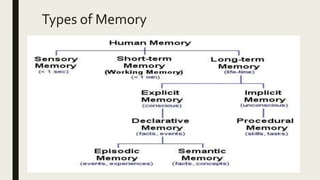
Types of Memory
Sensory Memory:
■ Sensory memory is the shortest-term element of memory. It is
the ability to retain impressions of sensory information after
the original stimuli have ended. ... For example, the ability to
look at something and remember what it looked like with just a
second of observation is an example of sensory memory.
Short-Term Memory:
■ Short-term memory is also known as working memory. It holds
only a few items (research shows a range of 7 +/- 2 items) and
only lasts for about 20 seconds. However, items can be moved
from short-term memory to long-term memory via processes
like rehearsal. An example of rehearsal is when someone gives
you a phone number verbally and you say it to yourself
repeatedly until you can write it down. If someone interrupts
your rehearsal by asking a question, you can easily forget the
number, since it is only being held in your short-term memory.
Long-Term Memory:
■ Long-term memories are all the memories we hold for
periods of time longer than a few seconds; long-term
memory encompasses everything from what we learned in
first grade to our old addresses to what we wore to work
yesterday. Long-term memory has an incredibly vast
storage capacity, and some memories can last from the
time they are created until we die.
■ There are many types of long-term
memory. Explicit or declarative memory requires
conscious recall; it consists of information that is
consciously stored or retrieved.
■ Explicit memory can be further subdivided into Semantic Memory (facts
taken out of context, such as “Paris is the capital of France”) and
Episodic Memory (personal experiences, such as “When I was in Paris, I
saw the Mona Lisa”).
■ In contrast to explicit/declarative memory, there is also a system for
procedural/implicit memory. These memories are not based on
consciously storing and retrieving information, but on implicit learning.
Often this type of memory is employed in learning new motor skills. An
example of implicit learning is learning to ride a bike: you do not need to
consciously remember how to ride a bike, you simply do. This is because
of implicit memory.
Information-processing Model:
■ The ideas about memory that emphasize the processing of
information in stages, or steps are known as information-
processing theories or models. A number of such models have
been proposed. The most prominent among them is the storage
and transfer model developed by Richard Atkinson and
Richard Shiffrin (1968).
Storage andTransfer Model
■ In this model, Atkinson and Shiffrin have suggested three
different memory storage systems: Sensory stores, a short-
term store and a long-term store.
■ According to this model the process of memorisation
starts with picking up of information by our sense organs
from the environment. Then this information will travel
through nervous system and reaches the brain where it is
evaluated.
■ The sensory information must stay in nervous system for
very short duration, approximately for less than a second
to allow the brain to interpret. This stage is called sensory
storage
■ Then this information is passed on to the short-term store where it is
held for about 30 seconds. Some of the information reaching short-
term memory is processed by being rehearsed-that is, having attention
focused on it, being repeated over and over, and this is a conscious
activity. The information not so processed is lost. Finally the
information rehearsed may then be passed on to long-term store.
■ When information is placed in long-term store, it is recognized into
categories, where they may reside for days, months, years or for a
lifetime. This long-term store is assumed to have almost unlimited
capacity for the storage.
■ This organized and stored information in the long-term store which is
in the coded form is transferred back to the short-term store, where it
is decoded and employed for response as ordered by the brain
through motor nerves.
Memory strategies refer to any of a broad set of techniques that are
designed to help one remember. Such strategies range from everyday,
external aids (e.g., using a planner) to internal memory strategies (e.g.,
mnemonic devices) that facilitate storage and retrieval from long-term
memory.
FocusYour Attention. ...
Avoid Cramming. ...
Structure and Organize. ...
Utilize Mnemonic Devices. ...
Elaborate and Rehearse. ...
Visualize Concepts. ...
Relate New Information toThingsYou Already Know. ...
Read Out Loud.
………………..

Memory slides

  • 1.
  • 2.
    What is memory? ■Memory is the ability to take in information, store it, and recall it at a later time. ■ In psychology, memory is broken into three stages: encoding, storage, and retrieval.
  • 3.
    Encoding, Storage, Retrieval: ■Encoding: We take information in either as a picture or a sound, or that we will give the information meaning the process of receiving, processing, and combining information. Encoding allows information from the outside world to reach our senses in the forms of chemical and physical stimuli. In this first stage we must change the information so that we may put the memory into the encoding process.
  • 4.
    ■ Storage: Thecreation of a permanent record of the encoded information. Storage is the second memory stage or process in which we maintain information over periods of time. ■ Retrieval (or recall, or recognition): The calling back of stored information in response to some cue for use in a process or activity. The third process is the retrieval of information that we have stored. We must locate it and return it to our consciousness. Some retrieval attempts may be effortless due to the type of information.
  • 5.
    Types Of Memory: ■Sensory Memory ■ Short-Term Memory ■ Long-Term Memory
  • 6.
  • 7.
    Sensory Memory: ■ Sensorymemory is the shortest-term element of memory. It is the ability to retain impressions of sensory information after the original stimuli have ended. ... For example, the ability to look at something and remember what it looked like with just a second of observation is an example of sensory memory.
  • 8.
    Short-Term Memory: ■ Short-termmemory is also known as working memory. It holds only a few items (research shows a range of 7 +/- 2 items) and only lasts for about 20 seconds. However, items can be moved from short-term memory to long-term memory via processes like rehearsal. An example of rehearsal is when someone gives you a phone number verbally and you say it to yourself repeatedly until you can write it down. If someone interrupts your rehearsal by asking a question, you can easily forget the number, since it is only being held in your short-term memory.
  • 9.
    Long-Term Memory: ■ Long-termmemories are all the memories we hold for periods of time longer than a few seconds; long-term memory encompasses everything from what we learned in first grade to our old addresses to what we wore to work yesterday. Long-term memory has an incredibly vast storage capacity, and some memories can last from the time they are created until we die. ■ There are many types of long-term memory. Explicit or declarative memory requires conscious recall; it consists of information that is consciously stored or retrieved.
  • 10.
    ■ Explicit memorycan be further subdivided into Semantic Memory (facts taken out of context, such as “Paris is the capital of France”) and Episodic Memory (personal experiences, such as “When I was in Paris, I saw the Mona Lisa”). ■ In contrast to explicit/declarative memory, there is also a system for procedural/implicit memory. These memories are not based on consciously storing and retrieving information, but on implicit learning. Often this type of memory is employed in learning new motor skills. An example of implicit learning is learning to ride a bike: you do not need to consciously remember how to ride a bike, you simply do. This is because of implicit memory.
  • 11.
    Information-processing Model: ■ Theideas about memory that emphasize the processing of information in stages, or steps are known as information- processing theories or models. A number of such models have been proposed. The most prominent among them is the storage and transfer model developed by Richard Atkinson and Richard Shiffrin (1968).
  • 12.
    Storage andTransfer Model ■In this model, Atkinson and Shiffrin have suggested three different memory storage systems: Sensory stores, a short- term store and a long-term store. ■ According to this model the process of memorisation starts with picking up of information by our sense organs from the environment. Then this information will travel through nervous system and reaches the brain where it is evaluated. ■ The sensory information must stay in nervous system for very short duration, approximately for less than a second to allow the brain to interpret. This stage is called sensory storage
  • 13.
    ■ Then thisinformation is passed on to the short-term store where it is held for about 30 seconds. Some of the information reaching short- term memory is processed by being rehearsed-that is, having attention focused on it, being repeated over and over, and this is a conscious activity. The information not so processed is lost. Finally the information rehearsed may then be passed on to long-term store. ■ When information is placed in long-term store, it is recognized into categories, where they may reside for days, months, years or for a lifetime. This long-term store is assumed to have almost unlimited capacity for the storage. ■ This organized and stored information in the long-term store which is in the coded form is transferred back to the short-term store, where it is decoded and employed for response as ordered by the brain through motor nerves.
  • 14.
    Memory strategies referto any of a broad set of techniques that are designed to help one remember. Such strategies range from everyday, external aids (e.g., using a planner) to internal memory strategies (e.g., mnemonic devices) that facilitate storage and retrieval from long-term memory. FocusYour Attention. ... Avoid Cramming. ... Structure and Organize. ... Utilize Mnemonic Devices. ... Elaborate and Rehearse. ... Visualize Concepts. ... Relate New Information toThingsYou Already Know. ... Read Out Loud. ………………..