Anas Suray
IPG Kampus Tuanku Bainun
A scientific and systematic process of gathering
information in order to answer the question(s) or the
hypothesis posted objectively (example: the relationship
between phenomena like motivation & academic
achievement)
Educational research
- a scientific and systematic process of gathering
information about the hypothesized relations between
phenomena in the field of education with the aim of
improving student learning.
What is Research?What is Research?
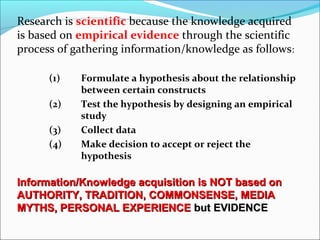
Research is scientific because the knowledge acquired
is based on empirical evidence through the scientific
process of gathering information/knowledge as follows:
(1) Formulate a hypothesis about the relationship
between certain constructs
(2) Test the hypothesis by designing an empirical
study
(3) Collect data
(4) Make decision to accept or reject the
hypothesis
Information/Knowledge acquisition is NOT based onInformation/Knowledge acquisition is NOT based on
AUTHORITY, TRADITION, COMMONSENSE, MEDIAAUTHORITY, TRADITION, COMMONSENSE, MEDIA
MYTHS, PERSONAL EXPERIENCEMYTHS, PERSONAL EXPERIENCE but EVIDENCEbut EVIDENCE
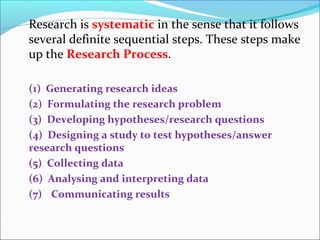
Research is systematic in the sense that it follows
several definite sequential steps. These steps make
up the Research Process.
(1) Generating research ideas
(2) Formulating the research problem
(3) Developing hypotheses/research questions
(4) Designing a study to test hypotheses/answer
research questions
(5) Collecting data
(6) Analysing and interpreting data
(7) Communicating results
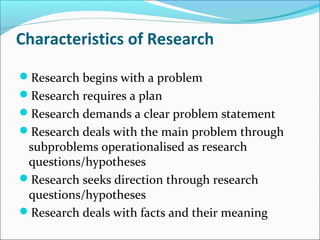
Characteristics of Research
Research begins with a problem
Research requires a plan
Research demands a clear problem statement
Research deals with the main problem through
subproblems operationalised as research
questions/hypotheses
Research seeks direction through research
questions/hypotheses
Research deals with facts and their meaning
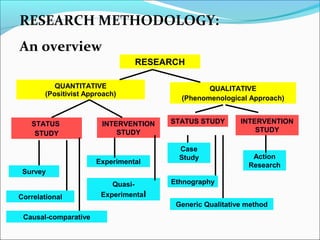
RESEARCH
QUANTITATIVE
(Positivist Approach)
QUALITATIVE
(Phenomenological Approach)
STATUS
STUDY
INTERVENTION
STUDY
STATUS STUDY
Survey
Experimental
Case
Study
Ethnography
Action
Research
Generic Qualitative method
INTERVENTION
STUDY
Correlational
Causal-comparative
Quasi-
Experimental
RESEARCH METHODOLOGY:
An overview
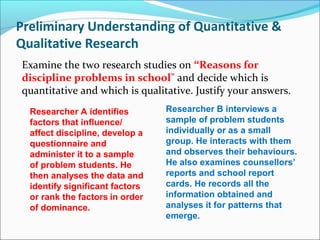
Preliminary Understanding of Quantitative &
Qualitative Research
Examine the two research studies on “Reasons for
discipline problems in school” and decide which is
quantitative and which is qualitative. Justify your answers.
Researcher A identifies
factors that influence/
affect discipline, develop a
questionnaire and
administer it to a sample
of problem students. He
then analyses the data and
identify significant factors
or rank the factors in order
of dominance.
Researcher B interviews a
sample of problem students
individually or as a small
group. He interacts with them
and observes their behaviours.
He also examines counsellors’
reports and school report
cards. He records all the
information obtained and
analyses it for patterns that
emerge.
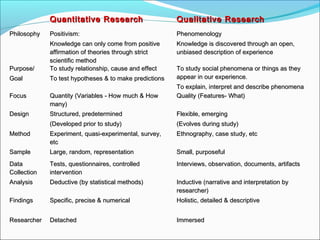
Quantitative ResearchQuantitative Research Qualitative ResearchQualitative Research
PhilosophyPhilosophy Positivism:Positivism:
Knowledge can only come from positiveKnowledge can only come from positive
affirmation of theories through strictaffirmation of theories through strict
scientific methodscientific method
PhenomenologyPhenomenology
Knowledge is discovered through an open,Knowledge is discovered through an open,
unbiased description of experienceunbiased description of experience
Purpose/Purpose/
GoalGoal
To study relationship, cause and effectTo study relationship, cause and effect
To test hypotheses & to make predictionsTo test hypotheses & to make predictions
To study social phenomena or things as theyTo study social phenomena or things as they
appear in our experience.appear in our experience.
To explain, interpret and describe phenomenaTo explain, interpret and describe phenomena
FocusFocus Quantity (Variables - How much & HowQuantity (Variables - How much & How
many)many)
Quality (Features- What)Quality (Features- What)
DesignDesign Structured, predeterminedStructured, predetermined
(Developed prior to study)(Developed prior to study)
Flexible, emergingFlexible, emerging
(Evolves during study)(Evolves during study)
MethodMethod Experiment, quasi-experimental, survey,Experiment, quasi-experimental, survey,
etcetc
Ethnography, case study, etcEthnography, case study, etc
SampleSample Large, random, representationLarge, random, representation Small, purposefulSmall, purposeful
DataData
CollectionCollection
Tests, questionnaires, controlledTests, questionnaires, controlled
interventionintervention
Interviews, observation, documents, artifactsInterviews, observation, documents, artifacts
AnalysisAnalysis Deductive (by statistical methods)Deductive (by statistical methods) Inductive (narrative and interpretation byInductive (narrative and interpretation by
researcher)researcher)
FindingsFindings Specific, precise & numericalSpecific, precise & numerical Holistic, detailed & descriptiveHolistic, detailed & descriptive
ResearcherResearcher DetachedDetached ImmersedImmersed
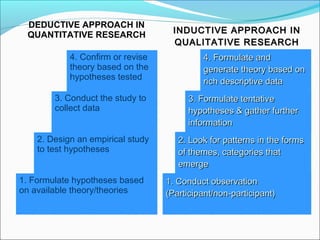
DEDUCTIVE APPROACH IN
QUANTITATIVE RESEARCH
4. Confirm or revise
theory based on the
hypotheses tested
3. Conduct the study to
collect data
2. Design an empirical study
to test hypotheses
1. Formulate hypotheses based
on available theory/theories
INDUCTIVE APPROACH ININDUCTIVE APPROACH IN
QUALITATIVE RESEARCHQUALITATIVE RESEARCH
4. Formulate and4. Formulate and
generate theory based ongenerate theory based on
rich descriptive datarich descriptive data
3. Formulate tentative3. Formulate tentative
hypotheses & gather furtherhypotheses & gather further
informationinformation
2. Look for patterns in the forms2. Look for patterns in the forms
of themes, categories thatof themes, categories that
emergeemerge
1. Conduct observation1. Conduct observation
(Participant/non-participant)(Participant/non-participant)
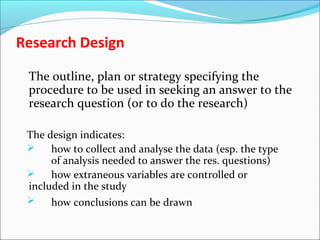
Research Design
The outline, plan or strategy specifying the
procedure to be used in seeking an answer to the
research question (or to do the research)
The design indicates:
 how to collect and analyse the data (esp. the type
of analysis needed to answer the res. questions)
 how extraneous variables are controlled or
included in the study
 how conclusions can be drawn
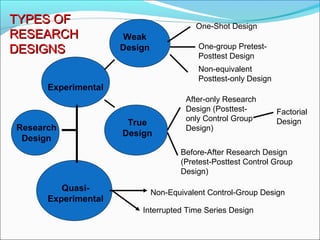
Research
Design
Weak
Design
True
Design
Experimental
Quasi-
Experimental
Non-Equivalent Control-Group Design
One-Shot Design
One-group Pretest-
Posttest Design
Non-equivalent
Posttest-only Design
After-only Research
Design (Posttest-
only Control Group
Design)
Factorial
Design
Before-After Research Design
(Pretest-Posttest Control Group
Design)
TYPES OFTYPES OF
RESEARCHRESEARCH
DESIGNSDESIGNS
Interrupted Time Series Design
Ethics in Research
Respect human values & protect human rights
Determine the degree of risks involved
Principal researcher undertakes full responsibility of the
study
Inform the subject before or after, the nature of the
experiment
Respect individual’s freedom to decline participation
All information collected & subjects involved should be
kept confidential. Report group performance, not
individual performance.
RESEARCH PROCESS: BASIC 5
STEPS
IDENTIFYING THE PROBLEM /FOCUS
PLANNING TO ANSWER QUESTIONS ABOUT THE
PROBLEM
IMPLEMENTING THE PLAN
COLLECTING DATA TO ANSWER THE
QUESTIONS
Can be more elaborate steps like:
(1) Generating research ideas
(2) Formulating the research problem
(3) Developing hypotheses/research questions
(4) Designing a study to test hypotheses/answer
research questions
(5) Collecting data
(6) Analysing and interpreting data
(7) Communicating results
IMPORTANT OF LITERATURE
REVIEW IN IDENTIFYING
RESEARCH PROBLEM
To understand in depth about the problem to be studied
To know what has been done about this problem
To gain insights into the theories, approaches and
methodologies adopted by different researchers. (This will
provide sound theoretical and methodological frameworks
for the intended study.)
To identify gaps in the literature so that the intended
study can focus on a research area that is significant and
that has not been explored adequately. This will ensure
that the research done will contribute towards knowledge
and/or theory development.
PURPOSE OF LITERATURE REVIEW
To help researchers to delimit the research problem
(narrow the scope) and define it clearly so that it has the
right focus.
To ensure that research to be done is on the right track in
line with the current trends. (Such information can be
obtained from the Recommendations for further research
section of every research study. These recommendations
are useful because they represent the insights of the
researcher after he/she has studied the phenomenon.)
To provide the intellectual context for the research to be
done, enabling the researcher to position his/her work
relative to other work. This is possible because the review
will show what has been done in the field and how the
new study relates to earlier research.
Theory & Review of Literature
Theory
 a statement or set of statements that explain and
predict phenomena.
 a statement that indicates the relationship between two or
more events
Ausubel’s Meaningful Learning Theory
Meaningful Learning takes place when a learner integrate new
information with old information
What does Ausubel.s Theory predict?
What variables does the theory try to relate?
THE ROLE OF THEORY IN EDUCATIONAL
RESEARCH
Theory provides an important guide or focus for the
direction of research by pointing to areas in which
meaningful relationships of events (variables) are likely to
be found.
Theory provides a rational basis for explaining or
interpreting the results of the research.
Theory enables the researcher to make predictions about a
wide range of situations
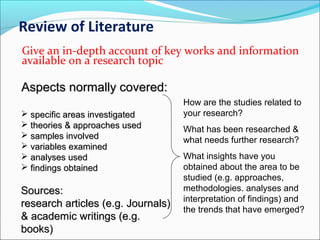
Review of Literature
Give an in-depth account of key works and information
available on a research topic
Aspects normally covered:Aspects normally covered:
 specific areas investigatedspecific areas investigated
 theories & approaches usedtheories & approaches used
 samples involvedsamples involved
 variables examinedvariables examined
 analyses usedanalyses used
 findings obtainedfindings obtained
Sources:Sources:
research articles (e.g. Journals)research articles (e.g. Journals)
& academic writings (e.g.& academic writings (e.g.
books)books)
How are the studies related to
your research?
What has been researched &
what needs further research?
What insights have you
obtained about the area to be
studied (e.g. approaches,
methodologies. analyses and
interpretation of findings) and
the trends that have emerged?
Sources of Literature Review
Secondary Sources (Sumber Sekunder)
Materials written based on the works of others (e.g. reference
books, text books, published academic writings, etc)
Primary Sources (Sumber Asli)
Materials written by someone who actually conducted the
investigation – 1st
hand information. (e.g. research articles
published in journals.)
Note: Research articles also contain information from secondary
sources when the writers quote the works of other people
Common weaknesses in Lit. Review
Mere presentation of research information without
relating it to the intended study
Mere presentation of research information without any
critical evaluation
Mere listing of past studies in isolation without making
any connection among them – differences & similarities
Heavy reliance on secondary sources and/or outdated
studies
Poor citations (Refer to APA)
Plagiarism

Introduction to educational research pismp

  • 1.
    Anas Suray IPG KampusTuanku Bainun
  • 2.
    A scientific andsystematic process of gathering information in order to answer the question(s) or the hypothesis posted objectively (example: the relationship between phenomena like motivation & academic achievement) Educational research - a scientific and systematic process of gathering information about the hypothesized relations between phenomena in the field of education with the aim of improving student learning. What is Research?What is Research?
  • 3.
    Research is scientificbecause the knowledge acquired is based on empirical evidence through the scientific process of gathering information/knowledge as follows: (1) Formulate a hypothesis about the relationship between certain constructs (2) Test the hypothesis by designing an empirical study (3) Collect data (4) Make decision to accept or reject the hypothesis Information/Knowledge acquisition is NOT based onInformation/Knowledge acquisition is NOT based on AUTHORITY, TRADITION, COMMONSENSE, MEDIAAUTHORITY, TRADITION, COMMONSENSE, MEDIA MYTHS, PERSONAL EXPERIENCEMYTHS, PERSONAL EXPERIENCE but EVIDENCEbut EVIDENCE
  • 4.
    Research is systematicin the sense that it follows several definite sequential steps. These steps make up the Research Process. (1) Generating research ideas (2) Formulating the research problem (3) Developing hypotheses/research questions (4) Designing a study to test hypotheses/answer research questions (5) Collecting data (6) Analysing and interpreting data (7) Communicating results
  • 5.
    Characteristics of Research Researchbegins with a problem Research requires a plan Research demands a clear problem statement Research deals with the main problem through subproblems operationalised as research questions/hypotheses Research seeks direction through research questions/hypotheses Research deals with facts and their meaning
  • 6.
    RESEARCH QUANTITATIVE (Positivist Approach) QUALITATIVE (Phenomenological Approach) STATUS STUDY INTERVENTION STUDY STATUSSTUDY Survey Experimental Case Study Ethnography Action Research Generic Qualitative method INTERVENTION STUDY Correlational Causal-comparative Quasi- Experimental RESEARCH METHODOLOGY: An overview
  • 7.
    Preliminary Understanding ofQuantitative & Qualitative Research Examine the two research studies on “Reasons for discipline problems in school” and decide which is quantitative and which is qualitative. Justify your answers. Researcher A identifies factors that influence/ affect discipline, develop a questionnaire and administer it to a sample of problem students. He then analyses the data and identify significant factors or rank the factors in order of dominance. Researcher B interviews a sample of problem students individually or as a small group. He interacts with them and observes their behaviours. He also examines counsellors’ reports and school report cards. He records all the information obtained and analyses it for patterns that emerge.
  • 8.
    Quantitative ResearchQuantitative ResearchQualitative ResearchQualitative Research PhilosophyPhilosophy Positivism:Positivism: Knowledge can only come from positiveKnowledge can only come from positive affirmation of theories through strictaffirmation of theories through strict scientific methodscientific method PhenomenologyPhenomenology Knowledge is discovered through an open,Knowledge is discovered through an open, unbiased description of experienceunbiased description of experience Purpose/Purpose/ GoalGoal To study relationship, cause and effectTo study relationship, cause and effect To test hypotheses & to make predictionsTo test hypotheses & to make predictions To study social phenomena or things as theyTo study social phenomena or things as they appear in our experience.appear in our experience. To explain, interpret and describe phenomenaTo explain, interpret and describe phenomena FocusFocus Quantity (Variables - How much & HowQuantity (Variables - How much & How many)many) Quality (Features- What)Quality (Features- What) DesignDesign Structured, predeterminedStructured, predetermined (Developed prior to study)(Developed prior to study) Flexible, emergingFlexible, emerging (Evolves during study)(Evolves during study) MethodMethod Experiment, quasi-experimental, survey,Experiment, quasi-experimental, survey, etcetc Ethnography, case study, etcEthnography, case study, etc SampleSample Large, random, representationLarge, random, representation Small, purposefulSmall, purposeful DataData CollectionCollection Tests, questionnaires, controlledTests, questionnaires, controlled interventionintervention Interviews, observation, documents, artifactsInterviews, observation, documents, artifacts AnalysisAnalysis Deductive (by statistical methods)Deductive (by statistical methods) Inductive (narrative and interpretation byInductive (narrative and interpretation by researcher)researcher) FindingsFindings Specific, precise & numericalSpecific, precise & numerical Holistic, detailed & descriptiveHolistic, detailed & descriptive ResearcherResearcher DetachedDetached ImmersedImmersed
  • 9.
    DEDUCTIVE APPROACH IN QUANTITATIVERESEARCH 4. Confirm or revise theory based on the hypotheses tested 3. Conduct the study to collect data 2. Design an empirical study to test hypotheses 1. Formulate hypotheses based on available theory/theories INDUCTIVE APPROACH ININDUCTIVE APPROACH IN QUALITATIVE RESEARCHQUALITATIVE RESEARCH 4. Formulate and4. Formulate and generate theory based ongenerate theory based on rich descriptive datarich descriptive data 3. Formulate tentative3. Formulate tentative hypotheses & gather furtherhypotheses & gather further informationinformation 2. Look for patterns in the forms2. Look for patterns in the forms of themes, categories thatof themes, categories that emergeemerge 1. Conduct observation1. Conduct observation (Participant/non-participant)(Participant/non-participant)
  • 10.
    Research Design The outline,plan or strategy specifying the procedure to be used in seeking an answer to the research question (or to do the research) The design indicates:  how to collect and analyse the data (esp. the type of analysis needed to answer the res. questions)  how extraneous variables are controlled or included in the study  how conclusions can be drawn
  • 11.
    Research Design Weak Design True Design Experimental Quasi- Experimental Non-Equivalent Control-Group Design One-ShotDesign One-group Pretest- Posttest Design Non-equivalent Posttest-only Design After-only Research Design (Posttest- only Control Group Design) Factorial Design Before-After Research Design (Pretest-Posttest Control Group Design) TYPES OFTYPES OF RESEARCHRESEARCH DESIGNSDESIGNS Interrupted Time Series Design
  • 12.
    Ethics in Research Respecthuman values & protect human rights Determine the degree of risks involved Principal researcher undertakes full responsibility of the study Inform the subject before or after, the nature of the experiment Respect individual’s freedom to decline participation All information collected & subjects involved should be kept confidential. Report group performance, not individual performance.
  • 13.
    RESEARCH PROCESS: BASIC5 STEPS IDENTIFYING THE PROBLEM /FOCUS PLANNING TO ANSWER QUESTIONS ABOUT THE PROBLEM IMPLEMENTING THE PLAN COLLECTING DATA TO ANSWER THE QUESTIONS
  • 14.
    Can be moreelaborate steps like: (1) Generating research ideas (2) Formulating the research problem (3) Developing hypotheses/research questions (4) Designing a study to test hypotheses/answer research questions (5) Collecting data (6) Analysing and interpreting data (7) Communicating results
  • 15.
    IMPORTANT OF LITERATURE REVIEWIN IDENTIFYING RESEARCH PROBLEM
  • 16.
    To understand indepth about the problem to be studied To know what has been done about this problem To gain insights into the theories, approaches and methodologies adopted by different researchers. (This will provide sound theoretical and methodological frameworks for the intended study.) To identify gaps in the literature so that the intended study can focus on a research area that is significant and that has not been explored adequately. This will ensure that the research done will contribute towards knowledge and/or theory development. PURPOSE OF LITERATURE REVIEW
  • 17.
    To help researchersto delimit the research problem (narrow the scope) and define it clearly so that it has the right focus. To ensure that research to be done is on the right track in line with the current trends. (Such information can be obtained from the Recommendations for further research section of every research study. These recommendations are useful because they represent the insights of the researcher after he/she has studied the phenomenon.) To provide the intellectual context for the research to be done, enabling the researcher to position his/her work relative to other work. This is possible because the review will show what has been done in the field and how the new study relates to earlier research.
  • 18.
    Theory & Reviewof Literature Theory  a statement or set of statements that explain and predict phenomena.  a statement that indicates the relationship between two or more events Ausubel’s Meaningful Learning Theory Meaningful Learning takes place when a learner integrate new information with old information What does Ausubel.s Theory predict? What variables does the theory try to relate?
  • 19.
    THE ROLE OFTHEORY IN EDUCATIONAL RESEARCH Theory provides an important guide or focus for the direction of research by pointing to areas in which meaningful relationships of events (variables) are likely to be found. Theory provides a rational basis for explaining or interpreting the results of the research. Theory enables the researcher to make predictions about a wide range of situations
  • 20.
    Review of Literature Givean in-depth account of key works and information available on a research topic Aspects normally covered:Aspects normally covered:  specific areas investigatedspecific areas investigated  theories & approaches usedtheories & approaches used  samples involvedsamples involved  variables examinedvariables examined  analyses usedanalyses used  findings obtainedfindings obtained Sources:Sources: research articles (e.g. Journals)research articles (e.g. Journals) & academic writings (e.g.& academic writings (e.g. books)books) How are the studies related to your research? What has been researched & what needs further research? What insights have you obtained about the area to be studied (e.g. approaches, methodologies. analyses and interpretation of findings) and the trends that have emerged?
  • 21.
    Sources of LiteratureReview Secondary Sources (Sumber Sekunder) Materials written based on the works of others (e.g. reference books, text books, published academic writings, etc) Primary Sources (Sumber Asli) Materials written by someone who actually conducted the investigation – 1st hand information. (e.g. research articles published in journals.) Note: Research articles also contain information from secondary sources when the writers quote the works of other people
  • 22.
    Common weaknesses inLit. Review Mere presentation of research information without relating it to the intended study Mere presentation of research information without any critical evaluation Mere listing of past studies in isolation without making any connection among them – differences & similarities Heavy reliance on secondary sources and/or outdated studies Poor citations (Refer to APA) Plagiarism