Educational Research
Chapter 1
Introduction to Educational Research
Gay, Mills, and Airasian
Overview
 Four sections of this presentation
 An overview of the scientific method and
educational research
 The classification of types of research by
purpose
 The classification of types of research by
method
 Examples of types of research
Ways of Knowing
 Five ways we can know something
 Personal experience
 Tradition
 Experts and authorities
 Logic
 Inductive
 Deductive
 The scientific method
Obj. 1.2
Ways of Knowing
 Personal experience
 Relying on one’s knowledge of prior
experiences
 Limitations
 How one is affected by an event depends on
who one is
 One frequently needs to know something that
cannot by learned through experience
Obj. 1.2
Ways of Knowing
 Tradition
 Doing things as they have always been done
 Limitations
 Traditions are often based on an idealized past
 Traditions can be distant from current realities and the
complexities associated with them
 Experts or authorities
 Relying on the expertise or authority of others
 Limitations
 Experts can be wrong
 Experts can disagree among themselves, as in a “second
opinion”
Obj. 1.2
Ways of Knowing
 Inductive reasoning
 Reasoning from the specific to the general
 Limitations
 In order to be certain of a conclusion one must
observe all examples
 All examples can be observed only in very
limited situations where there are few members
of the group
Obj. 1.2
Ways of Knowing
 Deductive reasoning
 Reasoning from the general to the specific
 Limitations
 You must begin with true premises in order to
arrive at true conclusions
 Deductive reasoning only organizes what is
already known
Obj. 1.2
The Scientific Method
 The goal of the scientific method is to
explain, predict, and/or control phenomena
 This involves the acquisition of knowledge
and the development and testing of theory
 The use of the scientific method is more
efficient and reliable than any other source of
knowledge
Obj. 1.1 & 1.4
The Scientific Method
 Five steps in the scientific method
 Recognition and definition of the problem
 Formulation of hypotheses
 Collection of data
 Analysis of data
 Stating conclusions
The Scientific Method
 Limitations of the scientific method
 Inability to answer value-based questions
involving “should”
 Inability to capture the full richness and
complexities of the participants
 Limitations of our measurement
instruments
 Ethical and legal responsibilities
Obj. 1.3
Educational Research
 The application of the scientific method
to study educational problems
 The goal is to explain, predict, and/or
control educational phenomena
Obj. 1.5 & 1.6
Educational Research
 Steps for conducting educational research
 Selection of a problem
 Use of specific research procedures to design and
collect data
 Analysis of data
 Statement of conclusions based on the results of
the data analyses
 Parallels the steps in the scientific method
Obj. 1.7
Educational Research
 Difficulties conducting educational research
 Involves human beings and the complexities
associated with them
 Difficulties generalizing from specific studies
 Problems when imposing sufficient controls to
conduct research in educational settings
 Complications when observing in educational
settings
 Indirect measurement of the variables being
studied
Obj. 1.8
Classifying Research
 Two helpful ways to view research
 Purpose
 The degree of direct applicability of research to
educational practices and settings
 Method
 The overall strategies followed to collect and
analyze data
Obj. 3.1, 3.2 & 3.5
The Purposes of Research
 Five categories
 Basic
 Applied
 Evaluation
 Research and development (R & D)
 Action
Obj. 3.3
The Purposes of Research
 Basic research
 Collection and analysis of data to develop
or enhance theory
 Examples related to learning theory
 Piaget
 Constructivism
 Mastery learning
 Gardner’s multiple intelligences
Obj. 3.4
The Purposes of Research
 Applied research
 Collection and analysis of data to examine the
usefulness of theory in solving practical
educational problems
 Examples
 Developing a seventh grade social studies curriculum
around a problem-solving approach to learning
 Examining the effectiveness of a computer-based algebra
program developed around a mastery learning approach
 Accommodating varied learning styles when teaching
lessons in modern literature
Obj. 3.4
The Purposes of Research
 The interaction of basic and applied
research
 Basic research provides the theory that
produces the concepts for solving
educational problems
 Applied research provides the data to help
support, guide, and revise the
development theory
Obj. 3.4
The Purposes of Research
 Evaluation research
 The collection and analysis of data to make
decisions related to the merit or worth of a
specific program
 Merit relates to a program accomplishing what
it was supposed to accomplish
 Worth relates to the value attached to a
program by those using it
Obj. 3.4
The Purposes of Research
 Evaluation research
 Types of evaluation
 Formative evaluation is designed to inform and
improve a program while it is being developed
or implemented
 Summative evaluation is designed to make
decisions regarding the overall quality of the
program being evaluated
Obj. 3.4
The Purposes of Research
 Evaluation research
 Examples
 The computerized algebra program being used
in Williams Middle School has been installed
properly, is being used properly, and student
achievement is increasing as a result of its use
 The computerized algebra program being used
in Williams Middle School is perceived to be an
efficient and effective expenditure of district
funds
Obj. 3.4
The Purposes of Research
 Research and development
 The development of effective products for
use in schools
 Examples
 The development of the software to create a
computerized algebra program that
incorporates an individualized mastery learning
approach to teaching basic algebraic concepts
 The development of a Smart Board to enhance
a teacher’s use of technology in the classroom
Obj. 3.4
The Purposes of Research
 Action research
 The collection and analysis of data to provide a
solution to the practical, valued problems of
educators within their own school or organization
 Examples
 How can our college move to a performance based
model for undergraduate teacher preparation programs?
 How can disciplinary policies be enforced consistently in
our school?
Obj. 3.4
Research Methods
 Two general categories of methods
currently being used in educational
research
 Quantitative
 Qualitative
Obj. 3.5
Quantitative Methods
 General purpose
 Collect and analyze data to explain, predict, or
control phenomena of interest
 Describe current conditions
 Investigate relationships
 Study causes and effects
 Assumptions of the researcher
 We live in a stable, uniform, and coherent world
 We can measure, understand, and generalize
about our world
 Generally regarded as a positivistic perspective
Obj. 3.6 & 5.1
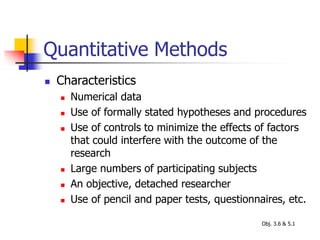
Quantitative Methods
 Characteristics
 Numerical data
 Use of formally stated hypotheses and procedures
 Use of controls to minimize the effects of factors
that could interfere with the outcome of the
research
 Large numbers of participating subjects
 An objective, detached researcher
 Use of pencil and paper tests, questionnaires, etc.
Obj. 3.6 & 5.1
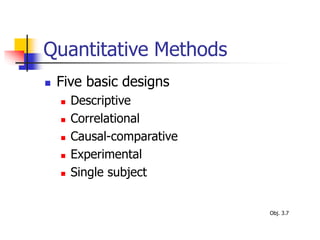
Quantitative Methods
 Five basic designs
 Descriptive
 Correlational
 Causal-comparative
 Experimental
 Single subject
Obj. 3.7
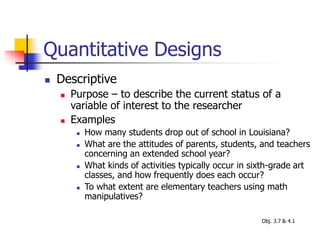
Quantitative Designs
 Descriptive
 Purpose – to describe the current status of a
variable of interest to the researcher
 Examples
 How many students drop out of school in Louisiana?
 What are the attitudes of parents, students, and teachers
concerning an extended school year?
 What kinds of activities typically occur in sixth-grade art
classes, and how frequently does each occur?
 To what extent are elementary teachers using math
manipulatives?
Obj. 3.7 & 4.1
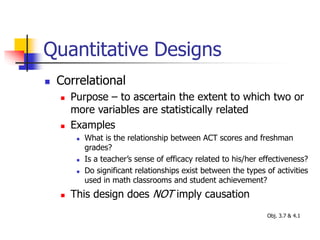
Quantitative Designs
 Correlational
 Purpose – to ascertain the extent to which two or
more variables are statistically related
 Examples
 What is the relationship between ACT scores and freshman
grades?
 Is a teacher’s sense of efficacy related to his/her effectiveness?
 Do significant relationships exist between the types of activities
used in math classrooms and student achievement?
 This design does NOT imply causation
Obj. 3.7 & 4.1
Quantitative Designs
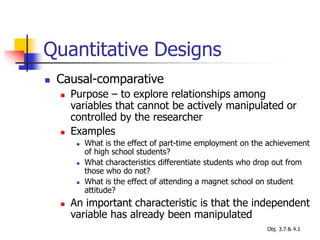
 Causal-comparative
 Purpose – to explore relationships among
variables that cannot be actively manipulated or
controlled by the researcher
 Examples
 What is the effect of part-time employment on the achievement
of high school students?
 What characteristics differentiate students who drop out from
those who do not?
 What is the effect of attending a magnet school on student
attitude?
 An important characteristic is that the independent
variable has already been manipulated
Obj. 3.7 & 4.1
Quantitative Designs
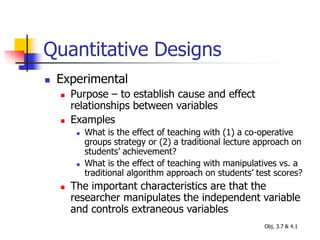
 Experimental
 Purpose – to establish cause and effect
relationships between variables
 Examples
 What is the effect of teaching with (1) a co-operative
groups strategy or (2) a traditional lecture approach on
students’ achievement?
 What is the effect of teaching with manipulatives vs. a
traditional algorithm approach on students’ test scores?
 The important characteristics are that the
researcher manipulates the independent variable
and controls extraneous variables
Obj. 3.7 & 4.1
Quantitative Designs
 Single subject
 Purpose – to investigate cause and effect
relationships with samples of one (1)
 Examples
 What is the effect of a behavior modification program on
John’s conduct in class?
 What is the effect of a behavioral training program on
Joan’s ability to complete her performance tasks?
 The important characteristic is the use of specific
interventions to cause behavioral changes in low
incidence populations (e.g., special education)
Obj. 3.7 & 4.1
Qualitative Methods
 General purpose
 To probe deeply into the research setting to obtain in-depth
understandings about the way things are, why they are like
that, and how participants perceive them
 The need to create a sustained, in-depth, in context study that
allows the researcher to uncover subtle, less overt personal
understandings
 Assumptions of the researcher
 All meaning is situated in a particular perspective or context
 Different people and groups often have different
perspectives and contexts, so there are many different
meanings in the world
 Generally regarded as a post-positivistic perspective
Obj. 3.8 & 5.1
Qualitative Methods
 Characteristics
 There are no hypotheses guiding the researcher, rather a
general issue known as the foreshadowed problem suggests
the general issues of concern
 Problems and methods tend to evolve over the course of the
study as understanding of the research context and
participants deepens
 Phenomena are examined as they exist in a natural context,
and they are viewed from the participants’ perspectives
 There are few participants involved in the study
 Data analysis is interpretative in nature
 The researcher interacts extensively with the participants
Obj. 3.8 & 5.1
Qualitative Methods
 Two basic designs
 Narrative
 Ethnography
Obj. 3.9
Qualitative Designs
 Narrative
 Purpose – focus on studying a single person and
gathering data through the collection of stories
that are used to construct a narrative about the
individual’s experience and the meanings he/she
attributes to them
 Examples
 What are the experiences of a veteran teacher who has
been moved into an administrative position in her
school?
 What does “inclusion” mean to a special needs child who
is placed in a regular education classroom?
Obj. 3.9 & 4.2
Qualitative Designs
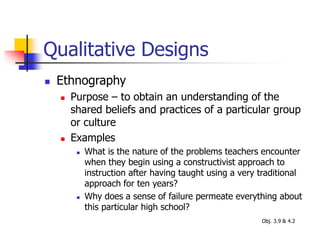
 Ethnography
 Purpose – to obtain an understanding of the
shared beliefs and practices of a particular group
or culture
 Examples
 What is the nature of the problems teachers encounter
when they begin using a constructivist approach to
instruction after having taught using a very traditional
approach for ten years?
 Why does a sense of failure permeate everything about
this particular high school?
Obj. 3.9 & 4.2
Quantitative and Qualitative
Methods
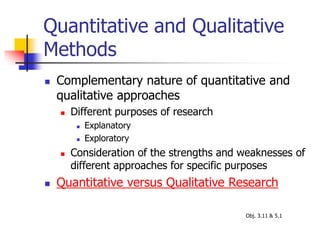
 Complementary nature of quantitative and
qualitative approaches
 Different purposes of research
 Explanatory
 Exploratory
 Consideration of the strengths and weaknesses of
different approaches for specific purposes
 Quantitative versus Qualitative Research
Obj. 3.11 & 5.1
Quantitative and Qualitative
Methods
 The ultimate goal when choosing a design is
to produce a credible answer to the research
question
 The research question drives the choice of a
research design
 The characteristics of specific designs suggest
they will produce more credible answers to
specific types of research questions than other
designs
 Specific purposes
 Specific procedures and analyses for each design
Using Your Knowledge
 Examine the following studies and categorize
them as quantitative or qualitative
 If quantitative, categorize them as
descriptive, correlational, causal-comparative,
experimental, or single subject
 If qualitative, categorize them as narrative or
ethnography
Using Your Knowledge
 Thinking about Brown and Walberg’s
article as well as Wolfe’s article…
 Why would you consider the first a
quantitative study and the second a
qualitative study?
 What would you suggest is the purpose of
each article using the five categories
described by the authors of the text?

CH01.PPT

  • 1.
    Educational Research Chapter 1 Introductionto Educational Research Gay, Mills, and Airasian
  • 2.
    Overview  Four sectionsof this presentation  An overview of the scientific method and educational research  The classification of types of research by purpose  The classification of types of research by method  Examples of types of research
  • 3.
    Ways of Knowing Five ways we can know something  Personal experience  Tradition  Experts and authorities  Logic  Inductive  Deductive  The scientific method Obj. 1.2
  • 4.
    Ways of Knowing Personal experience  Relying on one’s knowledge of prior experiences  Limitations  How one is affected by an event depends on who one is  One frequently needs to know something that cannot by learned through experience Obj. 1.2
  • 5.
    Ways of Knowing Tradition  Doing things as they have always been done  Limitations  Traditions are often based on an idealized past  Traditions can be distant from current realities and the complexities associated with them  Experts or authorities  Relying on the expertise or authority of others  Limitations  Experts can be wrong  Experts can disagree among themselves, as in a “second opinion” Obj. 1.2
  • 6.
    Ways of Knowing Inductive reasoning  Reasoning from the specific to the general  Limitations  In order to be certain of a conclusion one must observe all examples  All examples can be observed only in very limited situations where there are few members of the group Obj. 1.2
  • 7.
    Ways of Knowing Deductive reasoning  Reasoning from the general to the specific  Limitations  You must begin with true premises in order to arrive at true conclusions  Deductive reasoning only organizes what is already known Obj. 1.2
  • 8.
    The Scientific Method The goal of the scientific method is to explain, predict, and/or control phenomena  This involves the acquisition of knowledge and the development and testing of theory  The use of the scientific method is more efficient and reliable than any other source of knowledge Obj. 1.1 & 1.4
  • 9.
    The Scientific Method Five steps in the scientific method  Recognition and definition of the problem  Formulation of hypotheses  Collection of data  Analysis of data  Stating conclusions
  • 10.
    The Scientific Method Limitations of the scientific method  Inability to answer value-based questions involving “should”  Inability to capture the full richness and complexities of the participants  Limitations of our measurement instruments  Ethical and legal responsibilities Obj. 1.3
  • 11.
    Educational Research  Theapplication of the scientific method to study educational problems  The goal is to explain, predict, and/or control educational phenomena Obj. 1.5 & 1.6
  • 12.
    Educational Research  Stepsfor conducting educational research  Selection of a problem  Use of specific research procedures to design and collect data  Analysis of data  Statement of conclusions based on the results of the data analyses  Parallels the steps in the scientific method Obj. 1.7
  • 13.
    Educational Research  Difficultiesconducting educational research  Involves human beings and the complexities associated with them  Difficulties generalizing from specific studies  Problems when imposing sufficient controls to conduct research in educational settings  Complications when observing in educational settings  Indirect measurement of the variables being studied Obj. 1.8
  • 14.
    Classifying Research  Twohelpful ways to view research  Purpose  The degree of direct applicability of research to educational practices and settings  Method  The overall strategies followed to collect and analyze data Obj. 3.1, 3.2 & 3.5
  • 15.
    The Purposes ofResearch  Five categories  Basic  Applied  Evaluation  Research and development (R & D)  Action Obj. 3.3
  • 16.
    The Purposes ofResearch  Basic research  Collection and analysis of data to develop or enhance theory  Examples related to learning theory  Piaget  Constructivism  Mastery learning  Gardner’s multiple intelligences Obj. 3.4
  • 17.
    The Purposes ofResearch  Applied research  Collection and analysis of data to examine the usefulness of theory in solving practical educational problems  Examples  Developing a seventh grade social studies curriculum around a problem-solving approach to learning  Examining the effectiveness of a computer-based algebra program developed around a mastery learning approach  Accommodating varied learning styles when teaching lessons in modern literature Obj. 3.4
  • 18.
    The Purposes ofResearch  The interaction of basic and applied research  Basic research provides the theory that produces the concepts for solving educational problems  Applied research provides the data to help support, guide, and revise the development theory Obj. 3.4
  • 19.
    The Purposes ofResearch  Evaluation research  The collection and analysis of data to make decisions related to the merit or worth of a specific program  Merit relates to a program accomplishing what it was supposed to accomplish  Worth relates to the value attached to a program by those using it Obj. 3.4
  • 20.
    The Purposes ofResearch  Evaluation research  Types of evaluation  Formative evaluation is designed to inform and improve a program while it is being developed or implemented  Summative evaluation is designed to make decisions regarding the overall quality of the program being evaluated Obj. 3.4
  • 21.
    The Purposes ofResearch  Evaluation research  Examples  The computerized algebra program being used in Williams Middle School has been installed properly, is being used properly, and student achievement is increasing as a result of its use  The computerized algebra program being used in Williams Middle School is perceived to be an efficient and effective expenditure of district funds Obj. 3.4
  • 22.
    The Purposes ofResearch  Research and development  The development of effective products for use in schools  Examples  The development of the software to create a computerized algebra program that incorporates an individualized mastery learning approach to teaching basic algebraic concepts  The development of a Smart Board to enhance a teacher’s use of technology in the classroom Obj. 3.4
  • 23.
    The Purposes ofResearch  Action research  The collection and analysis of data to provide a solution to the practical, valued problems of educators within their own school or organization  Examples  How can our college move to a performance based model for undergraduate teacher preparation programs?  How can disciplinary policies be enforced consistently in our school? Obj. 3.4
  • 24.
    Research Methods  Twogeneral categories of methods currently being used in educational research  Quantitative  Qualitative Obj. 3.5
  • 25.
    Quantitative Methods  Generalpurpose  Collect and analyze data to explain, predict, or control phenomena of interest  Describe current conditions  Investigate relationships  Study causes and effects  Assumptions of the researcher  We live in a stable, uniform, and coherent world  We can measure, understand, and generalize about our world  Generally regarded as a positivistic perspective Obj. 3.6 & 5.1
  • 26.
    Quantitative Methods  Characteristics Numerical data  Use of formally stated hypotheses and procedures  Use of controls to minimize the effects of factors that could interfere with the outcome of the research  Large numbers of participating subjects  An objective, detached researcher  Use of pencil and paper tests, questionnaires, etc. Obj. 3.6 & 5.1
  • 27.
    Quantitative Methods  Fivebasic designs  Descriptive  Correlational  Causal-comparative  Experimental  Single subject Obj. 3.7
  • 28.
    Quantitative Designs  Descriptive Purpose – to describe the current status of a variable of interest to the researcher  Examples  How many students drop out of school in Louisiana?  What are the attitudes of parents, students, and teachers concerning an extended school year?  What kinds of activities typically occur in sixth-grade art classes, and how frequently does each occur?  To what extent are elementary teachers using math manipulatives? Obj. 3.7 & 4.1
  • 29.
    Quantitative Designs  Correlational Purpose – to ascertain the extent to which two or more variables are statistically related  Examples  What is the relationship between ACT scores and freshman grades?  Is a teacher’s sense of efficacy related to his/her effectiveness?  Do significant relationships exist between the types of activities used in math classrooms and student achievement?  This design does NOT imply causation Obj. 3.7 & 4.1
  • 30.
    Quantitative Designs  Causal-comparative Purpose – to explore relationships among variables that cannot be actively manipulated or controlled by the researcher  Examples  What is the effect of part-time employment on the achievement of high school students?  What characteristics differentiate students who drop out from those who do not?  What is the effect of attending a magnet school on student attitude?  An important characteristic is that the independent variable has already been manipulated Obj. 3.7 & 4.1
  • 31.
    Quantitative Designs  Experimental Purpose – to establish cause and effect relationships between variables  Examples  What is the effect of teaching with (1) a co-operative groups strategy or (2) a traditional lecture approach on students’ achievement?  What is the effect of teaching with manipulatives vs. a traditional algorithm approach on students’ test scores?  The important characteristics are that the researcher manipulates the independent variable and controls extraneous variables Obj. 3.7 & 4.1
  • 32.
    Quantitative Designs  Singlesubject  Purpose – to investigate cause and effect relationships with samples of one (1)  Examples  What is the effect of a behavior modification program on John’s conduct in class?  What is the effect of a behavioral training program on Joan’s ability to complete her performance tasks?  The important characteristic is the use of specific interventions to cause behavioral changes in low incidence populations (e.g., special education) Obj. 3.7 & 4.1
  • 33.
    Qualitative Methods  Generalpurpose  To probe deeply into the research setting to obtain in-depth understandings about the way things are, why they are like that, and how participants perceive them  The need to create a sustained, in-depth, in context study that allows the researcher to uncover subtle, less overt personal understandings  Assumptions of the researcher  All meaning is situated in a particular perspective or context  Different people and groups often have different perspectives and contexts, so there are many different meanings in the world  Generally regarded as a post-positivistic perspective Obj. 3.8 & 5.1
  • 34.
    Qualitative Methods  Characteristics There are no hypotheses guiding the researcher, rather a general issue known as the foreshadowed problem suggests the general issues of concern  Problems and methods tend to evolve over the course of the study as understanding of the research context and participants deepens  Phenomena are examined as they exist in a natural context, and they are viewed from the participants’ perspectives  There are few participants involved in the study  Data analysis is interpretative in nature  The researcher interacts extensively with the participants Obj. 3.8 & 5.1
  • 35.
    Qualitative Methods  Twobasic designs  Narrative  Ethnography Obj. 3.9
  • 36.
    Qualitative Designs  Narrative Purpose – focus on studying a single person and gathering data through the collection of stories that are used to construct a narrative about the individual’s experience and the meanings he/she attributes to them  Examples  What are the experiences of a veteran teacher who has been moved into an administrative position in her school?  What does “inclusion” mean to a special needs child who is placed in a regular education classroom? Obj. 3.9 & 4.2
  • 37.
    Qualitative Designs  Ethnography Purpose – to obtain an understanding of the shared beliefs and practices of a particular group or culture  Examples  What is the nature of the problems teachers encounter when they begin using a constructivist approach to instruction after having taught using a very traditional approach for ten years?  Why does a sense of failure permeate everything about this particular high school? Obj. 3.9 & 4.2
  • 38.
    Quantitative and Qualitative Methods Complementary nature of quantitative and qualitative approaches  Different purposes of research  Explanatory  Exploratory  Consideration of the strengths and weaknesses of different approaches for specific purposes  Quantitative versus Qualitative Research Obj. 3.11 & 5.1
  • 39.
    Quantitative and Qualitative Methods The ultimate goal when choosing a design is to produce a credible answer to the research question  The research question drives the choice of a research design  The characteristics of specific designs suggest they will produce more credible answers to specific types of research questions than other designs  Specific purposes  Specific procedures and analyses for each design
  • 40.
    Using Your Knowledge Examine the following studies and categorize them as quantitative or qualitative  If quantitative, categorize them as descriptive, correlational, causal-comparative, experimental, or single subject  If qualitative, categorize them as narrative or ethnography
  • 41.
    Using Your Knowledge Thinking about Brown and Walberg’s article as well as Wolfe’s article…  Why would you consider the first a quantitative study and the second a qualitative study?  What would you suggest is the purpose of each article using the five categories described by the authors of the text?