SCHOOL OF GOVERNANCE AND
DEVELOPMENT STUDIES
Advanced Research Methods- Quantitative and
qualitative
John W. Creswell (2012). Educational Research: Planning, Conducting, and
Evaluating Quantitative and Qualitative Research, 4th ed: Pearson Education Inc.
Chapter II The Process of Conducting Research: An introduction
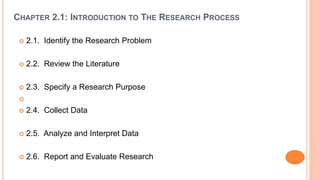
CHAPTER 2.1: INTRODUCTION TO THE RESEARCH PROCESS
 2.1. Identify the Research Problem
 2.2. Review the Literature
 2.3. Specify a Research Purpose

 2.4. Collect Data
 2.5. Analyze and Interpret Data
 2.6. Report and Evaluate Research
THE PROCESS OF CONDUCTING
RESEARCH
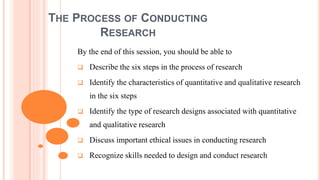
By the end of this session, you should be able to
 Describe the six steps in the process of research
 Identify the characteristics of quantitative and qualitative research
in the six steps
 Identify the type of research designs associated with quantitative
and qualitative research
 Discuss important ethical issues in conducting research
 Recognize skills needed to design and conduct research
UNDERSTANDING RESEARCH
 “…the systematic & objective analysis & recording of controlled observations
that may lead to the development of generalizations, principles, or theories,
resulting in prediction &possibly ultimate control of events
 a process of steps used to collect and analyze information to increase our understanding
of a topic or an issue.
 a process of interrelated activities rather than the application of an isolated, un-related
concepts and ideas.
 a general sequence of procedures- from identification of problems to the final report of
research. Understanding the sequence or flow of activities is central to the inquiry.
 Overall Research consists of three steps:
1. Pose a question,
2. Collect data to answer the question, and
3. Present an answer to the question.
 Addressing problems and searching for potential solutions
UNDERSTANDING…
Research is important for three important reasons
1. Adding knowledge - contribute to existing knowledge on a given
issue.
 Fill void in existing knowledge
 Confirm or disconfirm prior studies
 Add to the literature
 Provide info about people or places that have not been
previously studied
2. Research also improve practices and provide new ideas –research
findings and suggestions
3. Research informs policy makers
PROBLEMS WITH RESEARCH TODAY
 Contradictory and vague findings
 An expression of a confusion (an education aide to the Education and Labour
Committee of the US House of Representatives for 27 years)
“I read through every single evaluation…looking for a hard sentence- a
declarative sentence-something that I could put into the legislation, and there
were very few”. (Viadero, 1999, p.36).
 Questionable data -
 Information gap- due to ambiguous and vague
 Unclear statement
 Small Sample
 Inappropriate analysis method
 Lack of full disclosure of data collection procedures
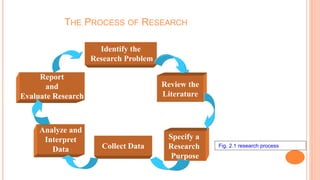
THE PROCESS OF RESEARCH
Identify the
Research Problem
Review the
Literature
Specify a
Research
Purpose
Collect Data
Analyze and
Interpret
Data
Report
and
Evaluate Research
Fig. 2.1 research process
THE PROCESS OF RESEARCH:
IDENTIFY THE RESEARCH PROBLEM
 Identify a topic to study- an issue or a problem that need to be resolved.
 Select and properly define the problem.
 Develop justifications for studying the problem.
 Suggest the importance of the study for select audiences that will read the
report
THE PROCESS OF RESEARCH:
REVIEW THE LITERATURE
 Reviewing the literature - Who has studied the research problem you plan to
examine?
 Locate resources i.e. Books, Journals, Electronic resources, etc.
 Choose resources to include in the review
 Review concepts and theories, methods and previous research finding
 Summarize the literature in a written report
THE PROCESS OF RESEARCH:
SPECIFY A RESEARCH PURPOSE
 If the research problem covers a broad topic of concern, need to focus it so that you
can study it.
 A focused restatement of the problem is the Purpose Statement
 The purpose of research consists of :
 Identifying the major intent/objective of the study
 Narrowing it into specific research questions or hypothesis
 The major focus of the study, participants, location and site of the inquiry
THE RESEARCH PROCESS:
COLLECT DATA
 Evidence helps provide answer to your research questions and hypothesis
Data collection involves
 Identifying and selecting individuals for a study
 Obtaining their permissions to study them
 Design data collection instruments and outline data collection procedures
 Gather information by asking people question or obtaining their behaviors
 Of paramount concern in this process is the need to obtain accurate data
from individuals and places
THE RESEARCH PROCESS:
ANALYZE AND INTERPRET DATA
 During or immediately after data collection the researcher need to make
sense of the information supplied by the individuals in the study.
 Analysis consists of “taking the data apart” to determine individual
responses, and then “putting it together” to summarize it.
 Represent the data in tables, figures, and pictures
 Explain conclusions from the data that address the research questions
 Usually titled result, findings or discussions
THE RESEARCH PROCESS:
REPORTING AND EVALUATING RESEARCH
 Reporting research
 Determine the audience for the report- academic researchers, educational agencies
 Structure the report
 Write the report sensitively and accurately
 Evaluating research
 Assess the quality of research using recognized standards in a discipline
 Standards can come from the academic community, school districts, or federal or
state agencies
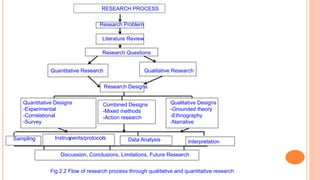
RESEARCH PROCESS
Research Problem
Research Questions Questions
Literature Review
Quantitative Research Qualitative Research
Research Designs
Quantitative Designs
-Experimental
-Correlational
-Survey
Combined Designs
-Mixed methods
-Action research
Qualitative Designs
-Grounded theory
-Ethnography
-Narrative
Sampling Instruments/protocols
/Protocols
N Data Analysis Interpretation
Discussion, Conclusions, Limitations, Future Research
Fig 2.2 Flow of research process through qualitative and quantitative research
IMPORTANT ETHICAL ISSUES IN CONDUCTING
RESEARCH
 Learn about the procedures involved in applying for approval
from your campus institutional review board
 Recognize guidelines from professional associations
 Use ethical practices throughout research
 Use respectful data collection procedures
 Show respect to audiences who read and use research study
information
SKILLS NEEDED FOR RESEARCH
Curiosity to solve puzzles
Long attention spans
Library and computer resource skills
Writing and editing skills

chapter session 2.1 Pro.of cond res..ppt

  • 1.
    SCHOOL OF GOVERNANCEAND DEVELOPMENT STUDIES Advanced Research Methods- Quantitative and qualitative John W. Creswell (2012). Educational Research: Planning, Conducting, and Evaluating Quantitative and Qualitative Research, 4th ed: Pearson Education Inc. Chapter II The Process of Conducting Research: An introduction
  • 2.
    CHAPTER 2.1: INTRODUCTIONTO THE RESEARCH PROCESS  2.1. Identify the Research Problem  2.2. Review the Literature  2.3. Specify a Research Purpose   2.4. Collect Data  2.5. Analyze and Interpret Data  2.6. Report and Evaluate Research
  • 3.
    THE PROCESS OFCONDUCTING RESEARCH By the end of this session, you should be able to  Describe the six steps in the process of research  Identify the characteristics of quantitative and qualitative research in the six steps  Identify the type of research designs associated with quantitative and qualitative research  Discuss important ethical issues in conducting research  Recognize skills needed to design and conduct research
  • 4.
    UNDERSTANDING RESEARCH  “…thesystematic & objective analysis & recording of controlled observations that may lead to the development of generalizations, principles, or theories, resulting in prediction &possibly ultimate control of events  a process of steps used to collect and analyze information to increase our understanding of a topic or an issue.  a process of interrelated activities rather than the application of an isolated, un-related concepts and ideas.  a general sequence of procedures- from identification of problems to the final report of research. Understanding the sequence or flow of activities is central to the inquiry.  Overall Research consists of three steps: 1. Pose a question, 2. Collect data to answer the question, and 3. Present an answer to the question.  Addressing problems and searching for potential solutions
  • 5.
    UNDERSTANDING… Research is importantfor three important reasons 1. Adding knowledge - contribute to existing knowledge on a given issue.  Fill void in existing knowledge  Confirm or disconfirm prior studies  Add to the literature  Provide info about people or places that have not been previously studied 2. Research also improve practices and provide new ideas –research findings and suggestions 3. Research informs policy makers
  • 6.
    PROBLEMS WITH RESEARCHTODAY  Contradictory and vague findings  An expression of a confusion (an education aide to the Education and Labour Committee of the US House of Representatives for 27 years) “I read through every single evaluation…looking for a hard sentence- a declarative sentence-something that I could put into the legislation, and there were very few”. (Viadero, 1999, p.36).  Questionable data -  Information gap- due to ambiguous and vague  Unclear statement  Small Sample  Inappropriate analysis method  Lack of full disclosure of data collection procedures
  • 7.
    THE PROCESS OFRESEARCH Identify the Research Problem Review the Literature Specify a Research Purpose Collect Data Analyze and Interpret Data Report and Evaluate Research Fig. 2.1 research process
  • 8.
    THE PROCESS OFRESEARCH: IDENTIFY THE RESEARCH PROBLEM  Identify a topic to study- an issue or a problem that need to be resolved.  Select and properly define the problem.  Develop justifications for studying the problem.  Suggest the importance of the study for select audiences that will read the report
  • 9.
    THE PROCESS OFRESEARCH: REVIEW THE LITERATURE  Reviewing the literature - Who has studied the research problem you plan to examine?  Locate resources i.e. Books, Journals, Electronic resources, etc.  Choose resources to include in the review  Review concepts and theories, methods and previous research finding  Summarize the literature in a written report
  • 10.
    THE PROCESS OFRESEARCH: SPECIFY A RESEARCH PURPOSE  If the research problem covers a broad topic of concern, need to focus it so that you can study it.  A focused restatement of the problem is the Purpose Statement  The purpose of research consists of :  Identifying the major intent/objective of the study  Narrowing it into specific research questions or hypothesis  The major focus of the study, participants, location and site of the inquiry
  • 11.
    THE RESEARCH PROCESS: COLLECTDATA  Evidence helps provide answer to your research questions and hypothesis Data collection involves  Identifying and selecting individuals for a study  Obtaining their permissions to study them  Design data collection instruments and outline data collection procedures  Gather information by asking people question or obtaining their behaviors  Of paramount concern in this process is the need to obtain accurate data from individuals and places
  • 12.
    THE RESEARCH PROCESS: ANALYZEAND INTERPRET DATA  During or immediately after data collection the researcher need to make sense of the information supplied by the individuals in the study.  Analysis consists of “taking the data apart” to determine individual responses, and then “putting it together” to summarize it.  Represent the data in tables, figures, and pictures  Explain conclusions from the data that address the research questions  Usually titled result, findings or discussions
  • 13.
    THE RESEARCH PROCESS: REPORTINGAND EVALUATING RESEARCH  Reporting research  Determine the audience for the report- academic researchers, educational agencies  Structure the report  Write the report sensitively and accurately  Evaluating research  Assess the quality of research using recognized standards in a discipline  Standards can come from the academic community, school districts, or federal or state agencies
  • 14.
    RESEARCH PROCESS Research Problem ResearchQuestions Questions Literature Review Quantitative Research Qualitative Research Research Designs Quantitative Designs -Experimental -Correlational -Survey Combined Designs -Mixed methods -Action research Qualitative Designs -Grounded theory -Ethnography -Narrative Sampling Instruments/protocols /Protocols N Data Analysis Interpretation Discussion, Conclusions, Limitations, Future Research Fig 2.2 Flow of research process through qualitative and quantitative research
  • 15.
    IMPORTANT ETHICAL ISSUESIN CONDUCTING RESEARCH  Learn about the procedures involved in applying for approval from your campus institutional review board  Recognize guidelines from professional associations  Use ethical practices throughout research  Use respectful data collection procedures  Show respect to audiences who read and use research study information
  • 16.
    SKILLS NEEDED FORRESEARCH Curiosity to solve puzzles Long attention spans Library and computer resource skills Writing and editing skills