Business
Research Methods
William G. Zikmund
Chapter 3:
Theory Building
Theory
• A theory consists of a coherent set of general
propositions that offer an explanation of
some phenomena by describing the way other
things correspond to this phenomena.
• A theory is a formal, testable explanation of
some events that includes explanations of
how things relate to one another.
How theory is built?
• A theory can be built
– through a process of reviewing previous findings
of similar studies,
– simple logical deduction,
– and/or knowledge of applicable theoretical areas.
Goals Of Theory
• Understanding
– The first goal allows the theorist to gain an
understanding of the relationship among
various phenomena.
• Predicting
– To predict the behavior or characteristics of
one phenomenon, the understanding or
knowledge of another phenomenon is
important.
Concept (or Construct)
• A concept or construct is a generalized idea
about a class of objects, attributes, occurrences,
or processes that has been given a name.
– Concepts are the building blocks of theory
– Concepts abstract reality i.e. concepts express in
words various events or objects.
• “leadership,” “productivity,” and “morale” are concepts
of organizational productivity
• “gross national product,” “asset,” and “inflation” are
concepts of economics.
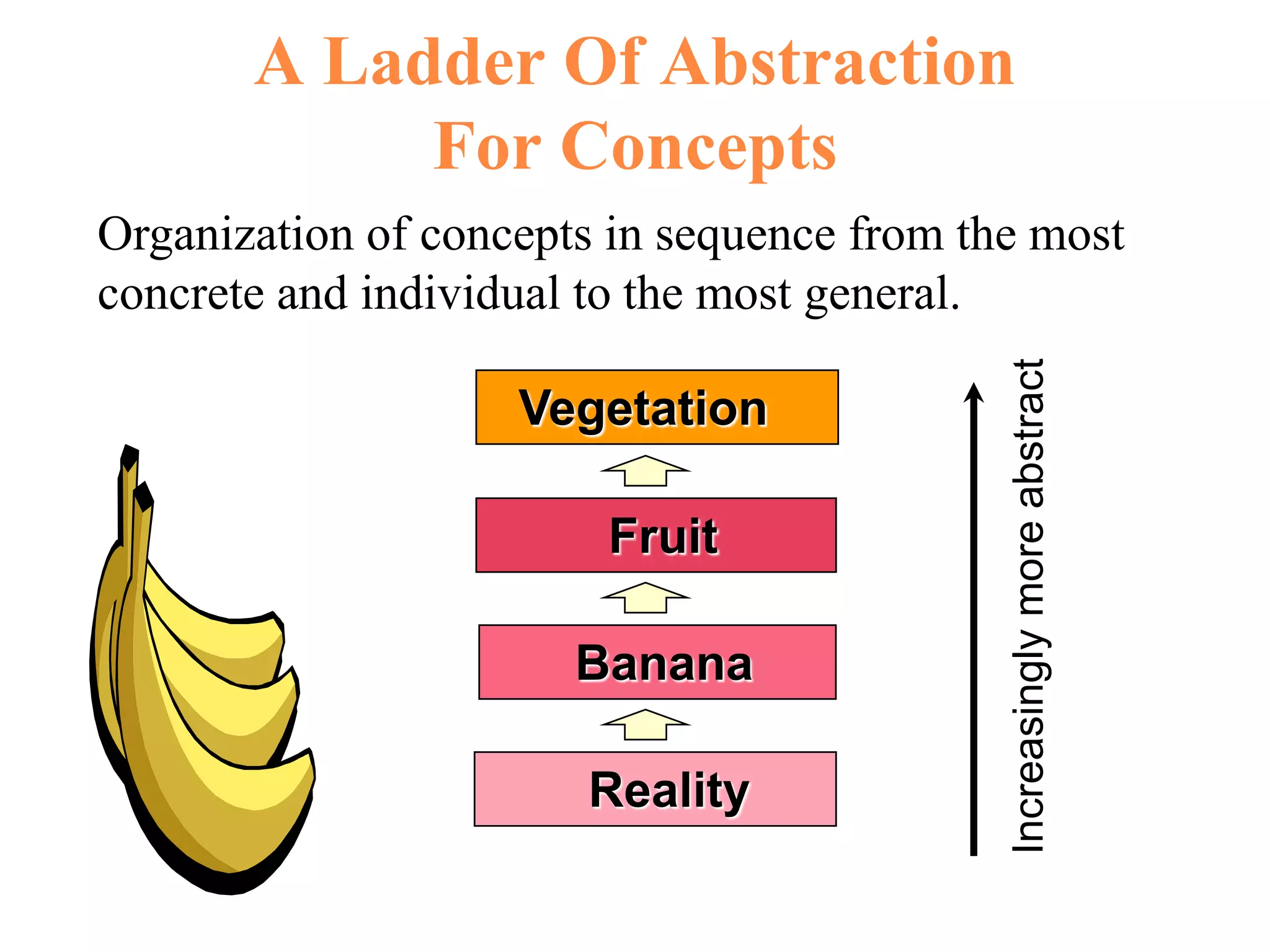
Vegetation
Fruit
Banana
Reality
Increasingly
more
abstract
A Ladder Of Abstraction
For Concepts
Organization of concepts in sequence from the most
concrete and individual to the most general.
Scientific Business Researchers
Operate at Two Levels
• Abstract level
– concepts
– propositions
• Empirical level
– variables
– hypotheses
Definitions
• Abstract level -In theory development, the
level of knowledge expressing a concept that
exists only as an idea or a quality apart from
an object.
• Empirical level -Level of knowledge
reflecting that which is verifiable by
experience or observation.
– At an empirical level, we must more clearly
define a construct and identify actual measures
that we can assess and measure to represent the
construct.
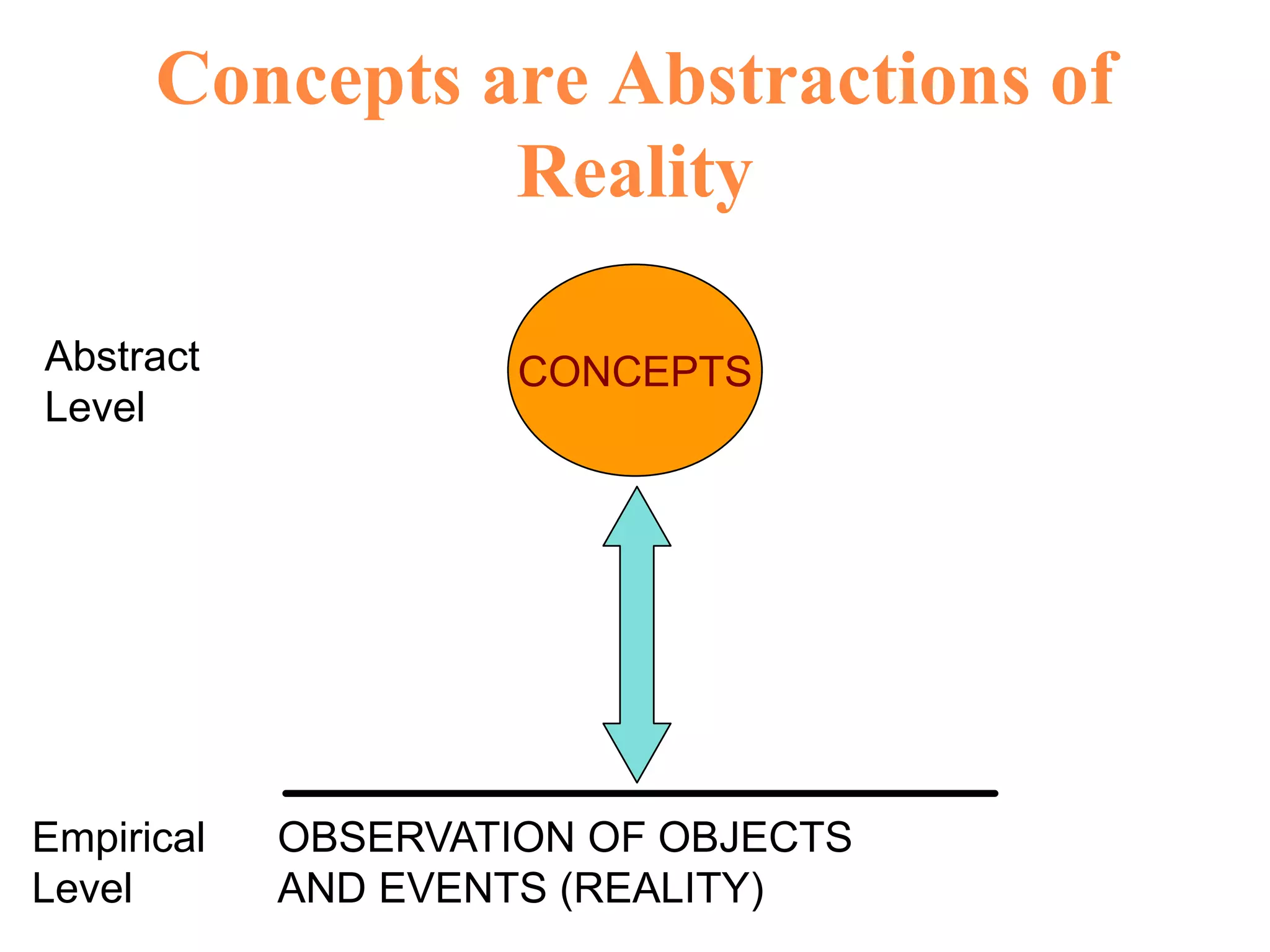
CONCEPTS
OBSERVATION OF OBJECTS
AND EVENTS (REALITY)
Empirical
Level
Abstract
Level
Concepts are Abstractions of
Reality
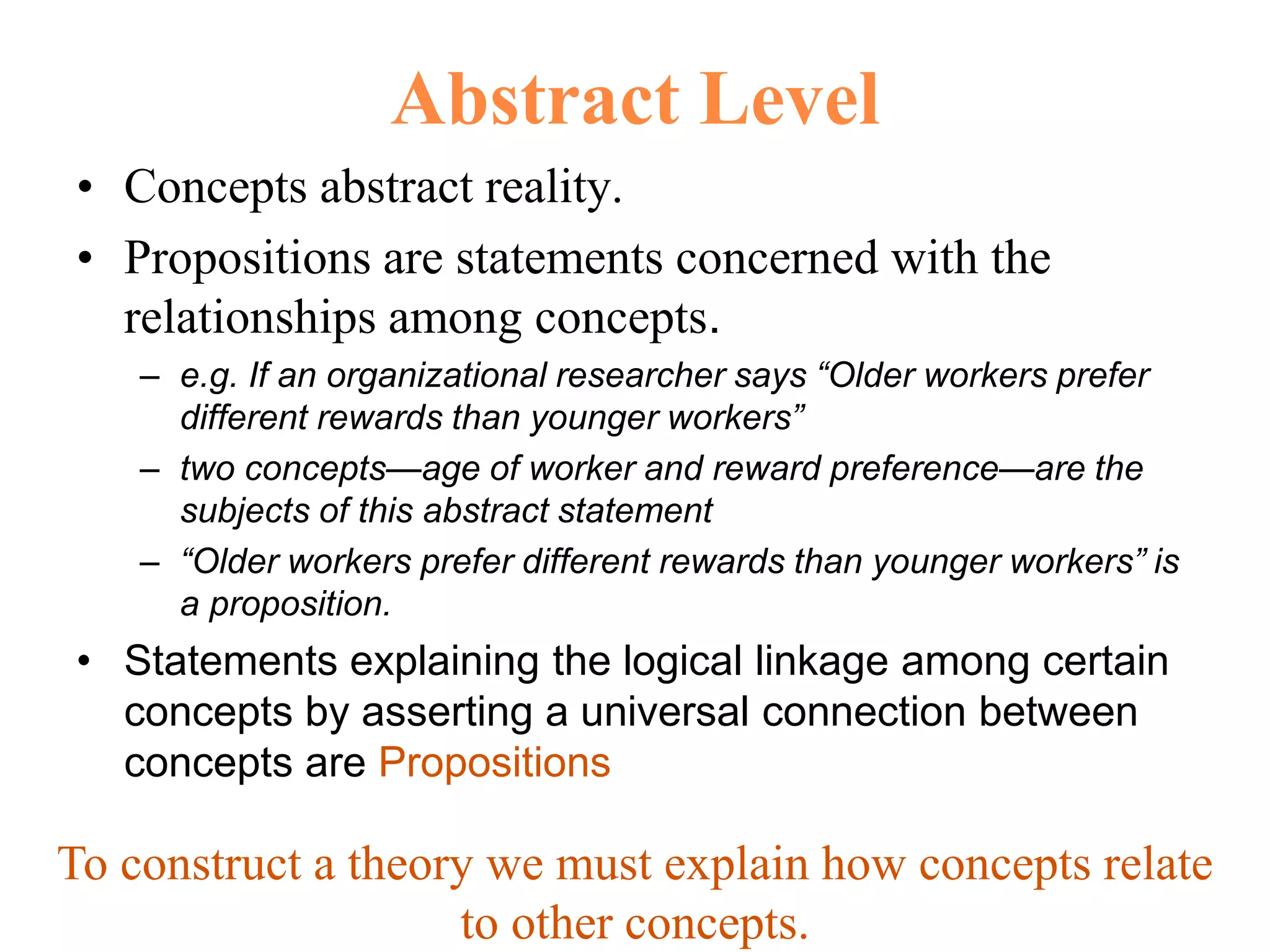
Abstract Level
• Concepts abstract reality.
• Propositions are statements concerned with the
relationships among concepts.
– e.g. If an organizational researcher says “Older workers prefer
different rewards than younger workers”
– two concepts—age of worker and reward preference—are the
subjects of this abstract statement
– “Older workers prefer different rewards than younger workers” is
a proposition.
• Statements explaining the logical linkage among certain
concepts by asserting a universal connection between
concepts are Propositions
To construct a theory we must explain how concepts relate
to other concepts.
• A hypothesis is a proposition that is empirically
testable. It is an empirical statement concerned with the
relationship among variables.
Formal statement of an unproven proposition that
is empirically testable
• Empirical testing is about examining a research
hypothesis against reality using data.
• A variable is anything that may assume different
numerical values, the empirical assessment of a
concept.
Always makes
four sales calls
a day
Dollar bonus for
sales volume
over quota
Concept B
(Habits)
Hypothesis at Empirical Level
Concept A
(Reinforcement)
Proposition at Abstract Level
The positive reinforcements will result in beneficial habits of
sales representatives.
Increasing the dollar bonus for sales volume over quota will
increase the number of sales calls by sales representatives.
Example
• “Treating our employees better will make
them more loyal employees”
• “Increasing retirement benefits will reduce
employee annual turnover”
• “Decreasing work hours will reduce annual
employee turnover”
• Retirement benefits
• Work hours
• Employee turnover
Proposition
Hypothesis
Variables
Theory and Song
A fact without a theory
Is like a ship without a sail,
Is like a boat without a rudder,
Is like a kite without a tail.
A fact without a figure is a tragic final act,
But one thing worse in this universe
Is a theory without a fact.
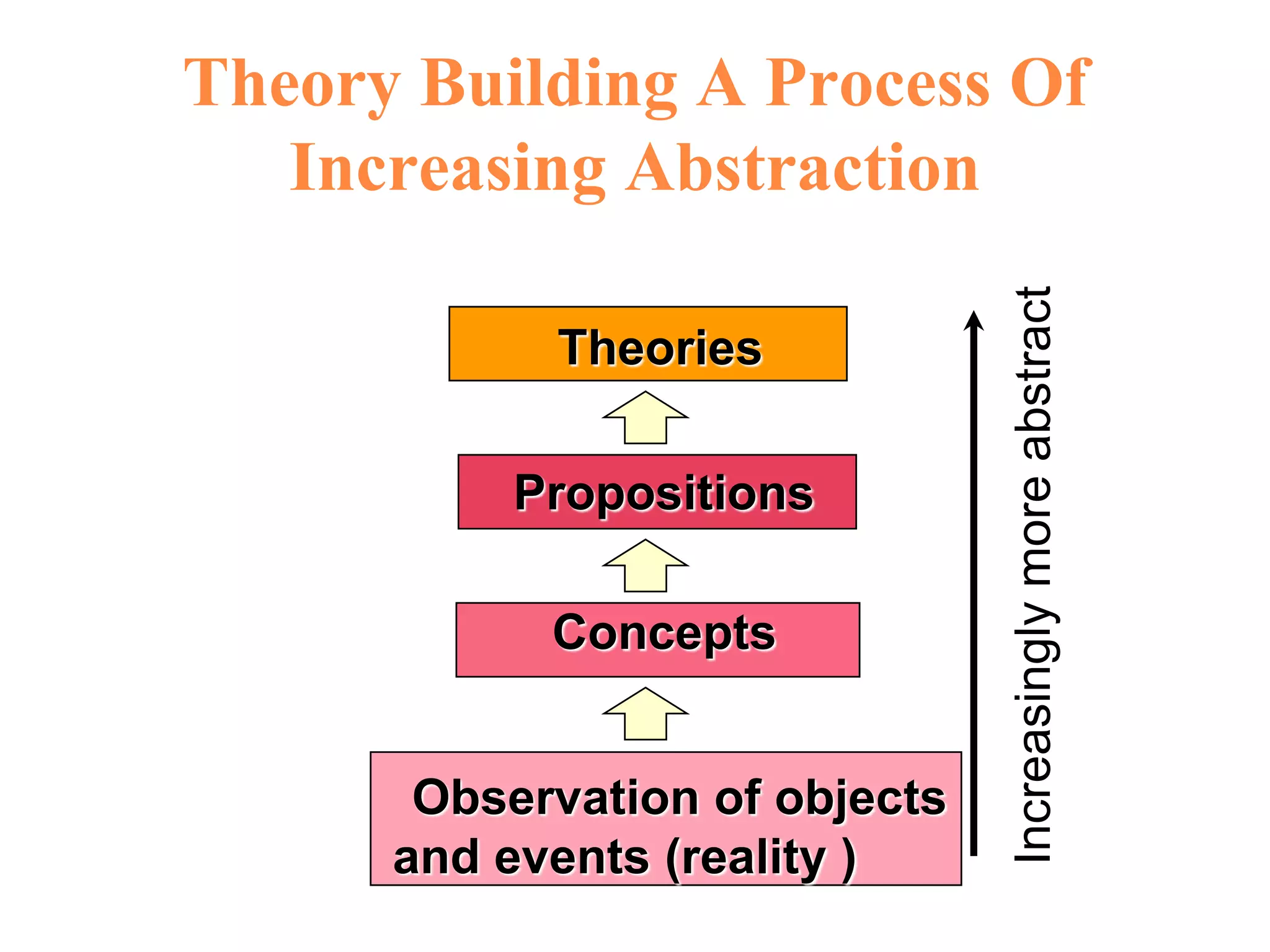
Theory Building A Process Of
Increasing Abstraction
Theories
Propositions
Concepts
Observation of objects
and events (reality )
Increasingly
more
abstract
Deductive Reasoning
• At the abstract, conceptual level, a theory may be
developed with deductive reasoning by going from a
general statement to a specific assertion
• The logical process of deriving a conclusion about a
specific instance based on a known general premise
or something known to be true
– Deductive reasoning reaches from general facts to specific
facts.
• We know that All dolphins are mammals.
• If we also know that All mammals have kidneys.
• Using deductive reasoning, you can conclude that all dolphins have
kidneys.
Inductive Reasoning
• At the empirical level, a theory may be
developed with inductive reasoning.
• The logical process of establishing a general
proposition on the basis of observation of
particular facts.
– Inductive reasoning reaches from specific facts to
general facts.
• All managers that have ever been seen are human beings;
therefore all managers are human beings.
• A recruiter conducts a study of recent hires who have
achieved success and stayed on with the organization. She
finds that they graduated from three local colleges, so she
decides to focus recruiting efforts on those schools.
The Scientific Method
A set of prescribed procedures for establishing
and connecting theoretical statements about
events, for analyzing empirical evidence, and
for predicting events yet unknown;
techniques or procedures used to analyze
empirical evidence in an attempt to confirm
or disprove prior conceptions.
Assess
relevant
existing
knowledge
Formulate
concepts &
Propositions
Statement
of
Hypotheses
Design
Research to
test
hypothesis
Acquire
meaningful
empirical
data
Analyze &
evaluate
data
Proposal of
explanation-
state new
problem
The Scientific Method:
An Overview
The Scientific Method
• In sum, the scientific method guides us
from the abstract nature of concepts and
propositions, to the empirical variables and
hypotheses, and to the testing and
verification of theory.

BRM Chapter 3.ppt

  • 1.
    Business Research Methods William G.Zikmund Chapter 3: Theory Building
  • 2.
    Theory • A theoryconsists of a coherent set of general propositions that offer an explanation of some phenomena by describing the way other things correspond to this phenomena. • A theory is a formal, testable explanation of some events that includes explanations of how things relate to one another.
  • 3.
    How theory isbuilt? • A theory can be built – through a process of reviewing previous findings of similar studies, – simple logical deduction, – and/or knowledge of applicable theoretical areas.
  • 4.
    Goals Of Theory •Understanding – The first goal allows the theorist to gain an understanding of the relationship among various phenomena. • Predicting – To predict the behavior or characteristics of one phenomenon, the understanding or knowledge of another phenomenon is important.
  • 5.
    Concept (or Construct) •A concept or construct is a generalized idea about a class of objects, attributes, occurrences, or processes that has been given a name. – Concepts are the building blocks of theory – Concepts abstract reality i.e. concepts express in words various events or objects. • “leadership,” “productivity,” and “morale” are concepts of organizational productivity • “gross national product,” “asset,” and “inflation” are concepts of economics.
  • 6.
    Vegetation Fruit Banana Reality Increasingly more abstract A Ladder OfAbstraction For Concepts Organization of concepts in sequence from the most concrete and individual to the most general.
  • 7.
    Scientific Business Researchers Operateat Two Levels • Abstract level – concepts – propositions • Empirical level – variables – hypotheses
  • 8.
    Definitions • Abstract level-In theory development, the level of knowledge expressing a concept that exists only as an idea or a quality apart from an object. • Empirical level -Level of knowledge reflecting that which is verifiable by experience or observation. – At an empirical level, we must more clearly define a construct and identify actual measures that we can assess and measure to represent the construct.
  • 9.
    CONCEPTS OBSERVATION OF OBJECTS ANDEVENTS (REALITY) Empirical Level Abstract Level Concepts are Abstractions of Reality
  • 10.
    Abstract Level • Conceptsabstract reality. • Propositions are statements concerned with the relationships among concepts. – e.g. If an organizational researcher says “Older workers prefer different rewards than younger workers” – two concepts—age of worker and reward preference—are the subjects of this abstract statement – “Older workers prefer different rewards than younger workers” is a proposition. • Statements explaining the logical linkage among certain concepts by asserting a universal connection between concepts are Propositions To construct a theory we must explain how concepts relate to other concepts.
  • 11.
    • A hypothesisis a proposition that is empirically testable. It is an empirical statement concerned with the relationship among variables. Formal statement of an unproven proposition that is empirically testable • Empirical testing is about examining a research hypothesis against reality using data. • A variable is anything that may assume different numerical values, the empirical assessment of a concept.
  • 12.
    Always makes four salescalls a day Dollar bonus for sales volume over quota Concept B (Habits) Hypothesis at Empirical Level Concept A (Reinforcement) Proposition at Abstract Level The positive reinforcements will result in beneficial habits of sales representatives. Increasing the dollar bonus for sales volume over quota will increase the number of sales calls by sales representatives.
  • 13.
    Example • “Treating ouremployees better will make them more loyal employees” • “Increasing retirement benefits will reduce employee annual turnover” • “Decreasing work hours will reduce annual employee turnover” • Retirement benefits • Work hours • Employee turnover Proposition Hypothesis Variables
  • 14.
    Theory and Song Afact without a theory Is like a ship without a sail, Is like a boat without a rudder, Is like a kite without a tail. A fact without a figure is a tragic final act, But one thing worse in this universe Is a theory without a fact.
  • 15.
    Theory Building AProcess Of Increasing Abstraction Theories Propositions Concepts Observation of objects and events (reality ) Increasingly more abstract
  • 16.
    Deductive Reasoning • Atthe abstract, conceptual level, a theory may be developed with deductive reasoning by going from a general statement to a specific assertion • The logical process of deriving a conclusion about a specific instance based on a known general premise or something known to be true – Deductive reasoning reaches from general facts to specific facts. • We know that All dolphins are mammals. • If we also know that All mammals have kidneys. • Using deductive reasoning, you can conclude that all dolphins have kidneys.
  • 17.
    Inductive Reasoning • Atthe empirical level, a theory may be developed with inductive reasoning. • The logical process of establishing a general proposition on the basis of observation of particular facts. – Inductive reasoning reaches from specific facts to general facts. • All managers that have ever been seen are human beings; therefore all managers are human beings. • A recruiter conducts a study of recent hires who have achieved success and stayed on with the organization. She finds that they graduated from three local colleges, so she decides to focus recruiting efforts on those schools.
  • 18.
    The Scientific Method Aset of prescribed procedures for establishing and connecting theoretical statements about events, for analyzing empirical evidence, and for predicting events yet unknown; techniques or procedures used to analyze empirical evidence in an attempt to confirm or disprove prior conceptions.
  • 19.
  • 20.
    The Scientific Method •In sum, the scientific method guides us from the abstract nature of concepts and propositions, to the empirical variables and hypotheses, and to the testing and verification of theory.