Action Research in
Education
TABINDA KHALID
JUNIOR WING (GARRISON ACADEMY SENIOR CAMPUS)
Definition : Action Research
 Action Research is a process in
which participants examine their own
educational practice systematically
and carefully, using the techniques of
research.
 (Watts, 1985, p.118)
 Action research can be described as a family of research
methodologies which pursue ACTION (or Change) and RESEARCH
(or Understanding) at the same time.
 To improve the quality of a PRACTICE.
 Conducted by practitioners who analyze the data to improve their own
practice.
 Done by individuals or by teams of colleagues
 Action research has the potential to generate genuine and sustained
improvements in schools
AR gives educators new opportunities to reflect on and assess their
teaching
 To explore and test new ideas, methods, and materials
To assess how effective the new approaches
To share feedback with fellow team members
To make decisions about which new approaches to include in the practice
Why Action Research is Important?
Steps in Action Research
Within all the definitions of action research, there are four basic themes;
 Empowerment of participants
 Collaboration through participation
 Acquisition of knowledge
 Social changes.
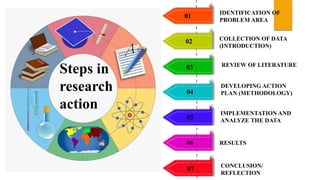
01
02
03
04
05
06
07
IDENTIFICATION OF
PROBLEM AREA
COLLECTION OF DATA
(INTRODUCTION)
REVIEW OF LITERATURE
DEVELOPING ACTION
PLAN (METHODOLOGY)
IMPLEMENTATION AND
ANALYZE THE DATA
RESULTS
CONCLUSION/
REFLECTION
Steps in
research
action
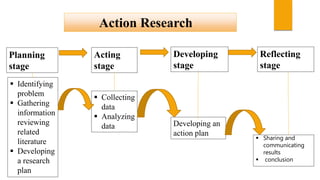
Action Research
Planning
stage
Acting
stage
Developing
stage
Reflecting
stage
 Identifying
problem
 Gathering
information
reviewing
related
literature
 Developing
a research
plan
 Collecting
data
 Analyzing
data Developing an
action plan
 Sharing and
communicating
results
 conclusion
1. Identify the Problem Area
There are several criteria to consider before investing the time and effort in
"researching” a problem. The question should
 be a higher-order question- not a yes/no
 be stated in common language, avoiding jargon
 be concise
 be meaningful
 not already have an answer
Collection of Data
The collection of data is an important step in
deciding what action needs to be taken.
Multiple sources of data are used to better
understand the scope of happenings in the
class room or school.
There are many vehicles for collection of data:
Interviews
Portfolios
Journals
Diaries
Video and Audio tapes
Case Studies
Surveys Field Notes
Checklist
Questionnaires
Logs of Meetings
Individual Files
Self-assessment
Records – tests, report cards, attendance
Review of Literature
“Related literature” can be loosely defined as any existing
source of information that can shed light on the topic
selected for investigation.
 These sources of information might include
 Professional books
 Research journals
 Complete Web sites or individual Web pages
 School or district documents (Creswell, 2005; Johnson,
2008).
 There really is no limit to what can be used as related literature because
the purpose of reviewing this information is to help the teacher-
researcher make informed decisions about the research focus and plan.
 This related information can provide guidance for defining or limiting
the problem, for developing an appropriate research design, or for
selecting legitimate instruments or techniques for collecting data
(Parsons & Brown, 2002).
 Again, this activity provides an opportunity for the action research to
connect existing theory and research to actual classroom practice
(Johnson, 2008).
Develop an Action Plan(Methodology)
 Identified the problem, described your vision
( methodology) how to successfully solve it.
 Brainstorming and reviewing the literature should
have provided you with ideas for new techniques and
strategies you think will produce better results.
 Focus your attention on the variables–the parts of
the formula you believe your actions can impact.
Criteria for selecting good action
research strategies
 Reliability and Validity are applicable to the action-research
strategy.
 For Example ; TEACHING METHODOLOGY
IMPLEMENTATION AND ANALYZE
THE DATA

A data analysis plan is a roadmap for how you're going
to organize and analyze your survey data—and it
should help you achieve three objectives that relate to the goal
you set before you started your survey
The motive behind data analysis in research is to present
 Accurate
 Reliable data.
Methods of Data Analysis
There are two main methods of Data Analysis:
 Qualitative Analysis.
This approach mainly answers questions such as 'why,'
'what' or 'how. ...
 Quantitative Analysis.
Generally, this analysis is measured in terms of
numbers. .
Results

The Evidence used to generate claims or action is clearly
documented; the action taken as a result of the research is tracked; the
findings are accessible to the consumer and relatable to their practice.

On the one hand, reflection is an essential condition for action research.
Reflection in action research makes the teacher aware of the various
forms of knowledge and action in education, of the tensions and
contradictions between the two, and of what is required to manage all
of this.
conclusion
When writing your conclusion, you can consider the steps
below to help you get started:
 Restate your research topic.
 Restate the thesis.
 Summarize the main points.
 State the significance or results.
 Conclude your thoughts
Benefits of action research
 Focus on school issue, problem or area of collective interest.
 Form of teacher professional development.
 Collegial interactions.
 Potential to impact school change.
 Reflect on own practice.
 Improved communications
 It provides an opportunity for reflection.
 It identifies measures of success.

Action research

  • 1.
    Action Research in Education TABINDAKHALID JUNIOR WING (GARRISON ACADEMY SENIOR CAMPUS)
  • 2.
    Definition : ActionResearch  Action Research is a process in which participants examine their own educational practice systematically and carefully, using the techniques of research.  (Watts, 1985, p.118)
  • 3.
     Action researchcan be described as a family of research methodologies which pursue ACTION (or Change) and RESEARCH (or Understanding) at the same time.  To improve the quality of a PRACTICE.  Conducted by practitioners who analyze the data to improve their own practice.  Done by individuals or by teams of colleagues  Action research has the potential to generate genuine and sustained improvements in schools
  • 4.
    AR gives educatorsnew opportunities to reflect on and assess their teaching  To explore and test new ideas, methods, and materials To assess how effective the new approaches To share feedback with fellow team members To make decisions about which new approaches to include in the practice Why Action Research is Important?
  • 5.
    Steps in ActionResearch Within all the definitions of action research, there are four basic themes;  Empowerment of participants  Collaboration through participation  Acquisition of knowledge  Social changes.
  • 6.
    01 02 03 04 05 06 07 IDENTIFICATION OF PROBLEM AREA COLLECTIONOF DATA (INTRODUCTION) REVIEW OF LITERATURE DEVELOPING ACTION PLAN (METHODOLOGY) IMPLEMENTATION AND ANALYZE THE DATA RESULTS CONCLUSION/ REFLECTION Steps in research action
  • 7.
    Action Research Planning stage Acting stage Developing stage Reflecting stage  Identifying problem Gathering information reviewing related literature  Developing a research plan  Collecting data  Analyzing data Developing an action plan  Sharing and communicating results  conclusion
  • 8.
    1. Identify theProblem Area There are several criteria to consider before investing the time and effort in "researching” a problem. The question should  be a higher-order question- not a yes/no  be stated in common language, avoiding jargon  be concise  be meaningful  not already have an answer
  • 9.
    Collection of Data Thecollection of data is an important step in deciding what action needs to be taken. Multiple sources of data are used to better understand the scope of happenings in the class room or school.
  • 10.
    There are manyvehicles for collection of data: Interviews Portfolios Journals Diaries Video and Audio tapes Case Studies Surveys Field Notes Checklist Questionnaires Logs of Meetings Individual Files Self-assessment Records – tests, report cards, attendance
  • 11.
    Review of Literature “Relatedliterature” can be loosely defined as any existing source of information that can shed light on the topic selected for investigation.  These sources of information might include  Professional books  Research journals  Complete Web sites or individual Web pages  School or district documents (Creswell, 2005; Johnson, 2008).
  • 12.
     There reallyis no limit to what can be used as related literature because the purpose of reviewing this information is to help the teacher- researcher make informed decisions about the research focus and plan.  This related information can provide guidance for defining or limiting the problem, for developing an appropriate research design, or for selecting legitimate instruments or techniques for collecting data (Parsons & Brown, 2002).  Again, this activity provides an opportunity for the action research to connect existing theory and research to actual classroom practice (Johnson, 2008).
  • 13.
    Develop an ActionPlan(Methodology)  Identified the problem, described your vision ( methodology) how to successfully solve it.  Brainstorming and reviewing the literature should have provided you with ideas for new techniques and strategies you think will produce better results.  Focus your attention on the variables–the parts of the formula you believe your actions can impact.
  • 14.
    Criteria for selectinggood action research strategies  Reliability and Validity are applicable to the action-research strategy.  For Example ; TEACHING METHODOLOGY
  • 15.
    IMPLEMENTATION AND ANALYZE THEDATA  A data analysis plan is a roadmap for how you're going to organize and analyze your survey data—and it should help you achieve three objectives that relate to the goal you set before you started your survey The motive behind data analysis in research is to present  Accurate  Reliable data.
  • 16.
    Methods of DataAnalysis There are two main methods of Data Analysis:  Qualitative Analysis. This approach mainly answers questions such as 'why,' 'what' or 'how. ...  Quantitative Analysis. Generally, this analysis is measured in terms of numbers. .
  • 17.
    Results  The Evidence usedto generate claims or action is clearly documented; the action taken as a result of the research is tracked; the findings are accessible to the consumer and relatable to their practice.  On the one hand, reflection is an essential condition for action research. Reflection in action research makes the teacher aware of the various forms of knowledge and action in education, of the tensions and contradictions between the two, and of what is required to manage all of this.
  • 18.
    conclusion When writing yourconclusion, you can consider the steps below to help you get started:  Restate your research topic.  Restate the thesis.  Summarize the main points.  State the significance or results.  Conclude your thoughts
  • 19.
    Benefits of actionresearch  Focus on school issue, problem or area of collective interest.  Form of teacher professional development.  Collegial interactions.  Potential to impact school change.  Reflect on own practice.  Improved communications  It provides an opportunity for reflection.  It identifies measures of success.