Dr. Enriqueta D. Reston
School of Education
University of San Carlos
Cebu City
EDUC 298/SCED 323:
Research Methods in Education/Seminar in Dissertation Writing
 “The systematic
collection and/or study
of evidence in order to
answer a question, solve
a problem, or create
knowledge. -Vogt (2007)
 Research is a process of steps used to
collect and analyze information to
increase our understanding of a topic or
issue. At a general level, research
consists of three steps:
1. Pose a question.
2. Collect data to answer the question.
3. Present an answer to the question.
(Creswell, 2013).
 The systematic investigation
involving the analysis of
information (data) to answer a
question or contribute to our
knowledge about an
educational theory or
practice. (McMillan & Wergin,
2008
For us in education, research may be viewed as a systematic process of
developing new knowledge about teaching and learning, and administration
for the improvement of educational practice .
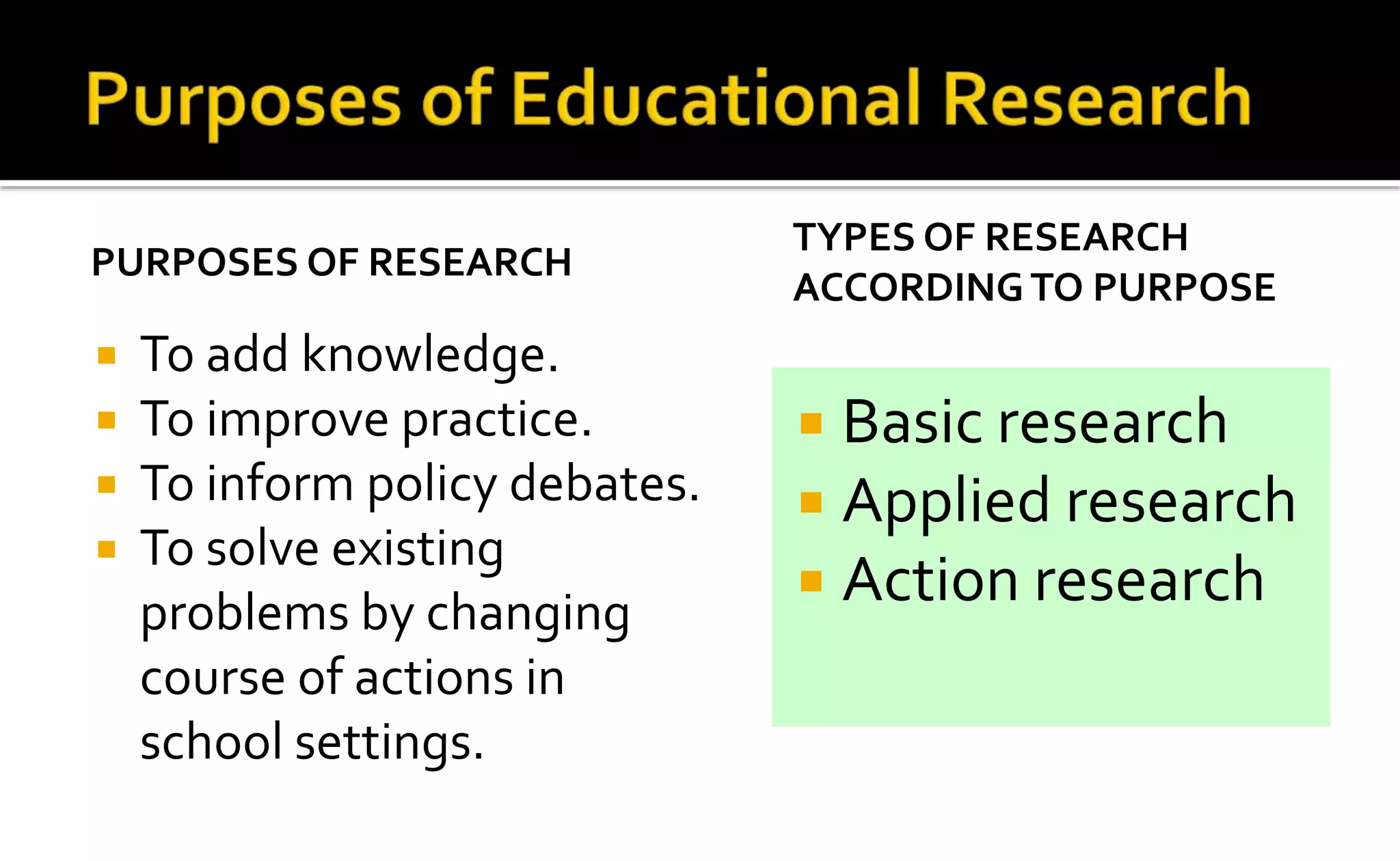
PURPOSES OF RESEARCH
 To add knowledge.
 To improve practice.
 To inform policy debates.
 To solve existing
problems by changing
course of actions in
school settings.
TYPES OF RESEARCH
ACCORDINGTO PURPOSE
 Basic research
 Applied research
 Action research
① Planning Phase – encompasses the processes in
developing the research proposal as the plan
② Empirical Phase- implementation of the research
which includes gathering data through various means
③ Analytical Phase – refers to analysis of data to
produce meaningful information as findings in answer
to your research questions
④ Dissemination Phase- writing the research report, oral
presentations, publications
⑤ Utilization Phase –using the findings of research to
improve practice or inform policy
 Multi-disciplinary
Content specific, curriculum, pedagogy, include
some psychological, social and philosophical
dimensions of education
 Multi-level
▪Individual, group (classes, schools) , society
 Multi-variant
Many factors interfere in problem situations.
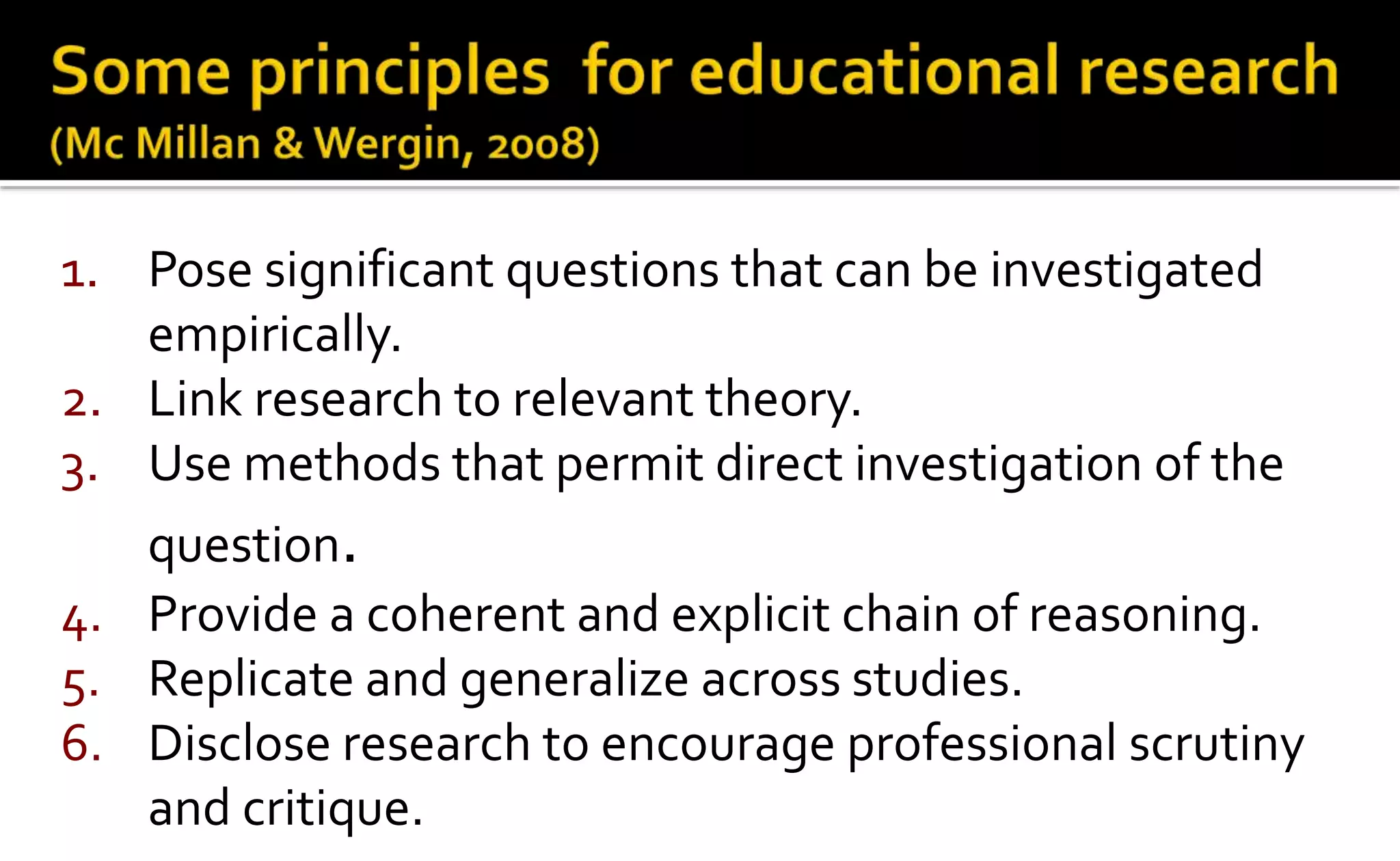
1. Pose significant questions that can be investigated
empirically.
2. Link research to relevant theory.
3. Use methods that permit direct investigation of the
question.
4. Provide a coherent and explicit chain of reasoning.
5. Replicate and generalize across studies.
6. Disclose research to encourage professional scrutiny
and critique.
 Research is Authentic Inquiry
◦ At its core, research is inquiry, the attempt to answer
significant question
 Research Advance knowledge in the Field
◦ The bottom line for judging research is, does it advance the
current knowledge in the field in a significant way?The field of
education may include practitioners of all kinds (teacher
educators, teachers, curriculum developers, administrators).
Thus, quality research provides knowledge that is not currently
available and that is needed.
IdeationalWing
CONCEPTUAL
CONTEXT/
FRAMEWORK
METHODS
PURPOSE
VALIDITY
RESEARCH
QUESTIONS
Empirical Wing

Review of Educational Research

  • 1.
    Dr. Enriqueta D.Reston School of Education University of San Carlos Cebu City EDUC 298/SCED 323: Research Methods in Education/Seminar in Dissertation Writing
  • 2.
     “The systematic collectionand/or study of evidence in order to answer a question, solve a problem, or create knowledge. -Vogt (2007)  Research is a process of steps used to collect and analyze information to increase our understanding of a topic or issue. At a general level, research consists of three steps: 1. Pose a question. 2. Collect data to answer the question. 3. Present an answer to the question. (Creswell, 2013).
  • 3.
     The systematicinvestigation involving the analysis of information (data) to answer a question or contribute to our knowledge about an educational theory or practice. (McMillan & Wergin, 2008 For us in education, research may be viewed as a systematic process of developing new knowledge about teaching and learning, and administration for the improvement of educational practice .
  • 4.
    PURPOSES OF RESEARCH To add knowledge.  To improve practice.  To inform policy debates.  To solve existing problems by changing course of actions in school settings. TYPES OF RESEARCH ACCORDINGTO PURPOSE  Basic research  Applied research  Action research
  • 6.
    ① Planning Phase– encompasses the processes in developing the research proposal as the plan ② Empirical Phase- implementation of the research which includes gathering data through various means ③ Analytical Phase – refers to analysis of data to produce meaningful information as findings in answer to your research questions ④ Dissemination Phase- writing the research report, oral presentations, publications ⑤ Utilization Phase –using the findings of research to improve practice or inform policy
  • 8.
     Multi-disciplinary Content specific,curriculum, pedagogy, include some psychological, social and philosophical dimensions of education  Multi-level ▪Individual, group (classes, schools) , society  Multi-variant Many factors interfere in problem situations.
  • 9.
    1. Pose significantquestions that can be investigated empirically. 2. Link research to relevant theory. 3. Use methods that permit direct investigation of the question. 4. Provide a coherent and explicit chain of reasoning. 5. Replicate and generalize across studies. 6. Disclose research to encourage professional scrutiny and critique.
  • 10.
     Research isAuthentic Inquiry ◦ At its core, research is inquiry, the attempt to answer significant question  Research Advance knowledge in the Field ◦ The bottom line for judging research is, does it advance the current knowledge in the field in a significant way?The field of education may include practitioners of all kinds (teacher educators, teachers, curriculum developers, administrators). Thus, quality research provides knowledge that is not currently available and that is needed.
  • 11.