


How to identify a topic for
research ?
Mrinmoy Majumder,PhD
Why identification of topic for research is ‘so important’ ?
 Identification of suitable topic will ensure proper utilization of
your expertise
 It will prevent repetition of research
 Relevant topic will help to identify relevant journals/conferences
 Zeroing to a topic of interest will produce quality research
 One can easily promote the research output to suitable and
targeted audience
 Which in turn will generate citations
Providing ‘roasted chicken’ to a cow will not yield the same result
when you feed the food to a hungry dog.
Similarly, selection of a topic which is interesting and falls under the
expertise of the researcher is extremely important in the success of the
research.
The recognition of the suitable topic will help to identify the
population interested to ‘eat’ the topic
So, the first step in your research career will be to identify a topic
which is interesting and falls under the scope of your
expertise/knowledge.
Identification of suitable
topic of research : First step
The first step for identification of “suitable topic of
research” is :
Pinpointing the expertise/domain of knowledge.
Many people do not know about their own expertise. It
is surprising but true.
That is why, knowing the domain of our knowledge is
extremely important.
Another point of concern is : ‘in which area of the
knowledge domain, one is passionate about’
Recognizing the knowledge domain as well as the area
of ‘passion’ is immensely important for the success of a
research career.
How to identify our ‘knowledge
base’ ?
 The branch/department of graduation/Bachelor degree ?
 Specialization of post graduation/Master degree ?
 Subjects in which maximum mark was secured ?
 Subject of interest for which books/videos are consulted during
the vacation/holiday/leisure time ?
 If science magazines or newspapers are subscribed, then the topic
which is eagerly awaited ?
The answer to the first three queries as described above, will give the
domain of our knowledge.
One or two keyword which represent the main theme of the
information, collected from the first three question, can be derived to
adequately identify the domain.
Lesser and shorter the keywords better will be the identification.
How to identify the ‘area of passion’ ?
 The answer to the last two questions converted into mono or bi-word keywords(key word
consisting of one or two words) will identify the ‘area of passion’.
Identification of suitable topic of
research : Second step
After the keywords which identifies the knowledge base
and the area of passion are recognized, following sites
may be searched to retrieve the number of documents
available for the keyword :
1)Google Scholar
2)Science Direct
3)Springer Link
4)Wiley
5)Taylor and Francis
The number of documents available for each keyword as
shown in the search results can show the popularity of
the identified keywords.
How to find the popularity of a keyword?
 The total number of documents found in the search results from all the websites
and counted per year basis will depict the total number of documents published
in that year.
 The suitable topic of research can be identified by :
 The average percentage of all the documents published in the last three
years on the topic will be minimum compared to all the keywords
considered in this analyses.
 And The percentage of documents published in the most recent year will
be maximum compared to that of all the keywords considered in this
analyses.
Why ?
A topic which is widely explored will have more document compared to the topic
which is rarely investigated. Publishing new papers in this topic will be difficult.
However, a topic has to be contemporary and to get higher number of citation,
sufficient amount of works must be carried out in the recent years. If a topic is rarely
researched then also publishing papers on that topic is not easy. But the topics,
which have not so high amount of document but number of publications has been
increased in the recent years will definitely be the topic in which further research is
required and may be selected as the topic of interest
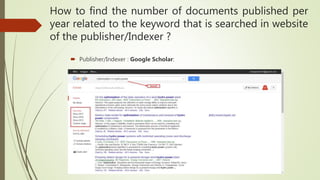
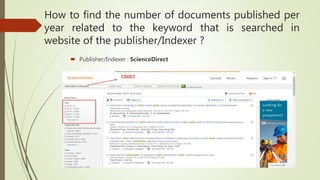
How to find the number of documents published per
year related to the keyword that is searched in website
of the publisher/Indexer ?
 Publisher/Indexer : Google Scholar:
 Publisher/Indexer : ScienceDirect
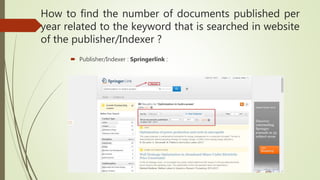
How to find the number of documents published per
year related to the keyword that is searched in
website of the publisher/Indexer ?
 Publisher/Indexer : Springerlink :
How to find the number of documents published per
year related to the keyword that is searched in website
of the publisher/Indexer ?
How to find the number of documents
published per year related to the keyword
that is searched in website of the
publisher/Indexer ?
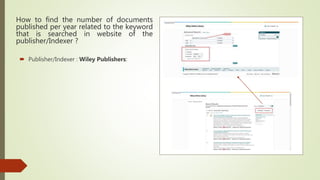
 Publisher/Indexer : Wiley Publishers:
How to find the number of documents published per
year related to the keyword that is searched in website
of the publisher/Indexer ?
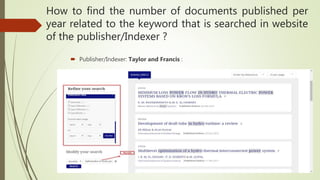
 Publisher/Indexer: Taylor and Francis :
Explanation of the Process
by an Example
 Following is an example :
I want to identify my topic of research. As described in the
previous slides, my first step will be to find the answer to the
following queries :
 The branch/department of graduation/Bachelor degree ?
 Electrical Engineering
 Specialization of post graduation/Master degree ?
 Water resources and hydraulics
 Subjects in which maximum mark was secured ?
 Advanced Hydropower
 Subject of interest for which other books/videos were
consulted during the vacation/holiday time ?
 Optimization, Neural networks, Renewable energy,
Watershed management
 If science magazines or newspapers are subscribed, then
the topic of research, which is eagerly awaited ?
 Watershed management, Renewable energy
Example, contd.
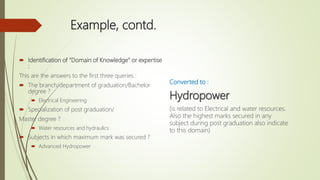
 Identification of “Domain of Knowledge” or expertise
:
This are the answers to the first three queries :
 The branch/department of graduation/Bachelor
degree ?
 Electrical Engineering
 Specialization of post graduation/
Master degree ?
 Water resources and hydraulics
 Subjects in which maximum mark was secured ?
 Advanced Hydropower
Converted to :
Hydropower
(is related to Electrical and water resources.
Also the highest marks secured in any
subject during post graduation also indicate
to this domain)
Example, contd.
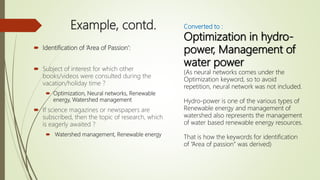
 Identification of ‘Area of Passion’:
 Subject of interest for which other
books/videos were consulted during the
vacation/holiday time ?
 Optimization, Neural networks, Renewable
energy, Watershed management
 If science magazines or newspapers are
subscribed, then the topic of research, which
is eagerly awaited ?
 Watershed management, Renewable energy
Converted to :
Optimization in hydro-
power, Management of
water power
(As neural networks comes under the
Optimization keyword, so to avoid
repetition, neural network was not included.
Hydro-power is one of the various types of
Renewable energy and management of
watershed also represents the management
of water based renewable energy resources.
That is how the keywords for identification
of “Area of passion” was derived)
Step Two
Example, contd.
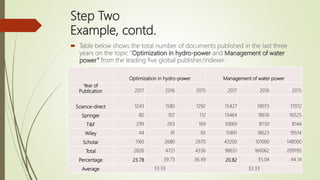
 Table below shows the total number of documents published in the last three
years on the topic “Optimization in hydro-power and Management of water
power” from the leading five global publisher/indexer:
Optimization in hydro-power Management of water power
Year of
Publication 2017 2016 2015 2017 2016 2015
Science-direct 1243 1580 1292 15427 19073 17012
Springer 80 107 112 13464 18616 16525
T&F 299 263 169 10669 8750 8144
Wiley 44 91 93 15891 18623 19514
Scholar 1160 2680 2670 43200 101000 148000
Total 2826 4721 4336 98651 166062 209195
Percentage 23.78 39.73 36.49 20.82 35.04 44.14
Average 33.33 33.33
Result : Topic of Research is
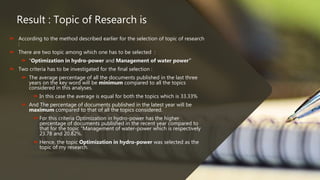
 According to the method described earlier for the selection of topic of research
:
 There are two topic among which one has to be selected :
 “Optimization in hydro-power and Management of water power”
 Two criteria has to be investigated for the final selection :
 The average percentage of all the documents published in the last three
years on the key word will be minimum compared to all the topics
considered in this analyses.
 In this case the average is equal for both the topics which is 33.33%
 And The percentage of documents published in the latest year will be
maximum compared to that of all the topics considered.
 For this criteria Optimization in hydro-power has the higher
percentage of documents published in the recent year compared to
that for the topic “Management of water-power which is respectively
23.78 and 20.82%.
 Hence, the topic Optimization in hydro-power was selected as the
topic of my research.
Conclusion
 In the example the first criteria was
indecisive(for both the keyword average was
33.33%)
 However, due to the imposition of the second
criteria, the tie was broken and I was successful
in selection of my topic of research.
 But it may happen that the second criteria is
also equal.
 Then inclusion of one more keyword will ease
the situation and may break the deadlock.
 This is an idea which has helped me in
segregation and identification of my topic of
research.
 I hope it will also help to solve the same
problem facing many budding researchers in
the world.

How to identify a topic for research

  • 1.
    How to identifya topic for research ? Mrinmoy Majumder,PhD
  • 2.
    Why identification oftopic for research is ‘so important’ ?  Identification of suitable topic will ensure proper utilization of your expertise  It will prevent repetition of research  Relevant topic will help to identify relevant journals/conferences  Zeroing to a topic of interest will produce quality research  One can easily promote the research output to suitable and targeted audience  Which in turn will generate citations Providing ‘roasted chicken’ to a cow will not yield the same result when you feed the food to a hungry dog. Similarly, selection of a topic which is interesting and falls under the expertise of the researcher is extremely important in the success of the research. The recognition of the suitable topic will help to identify the population interested to ‘eat’ the topic So, the first step in your research career will be to identify a topic which is interesting and falls under the scope of your expertise/knowledge.
  • 3.
    Identification of suitable topicof research : First step The first step for identification of “suitable topic of research” is : Pinpointing the expertise/domain of knowledge. Many people do not know about their own expertise. It is surprising but true. That is why, knowing the domain of our knowledge is extremely important. Another point of concern is : ‘in which area of the knowledge domain, one is passionate about’ Recognizing the knowledge domain as well as the area of ‘passion’ is immensely important for the success of a research career.
  • 4.
    How to identifyour ‘knowledge base’ ?  The branch/department of graduation/Bachelor degree ?  Specialization of post graduation/Master degree ?  Subjects in which maximum mark was secured ?  Subject of interest for which books/videos are consulted during the vacation/holiday/leisure time ?  If science magazines or newspapers are subscribed, then the topic which is eagerly awaited ? The answer to the first three queries as described above, will give the domain of our knowledge. One or two keyword which represent the main theme of the information, collected from the first three question, can be derived to adequately identify the domain. Lesser and shorter the keywords better will be the identification.
  • 5.
    How to identifythe ‘area of passion’ ?  The answer to the last two questions converted into mono or bi-word keywords(key word consisting of one or two words) will identify the ‘area of passion’.
  • 6.
    Identification of suitabletopic of research : Second step After the keywords which identifies the knowledge base and the area of passion are recognized, following sites may be searched to retrieve the number of documents available for the keyword : 1)Google Scholar 2)Science Direct 3)Springer Link 4)Wiley 5)Taylor and Francis The number of documents available for each keyword as shown in the search results can show the popularity of the identified keywords.
  • 7.
    How to findthe popularity of a keyword?  The total number of documents found in the search results from all the websites and counted per year basis will depict the total number of documents published in that year.  The suitable topic of research can be identified by :  The average percentage of all the documents published in the last three years on the topic will be minimum compared to all the keywords considered in this analyses.  And The percentage of documents published in the most recent year will be maximum compared to that of all the keywords considered in this analyses. Why ? A topic which is widely explored will have more document compared to the topic which is rarely investigated. Publishing new papers in this topic will be difficult. However, a topic has to be contemporary and to get higher number of citation, sufficient amount of works must be carried out in the recent years. If a topic is rarely researched then also publishing papers on that topic is not easy. But the topics, which have not so high amount of document but number of publications has been increased in the recent years will definitely be the topic in which further research is required and may be selected as the topic of interest
  • 8.
    How to findthe number of documents published per year related to the keyword that is searched in website of the publisher/Indexer ?  Publisher/Indexer : Google Scholar:
  • 9.
     Publisher/Indexer :ScienceDirect How to find the number of documents published per year related to the keyword that is searched in website of the publisher/Indexer ?
  • 10.
     Publisher/Indexer :Springerlink : How to find the number of documents published per year related to the keyword that is searched in website of the publisher/Indexer ?
  • 11.
    How to findthe number of documents published per year related to the keyword that is searched in website of the publisher/Indexer ?  Publisher/Indexer : Wiley Publishers:
  • 12.
    How to findthe number of documents published per year related to the keyword that is searched in website of the publisher/Indexer ?  Publisher/Indexer: Taylor and Francis :
  • 13.
    Explanation of theProcess by an Example  Following is an example : I want to identify my topic of research. As described in the previous slides, my first step will be to find the answer to the following queries :  The branch/department of graduation/Bachelor degree ?  Electrical Engineering  Specialization of post graduation/Master degree ?  Water resources and hydraulics  Subjects in which maximum mark was secured ?  Advanced Hydropower  Subject of interest for which other books/videos were consulted during the vacation/holiday time ?  Optimization, Neural networks, Renewable energy, Watershed management  If science magazines or newspapers are subscribed, then the topic of research, which is eagerly awaited ?  Watershed management, Renewable energy
  • 14.
    Example, contd.  Identificationof “Domain of Knowledge” or expertise : This are the answers to the first three queries :  The branch/department of graduation/Bachelor degree ?  Electrical Engineering  Specialization of post graduation/ Master degree ?  Water resources and hydraulics  Subjects in which maximum mark was secured ?  Advanced Hydropower Converted to : Hydropower (is related to Electrical and water resources. Also the highest marks secured in any subject during post graduation also indicate to this domain)
  • 15.
    Example, contd.  Identificationof ‘Area of Passion’:  Subject of interest for which other books/videos were consulted during the vacation/holiday time ?  Optimization, Neural networks, Renewable energy, Watershed management  If science magazines or newspapers are subscribed, then the topic of research, which is eagerly awaited ?  Watershed management, Renewable energy Converted to : Optimization in hydro- power, Management of water power (As neural networks comes under the Optimization keyword, so to avoid repetition, neural network was not included. Hydro-power is one of the various types of Renewable energy and management of watershed also represents the management of water based renewable energy resources. That is how the keywords for identification of “Area of passion” was derived)
  • 16.
    Step Two Example, contd. Table below shows the total number of documents published in the last three years on the topic “Optimization in hydro-power and Management of water power” from the leading five global publisher/indexer: Optimization in hydro-power Management of water power Year of Publication 2017 2016 2015 2017 2016 2015 Science-direct 1243 1580 1292 15427 19073 17012 Springer 80 107 112 13464 18616 16525 T&F 299 263 169 10669 8750 8144 Wiley 44 91 93 15891 18623 19514 Scholar 1160 2680 2670 43200 101000 148000 Total 2826 4721 4336 98651 166062 209195 Percentage 23.78 39.73 36.49 20.82 35.04 44.14 Average 33.33 33.33
  • 17.
    Result : Topicof Research is  According to the method described earlier for the selection of topic of research :  There are two topic among which one has to be selected :  “Optimization in hydro-power and Management of water power”  Two criteria has to be investigated for the final selection :  The average percentage of all the documents published in the last three years on the key word will be minimum compared to all the topics considered in this analyses.  In this case the average is equal for both the topics which is 33.33%  And The percentage of documents published in the latest year will be maximum compared to that of all the topics considered.  For this criteria Optimization in hydro-power has the higher percentage of documents published in the recent year compared to that for the topic “Management of water-power which is respectively 23.78 and 20.82%.  Hence, the topic Optimization in hydro-power was selected as the topic of my research.
  • 18.
    Conclusion  In theexample the first criteria was indecisive(for both the keyword average was 33.33%)  However, due to the imposition of the second criteria, the tie was broken and I was successful in selection of my topic of research.  But it may happen that the second criteria is also equal.  Then inclusion of one more keyword will ease the situation and may break the deadlock.  This is an idea which has helped me in segregation and identification of my topic of research.  I hope it will also help to solve the same problem facing many budding researchers in the world.