RESEARCH METHODOLOGY.
MA English: Semester III
CODE: ENGL 4145
Session: 4 - 6
Area/s to discuss
• Connotations of Research.
Some of the Accepted Connotations
of Research.
• Research is simply a systematic and refined
technique of thinking employing specialized
tools, instruments, and procedures in order to
obtain a more adequate solution of a problem
than would be possible under ordinary means.
B
• Research ‘per se’ constitutes a method for the
discovery of truth, which is really a method of
critical thinking.
• It comprises defining and redefining problems;
formulating hypothesis or suggested solution;
collecting, organizing and evaluating data;
making deductions and reaching conclusions;
and at last, carefully testing the conclusions to
determine whether they fit the formulating
hypothesis.
C
• The systematic and scholarly application of the
scientific method, interpreted in its broader
sense, to the solution of educational problems;
conversely, any systematic study designed to
promote the development of education as a
science can be considered educational
research.
D & E
• Research is a point of view, an attitude of inquiry
or a frame of mind. It asks questions which have
not been asked, it seeks to answer them by
following a fairly definite procedure, is not a
mere theorizing, rather it is an attempt to elicit
facts and to face them once they have
assembled.
• Research is also called a human behavior.
F
• Educational research is normally considered as
scientific research. It means the whole efforts
carried out by public or private bodies in order to
improve educational methods and educational
activity in general whether involving scientific
research and a high level or lore modest
experiments concerning the school system and
educational methods.
G
• While discussing the nature and
significance of educational research some
scholars say, “Educational research is that
activity which is directed towards
development of a science of behaviour in
educational situations. The ultimate of
such a science is to provide knowledge
that will permit the educator to achieve his
goals by the most effective methods”.
H
• Some scholars considered research as a
process of developing process. According to
them “Research may be defined as a method of
studying problems whose solutions are to be
delivered partly or wholly from facts.
Contd…
• The facts dealt with in research may be
statements of opinions, historical facts,
those contained in records and reports,
the results of tests, answers to questions,
experimental data of any sort, and so
forth.
Contd…
• The final purpose of educational research is to
ascertain principles and develop procedures for
use in the field of education; therefore, it should
conclude by formulating principles or
procedures.
I
• Research is simply a systematic and
refined technique of thinking employing
specialized tools, instruments, and
procedures in order to obtain a more
adequate solution of a problem than would
be possible under ordinary means.
J
• Research ‘per se’ constitutes a method for the
discovery of truth, which is really a method of
critical thinking.
• It comprises defining and redefining problems;
formulating hypothesis or suggested solution;
collecting, organizing and evaluating data;
making deductions and reaching conclusions;
and at last, carefully testing the conclusions to
determine whether they fit the formulating
hypothesis.
k
• The systematic and scholarly application
of the scientific method, interpreted in its
broader sense, to the solution of
educational problems; conversely, any
systematic study designed to promote the
development of education as a science
can be considered educational research.
L & M
• Research is a point of view, an attitude of inquiry
or a frame of mind. It asks questions which have
not been asked, it seeks to answer them by
following a fairly definite procedure, is not a
mere theorizing, rather it is an attempt to elicit
facts and to face them once they have
assembled.
• Research is also called a human behavior.
N
• Educational research is normally considered as
scientific research.
• It means the whole efforts carried out by public
or private bodies in order to improve educational
methods and educational activity in general
whether involving scientific research and a high
level or lore modest experiments concerning the
school system and educational methods.
o
• While discussing the nature and significance of
educational research some scholars say,
“Educational research is that activity which is
directed towards development of a science of
behaviour in educational situations. The ultimate
of such a science is to provide knowledge that
will permit the educator to achieve his goals by
the most effective methods”.
RESEARCH METHODOLOGY.
MA English: Semester III
CODE: ENGL 4145
Session: 7 & 8
Area/s to be discussed.
• Characteristics of research.
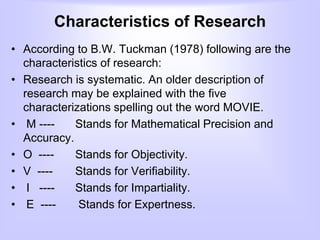
Characteristics of Research
• According to B.W. Tuckman (1978) following are the
characteristics of research:
• Research is systematic. An older description of
research may be explained with the five
characterizations spelling out the word MOVIE.
• M ---- Stands for Mathematical Precision and
Accuracy.
• O ---- Stands for Objectivity.
• V ---- Stands for Verifiability.
• I ---- Stands for Impartiality.
• E ---- Stands for Expertness.
Remember:
• Research is logical.
• Research is empirical.
• Research is reductive.
• Research is replicable and transmittable.
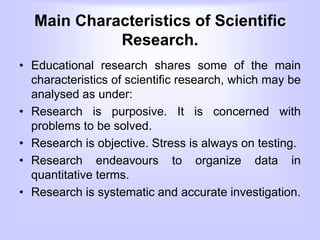
Main Characteristics of Scientific
Research.
• Educational research shares some of the main
characteristics of scientific research, which may be
analysed as under:
• Research is purposive. It is concerned with
problems to be solved.
• Research is objective. Stress is always on testing.
• Research endeavours to organize data in
quantitative terms.
• Research is systematic and accurate investigation.
Contd…
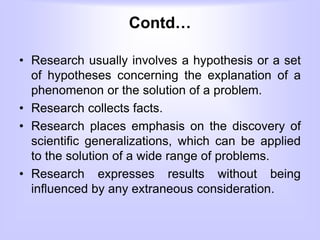
• Research usually involves a hypothesis or a set
of hypotheses concerning the explanation of a
phenomenon or the solution of a problem.
• Research collects facts.
• Research places emphasis on the discovery of
scientific generalizations, which can be applied
to the solution of a wide range of problems.
• Research expresses results without being
influenced by any extraneous consideration.
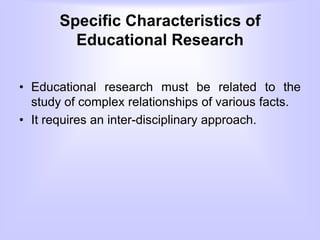
Specific Characteristics of
Educational Research
• Educational research must be related to the
study of complex relationships of various facts.
• It requires an inter-disciplinary approach.
Contd…
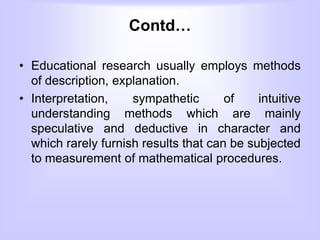
• Educational research usually employs methods
of description, explanation.
• Interpretation, sympathetic of intuitive
understanding methods which are mainly
speculative and deductive in character and
which rarely furnish results that can be subjected
to measurement of mathematical procedures.
Contd…
• Educational research should come out of a
desire to do things better. It should help them to
narrow down the proverbial gap between theory
and practice in education.
Contd…
• Educational research is not an exact research in
physical science. No human being has ever
been found to be alike.
• No scientific investigations of human behaviour-
even those of so called – “identical twins” have
resulted in the findings of individuals completely
similar in structure or behaviour.
• This fact stands in the way of making research
an exact science.
Contd…
• Educational research should be concerned
directly with the problems of school.
• It can properly concern itself with such matters
as child development, class organization,
teacher- pupil relationships, interaction with the
community, curriculum matters, teaching
techniques, and many others.
Contd…
• Any teacher with common sense, intelligence
and insight can undertake educational research.
• In the beginning such workers may require some
guidance and training but this can be made
easily available to them at the hands of experts.
Classification
• Educational research is classified in Basic
research, Applied research and Action research.
• Basic research.
• This type of research is also regarded as
fundamental / pure research. It builds up broad
generalizations, principles and theories of
education.
Contd…
• It results in the discovery of useful concepts
such as those of motivation, reinforcement,
concept, formation etc. It is not concerned with
day-to-day problems.
Applied Research
• This type of research is also called functional
research. Education like Medicine is an applied
science.
• Walter R. Borg has stated (1987), “The primary
function of research in education as in medicine-
is to find improvement for education or medicine
both to be understood as fields of human
actions, not as fields of knowledge
Contd…
• Applied research does not aim at solving the
problems, which are faced by the teachers,
educational planners, administrators, curriculum
specialists etc. Applied research deals with
problems of practical value.
• Applied research is less rigorous than the basic
research.

Rm 4 8 com

  • 1.
    RESEARCH METHODOLOGY. MA English:Semester III CODE: ENGL 4145 Session: 4 - 6
  • 2.
    Area/s to discuss •Connotations of Research.
  • 3.
    Some of theAccepted Connotations of Research. • Research is simply a systematic and refined technique of thinking employing specialized tools, instruments, and procedures in order to obtain a more adequate solution of a problem than would be possible under ordinary means.
  • 4.
    B • Research ‘perse’ constitutes a method for the discovery of truth, which is really a method of critical thinking. • It comprises defining and redefining problems; formulating hypothesis or suggested solution; collecting, organizing and evaluating data; making deductions and reaching conclusions; and at last, carefully testing the conclusions to determine whether they fit the formulating hypothesis.
  • 5.
    C • The systematicand scholarly application of the scientific method, interpreted in its broader sense, to the solution of educational problems; conversely, any systematic study designed to promote the development of education as a science can be considered educational research.
  • 6.
    D & E •Research is a point of view, an attitude of inquiry or a frame of mind. It asks questions which have not been asked, it seeks to answer them by following a fairly definite procedure, is not a mere theorizing, rather it is an attempt to elicit facts and to face them once they have assembled. • Research is also called a human behavior.
  • 7.
    F • Educational researchis normally considered as scientific research. It means the whole efforts carried out by public or private bodies in order to improve educational methods and educational activity in general whether involving scientific research and a high level or lore modest experiments concerning the school system and educational methods.
  • 8.
    G • While discussingthe nature and significance of educational research some scholars say, “Educational research is that activity which is directed towards development of a science of behaviour in educational situations. The ultimate of such a science is to provide knowledge that will permit the educator to achieve his goals by the most effective methods”.
  • 9.
    H • Some scholarsconsidered research as a process of developing process. According to them “Research may be defined as a method of studying problems whose solutions are to be delivered partly or wholly from facts.
  • 10.
    Contd… • The factsdealt with in research may be statements of opinions, historical facts, those contained in records and reports, the results of tests, answers to questions, experimental data of any sort, and so forth.
  • 11.
    Contd… • The finalpurpose of educational research is to ascertain principles and develop procedures for use in the field of education; therefore, it should conclude by formulating principles or procedures.
  • 12.
    I • Research issimply a systematic and refined technique of thinking employing specialized tools, instruments, and procedures in order to obtain a more adequate solution of a problem than would be possible under ordinary means.
  • 13.
    J • Research ‘perse’ constitutes a method for the discovery of truth, which is really a method of critical thinking. • It comprises defining and redefining problems; formulating hypothesis or suggested solution; collecting, organizing and evaluating data; making deductions and reaching conclusions; and at last, carefully testing the conclusions to determine whether they fit the formulating hypothesis.
  • 14.
    k • The systematicand scholarly application of the scientific method, interpreted in its broader sense, to the solution of educational problems; conversely, any systematic study designed to promote the development of education as a science can be considered educational research.
  • 15.
    L & M •Research is a point of view, an attitude of inquiry or a frame of mind. It asks questions which have not been asked, it seeks to answer them by following a fairly definite procedure, is not a mere theorizing, rather it is an attempt to elicit facts and to face them once they have assembled. • Research is also called a human behavior.
  • 16.
    N • Educational researchis normally considered as scientific research. • It means the whole efforts carried out by public or private bodies in order to improve educational methods and educational activity in general whether involving scientific research and a high level or lore modest experiments concerning the school system and educational methods.
  • 17.
    o • While discussingthe nature and significance of educational research some scholars say, “Educational research is that activity which is directed towards development of a science of behaviour in educational situations. The ultimate of such a science is to provide knowledge that will permit the educator to achieve his goals by the most effective methods”.
  • 18.
    RESEARCH METHODOLOGY. MA English:Semester III CODE: ENGL 4145 Session: 7 & 8
  • 19.
    Area/s to bediscussed. • Characteristics of research.
  • 20.
    Characteristics of Research •According to B.W. Tuckman (1978) following are the characteristics of research: • Research is systematic. An older description of research may be explained with the five characterizations spelling out the word MOVIE. • M ---- Stands for Mathematical Precision and Accuracy. • O ---- Stands for Objectivity. • V ---- Stands for Verifiability. • I ---- Stands for Impartiality. • E ---- Stands for Expertness.
  • 21.
    Remember: • Research islogical. • Research is empirical. • Research is reductive. • Research is replicable and transmittable.
  • 22.
    Main Characteristics ofScientific Research. • Educational research shares some of the main characteristics of scientific research, which may be analysed as under: • Research is purposive. It is concerned with problems to be solved. • Research is objective. Stress is always on testing. • Research endeavours to organize data in quantitative terms. • Research is systematic and accurate investigation.
  • 23.
    Contd… • Research usuallyinvolves a hypothesis or a set of hypotheses concerning the explanation of a phenomenon or the solution of a problem. • Research collects facts. • Research places emphasis on the discovery of scientific generalizations, which can be applied to the solution of a wide range of problems. • Research expresses results without being influenced by any extraneous consideration.
  • 24.
    Specific Characteristics of EducationalResearch • Educational research must be related to the study of complex relationships of various facts. • It requires an inter-disciplinary approach.
  • 25.
    Contd… • Educational researchusually employs methods of description, explanation. • Interpretation, sympathetic of intuitive understanding methods which are mainly speculative and deductive in character and which rarely furnish results that can be subjected to measurement of mathematical procedures.
  • 26.
    Contd… • Educational researchshould come out of a desire to do things better. It should help them to narrow down the proverbial gap between theory and practice in education.
  • 27.
    Contd… • Educational researchis not an exact research in physical science. No human being has ever been found to be alike. • No scientific investigations of human behaviour- even those of so called – “identical twins” have resulted in the findings of individuals completely similar in structure or behaviour. • This fact stands in the way of making research an exact science.
  • 28.
    Contd… • Educational researchshould be concerned directly with the problems of school. • It can properly concern itself with such matters as child development, class organization, teacher- pupil relationships, interaction with the community, curriculum matters, teaching techniques, and many others.
  • 29.
    Contd… • Any teacherwith common sense, intelligence and insight can undertake educational research. • In the beginning such workers may require some guidance and training but this can be made easily available to them at the hands of experts.
  • 30.
    Classification • Educational researchis classified in Basic research, Applied research and Action research. • Basic research. • This type of research is also regarded as fundamental / pure research. It builds up broad generalizations, principles and theories of education.
  • 31.
    Contd… • It resultsin the discovery of useful concepts such as those of motivation, reinforcement, concept, formation etc. It is not concerned with day-to-day problems.
  • 32.
    Applied Research • Thistype of research is also called functional research. Education like Medicine is an applied science. • Walter R. Borg has stated (1987), “The primary function of research in education as in medicine- is to find improvement for education or medicine both to be understood as fields of human actions, not as fields of knowledge
  • 33.
    Contd… • Applied researchdoes not aim at solving the problems, which are faced by the teachers, educational planners, administrators, curriculum specialists etc. Applied research deals with problems of practical value. • Applied research is less rigorous than the basic research.