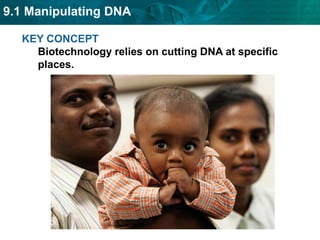
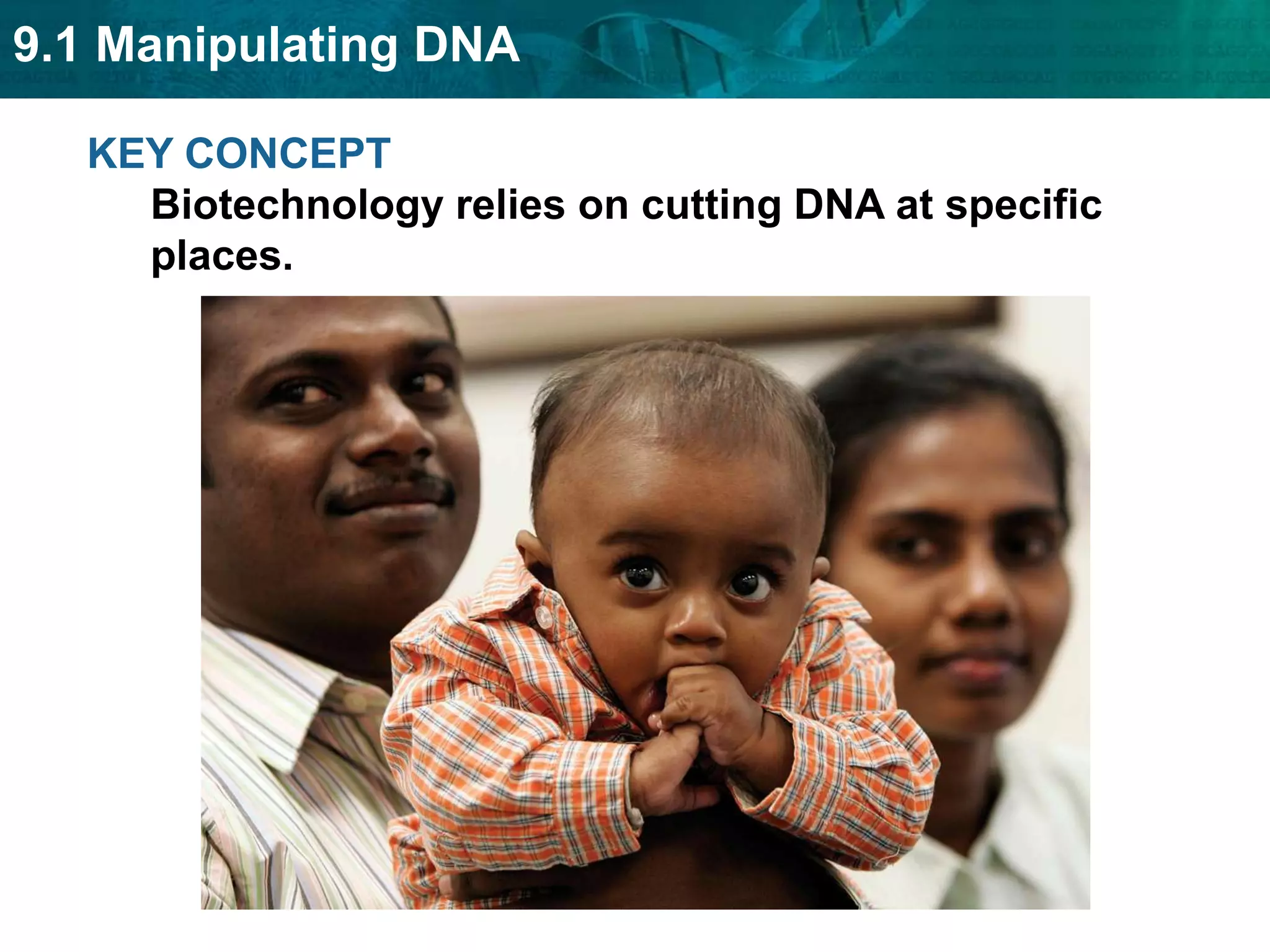
KEY CONCEPT Biotechnology relies on cutting DNA at specific places.
Scientists use several techniques to manipulate DNA. Chemicals, computers, and bacteria are used to work with DNA.Scientists use these tools in genetics research and biotechnology.
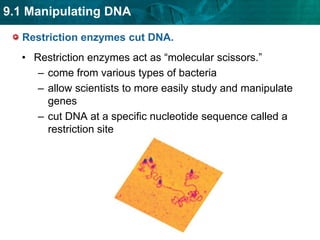
Restriction enzymes cut DNA. Restriction enzymes act as “molecular scissors.” come from various types of bacteriaallow scientists to more easily study and manipulate genescut DNA at a specific nucleotide sequence called a restriction site
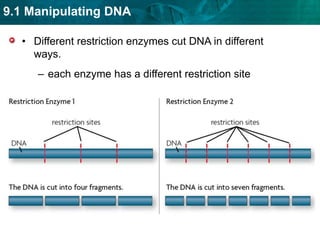
Different restriction enzymes cut DNA in different ways.
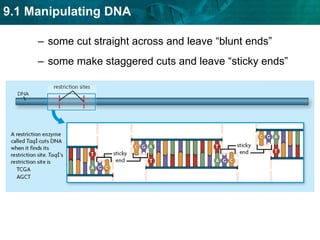
each enzyme has a different restriction sitesome cut straight across and leave “blunt ends”
some make staggered cuts and leave “sticky ends”Restriction maps show the lengths of DNA fragments. Gel electrophoresis is used to separate DNA fragments by size.A DNA sample is cut with restriction enzymes.Electrical current pulls DNA fragments through a gel.
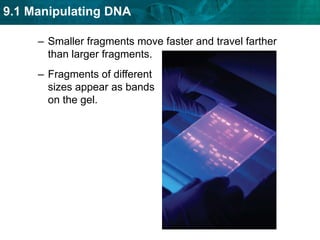
Smaller fragments move faster and travel farther than larger fragments.
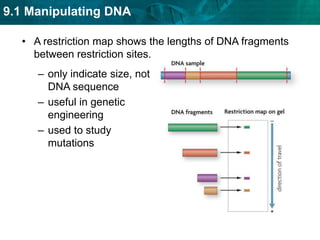
Fragments of different sizes appear as bands on the gel.A restriction map shows the lengths of DNA fragments between restriction sites.
only indicate size, not DNA sequence
useful in genetic engineering
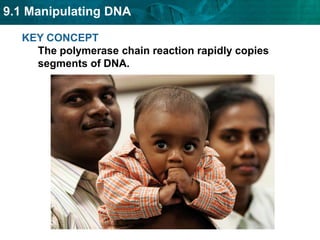
used to study mutationsKEY CONCEPT The polymerase chain reaction rapidly copies segments of DNA.
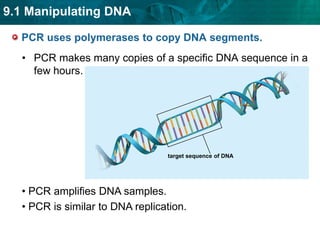
target sequence of DNAPCR uses polymerases to copy DNA segments.PCR makes many copies of a specific DNA sequence in a few hours. PCR amplifies DNA samples.
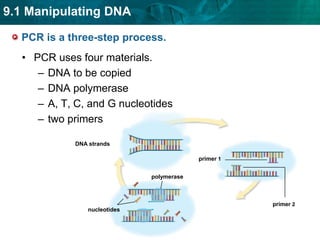
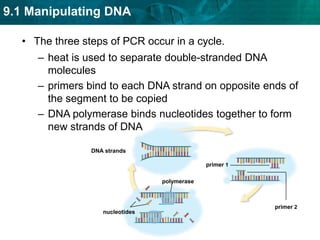
 PCR is similar to DNA replication.DNA strandsprimer1polymeraseprimer 2nucleotidesPCR is a three-step process. PCR uses four materials.DNA to be copiedDNA polymeraseA, T, C, and G nucleotidestwo primers
DNA strandsprimer1polymeraseprimer 2nucleotidesThe three steps of PCR occur in a cycle.
heat is used to separate double-stranded DNA molecules
primers bind to each DNA strand on opposite ends of the segment to be copied
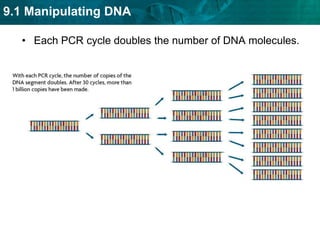
DNA polymerase binds nucleotides together to form new strands of DNA Each PCR cycle doubles the number of DNA molecules.
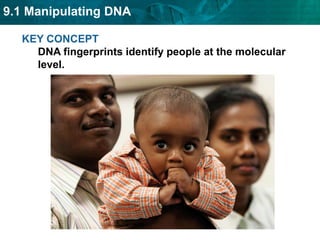
KEY CONCEPT DNA fingerprints identify people at the molecular level.
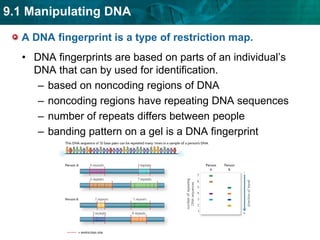
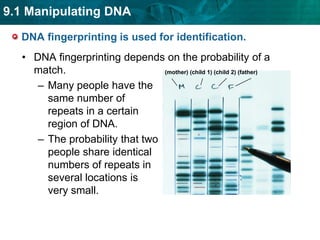
A DNA fingerprint is a type of restriction map.DNA fingerprints are based on parts of an individual’s DNA that can by used for identification.based on noncoding regions of DNAnoncoding regions have repeating DNA sequencesnumber of repeats differs between peoplebanding pattern on a gel is a DNA fingerprint
(mother) (child 1) (child 2) (father)DNA fingerprinting is used for identification. DNA fingerprinting depends on the probability of a match.Many people have thesame number ofrepeats in a certainregion of DNA.The probability that two people share identicalnumbers of repeats inseveral locations isvery small.
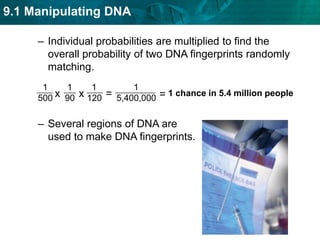
  1        1        1	             1500     90     120      5,400,000xx==1 chance in 5.4 million peopleIndividual probabilities are multiplied to find the overall probability of two DNA fingerprints randomly matching.
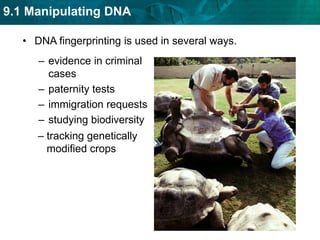
Several regions of DNA are used to make DNA fingerprints.DNA fingerprinting is used in several ways.
evidence in criminal cases
paternity tests
immigration requests
studying biodiversity
 tracking genetically   modified cropsKEY CONCEPT DNA sequences of organisms can be changed.
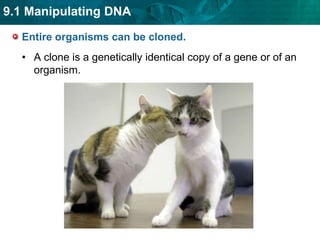
Entire organisms can be cloned.A clone is a genetically identical copy of a gene or of an organism.
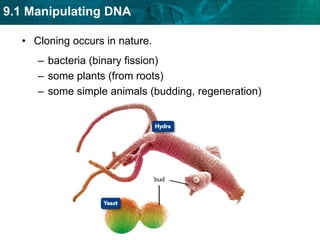
Cloning occurs in nature.
bacteria (binary fission)
some plants (from roots)
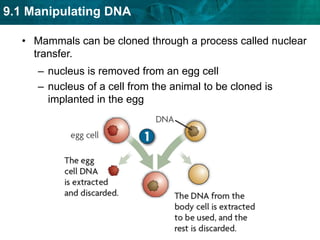
some simple animals (budding, regeneration)Mammals can be cloned through a process called nuclear transfer.
nucleus is removed from an egg cell
nucleus of a cell from the animal to be cloned is implanted in the eggCloning has potential benefits.
organs for transplant into humans
save endangered species
Cloning raises concerns.
low success rate
clones “imperfect” and less healthy than original animal

Unit 9 Manipulating Dna

  • 1.
    KEY CONCEPT Biotechnologyrelies on cutting DNA at specific places.
  • 2.
    Scientists use severaltechniques to manipulate DNA. Chemicals, computers, and bacteria are used to work with DNA.Scientists use these tools in genetics research and biotechnology.
  • 3.
    Restriction enzymes cutDNA. Restriction enzymes act as “molecular scissors.” come from various types of bacteriaallow scientists to more easily study and manipulate genescut DNA at a specific nucleotide sequence called a restriction site
  • 4.
    Different restriction enzymescut DNA in different ways.
  • 5.
    each enzyme hasa different restriction sitesome cut straight across and leave “blunt ends”
  • 6.
    some make staggeredcuts and leave “sticky ends”Restriction maps show the lengths of DNA fragments. Gel electrophoresis is used to separate DNA fragments by size.A DNA sample is cut with restriction enzymes.Electrical current pulls DNA fragments through a gel.
  • 7.
    Smaller fragments movefaster and travel farther than larger fragments.
  • 8.
    Fragments of differentsizes appear as bands on the gel.A restriction map shows the lengths of DNA fragments between restriction sites.
  • 9.
    only indicate size,not DNA sequence
  • 10.
  • 11.
    used to studymutationsKEY CONCEPT The polymerase chain reaction rapidly copies segments of DNA.
  • 12.
    target sequence ofDNAPCR uses polymerases to copy DNA segments.PCR makes many copies of a specific DNA sequence in a few hours. PCR amplifies DNA samples.
  • 13.
    PCR issimilar to DNA replication.DNA strandsprimer1polymeraseprimer 2nucleotidesPCR is a three-step process. PCR uses four materials.DNA to be copiedDNA polymeraseA, T, C, and G nucleotidestwo primers
  • 14.
    DNA strandsprimer1polymeraseprimer 2nucleotidesThethree steps of PCR occur in a cycle.
  • 15.
    heat is usedto separate double-stranded DNA molecules
  • 16.
    primers bind toeach DNA strand on opposite ends of the segment to be copied
  • 17.
    DNA polymerase bindsnucleotides together to form new strands of DNA Each PCR cycle doubles the number of DNA molecules.
  • 18.
    KEY CONCEPT DNAfingerprints identify people at the molecular level.
  • 19.
    A DNA fingerprintis a type of restriction map.DNA fingerprints are based on parts of an individual’s DNA that can by used for identification.based on noncoding regions of DNAnoncoding regions have repeating DNA sequencesnumber of repeats differs between peoplebanding pattern on a gel is a DNA fingerprint
  • 20.
    (mother) (child 1)(child 2) (father)DNA fingerprinting is used for identification. DNA fingerprinting depends on the probability of a match.Many people have thesame number ofrepeats in a certainregion of DNA.The probability that two people share identicalnumbers of repeats inseveral locations isvery small.
  • 21.
    1 1 1 1500 90 120 5,400,000xx==1 chance in 5.4 million peopleIndividual probabilities are multiplied to find the overall probability of two DNA fingerprints randomly matching.
  • 22.
    Several regions ofDNA are used to make DNA fingerprints.DNA fingerprinting is used in several ways.
  • 23.
  • 24.
  • 25.
  • 26.
  • 27.
    tracking genetically modified cropsKEY CONCEPT DNA sequences of organisms can be changed.
  • 28.
    Entire organisms canbe cloned.A clone is a genetically identical copy of a gene or of an organism.
  • 29.
  • 30.
  • 31.
  • 32.
    some simple animals(budding, regeneration)Mammals can be cloned through a process called nuclear transfer.
  • 33.
    nucleus is removedfrom an egg cell
  • 34.
    nucleus of acell from the animal to be cloned is implanted in the eggCloning has potential benefits.
  • 35.
  • 36.
  • 37.
  • 38.
  • 39.
    clones “imperfect” andless healthy than original animal