GENE CLONINGBHUPENDRA SINGH RATHOREB.sc. Biotech (II Sem.)
GENE CLONINGWhat does the term cloning mean?What is gene cloning? How does it differ from cloning an entire organism?Why is gene cloning done?How is gene cloning accomplished ?What are some of the ethical considerations regarding gene cloning?
CLONING-A DEFINITIONFrom the Greek - klon, a twigAn aggregate of the asexually produced progeny of an individual; a group of replicas of all or part of a macromolecule (such as DNA or an antibody)An individual grown from a single somatic cell of its parent & genetically identical to it
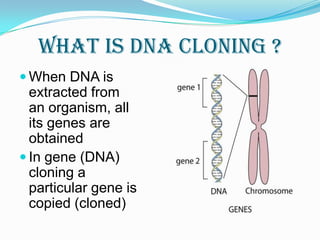
What is DNA cloning ?When DNA is extracted from an organism, all its genes are obtainedIn gene (DNA) cloning a particular gene is copied (cloned)
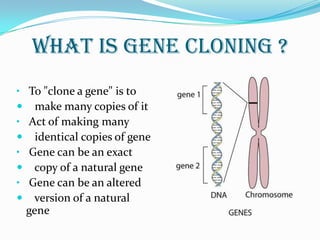
What is gene cloning ? To "clone a gene" is to     make many copies of it Act of making many    identical copies of gene Gene can be an exact      copy of a natural gene  Gene can be an altered    version of a natural gene
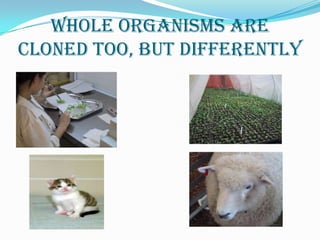
Whole organisms are cloned too, but differently
Why we clone dna ?A particular gene can be isolated and its nucleotide sequence determinedControl sequences of DNA can be identified & analyzedProtein/enzyme/RNA function can be investigatedMutations can be identified, e.g. gene defects related to specific diseasesOrganisms can be ‘engineered’ for specific purposes, e.g. insulin production, insect resistance, etc.
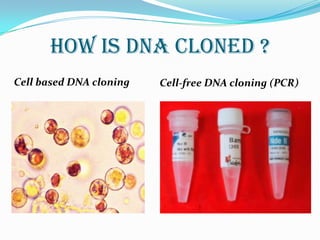
HOW IS DNA CLONED ?Cell based DNA cloningCell-free DNA cloning (PCR)
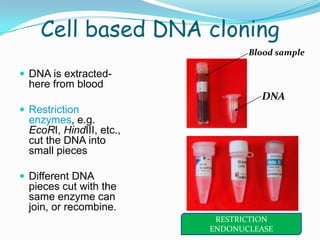
Cell based DNA cloningBlood sampleDNA is extracted- here from blood Restriction enzymes, e.g. EcoRI, HindIII, etc., cut the DNA into small piecesDifferent DNA pieces cut with the same enzyme can join, or recombine.DNARESTRICTION ENDONUCLEASE
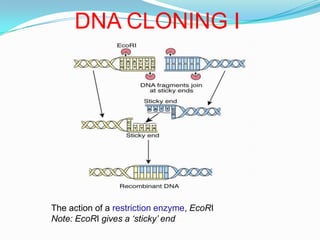
DNA CLONING IThe action of a restriction enzyme, EcoRINote: EcoRI gives a ‘sticky’ end
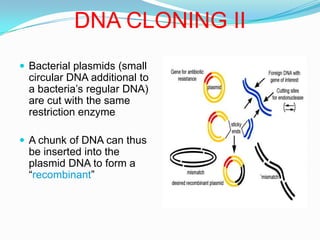
DNA CLONING IIBacterial plasmids (small circular DNA additional to a bacteria’s regular DNA) are cut with the same restriction enzyme
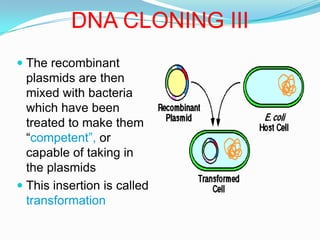
A chunk of DNA can thus be inserted into the plasmid DNA to form a “recombinant”DNA CLONING IIIThe recombinant plasmids are then mixed with bacteria which have been treated to make them “competent”, or capable of taking in the plasmids
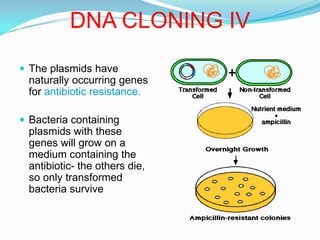
This insertion is called transformationDNA CLONING IVThe plasmids have naturally occurring genes for antibiotic resistance.Bacteria containing plasmids with these genes will grow on a medium containing the antibiotic- the others die, so only transformed bacteria survive
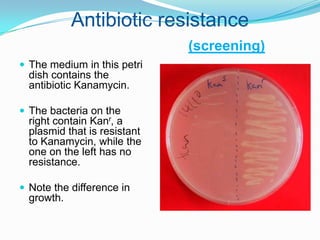
Antibiotic resistance(screening)The medium in this petri dish contains the antibiotic Kanamycin.The bacteria on the right contain Kanr, a plasmid that is resistant to Kanamycin, while the one on the left has no resistance.Note the difference in growth.
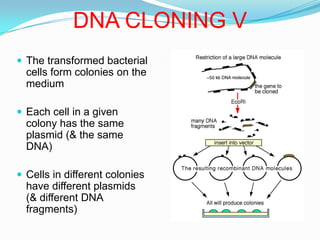
DNA CLONING VThe transformed bacterial cells form colonies on the medium
Each cell in a given colony has the same plasmid (& the same DNA)
Cells in different colonies have different plasmids (& different DNA fragments)Cell free DNA cloning (PCR)Developed in the mid 1980s.Kary Mullis - Nobel prize (1993).Revolutionized molecular biology.DNA fragments can be amplified in large amounts.In vitro technique.
What do we need for PCR?Sequence informationOligonucleotide primersDNANucleotidesHeat-stable DNA polymeraseTaq(Thermusaquaticus)
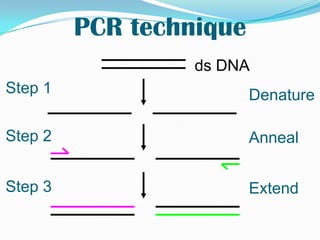
PCR techniqueds DNAStep 1DenatureStep 2AnnealStep 3Extend
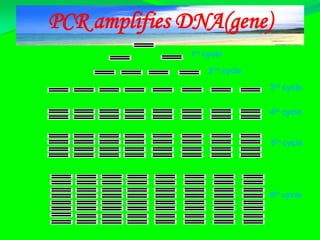
PCR amplifies DNA(gene)1st cycle1st cycle2nd cycle2nd cycle3rd cycle4th cycle5th cycle6th cycle
Any questions

Gene cloning

  • 1.
    GENE CLONINGBHUPENDRA SINGHRATHOREB.sc. Biotech (II Sem.)
  • 2.
    GENE CLONINGWhat doesthe term cloning mean?What is gene cloning? How does it differ from cloning an entire organism?Why is gene cloning done?How is gene cloning accomplished ?What are some of the ethical considerations regarding gene cloning?
  • 3.
    CLONING-A DEFINITIONFrom theGreek - klon, a twigAn aggregate of the asexually produced progeny of an individual; a group of replicas of all or part of a macromolecule (such as DNA or an antibody)An individual grown from a single somatic cell of its parent & genetically identical to it
  • 4.
    What is DNAcloning ?When DNA is extracted from an organism, all its genes are obtainedIn gene (DNA) cloning a particular gene is copied (cloned)
  • 5.
    What is genecloning ? To "clone a gene" is to make many copies of it Act of making many identical copies of gene Gene can be an exact copy of a natural gene Gene can be an altered version of a natural gene
  • 6.
    Whole organisms arecloned too, but differently
  • 7.
    Why we clonedna ?A particular gene can be isolated and its nucleotide sequence determinedControl sequences of DNA can be identified & analyzedProtein/enzyme/RNA function can be investigatedMutations can be identified, e.g. gene defects related to specific diseasesOrganisms can be ‘engineered’ for specific purposes, e.g. insulin production, insect resistance, etc.
  • 8.
    HOW IS DNACLONED ?Cell based DNA cloningCell-free DNA cloning (PCR)
  • 9.
    Cell based DNAcloningBlood sampleDNA is extracted- here from blood Restriction enzymes, e.g. EcoRI, HindIII, etc., cut the DNA into small piecesDifferent DNA pieces cut with the same enzyme can join, or recombine.DNARESTRICTION ENDONUCLEASE
  • 10.
    DNA CLONING ITheaction of a restriction enzyme, EcoRINote: EcoRI gives a ‘sticky’ end
  • 11.
    DNA CLONING IIBacterialplasmids (small circular DNA additional to a bacteria’s regular DNA) are cut with the same restriction enzyme
  • 12.
    A chunk ofDNA can thus be inserted into the plasmid DNA to form a “recombinant”DNA CLONING IIIThe recombinant plasmids are then mixed with bacteria which have been treated to make them “competent”, or capable of taking in the plasmids
  • 13.
    This insertion iscalled transformationDNA CLONING IVThe plasmids have naturally occurring genes for antibiotic resistance.Bacteria containing plasmids with these genes will grow on a medium containing the antibiotic- the others die, so only transformed bacteria survive
  • 14.
    Antibiotic resistance(screening)The mediumin this petri dish contains the antibiotic Kanamycin.The bacteria on the right contain Kanr, a plasmid that is resistant to Kanamycin, while the one on the left has no resistance.Note the difference in growth.
  • 15.
    DNA CLONING VThetransformed bacterial cells form colonies on the medium
  • 16.
    Each cell ina given colony has the same plasmid (& the same DNA)
  • 17.
    Cells in differentcolonies have different plasmids (& different DNA fragments)Cell free DNA cloning (PCR)Developed in the mid 1980s.Kary Mullis - Nobel prize (1993).Revolutionized molecular biology.DNA fragments can be amplified in large amounts.In vitro technique.
  • 18.
    What do weneed for PCR?Sequence informationOligonucleotide primersDNANucleotidesHeat-stable DNA polymeraseTaq(Thermusaquaticus)
  • 19.
    PCR techniqueds DNAStep1DenatureStep 2AnnealStep 3Extend
  • 20.
    PCR amplifies DNA(gene)1stcycle1st cycle2nd cycle2nd cycle3rd cycle4th cycle5th cycle6th cycle
  • 21.