Ch. 20 Biotech
Tools and Techniques
1. Restriction Enzymes
2. Gel Electrophoresis
3. PCR
4. Vectors/plasmids
5. Gene Library/Microarray
6. Stem Cells
7. DNA sequencing
8. DNA Cloning
• What is it?
• What is it used for?
• How does it work/what does it
do?
• Specifics
• Pic
Human Genome Project (HGP)
Francis Collins (NIH) & Jay Craig Ventor (Celera)
1.) HGP = Map of all 30,000 genes on the 46 human chromosomes (1988-2003)
• Information has led to many advances in the fields of medicine, agriculture, bio-
engineering
2.) An organism’s genome is the total DNA in the nucleus of each cell
• The human genome contains approx 3 billion nucleotide bases
• The average gene is made up of 3000 bases, but sizes of genes vary greatly.
• The total number of genes is estimated at around 30000.
• 99.9% nucleotide bases are exactly the same in all people
• As of September 2007 the complete sequence was known of,
• 1879 viruses,
• 577 bacterial species, and
• roughly 23 eukaryotic species (of which about half are
fungi).
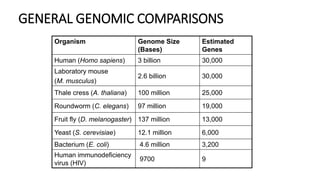
GENERAL GENOMIC COMPARISONS
Organism Genome Size
(Bases)
Estimated
Genes
Human (Homo sapiens) 3 billion 30,000
Laboratory mouse
(M. musculus)
2.6 billion 30,000
Thale cress (A. thaliana) 100 million 25,000
Roundworm (C. elegans) 97 million 19,000
Fruit fly (D. melanogaster) 137 million 13,000
Yeast (S. cerevisiae) 12.1 million 6,000
Bacterium (E. coli) 4.6 million 3,200
Human immunodeficiency
virus (HIV)
9700 9
GENETIC ENGINEERING
•Biotechnology refers to technology used to manipulate DNA
• The procedures are often referred to as genetic engineering
Recombinant DNA refers to the DNA from the two DIFFERENT
organisms
• Can be used for creating transgenic organisms, gene therapy, and cloning
• first used in the 1970’s with bacteria
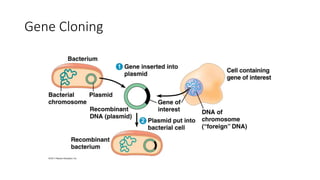
• Gene cloning: process by which scientists can produce multiple
copies of specific segments of DNA that they can then work with in
the lab
• Transformation: bacteria takes up plasmid (w/gene of interest)
Applications of DNA Technology
1. Diagnosis of disease – identify alleles, viral DNA
2. Gene therapy – alter afflicted genes
3. Production of pharmaceuticals
4. Forensic applications – DNA profiling
5. Environmental cleanup – use microorganisms
6. Agricultural applications - GMOs
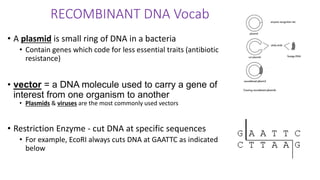
RECOMBINANT DNA Vocab
• A plasmid is small ring of DNA in a bacteria
• Contain genes which code for less essential traits (antibiotic
resistance)
• vector = a DNA molecule used to carry a gene of
interest from one organism to another
• Plasmids & viruses are the most commonly used vectors
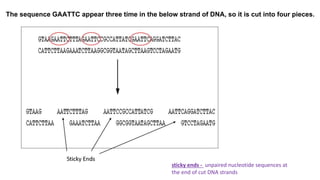
• Restriction Enzyme - cut DNA at specific sequences
• For example, EcoRI always cuts DNA at GAATTC as indicated
below
The sequence GAATTC appear three time in the below strand of DNA, so it is cut into four pieces.
sticky ends - unpaired nucleotide sequences at
the end of cut DNA strands
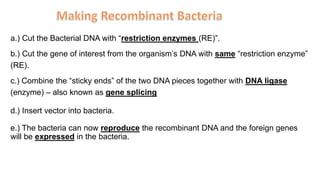
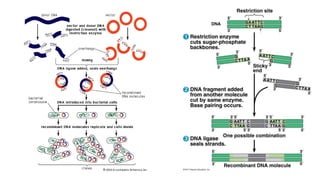
a.) Cut the Bacterial DNA with “restriction enzymes (RE)”.
b.) Cut the gene of interest from the organism’s DNA with same “restriction enzyme”
(RE).
c.) Combine the “sticky ends” of the two DNA pieces together with DNA ligase
(enzyme) – also known as gene splicing
d.) Insert vector into bacteria.
e.) The bacteria can now reproduce the recombinant DNA and the foreign genes
will be expressed in the bacteria.
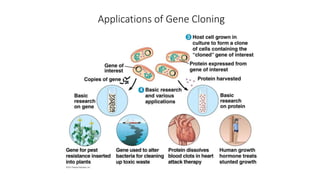
Gene Cloning
Applications of Gene Cloning
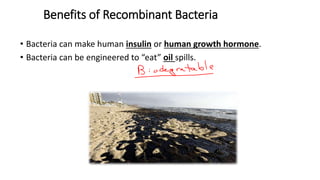
Benefits of Recombinant Bacteria
• Bacteria can make human insulin or human growth hormone.
• Bacteria can be engineered to “eat” oil spills.
Problems with inserting DNA
• Difference between eukaryotic RNA and prokaryotic RNA?
• Use reverse transcriptase
• an enzyme that catalyzes the formation of DNA from an RNA template in
reverse transcription
• Creates complementary DNA (cDNA) which lacks introns
• Can now be inserted into prokaryote
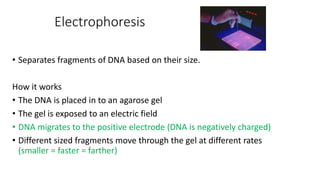
Electrophoresis
• Separates fragments of DNA based on their size.
How it works
• The DNA is placed in to an agarose gel
• The gel is exposed to an electric field
• DNA migrates to the positive electrode (DNA is negatively charged)
• Different sized fragments move through the gel at different rates
(smaller = faster = farther)
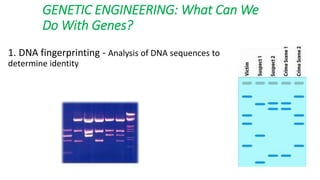
GENETIC ENGINEERING: What Can We
Do With Genes?
1. DNA fingerprinting - Analysis of DNA sequences to
determine identity
• Restriction Fragment Length Polymorphism (RFLPs – rif-lips)
• Cut DNA with different restriction enzymes
• Each person has different #s of DNA fragments created
• Analyze DNA samples on a gel for disease diagnosis
• Outdated method of DNA profiling (required a quarter-sized sample of blood)
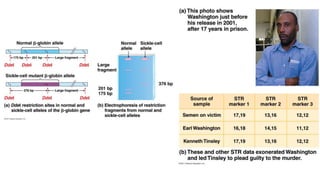
• STR = Short Tandem Repeats
• Non-coding DNA has regions with sequences (2-5 base length) that are
repeated
• Each person has different # of repeats at different locations (loci)
• Current method of DNA fingerprinting used – only need 20 cells for analysis
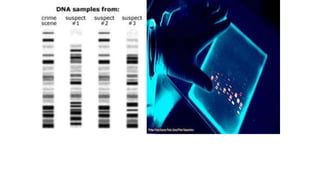
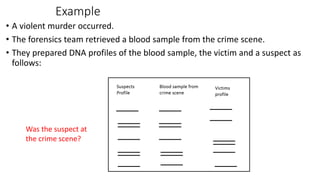
Example
• A violent murder occurred.
• The forensics team retrieved a blood sample from the crime scene.
• They prepared DNA profiles of the blood sample, the victim and a suspect as
follows:
Was the suspect at
the crime scene?
Solving Medical Problems
• Can be used to determine whether a particular person is the parent of a child
• A child's paternity (father) and maternity(mother) can be determined
• This information can be used in
• Paternity suits
• Inheritance cases
• Immigration cases
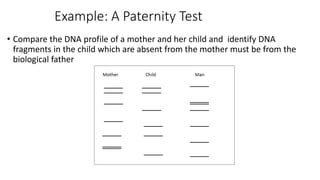
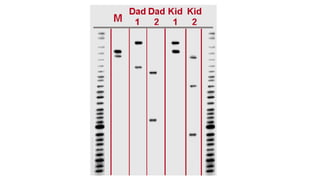
Example: A Paternity Test
• Compare the DNA profile of a mother and her child and identify DNA
fragments in the child which are absent from the mother must be from the
biological father
2. Gene therapy: A "normal" gene is inserted into the genome to
replace an "abnormal," disease-causing gene
• may be used treat a disorder by inserting a gene instead of using drugs or surgery
• Types of gene therapy: Replacing or inactivate a mutated gene that causes disease
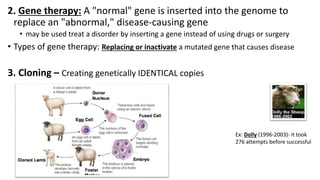
3. Cloning – Creating genetically IDENTICAL copies
Ex: Dolly (1996-2003)- it took
276 attempts before successful
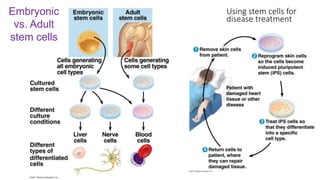
4. Stem cells
• Stem cells: can reproduce itself indefinitely and produce other specialized cells
• Zygote = totipotent (any type of cell)
• Embryonic stem cells = pluripotent (many cell types)
• Adult stem cells = multipotent (a few cell types) or induced pluripotent, iPS
(forced to be pluripotent)
• can be used to generate virtually any type of specialized cell in the human
body
• The goals to study human development and to treat disease
Embryonic
vs. Adult
stem cells
Using stem cells for
disease treatment
Other techniques
• CRISPER – nuclease that cuts DNA at a sequence it is directed to
• Use guide RNA molecule to direct
• Knock-out genes or insert genes
It is a molecule that finds a string of DNA code, locks on and makes a precision cut. And because
scientists can tune it to target any genetic sequence, they can use it to turn genes off or replace
them with new versions.
• RNA interference (RNAi) – silence gene expression
• Analyze function of genes
• Single nucleotide polymorphism (SNP) – a single base pair site where variation is
found in at least 1% of the population
• Find genes that cause disorders, disease, and give specific treatment
• SNP is near a disease associated allele
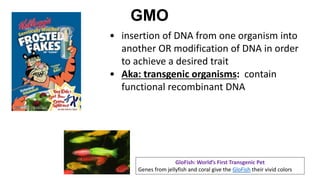
GMO
• insertion of DNA from one organism into
another OR modification of DNA in order
to achieve a desired trait
• Aka: transgenic organisms: contain
functional recombinant DNA
GloFish: World’s First Transgenic Pet
Genes from jellyfish and coral give the GloFish their vivid colors
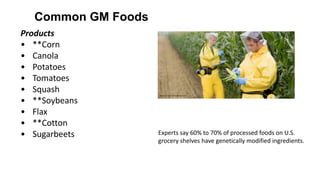
Common GM Foods
Products
• **Corn
• Canola
• Potatoes
• Tomatoes
• Squash
• **Soybeans
• Flax
• **Cotton
• Sugarbeets Experts say 60% to 70% of processed foods on U.S.
grocery shelves have genetically modified ingredients.
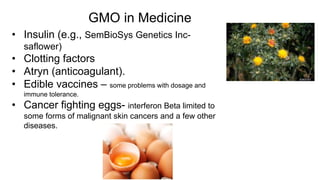
GMO in Medicine
• Insulin (e.g., SemBioSys Genetics Inc-
saflower)
• Clotting factors
• Atryn (anticoagulant).
• Edible vaccines – some problems with dosage and
immune tolerance.
• Cancer fighting eggs- interferon Beta limited to
some forms of malignant skin cancers and a few other
diseases.
Some current uses of Farming
GMO Medicine
• 1. Mapp Biopharmaceutical, Inc. – Using tobacco plants to make
components of Ebola vaccine ZMappTM.
• 2. Medicago – Making vaccines against viruses (e.g., influenza and
HIV) using tobacco plants.
• 3. Ventria Bioscience – Making human lactoferrin (VEN 100) in rice as
treatment against antibiotic-associated diarrhea.
• 4. Planet Biotechnology – Using plants to produce treatment of MERS
coronavirus infection.
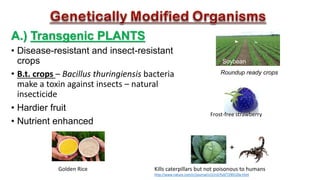
A.) Transgenic PLANTS
• Disease-resistant and insect-resistant
crops
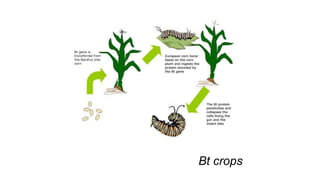
• B.t. crops – Bacillus thuringiensis bacteria
make a toxin against insects – natural
insecticide
• Hardier fruit
• Nutrient enhanced
Kills caterpillars but not poisonous to humans
http://www.nature.com/cr/journal/v12/n2/full/7290120a.html
Frost-free strawberry
Roundup ready crops
Soybean
Golden Rice
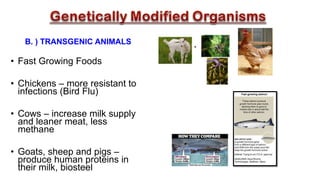
B. ) TRANSGENIC ANIMALS
• Fast Growing Foods
• Chickens – more resistant to
infections (Bird Flu)
• Cows – increase milk supply
and leaner meat, less
methane
• Goats, sheep and pigs –
produce human proteins in
their milk, biosteel
Bt crops
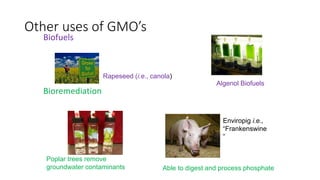
Biofuels
Bioremediation
Algenol Biofuels
Rapeseed (i.e., canola)
Enviropig i.e.,
“Frankenswine
”
Able to digest and process phosphate
Poplar trees remove
groundwater contaminants
Other uses of GMO’s
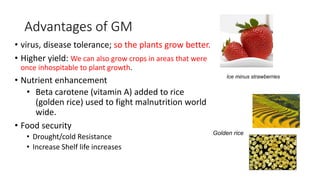
Advantages of GM
• virus, disease tolerance; so the plants grow better.
• Higher yield: We can also grow crops in areas that were
once inhospitable to plant growth.
• Nutrient enhancement
• Beta carotene (vitamin A) added to rice
(golden rice) used to fight malnutrition world
wide.
• Food security
• Drought/cold Resistance
• Increase Shelf life increases
Golden rice
Ice minus strawberries
Disadvantages
• Allergies and immunity to vaccines etc.
• Gene transfer
• Out-crossing/Accidental cross pollination
• Super weeds
• Contaminating streams
• Biodiversity issues
• Ownership of genes
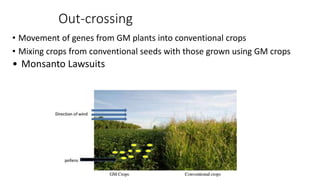
Out-crossing
• Movement of genes from GM plants into conventional crops
• Mixing crops from conventional seeds with those grown using GM crops
• Monsanto Lawsuits
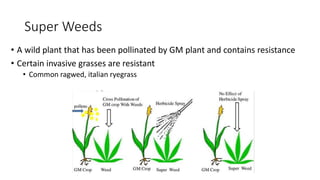
Super Weeds
• A wild plant that has been pollinated by GM plant and contains resistance
• Certain invasive grasses are resistant
• Common ragwed, italian ryegrass
• Disease resistant crops
• New vaccines & medications (insulin, human growth hormone)
• Bigger livestock- more meat, milk, wool etc.
• Possible cures for diseases
• Environmentally friendly organisms (envio-pig, less methane
producing cows, etc)
• Unpredictable – technology is new & no guarantee that products free of
side affects
• Money- companies patent genes & demand high prices
• Unexpected impacts on the environment
• Biological weapons
• Concerns over the safety and ethics of incorporating GMO’s into food
for human consumption
• Allergens
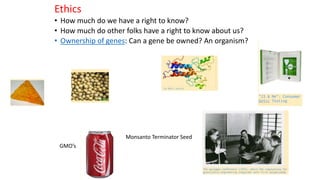
Ethics
• How much do we have a right to know?
• How much do other folks have a right to know about us?
• Ownership of genes: Can a gene be owned? An organism?
GMO’s
Monsanto Terminator Seed

DNA recombinant technology on insulin modification

  • 1.
  • 2.
    Tools and Techniques 1.Restriction Enzymes 2. Gel Electrophoresis 3. PCR 4. Vectors/plasmids 5. Gene Library/Microarray 6. Stem Cells 7. DNA sequencing 8. DNA Cloning • What is it? • What is it used for? • How does it work/what does it do? • Specifics • Pic
  • 3.
    Human Genome Project(HGP) Francis Collins (NIH) & Jay Craig Ventor (Celera) 1.) HGP = Map of all 30,000 genes on the 46 human chromosomes (1988-2003) • Information has led to many advances in the fields of medicine, agriculture, bio- engineering 2.) An organism’s genome is the total DNA in the nucleus of each cell • The human genome contains approx 3 billion nucleotide bases • The average gene is made up of 3000 bases, but sizes of genes vary greatly. • The total number of genes is estimated at around 30000. • 99.9% nucleotide bases are exactly the same in all people
  • 4.
    • As ofSeptember 2007 the complete sequence was known of, • 1879 viruses, • 577 bacterial species, and • roughly 23 eukaryotic species (of which about half are fungi).
  • 5.
    GENERAL GENOMIC COMPARISONS OrganismGenome Size (Bases) Estimated Genes Human (Homo sapiens) 3 billion 30,000 Laboratory mouse (M. musculus) 2.6 billion 30,000 Thale cress (A. thaliana) 100 million 25,000 Roundworm (C. elegans) 97 million 19,000 Fruit fly (D. melanogaster) 137 million 13,000 Yeast (S. cerevisiae) 12.1 million 6,000 Bacterium (E. coli) 4.6 million 3,200 Human immunodeficiency virus (HIV) 9700 9
  • 6.
    GENETIC ENGINEERING •Biotechnology refersto technology used to manipulate DNA • The procedures are often referred to as genetic engineering Recombinant DNA refers to the DNA from the two DIFFERENT organisms • Can be used for creating transgenic organisms, gene therapy, and cloning • first used in the 1970’s with bacteria • Gene cloning: process by which scientists can produce multiple copies of specific segments of DNA that they can then work with in the lab • Transformation: bacteria takes up plasmid (w/gene of interest)
  • 7.
    Applications of DNATechnology 1. Diagnosis of disease – identify alleles, viral DNA 2. Gene therapy – alter afflicted genes 3. Production of pharmaceuticals 4. Forensic applications – DNA profiling 5. Environmental cleanup – use microorganisms 6. Agricultural applications - GMOs
  • 8.
    RECOMBINANT DNA Vocab •A plasmid is small ring of DNA in a bacteria • Contain genes which code for less essential traits (antibiotic resistance) • vector = a DNA molecule used to carry a gene of interest from one organism to another • Plasmids & viruses are the most commonly used vectors • Restriction Enzyme - cut DNA at specific sequences • For example, EcoRI always cuts DNA at GAATTC as indicated below
  • 9.
    The sequence GAATTCappear three time in the below strand of DNA, so it is cut into four pieces. sticky ends - unpaired nucleotide sequences at the end of cut DNA strands
  • 10.
    a.) Cut theBacterial DNA with “restriction enzymes (RE)”. b.) Cut the gene of interest from the organism’s DNA with same “restriction enzyme” (RE). c.) Combine the “sticky ends” of the two DNA pieces together with DNA ligase (enzyme) – also known as gene splicing d.) Insert vector into bacteria. e.) The bacteria can now reproduce the recombinant DNA and the foreign genes will be expressed in the bacteria.
  • 12.
  • 13.
  • 14.
    Benefits of RecombinantBacteria • Bacteria can make human insulin or human growth hormone. • Bacteria can be engineered to “eat” oil spills.
  • 15.
    Problems with insertingDNA • Difference between eukaryotic RNA and prokaryotic RNA? • Use reverse transcriptase • an enzyme that catalyzes the formation of DNA from an RNA template in reverse transcription • Creates complementary DNA (cDNA) which lacks introns • Can now be inserted into prokaryote
  • 16.
    Electrophoresis • Separates fragmentsof DNA based on their size. How it works • The DNA is placed in to an agarose gel • The gel is exposed to an electric field • DNA migrates to the positive electrode (DNA is negatively charged) • Different sized fragments move through the gel at different rates (smaller = faster = farther)
  • 17.
    GENETIC ENGINEERING: WhatCan We Do With Genes? 1. DNA fingerprinting - Analysis of DNA sequences to determine identity
  • 19.
    • Restriction FragmentLength Polymorphism (RFLPs – rif-lips) • Cut DNA with different restriction enzymes • Each person has different #s of DNA fragments created • Analyze DNA samples on a gel for disease diagnosis • Outdated method of DNA profiling (required a quarter-sized sample of blood) • STR = Short Tandem Repeats • Non-coding DNA has regions with sequences (2-5 base length) that are repeated • Each person has different # of repeats at different locations (loci) • Current method of DNA fingerprinting used – only need 20 cells for analysis
  • 21.
    Example • A violentmurder occurred. • The forensics team retrieved a blood sample from the crime scene. • They prepared DNA profiles of the blood sample, the victim and a suspect as follows: Was the suspect at the crime scene?
  • 22.
    Solving Medical Problems •Can be used to determine whether a particular person is the parent of a child • A child's paternity (father) and maternity(mother) can be determined • This information can be used in • Paternity suits • Inheritance cases • Immigration cases
  • 23.
    Example: A PaternityTest • Compare the DNA profile of a mother and her child and identify DNA fragments in the child which are absent from the mother must be from the biological father
  • 25.
    2. Gene therapy:A "normal" gene is inserted into the genome to replace an "abnormal," disease-causing gene • may be used treat a disorder by inserting a gene instead of using drugs or surgery • Types of gene therapy: Replacing or inactivate a mutated gene that causes disease 3. Cloning – Creating genetically IDENTICAL copies Ex: Dolly (1996-2003)- it took 276 attempts before successful
  • 26.
    4. Stem cells •Stem cells: can reproduce itself indefinitely and produce other specialized cells • Zygote = totipotent (any type of cell) • Embryonic stem cells = pluripotent (many cell types) • Adult stem cells = multipotent (a few cell types) or induced pluripotent, iPS (forced to be pluripotent) • can be used to generate virtually any type of specialized cell in the human body • The goals to study human development and to treat disease
  • 27.
    Embryonic vs. Adult stem cells Usingstem cells for disease treatment
  • 28.
    Other techniques • CRISPER– nuclease that cuts DNA at a sequence it is directed to • Use guide RNA molecule to direct • Knock-out genes or insert genes It is a molecule that finds a string of DNA code, locks on and makes a precision cut. And because scientists can tune it to target any genetic sequence, they can use it to turn genes off or replace them with new versions. • RNA interference (RNAi) – silence gene expression • Analyze function of genes • Single nucleotide polymorphism (SNP) – a single base pair site where variation is found in at least 1% of the population • Find genes that cause disorders, disease, and give specific treatment • SNP is near a disease associated allele
  • 29.
    GMO • insertion ofDNA from one organism into another OR modification of DNA in order to achieve a desired trait • Aka: transgenic organisms: contain functional recombinant DNA GloFish: World’s First Transgenic Pet Genes from jellyfish and coral give the GloFish their vivid colors
  • 30.
    Common GM Foods Products •**Corn • Canola • Potatoes • Tomatoes • Squash • **Soybeans • Flax • **Cotton • Sugarbeets Experts say 60% to 70% of processed foods on U.S. grocery shelves have genetically modified ingredients.
  • 31.
    GMO in Medicine •Insulin (e.g., SemBioSys Genetics Inc- saflower) • Clotting factors • Atryn (anticoagulant). • Edible vaccines – some problems with dosage and immune tolerance. • Cancer fighting eggs- interferon Beta limited to some forms of malignant skin cancers and a few other diseases.
  • 32.
    Some current usesof Farming GMO Medicine • 1. Mapp Biopharmaceutical, Inc. – Using tobacco plants to make components of Ebola vaccine ZMappTM. • 2. Medicago – Making vaccines against viruses (e.g., influenza and HIV) using tobacco plants. • 3. Ventria Bioscience – Making human lactoferrin (VEN 100) in rice as treatment against antibiotic-associated diarrhea. • 4. Planet Biotechnology – Using plants to produce treatment of MERS coronavirus infection.
  • 33.
    A.) Transgenic PLANTS •Disease-resistant and insect-resistant crops • B.t. crops – Bacillus thuringiensis bacteria make a toxin against insects – natural insecticide • Hardier fruit • Nutrient enhanced Kills caterpillars but not poisonous to humans http://www.nature.com/cr/journal/v12/n2/full/7290120a.html Frost-free strawberry Roundup ready crops Soybean Golden Rice
  • 34.
    B. ) TRANSGENICANIMALS • Fast Growing Foods • Chickens – more resistant to infections (Bird Flu) • Cows – increase milk supply and leaner meat, less methane • Goats, sheep and pigs – produce human proteins in their milk, biosteel
  • 35.
  • 36.
    Biofuels Bioremediation Algenol Biofuels Rapeseed (i.e.,canola) Enviropig i.e., “Frankenswine ” Able to digest and process phosphate Poplar trees remove groundwater contaminants Other uses of GMO’s
  • 37.
    Advantages of GM •virus, disease tolerance; so the plants grow better. • Higher yield: We can also grow crops in areas that were once inhospitable to plant growth. • Nutrient enhancement • Beta carotene (vitamin A) added to rice (golden rice) used to fight malnutrition world wide. • Food security • Drought/cold Resistance • Increase Shelf life increases Golden rice Ice minus strawberries
  • 38.
    Disadvantages • Allergies andimmunity to vaccines etc. • Gene transfer • Out-crossing/Accidental cross pollination • Super weeds • Contaminating streams • Biodiversity issues • Ownership of genes
  • 39.
    Out-crossing • Movement ofgenes from GM plants into conventional crops • Mixing crops from conventional seeds with those grown using GM crops • Monsanto Lawsuits
  • 40.
    Super Weeds • Awild plant that has been pollinated by GM plant and contains resistance • Certain invasive grasses are resistant • Common ragwed, italian ryegrass
  • 41.
    • Disease resistantcrops • New vaccines & medications (insulin, human growth hormone) • Bigger livestock- more meat, milk, wool etc. • Possible cures for diseases • Environmentally friendly organisms (envio-pig, less methane producing cows, etc)
  • 42.
    • Unpredictable –technology is new & no guarantee that products free of side affects • Money- companies patent genes & demand high prices • Unexpected impacts on the environment • Biological weapons • Concerns over the safety and ethics of incorporating GMO’s into food for human consumption • Allergens
  • 43.
    Ethics • How muchdo we have a right to know? • How much do other folks have a right to know about us? • Ownership of genes: Can a gene be owned? An organism? GMO’s Monsanto Terminator Seed