Human Genome
    Project
Georgia Stangeland, Melis Colak, Lisa Feng
History
• 1990: with the joint cooperation of the United States
  Department of Energy and the National Institutes of
  Health, the Human Genome Project was initiated
• 1998: Celera Corporation launched a parallel project
  to race against the public sector
• 2000: a working draft of the human genome was
  completed
• 2001: analyses of the working draft were published
• 2003: the Human Genome Project was completed
Goals
• Identify all the genes in human DNA
• Determine the sequences of the nitrogenous base
  pairs that make up human DNA
• Put information in databases for storage and
  reference
• Discover more efficient technologies for data
  analysis
• Allow the private sector access to information and
  new technologies that arise from this project
• Address the ethical, legal and social issues
Techniques


• Shotgun Method
• Dideoxy/Sanger/Chain Termination
  Method
The Shotgun Methods


• Hierarchical shotgun sequencing
  method
• Whole genome shotgun sequencing
  method
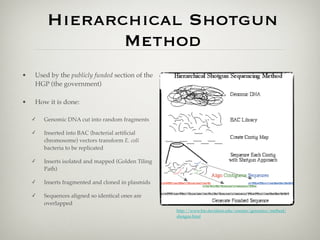
Hierarchical Shotgun
                Method
•   Used by the publicly funded section of the
    HGP (the government)

•   How it is done:

    ✓   Genomic DNA cut into random fragments

    ✓   Inserted into BAC (bacterial artificial
        chromosome) vectors transform E. coli
        bacteria to be replicated

    ✓   Inserts isolated and mapped (Golden Tiling
        Path)

    ✓   Inserts fragmented and cloned in plasmids

    ✓   Sequences aligned so identical ones are
        overlapped
                                                     http://www.bio.davidson.edu/courses/genomics/method/
                                                     shotgun.html
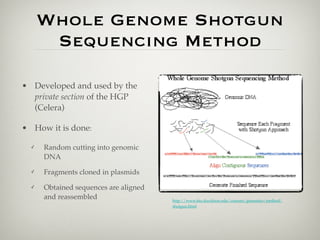
Whole Genome Shotgun
       Sequencing Method

• Developed and used by the
  private section of the HGP
  (Celera)

• How it is done:

  ✓   Random cutting into genomic
      DNA
  ✓   Fragments cloned in plasmids
  ✓   Obtained sequences are aligned
      and reassembled                  http://www.bio.davidson.edu/courses/genomics/method/
                                       shotgun.html
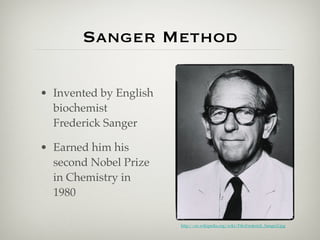
Sanger Method

• Invented by English
  biochemist
  Frederick Sanger

• Earned him his
  second Nobel Prize
  in Chemistry in
  1980

                        http://en.wikipedia.org/wiki/File:Frederick_Sanger2.jpg
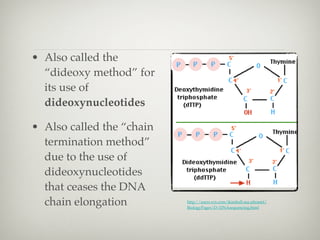
• Also called the
  “dideoxy method” for
  its use of
  dideoxynucleotides

• Also called the “chain
  termination method”
  due to the use of
  dideoxynucleotides
  that ceases the DNA
  chain elongation         http://users.rcn.com/jkimball.ma.ultranet/
                           BiologyPages/D/DNAsequencing.html
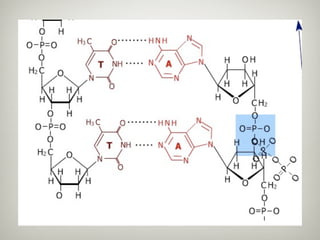
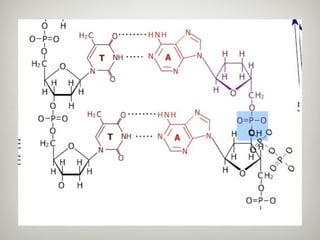
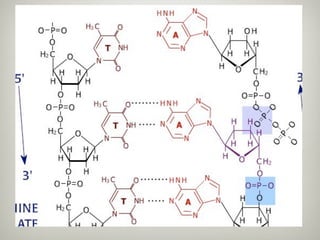
Dideoxynucleotides
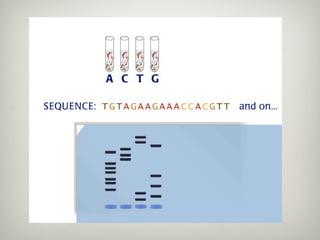
• Lack the -OH chain at the 3’ end of DNA

• Inhibits further elongation of DNA past the
  dideoxynucleotide due to the lack of the O
  atom

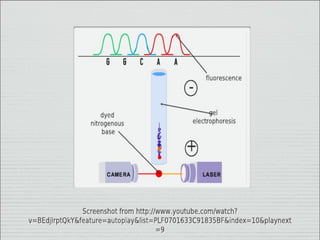
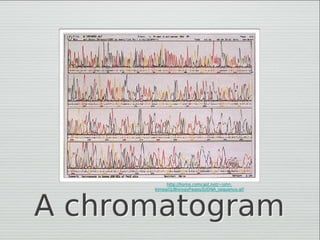
• Dyed to be seen once fluoresced using laser
  beams

• Each nitrogenous bases fluoresces different
  colours
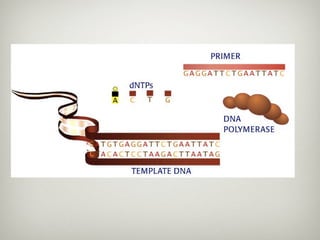
How it is done
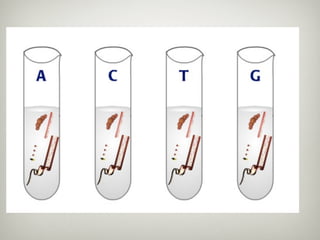
• DNA template supplied with :

  ❖   deoxynucleotides (dATP, dTTP, dGTP,
      dCTP)

  ❖   dideoxynucleotides that have been dyed in
      different colours (ddATP, ddTTP, ddGTP,
      ddCTP)

  ❖   Taq DNA polymerase
Ethical, Legal, and
        Social Issues
• Privacy and Confidentiality of Genetic Information
  ✓   Who should have access to the information?
  ✓   Who owns and controls the genetic information?
  ✓   Should the genetic information have patents or copyrights attached to
      it?


• Fairness in the use of Genetic Information
  ✓   How will this personal information be used?
  ✓   Should an individual be denied health insurance because of an
      increased risk of a disease found in their personal genome?


• Psychological Impact, Stigmatism and
  Discrimination
  ✓   How does personal genetic information affect an individual and
      society’s perceptions of the individual?
  ✓   How does the genomic information affect members of minority
      communities?
Case Study
Kyle is a gifted athlete who recently became a
professional football player and signed a $50 million
contract. During a routine physical checkup, Kyle was
genetically tested, along with the rest of the team, for
risk of heart disease (a positive result would mean that
the individual has a higher risk for the disease but it
does not mean he or she will definitely become sick).
Kyle’s test declared that he has a 25% chance of
developing a specific heart disease. As a result, Kyle
was released from his contract because the team did not
want to take any chances, even though Kyle was not
sick and was not guaranteed to develop any heart
disease.
Benefits

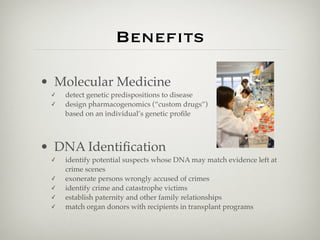
• Molecular Medicine
 ✓   detect genetic predispositions to disease
 ✓   design pharmacogenomics (“custom drugs”)
     based on an individual’s genetic profile


• DNA Identification
 ✓   identify potential suspects whose DNA may match evidence left at
     crime scenes
 ✓   exonerate persons wrongly accused of crimes
 ✓   identify crime and catastrophe victims
 ✓   establish paternity and other family relationships
 ✓   match organ donors with recipients in transplant programs
Relevance to Modern Day
        Science


• Gene Testing Therapy
• Pharmacogenomics
• Gene Therapy
Gene Testing Therapy
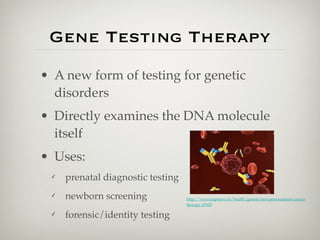
• A new form of testing for genetic
  disorders
• Directly examines the DNA molecule
  itself
• Uses:
 ✓   prenatal diagnostic testing
 ✓   newborn screening             http://www.topnews.in/health/genetic-test-personalized-cancer-
                                   therapy-27653

 ✓   forensic/identity testing
Pharmacogenomics
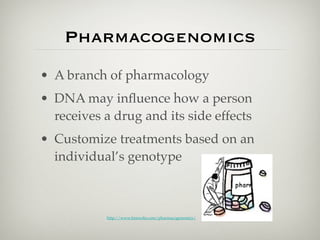
• A branch of pharmacology
• DNA may influence how a person
  receives a drug and its side effects
• Customize treatments based on an
  individual’s genotype


           http://www.freewebs.com/pharmacogenomics/
Gene Therapy
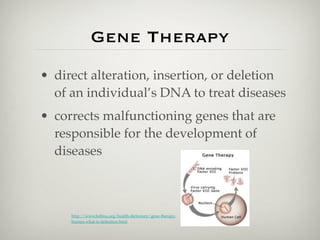
• direct alteration, insertion, or deletion
  of an individual’s DNA to treat diseases
• corrects malfunctioning genes that are
  responsible for the development of
  diseases


     http://www.beltina.org/health-dictionary/gene-therapy-
     human-what-is-definition.html
Conclusion
The Human Genome Project has
enabled us to explore a new world
of self-identification. It is extremely
helpful when identifying criminals
or genetic diseases. It can be the
basis of technological and social
development in the near future. And
thus unlocks the door to new
prospects.
Resources
http://www.councilforresponsiblegenetics.org/blog/post/Anniversary-of-the-Human-Genome-Project-Anything-to-Celebrate.aspx

Cook-Deegan R (1989). "The Alta Summit, December 1984". Genomics 5 (3): 661–3.doi:10.1016/0888-7543(89)90042-6

Barnhart, Benjamin J. (1989). "DOE Human Genome Program". Human Genome Quarterly

http://genomics.energy.gov/

http://www.ornl.gov/sci/techresources/Human_Genome/medicine/genetest.shtml

 http://www.topnews.in/health/genetic-test-personalized-cancer-therapy-27653

 http://pharmaxchange.info/press/2011/01/gene-therapy-2/

 http://www.freewebs.com/pharmacogenomics/

 http://www.beltina.org/health-dictionary/gene-therapy-human-what-is-definition.html

 http://users.rcn.com/jkimball.ma.ultranet/BiologyPages/D/DNAsequencing.html

 http://www.bio.davidson.edu/courses/genomics/method/shotgun.html

 http://home.comcast.net/~john.kimball1/BiologyPages/D/DNA_sequence.gif

 http://www.nature.com/scitable/topicpage/dna-sequencing-technologies-690

http://www.dnalc.org/resources/animations/sangerseq.html

http://www.woodrow.org/teachers/bi/1992/human_genome.html

http://www.ornl.gov/sci/techresources/Human_Genome/publicat/primer/prim2.html

http://www.genomenewsnetwork.org/articles/06_00/sequence_primer.shtml

YSP Week 3 HGP

  • 1.
    Human Genome Project Georgia Stangeland, Melis Colak, Lisa Feng
  • 2.
    History • 1990: withthe joint cooperation of the United States Department of Energy and the National Institutes of Health, the Human Genome Project was initiated • 1998: Celera Corporation launched a parallel project to race against the public sector • 2000: a working draft of the human genome was completed • 2001: analyses of the working draft were published • 2003: the Human Genome Project was completed
  • 3.
    Goals • Identify allthe genes in human DNA • Determine the sequences of the nitrogenous base pairs that make up human DNA • Put information in databases for storage and reference • Discover more efficient technologies for data analysis • Allow the private sector access to information and new technologies that arise from this project • Address the ethical, legal and social issues
  • 4.
    Techniques • Shotgun Method •Dideoxy/Sanger/Chain Termination Method
  • 5.
    The Shotgun Methods •Hierarchical shotgun sequencing method • Whole genome shotgun sequencing method
  • 6.
    Hierarchical Shotgun Method • Used by the publicly funded section of the HGP (the government) • How it is done: ✓ Genomic DNA cut into random fragments ✓ Inserted into BAC (bacterial artificial chromosome) vectors transform E. coli bacteria to be replicated ✓ Inserts isolated and mapped (Golden Tiling Path) ✓ Inserts fragmented and cloned in plasmids ✓ Sequences aligned so identical ones are overlapped http://www.bio.davidson.edu/courses/genomics/method/ shotgun.html
  • 7.
    Whole Genome Shotgun Sequencing Method • Developed and used by the private section of the HGP (Celera) • How it is done: ✓ Random cutting into genomic DNA ✓ Fragments cloned in plasmids ✓ Obtained sequences are aligned and reassembled http://www.bio.davidson.edu/courses/genomics/method/ shotgun.html
  • 8.
    Sanger Method • Inventedby English biochemist Frederick Sanger • Earned him his second Nobel Prize in Chemistry in 1980 http://en.wikipedia.org/wiki/File:Frederick_Sanger2.jpg
  • 9.
    • Also calledthe “dideoxy method” for its use of dideoxynucleotides • Also called the “chain termination method” due to the use of dideoxynucleotides that ceases the DNA chain elongation http://users.rcn.com/jkimball.ma.ultranet/ BiologyPages/D/DNAsequencing.html
  • 10.
    Dideoxynucleotides • Lack the-OH chain at the 3’ end of DNA • Inhibits further elongation of DNA past the dideoxynucleotide due to the lack of the O atom • Dyed to be seen once fluoresced using laser beams • Each nitrogenous bases fluoresces different colours
  • 11.
    How it isdone • DNA template supplied with : ❖ deoxynucleotides (dATP, dTTP, dGTP, dCTP) ❖ dideoxynucleotides that have been dyed in different colours (ddATP, ddTTP, ddGTP, ddCTP) ❖ Taq DNA polymerase
  • 23.
    Ethical, Legal, and Social Issues • Privacy and Confidentiality of Genetic Information ✓ Who should have access to the information? ✓ Who owns and controls the genetic information? ✓ Should the genetic information have patents or copyrights attached to it? • Fairness in the use of Genetic Information ✓ How will this personal information be used? ✓ Should an individual be denied health insurance because of an increased risk of a disease found in their personal genome? • Psychological Impact, Stigmatism and Discrimination ✓ How does personal genetic information affect an individual and society’s perceptions of the individual? ✓ How does the genomic information affect members of minority communities?
  • 24.
    Case Study Kyle isa gifted athlete who recently became a professional football player and signed a $50 million contract. During a routine physical checkup, Kyle was genetically tested, along with the rest of the team, for risk of heart disease (a positive result would mean that the individual has a higher risk for the disease but it does not mean he or she will definitely become sick). Kyle’s test declared that he has a 25% chance of developing a specific heart disease. As a result, Kyle was released from his contract because the team did not want to take any chances, even though Kyle was not sick and was not guaranteed to develop any heart disease.
  • 25.
    Benefits • Molecular Medicine ✓ detect genetic predispositions to disease ✓ design pharmacogenomics (“custom drugs”) based on an individual’s genetic profile • DNA Identification ✓ identify potential suspects whose DNA may match evidence left at crime scenes ✓ exonerate persons wrongly accused of crimes ✓ identify crime and catastrophe victims ✓ establish paternity and other family relationships ✓ match organ donors with recipients in transplant programs
  • 26.
    Relevance to ModernDay Science • Gene Testing Therapy • Pharmacogenomics • Gene Therapy
  • 27.
    Gene Testing Therapy •A new form of testing for genetic disorders • Directly examines the DNA molecule itself • Uses: ✓ prenatal diagnostic testing ✓ newborn screening http://www.topnews.in/health/genetic-test-personalized-cancer- therapy-27653 ✓ forensic/identity testing
  • 28.
    Pharmacogenomics • A branchof pharmacology • DNA may influence how a person receives a drug and its side effects • Customize treatments based on an individual’s genotype http://www.freewebs.com/pharmacogenomics/
  • 29.
    Gene Therapy • directalteration, insertion, or deletion of an individual’s DNA to treat diseases • corrects malfunctioning genes that are responsible for the development of diseases http://www.beltina.org/health-dictionary/gene-therapy- human-what-is-definition.html
  • 30.
    Conclusion The Human GenomeProject has enabled us to explore a new world of self-identification. It is extremely helpful when identifying criminals or genetic diseases. It can be the basis of technological and social development in the near future. And thus unlocks the door to new prospects.
  • 31.
    Resources http://www.councilforresponsiblegenetics.org/blog/post/Anniversary-of-the-Human-Genome-Project-Anything-to-Celebrate.aspx Cook-Deegan R (1989)."The Alta Summit, December 1984". Genomics 5 (3): 661–3.doi:10.1016/0888-7543(89)90042-6 Barnhart, Benjamin J. (1989). "DOE Human Genome Program". Human Genome Quarterly http://genomics.energy.gov/ http://www.ornl.gov/sci/techresources/Human_Genome/medicine/genetest.shtml http://www.topnews.in/health/genetic-test-personalized-cancer-therapy-27653 http://pharmaxchange.info/press/2011/01/gene-therapy-2/ http://www.freewebs.com/pharmacogenomics/ http://www.beltina.org/health-dictionary/gene-therapy-human-what-is-definition.html http://users.rcn.com/jkimball.ma.ultranet/BiologyPages/D/DNAsequencing.html http://www.bio.davidson.edu/courses/genomics/method/shotgun.html http://home.comcast.net/~john.kimball1/BiologyPages/D/DNA_sequence.gif http://www.nature.com/scitable/topicpage/dna-sequencing-technologies-690 http://www.dnalc.org/resources/animations/sangerseq.html http://www.woodrow.org/teachers/bi/1992/human_genome.html http://www.ornl.gov/sci/techresources/Human_Genome/publicat/primer/prim2.html http://www.genomenewsnetwork.org/articles/06_00/sequence_primer.shtml

Editor's Notes