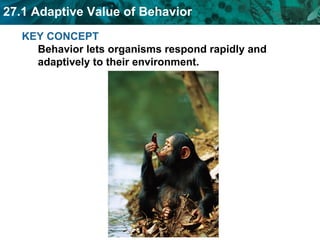
KEY CONCEPT  Behavior lets organisms respond rapidly and adaptively to their environment.
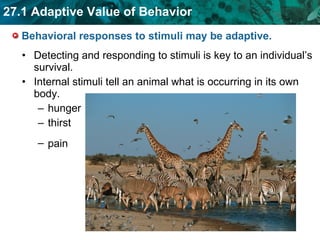
Behavioral responses to stimuli may be adaptive.  Detecting and responding to stimuli is key to an individual’s survival. Internal stimuli tell an animal what is occurring in its own body. hunger thirst pain
External stimuli give an animal information about its surroundings. sound sight changes in day length or temperature
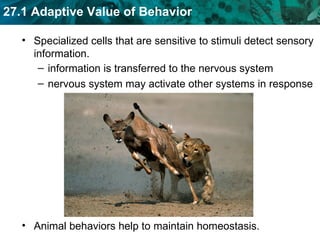
Specialized cells that are sensitive to stimuli detect sensory information. information is transferred to the nervous system nervous system may activate other systems in response Animal behaviors help to maintain homeostasis.
Kinesis and taxis are two types of movement-related behaviors. Kinesis is an increase in random movement. Taxis is movement in a particular direction.
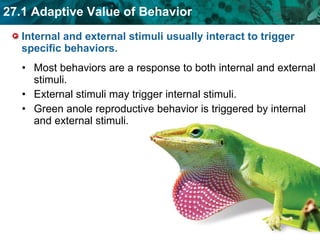
Internal and external stimuli usually interact to trigger specific behaviors.  Most behaviors are a response to both internal and external stimuli. External stimuli may trigger internal stimuli. Green anole reproductive behavior is triggered by internal and external stimuli.
Some behaviors occur in cycles.  A circadian rhythm is the daily cycle of activity. occurs over 24-hour period run by a biological clock
Behaviors may occur daily, monthly, seasonally, or annually. During hibernation, an animal enters a seasonal dormant state.
Behaviors may occur daily, monthly, seasonally, or annually. During migration, animals move seasonally from one portion of their range to another. During hibernation, an animal enters a seasonal dormant state.
KEY CONCEPT  Both genes and environment affect an animal’s behavior.
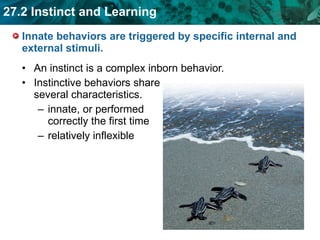
Innate behaviors are triggered by specific internal and external stimuli.  An instinct is a complex inborn behavior. Instinctive behaviors share several characteristics. innate, or performed correctly the first time relatively inflexible
releaser is a simple signal: touch, sight, sound, scent herring gulls chicks and red dot releaser environmental factors can affect innate behaviors Many innate behaviors are triggered by a releaser.
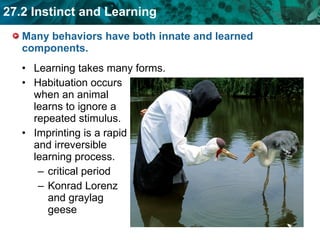
Many behaviors have both innate and learned components.  Learning takes many forms. Habituation occurs when an animal learns to ignore a repeated stimulus. Imprinting is a rapid and irreversible learning process. critical period Konrad Lorenz and graylag geese
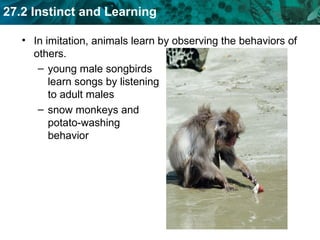
In imitation, animals learn by observing the behaviors of others. young male songbirds learn songs by listening to adult males snow monkeys and potato-washing behavior
Learning is adaptive.  Animals that can learn can better adapt to new situations. In associative learning, a specific action is associated with its consequences. Conditioning is one type of associative learning.
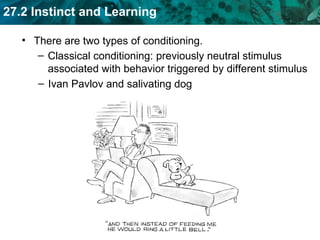
There are two types of conditioning. Classical conditioning: previously neutral stimulus associated with behavior triggered by different stimulus Ivan Pavlov and salivating dog
There are two types of conditioning. Operant conditioning: behavior increased or decreased by positive or negative reinforcement B.F. Skinner and “Skinner boxes”
KEY CONCEPT  Every behavior has costs and benefits.
Even beneficial behaviors have associated costs.  The benefits of a behavior are increased survivorship and reproduction rates. both increase an individual’s fitness both have costs
Behavioral costs can be divided into three categories. energy costs opportunity costs risk costs
Animals perform behaviors whose benefits outweigh their costs.  Behaviors evolve only if they improve fitness. Territoriality refers to the control of a specific area. benefits: control resources costs: energy and time
Optimal foraging states that natural selection favors behaviors that get animals the most calories for the cost. benefits: amount of energy gained costs: energy used to search for, catch, and eat food; risk of capture; time
KEY CONCEPT  Social behaviors enhance the benefits of living in a group.
Living in groups also has benefits and costs.  Social behaviors evolve when the benefits of group living outweigh its costs. benefits: improved foraging, reproductive assistance, reduced chance of predation costs: increased visibility, competition, disease contraction Group living requires learning social structure and membership.
Social behaviors are interactions between members of the same or different species. Animals use communication to keep in contact. visual  sound  touch  chemical
Courtship displays are used to evaluate the fitness of a potential mate. Defensive behaviors are used to protect the individual and/or the group.
Some behaviors benefit other group members at a cost to the individual performing them.  There are many types of helpful social behavior. cooperation reciprocity  altruism
In altruism, an individual reduces its own fitness to help other members of its social group. inclusive fitness kin selection
Eusocial behavior is an example of extreme altruism.  Eusocial species live in large groups of mostly nonreproductive individuals. haplodiploid species: social insects (wasps, bees, ants) Queen Minor   worker Major   worker diploid species: termites, snapping shrimp, naked mole rats Eusocial behaviors likely evolve by kin selection.
KEY CONCEPT  Some animals other than humans exhibit behaviors requiring complex cognitive abilities.
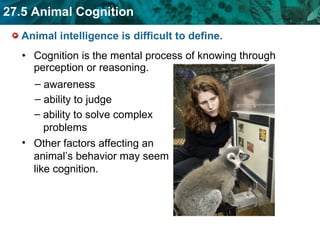
Animal intelligence is difficult to define.  Cognition is the mental process of knowing through perception or reasoning. Other factors affecting an animal’s behavior may seem like cognition. awareness ability to judge ability to solve complex    problems
Some animals can solve problems.  Insight is the ability to solve a problem mentally without repeated trial and error.  observed in primates, dolphins, and corvids chimpanzee retrieving hanging bananas
Tool use helps an animal accomplish a task. some dolphins use sponges to protect and hunt crows and chimpanzees make probing sticks capuchin monkeys use rocks to crack nuts
Cognitive ability may provide an adaptive advantage for living in social groups. Intelligence in animals seems to be correlated with two characteristics. relatively large brains for their body size live in complex social groups
Cultural behavior spreads through a population by learning, not by selection. taught to one generation by another aided by living in close proximity

Unit 27 Behavioral Biology

  • 1.
    KEY CONCEPT Behavior lets organisms respond rapidly and adaptively to their environment.
  • 2.
    Behavioral responses tostimuli may be adaptive. Detecting and responding to stimuli is key to an individual’s survival. Internal stimuli tell an animal what is occurring in its own body. hunger thirst pain
  • 3.
    External stimuli givean animal information about its surroundings. sound sight changes in day length or temperature
  • 4.
    Specialized cells thatare sensitive to stimuli detect sensory information. information is transferred to the nervous system nervous system may activate other systems in response Animal behaviors help to maintain homeostasis.
  • 5.
    Kinesis and taxisare two types of movement-related behaviors. Kinesis is an increase in random movement. Taxis is movement in a particular direction.
  • 6.
    Internal and externalstimuli usually interact to trigger specific behaviors. Most behaviors are a response to both internal and external stimuli. External stimuli may trigger internal stimuli. Green anole reproductive behavior is triggered by internal and external stimuli.
  • 7.
    Some behaviors occurin cycles. A circadian rhythm is the daily cycle of activity. occurs over 24-hour period run by a biological clock
  • 8.
    Behaviors may occurdaily, monthly, seasonally, or annually. During hibernation, an animal enters a seasonal dormant state.
  • 9.
    Behaviors may occurdaily, monthly, seasonally, or annually. During migration, animals move seasonally from one portion of their range to another. During hibernation, an animal enters a seasonal dormant state.
  • 10.
    KEY CONCEPT Both genes and environment affect an animal’s behavior.
  • 11.
    Innate behaviors aretriggered by specific internal and external stimuli. An instinct is a complex inborn behavior. Instinctive behaviors share several characteristics. innate, or performed correctly the first time relatively inflexible
  • 12.
    releaser is asimple signal: touch, sight, sound, scent herring gulls chicks and red dot releaser environmental factors can affect innate behaviors Many innate behaviors are triggered by a releaser.
  • 13.
    Many behaviors haveboth innate and learned components. Learning takes many forms. Habituation occurs when an animal learns to ignore a repeated stimulus. Imprinting is a rapid and irreversible learning process. critical period Konrad Lorenz and graylag geese
  • 14.
    In imitation, animalslearn by observing the behaviors of others. young male songbirds learn songs by listening to adult males snow monkeys and potato-washing behavior
  • 15.
    Learning is adaptive. Animals that can learn can better adapt to new situations. In associative learning, a specific action is associated with its consequences. Conditioning is one type of associative learning.
  • 16.
    There are twotypes of conditioning. Classical conditioning: previously neutral stimulus associated with behavior triggered by different stimulus Ivan Pavlov and salivating dog
  • 17.
    There are twotypes of conditioning. Operant conditioning: behavior increased or decreased by positive or negative reinforcement B.F. Skinner and “Skinner boxes”
  • 18.
    KEY CONCEPT Every behavior has costs and benefits.
  • 19.
    Even beneficial behaviorshave associated costs. The benefits of a behavior are increased survivorship and reproduction rates. both increase an individual’s fitness both have costs
  • 20.
    Behavioral costs canbe divided into three categories. energy costs opportunity costs risk costs
  • 21.
    Animals perform behaviorswhose benefits outweigh their costs. Behaviors evolve only if they improve fitness. Territoriality refers to the control of a specific area. benefits: control resources costs: energy and time
  • 22.
    Optimal foraging statesthat natural selection favors behaviors that get animals the most calories for the cost. benefits: amount of energy gained costs: energy used to search for, catch, and eat food; risk of capture; time
  • 23.
    KEY CONCEPT Social behaviors enhance the benefits of living in a group.
  • 24.
    Living in groupsalso has benefits and costs. Social behaviors evolve when the benefits of group living outweigh its costs. benefits: improved foraging, reproductive assistance, reduced chance of predation costs: increased visibility, competition, disease contraction Group living requires learning social structure and membership.
  • 25.
    Social behaviors areinteractions between members of the same or different species. Animals use communication to keep in contact. visual sound touch chemical
  • 26.
    Courtship displays areused to evaluate the fitness of a potential mate. Defensive behaviors are used to protect the individual and/or the group.
  • 27.
    Some behaviors benefitother group members at a cost to the individual performing them. There are many types of helpful social behavior. cooperation reciprocity altruism
  • 28.
    In altruism, anindividual reduces its own fitness to help other members of its social group. inclusive fitness kin selection
  • 29.
    Eusocial behavior isan example of extreme altruism. Eusocial species live in large groups of mostly nonreproductive individuals. haplodiploid species: social insects (wasps, bees, ants) Queen Minor worker Major worker diploid species: termites, snapping shrimp, naked mole rats Eusocial behaviors likely evolve by kin selection.
  • 30.
    KEY CONCEPT Some animals other than humans exhibit behaviors requiring complex cognitive abilities.
  • 31.
    Animal intelligence isdifficult to define. Cognition is the mental process of knowing through perception or reasoning. Other factors affecting an animal’s behavior may seem like cognition. awareness ability to judge ability to solve complex problems
  • 32.
    Some animals cansolve problems. Insight is the ability to solve a problem mentally without repeated trial and error. observed in primates, dolphins, and corvids chimpanzee retrieving hanging bananas
  • 33.
    Tool use helpsan animal accomplish a task. some dolphins use sponges to protect and hunt crows and chimpanzees make probing sticks capuchin monkeys use rocks to crack nuts
  • 34.
    Cognitive ability mayprovide an adaptive advantage for living in social groups. Intelligence in animals seems to be correlated with two characteristics. relatively large brains for their body size live in complex social groups
  • 35.
    Cultural behavior spreadsthrough a population by learning, not by selection. taught to one generation by another aided by living in close proximity