Abhinav Srivastava, Ph.D
Director
Indian Biosciences and Research Institute
C-50, Sector-02, NOIDA-201310, Uttar Pradesh email: director@ibri.org.in
INTRODUCTION
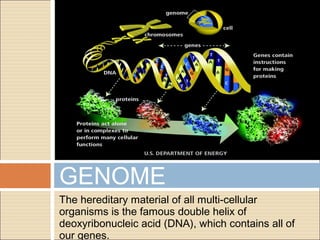
GENOME
The hereditary material of all multi-cellular
organisms is the famous double helix of
deoxyribonucleic acid (DNA), which contains all of
our genes.
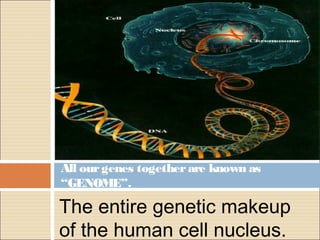
All our genes together are known as
“GENOME”.

The entire genetic makeup
of the human cell nucleus.
HUMAN GENOME
PROJECT
HUMAN GENOME PROJECT

   The Human Genome Project (HGP) was the
    international, collaborative research program
    whose goal was the complete mapping and
    understanding of all the genes of human
    beings.
   Genes carry the information for making all of the
    proteins required by the body for growth and
    maintenance.
   Made up of ~35,000-50,000 genes which code
    for functional proteins in the body.
GOAL OF HGP
 Identify all of the genes in human DNA.
 Determine the sequence of the 3 billion

  chemical nucleotide bases that make up
  human DNA.
 Store this information in data bases.

 Develop faster, more efficient sequencing

  technologies.
GOAL OF HGP :
 Develop tools for data analysis.
 Address the ethical, legal, and social

  issues (ELSI) associated with the project.
Two Different Groups W   orked to Obtain
 the DNA Sequence of the Human
 Genome
 The HGP is a multinational consortium

  established by government research
  agencies and funded publicly.
 Celera Genomics is a private company

  whose former CEO, J. Craig Venter, ran
  an independent sequencing project.
 June 6, 2000, the HGP and Celera

  Genomics held a joint press conference to
  announce that TOGETHER they had
  completed ~97% of the human genome.
PUBLICATION
   The International Human Genome Sequencing
    Consortium published their results in Nature,
    409 (6822): 860-921, 2001.
      “Initial Sequencing and Analysis of the Human
      Genome”


   Celera Genomics published their results in
    Science, Vol 291(5507): 1304-1351, 2001.
      “The Sequence of the Human Genome”
METHODS AND
TOOLS
STRATEGY INVOLVED
   This is regarded as the most ambitious project
    ever undertaken by man.
   Strategy may be grouped into following three
    stages:
              i) Mapping
              ii) Sequencing
              iii) Functional analysis
MAPPING
   The first major goal of the project is to prepare
    high resolution or saturated genetic and
    physical maps of human genome.
   Molecular markers have been used to produce
    maps of all the human chromosome.
   By August 2000, over 9,300 markers had been
    mapped to particular chromosome. Therefore,
    any new DNA sequence (i.e., an additional
    marker) can be easily linked with these
    markers.
SEQUENCING
   Determination of precise order of nucleotide in
    DNA.
   There are following techniques for the DNA
    sequencing:
    i) Chain termination method By F.Sanger & A.
    R. Coulson
    ii) Chemical degradation method By A.
    Maxam & W. Gilbert
    iii) Automated DNA sequencing
CHAIN TERMINATION
METHOD
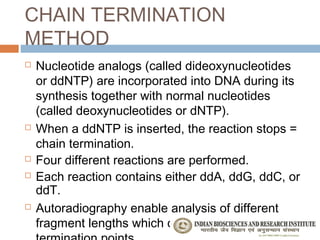
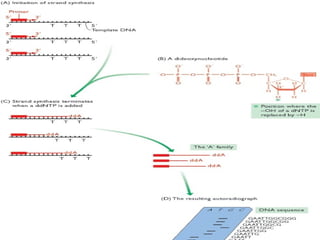
   Nucleotide analogs (called dideoxynucleotides
    or ddNTP) are incorporated into DNA during its
    synthesis together with normal nucleotides
    (called deoxynucleotides or dNTP).
   When a ddNTP is inserted, the reaction stops =
    chain termination.
   Four different reactions are performed.
   Each reaction contains either ddA, ddG, ddC, or
    ddT.
   Autoradiography enable analysis of different
    fragment lengths which correspond to different
CHEMICAL DEGRADATION
METHOD
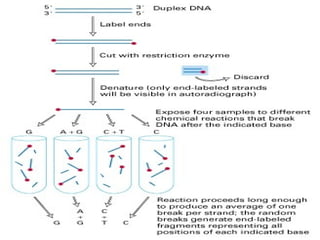
   Double stranded DNA fragment to be sequenced is
    first labeled by attaching a radioactive phosphorous
    group to the 5’end of each strand.
   DMSO then added and the sample heated to 90°C,
    degraded sample is allowed for GE.
   One strand is purified from gel & divided into foru
    sample each of which is treated with one of the
    CLEAVAGE REAGENT.
   The first set of reagent to be added cause a chemical
    modification in the nucleotide for which they are
    specific, making the strand susceptible to cleavage at
    that nucleotide when an additional chemical is added.
AUTOMATED DNA
SEQUENCING
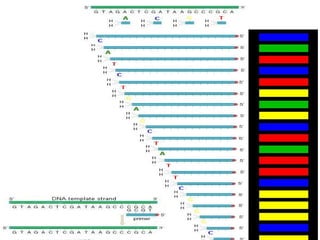
   This is carried out in the same way as the
    chain termination method with only one
    difference.
   Here we use FLUORESCENT LABELS to
    label the strand instead of radioactive label.
   These labels are usually attached to the
    ddNTP so each chain terminated molecule
    carries a single label at its 3’end.
   Different fluorochrome can be used for four
    different ddNTP.
FUNCTIONAL ANALYSIS

   The ultimate objective of the HGPis to
    decipher the function of each of the genes
    estimated to be present in the human
    genome.
OTHER COMPLETED
GENOMES
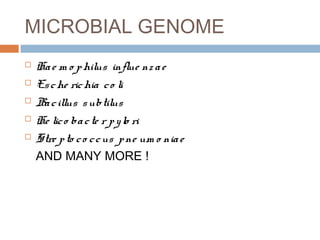
MICROBIAL GENOME
   Ha e m o p hilus influe nz a e
   Es c he ric hia c o li
   Ba c illus s ubtilus
   He lic o ba c te r p y lo ri
   Stre p to c o c c us p ne um o nia e
    AND MANY MORE !
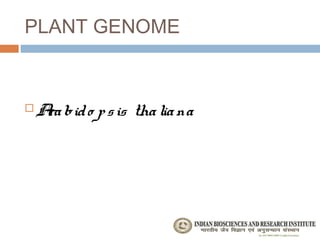
PLANT GENOME


   A bid o p s is tha lia na
     ra
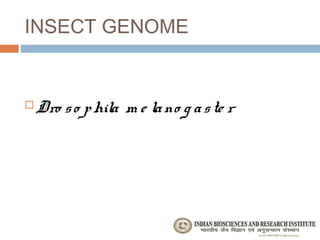
INSECT GENOME


   Dro s o p hila m e la no g a s te r
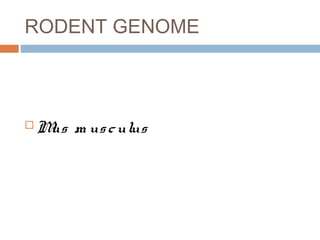
RODENT GENOME


   M m us c ulus
     us
ETHICAL, LEGAL & SOCIAL
ISSUES
         [ELSI]
   The U.S. Department of Energy (DOE)
    and the National Institutes of Health (NIH)
    spend between 3-5% of their annual HGP
    budgets toward studying the ELSI
    associated with availability of genetic
    information.

   This budget is the world’s largest
    bioethics program, and has become a
    worldwide model.
EXAMPLE OF ELSI
   Privacy legislation
   Gene testing
   Patenting
   Forensics
   Behavioral Genetics
   Genetics in the Courtroom
   Who should have access to this information ?

       Employers
       Insurers
       Schools
       Courts
       Adoption agencies
       Military
   How is privacy and confidentiality managed ?
   Affects on society’s perceptions and
    expectations of the individual
   Who owns genes and DNA sequences ?
       The person (or company) who discovered it,
        or the person whose body it came from?
       Should genetic information be the property
        of humanity?
       Is it ethical to charge someone for access to
        a database of genetic information?
APPLICATION
W hich branches of
biology will benefit from
this knowledge ?
MEDICINE
 Improvements in diagnostic
  and therapeutic applications
 Implementation of
  preventative measures.
 Increases in gene therapy
  applications.
BIOTECHNOLOGY
   Production of useful protein products for use
    in medicine, agriculture, bioremediation and
    pharmaceutical industries.
      Antibiotics
      Protein replacement (factor VIII, TPA,
       streptokinase, insulin, interferon…)
      BT insecticide toxin (from Ba c illus
       thuring ie ns is )
      Herbicide resistance (glyphosate resistance)
      Bioengineered foods [e.g. Flavr Savr tomato
       (antisense – polygalacturonase) to delay
       rotting]
BIOINFORMATICS
   The newest, fastest growing specialty in
    the life sciences that integrates
    biotechnology and computer science.
   Involved in DNA sequence assembly
    and analysis using computer-based
    techniques to determine gene function,
    regulation and control.
   Unknown gene sequences can be
    compared to databases of known genes
    to enable similarities to lead to
    determination of an unknown gene’s
PROTEOMICS

   Investigates patterns and levels of
    gene expression in diseased cells
    that can be analyzed to build
    databases of expression profiles.
PHARMACOGENOMICS

   Investigates SNPs and DNA
    mutations associated with
    disease susceptibility and drug
    sensitivities.
DEVELOPMENTAL
BIOLOGY

 Regulation of embryonic
  development.
 Regulation of the aging process.
EVOLUTIONARY AND
COMPARATIVE BIOLOGY

   Because DNA mutates at a
    constant rate, comparisons of
    DNA between different
    organisms can provide
    evolutionary histories.
SUMMARY
 The significance of the completion of the
  human genome project cannot be
  overstated.
 With the dictionary of the genome

  available, the molecular mechanisms of
  human health and disease will be
  resolved.
 Armed with this knowledge a

  transformation in medical diagnostics and
  therapy is underway and will continue into
  the next few decades.
REFERENCES
   Cook-Deegan R (1989). "The Alta Summit, December 1984". G e no m ic s  5:
    661–3.
   Barnhart, Benjamin J. (1989). "DOE Human Genome Program". Hum a n
    G e no m e Qua rte rly  1: 1. Retrieved 2005-02-03.
   DeLisi, Charles (2001). "Genomes: 15 Years Later A Perspective by
    Charles DeLisi, HGP Pioneer". Hum a n G e no m e N ws  11: 3–4. Retrieved
                                                      e
    2005-02-03.
    International Human Genome Sequencing Consortium (2001). "Initial
    sequencing and analysis of the human genome." (PDF). N ture  409: 860–
                                                          a
    921.
    Venter, JC, et al. (2001). "The sequence of the human genome."
    (PDF). Sc ie nc e  291: 1304–1351.
   Sanger F, Air GM, Barrell BG, e t a l.  (February 1977). "Nucleotide sequence
    of bacteriophage phi X174 DNA". N ture  265 (5596): 687–95.
                                           a
   Waterston RH, Lander ES, Sulston JE (2003). "More on the sequencing of
    the human genome". Pro c N tl A a d Sc i U S A 100: 3022–4.
                              a    c              .

THANK YOU !

Human genome project(ibri)

  • 1.
    Abhinav Srivastava, Ph.D Director IndianBiosciences and Research Institute C-50, Sector-02, NOIDA-201310, Uttar Pradesh email: director@ibri.org.in
  • 2.
  • 3.
    GENOME The hereditary materialof all multi-cellular organisms is the famous double helix of deoxyribonucleic acid (DNA), which contains all of our genes.
  • 4.
    All our genestogether are known as “GENOME”. The entire genetic makeup of the human cell nucleus.
  • 5.
  • 6.
    HUMAN GENOME PROJECT  The Human Genome Project (HGP) was the international, collaborative research program whose goal was the complete mapping and understanding of all the genes of human beings.  Genes carry the information for making all of the proteins required by the body for growth and maintenance.  Made up of ~35,000-50,000 genes which code for functional proteins in the body.
  • 7.
    GOAL OF HGP Identify all of the genes in human DNA.  Determine the sequence of the 3 billion chemical nucleotide bases that make up human DNA.  Store this information in data bases.  Develop faster, more efficient sequencing technologies.
  • 8.
    GOAL OF HGP:  Develop tools for data analysis.  Address the ethical, legal, and social issues (ELSI) associated with the project.
  • 9.
    Two Different GroupsW orked to Obtain the DNA Sequence of the Human Genome  The HGP is a multinational consortium established by government research agencies and funded publicly.  Celera Genomics is a private company whose former CEO, J. Craig Venter, ran an independent sequencing project.  June 6, 2000, the HGP and Celera Genomics held a joint press conference to announce that TOGETHER they had completed ~97% of the human genome.
  • 10.
    PUBLICATION  The International Human Genome Sequencing Consortium published their results in Nature, 409 (6822): 860-921, 2001. “Initial Sequencing and Analysis of the Human Genome”  Celera Genomics published their results in Science, Vol 291(5507): 1304-1351, 2001. “The Sequence of the Human Genome”
  • 11.
  • 12.
    STRATEGY INVOLVED  This is regarded as the most ambitious project ever undertaken by man.  Strategy may be grouped into following three stages: i) Mapping ii) Sequencing iii) Functional analysis
  • 13.
    MAPPING  The first major goal of the project is to prepare high resolution or saturated genetic and physical maps of human genome.  Molecular markers have been used to produce maps of all the human chromosome.  By August 2000, over 9,300 markers had been mapped to particular chromosome. Therefore, any new DNA sequence (i.e., an additional marker) can be easily linked with these markers.
  • 14.
    SEQUENCING  Determination of precise order of nucleotide in DNA.  There are following techniques for the DNA sequencing: i) Chain termination method By F.Sanger & A. R. Coulson ii) Chemical degradation method By A. Maxam & W. Gilbert iii) Automated DNA sequencing
  • 15.
    CHAIN TERMINATION METHOD  Nucleotide analogs (called dideoxynucleotides or ddNTP) are incorporated into DNA during its synthesis together with normal nucleotides (called deoxynucleotides or dNTP).  When a ddNTP is inserted, the reaction stops = chain termination.  Four different reactions are performed.  Each reaction contains either ddA, ddG, ddC, or ddT.  Autoradiography enable analysis of different fragment lengths which correspond to different
  • 17.
    CHEMICAL DEGRADATION METHOD  Double stranded DNA fragment to be sequenced is first labeled by attaching a radioactive phosphorous group to the 5’end of each strand.  DMSO then added and the sample heated to 90°C, degraded sample is allowed for GE.  One strand is purified from gel & divided into foru sample each of which is treated with one of the CLEAVAGE REAGENT.  The first set of reagent to be added cause a chemical modification in the nucleotide for which they are specific, making the strand susceptible to cleavage at that nucleotide when an additional chemical is added.
  • 19.
    AUTOMATED DNA SEQUENCING  This is carried out in the same way as the chain termination method with only one difference.  Here we use FLUORESCENT LABELS to label the strand instead of radioactive label.  These labels are usually attached to the ddNTP so each chain terminated molecule carries a single label at its 3’end.  Different fluorochrome can be used for four different ddNTP.
  • 21.
    FUNCTIONAL ANALYSIS  The ultimate objective of the HGPis to decipher the function of each of the genes estimated to be present in the human genome.
  • 22.
  • 23.
    MICROBIAL GENOME  Ha e m o p hilus influe nz a e  Es c he ric hia c o li  Ba c illus s ubtilus  He lic o ba c te r p y lo ri  Stre p to c o c c us p ne um o nia e AND MANY MORE !
  • 24.
    PLANT GENOME  A bid o p s is tha lia na ra
  • 25.
    INSECT GENOME  Dro s o p hila m e la no g a s te r
  • 26.
    RODENT GENOME  M m us c ulus us
  • 27.
    ETHICAL, LEGAL &SOCIAL ISSUES [ELSI]
  • 28.
    The U.S. Department of Energy (DOE) and the National Institutes of Health (NIH) spend between 3-5% of their annual HGP budgets toward studying the ELSI associated with availability of genetic information.  This budget is the world’s largest bioethics program, and has become a worldwide model.
  • 29.
    EXAMPLE OF ELSI  Privacy legislation  Gene testing  Patenting  Forensics  Behavioral Genetics  Genetics in the Courtroom
  • 30.
    Who should have access to this information ?  Employers  Insurers  Schools  Courts  Adoption agencies  Military
  • 31.
    How is privacy and confidentiality managed ?  Affects on society’s perceptions and expectations of the individual  Who owns genes and DNA sequences ?  The person (or company) who discovered it, or the person whose body it came from?  Should genetic information be the property of humanity?  Is it ethical to charge someone for access to a database of genetic information?
  • 32.
    APPLICATION W hich branchesof biology will benefit from this knowledge ?
  • 33.
    MEDICINE  Improvements indiagnostic and therapeutic applications  Implementation of preventative measures.  Increases in gene therapy applications.
  • 34.
    BIOTECHNOLOGY  Production of useful protein products for use in medicine, agriculture, bioremediation and pharmaceutical industries.  Antibiotics  Protein replacement (factor VIII, TPA, streptokinase, insulin, interferon…)  BT insecticide toxin (from Ba c illus thuring ie ns is )  Herbicide resistance (glyphosate resistance)  Bioengineered foods [e.g. Flavr Savr tomato (antisense – polygalacturonase) to delay rotting]
  • 35.
    BIOINFORMATICS  The newest, fastest growing specialty in the life sciences that integrates biotechnology and computer science.  Involved in DNA sequence assembly and analysis using computer-based techniques to determine gene function, regulation and control.  Unknown gene sequences can be compared to databases of known genes to enable similarities to lead to determination of an unknown gene’s
  • 36.
    PROTEOMICS  Investigates patterns and levels of gene expression in diseased cells that can be analyzed to build databases of expression profiles.
  • 37.
    PHARMACOGENOMICS  Investigates SNPs and DNA mutations associated with disease susceptibility and drug sensitivities.
  • 38.
    DEVELOPMENTAL BIOLOGY  Regulation ofembryonic development.  Regulation of the aging process.
  • 39.
    EVOLUTIONARY AND COMPARATIVE BIOLOGY  Because DNA mutates at a constant rate, comparisons of DNA between different organisms can provide evolutionary histories.
  • 40.
    SUMMARY  The significanceof the completion of the human genome project cannot be overstated.  With the dictionary of the genome available, the molecular mechanisms of human health and disease will be resolved.  Armed with this knowledge a transformation in medical diagnostics and therapy is underway and will continue into the next few decades.
  • 41.
    REFERENCES  Cook-Deegan R (1989). "The Alta Summit, December 1984". G e no m ic s  5: 661–3.  Barnhart, Benjamin J. (1989). "DOE Human Genome Program". Hum a n G e no m e Qua rte rly  1: 1. Retrieved 2005-02-03.  DeLisi, Charles (2001). "Genomes: 15 Years Later A Perspective by Charles DeLisi, HGP Pioneer". Hum a n G e no m e N ws  11: 3–4. Retrieved e 2005-02-03.   International Human Genome Sequencing Consortium (2001). "Initial sequencing and analysis of the human genome." (PDF). N ture  409: 860– a 921.   Venter, JC, et al. (2001). "The sequence of the human genome." (PDF). Sc ie nc e  291: 1304–1351.  Sanger F, Air GM, Barrell BG, e t a l.  (February 1977). "Nucleotide sequence of bacteriophage phi X174 DNA". N ture  265 (5596): 687–95. a  Waterston RH, Lander ES, Sulston JE (2003). "More on the sequencing of the human genome". Pro c N tl A a d Sc i U S A 100: 3022–4. a c . 
  • 42.