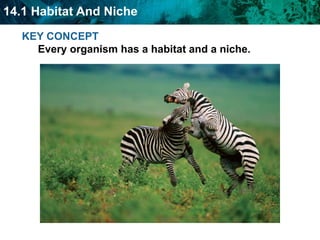
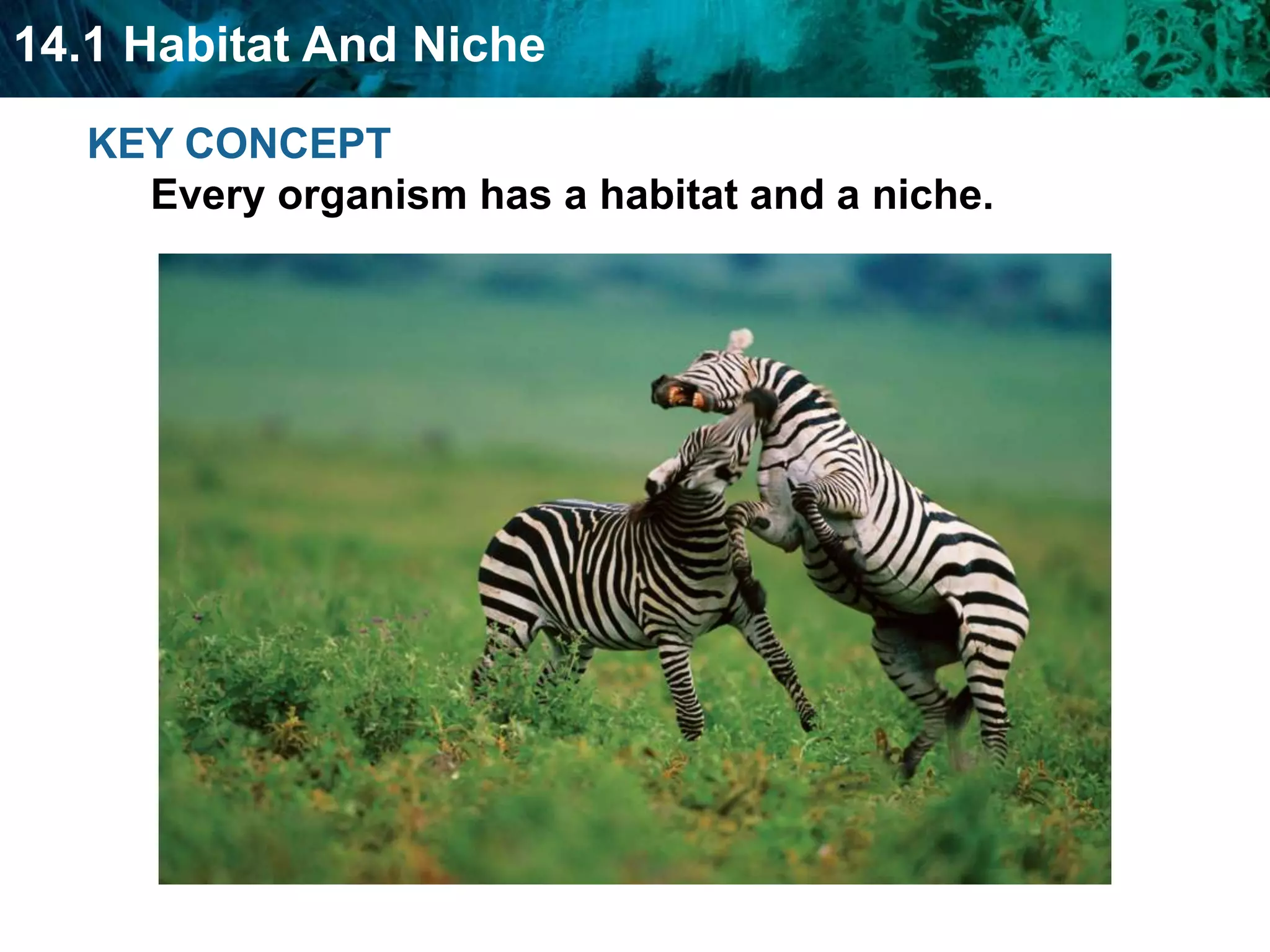
KEY CONCEPT Every organism has a habitat and a niche.
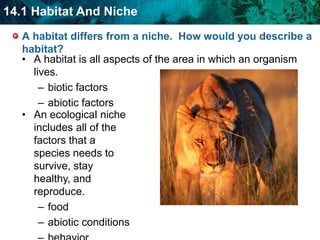
A habitat differs from a niche.  How would you describe a habitat? A habitat is all aspects of the area in which an organism lives.biotic factorsabiotic factorsAn ecological niche includes all of the factors that a species needs to survive, stay healthy, and reproduce.
food
abiotic conditions
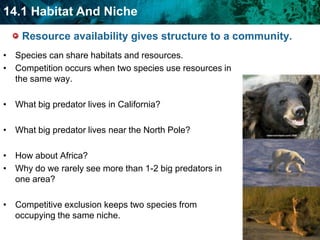
behaviorResource availability gives structure to a community.Species can share habitats and resources.Competition occurs when two species use resources in the same way.What big predator lives in California?What big predator lives near the North Pole?How about Africa?Why do we rarely see more than 1-2 big predators in one area?Competitive exclusion keeps two species from occupying the same niche.
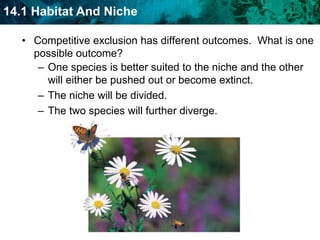
Competitive exclusion has different outcomes.  What is one possible outcome?One species is better suited to the niche and the other will either be pushed out or become extinct.
The niche will be divided.
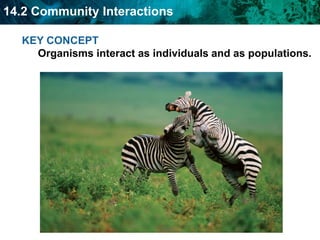
The two species will further diverge.KEY CONCEPT Organisms interact as individuals and as populations.
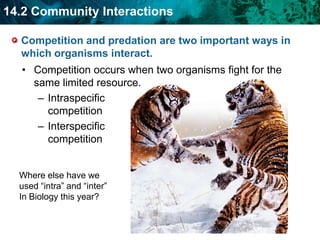
Competition and predation are two important ways inwhich organisms interact. Competition occurs when two organisms fight for thesame limited resource.IntraspecificcompetitionInterspecificcompetitionWhere else have we used “intra” and “inter”In Biology this year?
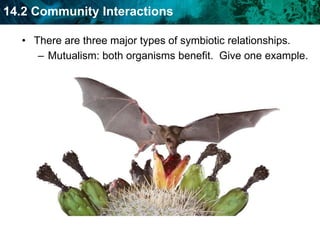
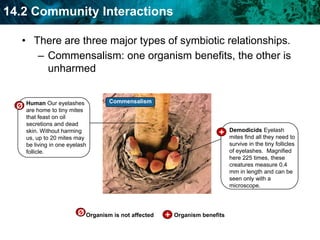
There are three major types of symbiotic relationships.Mutualism: both organisms benefit.  Give one example.CommensalismHuman Our eyelashes are home to tiny mitesthat feast on oil secretions and dead skin. Without harming us, up to 20 mites may be living in one eyelash follicle.ØDemodicids Eyelash mites find all they need to survive in the tiny folliclesof eyelashes.  Magnified here 225 times, these creatures measure 0.4 mm in length and can be seen only with a microscope.+Ø+Organism benefitsOrganism is not affectedThere are three major types of symbiotic relationships.
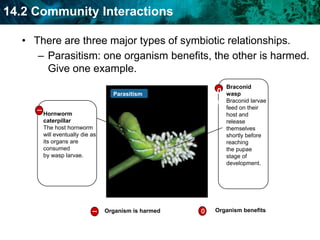
Commensalism: one organism benefits, the other is unharmedBraconid waspBraconid larvae feed on their host and release themselves shortly before reachingthe pupae stage of development.0Parasitism+_Hornworm caterpillarThe host hornworm will eventually die as its organs are consumedby wasp larvae._Organism benefitsOrganism is harmed0There are three major types of symbiotic relationships.Parasitism: one organism benefits, the other is harmed.  Give one example.
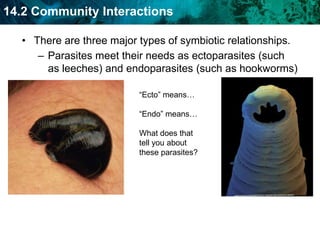
There are three major types of symbiotic relationships.Parasites meet their needs as ectoparasites (such as leeches) and endoparasites (such as hookworms)“Ecto” means…“Endo” means…What does that tell you about these parasites?
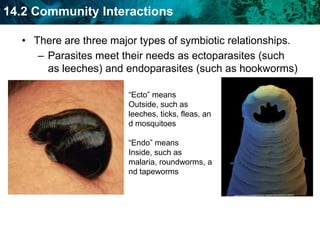
There are three major types of symbiotic relationships.Parasites meet their needs as ectoparasites (such as leeches) and endoparasites (such as hookworms)“Ecto” means Outside, such as leeches, ticks, fleas, and mosquitoes“Endo” means Inside, such as malaria, roundworms, and tapeworms
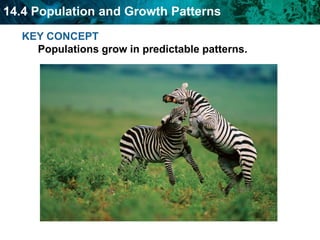
KEY CONCEPT Populations grow in predictable patterns.
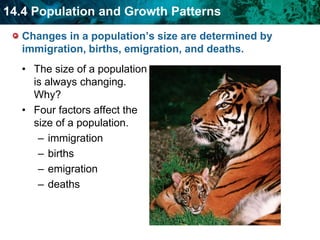
Changes in a population’s size are determined by immigration, births, emigration, and deaths. The size of a population is always changing.  Why?Four factors affect the size of a population.immigrationbirthsemigrationdeaths
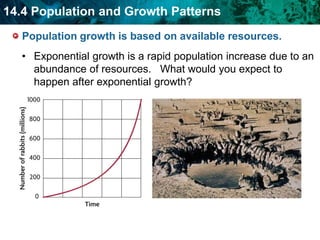
Population growth is based on available resources.Exponential growth is a rapid population increase due to an abundance of resources.   What would you expect to happen after exponential growth?
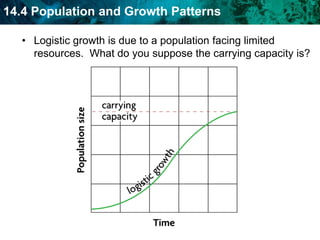
Logistic growth is due to a population facing limited resources.  What do you suppose the carrying capacity is?
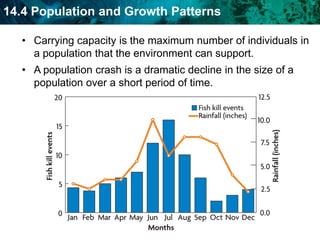
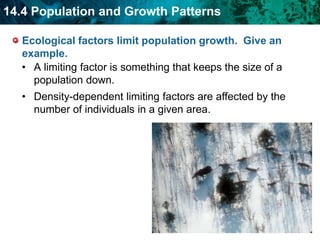
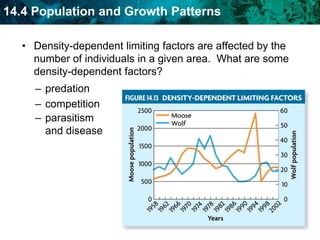
Carrying capacity is the maximum number of individuals in a population that the environment can support.A population crash is a dramatic decline in the size of a population over a short period of time.Ecological factors limit population growth.  Give an example.   A limiting factor is something that keeps the size of a population down. Density-dependent limiting factors are affected by the number of individuals in a given area.Density-dependent limiting factors are affected by the number of individuals in a given area.  What are some density-dependent factors?predation
competition
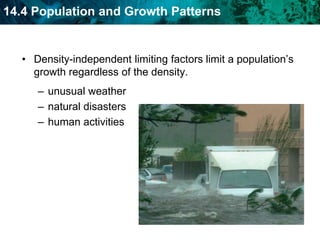
parasitism and diseaseDensity-independent limiting factors limit a population’s growth regardless of the density.unusual weather
natural disasters
human activitiesWhat does the term ecological equivalents describe? A. species that occupy the same niche in the same community B. species that occupy similar niches in different geographical regions C. species that occupy different niches in the same habitat D. species that occupy different niches in different geographical regions
What does the term ecological equivalents describe? A. species that occupy the same niche in the same community B. species that occupy similar niches in different geographical regions C. species that occupy different niches in the same habitat D. species that occupy different niches in different geographical regions Correct Answer = BWhat is the habitat of a zebra? A. African savannah B. tropical rain forest C. wetland D. mountainside

Unit 15a Habitat niche interactions and growth patterns

  • 1.
    KEY CONCEPT Everyorganism has a habitat and a niche.
  • 2.
    A habitat differsfrom a niche. How would you describe a habitat? A habitat is all aspects of the area in which an organism lives.biotic factorsabiotic factorsAn ecological niche includes all of the factors that a species needs to survive, stay healthy, and reproduce.
  • 3.
  • 4.
  • 5.
    behaviorResource availability givesstructure to a community.Species can share habitats and resources.Competition occurs when two species use resources in the same way.What big predator lives in California?What big predator lives near the North Pole?How about Africa?Why do we rarely see more than 1-2 big predators in one area?Competitive exclusion keeps two species from occupying the same niche.
  • 6.
    Competitive exclusion hasdifferent outcomes. What is one possible outcome?One species is better suited to the niche and the other will either be pushed out or become extinct.
  • 7.
    The niche willbe divided.
  • 8.
    The two specieswill further diverge.KEY CONCEPT Organisms interact as individuals and as populations.
  • 9.
    Competition and predationare two important ways inwhich organisms interact. Competition occurs when two organisms fight for thesame limited resource.IntraspecificcompetitionInterspecificcompetitionWhere else have we used “intra” and “inter”In Biology this year?
  • 10.
    There are threemajor types of symbiotic relationships.Mutualism: both organisms benefit. Give one example.CommensalismHuman Our eyelashes are home to tiny mitesthat feast on oil secretions and dead skin. Without harming us, up to 20 mites may be living in one eyelash follicle.ØDemodicids Eyelash mites find all they need to survive in the tiny folliclesof eyelashes. Magnified here 225 times, these creatures measure 0.4 mm in length and can be seen only with a microscope.+Ø+Organism benefitsOrganism is not affectedThere are three major types of symbiotic relationships.
  • 11.
    Commensalism: one organismbenefits, the other is unharmedBraconid waspBraconid larvae feed on their host and release themselves shortly before reachingthe pupae stage of development.0Parasitism+_Hornworm caterpillarThe host hornworm will eventually die as its organs are consumedby wasp larvae._Organism benefitsOrganism is harmed0There are three major types of symbiotic relationships.Parasitism: one organism benefits, the other is harmed. Give one example.
  • 12.
    There are threemajor types of symbiotic relationships.Parasites meet their needs as ectoparasites (such as leeches) and endoparasites (such as hookworms)“Ecto” means…“Endo” means…What does that tell you about these parasites?
  • 13.
    There are threemajor types of symbiotic relationships.Parasites meet their needs as ectoparasites (such as leeches) and endoparasites (such as hookworms)“Ecto” means Outside, such as leeches, ticks, fleas, and mosquitoes“Endo” means Inside, such as malaria, roundworms, and tapeworms
  • 14.
    KEY CONCEPT Populationsgrow in predictable patterns.
  • 15.
    Changes in apopulation’s size are determined by immigration, births, emigration, and deaths. The size of a population is always changing. Why?Four factors affect the size of a population.immigrationbirthsemigrationdeaths
  • 16.
    Population growth isbased on available resources.Exponential growth is a rapid population increase due to an abundance of resources. What would you expect to happen after exponential growth?
  • 17.
    Logistic growth isdue to a population facing limited resources. What do you suppose the carrying capacity is?
  • 18.
    Carrying capacity isthe maximum number of individuals in a population that the environment can support.A population crash is a dramatic decline in the size of a population over a short period of time.Ecological factors limit population growth. Give an example. A limiting factor is something that keeps the size of a population down. Density-dependent limiting factors are affected by the number of individuals in a given area.Density-dependent limiting factors are affected by the number of individuals in a given area. What are some density-dependent factors?predation
  • 19.
  • 20.
    parasitism and diseaseDensity-independentlimiting factors limit a population’s growth regardless of the density.unusual weather
  • 21.
  • 22.
    human activitiesWhat doesthe term ecological equivalents describe? A. species that occupy the same niche in the same community B. species that occupy similar niches in different geographical regions C. species that occupy different niches in the same habitat D. species that occupy different niches in different geographical regions
  • 23.
    What does theterm ecological equivalents describe? A. species that occupy the same niche in the same community B. species that occupy similar niches in different geographical regions C. species that occupy different niches in the same habitat D. species that occupy different niches in different geographical regions Correct Answer = BWhat is the habitat of a zebra? A. African savannah B. tropical rain forest C. wetland D. mountainside