Data released by the United States Environmental Protection Agency shows that somewhere between 500 billion and a trillion plastic bags are consumed worldwide each year.National Geographic News September 2, 2003
Less than 1% of bags are recycled.  It cost more to recycle a bag than to produce a new one.
“There's harsh economics behind bag recycling: It costs $4,000 to process and recycle 1 ton of plastic bags, which can then be sold on the commodities market for $32”- Jared Blumenfeld (Director of San Francisco's Department of the Environment)
Then…Where Do They Go?
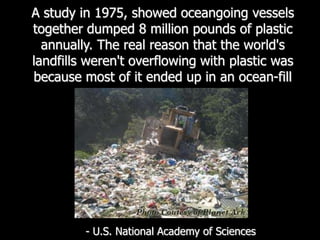
A study in 1975, showed oceangoing vessels together dumped 8 million pounds of plastic annually. The real reason that the world's landfills weren't overflowing with plastic was because most of it ended up in an ocean-fill- U.S. National Academy of Sciences
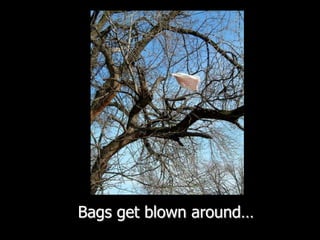
Bags get blown around…
…to different parts of our lands
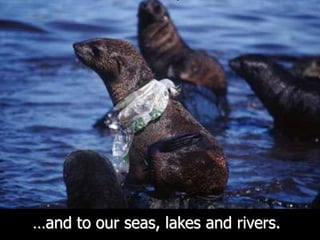
…and to our seas, lakes and rivers.
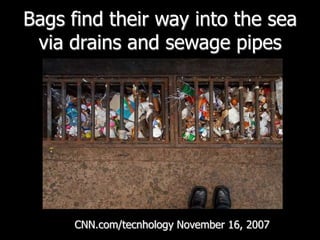
Bags find their way into the sea via drains and sewage pipes CNN.com/tecnhologyNovember 16, 2007
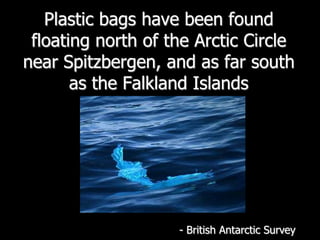
Plastic bags have been found floating north of the Arctic Circle near Spitzbergen, and as far south as the Falkland Islands- British Antarctic Survey
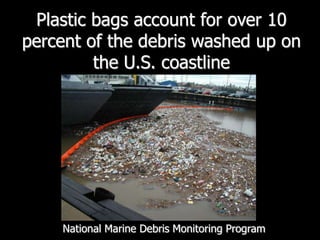
Plastic bags account for over 10 percent of the debris washed up on the U.S. coastlineNational Marine Debris Monitoring Program
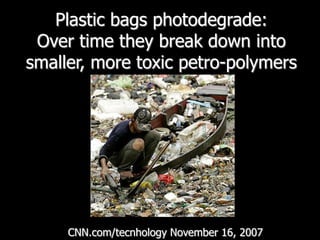
Plastic bags photodegrade:Over time they break down into smaller, more toxic petro-polymersCNN.com/tecnhologyNovember 16, 2007
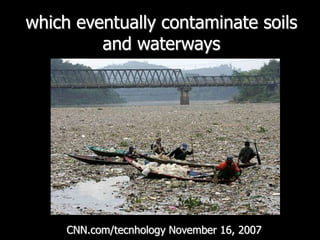
which eventually contaminate soils and waterwaysCNN.com/tecnhologyNovember 16, 2007
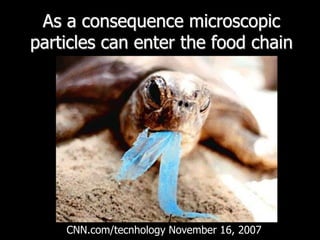
As a consequence microscopic particles can enter the food chainCNN.com/tecnhologyNovember 16, 2007
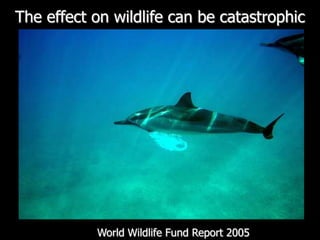
The effect on wildlife can be catastrophicWorld Wildlife Fund Report 2005
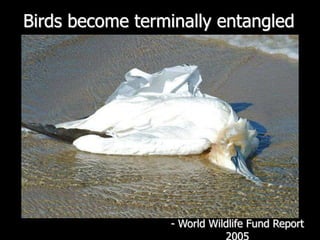
Birds become terminally entangled - World Wildlife Fund Report 2005
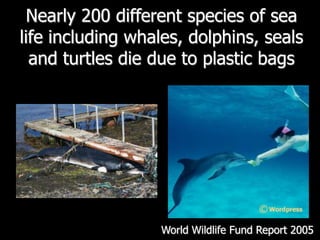
Nearly 200 different species of sea life including whales, dolphins, seals and turtles die due to plastic bagsWorld Wildlife Fund Report 2005
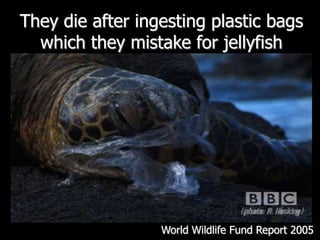
They die after ingesting plastic bags which they mistake for jellyfishWorld Wildlife Fund Report 2005
So…What do we do?
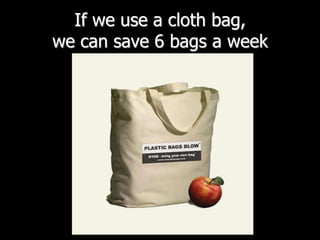
If we use a cloth bag, we can save 6 bags a week
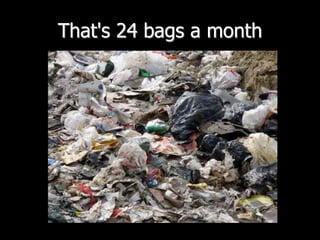
That's 24 bags a month
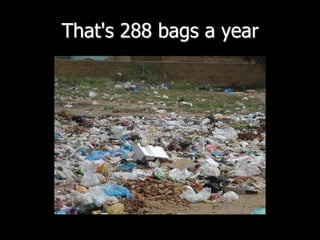
That's 288 bags a year
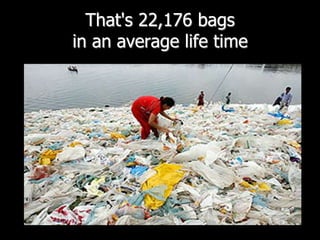
That's 22,176 bags in an average life time
 If just 1 out of 5 people in our country did this we would save 1,330,560,000,000 bags over our life time
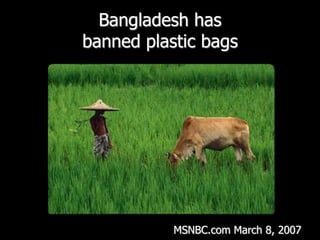
Bangladesh has banned plastic bags MSNBC.com March 8, 2007
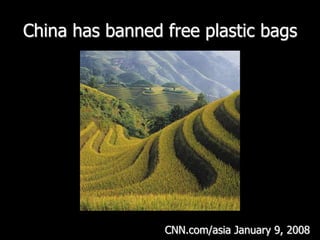
China has banned free plastic bagsCNN.com/asiaJanuary 9, 2008
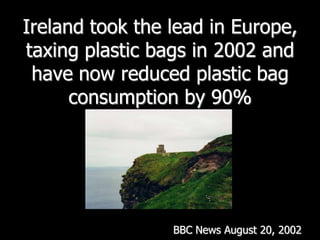
Ireland took the lead in Europe, taxing plastic bags in 2002 and have now reduced plastic bag consumption by 90% BBC News August 20, 2002
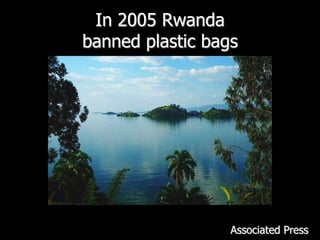
In 2005 Rwanda banned plastic bags Associated Press
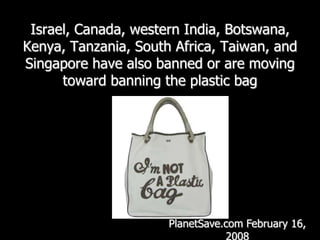
Israel, Canada, western India, Botswana, Kenya, Tanzania, South Africa, Taiwan, and Singapore have also banned or are moving toward banning the plastic bag PlanetSave.com February 16, 2008
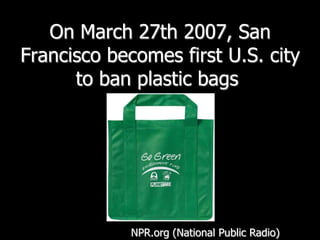
On March 27th 2007, San Francisco becomes first U.S. city to ban plastic bags NPR.org (National Public Radio)
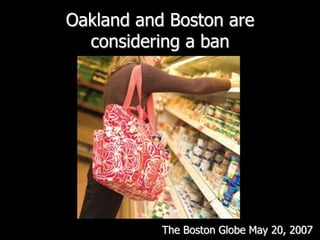
Oakland and Boston are considering a ban The Boston Globe May 20, 2007
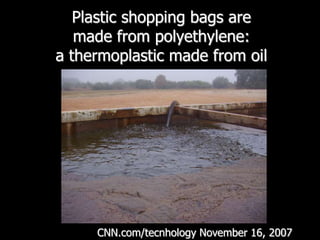
Plastic shopping bags are made from polyethylene: a thermoplastic made from oil CNN.com/tecnhologyNovember 16, 2007
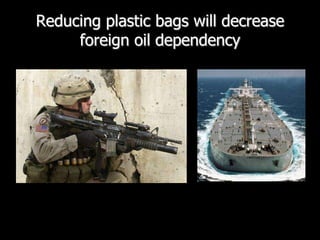
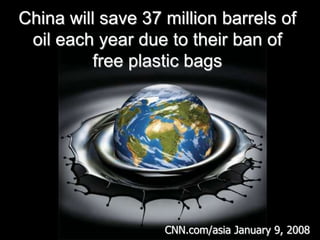
Reducing plastic bags will decrease foreign oil dependency
China will save 37 million barrels of oil each year due to their ban of free plastic bags CNN.com/asiaJanuary 9, 2008
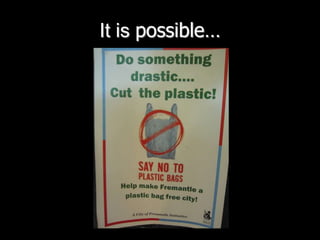
It is possible...

The facts about plastic bags

  • 1.
    Data released bythe United States Environmental Protection Agency shows that somewhere between 500 billion and a trillion plastic bags are consumed worldwide each year.National Geographic News September 2, 2003
  • 2.
    Less than 1%of bags are recycled. It cost more to recycle a bag than to produce a new one.
  • 3.
    “There's harsh economicsbehind bag recycling: It costs $4,000 to process and recycle 1 ton of plastic bags, which can then be sold on the commodities market for $32”- Jared Blumenfeld (Director of San Francisco's Department of the Environment)
  • 4.
  • 5.
    A study in1975, showed oceangoing vessels together dumped 8 million pounds of plastic annually. The real reason that the world's landfills weren't overflowing with plastic was because most of it ended up in an ocean-fill- U.S. National Academy of Sciences
  • 6.
    Bags get blownaround…
  • 7.
  • 8.
    …and to ourseas, lakes and rivers.
  • 9.
    Bags find theirway into the sea via drains and sewage pipes CNN.com/tecnhologyNovember 16, 2007
  • 10.
    Plastic bags havebeen found floating north of the Arctic Circle near Spitzbergen, and as far south as the Falkland Islands- British Antarctic Survey
  • 11.
    Plastic bags accountfor over 10 percent of the debris washed up on the U.S. coastlineNational Marine Debris Monitoring Program
  • 12.
    Plastic bags photodegrade:Overtime they break down into smaller, more toxic petro-polymersCNN.com/tecnhologyNovember 16, 2007
  • 13.
    which eventually contaminatesoils and waterwaysCNN.com/tecnhologyNovember 16, 2007
  • 14.
    As a consequencemicroscopic particles can enter the food chainCNN.com/tecnhologyNovember 16, 2007
  • 15.
    The effect onwildlife can be catastrophicWorld Wildlife Fund Report 2005
  • 16.
    Birds become terminallyentangled - World Wildlife Fund Report 2005
  • 18.
    Nearly 200 differentspecies of sea life including whales, dolphins, seals and turtles die due to plastic bagsWorld Wildlife Fund Report 2005
  • 19.
    They die afteringesting plastic bags which they mistake for jellyfishWorld Wildlife Fund Report 2005
  • 20.
  • 21.
    If we usea cloth bag, we can save 6 bags a week
  • 22.
  • 23.
  • 24.
    That's 22,176 bagsin an average life time
  • 25.
    If just1 out of 5 people in our country did this we would save 1,330,560,000,000 bags over our life time
  • 26.
    Bangladesh has bannedplastic bags MSNBC.com March 8, 2007
  • 27.
    China has bannedfree plastic bagsCNN.com/asiaJanuary 9, 2008
  • 28.
    Ireland took thelead in Europe, taxing plastic bags in 2002 and have now reduced plastic bag consumption by 90% BBC News August 20, 2002
  • 29.
    In 2005 Rwandabanned plastic bags Associated Press
  • 30.
    Israel, Canada, westernIndia, Botswana, Kenya, Tanzania, South Africa, Taiwan, and Singapore have also banned or are moving toward banning the plastic bag PlanetSave.com February 16, 2008
  • 31.
    On March 27th2007, San Francisco becomes first U.S. city to ban plastic bags NPR.org (National Public Radio)
  • 32.
    Oakland and Bostonare considering a ban The Boston Globe May 20, 2007
  • 33.
    Plastic shopping bagsare made from polyethylene: a thermoplastic made from oil CNN.com/tecnhologyNovember 16, 2007
  • 34.
    Reducing plastic bagswill decrease foreign oil dependency
  • 35.
    China will save 37 millionbarrels of oil each year due to their ban of free plastic bags CNN.com/asiaJanuary 9, 2008
  • 36.