DNA Polymorphisms
in the Human Genome.
Mutations and Genetic
       Diseases.


Marie Kopecká 2007/2008   mkopecka@med.muni.cz
• GENOME

• All of the genetic material of a cell
  or of an individual.
The Human Genome


• Nuclear genome.
• Mitochondrial genome.*

Lecture concerns „Nuclear genome”
only, for which the term „Human genome” is used.

*   1994
• POLYMORPHISM, GENETIC (Ford, 1940)

• Existence of more than one normal allele
  at a gene locus
• with the rarest allele exceeding a
  frequency of 1%.
• A polymorphism may exists at several
  levels, i.e., variants in DNA sequence,
• amino acid sequence,
• chromosomal structure, or
• phenotypic traits.
• DNA POLYMORPHISM

• A difference in DNA sequence among
  individuals, groups, or populations.
• Sources include single nucleotide
  polymorphisms (SNPs),
• sequence repeats,
• insertions,
• deletions and
• inversions.
1866 Johan Gregor Mendel: genes (elements)
1869 Fritz Miescher: DNA (nuclein)
1882 Walther Flemming: chromosomes in mitosis
1911 Thomas Hunt Morgan: genes in chromosomes
1944 Oswald Avery, Colin MacLeod, Maclyn McCarty:
     DNA is carrier of genetic information in bacteria
1952 Al Hershey, Martha Chase:
     DNA is carrier of genetic information in viruses
1953 James Watson, Francis Crick: double-helix of DNA
1956 Tjio and Levan: human karyotype
1970 Hamilton Smith: restriction endonuclease HindII
1977 Fred Sanger/Allan Maxam,Walter Gilbert: DNA sequencing
1983 Kerry Mullis: PCR
2001 First „draft” of human genome:
     Length of DNA=3.2 x 10⁹ bp. Gene number = 26 383.
Nature 409: 860-921, (2001) - 15. 2. 2001 - HUGO,
Science 291: 1304, (2001)- 16. 2. 2001 - Celera Genomics
2006 Sharp, Cheng, Eichler, ARGHG 7 (2006): human genome   24 652 genes
The Human Genome:
   First estimation of gene number?

• 1980 Walter Gilbert:

• The human genome has about
  3 000 000 000 bp.
• The gene size is about 30 000 bp.
• How many genes in human DNA?
• 3 000 000 000 : 30 000 = 100 000
• The human genome contains about
  100 000 genes !
The Human Genome (2001):
     comparison with other genomes


Yeast        6 200 genes
Drosophila 14 000 genes
C. elegans 19 000 genes
Arabidopsis 27 000 genes
Homo sapiens ~ 25 000 genes
HUMAN GENOME – Important data:
1A. Length of DNA: 2.9 x 10⁹ bp (Campbell, Reece 2005)
   Number of genes coding proteins: 25 000
1B. Length of DNA 3.2 x 10⁹ pb (Alberts et al. 2004)
   Number of genes: 31 000
2. DNA (Alberts et al. 2004)
A. UNIQUE DNA: (39%)
  CODING SEQUENCES 1.5% (Exon regions of genes coding
  for proteins, rRNAs and tRNAs)
  Introns and regulatory sequences (~24%)
  Unique non-coding DNA (~15%)
B. REPETETIVE DNA (53%)
   LINEs 21%
   SINEs 13%
   Retroviral-like elements 8%
   DNA- only transposon „fossils” 3%
   Segmental duplications 3%
   Simple sequence repeats 5%
C. HETEROCHROMATIN (8%)            -
Repetitive sequences at centromeric and telomeric
regions and intersperesed among the genes.
Examples of repetitive sequences in 7th intron of dystrophin gene
Human genome
• As one commmentator described our genome:
  „In some ways our genome may resemble
  your garage/ bedroom/ refrigerator/ life:
  highly individualistic, but unkempt; little
  evidence of organization; much accumulated
  „junk“; virtually nothing ever discarded; and
  the few patently valuable items
  indiscriminately, apparently carelessly,
  scattered throughout.”
Genetic Variations Within the Human Genome

With the exception of identical twins, no two people have the
 exact same genome.

When the same region of the genome from two different
 humans is compared, the nucleotide sequences typically
 differ by about 0.1 %.

When considering the size of human genome
 (~3 000 000 000 bp) that amounts ~ 3 000 000
 genetic differences in each maternal and paternal
 chromosome set between one person and the next.
DNA POLYMORPHISM / GENE MUTATION
DNA POLYMORPHISM (D.P.)=
a difference in DNA sequence among individuals, groups, or populations.
D.P. include SNP, sequence repeats, insertions, deletions, recombination.
   Example: blue eyes versus brown eyes; straight hair versus curly hair.
If a difference in DNA sequence is associated with disease, it is usually
   called a genetic mutation.
Changes in DNA caused by external agents (mutagens) are also called
   „mutations” rather than „polymorphisms”.

GENE MUTATION:
A change in the nucleotide sequence of a DNA molecule. Genetic mutations
   are a kind of genetic polymorphism.
The term „mutation” as opposed to „polymorphism” is generally used to
   refer to changes in DNA sequence which are not present in most
   individuals of a species and either have been associated with disease (or
   risk of disease) or have resulted from damage inflicted by external
   agents (viruses, radiation, chemical mutagens.)
SINGLE NUCLEOTIDE POLYMORPHISM (SNP)


• SINGLE NUCLEOTIDE POLYMORPHISM
   is a source variance in a genome.
• A SNP is a single base variation in DNA.
• SNPs are the most simple form and
• most common source of genetic polymorphism in the human
  genome = 90% of all human DNA polymorphisms.
• The bulk of this variation was inherited from our ancestors.
SNPs (cont.)
Frequency:
   1/1000 base pairs between two equivalent chromosomes.
Distribution:
   SNPs are not uniformly distributed over the entire human genome,
    however, they can be found in non-coding and coding regions.
Coding regions:
  SNPs in a coding region may have two different efects on the resulting protein:
  Synonymous: the substitution causes no amino acid change = silent mutation.
  Non-synonymous: the substitution results in an alteration of the encoded amino
   acid:
   -a missense mutation changes the protein by causing a change of codon;
   -a nonsense mutation results in a misplaced termination codon.
Regulatory regions: SNPs may change the amount of or timing of protein
   production.
Non-coding regions: In healthy people, DNA polymorphisms probably occur
   predominantly in non-coding DNA sequences or in DNA regions that do not
   influence the function of coded proteins.
SNPs
These polymorphisms are scattered throughout the genome.
More than 90% of all human genes contain at least one SNP.
Because SNPs are present at such a high density, they are
useful markers for identification of mutated gene.
Most of the SNP and other variations are genetically silent =
affect the DNA sequences in noncritical regions of the
genome. These SNP have no effect on how we look or how our
cells function.
• However, a tiny subset od SNP are presumably responsible
for nearly all heritable aspects of human individuality. Major
task is to learn to recognize those relatively few variations
that are functionally important against the large background
of neutral variation that distinguishes the genomes of any
two human beings.
DNA Polymorphisms in the Human Genome


Examples:
• Single nucleotide polymorphisms (SNPs)

• Variable Number of Tandem Repeats
  (VNTR)
Single nucleotide polymorphisms (SNPs) [„SNiPS”]
Recognition sites for one restriction endonuclease in        Electrophoresis of
SNP       homologous chromosomes                                       restriction fragments of
                                                                       DNA and Souhern blot


             Variability in a number of repetitive sequence
VNTR         (CACACACA…)


                          Recognition site
                          for restriction                         Recognition site
           Gene                                                   for restriction enzyme absent
           probe          enzyme present

Two types of DNA polymorphism: Single Nucleotide Polymorphism (SNP)(top
left) and Variable Number of Tandem Repeats (VNTR) (bottom left), both
resulting in Restriction Fragment Length Polymorphism (RFLP) (right). Polymor-
phisms are detectable by Southern blotting,PCR,DNA sequencing,microarrays
• How to use SNP or VNTR ?

• SNP and VNTR change the lenth of
  restriction fragments of DNA (RFLP).

• It is possible to use RFLP in indirect
  DNA diagnosis
 (see Lab book, p. 114)
Direct DNA diagnosis:
Direct identification of mutation in the human
  genome by:
• DNA sequencing,
• Oligonucleotide probes (ASO) in Southern
  blotting,
• PCR… (see Lab book, p. 113-117)
Indirect DNA diagnosis:
  If mutation cannot be identified directly,
  effort is to identify mutation by indirect
  methods, f.e. by SNP near mutation by RFLP
  (see Lab book, 114-117 and the next slides)
Example of linkage of mutated gene causing disease and SNP close on the same chromosome
Dystrophin 2.4 x 10⁶ pb.   Gene mutation → Muscle dystrophy
Indirect DNA diagnosis of muscle dystrophy by RFLP


   (GR)

                                       Conclusion:
                                       Mother´s sister does not
                          6 year boy
                                       have mutated allele


 DNA of family                          Normal allele for
 members + restriction                  dystrophin
 endonuclease,
 gel electrophoresis of                 Deletion mutation in the
 restriction fragments,                 dystrophin alelle
 Southern blotting
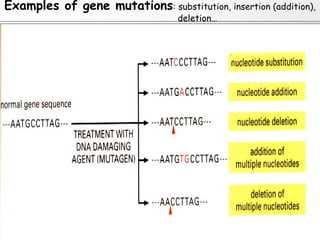
Examples of gene mutations: substitution, insertion (addition),
                                   deletion…
Consequences of the gene mutation for the function
           of mutated protein product


                         deletion mutation
Another example:
mutated enzyme
 Indirect DNA
 diagnosis of
 phenylketonuria
 (AR)
 by means of
 RFLP


 Conclusion:       DNA of

 II. 2 will be
                   family
                   members
                   +
 healthy           restriction
                   endonu-

 heterozygote      clease, gel
                   electro-
                   phoresis
                   and
                   Southern
                   blotting
It is easier than to look for single SNPs to identify the whole
   haplotype* block and to identify SNP inside of this block!


Haplotype* = combination of alelles and futher DNA markers in linear block of DNA that is not
interrupted by recombination and that is transferred for many generations.
• The investigation of the human genome
  continues.
• The aim is to understand the molecular
  nature of mutation of genes responsible for
  human diseases.

• Identification of DNA polymorphisms of
  individuals and of human haplotype map may
  help to identify
• pre-dispositions to diseases,
• the diagnosis and the course of diseases and
• their potential therapy.
Specific terms
•   ALLELE The alternative forms of a genetic character found at a given locus on a chromosome.
•   DIPLOID The chromosome complement consists of two copies (homologues) of each chromosome.
    In humans, the each chromosome pair is from a different origin (mother, father).
•   GENE (Johannsen, 1909) A hereditary factor that constitutes a single unit of hereditary material. It
    corresponds to a segment of DNA that codes for the synthesis of a single polypeptide chain.
•   GENE LOCUS (Morgan, 1915) The position of a gene on a chromosome.
•   GENE MAP The position of gene loci on chromosomes. Physical map – the absolute position of gene
    loci, their distance from each other being expressed by the number of base pairs between them. Genetic
    map – expresses the distance of genetically linked loci by their frequency of recombinations.
•   GENETIC MARKER A polymorphic genetic property that can be used to distinguish the parental origin
    of alleles.
•   GENETIC POLYMORPHISM A difference in DNA sequence among individuals, groups, or
    populations. Sources include SNPs, sequence repeats, insertions, deletions and recombination.
•   GENOME All of the genetic material of a cell or of an individual.
•   GENOMICS The scientific field dealing with the structure and function of the entire genome.
•   GENOTYPE An exact description of the genetic constitution of an individual, with respect to a single
    trait or a larger set of traits. The genetic constitution of an organism as revealed by genetic or molecular
    analysis, i.e. the complete set of genes, both dominant and recessive, possessed by a particular cell or
    organism.
•   GENOTYPING Genotyping is normally defined as detecting the genotypes of individual SNPs.
•   HAPLOTYPE (haploid genotype). A combination of alleles of closely linked loci that are found in a
    single chromosome and tend to be inherited together. The linear, ordered arrangement of alleles in a
    chromosome. A particular pattern of sequential SNPs (or alleles) found on a single chromosome. These
    SNPs tend to be inherited together over time and can serve as disease- gene markers.
•   HOMOZYGOUS A diploid organism having identical alleles of a given gene on both homologous
    chromosomes.
•   HETEROZYGOUS A diploid organism having different alleles of a given gene on both homologous
    chromosomes.
•   LINES Long interspersed nuclear elements= long interspersed repetitive DNA sequence.
    POLYMORPHISM, GENETIC (Ford, 1940) Existence of more than one normal allele at a gene locus
    with the rarest allele exceeding a frequency of 1%. A polymorphism may exists at several levels, i.e.,
    variants in DNA sequence, amino acid sequence, chromosomal structure, or phenotypic traits.
•   PHENOTYPE (Johannsen, 1909) The observable effect of one or more genes on an individual or a cell.
    The observable properties of an individual as they have developed under the combined influences of the
    individual´s genotype and the effects of environmental factors.
•   PROTEOM The complete set of all protein encoding genes or all proteins produced by them.
•   PSEUDOGENE Nucleotide sequence of DNA similar to functional gene, but containing many mutations
    that prevent expression.
•   SINE Short interspersed nuclear element=short repetitive DNA sequences.
•   SINGLE NUCLEOTIDE POLYMORPHISM (SNP) SNP is a source variance in a genome. A SNP is a
    single base variation in DNA. SNPs are the most simple form and most common source of genetic
    polymorphism in the human genome (90% of all human DNA polymorphisms).

L11 dna__polymorphisms__mutations_and_genetic_diseases4

  • 1.
    DNA Polymorphisms in theHuman Genome. Mutations and Genetic Diseases. Marie Kopecká 2007/2008 mkopecka@med.muni.cz
  • 2.
    • GENOME • Allof the genetic material of a cell or of an individual.
  • 3.
    The Human Genome •Nuclear genome. • Mitochondrial genome.* Lecture concerns „Nuclear genome” only, for which the term „Human genome” is used. * 1994
  • 4.
    • POLYMORPHISM, GENETIC(Ford, 1940) • Existence of more than one normal allele at a gene locus • with the rarest allele exceeding a frequency of 1%. • A polymorphism may exists at several levels, i.e., variants in DNA sequence, • amino acid sequence, • chromosomal structure, or • phenotypic traits.
  • 5.
    • DNA POLYMORPHISM •A difference in DNA sequence among individuals, groups, or populations. • Sources include single nucleotide polymorphisms (SNPs), • sequence repeats, • insertions, • deletions and • inversions.
  • 6.
    1866 Johan GregorMendel: genes (elements) 1869 Fritz Miescher: DNA (nuclein) 1882 Walther Flemming: chromosomes in mitosis 1911 Thomas Hunt Morgan: genes in chromosomes 1944 Oswald Avery, Colin MacLeod, Maclyn McCarty: DNA is carrier of genetic information in bacteria 1952 Al Hershey, Martha Chase: DNA is carrier of genetic information in viruses 1953 James Watson, Francis Crick: double-helix of DNA 1956 Tjio and Levan: human karyotype 1970 Hamilton Smith: restriction endonuclease HindII 1977 Fred Sanger/Allan Maxam,Walter Gilbert: DNA sequencing 1983 Kerry Mullis: PCR 2001 First „draft” of human genome: Length of DNA=3.2 x 10⁹ bp. Gene number = 26 383. Nature 409: 860-921, (2001) - 15. 2. 2001 - HUGO, Science 291: 1304, (2001)- 16. 2. 2001 - Celera Genomics 2006 Sharp, Cheng, Eichler, ARGHG 7 (2006): human genome 24 652 genes
  • 7.
    The Human Genome: First estimation of gene number? • 1980 Walter Gilbert: • The human genome has about 3 000 000 000 bp. • The gene size is about 30 000 bp. • How many genes in human DNA? • 3 000 000 000 : 30 000 = 100 000 • The human genome contains about 100 000 genes !
  • 8.
    The Human Genome(2001): comparison with other genomes Yeast 6 200 genes Drosophila 14 000 genes C. elegans 19 000 genes Arabidopsis 27 000 genes Homo sapiens ~ 25 000 genes
  • 9.
    HUMAN GENOME –Important data: 1A. Length of DNA: 2.9 x 10⁹ bp (Campbell, Reece 2005) Number of genes coding proteins: 25 000 1B. Length of DNA 3.2 x 10⁹ pb (Alberts et al. 2004) Number of genes: 31 000 2. DNA (Alberts et al. 2004) A. UNIQUE DNA: (39%) CODING SEQUENCES 1.5% (Exon regions of genes coding for proteins, rRNAs and tRNAs) Introns and regulatory sequences (~24%) Unique non-coding DNA (~15%) B. REPETETIVE DNA (53%) LINEs 21% SINEs 13% Retroviral-like elements 8% DNA- only transposon „fossils” 3% Segmental duplications 3% Simple sequence repeats 5% C. HETEROCHROMATIN (8%) -
  • 10.
    Repetitive sequences atcentromeric and telomeric regions and intersperesed among the genes.
  • 11.
    Examples of repetitivesequences in 7th intron of dystrophin gene
  • 12.
    Human genome • Asone commmentator described our genome: „In some ways our genome may resemble your garage/ bedroom/ refrigerator/ life: highly individualistic, but unkempt; little evidence of organization; much accumulated „junk“; virtually nothing ever discarded; and the few patently valuable items indiscriminately, apparently carelessly, scattered throughout.”
  • 13.
    Genetic Variations Withinthe Human Genome With the exception of identical twins, no two people have the exact same genome. When the same region of the genome from two different humans is compared, the nucleotide sequences typically differ by about 0.1 %. When considering the size of human genome (~3 000 000 000 bp) that amounts ~ 3 000 000 genetic differences in each maternal and paternal chromosome set between one person and the next.
  • 14.
    DNA POLYMORPHISM /GENE MUTATION DNA POLYMORPHISM (D.P.)= a difference in DNA sequence among individuals, groups, or populations. D.P. include SNP, sequence repeats, insertions, deletions, recombination. Example: blue eyes versus brown eyes; straight hair versus curly hair. If a difference in DNA sequence is associated with disease, it is usually called a genetic mutation. Changes in DNA caused by external agents (mutagens) are also called „mutations” rather than „polymorphisms”. GENE MUTATION: A change in the nucleotide sequence of a DNA molecule. Genetic mutations are a kind of genetic polymorphism. The term „mutation” as opposed to „polymorphism” is generally used to refer to changes in DNA sequence which are not present in most individuals of a species and either have been associated with disease (or risk of disease) or have resulted from damage inflicted by external agents (viruses, radiation, chemical mutagens.)
  • 15.
    SINGLE NUCLEOTIDE POLYMORPHISM(SNP) • SINGLE NUCLEOTIDE POLYMORPHISM is a source variance in a genome. • A SNP is a single base variation in DNA. • SNPs are the most simple form and • most common source of genetic polymorphism in the human genome = 90% of all human DNA polymorphisms. • The bulk of this variation was inherited from our ancestors.
  • 16.
    SNPs (cont.) Frequency: 1/1000 base pairs between two equivalent chromosomes. Distribution: SNPs are not uniformly distributed over the entire human genome, however, they can be found in non-coding and coding regions. Coding regions: SNPs in a coding region may have two different efects on the resulting protein: Synonymous: the substitution causes no amino acid change = silent mutation. Non-synonymous: the substitution results in an alteration of the encoded amino acid: -a missense mutation changes the protein by causing a change of codon; -a nonsense mutation results in a misplaced termination codon. Regulatory regions: SNPs may change the amount of or timing of protein production. Non-coding regions: In healthy people, DNA polymorphisms probably occur predominantly in non-coding DNA sequences or in DNA regions that do not influence the function of coded proteins.
  • 17.
    SNPs These polymorphisms arescattered throughout the genome. More than 90% of all human genes contain at least one SNP. Because SNPs are present at such a high density, they are useful markers for identification of mutated gene. Most of the SNP and other variations are genetically silent = affect the DNA sequences in noncritical regions of the genome. These SNP have no effect on how we look or how our cells function. • However, a tiny subset od SNP are presumably responsible for nearly all heritable aspects of human individuality. Major task is to learn to recognize those relatively few variations that are functionally important against the large background of neutral variation that distinguishes the genomes of any two human beings.
  • 18.
    DNA Polymorphisms inthe Human Genome Examples: • Single nucleotide polymorphisms (SNPs) • Variable Number of Tandem Repeats (VNTR)
  • 19.
    Single nucleotide polymorphisms(SNPs) [„SNiPS”]
  • 20.
    Recognition sites forone restriction endonuclease in Electrophoresis of SNP homologous chromosomes restriction fragments of DNA and Souhern blot Variability in a number of repetitive sequence VNTR (CACACACA…) Recognition site for restriction Recognition site Gene for restriction enzyme absent probe enzyme present Two types of DNA polymorphism: Single Nucleotide Polymorphism (SNP)(top left) and Variable Number of Tandem Repeats (VNTR) (bottom left), both resulting in Restriction Fragment Length Polymorphism (RFLP) (right). Polymor- phisms are detectable by Southern blotting,PCR,DNA sequencing,microarrays
  • 21.
    • How touse SNP or VNTR ? • SNP and VNTR change the lenth of restriction fragments of DNA (RFLP). • It is possible to use RFLP in indirect DNA diagnosis (see Lab book, p. 114)
  • 22.
    Direct DNA diagnosis: Directidentification of mutation in the human genome by: • DNA sequencing, • Oligonucleotide probes (ASO) in Southern blotting, • PCR… (see Lab book, p. 113-117) Indirect DNA diagnosis: If mutation cannot be identified directly, effort is to identify mutation by indirect methods, f.e. by SNP near mutation by RFLP (see Lab book, 114-117 and the next slides)
  • 23.
    Example of linkageof mutated gene causing disease and SNP close on the same chromosome
  • 24.
    Dystrophin 2.4 x10⁶ pb. Gene mutation → Muscle dystrophy
  • 25.
    Indirect DNA diagnosisof muscle dystrophy by RFLP (GR) Conclusion: Mother´s sister does not 6 year boy have mutated allele DNA of family Normal allele for members + restriction dystrophin endonuclease, gel electrophoresis of Deletion mutation in the restriction fragments, dystrophin alelle Southern blotting
  • 26.
    Examples of genemutations: substitution, insertion (addition), deletion…
  • 27.
    Consequences of thegene mutation for the function of mutated protein product deletion mutation
  • 28.
    Another example: mutated enzyme Indirect DNA diagnosis of phenylketonuria (AR) by means of RFLP Conclusion: DNA of II. 2 will be family members + healthy restriction endonu- heterozygote clease, gel electro- phoresis and Southern blotting
  • 29.
    It is easierthan to look for single SNPs to identify the whole haplotype* block and to identify SNP inside of this block! Haplotype* = combination of alelles and futher DNA markers in linear block of DNA that is not interrupted by recombination and that is transferred for many generations.
  • 30.
    • The investigationof the human genome continues. • The aim is to understand the molecular nature of mutation of genes responsible for human diseases. • Identification of DNA polymorphisms of individuals and of human haplotype map may help to identify • pre-dispositions to diseases, • the diagnosis and the course of diseases and • their potential therapy.
  • 31.
    Specific terms • ALLELE The alternative forms of a genetic character found at a given locus on a chromosome. • DIPLOID The chromosome complement consists of two copies (homologues) of each chromosome. In humans, the each chromosome pair is from a different origin (mother, father). • GENE (Johannsen, 1909) A hereditary factor that constitutes a single unit of hereditary material. It corresponds to a segment of DNA that codes for the synthesis of a single polypeptide chain. • GENE LOCUS (Morgan, 1915) The position of a gene on a chromosome. • GENE MAP The position of gene loci on chromosomes. Physical map – the absolute position of gene loci, their distance from each other being expressed by the number of base pairs between them. Genetic map – expresses the distance of genetically linked loci by their frequency of recombinations. • GENETIC MARKER A polymorphic genetic property that can be used to distinguish the parental origin of alleles. • GENETIC POLYMORPHISM A difference in DNA sequence among individuals, groups, or populations. Sources include SNPs, sequence repeats, insertions, deletions and recombination. • GENOME All of the genetic material of a cell or of an individual. • GENOMICS The scientific field dealing with the structure and function of the entire genome. • GENOTYPE An exact description of the genetic constitution of an individual, with respect to a single trait or a larger set of traits. The genetic constitution of an organism as revealed by genetic or molecular analysis, i.e. the complete set of genes, both dominant and recessive, possessed by a particular cell or organism. • GENOTYPING Genotyping is normally defined as detecting the genotypes of individual SNPs. • HAPLOTYPE (haploid genotype). A combination of alleles of closely linked loci that are found in a single chromosome and tend to be inherited together. The linear, ordered arrangement of alleles in a chromosome. A particular pattern of sequential SNPs (or alleles) found on a single chromosome. These SNPs tend to be inherited together over time and can serve as disease- gene markers. • HOMOZYGOUS A diploid organism having identical alleles of a given gene on both homologous chromosomes. • HETEROZYGOUS A diploid organism having different alleles of a given gene on both homologous chromosomes.
  • 32.
    LINES Long interspersed nuclear elements= long interspersed repetitive DNA sequence. POLYMORPHISM, GENETIC (Ford, 1940) Existence of more than one normal allele at a gene locus with the rarest allele exceeding a frequency of 1%. A polymorphism may exists at several levels, i.e., variants in DNA sequence, amino acid sequence, chromosomal structure, or phenotypic traits. • PHENOTYPE (Johannsen, 1909) The observable effect of one or more genes on an individual or a cell. The observable properties of an individual as they have developed under the combined influences of the individual´s genotype and the effects of environmental factors. • PROTEOM The complete set of all protein encoding genes or all proteins produced by them. • PSEUDOGENE Nucleotide sequence of DNA similar to functional gene, but containing many mutations that prevent expression. • SINE Short interspersed nuclear element=short repetitive DNA sequences. • SINGLE NUCLEOTIDE POLYMORPHISM (SNP) SNP is a source variance in a genome. A SNP is a single base variation in DNA. SNPs are the most simple form and most common source of genetic polymorphism in the human genome (90% of all human DNA polymorphisms).