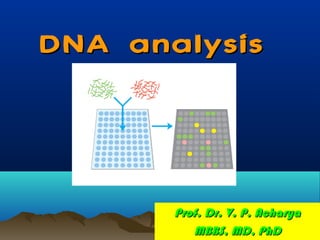
DNA analysisDNA analysis
Prof. Dr. V. P. AcharyaProf. Dr. V. P. Acharya
MBBS, MD, PhDMBBS, MD, PhD
• Can take many approaches from simple
quantification to complete sequence
• Common forms of analysis are
– size of DNA - electrophoresis
– homology of DNA - blotting, PCR
– arrangement of DNA - blotting, PCR,
sequencing
Blot transfer techniquesBlot transfer techniques
• Southern blot– DNA
• Northern blot– RNA
• Western blot– Protein
• Technique to visualise specific DNA, RNA
and Protein among other molecules
Southern BlotSouthern Blot
• E. M. Southern– 1976
• Useful for quantitating a specific gene
• Know mutation in the gene
• DNA extracted
• Digested with restriction endonucleases
• Fragments separated by gel
electrophoresis
• After a suitable time, DNA denatured by
mild alkali to ssDNA
• DNA transferred to nitrocellulose
membrane (Blot)
• Paper exposed to cDNA probes
• Paper exposed to X-ray– specific bands
seen
Application of Southern blotApplication of Southern blot
• Mutant genes detected e.g. HbS, Cystic
fibrosis, PKU, Viral DNA
• Forensic purpose
• RFLP for pathological disease
• Confirmation of DNA cloning results
Northern BlotNorthern Blot
• Size and quantitate specific RNA molecule
• Alkali not used
• cDNA probes are used- RNA-DNA
Hybridisation
• Similar to Southern blot
Application:
Detection of gene expression in a tissue
Western BlotWestern Blot
• Size and quantitate specific protein
molecule
• No complementary substance required
Application:
Detection of HIV viral proteins- confirmatory
test
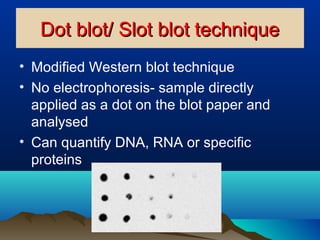
Dot blot/ Slot blot techniqueDot blot/ Slot blot technique
• Modified Western blot technique
• No electrophoresis- sample directly
applied as a dot on the blot paper and
analysed
• Can quantify DNA, RNA or specific
proteins
Restriction Fragment length PolymorphismRestriction Fragment length Polymorphism
• Variation in DNA sequence–
Polymorphism
• Occurs once every 500 nucleotides &107
times per genome
• Normally takes place in non-coding
regions
• These variations cause variation in the
restriction sites and thus length of
restriction fragments
• Inherited difference in the pattern of restriction sites- RFLP
Application of RFLPApplication of RFLP
• Detects genetic defects in parents and
fetal tissues e.g. sickle cell anaemia,
Retinoblastoma, Alzeihmer’s disease
• Forensic medicine– DNA fingerprinting
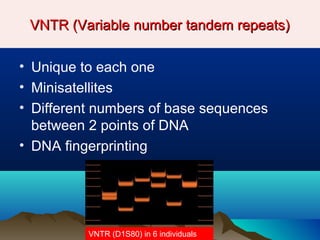
VNTR (Variable number tandem repeats)VNTR (Variable number tandem repeats)
• Unique to each one
• Minisatellites
• Different numbers of base sequences
between 2 points of DNA
• DNA fingerprinting
VNTR (D1S80) in 6 individuals
Microsatellites/ Simple tandemMicrosatellites/ Simple tandem
repeats (STR)repeats (STR)
• 2-3 nucleotides
• Evenly distributed throughout the genome
• More preferred over VNTR
• Can be identified by PCR
DNA SequencingDNA Sequencing
• Maxam Gilbert technique
• Sanger’s method-
interrupted enzymatic
cleavage
• Automated DNA sequencing
• DNA chips- Microarray
P C R
Polymerase Chain reaCtionPolymerase Chain reaCtion
• Karry Mullis– 1994
• Works like a photocopier
• PCR is a technique that takes a specific
sequence of DNA of small amounts and
amplifies it to be used for further testing.
PCR targetsPCR targets
The targets in PCR are the sequences of DNA
on each end of the region of interest, which can
be a complete gene or small sequence.
The number of bases in the targets can vary.
TTAAGGCTCGA . . . . AATTGGTTAA
The . . . . Represents the middle DNA sequence,
and does not have to be known to replicate it.
Requisites for PCRRequisites for PCR
• DNA nucleotides, the building blocks for the new
DNA
• Template DNA, the DNA sequence that you
want to amplify
• Primers, single-stranded DNAs between 20 and
50 nucleotides long (oligonucleotides) that are
complementary to a short region on either side
of the template DNA
• DNA polymerase (Taq Polymerase, Tth
polymerase), a heat stable enzyme that drives,
or catalyzes, the synthesis of new DNA
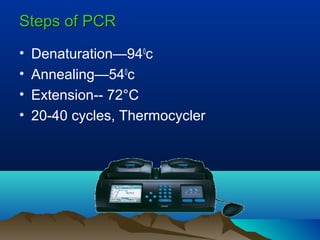
Steps of PCRSteps of PCR
• Denaturation—940
c
• Annealing—540
c
• Extension-- 72°C
• 20-40 cycles, Thermocycler
Exponential increase in the no. of copies of DNAExponential increase in the no. of copies of DNA
3 stages in each cycle of PCR3 stages in each cycle of PCR
It can’t go on infinitelyIt can’t go on infinitely
• Saturation
• Competition for primers
• Rapid cycling- less non-
specific products
• Size matters- primer
length ideal between 18-
25bp
• Small length DNA should
be chosen to be copied
Variations of PCRVariations of PCR
• RT-PCR
• Nested PCR
• Real-time PCR
• Multiplex PCR
Applications of PCRApplications of PCR
• Clinical diagnosis
 Prenatal diagnosis
 Retroviral infections
 Bacterial infections
 cancers
• DNA sequencing
• Comparative studies of genome
• Forensic medicine
Other forms of target amplificationsOther forms of target amplifications
• Transcription-based amplification method
• Strand displacement amplification
• Loop-mediated amplification
• Whole genome and whole transcriptome
amplification
www.vpacharya.com

DNA analysis

  • 1.
    DNA analysisDNA analysis Prof.Dr. V. P. AcharyaProf. Dr. V. P. Acharya MBBS, MD, PhDMBBS, MD, PhD
  • 2.
    • Can takemany approaches from simple quantification to complete sequence • Common forms of analysis are – size of DNA - electrophoresis – homology of DNA - blotting, PCR – arrangement of DNA - blotting, PCR, sequencing
  • 3.
    Blot transfer techniquesBlottransfer techniques • Southern blot– DNA • Northern blot– RNA • Western blot– Protein • Technique to visualise specific DNA, RNA and Protein among other molecules
  • 4.
    Southern BlotSouthern Blot •E. M. Southern– 1976 • Useful for quantitating a specific gene • Know mutation in the gene
  • 5.
    • DNA extracted •Digested with restriction endonucleases • Fragments separated by gel electrophoresis • After a suitable time, DNA denatured by mild alkali to ssDNA • DNA transferred to nitrocellulose membrane (Blot) • Paper exposed to cDNA probes • Paper exposed to X-ray– specific bands seen
  • 6.
    Application of SouthernblotApplication of Southern blot • Mutant genes detected e.g. HbS, Cystic fibrosis, PKU, Viral DNA • Forensic purpose • RFLP for pathological disease • Confirmation of DNA cloning results
  • 7.
    Northern BlotNorthern Blot •Size and quantitate specific RNA molecule • Alkali not used • cDNA probes are used- RNA-DNA Hybridisation • Similar to Southern blot Application: Detection of gene expression in a tissue
  • 8.
    Western BlotWestern Blot •Size and quantitate specific protein molecule • No complementary substance required Application: Detection of HIV viral proteins- confirmatory test
  • 9.
    Dot blot/ Slotblot techniqueDot blot/ Slot blot technique • Modified Western blot technique • No electrophoresis- sample directly applied as a dot on the blot paper and analysed • Can quantify DNA, RNA or specific proteins
  • 10.
    Restriction Fragment lengthPolymorphismRestriction Fragment length Polymorphism • Variation in DNA sequence– Polymorphism • Occurs once every 500 nucleotides &107 times per genome • Normally takes place in non-coding regions • These variations cause variation in the restriction sites and thus length of restriction fragments • Inherited difference in the pattern of restriction sites- RFLP
  • 11.
    Application of RFLPApplicationof RFLP • Detects genetic defects in parents and fetal tissues e.g. sickle cell anaemia, Retinoblastoma, Alzeihmer’s disease • Forensic medicine– DNA fingerprinting
  • 12.
    VNTR (Variable numbertandem repeats)VNTR (Variable number tandem repeats) • Unique to each one • Minisatellites • Different numbers of base sequences between 2 points of DNA • DNA fingerprinting VNTR (D1S80) in 6 individuals
  • 13.
    Microsatellites/ Simple tandemMicrosatellites/Simple tandem repeats (STR)repeats (STR) • 2-3 nucleotides • Evenly distributed throughout the genome • More preferred over VNTR • Can be identified by PCR
  • 14.
    DNA SequencingDNA Sequencing •Maxam Gilbert technique • Sanger’s method- interrupted enzymatic cleavage • Automated DNA sequencing • DNA chips- Microarray
  • 15.
  • 16.
    Polymerase Chain reaCtionPolymeraseChain reaCtion • Karry Mullis– 1994 • Works like a photocopier • PCR is a technique that takes a specific sequence of DNA of small amounts and amplifies it to be used for further testing.
  • 17.
    PCR targetsPCR targets Thetargets in PCR are the sequences of DNA on each end of the region of interest, which can be a complete gene or small sequence. The number of bases in the targets can vary. TTAAGGCTCGA . . . . AATTGGTTAA The . . . . Represents the middle DNA sequence, and does not have to be known to replicate it.
  • 18.
    Requisites for PCRRequisitesfor PCR • DNA nucleotides, the building blocks for the new DNA • Template DNA, the DNA sequence that you want to amplify • Primers, single-stranded DNAs between 20 and 50 nucleotides long (oligonucleotides) that are complementary to a short region on either side of the template DNA • DNA polymerase (Taq Polymerase, Tth polymerase), a heat stable enzyme that drives, or catalyzes, the synthesis of new DNA
  • 19.
    Steps of PCRStepsof PCR • Denaturation—940 c • Annealing—540 c • Extension-- 72°C • 20-40 cycles, Thermocycler
  • 21.
    Exponential increase inthe no. of copies of DNAExponential increase in the no. of copies of DNA
  • 22.
    3 stages ineach cycle of PCR3 stages in each cycle of PCR
  • 23.
    It can’t goon infinitelyIt can’t go on infinitely • Saturation • Competition for primers • Rapid cycling- less non- specific products • Size matters- primer length ideal between 18- 25bp • Small length DNA should be chosen to be copied
  • 24.
    Variations of PCRVariationsof PCR • RT-PCR • Nested PCR • Real-time PCR • Multiplex PCR
  • 25.
    Applications of PCRApplicationsof PCR • Clinical diagnosis  Prenatal diagnosis  Retroviral infections  Bacterial infections  cancers • DNA sequencing • Comparative studies of genome • Forensic medicine
  • 26.
    Other forms oftarget amplificationsOther forms of target amplifications • Transcription-based amplification method • Strand displacement amplification • Loop-mediated amplification • Whole genome and whole transcriptome amplification
  • 27.

Editor's Notes

  • #19 Tth- capability to act on both DNA polymerase and reverse transcription activities