construction of gene library
By
Achudhan.D
Introduction
 In humans, approximately 25,000 genes exit
among the 3 billion base pairs of DNA in the
genome.
 To study anyone of these genes, a researcher
first isolates it from all of the other genes in an
organisms DNA.
 One isolation method has a relatively long
history and involves the construction of a DNA
library
 When a gene is identified and copied, it is said
to have been “cloned”
What is genomic library?
• “A genomic library is a collection of bacteria which have
been genetically engineered to hold the entire DNA of an
organism”
• A genomic library is a collection of genes or DNA sequences
created using molecular cloning.
• These libraries are constructed using clones of bacteria or
yeast that contain vectors into which fragments of partially
digested DNA have been inserted.
• These bacteria and yeast are subsequently grown in culture
and when these microorganisms replicate their genome, they
also replicate the vector genome contained within them, that
is, they replicate
Continue.
• DNA fragments that had been inserted in vectors
producing clones of the orignal genome.
• This collection of clones, in theory, contains all
sequences found in the original source, including the
sequence of interest.
• Genomic libraries can be constructed using various
hosts like plasmids, bacteriophage lambdas , cosmids,
YACs and many more.
GENOMIC LIBRARY
What are DNA libraries?
A DNA library is a collection of clones of DNA
designed so that there is a high probility of
finding any particular piece of the source DNA
in the collection.
What are the types of DNA libraries?
The two types o DNA libraries are:
1.GENOMIC LIBRARY:
The genomic library contains DNA fragments
representing entire genome of an organism.
2.cDNA LIBRARY:
• The cDNA library contains only complementry
DNA molecules synthesized from mRNA
molecules in a cell.
For the construction of DNA Library
 Size of the gene
 Capacity of the vector
 Molecular tools
 Vectors
Steps of Genomic Library
construction
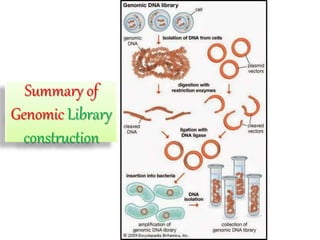
 Isolation of DNA from cells
 Digestion into small fragments
 Introduction into suitable vectors
 Insertion into bacteria
 DNA isolation
 Collection of Genomic DNA library
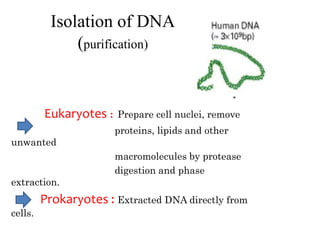
Isolation of DNA
(purification)
Eukaryotes : Prepare cell nuclei, remove
proteins, lipids and other
unwanted
macromolecules by protease
digestion and phase
extraction.
Prokaryotes : Extracted DNA directly from
cells.
Digestion into small
fragments
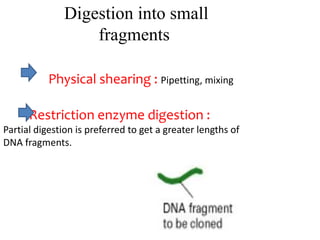
Physical shearing : Pipetting, mixing
Restriction enzyme digestion :
Partial digestion is preferred to get a greater lengths of
DNA fragments.
Introduction into suitable vectors
 Each fragment is different
and have a unique DNA
sequence
 Inserted into suitable
vectors including plasmids
and bacteriophage vectors.
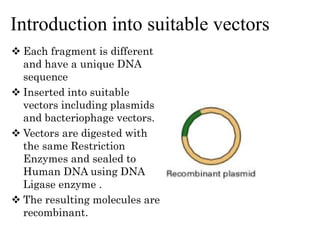
 Vectors are digested with
the same Restriction
Enzymes and sealed to
Human DNA using DNA
Ligase enzyme .
 The resulting molecules are
recombinant.
Insertion into Bacteria
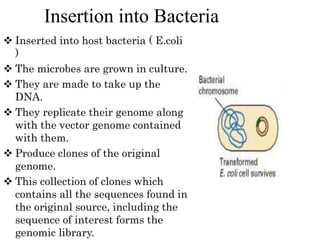
 Inserted into host bacteria ( E.coli
)
 The microbes are grown in culture.
 They are made to take up the
DNA.
 They replicate their genome along
with the vector genome contained
with them.
 Produce clones of the original
genome.
 This collection of clones which
contains all the sequences found in
the original source, including the
sequence of interest forms the
genomic library.
Multiplication and Production of
clones
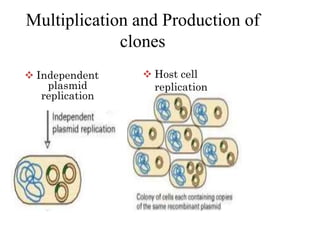
 Independent
plasmid
replication
 Host cell
replication
Summary of
Genomic Library
construction
What are the steps involved in the construction of
genomic library?
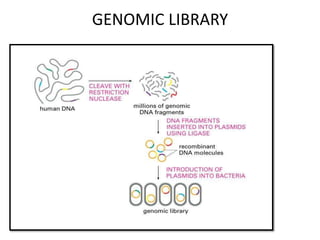
• To create a human genome library, a researcher
begins by extracting and purifying DNA from
human cell.
• The purified DNA consist of extremely long
strands.To begin working with DNA, the strands
must first be cut into manageable sizes.
• The DNA therefore is digested with restriction
enzymes which cut the DNA at specific
sequences. The restriction enzyme cut the DNA
into 1000s of smaller fragments, each of which
may contain one or more gene.
•The plasmids are digested with the restriction enzymes and then
sealed to human DNA using DNA ligase enzymethe resulting
molecules are “recombinanat”.
•The recombinant DNA molecule are added to bacteria,and the
bacteria are made to take up the DNA. When bacteria have taken up
the DNA, the entire collection of cells and DNA represents a human
genome library. The recombinant plasmids remain separate from the
bacteria’s own DNA, making it easy to extract again.
•Each fragment is different and have unique DNA sequence. To
create the library,each fragment must be inserted into loops of DNA
called plasmids. A plasmid is a type of vector that allows the DNA to
be shuttled in bacteria
What are the uses of Genomic
Library?
 Researchers can explore the genome of an organism
to learn more about genomic structure and function
 They can map the genome, identifying the locations
of specific genes.
 Helps to develop tests which can be used to locate
genetic variations including mutations
 Useful in Recombinant DNA Technology, helps to
genetically modify organisms and produce clones of
desired types.
 Genomic library construction is the first step in any
DNA sequencing projects.
 Genomic library helps in identification of the novel
pharmaceutically important genes.
Reference
• Dr R. C. Dubey, A textbook of Biotechnology, 5th edition, S. Chand
Publishing, 2014, Chapter 6, Techniques of Genetic Engineering
(Cloning Methods and DNA Analysis) Genomic Library, 98-131,
Chapter 7, Genomics and Proteomics, 158-180
• http://www.sumanasinc.com/webcontent/animations/content/d
nalibrary.html, Construction of Genomic Library, 2006
• http://www.slideshare.net/MariamNaseer/genomic-library,
Genomic library,
• http://www.slideshare.net/abdullahabobakr7/dna-library-
lecturegene-libraries-and-screening, Genomic library, cDNA
library and screening procedures
• http://www.yourgenome.org/facts/what-is-shotgun-sequencing,
shot gun sequencing, 2014
• https://en.wikipedia.org/wiki/Shotgun_sequencing, shotgun
sequencing, 2015
• https://en.wikipedia.org/wiki/Genomic_library, genomic library,
2015
Construction of gene library

Construction of gene library

  • 1.
    construction of genelibrary By Achudhan.D
  • 2.
    Introduction  In humans,approximately 25,000 genes exit among the 3 billion base pairs of DNA in the genome.  To study anyone of these genes, a researcher first isolates it from all of the other genes in an organisms DNA.  One isolation method has a relatively long history and involves the construction of a DNA library  When a gene is identified and copied, it is said to have been “cloned”
  • 3.
    What is genomiclibrary? • “A genomic library is a collection of bacteria which have been genetically engineered to hold the entire DNA of an organism” • A genomic library is a collection of genes or DNA sequences created using molecular cloning. • These libraries are constructed using clones of bacteria or yeast that contain vectors into which fragments of partially digested DNA have been inserted. • These bacteria and yeast are subsequently grown in culture and when these microorganisms replicate their genome, they also replicate the vector genome contained within them, that is, they replicate
  • 4.
    Continue. • DNA fragmentsthat had been inserted in vectors producing clones of the orignal genome. • This collection of clones, in theory, contains all sequences found in the original source, including the sequence of interest. • Genomic libraries can be constructed using various hosts like plasmids, bacteriophage lambdas , cosmids, YACs and many more.
  • 5.
  • 6.
    What are DNAlibraries? A DNA library is a collection of clones of DNA designed so that there is a high probility of finding any particular piece of the source DNA in the collection. What are the types of DNA libraries? The two types o DNA libraries are: 1.GENOMIC LIBRARY: The genomic library contains DNA fragments representing entire genome of an organism. 2.cDNA LIBRARY: • The cDNA library contains only complementry DNA molecules synthesized from mRNA molecules in a cell.
  • 7.
    For the constructionof DNA Library  Size of the gene  Capacity of the vector  Molecular tools  Vectors
  • 9.
    Steps of GenomicLibrary construction  Isolation of DNA from cells  Digestion into small fragments  Introduction into suitable vectors  Insertion into bacteria  DNA isolation  Collection of Genomic DNA library
  • 10.
    Isolation of DNA (purification) Eukaryotes: Prepare cell nuclei, remove proteins, lipids and other unwanted macromolecules by protease digestion and phase extraction. Prokaryotes : Extracted DNA directly from cells.
  • 11.
    Digestion into small fragments Physicalshearing : Pipetting, mixing Restriction enzyme digestion : Partial digestion is preferred to get a greater lengths of DNA fragments.
  • 12.
    Introduction into suitablevectors  Each fragment is different and have a unique DNA sequence  Inserted into suitable vectors including plasmids and bacteriophage vectors.  Vectors are digested with the same Restriction Enzymes and sealed to Human DNA using DNA Ligase enzyme .  The resulting molecules are recombinant.
  • 13.
    Insertion into Bacteria Inserted into host bacteria ( E.coli )  The microbes are grown in culture.  They are made to take up the DNA.  They replicate their genome along with the vector genome contained with them.  Produce clones of the original genome.  This collection of clones which contains all the sequences found in the original source, including the sequence of interest forms the genomic library.
  • 14.
    Multiplication and Productionof clones  Independent plasmid replication  Host cell replication
  • 15.
  • 16.
    What are thesteps involved in the construction of genomic library? • To create a human genome library, a researcher begins by extracting and purifying DNA from human cell. • The purified DNA consist of extremely long strands.To begin working with DNA, the strands must first be cut into manageable sizes. • The DNA therefore is digested with restriction enzymes which cut the DNA at specific sequences. The restriction enzyme cut the DNA into 1000s of smaller fragments, each of which may contain one or more gene.
  • 17.
    •The plasmids aredigested with the restriction enzymes and then sealed to human DNA using DNA ligase enzymethe resulting molecules are “recombinanat”. •The recombinant DNA molecule are added to bacteria,and the bacteria are made to take up the DNA. When bacteria have taken up the DNA, the entire collection of cells and DNA represents a human genome library. The recombinant plasmids remain separate from the bacteria’s own DNA, making it easy to extract again. •Each fragment is different and have unique DNA sequence. To create the library,each fragment must be inserted into loops of DNA called plasmids. A plasmid is a type of vector that allows the DNA to be shuttled in bacteria
  • 18.
    What are theuses of Genomic Library?  Researchers can explore the genome of an organism to learn more about genomic structure and function  They can map the genome, identifying the locations of specific genes.  Helps to develop tests which can be used to locate genetic variations including mutations  Useful in Recombinant DNA Technology, helps to genetically modify organisms and produce clones of desired types.  Genomic library construction is the first step in any DNA sequencing projects.  Genomic library helps in identification of the novel pharmaceutically important genes.
  • 19.
    Reference • Dr R.C. Dubey, A textbook of Biotechnology, 5th edition, S. Chand Publishing, 2014, Chapter 6, Techniques of Genetic Engineering (Cloning Methods and DNA Analysis) Genomic Library, 98-131, Chapter 7, Genomics and Proteomics, 158-180 • http://www.sumanasinc.com/webcontent/animations/content/d nalibrary.html, Construction of Genomic Library, 2006 • http://www.slideshare.net/MariamNaseer/genomic-library, Genomic library, • http://www.slideshare.net/abdullahabobakr7/dna-library- lecturegene-libraries-and-screening, Genomic library, cDNA library and screening procedures • http://www.yourgenome.org/facts/what-is-shotgun-sequencing, shot gun sequencing, 2014 • https://en.wikipedia.org/wiki/Shotgun_sequencing, shotgun sequencing, 2015 • https://en.wikipedia.org/wiki/Genomic_library, genomic library, 2015