APPLIED PHYSICS
 CODE : 07A1BS05
     I B.TECH
CSE, IT, ECE & EEE
       UNIT-3
NO. OF SLIDES : 24


                     1
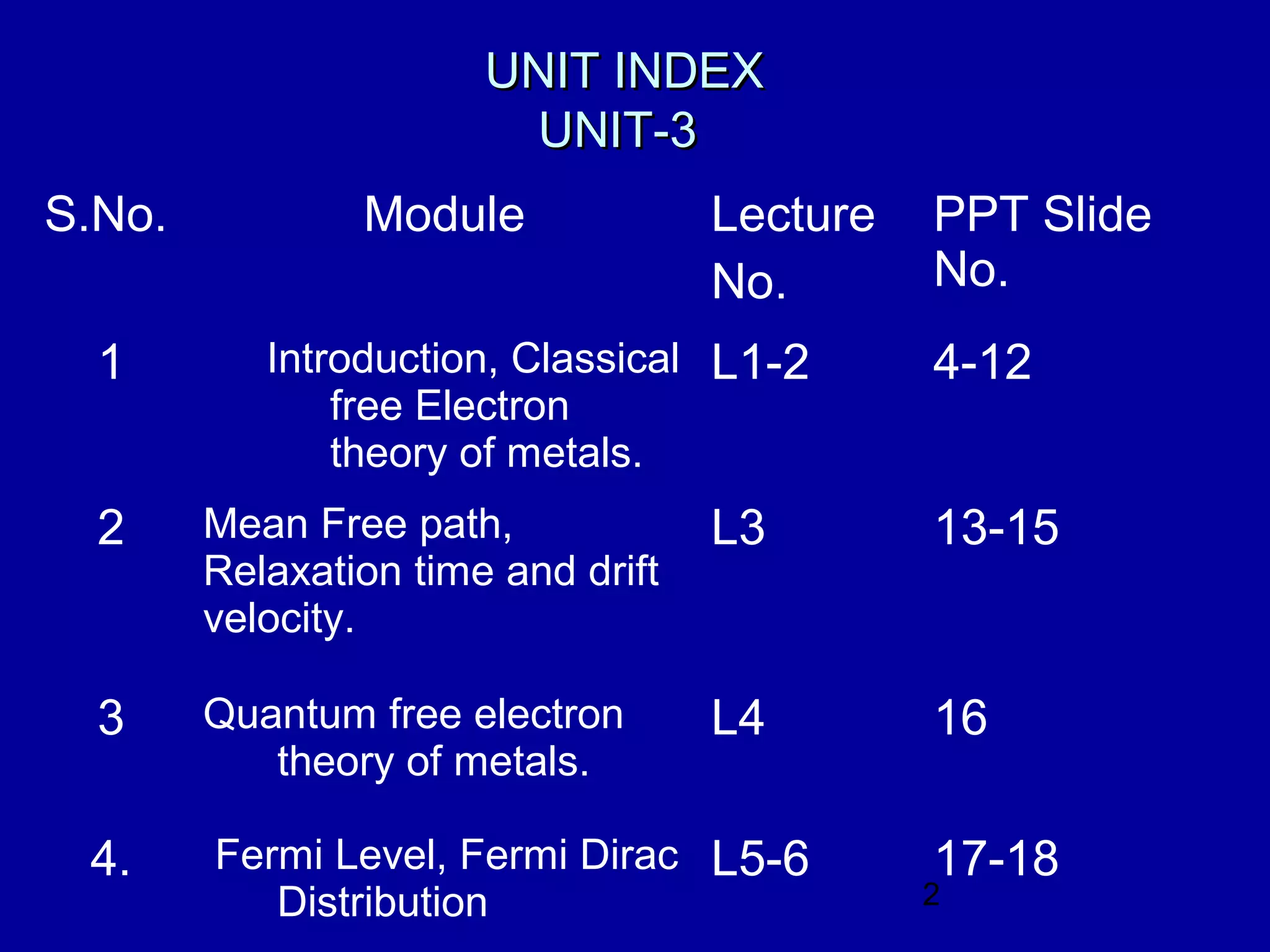
UNIT INDEX
                        UNIT-3
S.No.           Module              Lecture   PPT Slide
                                    No.       No.
  1        Introduction, Classical L1-2       4-12
               free Electron
               theory of metals.
  2     Mean Free path,             L3        13-15
        Relaxation time and drift
        velocity.

  3     Quantum free electron       L4        16
           theory of metals.

 4.     Fermi Level, Fermi Dirac L5-6         17-18
           Distribution                       2
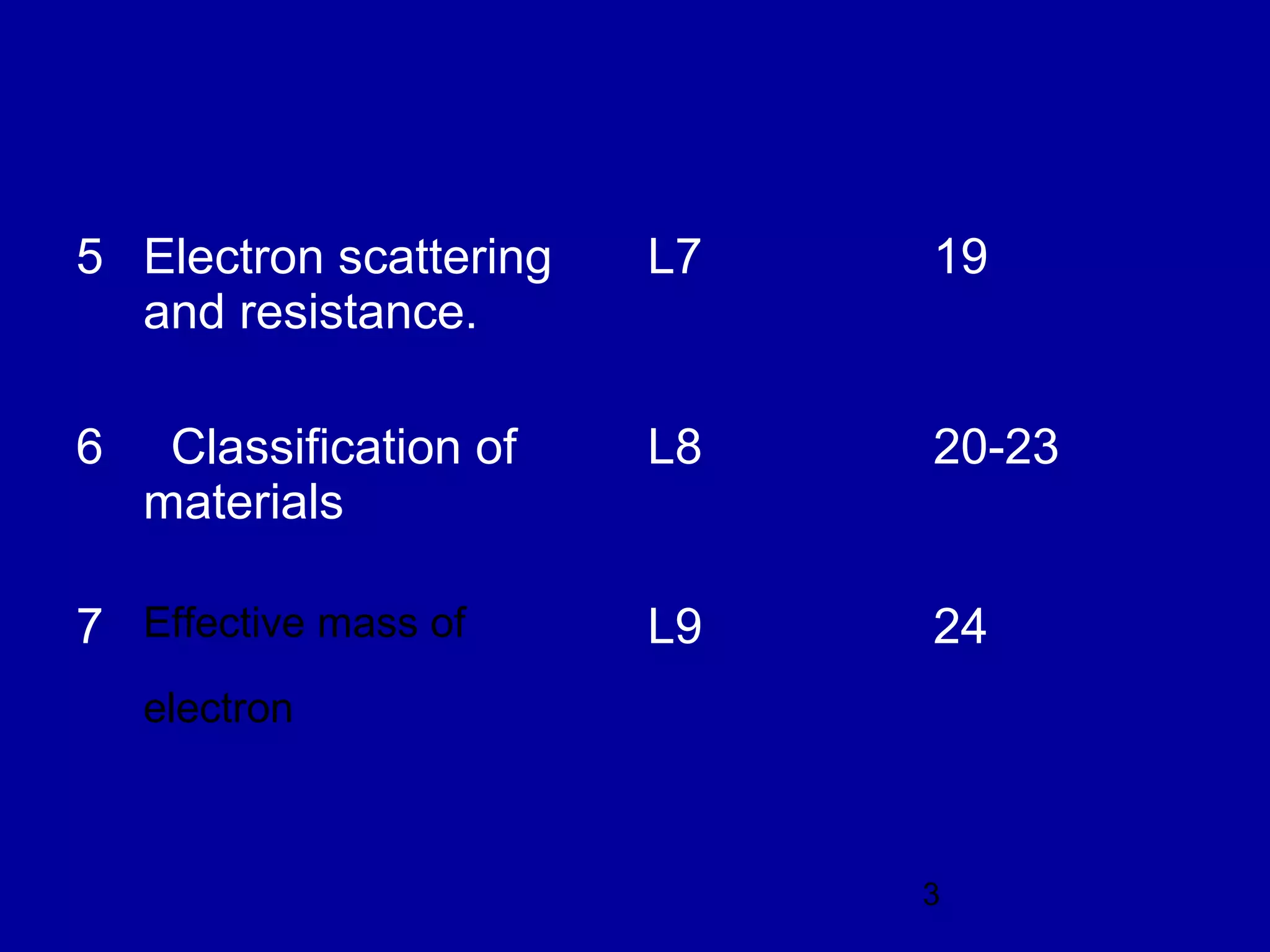
5 Electron scattering    L7   19
  and resistance.

6    Classification of   L8   20-23
    materials

7 Effective mass of      L9   24
    electron


                              3
INTRODUCTION
                             Lecture-1


  The electron theory of solids
aims to explain the structures and
properties of solids through their
       electronic structure.
The electron theory of solids has
  been developed in three main
              stages.      4
(i). The classical free electron theory:
Drude and Lorentz developed this theory in
   1900. According to this theory, the metals
   containing free electrons obey the laws of
   classical mechanics.
(ii). The Quantum free electron theory:
 Sommerfeld developed this theory during
   1928. According to this theory, the free
   electrons obey quantum laws. 5
(iii). The Zone theory:
    Bloch stated this theory in 1928.
  According to this theory, the free
  electrons move in a periodic field
  provided by the lattice. This theory
  is also called “Band theory of solids”.

                               6
The classical Free Electron Theory of
Metals (Drude - Lorentz theory of metals
                                                   Lecture-2

postulates :
(a). In an atom electrons revolue around the nucleus and
   a metal is composed of such atoms.
(b). The valence electrons of atoms are free to move
   about the whole volume of the metals like the
   molecules of a perfect gas in a container. The
   collection of valence electrons
  from all the atoms in a given piece of metal forms
   electrons gas. It is free to move throughout the
   volume of the metal


                                          7
(c) These free electrons move in random directions and
   collide with either positive ions fixed to the lattice or
   other free electrons. All the collisions are elastic i.e.,
   there is no loss of energy.
(d). The movements of free electrons obey the laws of
   the classical kinetic theory of gases.
(e). The electron velocities in a metal obey the classical
   Maxwell – Boltzmann distribution of velocities.


                                              8
(f). The electrons move in a completely
  uniform potential field due to ions fixed in
  the lattice.

(g). When an electric field is applied to the
  metal, the free electrons are accelerated in
  the direction opposite to the direction of
  applied electric field.
                                    9
Success of classical free electron
                theory:
(1). It verifies Ohm’s law.

(2). It explains the electrical and thermal
  conductivities of metals.

(3). It derives Wiedemann – Franz law. (i.e., the
  relation between electrical conductivity and
  thermal conductivity)

(4). It explains optical properties of metalsl.
                                        10
Drawbacks of classical free electron
             theory:
1. The phenomena such a photoelectric effect,
   Compton effect and the black body radiation
   couldn’t be explained by classical free
   electron theory.
2. According to the classical free electron
   theory the value of specific heat of metals is
   given by 4.5Ru is the Universal gas constant
   whereas the experimental value is nearly
   equal to 3Ru. Also according to this theory
   the value of electronic specific heat is equal
   to 3/2Ru while the actual value is about 0.01Ru
                                        11
3.Electrical conductivity of semiconductor or
    insulators couldn’t be explained using this
    model.
4. Though K/σT is a constant (Wiedemann –
    Franz Law) according to the Classical free
    electron theory, it is not a constant at low
    temperature.
5. Ferromagnetism couldn’t be explained by this
    theory. The theoretical value of paramagnetic
    susceptibility is greater than the experimental
    value.                              12
Mean free path              Lecture-3


The average distance traveled by an electron
 between two successive collisions inside a
 metal in the presence of applied field is known
 as mean free path.


                                     13
Relaxation Time

The time taken by the electron to
 reach equilibrium position from
 its disturbed position in the
 presence of an electric field is
 called relaxation time.

                          14
Drift velocity

• In the presence of electric field, in
  addition to random velocity there is an
  additional net velocity associated with
  electrons called drift velocity.
• Due to drift velocity, the electrons with
  negative charge move opposie to the
  field direction.

                                15
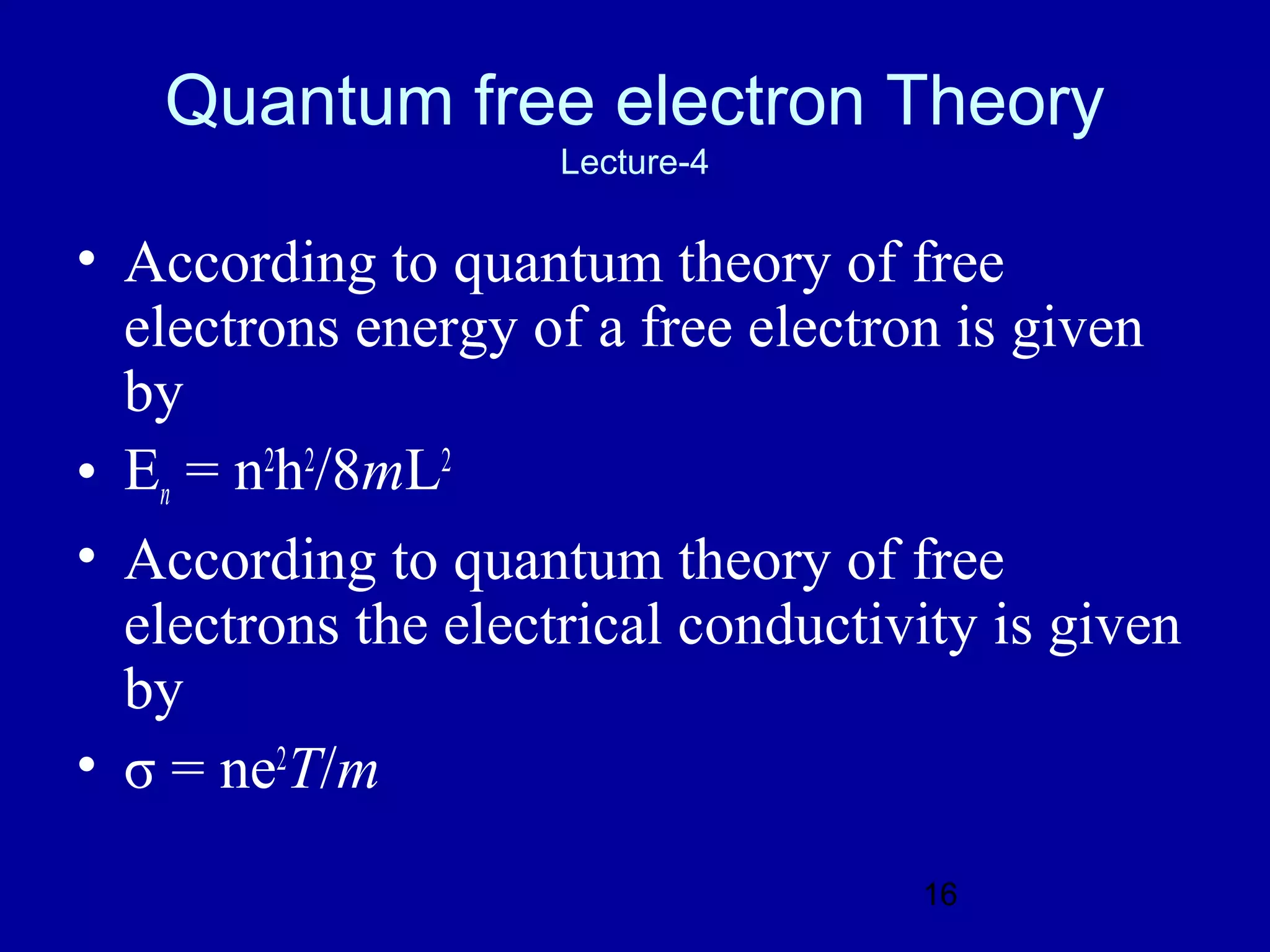
Quantum free electron Theory
                     Lecture-4

• According to quantum theory of free
  electrons energy of a free electron is given
  by
• En = n2h2/8mL2
• According to quantum theory of free
  electrons the electrical conductivity is given
  by
• σ = ne2T/m

                                    16
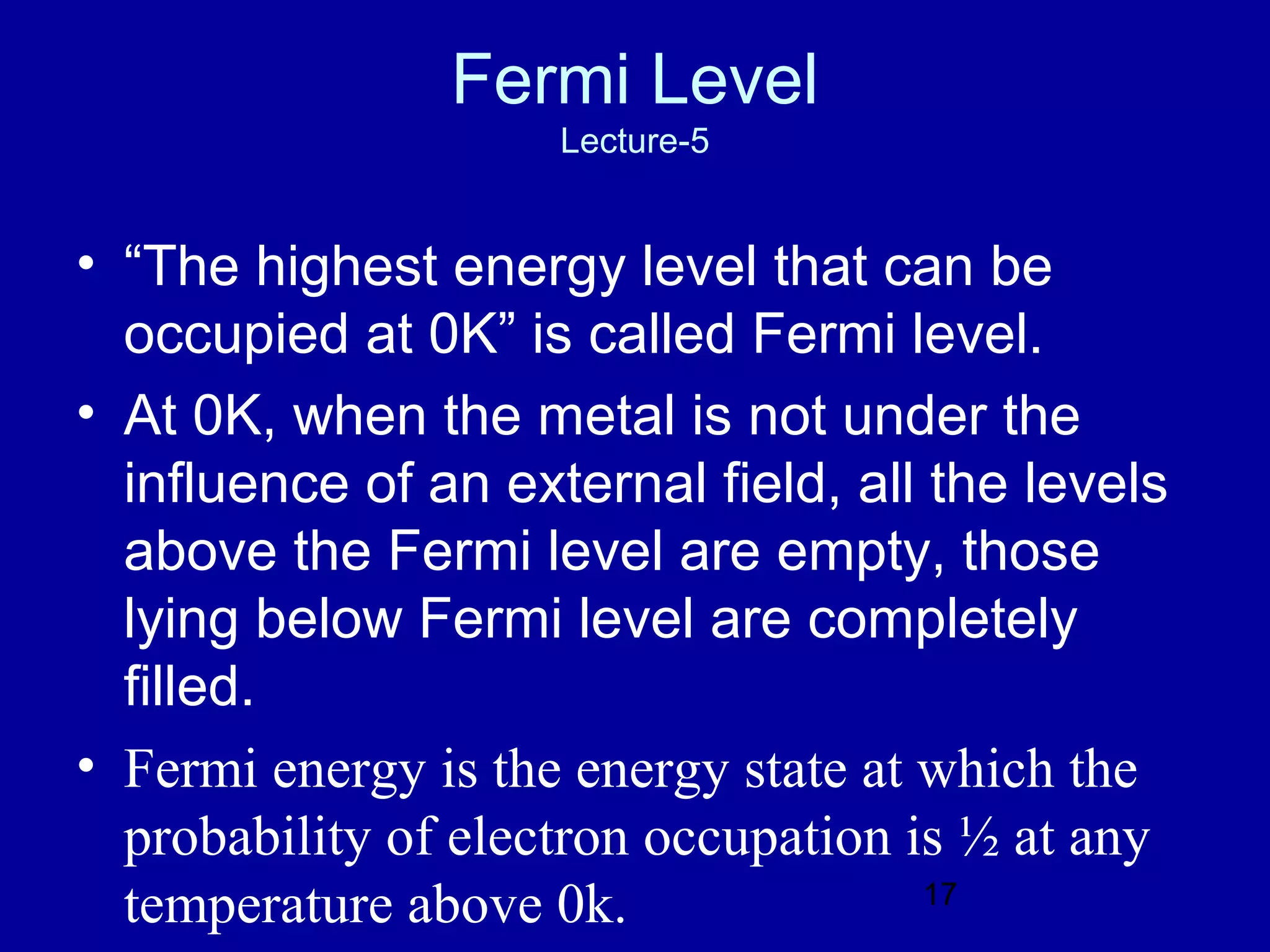
Fermi Level
                     Lecture-5


• “The highest energy level that can be
  occupied at 0K” is called Fermi level.
• At 0K, when the metal is not under the
  influence of an external field, all the levels
  above the Fermi level are empty, those
  lying below Fermi level are completely
  filled.
• Fermi energy is the energy state at which the
  probability of electron occupation is ½ at any
  temperature above 0k.               17
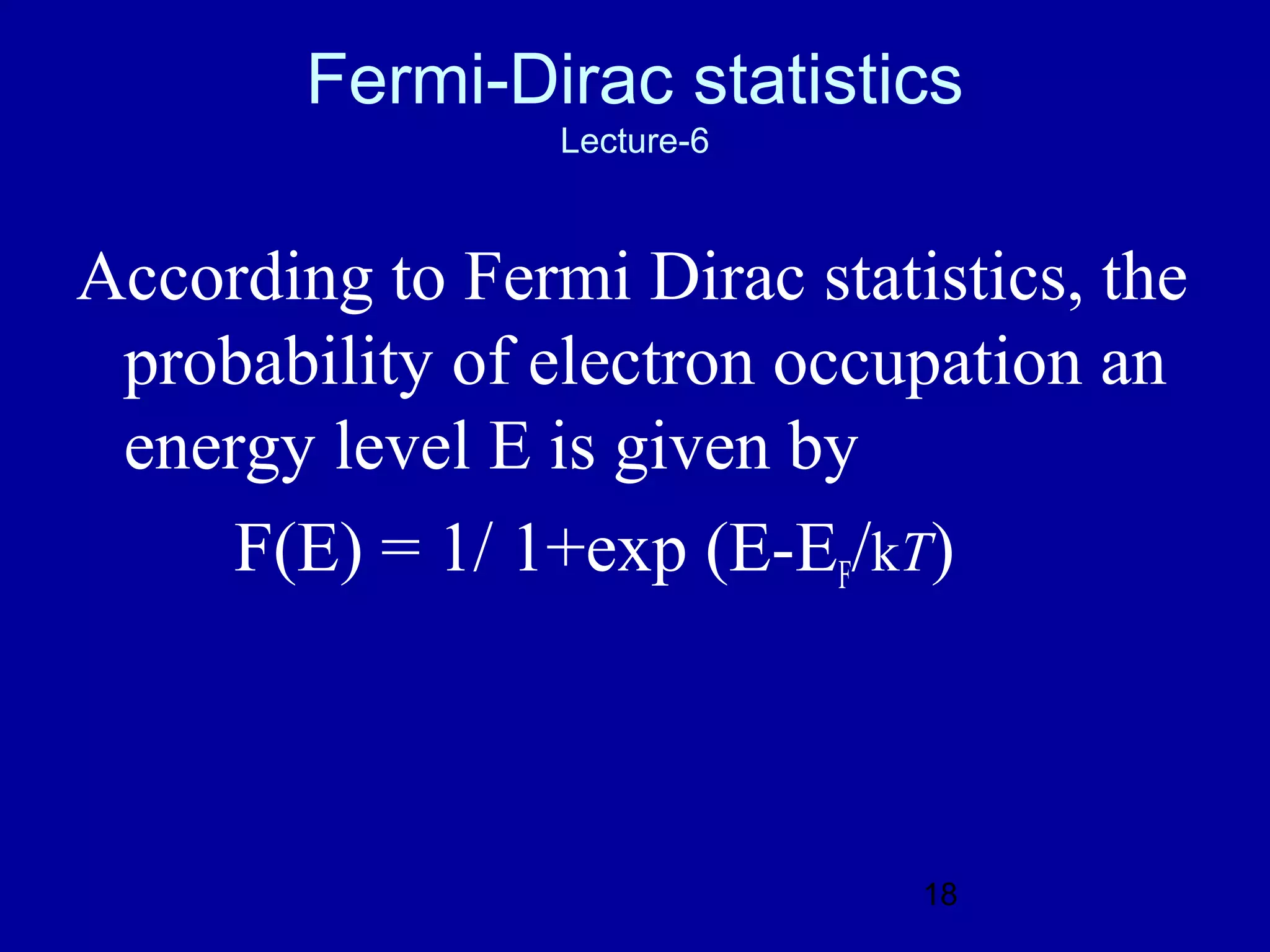
Fermi-Dirac statistics
                 Lecture-6


According to Fermi Dirac statistics, the
 probability of electron occupation an
 energy level E is given by
     F(E) = 1/ 1+exp (E-EF/kT)


                              18
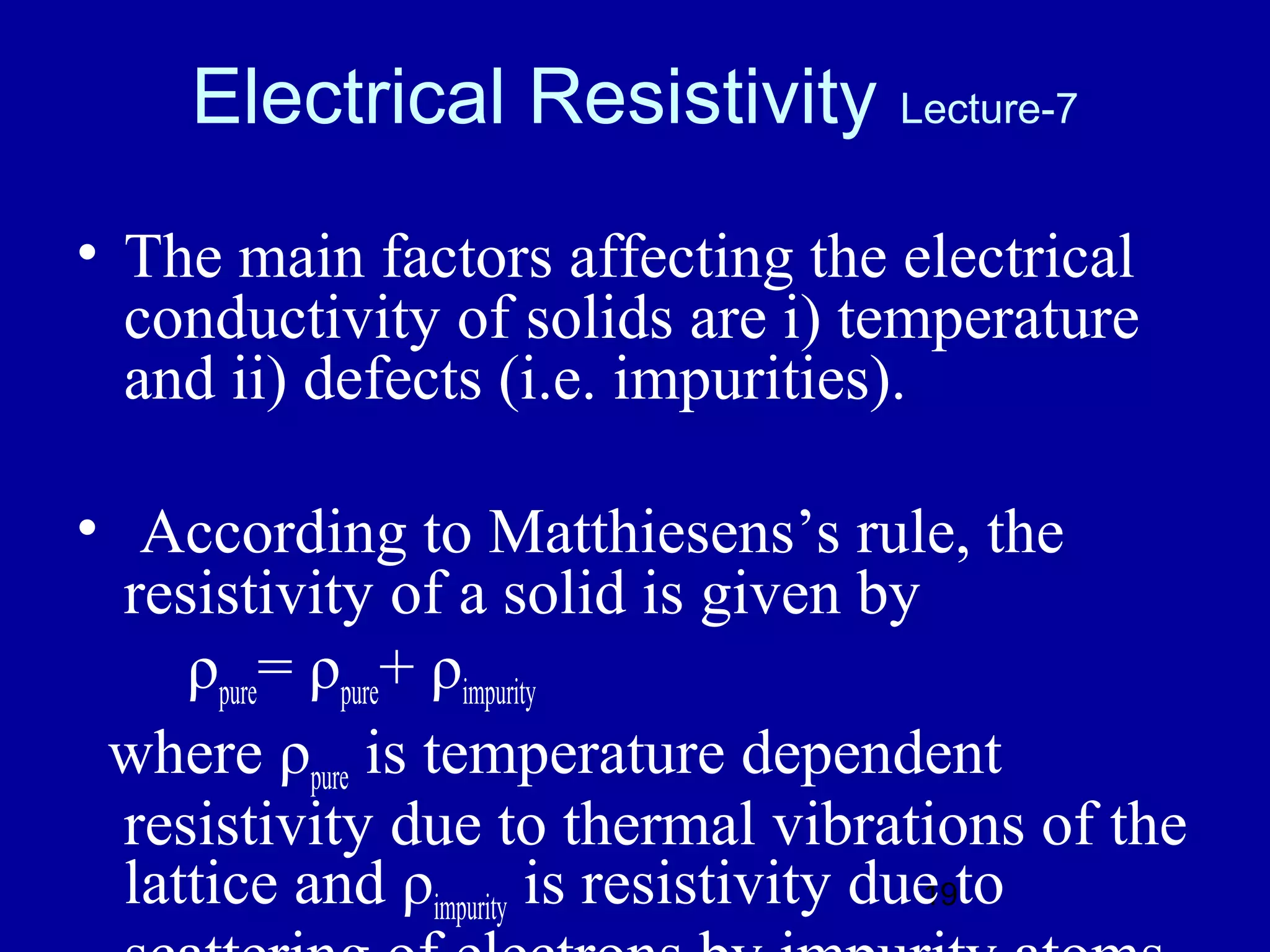
Electrical Resistivity Lecture-7
• The main factors affecting the electrical
  conductivity of solids are i) temperature
  and ii) defects (i.e. impurities).

• According to Matthiesens’s rule, the
  resistivity of a solid is given by
     ρpure= ρpure+ ρimpurity
 where ρpure is temperature dependent
  resistivity due to thermal vibrations of the
  lattice and ρimpurity is resistivity due to
                                         19
CLASSIFICATION OF MATERIALS
               Lecture-8


• Based on ‘band theory’, solids
   can be classified into three
   categories, namely,
1. insulators,
2. semiconductors &
3. conductors.
                           20
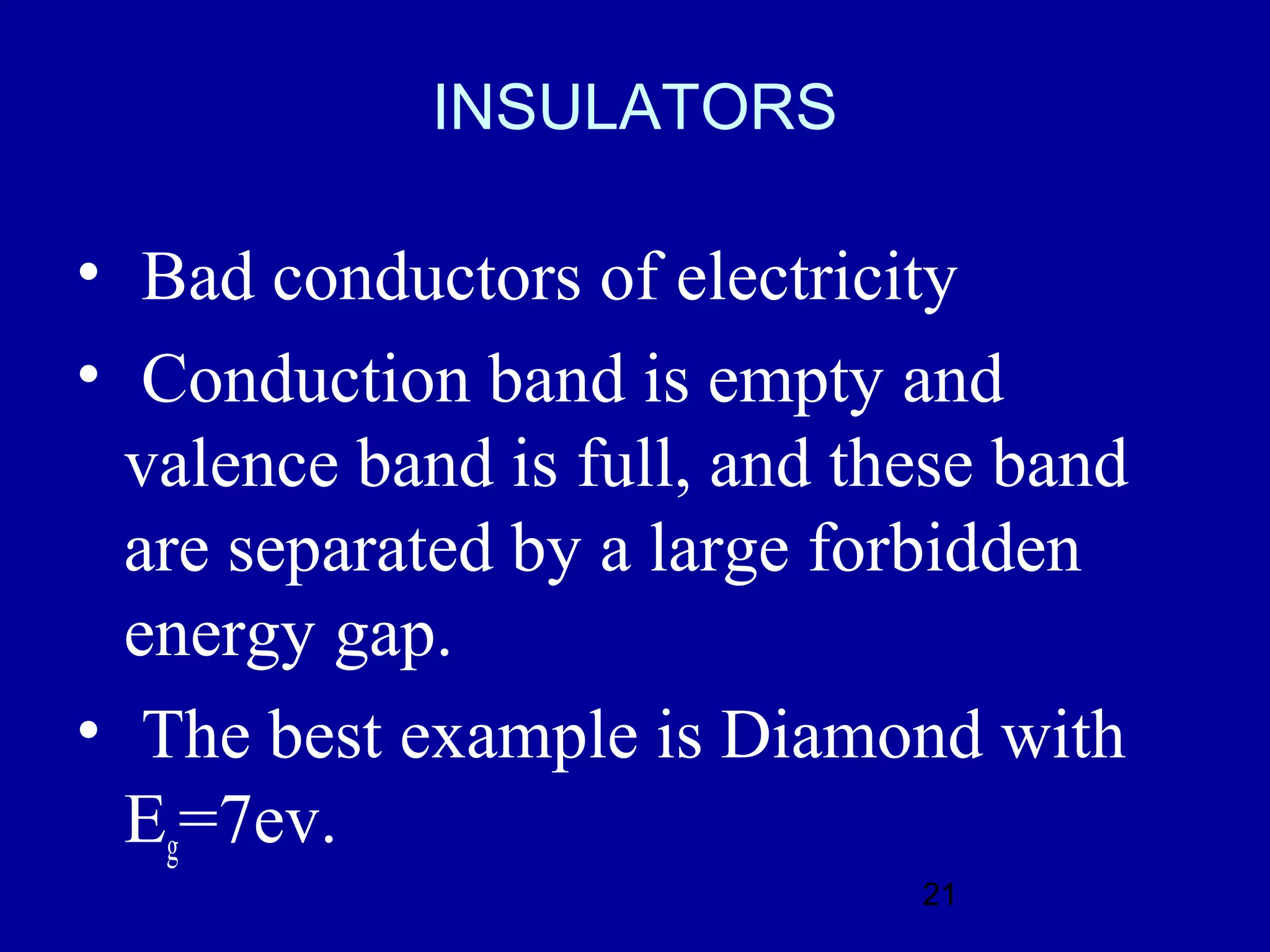
INSULATORS

• Bad conductors of electricity
• Conduction band is empty and
  valence band is full, and these band
  are separated by a large forbidden
  energy gap.
• The best example is Diamond with
  Eg=7ev.
                              21
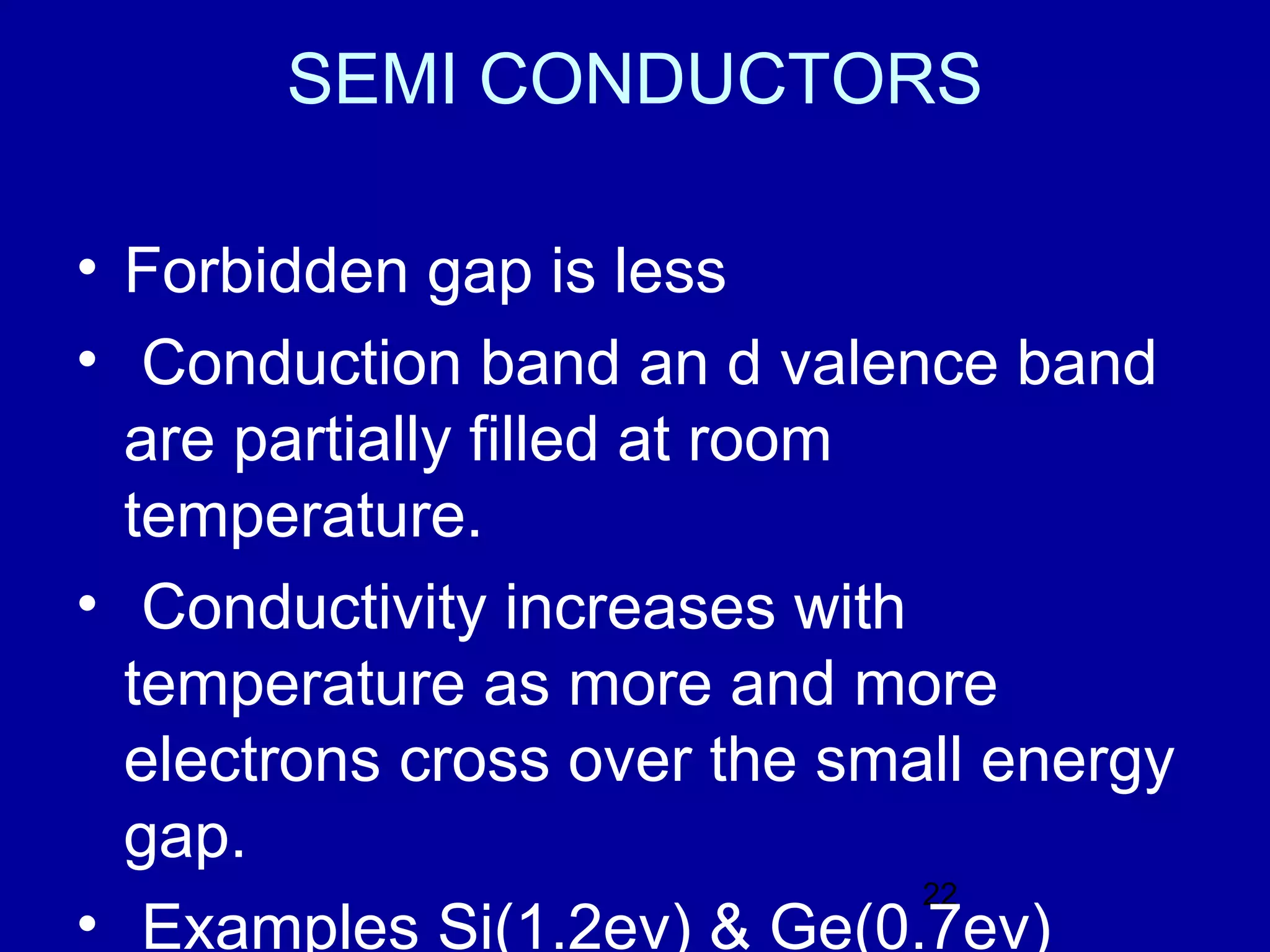
SEMI CONDUCTORS

• Forbidden gap is less
• Conduction band an d valence band
  are partially filled at room
  temperature.
• Conductivity increases with
  temperature as more and more
  electrons cross over the small energy
  gap.
                               22
• Examples Si(1.2ev) & Ge(0.7ev)
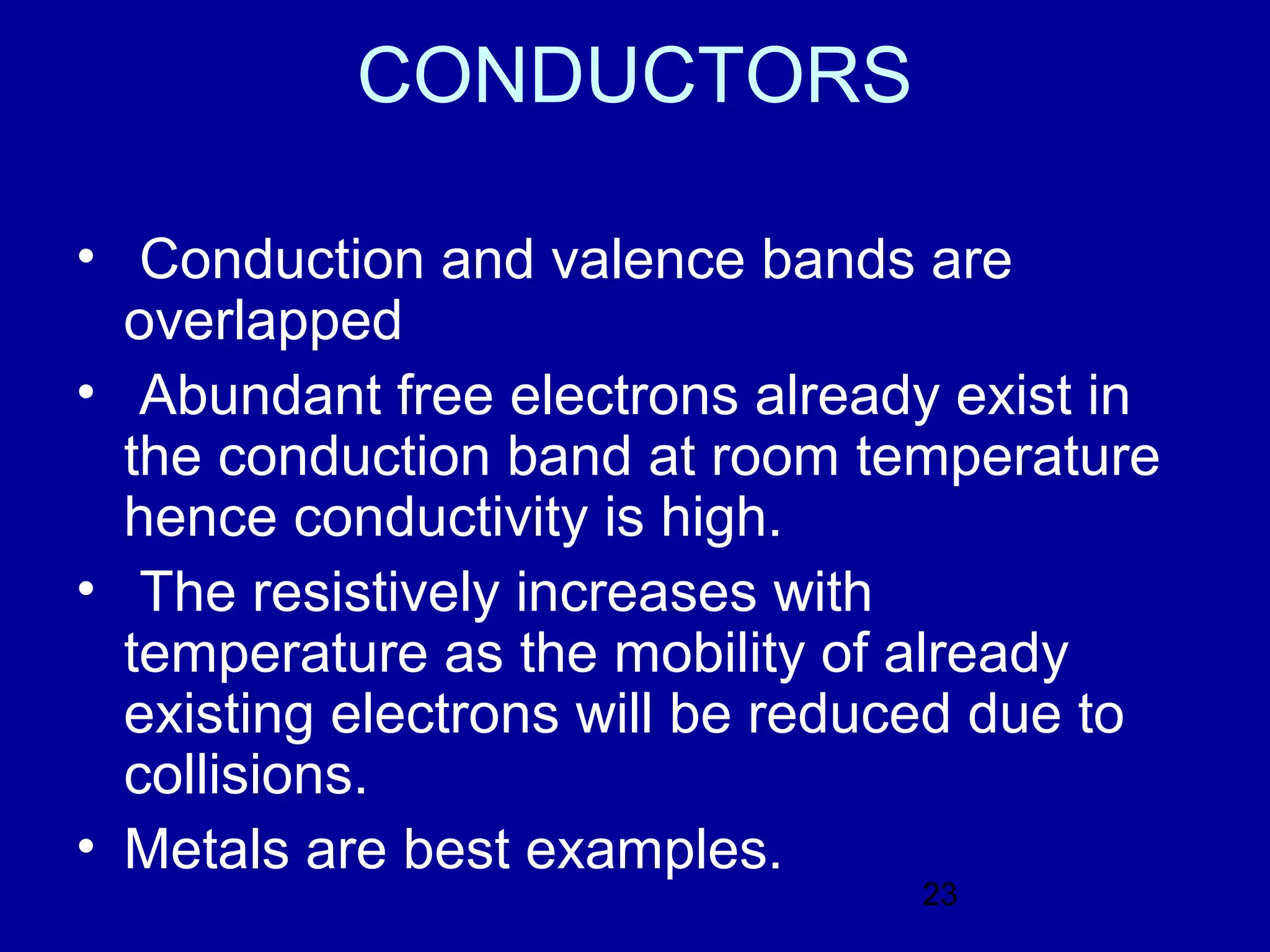
CONDUCTORS

• Conduction and valence bands are
  overlapped
• Abundant free electrons already exist in
  the conduction band at room temperature
  hence conductivity is high.
• The resistively increases with
  temperature as the mobility of already
  existing electrons will be reduced due to
  collisions.
• Metals are best examples.
                                 23
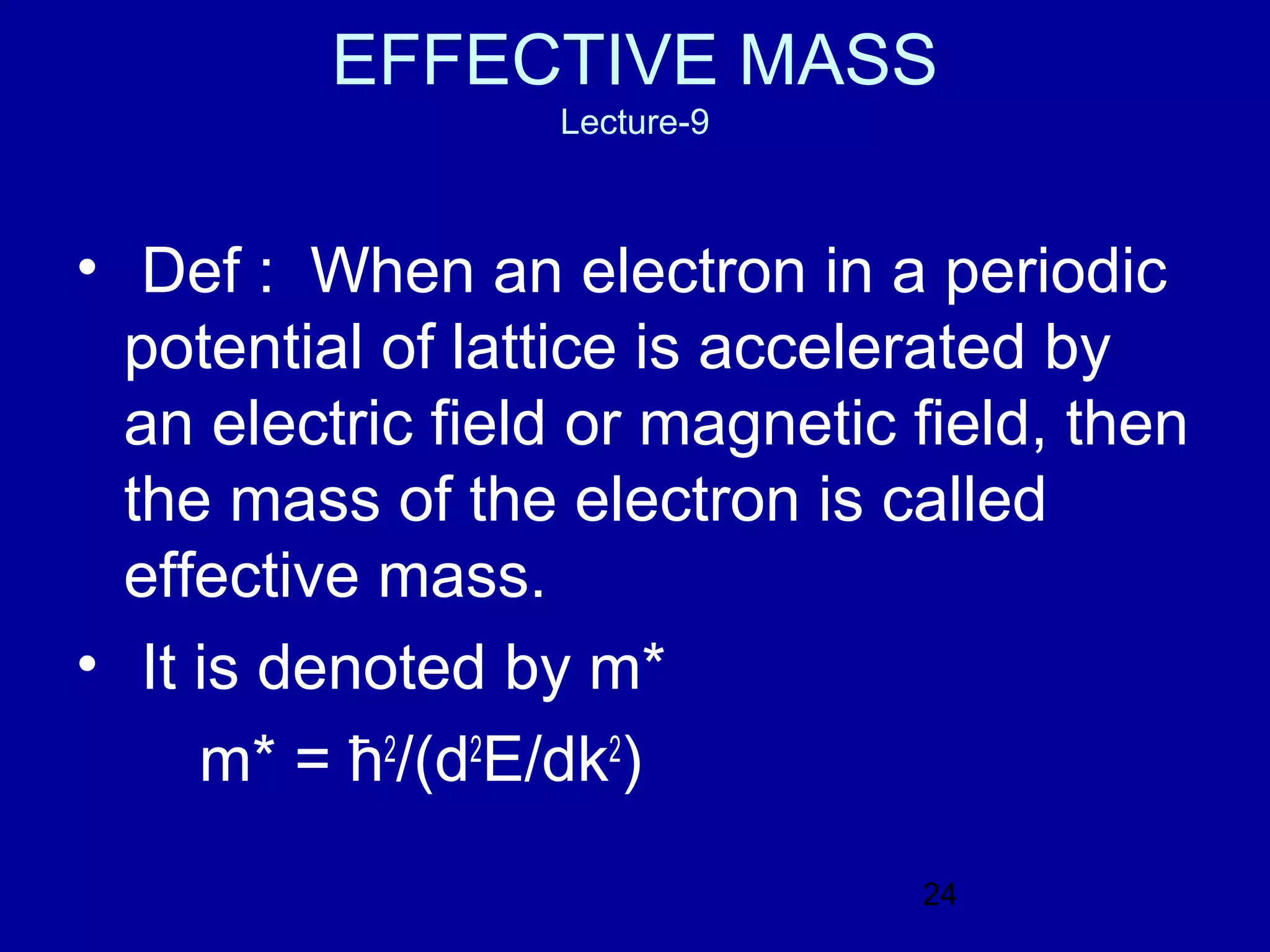
EFFECTIVE MASS
                  Lecture-9


• Def : When an electron in a periodic
  potential of lattice is accelerated by
  an electric field or magnetic field, then
  the mass of the electron is called
  effective mass.
• It is denoted by m*
     m* = ћ2/(d2E/dk2)
                                24

Unit 3

  • 1.
    APPLIED PHYSICS CODE: 07A1BS05 I B.TECH CSE, IT, ECE & EEE UNIT-3 NO. OF SLIDES : 24 1
  • 2.
    UNIT INDEX UNIT-3 S.No. Module Lecture PPT Slide No. No. 1 Introduction, Classical L1-2 4-12 free Electron theory of metals. 2 Mean Free path, L3 13-15 Relaxation time and drift velocity. 3 Quantum free electron L4 16 theory of metals. 4. Fermi Level, Fermi Dirac L5-6 17-18 Distribution 2
  • 3.
    5 Electron scattering L7 19 and resistance. 6 Classification of L8 20-23 materials 7 Effective mass of L9 24 electron 3
  • 4.
    INTRODUCTION Lecture-1 The electron theory of solids aims to explain the structures and properties of solids through their electronic structure. The electron theory of solids has been developed in three main stages. 4
  • 5.
    (i). The classicalfree electron theory: Drude and Lorentz developed this theory in 1900. According to this theory, the metals containing free electrons obey the laws of classical mechanics. (ii). The Quantum free electron theory: Sommerfeld developed this theory during 1928. According to this theory, the free electrons obey quantum laws. 5
  • 6.
    (iii). The Zonetheory: Bloch stated this theory in 1928. According to this theory, the free electrons move in a periodic field provided by the lattice. This theory is also called “Band theory of solids”. 6
  • 7.
    The classical FreeElectron Theory of Metals (Drude - Lorentz theory of metals Lecture-2 postulates : (a). In an atom electrons revolue around the nucleus and a metal is composed of such atoms. (b). The valence electrons of atoms are free to move about the whole volume of the metals like the molecules of a perfect gas in a container. The collection of valence electrons from all the atoms in a given piece of metal forms electrons gas. It is free to move throughout the volume of the metal 7
  • 8.
    (c) These freeelectrons move in random directions and collide with either positive ions fixed to the lattice or other free electrons. All the collisions are elastic i.e., there is no loss of energy. (d). The movements of free electrons obey the laws of the classical kinetic theory of gases. (e). The electron velocities in a metal obey the classical Maxwell – Boltzmann distribution of velocities. 8
  • 9.
    (f). The electronsmove in a completely uniform potential field due to ions fixed in the lattice. (g). When an electric field is applied to the metal, the free electrons are accelerated in the direction opposite to the direction of applied electric field. 9
  • 10.
    Success of classicalfree electron theory: (1). It verifies Ohm’s law. (2). It explains the electrical and thermal conductivities of metals. (3). It derives Wiedemann – Franz law. (i.e., the relation between electrical conductivity and thermal conductivity) (4). It explains optical properties of metalsl. 10
  • 11.
    Drawbacks of classicalfree electron theory: 1. The phenomena such a photoelectric effect, Compton effect and the black body radiation couldn’t be explained by classical free electron theory. 2. According to the classical free electron theory the value of specific heat of metals is given by 4.5Ru is the Universal gas constant whereas the experimental value is nearly equal to 3Ru. Also according to this theory the value of electronic specific heat is equal to 3/2Ru while the actual value is about 0.01Ru 11
  • 12.
    3.Electrical conductivity ofsemiconductor or insulators couldn’t be explained using this model. 4. Though K/σT is a constant (Wiedemann – Franz Law) according to the Classical free electron theory, it is not a constant at low temperature. 5. Ferromagnetism couldn’t be explained by this theory. The theoretical value of paramagnetic susceptibility is greater than the experimental value. 12
  • 13.
    Mean free path Lecture-3 The average distance traveled by an electron between two successive collisions inside a metal in the presence of applied field is known as mean free path. 13
  • 14.
    Relaxation Time The timetaken by the electron to reach equilibrium position from its disturbed position in the presence of an electric field is called relaxation time. 14
  • 15.
    Drift velocity • Inthe presence of electric field, in addition to random velocity there is an additional net velocity associated with electrons called drift velocity. • Due to drift velocity, the electrons with negative charge move opposie to the field direction. 15
  • 16.
    Quantum free electronTheory Lecture-4 • According to quantum theory of free electrons energy of a free electron is given by • En = n2h2/8mL2 • According to quantum theory of free electrons the electrical conductivity is given by • σ = ne2T/m 16
  • 17.
    Fermi Level Lecture-5 • “The highest energy level that can be occupied at 0K” is called Fermi level. • At 0K, when the metal is not under the influence of an external field, all the levels above the Fermi level are empty, those lying below Fermi level are completely filled. • Fermi energy is the energy state at which the probability of electron occupation is ½ at any temperature above 0k. 17
  • 18.
    Fermi-Dirac statistics Lecture-6 According to Fermi Dirac statistics, the probability of electron occupation an energy level E is given by F(E) = 1/ 1+exp (E-EF/kT) 18
  • 19.
    Electrical Resistivity Lecture-7 •The main factors affecting the electrical conductivity of solids are i) temperature and ii) defects (i.e. impurities). • According to Matthiesens’s rule, the resistivity of a solid is given by ρpure= ρpure+ ρimpurity where ρpure is temperature dependent resistivity due to thermal vibrations of the lattice and ρimpurity is resistivity due to 19
  • 20.
    CLASSIFICATION OF MATERIALS Lecture-8 • Based on ‘band theory’, solids can be classified into three categories, namely, 1. insulators, 2. semiconductors & 3. conductors. 20
  • 21.
    INSULATORS • Bad conductorsof electricity • Conduction band is empty and valence band is full, and these band are separated by a large forbidden energy gap. • The best example is Diamond with Eg=7ev. 21
  • 22.
    SEMI CONDUCTORS • Forbiddengap is less • Conduction band an d valence band are partially filled at room temperature. • Conductivity increases with temperature as more and more electrons cross over the small energy gap. 22 • Examples Si(1.2ev) & Ge(0.7ev)
  • 23.
    CONDUCTORS • Conduction andvalence bands are overlapped • Abundant free electrons already exist in the conduction band at room temperature hence conductivity is high. • The resistively increases with temperature as the mobility of already existing electrons will be reduced due to collisions. • Metals are best examples. 23
  • 24.
    EFFECTIVE MASS Lecture-9 • Def : When an electron in a periodic potential of lattice is accelerated by an electric field or magnetic field, then the mass of the electron is called effective mass. • It is denoted by m* m* = ћ2/(d2E/dk2) 24