SEMICONDUCTOR PHYSICS- (BTPH104-18)
&
SEMICONDUCTOR &OPTOELECTRONICS PHYSICS
(BTPH105-18)
BRANCH- CSE/ECE
ELECTRONIC MATERIALS
OUTLINE
 Free electron theory of metals
 Bloch’s theorem for particles in a periodic potential
 Energy band diagrams
 Kronig-Penny model (to introduce origin of band gap)
 Energy bands in solids
 E-k diagram, Direct and indirect bandgaps
 Occupation probability, Fermi level and Effective mass
 Density of states in 1D, 2D, and 3D
 Types of electronic materials: metals, semiconductors, and insulators
Development of Free Electron Theory
The classical free electron theory [Drude and Lorentz]
It is a macroscopic theory, in which the electrons move freely in lattice and it obeys the laws of
classical mechanics. Here the electrons are assumed to move in a constant potential.
The quantum free electron theory [Sommerfeld Theory]
It is a microscopic theory, according to this theory the electrons in lattice moves in a constant
potential and it obeys law of quantum mechanics.
Brillouin Zone Theory [Band Theory]
Bloch developed this theory in which the electrons move in a periodic potential provided by
periodicity of crystal lattice. It explains the mechanisms of conductivity on the basis of energy bands
and hence band theory.
The electron theory explains the structure and properties of solids through their electronic structure.
It explains the binding in solids, behaviour of conductors and insulators, ferromagnetism, electrical and
thermal conductivities of solids, elasticity, cohesive and repulsive forces in solids etc.
Classical free electron theory of metals
This theory was developed by Drude and Lorentz during 1900 and
hence is also known as Drude-Lorentz theory. According to this theory, a metal consists of electrons which
are free to move about in the crystal like molecules of a gas in a container. Mutual repulsion between
electrons is ignored and hence potential energy is taken as zero. Therefore the total energy of the electron
is equal to its kinetic energy.
Postulates of Classical free electron theory:
1) All the atoms are composed of atoms. Each atom have central nucleus around which there are revolving
electrons.
2) The electrons are free to move in all possible directions about the whole volume of metals.
3) In the absence of an electric field the electrons move in random directions making collisions from time
to time with positive ions which are fixed in the lattice or other free electrons. All the collisions are elastic
i.e.; no loss of energy.
4) When an external field is applied the free electrons are slowly drifting towards the positive potential.
5) Since the electrons are assumed to be a perfect gas they obey classical kinetic theory of gasses.
6) Classical free electrons in the metal obey Maxwell-Boltzmann statistics.
Drawbacks of Classical free electron theory:
1) According to this theory, K/σT = L, a constant (Wiedemann-Franz law) for all temperatures. But this is
not true at low temperatures.
2) The theoretically predicted value of specific heat of a metal does not agree with the experimentally
obtained value.
3) This theory fails to explain ferromagnetism, superconductivity, photoelectric effect, Compton Effect
and black body radiation.
4) It is a macroscopic theory.
Merits of Classical Free Eletron Theory:
1) It is used to verify Ohm's law.
2) The electrical and thermal conductivities of metals can be explained.
3) It is used to derive Wiedemann- Franz law
4) It is used to explain the optical properties of metals.
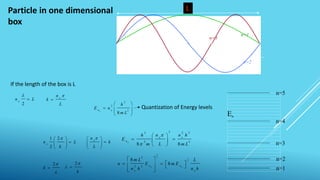
If the length of the box is L
2
x
n L


2
2
2
8
x
n x
h
E n
m L


 

 
x
n
k
L


L
Quantization of Energy levels
2
k



2
k

 
1 2
2
x
n L
k
 


 
 
x
n
k
L
 


 
 
2
2 2 2
2 2
8 8
x
x x
n
h n n h
E
m L m L




 
 
 
1
2
1
2
2
2 2
8
8
x x
n n
x x
m L L
n E m E
n h n h
 
 
 
   
 
Particle in one dimensional
box
n=1
n=2
n=3
Bloch’s Theorem
The eigenstates (r) of the one-electron Hamiltonian
where V(r + R) = V(r) for all R in a Bravais lattice, can be chosen to have the form of a
plane wave times a function with the periodicity of the Bravais lattice:
)
(
)
( ,
,
r
r k
r
k
k n
i
n
u
e



where un,k(r + R) = un,k(r)
Equivalently,
)
(
)
( ,
,
r
R
r k
R
k
k n
i
n
e 




)
(
2
ˆ 2
2
r
V
m
H 




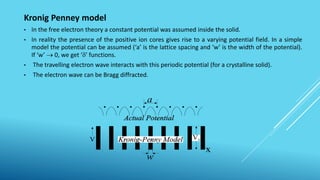
Kronig Penney model
• In the free electron theory a constant potential was assumed inside the solid.
• In reality the presence of the positive ion cores gives rise to a varying potential field. In a simple
model the potential can be assumed (‘a’ is the lattice spacing and ‘w’ is the width of the potential).
If ‘w’  0, we get ‘’ functions.
• The travelling electron wave interacts with this periodic potential (for a crystalline solid).
• The electron wave can be Bragg diffracted.
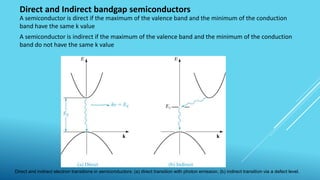
Direct and Indirect bandgap semiconductors
A semiconductor is indirect if the maximum of the valence band and the minimum of the conduction
band do not have the same k value
A semiconductor is direct if the maximum of the valence band and the minimum of the conduction
band have the same k value
Direct and indirect electron transitions in semiconductors: (a) direct transition with photon emission; (b) indirect transition via a defect level.
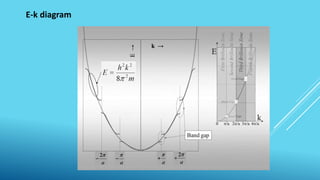
E-k diagram
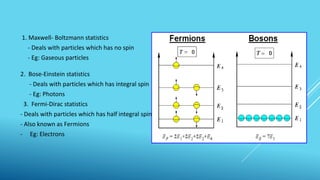
1. Maxwell- Boltzmann statistics
- Deals with particles which has no spin
- Eg: Gaseous particles
2. Bose-Einstein statistics
- Deals with particles which has integral spin
- Eg: Photons
3. Fermi-Dirac statistics
- Deals with particles which has half integral spin
- Also known as Fermions
- Eg: Electrons
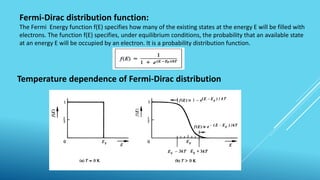
Fermi-Dirac distribution function:
The Fermi Energy function f(E) specifies how many of the existing states at the energy E will be filled with
electrons. The function f(E) specifies, under equilibrium conditions, the probability that an available state
at an energy E will be occupied by an electron. It is a probability distribution function.
Temperature dependence of Fermi-Dirac distribution
Fermi level
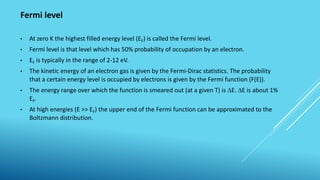
• At zero K the highest filled energy level (EF) is called the Fermi level.
• Fermi level is that level which has 50% probability of occupation by an electron.
• EF is typically in the range of 2-12 eV.
• The kinetic energy of an electron gas is given by the Fermi-Dirac statistics. The probability
that a certain energy level is occupied by electrons is given by the Fermi function (F(E)).
• The energy range over which the function is smeared out (at a given T) is E. E is about 1%
EF.
• At high energies (E >> EF) the upper end of the Fermi function can be approximated to the
Boltzmann distribution.
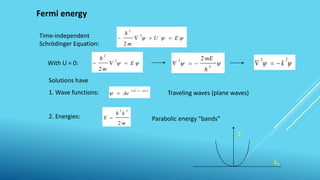
Fermi energy
Solutions have
1. Wave functions:
2. Energies:
Time-independent
Schrödinger Equation:
With U = 0:
Traveling waves (plane waves)
Parabolic energy “bands”


 E
U
m




2
2
2


 E
m



2
2
2


 2
2 2

mE


 

2
2
k



)
( t
r
k
i
Ae







m
k
E
2
2
2


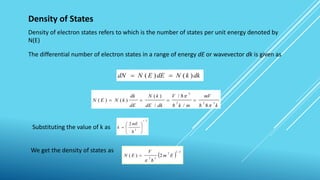
Substituting the value of k as
We get the density of states as
Density of States
Density of electron states refers to which is the number of states per unit energy denoted by
N(E)
The differential number of electron states in a range of energy dE or wavevector dk is given as
k
mV
m
k
V
dk
dE
k
N
dE
dk
k
N
E
N 3
2
2
3
8
/
8
/
/
)
(
)
(
)
(








dk
k
N
dE
E
N
dN )
(
)
( 

2
/
1
2
2








mE
k
 
2
/
1
3
3
2
2
)
( E
m
V
E
N



Semiconductors
OUTLINE
 Types of electronic materials
 Conductors
 semiconductors
 Insulators
 Metal-metal junction
 Metal-semiconductor Junction
 Ohmic junction
 Schottky junction
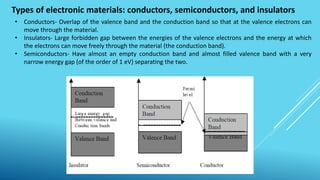
Types of electronic materials: conductors, semiconductors, and insulators
• Conductors- Overlap of the valence band and the conduction band so that at the valence electrons can
move through the material.
• Insulators- Large forbidden gap between the energies of the valence electrons and the energy at which
the electrons can move freely through the material (the conduction band).
• Semiconductors- Have almost an empty conduction band and almost filled valence band with a very
narrow energy gap (of the order of 1 eV) separating the two.
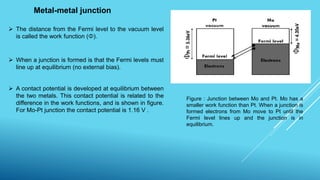
Metal-metal junction
Figure : Junction between Mo and Pt. Mo has a
smaller work function than Pt. When a junction is
formed electrons from Mo move to Pt until the
Fermi level lines up and the junction is in
equilibrium.
 The distance from the Fermi level to the vacuum level
is called the work function (Φ).
 When a junction is formed is that the Fermi levels must
line up at equilibrium (no external bias).
 A contact potential is developed at equilibrium between
the two metals. This contact potential is related to the
difference in the work functions, and is shown in figure.
For Mo-Pt junction the contact potential is 1.16 V .
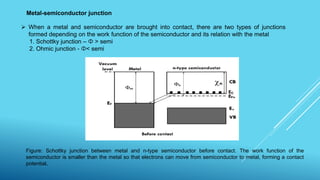
Metal-semiconductor junction
 When a metal and semiconductor are brought into contact, there are two types of junctions
formed depending on the work function of the semiconductor and its relation with the metal
1. Schottky junction – Φ > semi
2. Ohmic junction - Φ< semi
Figure: Schottky junction between metal and n-type semiconductor before contact. The work function of the
semiconductor is smaller than the metal so that electrons can move from semiconductor to metal, forming a contact
potential.
OPTOELECTRONICS DEVICES
OUTLINE
 Lasers
 Spontaneous emission, stimulated absorption, stimulated emission
 Population inversion
 Semiconductor lasers
 Photodetectors
 Noise source
 Fermi Golden Rule
LASER
LASER stands for Light Amplification by Stimulated Emission of Radiation.
Laser is a very intense, concentrated, highly parallel and monochromatic beam of light.
Coherence is very important property of Laser.
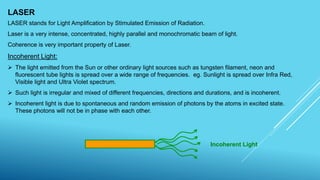
Incoherent Light:
 The light emitted from the Sun or other ordinary light sources such as tungsten filament, neon and
fluorescent tube lights is spread over a wide range of frequencies. eg. Sunlight is spread over Infra Red,
Visible light and Ultra Violet spectrum.
 Such light is irregular and mixed of different frequencies, directions and durations, and is incoherent.
 Incoherent light is due to spontaneous and random emission of photons by the atoms in excited state.
These photons will not be in phase with each other.
Incoherent Light
Coherent Light:
Coherent light is uniform in frequency, amplitude, continuity and constant initial phase difference.
Coherent beam of light is obtained due to stimulated emission of photons from the atoms jumping from meta-
stable state to lower energy state.
Coherent Light
Various Atomic Interactions related to LASER:
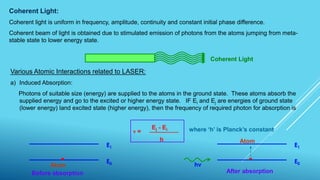
a) Induced Absorption:
Photons of suitable size (energy) are supplied to the atoms in the ground state. These atoms absorb the
supplied energy and go to the excited or higher energy state. IF Ei and Ej are energies of ground state
(lower energy) land excited state (higher energy), then the frequency of required photon for absorption is
where ‘h’ is Planck’s constant
E1
E0
Before absorption
Atom hν
E1
E0
After absorption
Atom
ν =
Ej - Ei
h
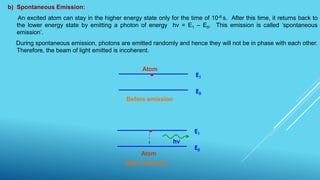
b) Spontaneous Emission:
An excited atom can stay in the higher energy state only for the time of 10-8 s. After this time, it returns back to
the lower energy state by emitting a photon of energy hν = E1 – E0. This emission is called ‘spontaneous
emission’.
During spontaneous emission, photons are emitted randomly and hence they will not be in phase with each other.
Therefore, the beam of light emitted is incoherent.
E1
E0
Before emission
Atom
hν
E1
E0
Atom
After emission
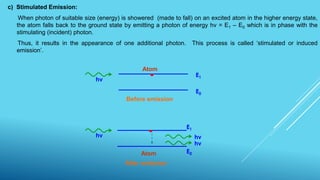
c) Stimulated Emission:
When photon of suitable size (energy) is showered (made to fall) on an excited atom in the higher energy state,
the atom falls back to the ground state by emitting a photon of energy hν = E1 – E0 which is in phase with the
stimulating (incident) photon.
Thus, it results in the appearance of one additional photon. This process is called ‘stimulated or induced
emission’.
E1
E0
Before emission
Atom
hν
E1
E0
Atom
After emission
hν
hν
hν
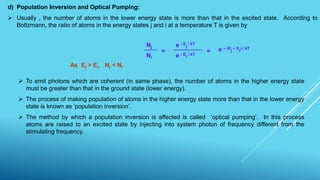
d) Population Inversion and Optical Pumping:
 Usually , the number of atoms in the lower energy state is more than that in the excited state. According to
Boltzmann, the ratio of atoms in the energy states j and i at a temperature T is given by
=
Nj e - E
j
/ kT
Ni e - E
i
/ kT
= e – (E
j
– E
i
) / kT
As Ej > Ei, Nj < Ni
 To emit photons which are coherent (in same phase), the number of atoms in the higher energy state
must be greater than that in the ground state (lower energy).
 The process of making population of atoms in the higher energy state more than that in the lower energy
state is known as ‘population inversion’.
 The method by which a population inversion is affected is called ‘optical pumping’. In this process
atoms are raised to an excited state by injecting into system photon of frequency different from the
stimulating frequency.
Semiconductor lasers
 While there are a number of different laser systems, semiconductor lasers have some unique characteristics.
 In semiconductors, transitions are between energy bands while in conventional lasers these are usually
individual atomic states (either in the gas phase or defect states in the solid phase). Electrons in a band have
an energy spread due to thermal fluctuations. This can affect the laser line width. This is similar to the
thermal line broadening observed in LEDs.
 The active region in the laser is narrow, typically less than 1 m. This can cause a large beam divergence.
 The spatial and spectral characteristics are influenced by the laser material like band gap and refractive
index.
 The lasing action is controlled by the incident current so modulation by the current is possible. This is also
possible because of the short photon lifetimes in the semiconductor material.
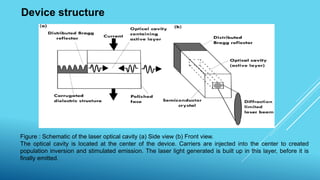
Device structure
Figure : Schematic of the laser optical cavity (a) Side view (b) Front view.
The optical cavity is located at the center of the device. Carriers are injected into the center to created
population inversion and stimulated emission. The laser light generated is built up in this layer, before it is
finally emitted.
Photodetectors
 These are Opto-electric devices i.e. to convert the optical signal back into electrical
impulses. The light detectors are commonly made up of semiconductor material.
Photodetectors parameters
 Quantum Efficiency
It is the ratio of primary electron-hole pairs created by incident photon to the photon incident on the diode
material. This is the ratio of output current to input optical power. Hence this is the efficiency of the
device.
 Spectral Response Range
This is the range of wavelengths over which the device will operate.
 Noise Characteristics
The level of noise produced in the device is critical to its operation at low levels of input light.
 Response Time
This is a measure of how quickly the detector can respond to variations in the input light intensity.
 Noise Characteristics
The level of noise produced in the device is critical to its operation at low levels of input light.
Types of Light Detectors
 PIN Photodiode
 The device structure consists of p and n semiconductor regions separated by a very lightly n-
doped intrinsic region. In normal operation a reverse-bias voltage is applied across the device so
that no free electrons or holes exist in the intrinsic region.
 Incident photon having energy greater than or equal to the bandgap energy of the semiconductor
material, give up its energy and excite an electron from the valence band to the conduction band.
 Avalanche Photodiode (APD)
 APDs internally multiply the primary photocurrent before it enters to following circuitry. In order
to carrier multiplication take place, the photogenerated carriers must traverse along a high field
region. In this region, photogenerated electrons and holes gain enough energy to ionize bound
electrons in VB upon colliding with them. This multiplication is known as impact ionization.
 The newly created carriers in the presence of high electric field result in more ionization called
avalanche effect.
Noise Sources in Photodetecors
 The principal noises associated with photodetectors are :
 Quantum (Shot) noise: arises from statistical nature of the production and collection of photo-
generated electrons upon optical illumination. It has been shown that the statistics follow a Poisson
process.
 Dark current noise: is the current that continues to flow through the bias circuit in the absence of the
light. This is the combination of bulk dark current, which is due to thermally generated e and h in the pn
junction, and the surface dark current, due to surface defects, bias voltage and surface area.
 Surface dark current is also known as surface leakage current. It depends on surface defects,
cleanliness, bias voltage and surface area. The surface current can be reduced by using the guard
rings so that the surface current should not flow through the load resistor.
 In order to calculate the total noise present in photodetector, we should sum up the root mean square
of each noise current by assuming that those are uncorrelated.
 FERMI’S GOLDEN RULE
 Fermi’s golden rule is a simple expression for the transition probabilities between states of a
quantum system, which are subjected to a perturbation. It is used for a large variety of physical
systems covering, e.g., nuclear reactions, optical transitions, or scattering of electrons in solids.
 In semiconductors, the Fermi golden rule can be used for calculating the transition probability rate
for an electron that is excited by a photon from the valence band to the conduction band in a direct
band-gap semiconductor, and also for when the electron recombines with the hole and emits a
photon.
Measurement
Techniques
OUTLINE
 P-N Junction diode characteristics
 V-I Characteristics
 Mathematical approximation
 Four Point probe method
 Hot Point Probe method
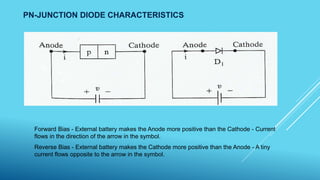
PN-JUNCTION DIODE CHARACTERISTICS
Forward Bias - External battery makes the Anode more positive than the Cathode - Current
flows in the direction of the arrow in the symbol.
Reverse Bias - External battery makes the Cathode more positive than the Anode - A tiny
current flows opposite to the arrow in the symbol.
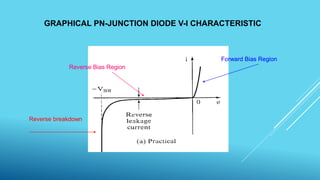
GRAPHICAL PN-JUNCTION DIODE V-I CHARACTERISTIC
Reverse breakdown
Forward Bias Region
Reverse Bias Region
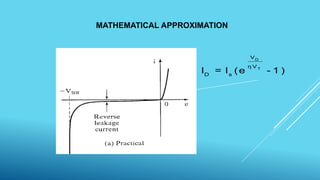
MATHEMATICAL APPROXIMATION
D
T
V
η V
D s
I = I (e - 1 )
FOUR POINT PROBE METHOD
 Four Point Probing is a method for measuring the resistivity of a substance.
 It can measure either bulk or thin film specimen.
 It is a technique to measure electrical impedance.
 It uses separate pairs for current carrying and voltage sensing electrodes.
 This method is capable of making more accurate measurements than two terminal sensing.
 In this method, current is supplied via a pair of current leads.
 The voltage drop across the impedance is measured by a separate pair of leads.
Thus, the voltage drop in the current carrying wires is prevented from being added to the actual value.
FOUR POINT PROBE METHOD
(CONTD….)
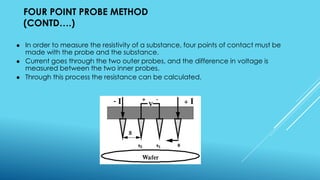
 In order to measure the resistivity of a substance, four points of contact must be
made with the probe and the substance.
 Current goes through the two outer probes, and the difference in voltage is
measured between the two inner probes.
 Through this process the resistance can be calculated.
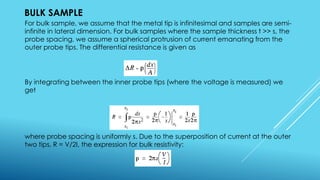
BULK SAMPLE
For bulk sample, we assume that the metal tip is infinitesimal and samples are semi-
infinite in lateral dimension. For bulk samples where the sample thickness t >> s, the
probe spacing, we assume a spherical protrusion of current emanating from the
outer probe tips. The differential resistance is given as
By integrating between the inner probe tips (where the voltage is measured) we
get
where probe spacing is uniformly s. Due to the superposition of current at the outer
two tips, R = V/2I, the expression for bulk resistivity:
THIN SHEET
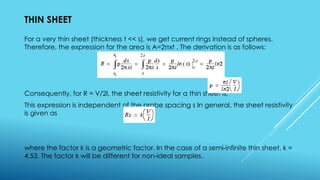
For a very thin sheet (thickness t << s), we get current rings instead of spheres.
Therefore, the expression for the area is A=2πxt . The derivation is as follows:
Consequently, for R = V/2I, the sheet resistivity for a thin sheet is,
This expression is independent of the probe spacing s In general, the sheet resistivity
is given as
where the factor k is a geometric factor. In the case of a semi-infinite thin sheet, k =
4.53. The factor k will be different for non-ideal samples.
HOT POINT PROBE METHOD
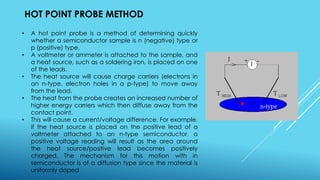
• A hot point probe is a method of determining quickly
whether a semiconductor sample is n (negative) type or
p (positive) type.
• A voltmeter or ammeter is attached to the sample, and
a heat source, such as a soldering iron, is placed on one
of the leads.
• The heat source will cause charge carriers (electrons in
an n-type, electron holes in a p-type) to move away
from the lead.
• The heat from the probe creates an increased number of
higher energy carriers which then diffuse away from the
contact point.
• This will cause a current/voltage difference. For example,
if the heat source is placed on the positive lead of a
voltmeter attached to an n-type semiconductor, a
positive voltage reading will result as the area around
the heat source/positive lead becomes positively
charged. The mechanism for this motion with in
semiconductor is of a diffusion type since the material is
uniformly doped
Thanks

PPT-Physics-CSE-ECE1pranil_arun_JADHAV_by

  • 1.
    SEMICONDUCTOR PHYSICS- (BTPH104-18) & SEMICONDUCTOR&OPTOELECTRONICS PHYSICS (BTPH105-18) BRANCH- CSE/ECE ELECTRONIC MATERIALS
  • 2.
    OUTLINE  Free electrontheory of metals  Bloch’s theorem for particles in a periodic potential  Energy band diagrams  Kronig-Penny model (to introduce origin of band gap)  Energy bands in solids  E-k diagram, Direct and indirect bandgaps  Occupation probability, Fermi level and Effective mass  Density of states in 1D, 2D, and 3D  Types of electronic materials: metals, semiconductors, and insulators
  • 3.
    Development of FreeElectron Theory The classical free electron theory [Drude and Lorentz] It is a macroscopic theory, in which the electrons move freely in lattice and it obeys the laws of classical mechanics. Here the electrons are assumed to move in a constant potential. The quantum free electron theory [Sommerfeld Theory] It is a microscopic theory, according to this theory the electrons in lattice moves in a constant potential and it obeys law of quantum mechanics. Brillouin Zone Theory [Band Theory] Bloch developed this theory in which the electrons move in a periodic potential provided by periodicity of crystal lattice. It explains the mechanisms of conductivity on the basis of energy bands and hence band theory. The electron theory explains the structure and properties of solids through their electronic structure. It explains the binding in solids, behaviour of conductors and insulators, ferromagnetism, electrical and thermal conductivities of solids, elasticity, cohesive and repulsive forces in solids etc.
  • 4.
    Classical free electrontheory of metals This theory was developed by Drude and Lorentz during 1900 and hence is also known as Drude-Lorentz theory. According to this theory, a metal consists of electrons which are free to move about in the crystal like molecules of a gas in a container. Mutual repulsion between electrons is ignored and hence potential energy is taken as zero. Therefore the total energy of the electron is equal to its kinetic energy. Postulates of Classical free electron theory: 1) All the atoms are composed of atoms. Each atom have central nucleus around which there are revolving electrons. 2) The electrons are free to move in all possible directions about the whole volume of metals. 3) In the absence of an electric field the electrons move in random directions making collisions from time to time with positive ions which are fixed in the lattice or other free electrons. All the collisions are elastic i.e.; no loss of energy. 4) When an external field is applied the free electrons are slowly drifting towards the positive potential. 5) Since the electrons are assumed to be a perfect gas they obey classical kinetic theory of gasses. 6) Classical free electrons in the metal obey Maxwell-Boltzmann statistics.
  • 5.
    Drawbacks of Classicalfree electron theory: 1) According to this theory, K/σT = L, a constant (Wiedemann-Franz law) for all temperatures. But this is not true at low temperatures. 2) The theoretically predicted value of specific heat of a metal does not agree with the experimentally obtained value. 3) This theory fails to explain ferromagnetism, superconductivity, photoelectric effect, Compton Effect and black body radiation. 4) It is a macroscopic theory. Merits of Classical Free Eletron Theory: 1) It is used to verify Ohm's law. 2) The electrical and thermal conductivities of metals can be explained. 3) It is used to derive Wiedemann- Franz law 4) It is used to explain the optical properties of metals.
  • 6.
    If the lengthof the box is L 2 x n L   2 2 2 8 x n x h E n m L        x n k L   L Quantization of Energy levels 2 k    2 k    1 2 2 x n L k         x n k L         2 2 2 2 2 2 8 8 x x x n h n n h E m L m L           1 2 1 2 2 2 2 8 8 x x n n x x m L L n E m E n h n h             Particle in one dimensional box n=1 n=2 n=3
  • 7.
    Bloch’s Theorem The eigenstates(r) of the one-electron Hamiltonian where V(r + R) = V(r) for all R in a Bravais lattice, can be chosen to have the form of a plane wave times a function with the periodicity of the Bravais lattice: ) ( ) ( , , r r k r k k n i n u e    where un,k(r + R) = un,k(r) Equivalently, ) ( ) ( , , r R r k R k k n i n e      ) ( 2 ˆ 2 2 r V m H     
  • 8.
    Kronig Penney model •In the free electron theory a constant potential was assumed inside the solid. • In reality the presence of the positive ion cores gives rise to a varying potential field. In a simple model the potential can be assumed (‘a’ is the lattice spacing and ‘w’ is the width of the potential). If ‘w’  0, we get ‘’ functions. • The travelling electron wave interacts with this periodic potential (for a crystalline solid). • The electron wave can be Bragg diffracted.
  • 9.
    Direct and Indirectbandgap semiconductors A semiconductor is indirect if the maximum of the valence band and the minimum of the conduction band do not have the same k value A semiconductor is direct if the maximum of the valence band and the minimum of the conduction band have the same k value Direct and indirect electron transitions in semiconductors: (a) direct transition with photon emission; (b) indirect transition via a defect level.
  • 10.
  • 11.
    1. Maxwell- Boltzmannstatistics - Deals with particles which has no spin - Eg: Gaseous particles 2. Bose-Einstein statistics - Deals with particles which has integral spin - Eg: Photons 3. Fermi-Dirac statistics - Deals with particles which has half integral spin - Also known as Fermions - Eg: Electrons
  • 12.
    Fermi-Dirac distribution function: TheFermi Energy function f(E) specifies how many of the existing states at the energy E will be filled with electrons. The function f(E) specifies, under equilibrium conditions, the probability that an available state at an energy E will be occupied by an electron. It is a probability distribution function. Temperature dependence of Fermi-Dirac distribution
  • 13.
    Fermi level • Atzero K the highest filled energy level (EF) is called the Fermi level. • Fermi level is that level which has 50% probability of occupation by an electron. • EF is typically in the range of 2-12 eV. • The kinetic energy of an electron gas is given by the Fermi-Dirac statistics. The probability that a certain energy level is occupied by electrons is given by the Fermi function (F(E)). • The energy range over which the function is smeared out (at a given T) is E. E is about 1% EF. • At high energies (E >> EF) the upper end of the Fermi function can be approximated to the Boltzmann distribution.
  • 14.
    Fermi energy Solutions have 1.Wave functions: 2. Energies: Time-independent Schrödinger Equation: With U = 0: Traveling waves (plane waves) Parabolic energy “bands”    E U m     2 2 2    E m    2 2 2    2 2 2  mE      2 2 k    ) ( t r k i Ae        m k E 2 2 2  
  • 15.
    Substituting the valueof k as We get the density of states as Density of States Density of electron states refers to which is the number of states per unit energy denoted by N(E) The differential number of electron states in a range of energy dE or wavevector dk is given as k mV m k V dk dE k N dE dk k N E N 3 2 2 3 8 / 8 / / ) ( ) ( ) (         dk k N dE E N dN ) ( ) (   2 / 1 2 2         mE k   2 / 1 3 3 2 2 ) ( E m V E N   
  • 16.
  • 17.
    OUTLINE  Types ofelectronic materials  Conductors  semiconductors  Insulators  Metal-metal junction  Metal-semiconductor Junction  Ohmic junction  Schottky junction
  • 18.
    Types of electronicmaterials: conductors, semiconductors, and insulators • Conductors- Overlap of the valence band and the conduction band so that at the valence electrons can move through the material. • Insulators- Large forbidden gap between the energies of the valence electrons and the energy at which the electrons can move freely through the material (the conduction band). • Semiconductors- Have almost an empty conduction band and almost filled valence band with a very narrow energy gap (of the order of 1 eV) separating the two.
  • 19.
    Metal-metal junction Figure :Junction between Mo and Pt. Mo has a smaller work function than Pt. When a junction is formed electrons from Mo move to Pt until the Fermi level lines up and the junction is in equilibrium.  The distance from the Fermi level to the vacuum level is called the work function (Φ).  When a junction is formed is that the Fermi levels must line up at equilibrium (no external bias).  A contact potential is developed at equilibrium between the two metals. This contact potential is related to the difference in the work functions, and is shown in figure. For Mo-Pt junction the contact potential is 1.16 V .
  • 20.
    Metal-semiconductor junction  Whena metal and semiconductor are brought into contact, there are two types of junctions formed depending on the work function of the semiconductor and its relation with the metal 1. Schottky junction – Φ > semi 2. Ohmic junction - Φ< semi Figure: Schottky junction between metal and n-type semiconductor before contact. The work function of the semiconductor is smaller than the metal so that electrons can move from semiconductor to metal, forming a contact potential.
  • 21.
  • 22.
    OUTLINE  Lasers  Spontaneousemission, stimulated absorption, stimulated emission  Population inversion  Semiconductor lasers  Photodetectors  Noise source  Fermi Golden Rule
  • 23.
    LASER LASER stands forLight Amplification by Stimulated Emission of Radiation. Laser is a very intense, concentrated, highly parallel and monochromatic beam of light. Coherence is very important property of Laser. Incoherent Light:  The light emitted from the Sun or other ordinary light sources such as tungsten filament, neon and fluorescent tube lights is spread over a wide range of frequencies. eg. Sunlight is spread over Infra Red, Visible light and Ultra Violet spectrum.  Such light is irregular and mixed of different frequencies, directions and durations, and is incoherent.  Incoherent light is due to spontaneous and random emission of photons by the atoms in excited state. These photons will not be in phase with each other. Incoherent Light
  • 24.
    Coherent Light: Coherent lightis uniform in frequency, amplitude, continuity and constant initial phase difference. Coherent beam of light is obtained due to stimulated emission of photons from the atoms jumping from meta- stable state to lower energy state. Coherent Light Various Atomic Interactions related to LASER: a) Induced Absorption: Photons of suitable size (energy) are supplied to the atoms in the ground state. These atoms absorb the supplied energy and go to the excited or higher energy state. IF Ei and Ej are energies of ground state (lower energy) land excited state (higher energy), then the frequency of required photon for absorption is where ‘h’ is Planck’s constant E1 E0 Before absorption Atom hν E1 E0 After absorption Atom ν = Ej - Ei h
  • 25.
    b) Spontaneous Emission: Anexcited atom can stay in the higher energy state only for the time of 10-8 s. After this time, it returns back to the lower energy state by emitting a photon of energy hν = E1 – E0. This emission is called ‘spontaneous emission’. During spontaneous emission, photons are emitted randomly and hence they will not be in phase with each other. Therefore, the beam of light emitted is incoherent. E1 E0 Before emission Atom hν E1 E0 Atom After emission
  • 26.
    c) Stimulated Emission: Whenphoton of suitable size (energy) is showered (made to fall) on an excited atom in the higher energy state, the atom falls back to the ground state by emitting a photon of energy hν = E1 – E0 which is in phase with the stimulating (incident) photon. Thus, it results in the appearance of one additional photon. This process is called ‘stimulated or induced emission’. E1 E0 Before emission Atom hν E1 E0 Atom After emission hν hν hν
  • 27.
    d) Population Inversionand Optical Pumping:  Usually , the number of atoms in the lower energy state is more than that in the excited state. According to Boltzmann, the ratio of atoms in the energy states j and i at a temperature T is given by = Nj e - E j / kT Ni e - E i / kT = e – (E j – E i ) / kT As Ej > Ei, Nj < Ni  To emit photons which are coherent (in same phase), the number of atoms in the higher energy state must be greater than that in the ground state (lower energy).  The process of making population of atoms in the higher energy state more than that in the lower energy state is known as ‘population inversion’.  The method by which a population inversion is affected is called ‘optical pumping’. In this process atoms are raised to an excited state by injecting into system photon of frequency different from the stimulating frequency.
  • 28.
    Semiconductor lasers  Whilethere are a number of different laser systems, semiconductor lasers have some unique characteristics.  In semiconductors, transitions are between energy bands while in conventional lasers these are usually individual atomic states (either in the gas phase or defect states in the solid phase). Electrons in a band have an energy spread due to thermal fluctuations. This can affect the laser line width. This is similar to the thermal line broadening observed in LEDs.  The active region in the laser is narrow, typically less than 1 m. This can cause a large beam divergence.  The spatial and spectral characteristics are influenced by the laser material like band gap and refractive index.  The lasing action is controlled by the incident current so modulation by the current is possible. This is also possible because of the short photon lifetimes in the semiconductor material.
  • 29.
    Device structure Figure :Schematic of the laser optical cavity (a) Side view (b) Front view. The optical cavity is located at the center of the device. Carriers are injected into the center to created population inversion and stimulated emission. The laser light generated is built up in this layer, before it is finally emitted.
  • 30.
    Photodetectors  These areOpto-electric devices i.e. to convert the optical signal back into electrical impulses. The light detectors are commonly made up of semiconductor material. Photodetectors parameters  Quantum Efficiency It is the ratio of primary electron-hole pairs created by incident photon to the photon incident on the diode material. This is the ratio of output current to input optical power. Hence this is the efficiency of the device.  Spectral Response Range This is the range of wavelengths over which the device will operate.  Noise Characteristics The level of noise produced in the device is critical to its operation at low levels of input light.  Response Time This is a measure of how quickly the detector can respond to variations in the input light intensity.  Noise Characteristics The level of noise produced in the device is critical to its operation at low levels of input light.
  • 31.
    Types of LightDetectors  PIN Photodiode  The device structure consists of p and n semiconductor regions separated by a very lightly n- doped intrinsic region. In normal operation a reverse-bias voltage is applied across the device so that no free electrons or holes exist in the intrinsic region.  Incident photon having energy greater than or equal to the bandgap energy of the semiconductor material, give up its energy and excite an electron from the valence band to the conduction band.  Avalanche Photodiode (APD)  APDs internally multiply the primary photocurrent before it enters to following circuitry. In order to carrier multiplication take place, the photogenerated carriers must traverse along a high field region. In this region, photogenerated electrons and holes gain enough energy to ionize bound electrons in VB upon colliding with them. This multiplication is known as impact ionization.  The newly created carriers in the presence of high electric field result in more ionization called avalanche effect.
  • 32.
    Noise Sources inPhotodetecors  The principal noises associated with photodetectors are :  Quantum (Shot) noise: arises from statistical nature of the production and collection of photo- generated electrons upon optical illumination. It has been shown that the statistics follow a Poisson process.  Dark current noise: is the current that continues to flow through the bias circuit in the absence of the light. This is the combination of bulk dark current, which is due to thermally generated e and h in the pn junction, and the surface dark current, due to surface defects, bias voltage and surface area.  Surface dark current is also known as surface leakage current. It depends on surface defects, cleanliness, bias voltage and surface area. The surface current can be reduced by using the guard rings so that the surface current should not flow through the load resistor.  In order to calculate the total noise present in photodetector, we should sum up the root mean square of each noise current by assuming that those are uncorrelated.
  • 33.
     FERMI’S GOLDENRULE  Fermi’s golden rule is a simple expression for the transition probabilities between states of a quantum system, which are subjected to a perturbation. It is used for a large variety of physical systems covering, e.g., nuclear reactions, optical transitions, or scattering of electrons in solids.  In semiconductors, the Fermi golden rule can be used for calculating the transition probability rate for an electron that is excited by a photon from the valence band to the conduction band in a direct band-gap semiconductor, and also for when the electron recombines with the hole and emits a photon.
  • 34.
  • 35.
    OUTLINE  P-N Junctiondiode characteristics  V-I Characteristics  Mathematical approximation  Four Point probe method  Hot Point Probe method
  • 36.
    PN-JUNCTION DIODE CHARACTERISTICS ForwardBias - External battery makes the Anode more positive than the Cathode - Current flows in the direction of the arrow in the symbol. Reverse Bias - External battery makes the Cathode more positive than the Anode - A tiny current flows opposite to the arrow in the symbol.
  • 37.
    GRAPHICAL PN-JUNCTION DIODEV-I CHARACTERISTIC Reverse breakdown Forward Bias Region Reverse Bias Region
  • 38.
  • 39.
    FOUR POINT PROBEMETHOD  Four Point Probing is a method for measuring the resistivity of a substance.  It can measure either bulk or thin film specimen.  It is a technique to measure electrical impedance.  It uses separate pairs for current carrying and voltage sensing electrodes.  This method is capable of making more accurate measurements than two terminal sensing.  In this method, current is supplied via a pair of current leads.  The voltage drop across the impedance is measured by a separate pair of leads. Thus, the voltage drop in the current carrying wires is prevented from being added to the actual value.
  • 40.
    FOUR POINT PROBEMETHOD (CONTD….)  In order to measure the resistivity of a substance, four points of contact must be made with the probe and the substance.  Current goes through the two outer probes, and the difference in voltage is measured between the two inner probes.  Through this process the resistance can be calculated.
  • 41.
    BULK SAMPLE For bulksample, we assume that the metal tip is infinitesimal and samples are semi- infinite in lateral dimension. For bulk samples where the sample thickness t >> s, the probe spacing, we assume a spherical protrusion of current emanating from the outer probe tips. The differential resistance is given as By integrating between the inner probe tips (where the voltage is measured) we get where probe spacing is uniformly s. Due to the superposition of current at the outer two tips, R = V/2I, the expression for bulk resistivity:
  • 42.
    THIN SHEET For avery thin sheet (thickness t << s), we get current rings instead of spheres. Therefore, the expression for the area is A=2πxt . The derivation is as follows: Consequently, for R = V/2I, the sheet resistivity for a thin sheet is, This expression is independent of the probe spacing s In general, the sheet resistivity is given as where the factor k is a geometric factor. In the case of a semi-infinite thin sheet, k = 4.53. The factor k will be different for non-ideal samples.
  • 43.
    HOT POINT PROBEMETHOD • A hot point probe is a method of determining quickly whether a semiconductor sample is n (negative) type or p (positive) type. • A voltmeter or ammeter is attached to the sample, and a heat source, such as a soldering iron, is placed on one of the leads. • The heat source will cause charge carriers (electrons in an n-type, electron holes in a p-type) to move away from the lead. • The heat from the probe creates an increased number of higher energy carriers which then diffuse away from the contact point. • This will cause a current/voltage difference. For example, if the heat source is placed on the positive lead of a voltmeter attached to an n-type semiconductor, a positive voltage reading will result as the area around the heat source/positive lead becomes positively charged. The mechanism for this motion with in semiconductor is of a diffusion type since the material is uniformly doped
  • 44.