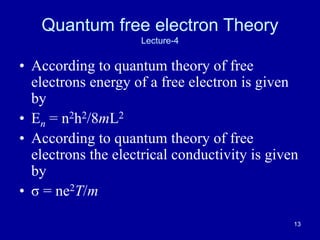
The electron theory of solids has developed in three stages: (1) the classical free electron theory developed by Drude and Lorentz in 1900, which treated electrons as a free gas obeying classical mechanics; (2) the quantum free electron theory developed by Sommerfeld in 1928, which treated electrons as obeying quantum laws; and (3) Bloch's zone theory from 1928, which treated electrons moving in a periodic potential from the lattice. The classical theory could explain properties like conductivity but had limitations, while the quantum theory improved explanations but new theories were still needed to explain new discoveries like semiconductors. Bands of allowed energy levels in solids help classify them as conductors, semiconductors or