FREE ELECTRON
THEORY
B Y
BY
THANUSH.S
22ECR214
Current Density
It is the current flowing across unit area
of a metal in the presence of an external
electric field.
It is given by
j = nevd
where n is the carrier concentration, e is
the charge of electron and vd is
the drift velocity of free electrons.
Its unit of measurement is
Ampere/metre2.
Mean Free Path & Mean Free Time
It is the average distance
travelled by free electrons
between two successive
collisions with lattice ions
in a metal subjected to
electric field.
It is the average time
taken by the free electrons
between two successive
collisions with the lattice
ions in a metal subjected
to electric field.
Postulates of Classical Free Electron Theory
• Metals consist of atoms, which in turn, consist of a nucleus and electrons.
• Valence electrons are free and the metal is visualized as an array
of ions permeated by a gas of free electrons.
• In the absence of an electrical field, electrons move in random
directions colliding with ions or free electrons.
• In an electrical field, free electrons are accelerated and move in
the opposite direction compared to that of the electric field.
• Electron velocities obey Maxwell–Boltzmann distribution function.
• Free electrons move without interaction between them and they obey the laws of
classical kinetic theory of gases.
• Free electrons move in a uniform potential field since ions are fixed in the lattice.
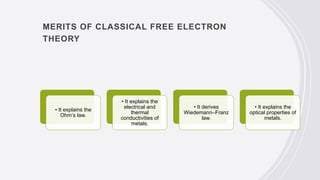
MERITS OF CLASSICAL FREE ELECTRON
THEORY
• It explains the
Ohm’s law.
• It explains the
electrical and
thermal
conductivities of
metals.
• It derives
Wiedemann–Franz
law.
• It explains the
optical properties of
metals.
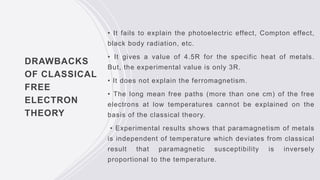
DRAWBACKS
OF CLASSICAL
FREE
ELECTRON
THEORY
• It fails to explain the photoelectric effect, Compton effect,
black body radiation, etc.
• It gives a value of 4.5R for the specific heat of metals.
But, the experimental value is only 3R.
• It does not explain the ferromagnetism.
• The long mean free paths (more than one cm) of the free
electrons at low temperatures cannot be explained on the
basis of the classical theory.
• Experimental results shows that paramagnetism of metals
is independent of temperature which deviates from classical
result that paramagnetic susceptibility is inversely
proportional to the temperature.
ELECTRICAL
CONDUCTIVITY
Electrical conductivity refers to
the ability of the metal to
conduct electrical energy.
QUANTUM FREE ELECTRON THEORY
The important assumptions made by Sommerfeld are given below:
• The free electrons move in a constant potential inside the metal
and are confined within defined boundaries.
• The eigen values of the conduction electron are quantized.
• The electrons are considered to posses wave nature.
• In the various allowed energy levels, distribution of electrons takes
place according to Pauli’s exclusion principle.
• Mutual attraction between electrons and lattice ions and the
repulsion between individual electrons may be ignored.
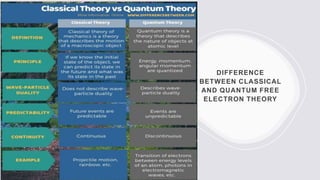
DIFFERENCE
BETWEEN CLASSICAL
AND QUANTUM FREE
ELECTRON THEORY
THANK
YOU

FREE ELECTRON THEORY.pptx

  • 1.
  • 2.
    Current Density It isthe current flowing across unit area of a metal in the presence of an external electric field. It is given by j = nevd where n is the carrier concentration, e is the charge of electron and vd is the drift velocity of free electrons. Its unit of measurement is Ampere/metre2.
  • 3.
    Mean Free Path& Mean Free Time It is the average distance travelled by free electrons between two successive collisions with lattice ions in a metal subjected to electric field. It is the average time taken by the free electrons between two successive collisions with the lattice ions in a metal subjected to electric field.
  • 4.
    Postulates of ClassicalFree Electron Theory • Metals consist of atoms, which in turn, consist of a nucleus and electrons. • Valence electrons are free and the metal is visualized as an array of ions permeated by a gas of free electrons. • In the absence of an electrical field, electrons move in random directions colliding with ions or free electrons. • In an electrical field, free electrons are accelerated and move in the opposite direction compared to that of the electric field. • Electron velocities obey Maxwell–Boltzmann distribution function. • Free electrons move without interaction between them and they obey the laws of classical kinetic theory of gases. • Free electrons move in a uniform potential field since ions are fixed in the lattice.
  • 5.
    MERITS OF CLASSICALFREE ELECTRON THEORY • It explains the Ohm’s law. • It explains the electrical and thermal conductivities of metals. • It derives Wiedemann–Franz law. • It explains the optical properties of metals.
  • 6.
    DRAWBACKS OF CLASSICAL FREE ELECTRON THEORY • Itfails to explain the photoelectric effect, Compton effect, black body radiation, etc. • It gives a value of 4.5R for the specific heat of metals. But, the experimental value is only 3R. • It does not explain the ferromagnetism. • The long mean free paths (more than one cm) of the free electrons at low temperatures cannot be explained on the basis of the classical theory. • Experimental results shows that paramagnetism of metals is independent of temperature which deviates from classical result that paramagnetic susceptibility is inversely proportional to the temperature.
  • 7.
    ELECTRICAL CONDUCTIVITY Electrical conductivity refersto the ability of the metal to conduct electrical energy.
  • 8.
    QUANTUM FREE ELECTRONTHEORY The important assumptions made by Sommerfeld are given below: • The free electrons move in a constant potential inside the metal and are confined within defined boundaries. • The eigen values of the conduction electron are quantized. • The electrons are considered to posses wave nature. • In the various allowed energy levels, distribution of electrons takes place according to Pauli’s exclusion principle. • Mutual attraction between electrons and lattice ions and the repulsion between individual electrons may be ignored.
  • 9.
  • 10.