1/15/2017 1
Dr A K Mishra, Academic Coordinator,
JIT Jahangirabad
Engineering Physics II Unit IV
Presentation By
Dr.A.K.Mishra
Associate Professor
Jahangirabad Institute of Technology, Barabanki
Email: akmishra.phy@gmail.com
Arun.Kumar@jit.edu.in
SEMICONDUCTOR
• The branch of engineering which deals with current con-duction
through a vacuum or gas or semiconductor is known as electronics.
• Electronics essentially deals with electronic devices and their
utilization.
• An electronic device is that in which current flows through a vacuum
or gas or semiconductor.
• Principles of Electronics
• The last orbit cannot have more than 8 electrons.
• The last but one orbit cannot have more than 18 electrons
Structure of Elements
• Atoms are made up of protons, neutrons and electrons.
• The difference between various types of elements is due to the
different number and arrangement.
1/15/2017
Dr A K Mishra, Academic Coordinator,
JIT Jahangirabad
2
Continued………….
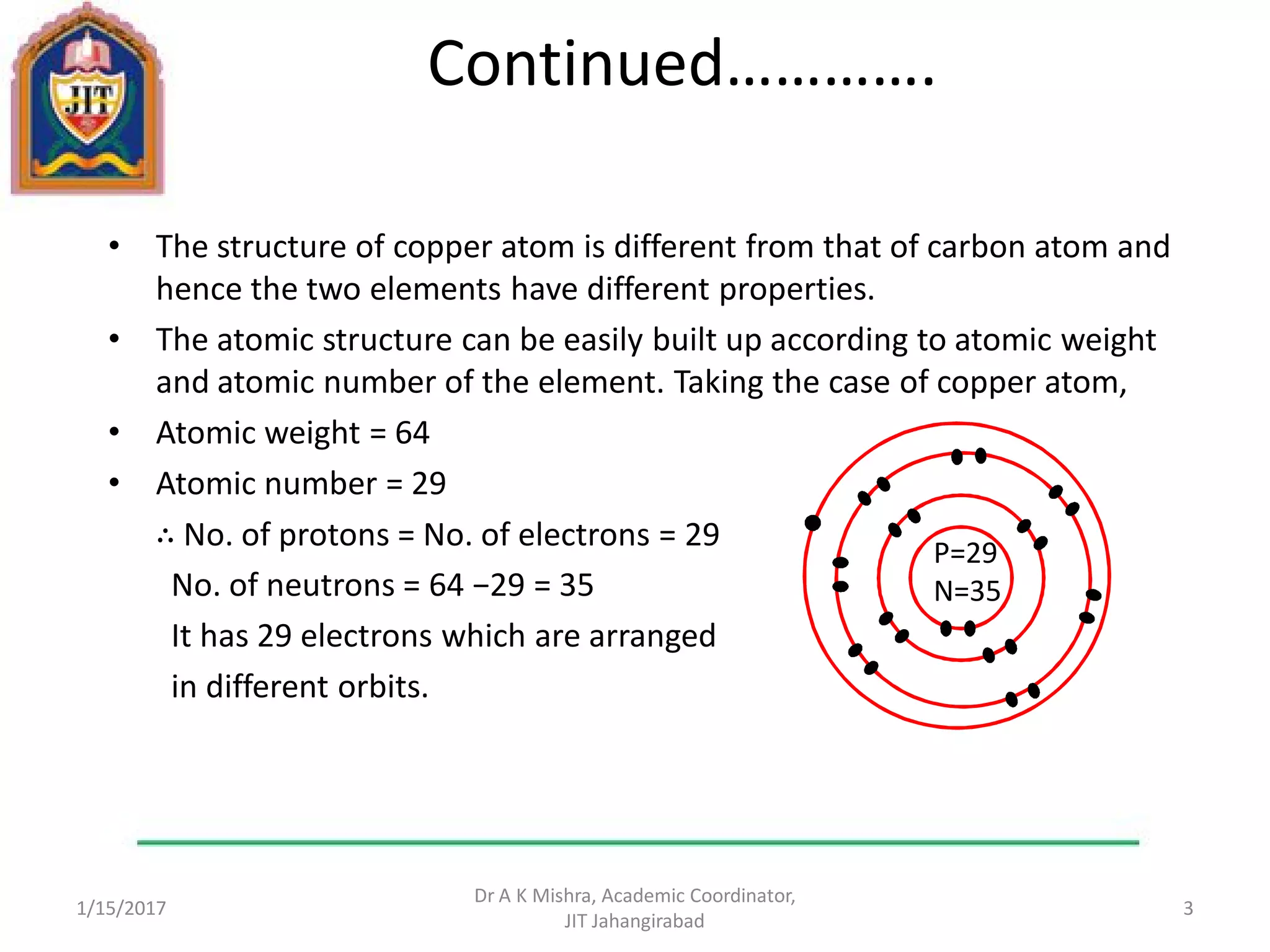
• The structure of copper atom is different from that of carbon atom and
hence the two elements have different properties.
• The atomic structure can be easily built up according to atomic weight
and atomic number of the element. Taking the case of copper atom,
• Atomic weight = 64
• Atomic number = 29
∴ No. of protons = No. of electrons = 29
No. of neutrons = 64 −29 = 35
It has 29 electrons which are arranged
in different orbits.
1/15/2017
Dr A K Mishra, Academic Coordinator,
JIT Jahangirabad
3
P=29
N=35
Continued……………..
• An electron is a negatively charged particle having negligible mass. Some
of the important properties of an electron are
• Charge on an electron= 1.602 ×10⁻¹⁹coulomb
• Mass of an electron= 9.0 ×10⁻³¹kg
• Radius of an electron= 1.9 ×10⁻¹⁵metre
• The ratio e/m of an electron is 1.77 ×10¹¹coulombs/kg.
• This means that mass of an electron is very small as compared to its
charge
• The total energy of the electron is the sum of (KE +PE ).
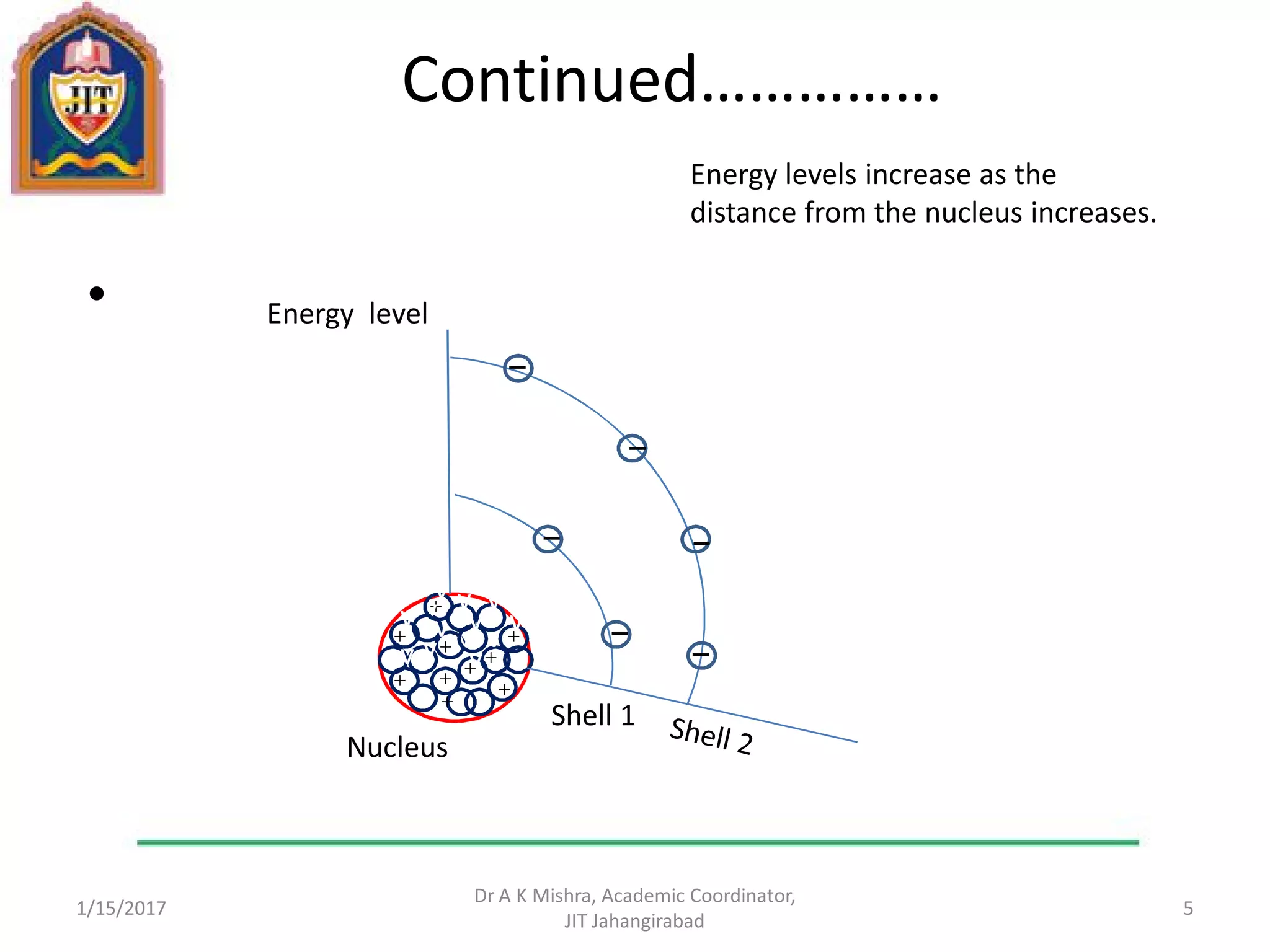
• The energy of an electron increases as its distance from the nucleus
increases.
1/15/2017
Dr A K Mishra, Academic Coordinator,
JIT Jahangirabad
4
Continued……………
•
1/15/2017
Dr A K Mishra, Academic Coordinator,
JIT Jahangirabad
5
Energy levels increase as the
distance from the nucleus increases.

v
v
v
v
v
v
v
v
v
v
v
v
v
v
v






 





Energy level
Nucleus
Shell 1
Valence Electrons
• The electrons in the outermost orbit of an atom are known as valence
electrons.
• The outermost orbit can have a maximum of 8 electrons i.e.the maximum
number of valence electrons can be 8.
• The valence electrons determine the physical and chemical properties of a
material.
• These electrons also determine the electrical properties of a material.
• On the basis of electrical conductivity, materials are generally classified
into Conductors insulators and semi-conductors.
• the number of valence electrons of an atom is less than 4 (i.e.half of the
maximum eight electrons), the material is usually a metal and a conductor
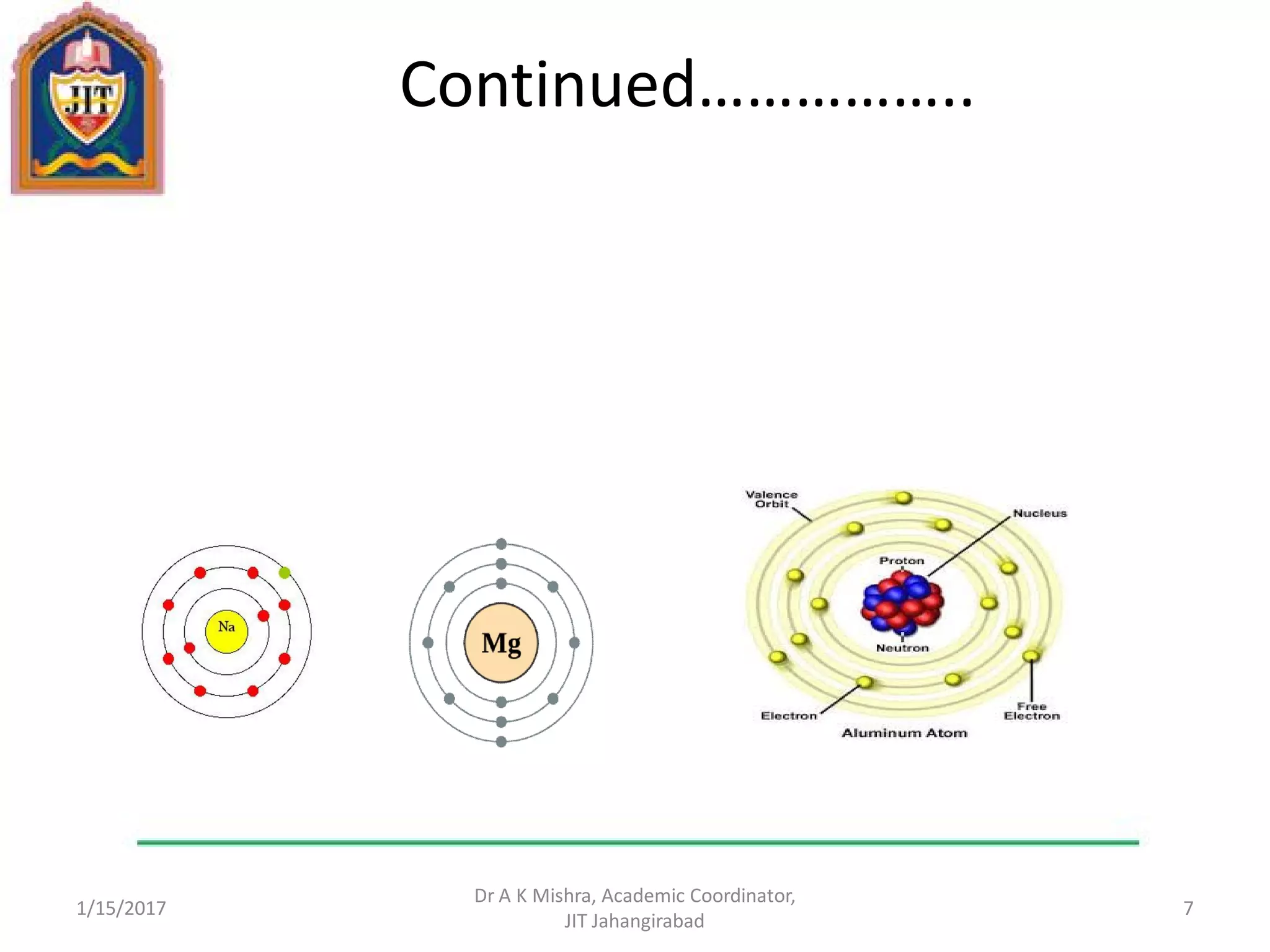
Examples are sodium, magnesium and aluminum which have 1, 2 and 3
valence electrons respectively.
1/15/2017
Dr A K Mishra, Academic Coordinator,
JIT Jahangirabad
6
Continued……………..
1/15/2017
Dr A K Mishra, Academic Coordinator,
JIT Jahangirabad
7
Band Theory of Solids
Band Theory:
1/15/2017
Dr A K Mishra, Academic Coordinator,
JIT Jahangirabad
8
No.1
No.2
No.3
No.4
No.5
Electron energy
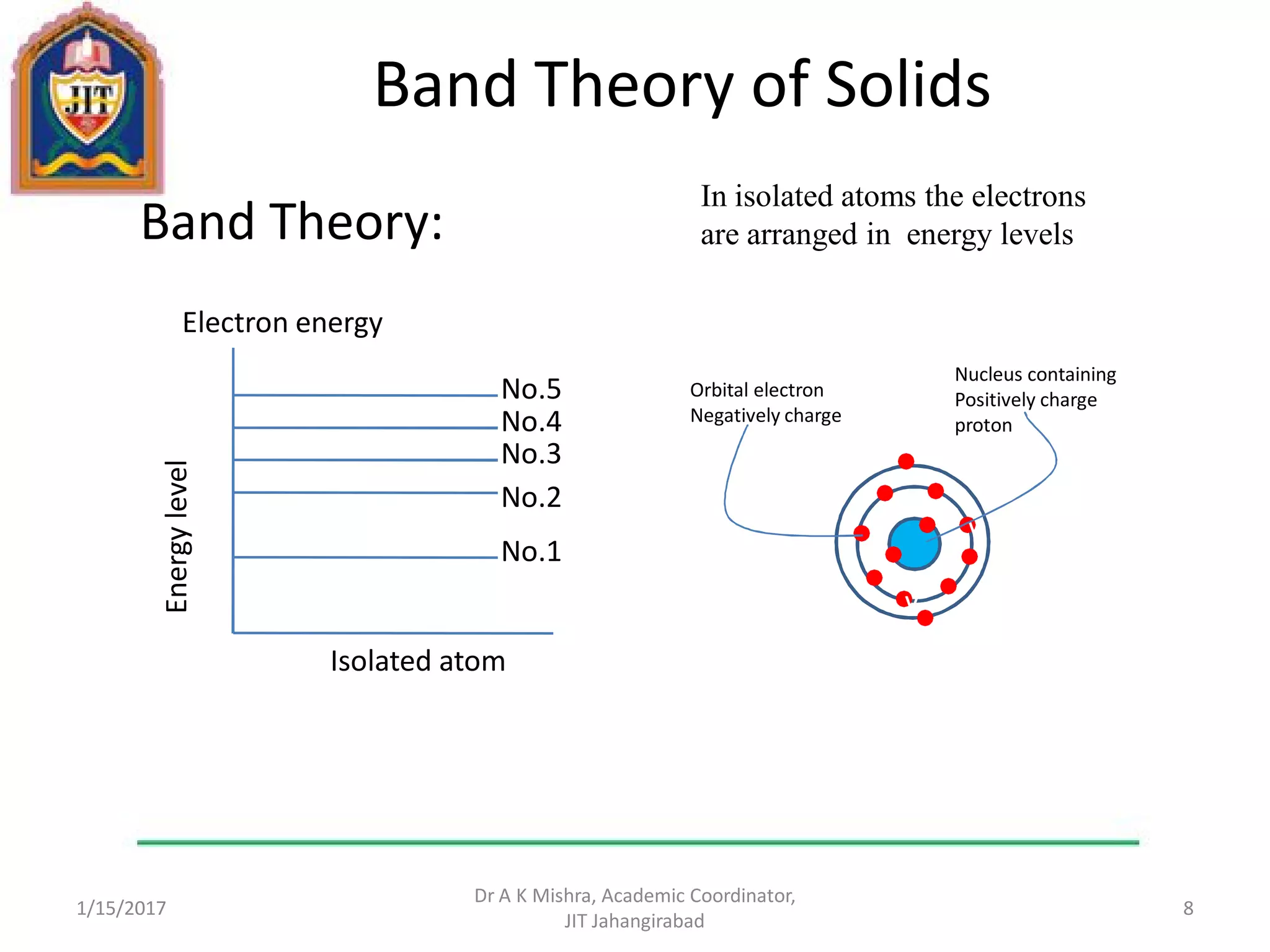
Nucleus containing
Positively charge
proton
v
v
Orbital electron
Negatively charge
In isolated atoms the electrons
are arranged in energy levels
Isolated atom
Energylevel
Band Theory of Solids
• A useful way to visualize the difference between conductors, insulators
and semiconductors is to plot the available energies for electrons in the
materials. Instead of having discrete energies as in the case of free atoms,
the available energy states form bands.
• Conduction process is whether or not there are electrons in the
conduction band.
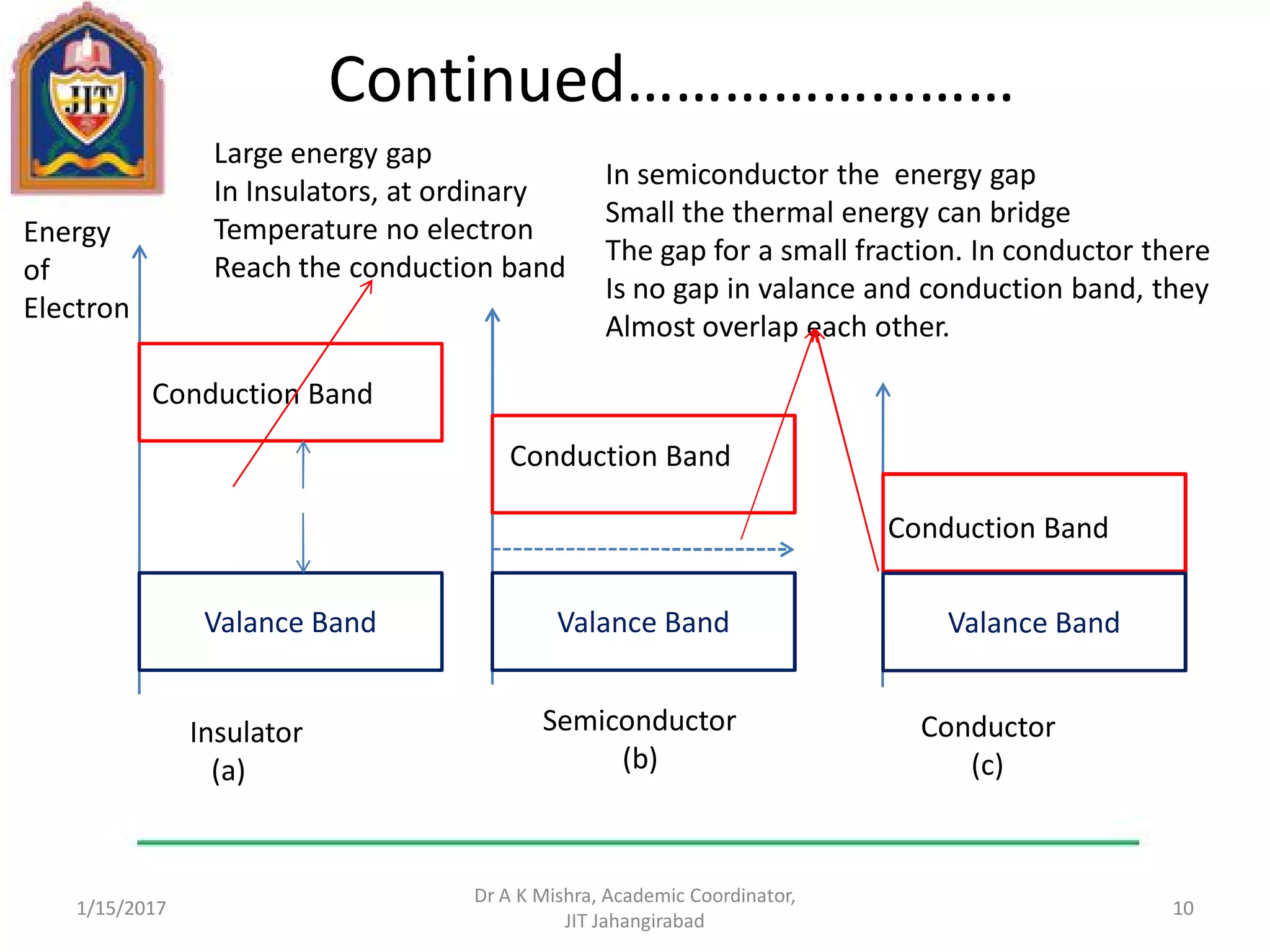
• In insulators the electrons in the valence band are separated by a large
gap from the conduction band.
• in conductors like metals the valence band overlaps the conduction band,
and in semiconductors there is a small enough gap between the valence
and conduction bands that thermal or other excitations can bridge the
gap. With such a small gap, the presence of a small percentage of a doping
material can increase conductivity dramatically.
1/15/2017
Dr A K Mishra, Academic Coordinator,
JIT Jahangirabad
9
Continued……………………
1/15/2017
Dr A K Mishra, Academic Coordinator,
JIT Jahangirabad
10
Insulator
(a)
Semiconductor
(b)
Conductor
(c)
Valance Band
Conduction Band
Large energy gap
In Insulators, at ordinary
Temperature no electron
Reach the conduction band
Valance Band
Conduction Band
Conduction Band
Valance Band
Energy
of
Electron
In semiconductor the energy gap
Small the thermal energy can bridge
The gap for a small fraction. In conductor there
Is no gap in valance and conduction band, they
Almost overlap each other.
Insulators, Conductors, and Semiconductors
materials are made up of atoms. These atoms contribute
to the electrical properties of a material, including its
ability to conduct electrical current.
For purposes of discussing electrical properties, an atom
can be represented by the valence shell and a core that
consists of all the inner shells and the nucleus.
This concept can be understand as Carbon is used in some
types of electrical resistors. Notice that the carbon atom
has four electrons in the valence shell and two electrons
in the inner shell. The nucleus consists of six protons and
six neutrons, so the 6 indicates the positive charge of the
six protons. The core has a net charge of 4 (6 for the
nucleus and for the two inner-shell electrons).
1/15/2017
Dr A K Mishra, Academic Coordinator,
JIT Jahangirabad
11
• Insulators: An insulators a material that does not conduct electrical
current under normal conditions. Most good insulators are compounds
rather than single-element materials and have very high resistivity's.
Valence electrons are tightly bound to the atoms; therefore, there are very
few free electrons in an insulator. Examples of insulators are rubber,
plastics, glass, mica, and quartz.
• Conductors A conductor is a material that easily conducts electrical
current. Most metals are good conductors. The best conductors are single-
element materials, such as copper (Cu), silver (Ag), gold (Au), and
aluminum (Al), which are characterized by atoms with only one valence
electron very loosely bound to the atom. These loosely bound valence
electrons become free electrons. Therefore, in a conductive material the
free electrons are valence electrons.
1/15/2017
Dr A K Mishra, Academic Coordinator,
JIT Jahangirabad
12
• Semiconductors A semiconductor is a material that is between
conductors and insulators in its ability to conduct electrical
current. A semiconductor in its pure (intrinsic) state is neither
a good conductor nor a good insulator. Single-element
semiconductors are antimony (Sb), arsenic (As), astatine (At),
boron (B), polonium (Po), tellurium (Te), silicon (Si), and
germanium (Ge). Compound semiconductors such as gallium
arsenide, indium phosphide, gallium nitride, silicon carbide,
and silicon germanium are also commonly used. The single-
element semiconductors are characterized by atoms with four
valence electrons. Silicon is the most commonly used
semiconductor.
1/15/2017
Dr A K Mishra, Academic Coordinator,
JIT Jahangirabad
13
Valence band,condunction band
and Forbidden Bands
• Due intermixing of neighboring electron energy levels the permissible
energy level increases. the splitting are so closely space, they form a
virtual continuum which s called an energy band.
• The band of energy develop by the splitting of valence electron and
occupied by the valence electrons is called valence energy band or
Valence Band. may be completely/partially filled at any temperature.
• The permitted energy band next higher to the valence band is called
Conduction band (lowest unfilled energy band).may be empty or partially
filled.
• In between the conduction band and valence band there is a region of
energy gap known as Forbidden band or Band gap. formed by a series of
close levels above the top level of valence band and below he bottom of
conduction band ,forbidden band is free from electrons i.e. electron can
not exist in this band.
1/15/2017
Dr A K Mishra, Academic Coordinator,
JIT Jahangirabad
14
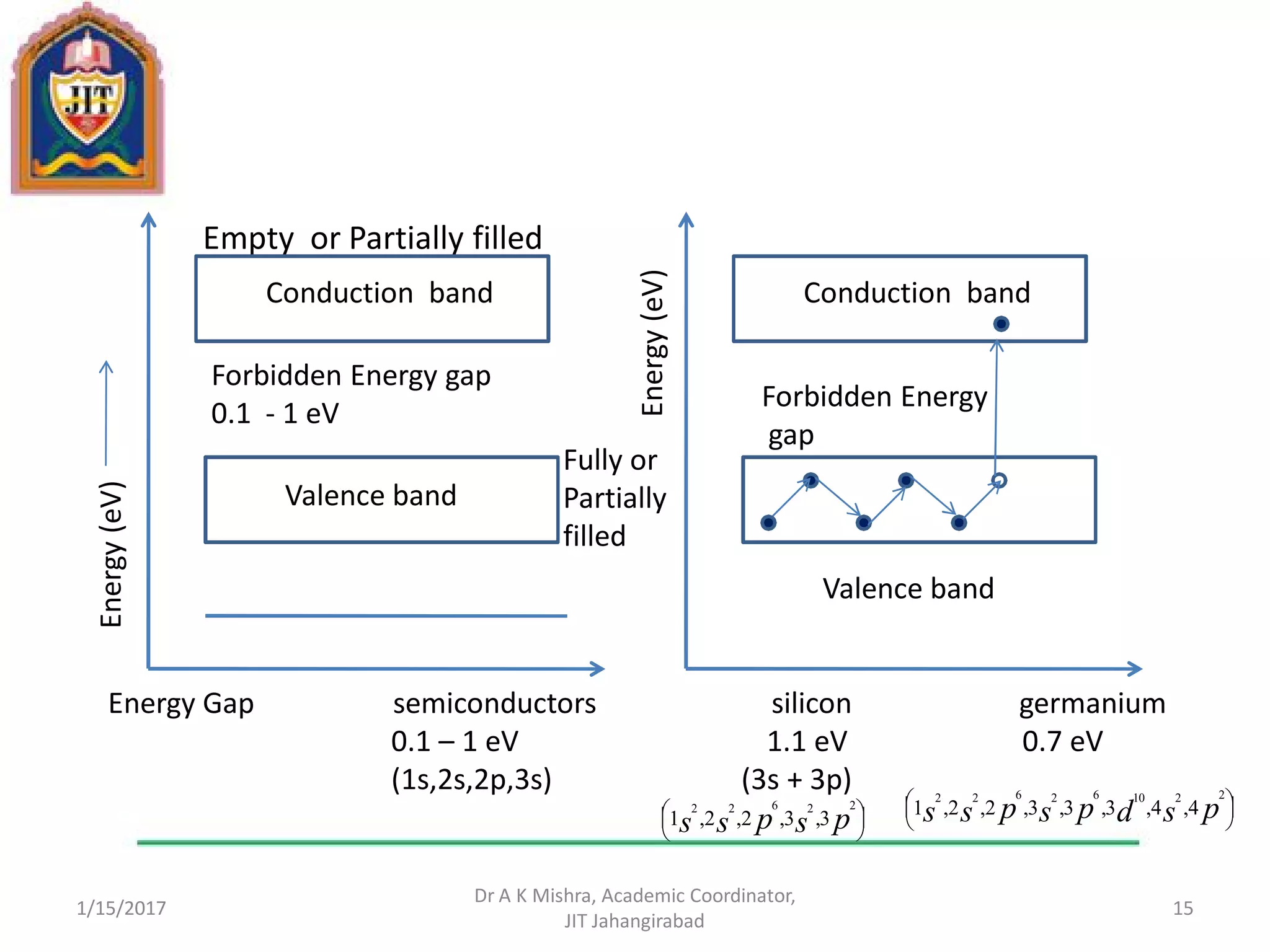
Empty or Partially filled
1/15/2017
Dr A K Mishra, Academic Coordinator,
JIT Jahangirabad
15
Valence band
Conduction band
Forbidden Energy gap
0.1 - 1 eV
Fully or
Partially
filled
Energy(eV)
Energy(eV)
Valence band
Conduction band
Forbidden Energy
gap
Energy Gap semiconductors silicon germanium
0.1 – 1 eV 1.1 eV 0.7 eV
(1s,2s,2p,3s) (3s + 3p)
3,3,2,2,1
22622





pspss
4,4,3,3,3,2,2,1
221062622





psdpspss
Band Gap
• When an electron acquires enough additional
energy, it can leave the valence shell, become a
free electron, and exist in the conduction band.
The difference in energy between the valence
band and the conduction band is called an energy
gap or band gap. This is the amount of energy
that a valence electron must have in order to
jump from the valence band to the conduction
band. Once in the conduction band, the electron
is free to move throughout the material and is
not tied to any given atom.
1/15/2017
Dr A K Mishra, Academic Coordinator,
JIT Jahangirabad
16
Comparison of a Semiconductor
Atom to a Conductor Atom
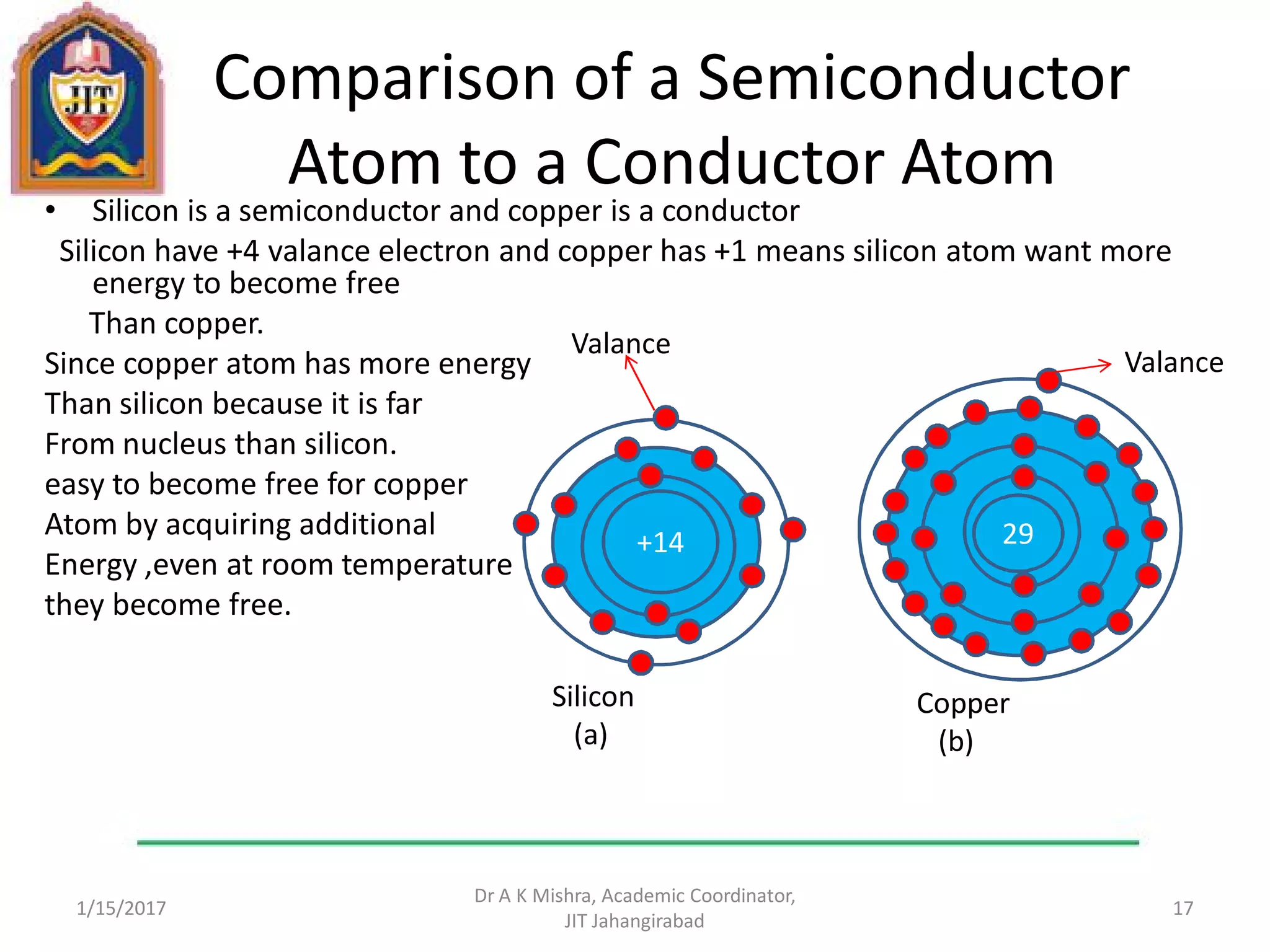
• Silicon is a semiconductor and copper is a conductor
Silicon have +4 valance electron and copper has +1 means silicon atom want more
energy to become free
Than copper.
Since copper atom has more energy
Than silicon because it is far
From nucleus than silicon.
easy to become free for copper
Atom by acquiring additional
Energy ,even at room temperature
they become free.
1/15/2017
Dr A K Mishra, Academic Coordinator,
JIT Jahangirabad
17
+14 +29
Silicon
(a)
Valance
Valance
Copper
(b)
29
Covalent Bonds
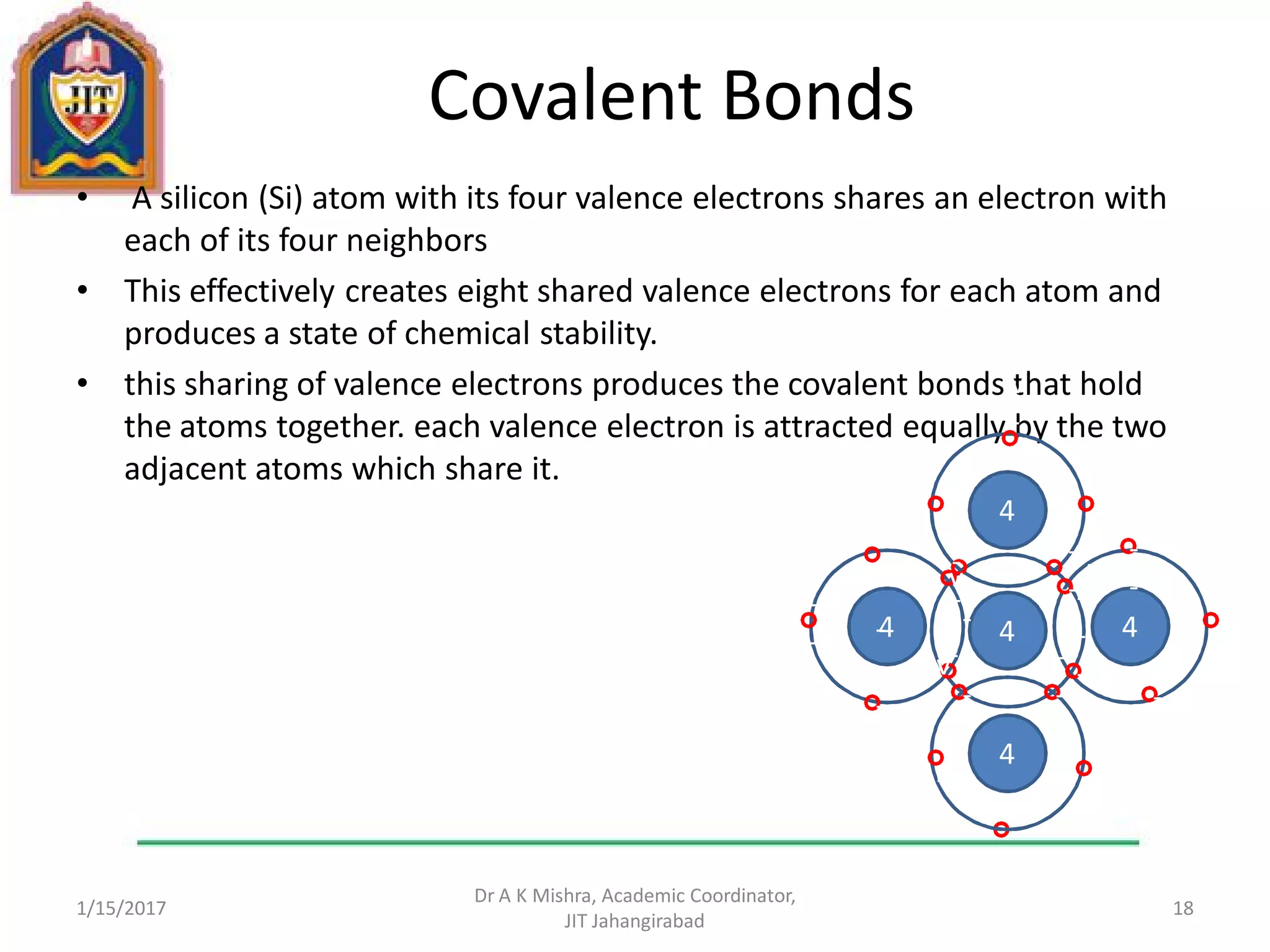
• A silicon (Si) atom with its four valence electrons shares an electron with
each of its four neighbors
• This effectively creates eight shared valence electrons for each atom and
produces a state of chemical stability.
• this sharing of valence electrons produces the covalent bonds that hold
the atoms together. each valence electron is attracted equally by the two
adjacent atoms which share it.
1/15/2017
Dr A K Mishra, Academic Coordinator,
JIT Jahangirabad
18
v
-
-
-
-
4
4
4
4
4
-
-
-
-
-
-
v
-
-
-
-
-
-
-
-
-
-
-
-
-
-
-
-
-
-
-
--
-
-
-
v
-
-
-
-
v
-
-
-
- v
-
-
-
-
v
-
-
-
-
v
-
-
-
-
v
-
-
-
v
-
-
-
-
v
-
-
-
-
v
-
-
Density of states
Since maximum spacing between consecutive energy level in solid is > eV.
Large number of discrete energy levels exist in a small interval of energy dE.
Each energy level consist two state and each state have only one electron.
The energy levels are filled as per paulis exclusion principle according to
which energy level can accommodate two electrons, one with Spin up and
other with Spin down.
The density of state shows the number of states within a given interval of
energy that the electron may possess.
If f(E) denote the average number of electrons that occupy a single quantum
state of energy E.
Let g(E) dE be the number of quantum state of the system whose energy lies
in the range dE, the the number of electrons of the system whose energy in
the range dE is given by,
N(E) dE = f(E) g(E) dE
1/15/2017
Dr A K Mishra, Academic Coordinator,
JIT Jahangirabad
19
10
6
Continue…………….
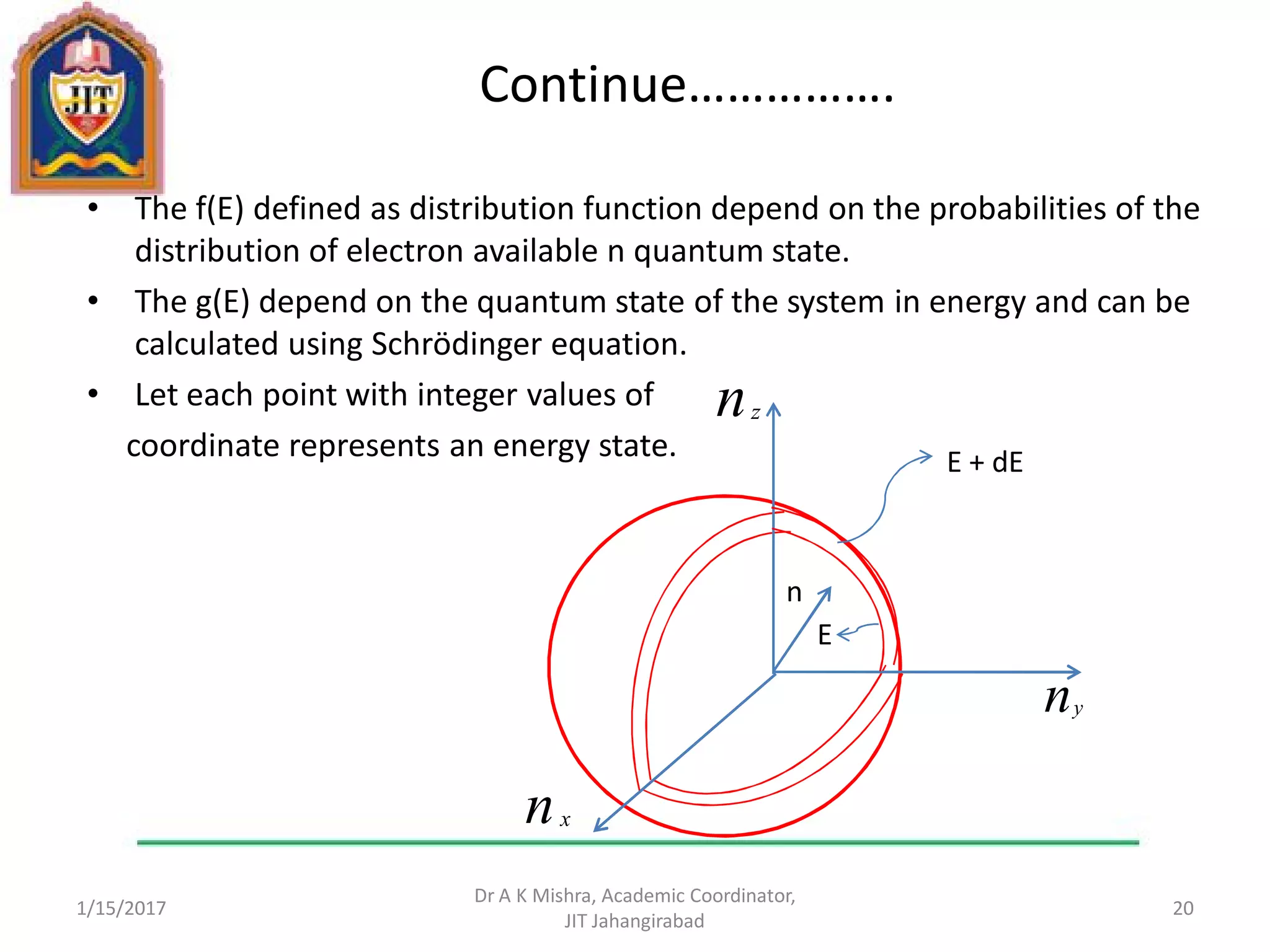
• The f(E) defined as distribution function depend on the probabilities of the
distribution of electron available n quantum state.
• The g(E) depend on the quantum state of the system in energy and can be
calculated using Schrödinger equation.
• Let each point with integer values of
coordinate represents an energy state.
1/15/2017
Dr A K Mishra, Academic Coordinator,
JIT Jahangirabad
20
n
E
E + dE
nx
ny
nz
Continued……………
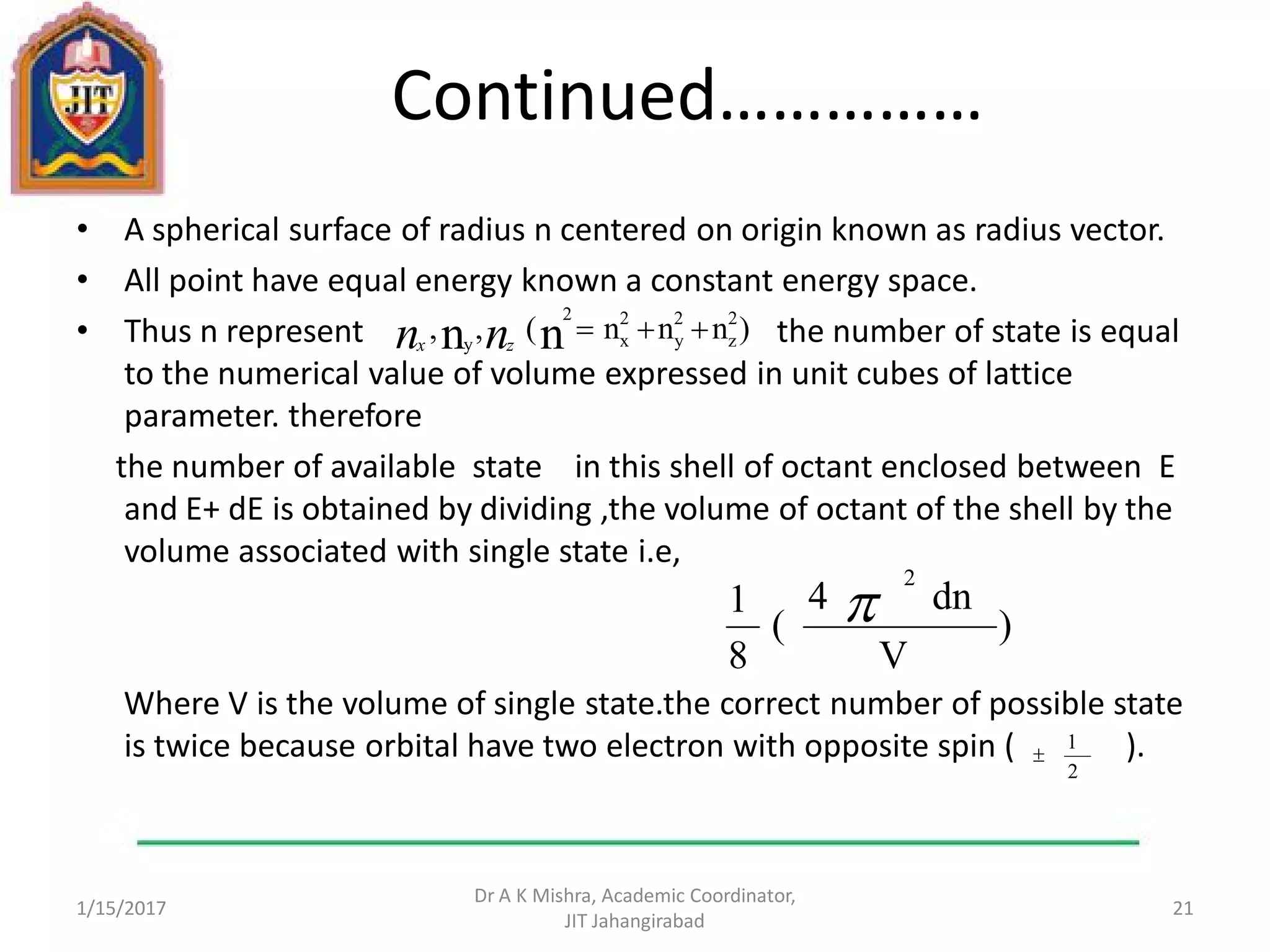
• A spherical surface of radius n centered on origin known as radius vector.
• All point have equal energy known a constant energy space.
• Thus n represent the number of state is equal
to the numerical value of volume expressed in unit cubes of lattice
parameter. therefore
the number of available state in this shell of octant enclosed between E
and E+ dE is obtained by dividing ,the volume of octant of the shell by the
volume associated with single state i.e,
Where V is the volume of single state.the correct number of possible state
is twice because orbital have two electron with opposite spin ( ).
1/15/2017
Dr A K Mishra, Academic Coordinator,
JIT Jahangirabad
21
)nnn(,, 2
z
2
y
2
x
2
y nn nn zx
)
V
dn4
(
8
1
2

2
1

Continued……….
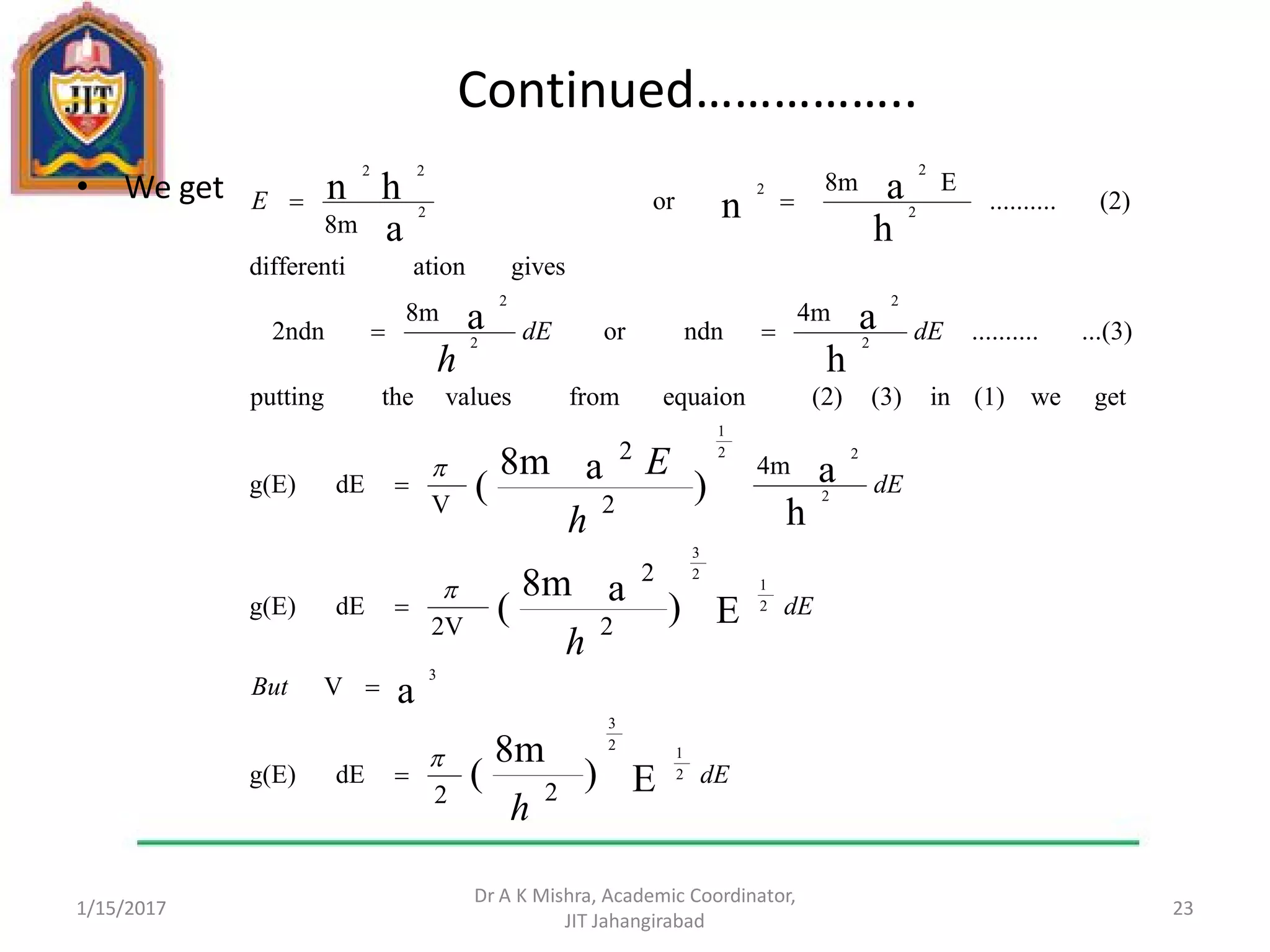
• Two electron in orbital are in different state, therefore if g(E) denotes the
density of state, then
1/15/2017
Dr A K Mishra, Academic Coordinator,
JIT Jahangirabad
22
asexpressedisasideofboxrigidainbem,electron
theofmassbox.letldimentionaoneinparticlenapplicatio
usinganalyzedbecanlatticeionicithin theelectron wan
1).........(....................dE)(
V
dm)(4
8
1
2dE)(
n
n
2
2
dn
V
Eg
Eg




Continued……………..
• We get
1/15/2017
Dr A K Mishra, Academic Coordinator,
JIT Jahangirabad
23
dE
But
dE
dE
dEdE
E
h
h
h
E
h
22
dEg(E)
V
2
2
2V
dEg(E)
4m
2
2
V
dEg(E)
getwe(1)in(3)(2)equaionfromvaluestheputting
...(3)..........
4m
ndnor
8m
2ndn
givesationdifferenti
(2)..........
E8m
or
8m
E)
8m
(
a
E)a8m
(
h
a)a8m
(
h
aa
h
an
a
hn
2
1
2
3
3
2
1
2
3
2
22
1
2
2
2
2
2
2
2
2
22









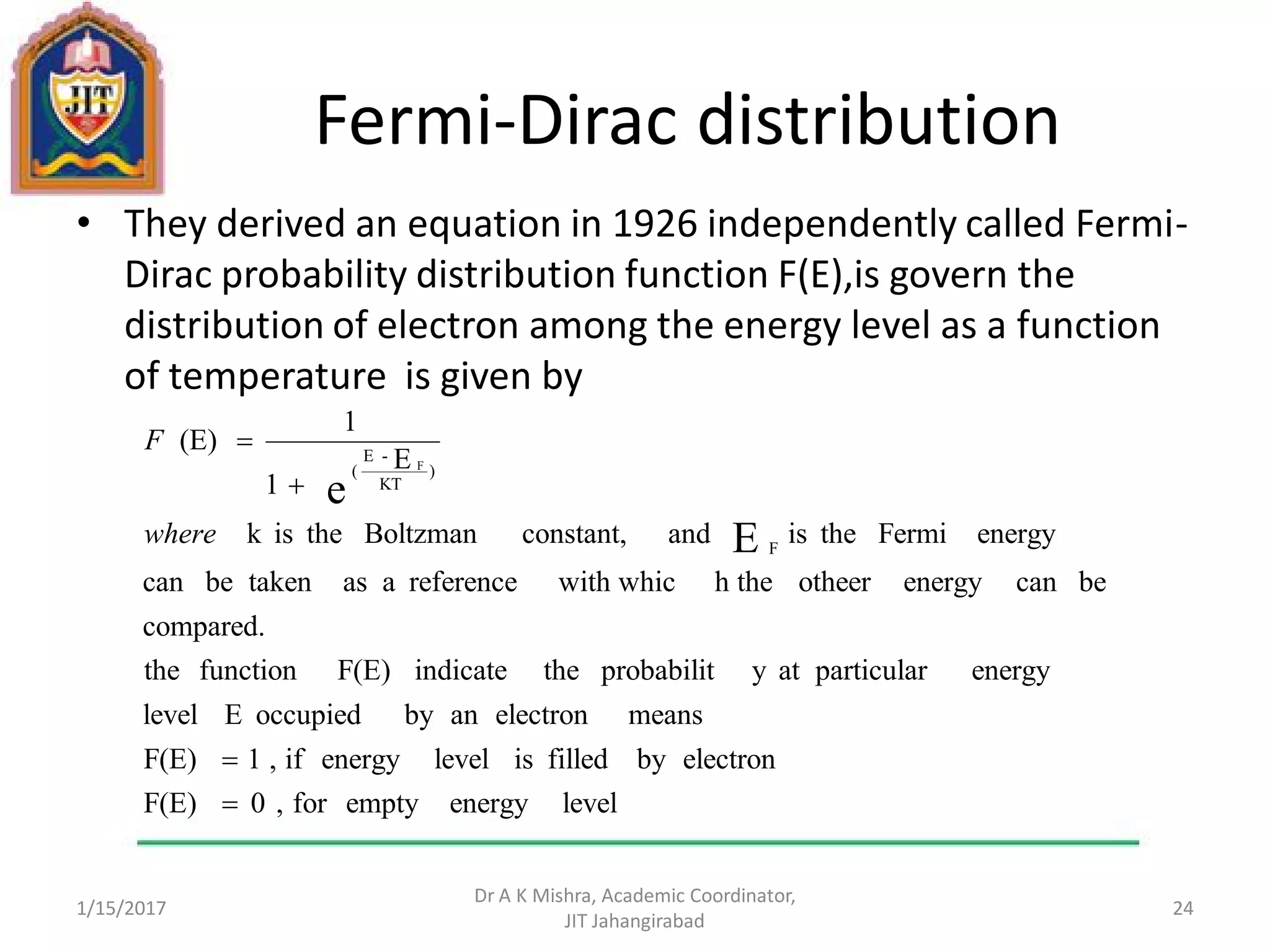
Fermi-Dirac distribution
• They derived an equation in 1926 independently called Fermi-
Dirac probability distribution function F(E),is govern the
distribution of electron among the energy level as a function
of temperature is given by
1/15/2017
Dr A K Mishra, Academic Coordinator,
JIT Jahangirabad
24
levelenergyemptyfor,0F(E)
electronbyfilledislevelenergyif,1F(E)
meanselectronanbyoccupiedElevel
energyparticularatyprobabilittheindicateF(E)functionthe
compared.
becanenergyotheerh thewith whicreferenceaastakenbecan
energyFermitheisandconstant,Boltzmantheisk
E
1
1
(E)
E
e
F
)
KT
-E
( F




where
F
Continued………..
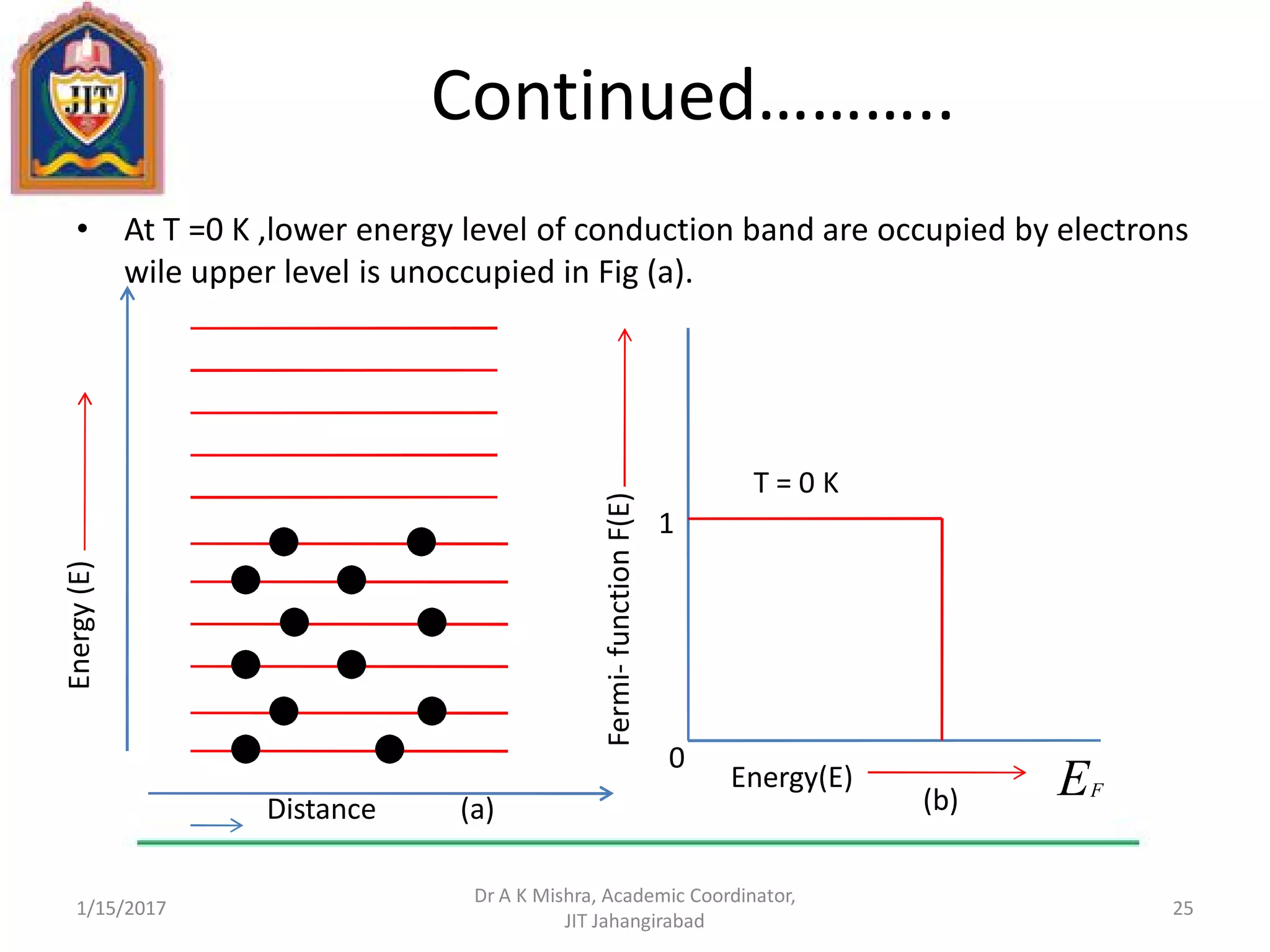
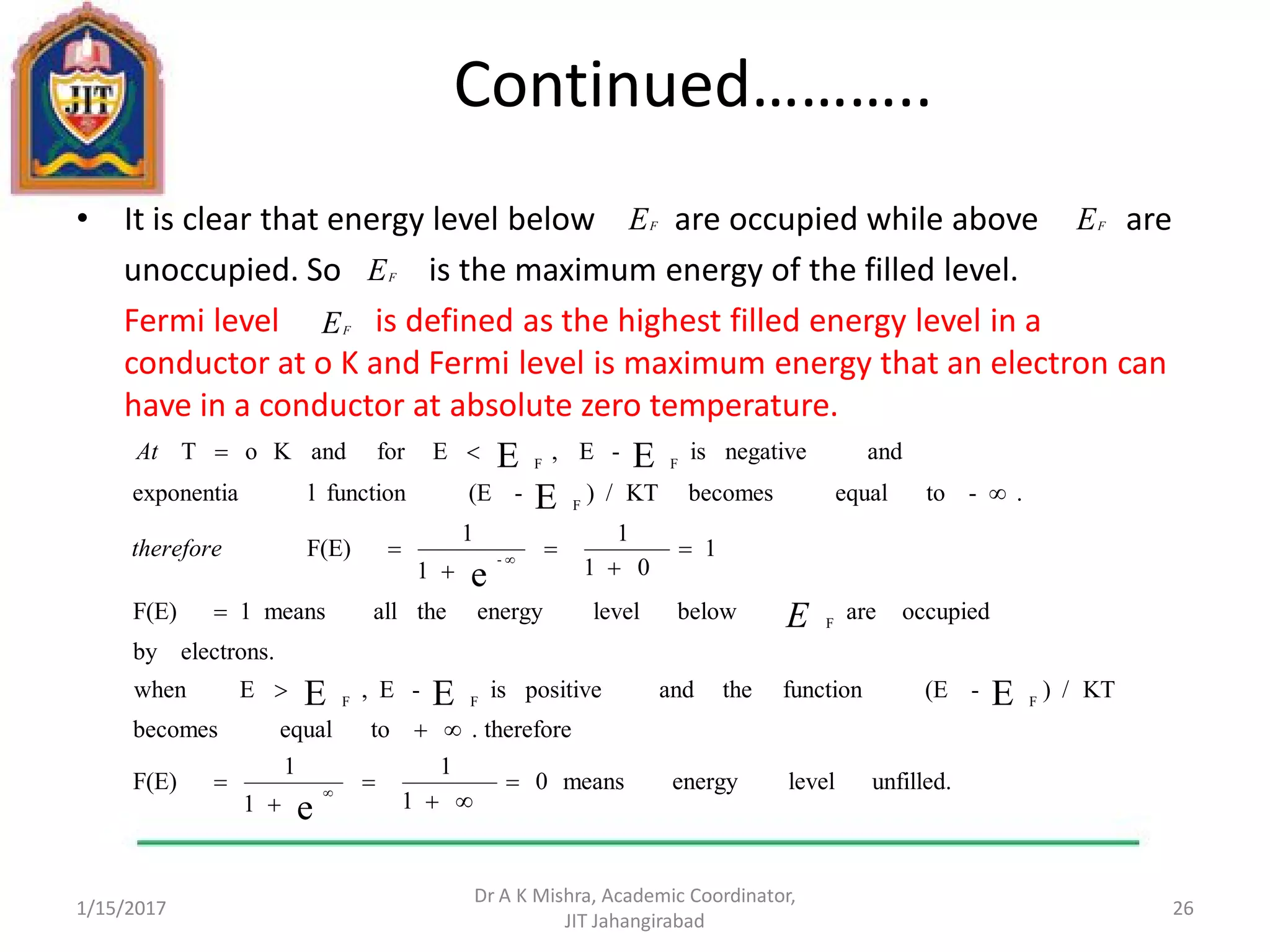
• At T =0 K ,lower energy level of conduction band are occupied by electrons
wile upper level is unoccupied in Fig (a).
1/15/2017
Dr A K Mishra, Academic Coordinator,
JIT Jahangirabad
25
Distance (b)(a)
Energy(E)
Fermi-functionF(E)
Energy(E)
T = 0 K
EF
1
0
Continued………..
• It is clear that energy level below are occupied while above are
unoccupied. So is the maximum energy of the filled level.
Fermi level is defined as the highest filled energy level in a
conductor at o K and Fermi level is maximum energy that an electron can
have in a conductor at absolute zero temperature.
1/15/2017
Dr A K Mishra, Academic Coordinator,
JIT Jahangirabad
26
EF EF
EF
EF
unfilled.levelenergymeans0
1
1
1
1
F(E)
therefore.toequalbecomes
KT/)-(Efunctiontheandpositiveis-E,Ewhen
electrons.by
occupiedarebelowlevelenergytheallmeans1F(E)
1
01
1
1
1
F(E)
.-toequalbecomesKT/)-(Efunctionlexponentia
andnegativeis-E,EforandKoT
e
EEE
e
E
EE
FFF
F
-
F
FF

















E
therefore
At
Charge carrier density (electrons and
Holes)in intrinsic semiconductor
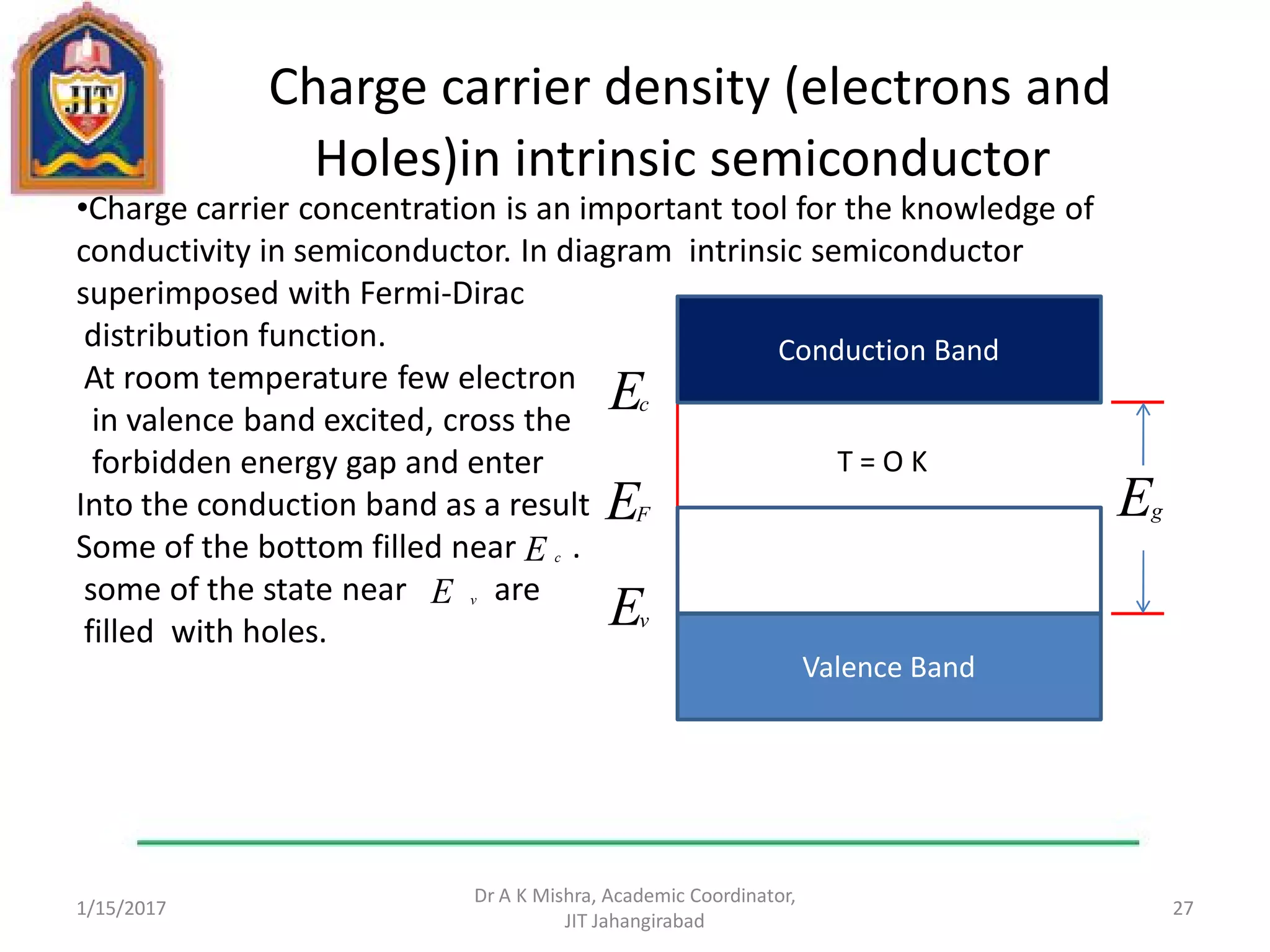
•Charge carrier concentration is an important tool for the knowledge of
conductivity in semiconductor. In diagram intrinsic semiconductor
superimposed with Fermi-Dirac
distribution function.
At room temperature few electron
in valence band excited, cross the
forbidden energy gap and enter
Into the conduction band as a result
Some of the bottom filled near .
some of the state near are
filled with holes.
1/15/2017
Dr A K Mishra, Academic Coordinator,
JIT Jahangirabad
27
Valence Band
TTTa
Conduction Band
T = O K
Eg
Ec
EF
Ev
E c
E v
Continued………………
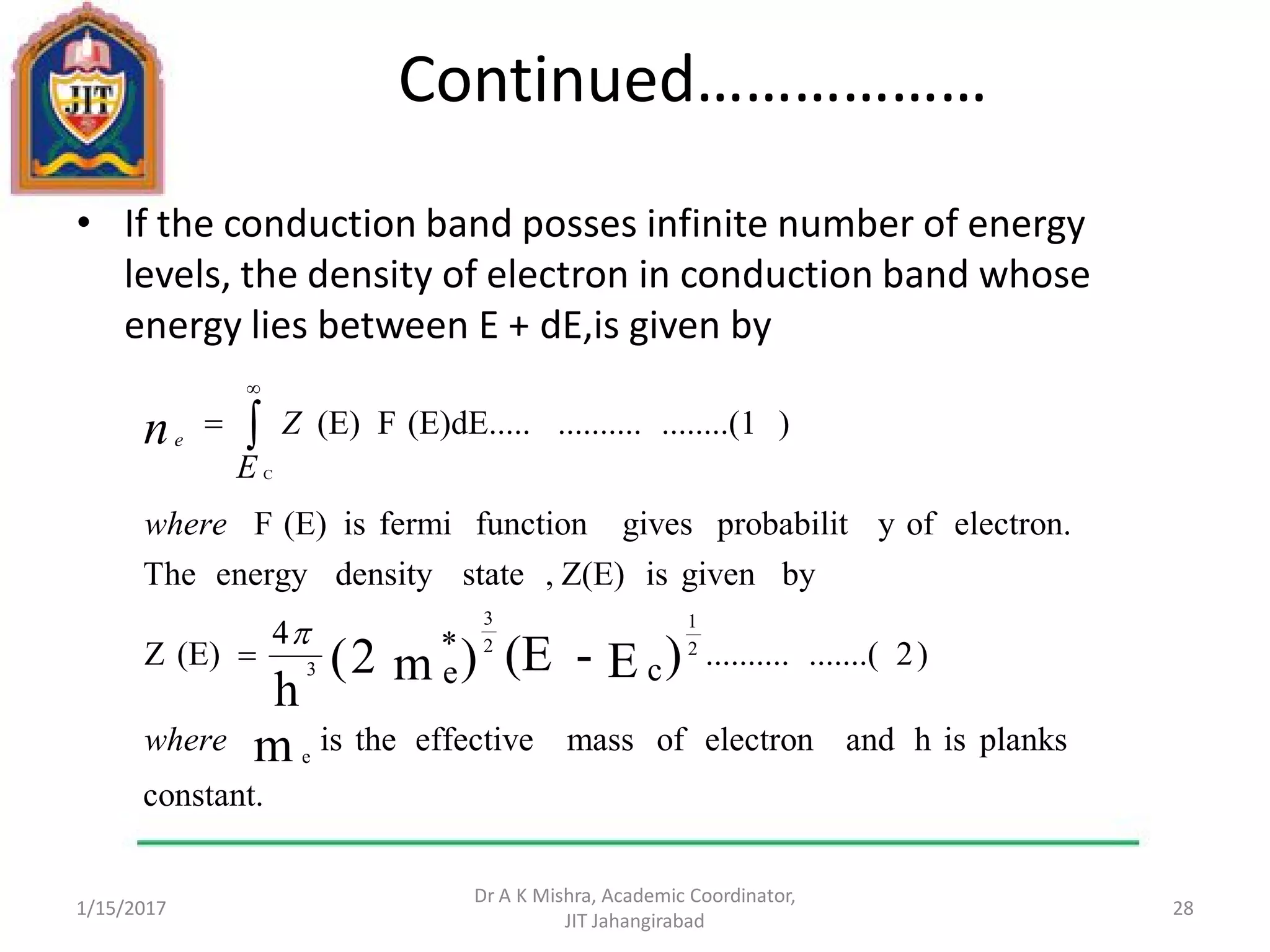
• If the conduction band posses infinite number of energy
levels, the density of electron in conduction band whose
energy lies between E + dE,is given by
1/15/2017
Dr A K Mishra, Academic Coordinator,
JIT Jahangirabad
28
constant.
planksishandelectronofmasseffectivetheis
)2.......(..........c
*
e
4
(E)Z
bygivenisZ(E),statedensityenergyThe
electron.ofyprobabilitgivesfunctionfermiis(E)F
)........(1..........(E)dE.....F(E)
m
)E-(E)m2(
h
e
2
1
2
3
3
C
where
where
E
Zne


 

Continued………
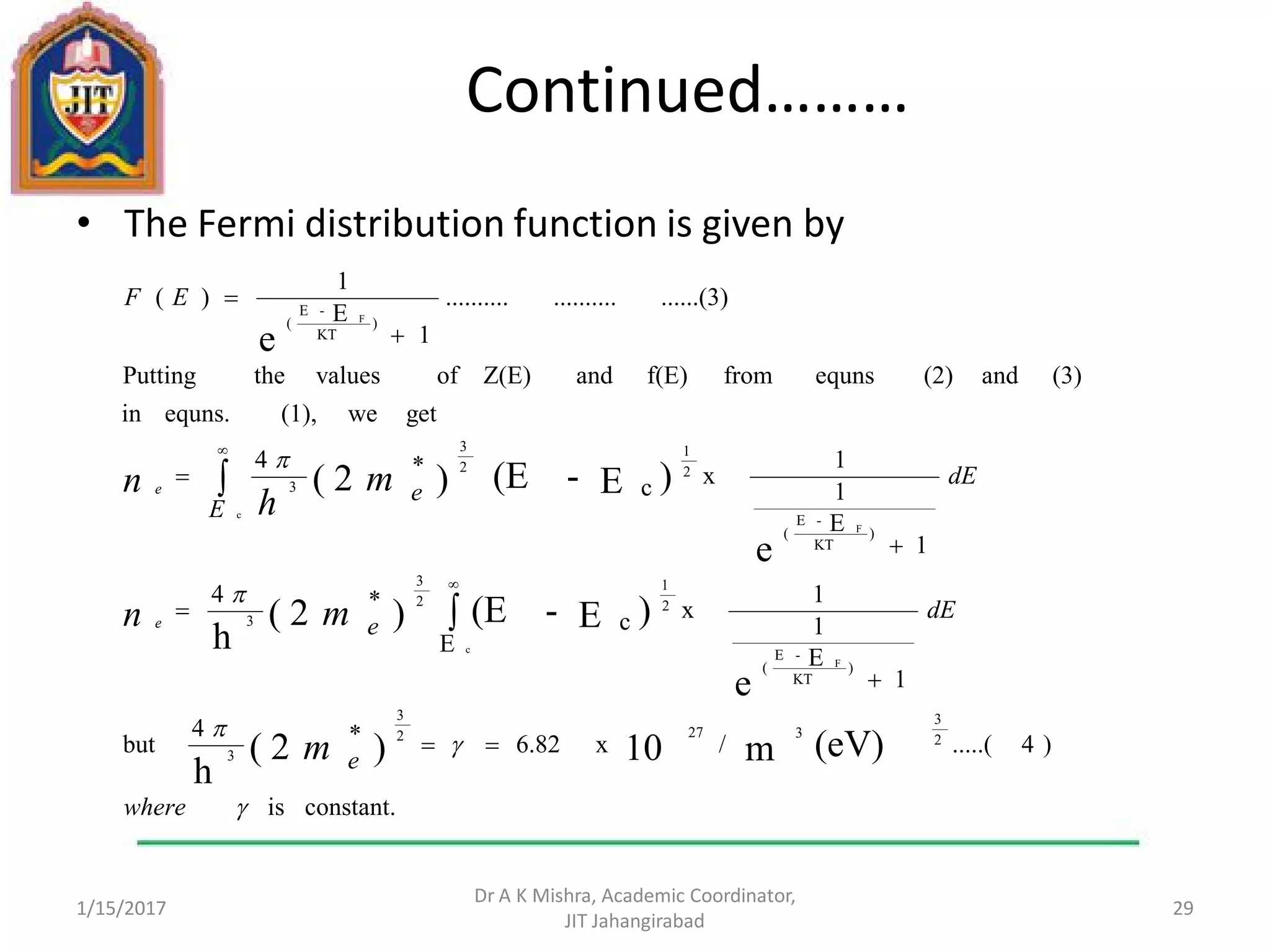
• The Fermi distribution function is given by
1/15/2017
Dr A K Mishra, Academic Coordinator,
JIT Jahangirabad
29
constant.is
)4.....(/x6.82*4
but
E
1
E
1
1
xc
*4
1
E
1
1
xc
*4
getwe(1),equns.in
(3)and(2)equnsfromf(E)andZ(E)ofvaluesthePutting
......(3)....................
1
E
1
)(
(eV)m10)2(
h
e
)E-(E)2(
h
e
)E-(E)2(
e
2
3
3272
3
3
)
KT
-E
(
2
1
2
3
3
)
KT
-E
(
2
1
2
3
3
)
KT
-E
(
c
F
F
c
F





where
e
dE
e
dE
e
E
EF
m
mn
m
h
n
e
e











Continued………
• therefore
1/15/2017
Dr A K Mishra, Academic Coordinator,
JIT Jahangirabad
30








E
1
Ec
(5).Henceequationinneglectcanweso
1
E
,-E,EFor
.(5)....................
E 1
E
c
c
F
F
c
F
e
)E-(E
eE
e
)E-(E
)
KT
-E
(
2
1
)
KT
-E
(
FF
)
KT
-E
(
2
1
dE
thereforeKT
dE
n
E
n
e
e


Continued…………….
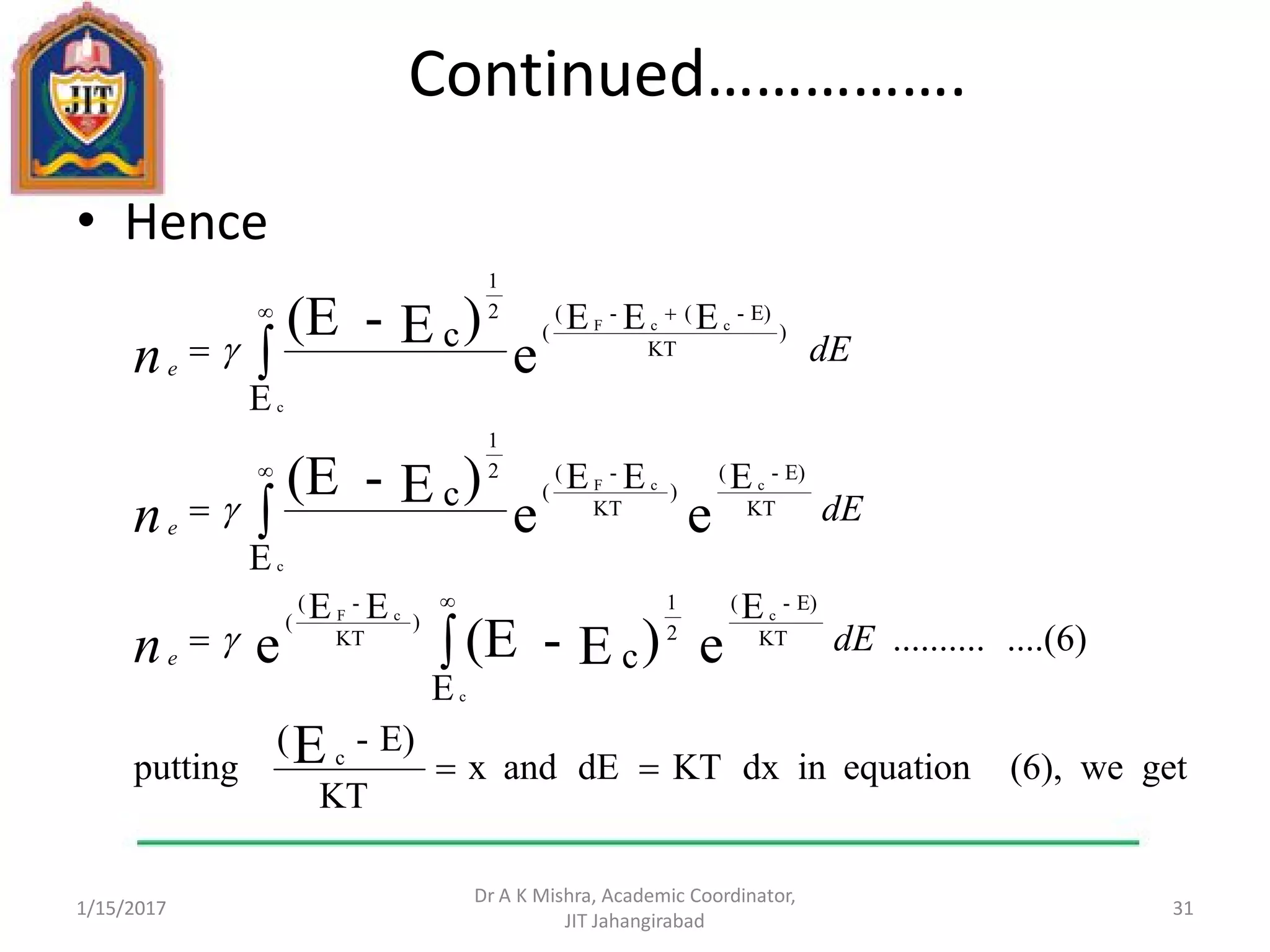
• Hence
1/15/2017
Dr A K Mishra, Academic Coordinator,
JIT Jahangirabad
31
getwe(6),equationindxKTdEandx
KT
E)-(
putting
....(6)..........
E
E
c
EE
E
EEEc
E
EEEc
E
e)E-(Ee
ee
)E-(E
e
)E-(E
c
KT
E)-(
2
1
)
KT
-(
(
KT
E)-(
)
KT
-(
(
2
1
)
KT
E)-(-(
(
2
1
c
c
cF
c
ccF
c
ccF









 
dE
dE
dE
n
n
n
e
e
e



Continued…………….
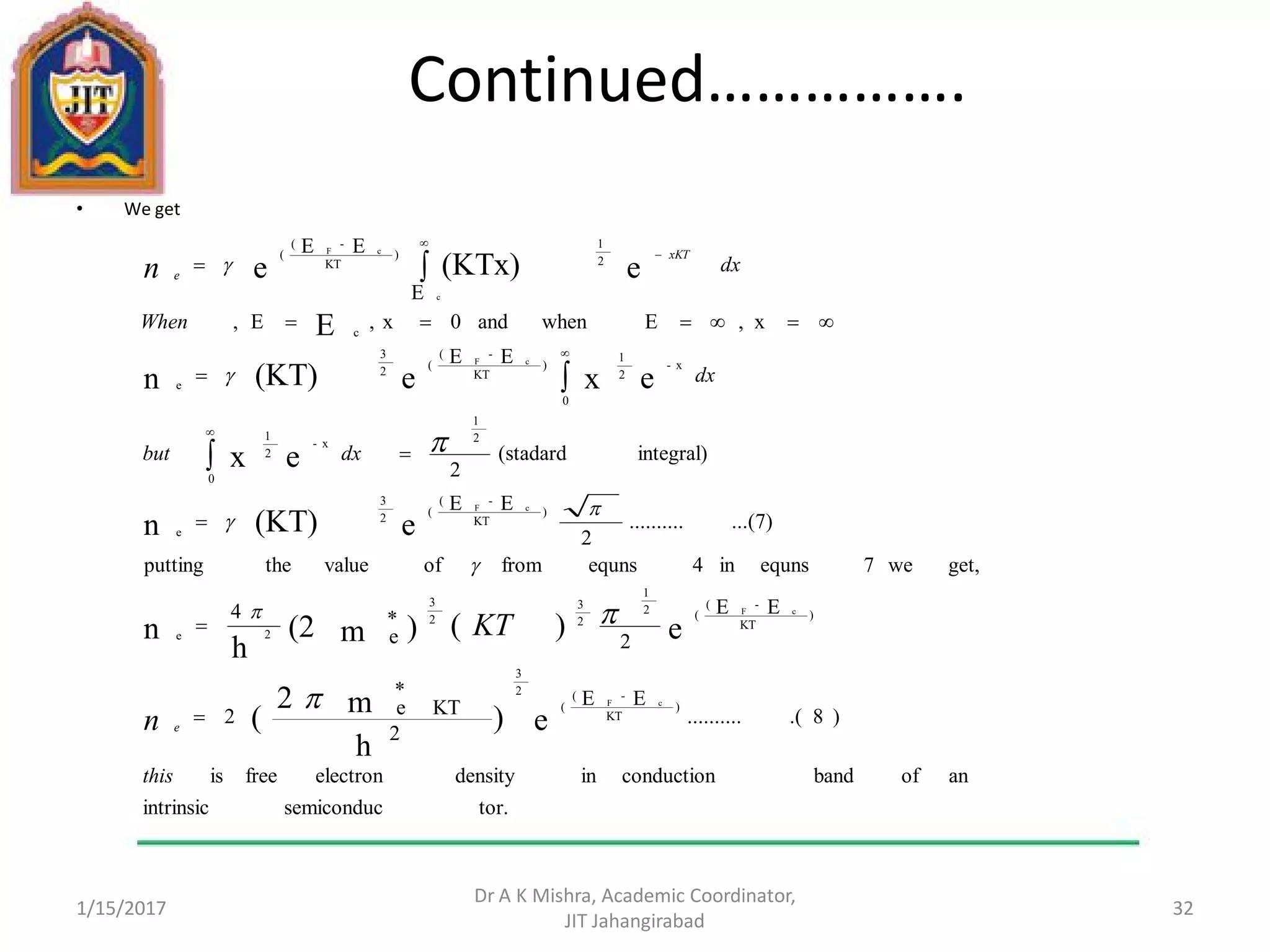
• We get
1/15/2017
Dr A K Mishra, Academic Coordinator,
JIT Jahangirabad
32
tor.semiconducintrinsic
anofbandconductionindensityelectronfreeis
)8.(..........
EE
2
*
KTe2
EE
2
*
e
4
get,we7equnsin4equnsfromofvaluetheputting
...(7)..........
2
EE
integral)(stadard
2
EE
x,Ewhenand0x,E,
E
EE
e)
h
m2
(
e)()m(2
h
n
e(KT)n
ex
exe(KT)n
E
e(KTx)e
)
KT
-(
(
2
3
)
KT
-(
(2
1
2
3
2
3
2e
)
KT
-(
(
2
3
e
2
1
x-
0
2
1
x-
0
2
1
)
KT
-(
(
2
3
e
c
2
1
)
KT
-(
(
cF
cF
cF
cF
c
cF
this
dxbut
dx
When
dx
n
KT
n
e
xKT
e























Position of Fermi level in intrinsic
semiconductors
• Width of conduction band and valence band is small as
compared to forbidden energy gap.
• All energy level in one band is same energy.
• At o k no conduction because at o k valence band is
completely filled while conduction band empty and
semiconductor behave as insulator.
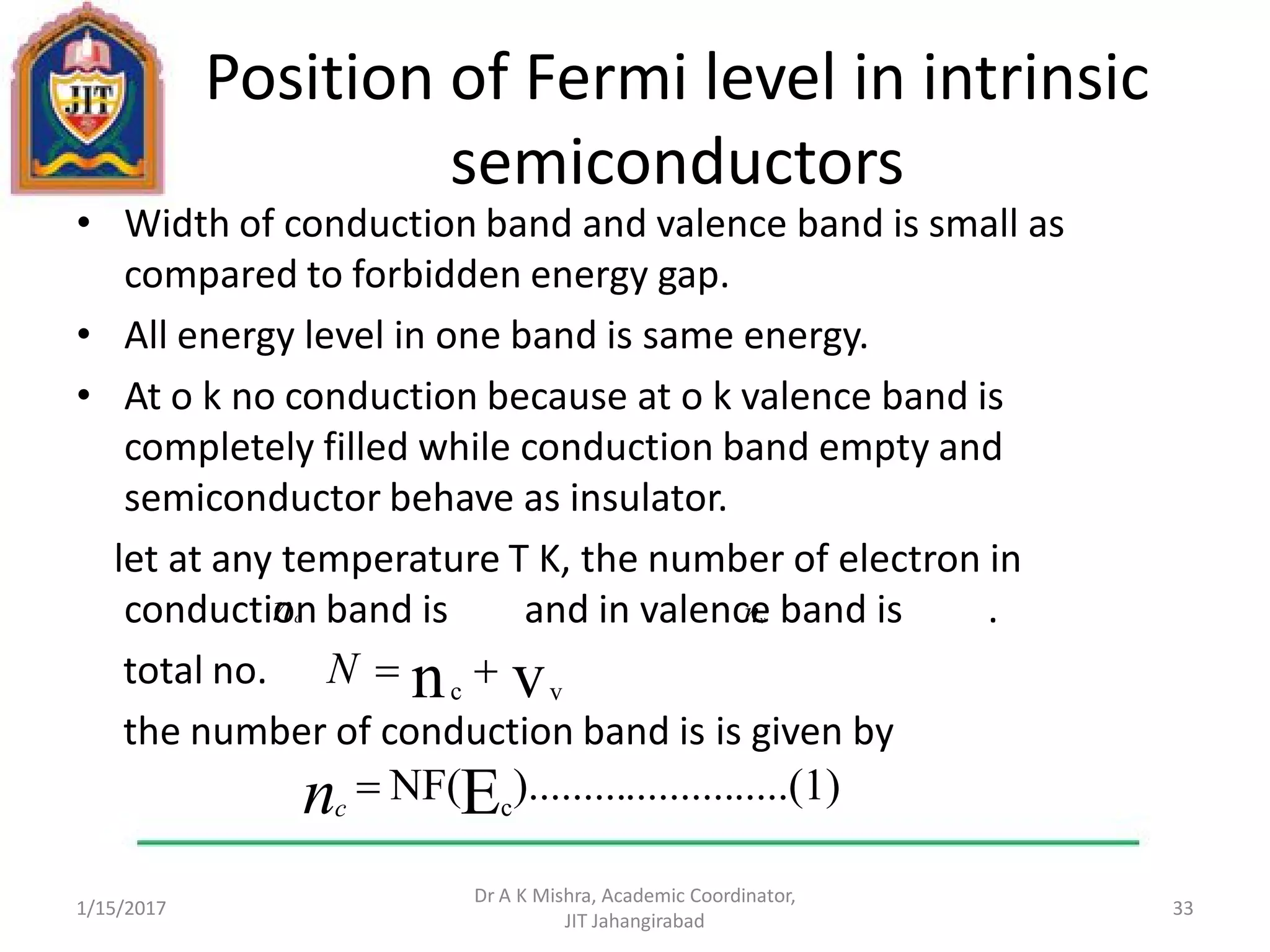
let at any temperature T K, the number of electron in
conduction band is and in valence band is .
total no.
the number of conduction band is is given by
1/15/2017
Dr A K Mishra, Academic Coordinator,
JIT Jahangirabad
33
nc nv
.....(1)..........).........NF(Ec
nc
vn vc
N
Continued………………
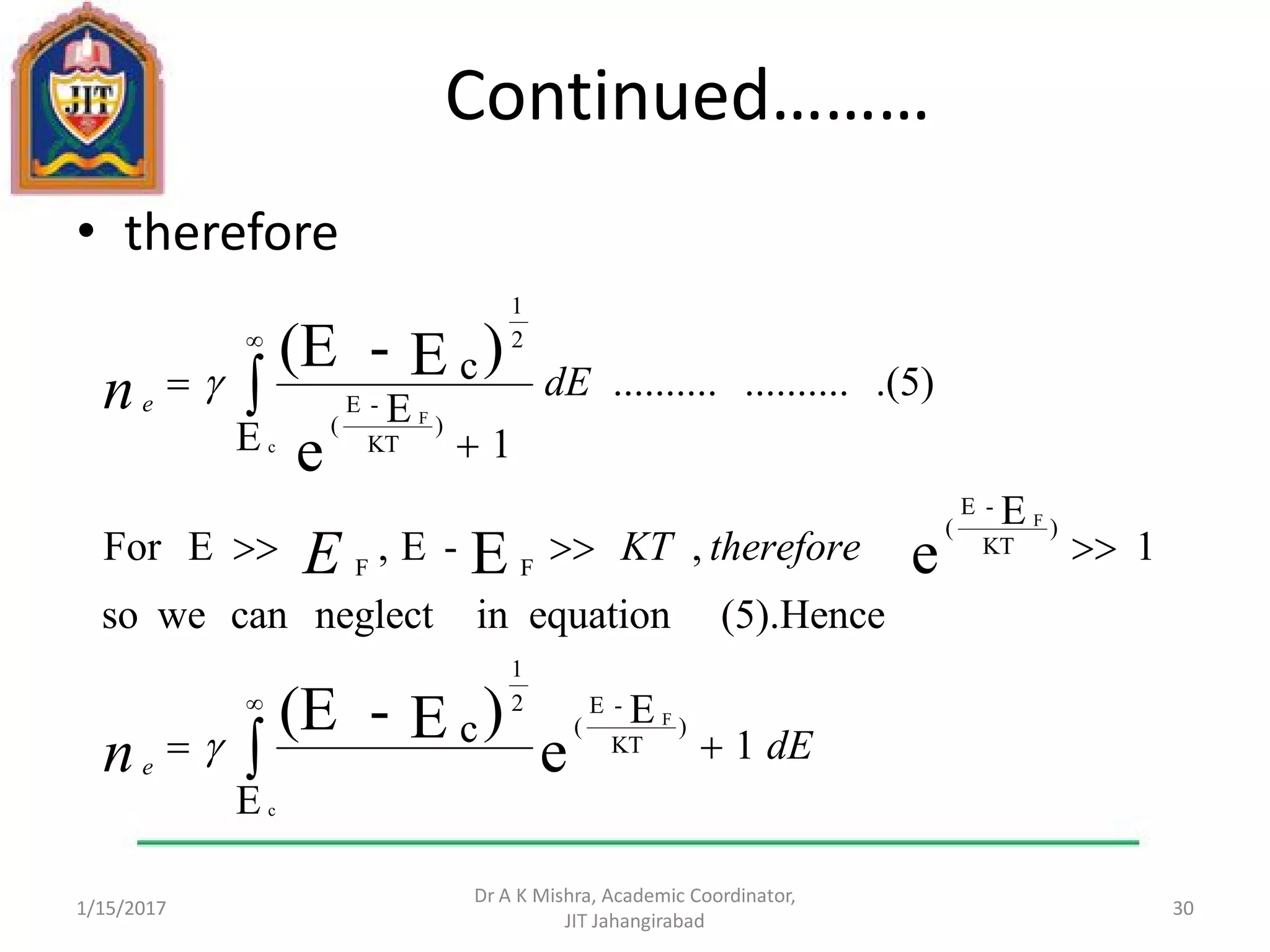
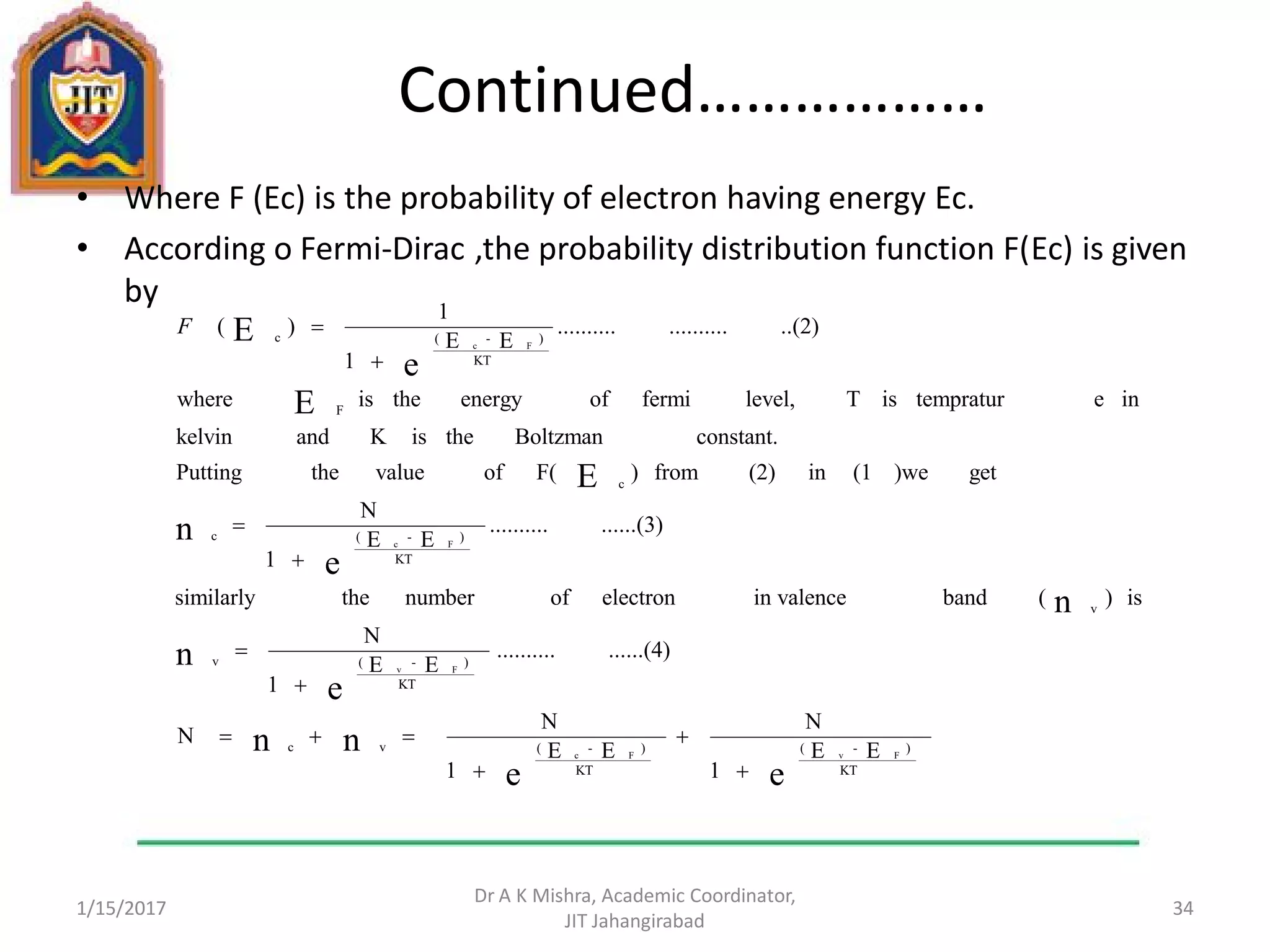
• Where F (Ec) is the probability of electron having energy Ec.
• According o Fermi-Dirac ,the probability distribution function F(Ec) is given
by
1/15/2017
Dr A K Mishra, Academic Coordinator,
JIT Jahangirabad
34
EE
1
N
EE
1
N
N
......(4)..........
EE
1
N
is)(bandin valenceelectronofnumberthesimilarly
......(3)..........
EE
1
N
get)we(1in(2)from)F(ofvaluethePutting
constant.BoltzmantheisKandkelvin
inetempraturisTlevel,fermiofenergytheiswhere
..(2)....................
EE
1
1
)(
ee
nn
e
n
n
e
n
E
E
e
E
KT
)-(
KT
)-(vc
KT
)-(v
v
KT
)-(c
c
F
KT
)-(c
FvFc
Fv
Fc
Fc









F
Continued………………
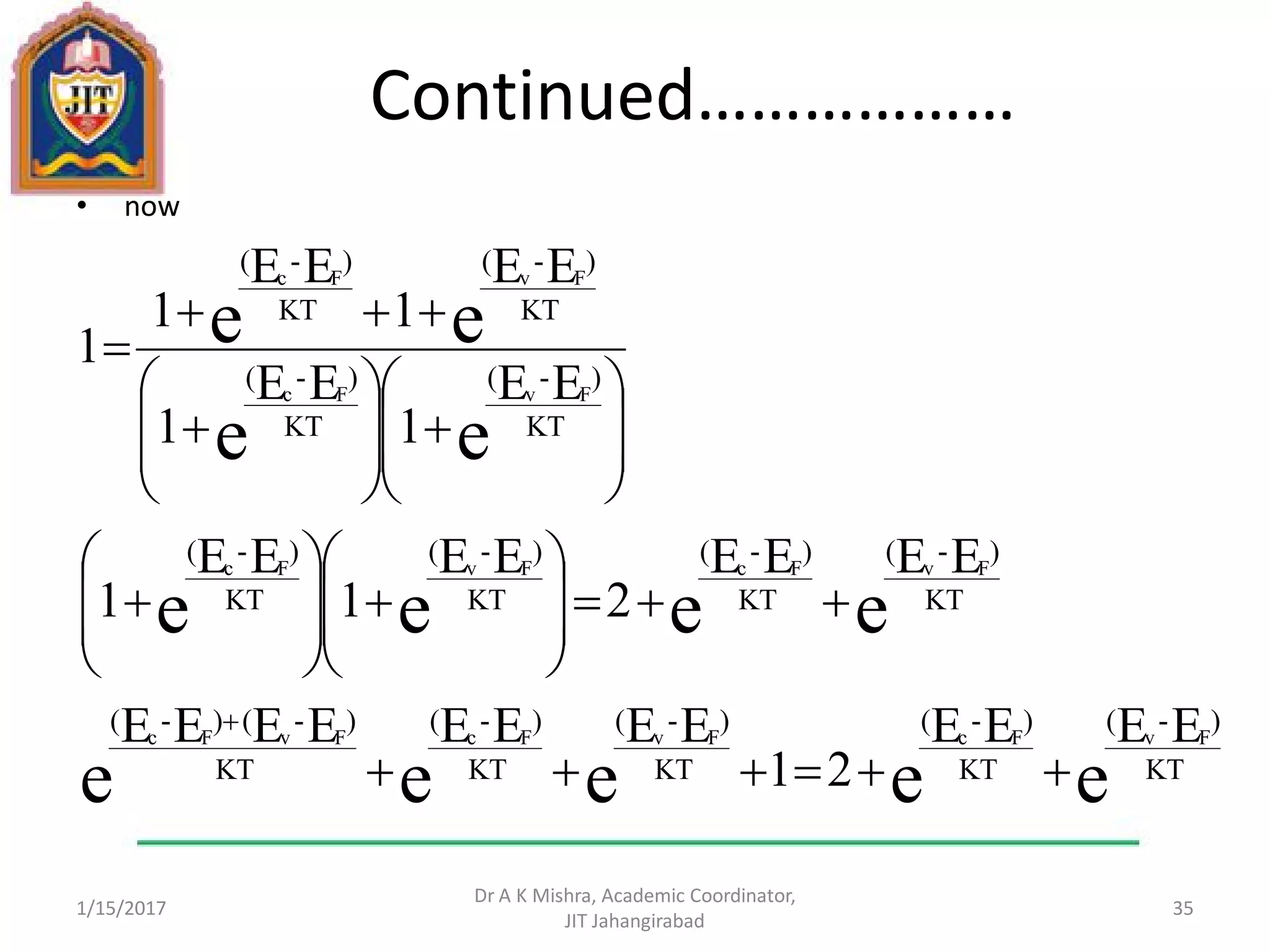
• now
1/15/2017
Dr A K Mishra, Academic Coordinator,
JIT Jahangirabad
35
eeeee
eeee
ee
ee
KT
)-(
KT
)-(
KT
)-(
KT
)-(
KT
)-()-(
KT
)-(
KT
)-(
KT
)-(
KT
)-(
KT
)-(
KT
)-(
KT
)-(
KT
)-(
EEEE
21
EEEEEEEE
EEEE
2
EE
1
EE
1
EE
1
EE
1
EE
1
EE
1
1
FvFcFvFcFvFc
FvFcFvFc
FvFc
FvFc







































Continued………………
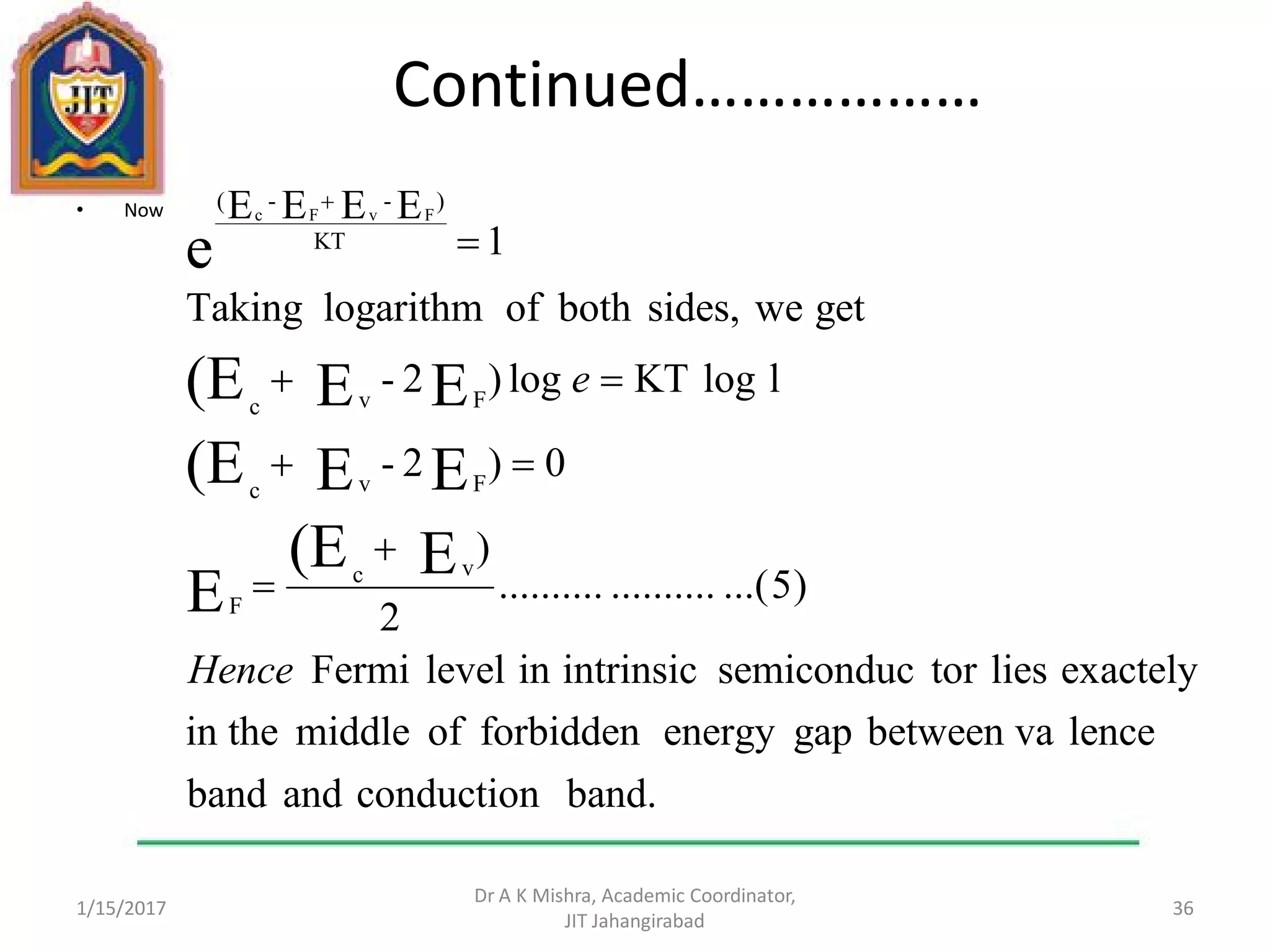
• Now
1/15/2017
Dr A K Mishra, Academic Coordinator,
JIT Jahangirabad
36
band.conductionandband
lencebetween vagapenergyforbiddenofmiddlein the
exactelyliestorsemiconducintrinsicinlevelFermi
)5...(....................
2
)
0)2-
llogKTlog)2-
getwesides,bothoflogarithmTaking
1
EEEE
E(E
E
EE(E
EE(E
e
vc
F
Fvc
Fvc
KT
)--( FvFc
Hence
e






Position of Fermi level in extrinsic
semiconductors
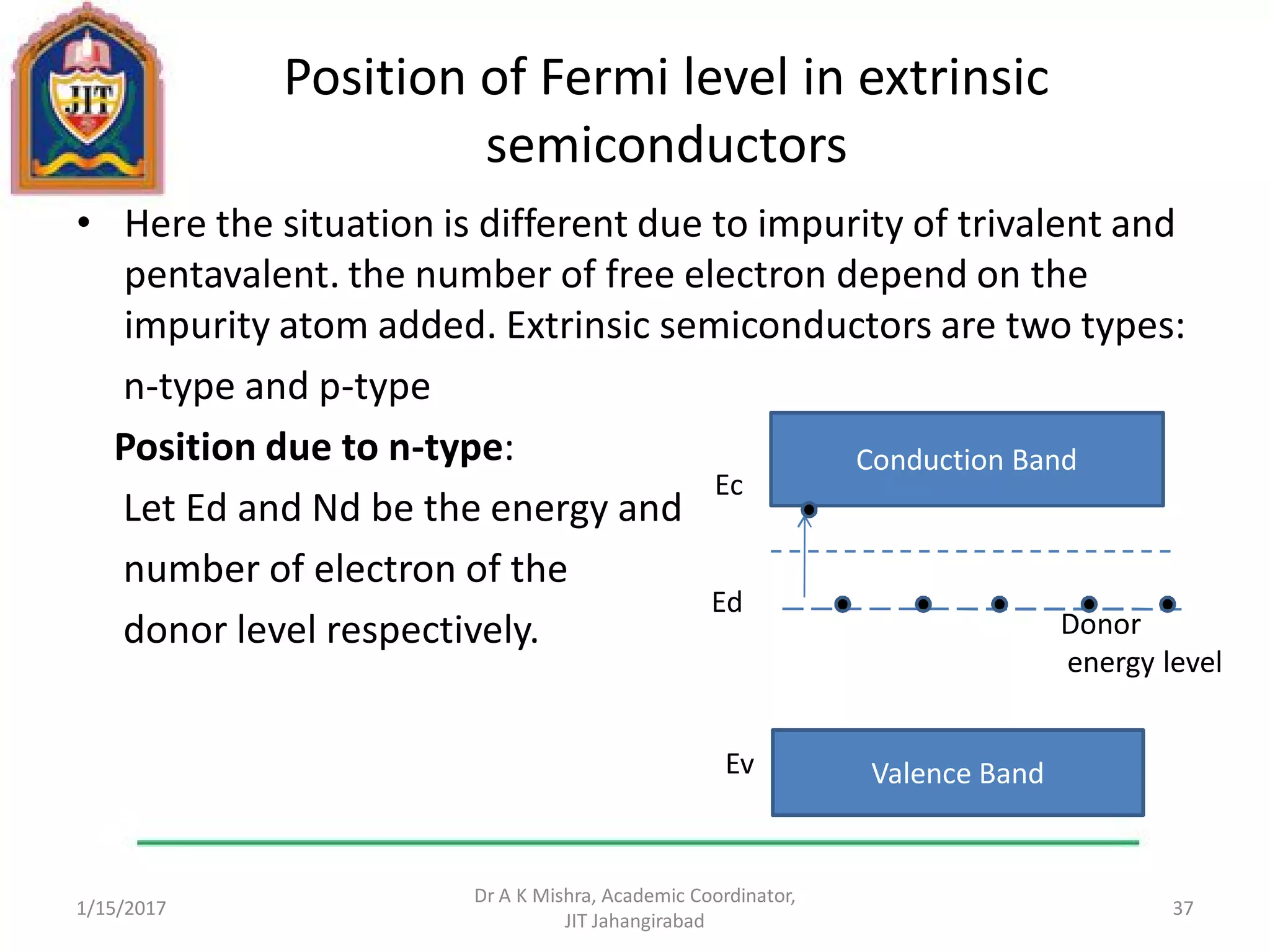
• Here the situation is different due to impurity of trivalent and
pentavalent. the number of free electron depend on the
impurity atom added. Extrinsic semiconductors are two types:
n-type and p-type
Position due to n-type:
Let Ed and Nd be the energy and
number of electron of the
donor level respectively.
1/15/2017
Dr A K Mishra, Academic Coordinator,
JIT Jahangirabad
37
Valence Band
Donor
energy level
Conduction Band
Ed
Ec
Ev
Continued…………….
• The number of vacancies per unit volume in
the donor level is
1/15/2017
Dr A K Mishra, Academic Coordinator,
JIT Jahangirabad
38
  













































































e
e
e
eN
e
N
1
KT
-
KT
-
1
KT
-
1-1
KT
-
d
1
KT
-d
EE
EE
donoremptyofDensity
EE
EE
donoremptyofDensity
electronsby
occupiedbetoEstateenergyofprobabiltyis(E)F
EE
1
-1EF-1
Fd
Fd
Fd
Fd
Fd
N
N
d
d
where
Continued……………..
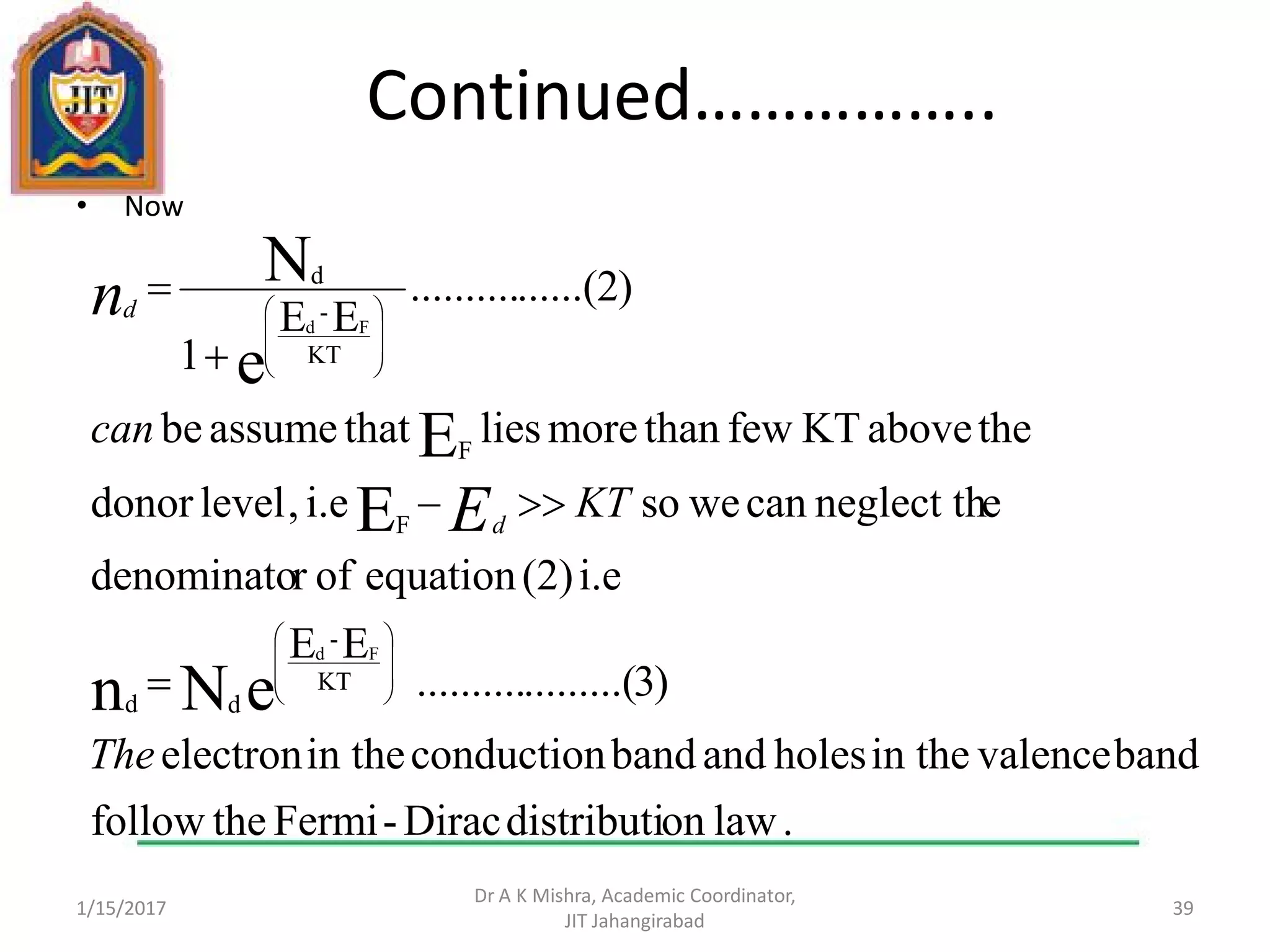
• Now
1/15/2017
Dr A K Mishra, Academic Coordinator,
JIT Jahangirabad
39
.lawondistributiDirac-Fermithefollow
bandvalencein theholesandbandconductionin theelectron
)3.........(..........
EE
i.e(2)equationofrdenominato
eneglect thcanwesoi.e,leveldonor
theaboveKTfewthanmoreliesthatassumebe
)2......(..........
EE
1
eNn
E
E
e
N
KT
-
dd
F
F
KT
-
d
Fd
Fd
The
KT
can
E
n
d
d




















Continued……………..
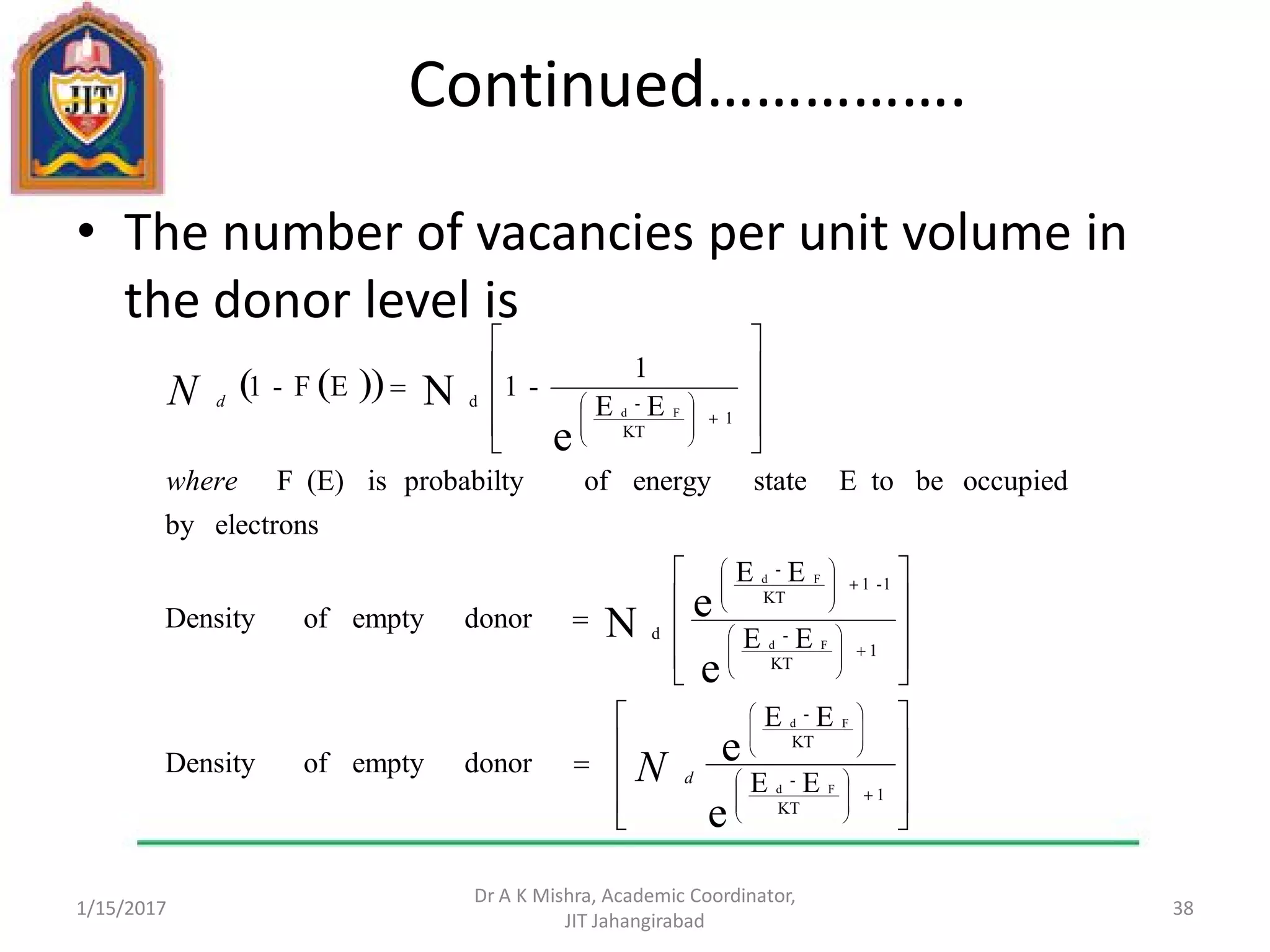
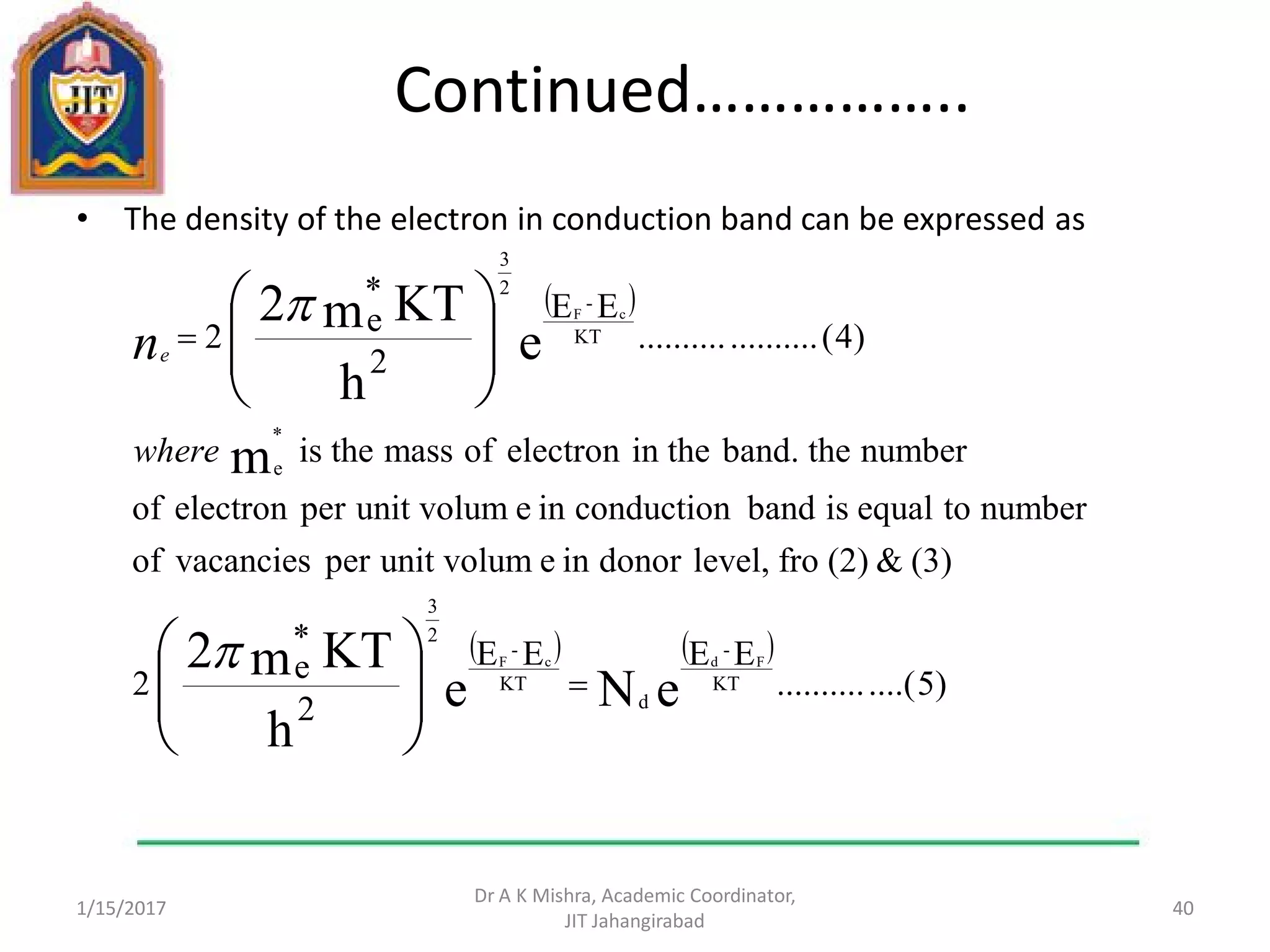
• The density of the electron in conduction band can be expressed as
1/15/2017
Dr A K Mishra, Academic Coordinator,
JIT Jahangirabad
40
 
   
)5....(..........
EEEE
2
*
e2
(3)&(2)frolevel,donorineunit volumpervacanciesof
numbertoequalisbandconductionineunit volumperelectronof
numbertheband.in theelectronofmasstheis
)4(....................
EE
2
*
e2
eNe
h
KTm2
m
e
h
KTm2
KT
-
d
KT
-
2
3
*
e
KT
-
2
3
FdcF
cF
















where
ne
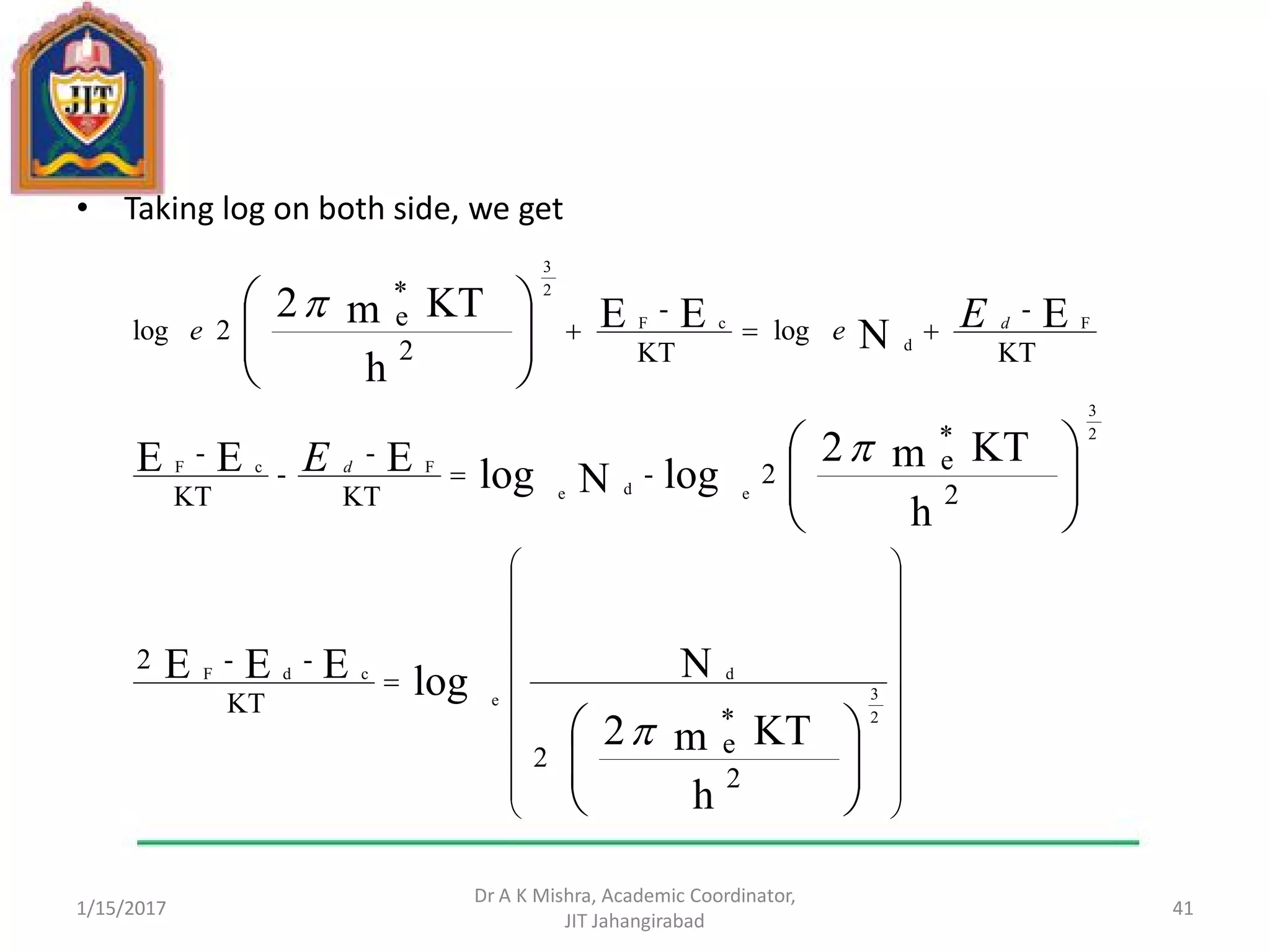
• Taking log on both side, we get
1/15/2017
Dr A K Mishra, Academic Coordinator,
JIT Jahangirabad
41









































h
KTm2
NlogEEE
h
KTm2
logNlogEEE
ENEE
h
KTm2
2
*
e2
KT
--2
2
*
e2-
KT
-
-
KT
-
KT
-
log
KT
-
2
*
e2log
2
3
d
e
cdF
2
3
ede
FcF
F
d
cF
2
3



E
E
d
d
ee
Continued………..
1/15/2017
Dr A K Mishra, Academic Coordinator,
JIT Jahangirabad
42
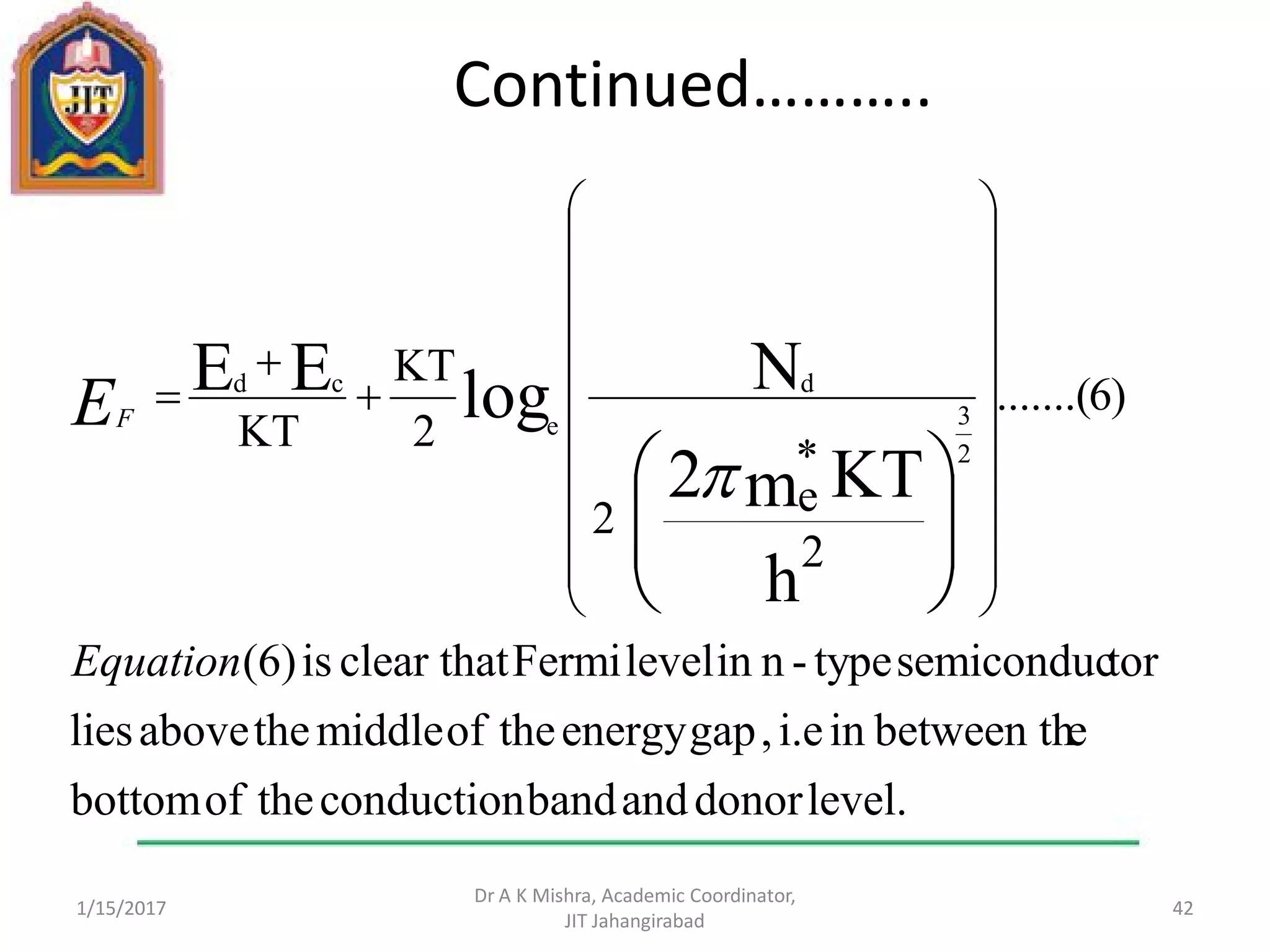
level.donorandbandconductiontheofbottom
ebetween thini.e,gapenergytheofmiddletheabovelies
torsemiconductype-ninlevelFermiclear thatis(6)
)6.......(
2
*
e2
2
KT
KT
h
KTm2
NlogEE
2
3
d
e
cd
Equation
EF




























 
Position due to p-type
1/15/2017
Dr A K Mishra, Academic Coordinator,
JIT Jahangirabad
43
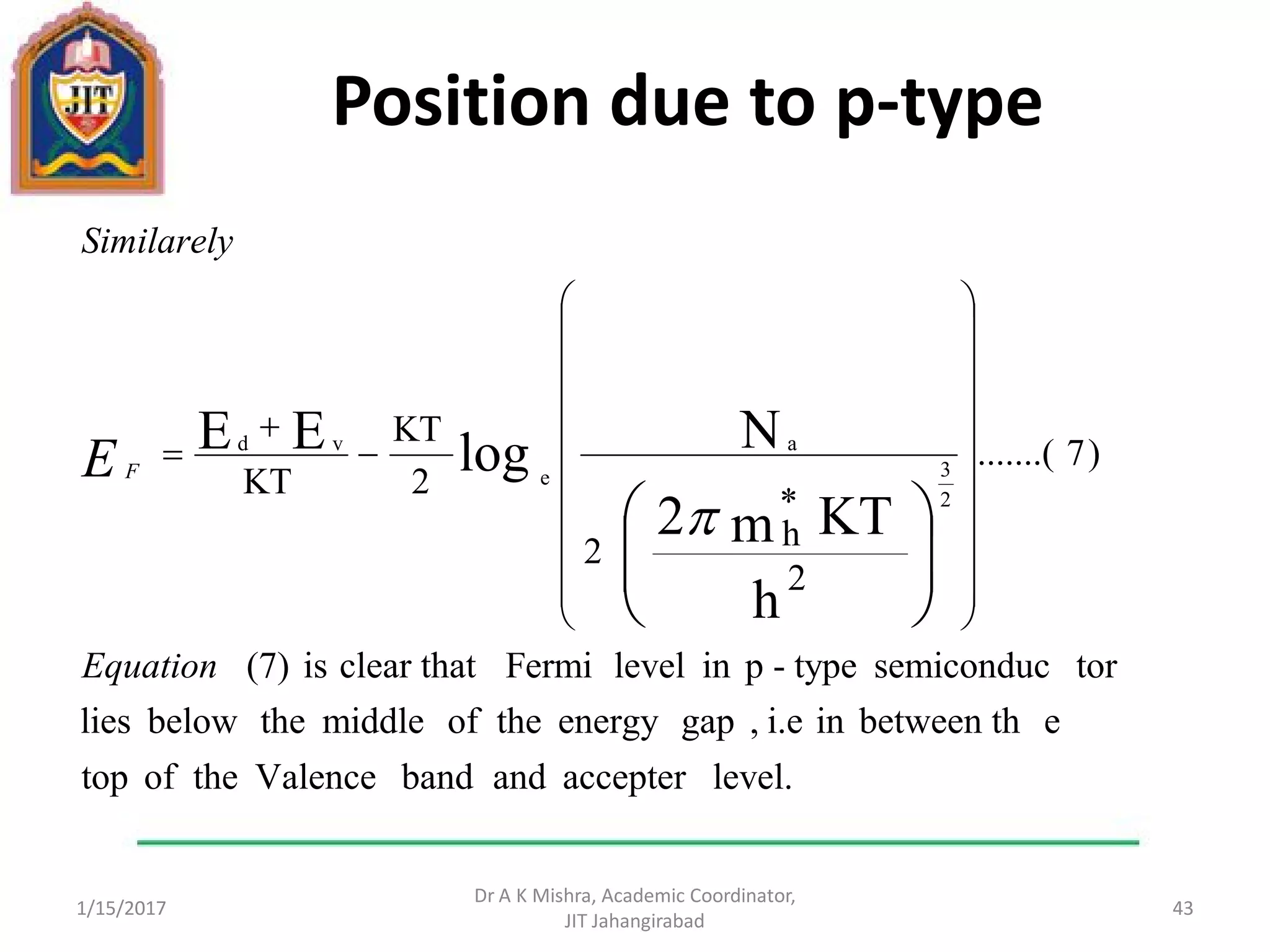
level.accepterandbandValencetheoftop
ebetween thini.e,gapenergytheofmiddlethebelowlies
torsemiconductype-pinlevelFermiclear thatis(7)
)7.......(
2
*
h2
2
KT
KT
h
KTm2
NlogEE
2
3
a
e
vd
Equation
Similarely
E F




























 
Conductivity of semiconductors
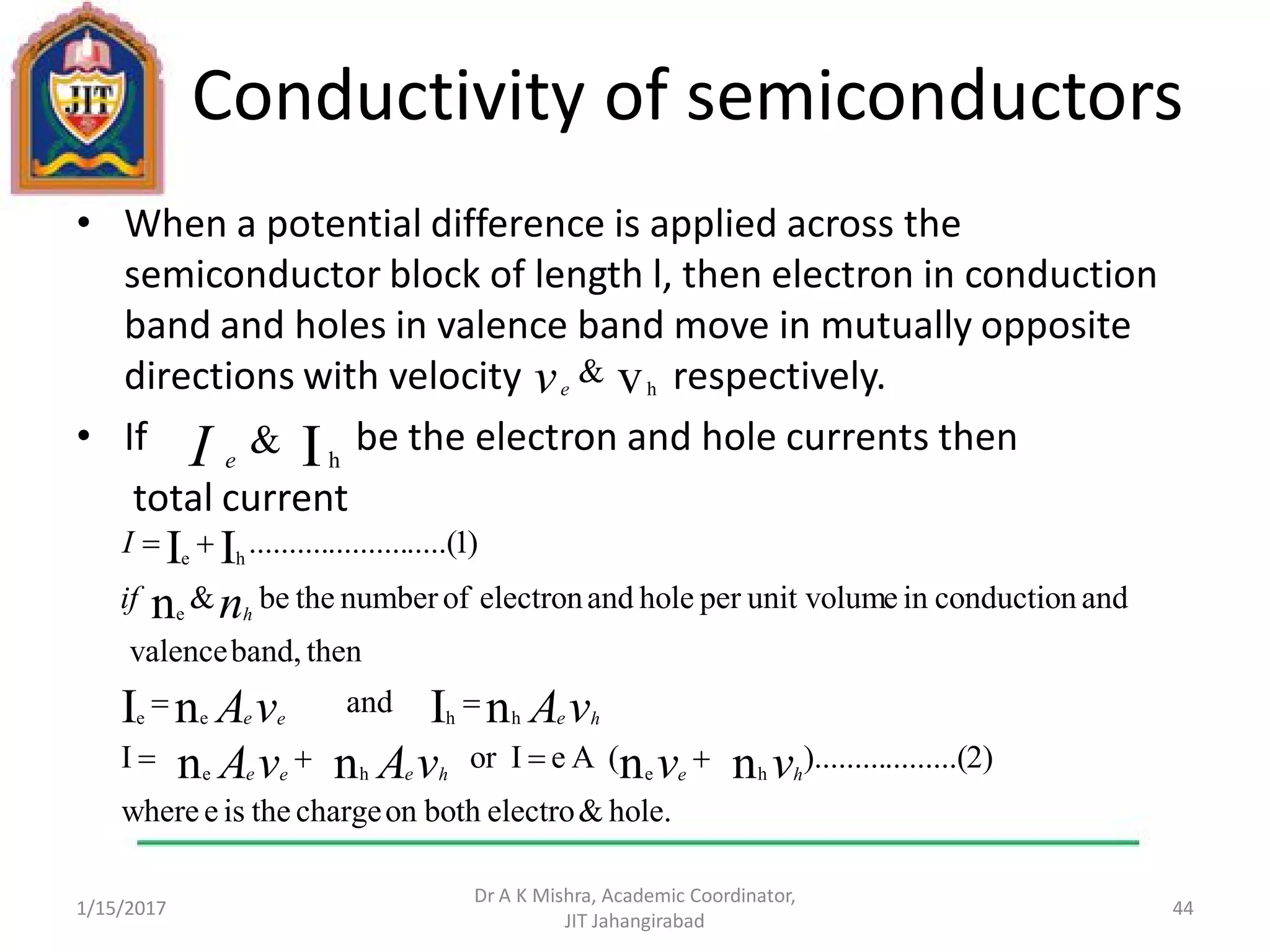
• When a potential difference is applied across the
semiconductor block of length l, then electron in conduction
band and holes in valence band move in mutually opposite
directions with velocity respectively.
• If be the electron and hole currents then
total current
1/15/2017
Dr A K Mishra, Academic Coordinator,
JIT Jahangirabad
44
vh
&ve
Ih
&I e
hole.&electrobothonchargetheisewhere
2).........().........(AeIorI
and
thenband,valence
andconductionineunit volumperholeandelectronofnumberthebe&
)1.....(....................
nnnn
nInI
n
II
hehe
hhee
e
he
vvvAvA
vAvA
n
heheee
heee
h
if
I



Continued………….
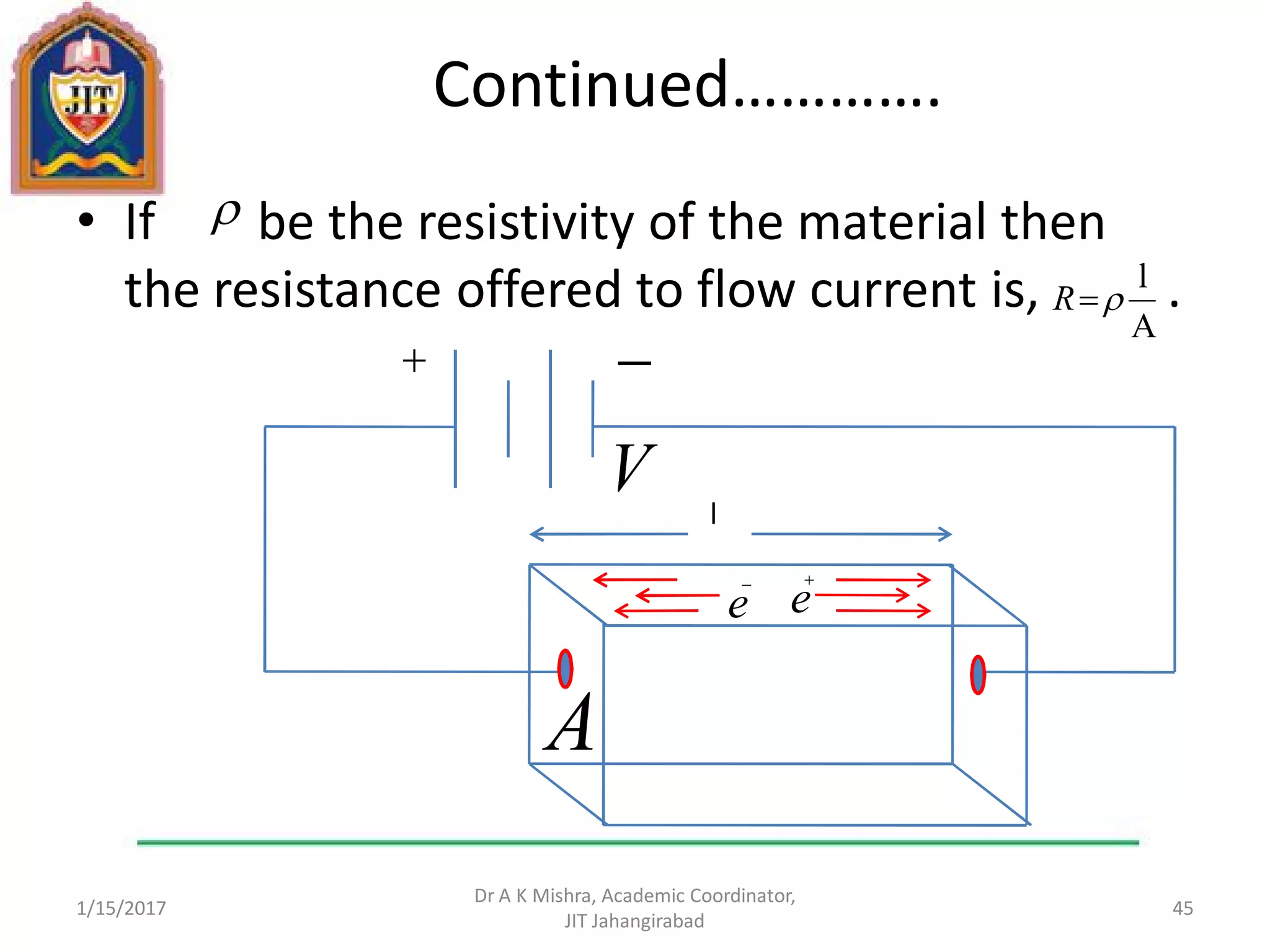
• If be the resistivity of the material then
the resistance offered to flow current is, .
1/15/2017
Dr A K Mishra, Academic Coordinator,
JIT Jahangirabad
45

A
l
R

e

e


V
A
l
Continued……………..
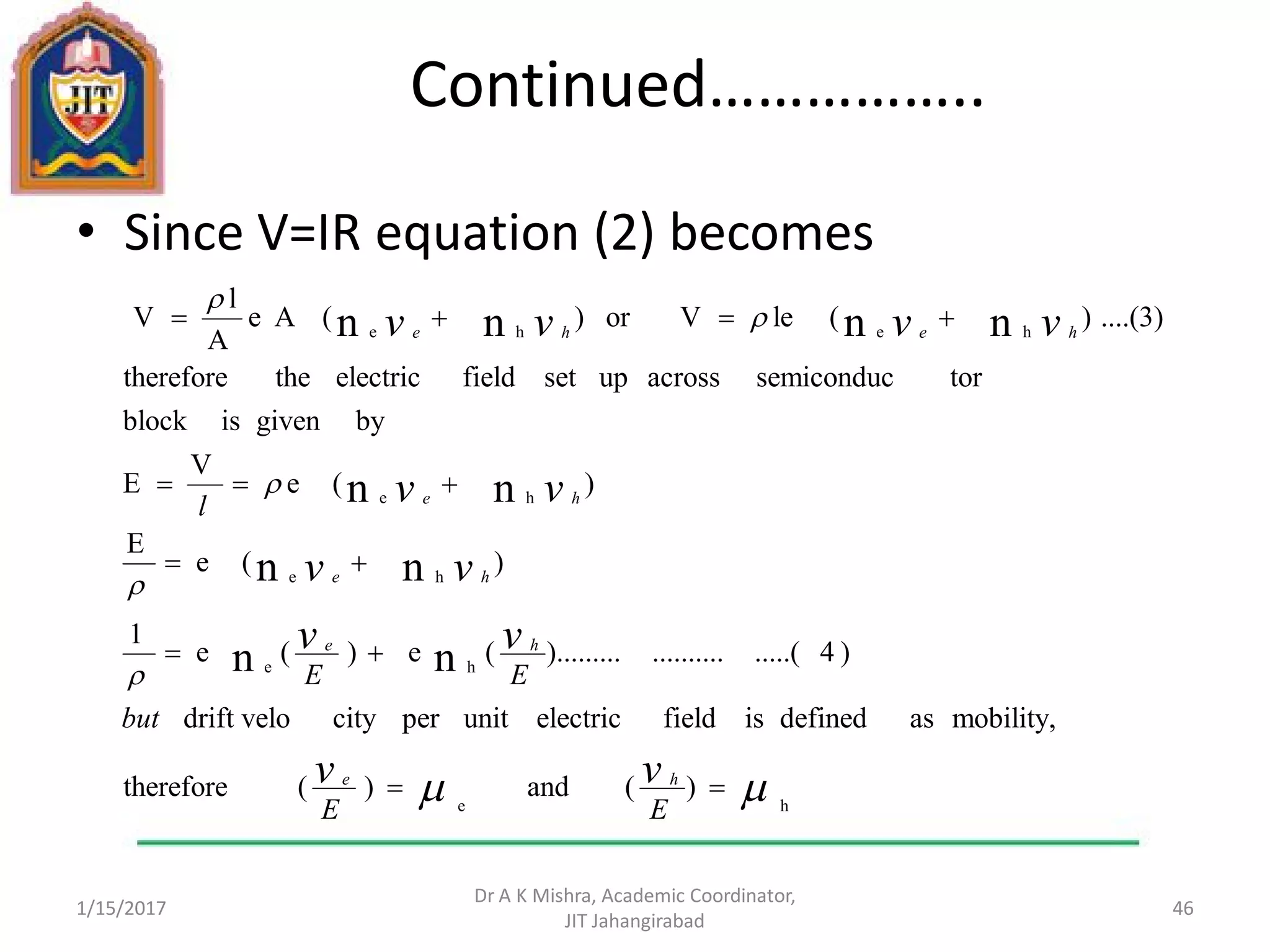
• Since V=IR equation (2) becomes
1/15/2017
Dr A K Mishra, Academic Coordinator,
JIT Jahangirabad
46
)(and)(therefore
mobility,asdefinedisfieldelectricunitpercitydrift velo
)4.....(..........).........(e)(e
1
)(e
E
)(e
V
E
bygivenisblock
torsemiconducacrossupsetfieldelectricthetherefore
....(3))(leVor)(Ae
A
l
V
he
he
he
he
hehe
nn
nn
nn
nnnn











EE
but
EE
l
vv
vv
vv
vv
vvvv
he
he
he
he
hehe
Continued……………..
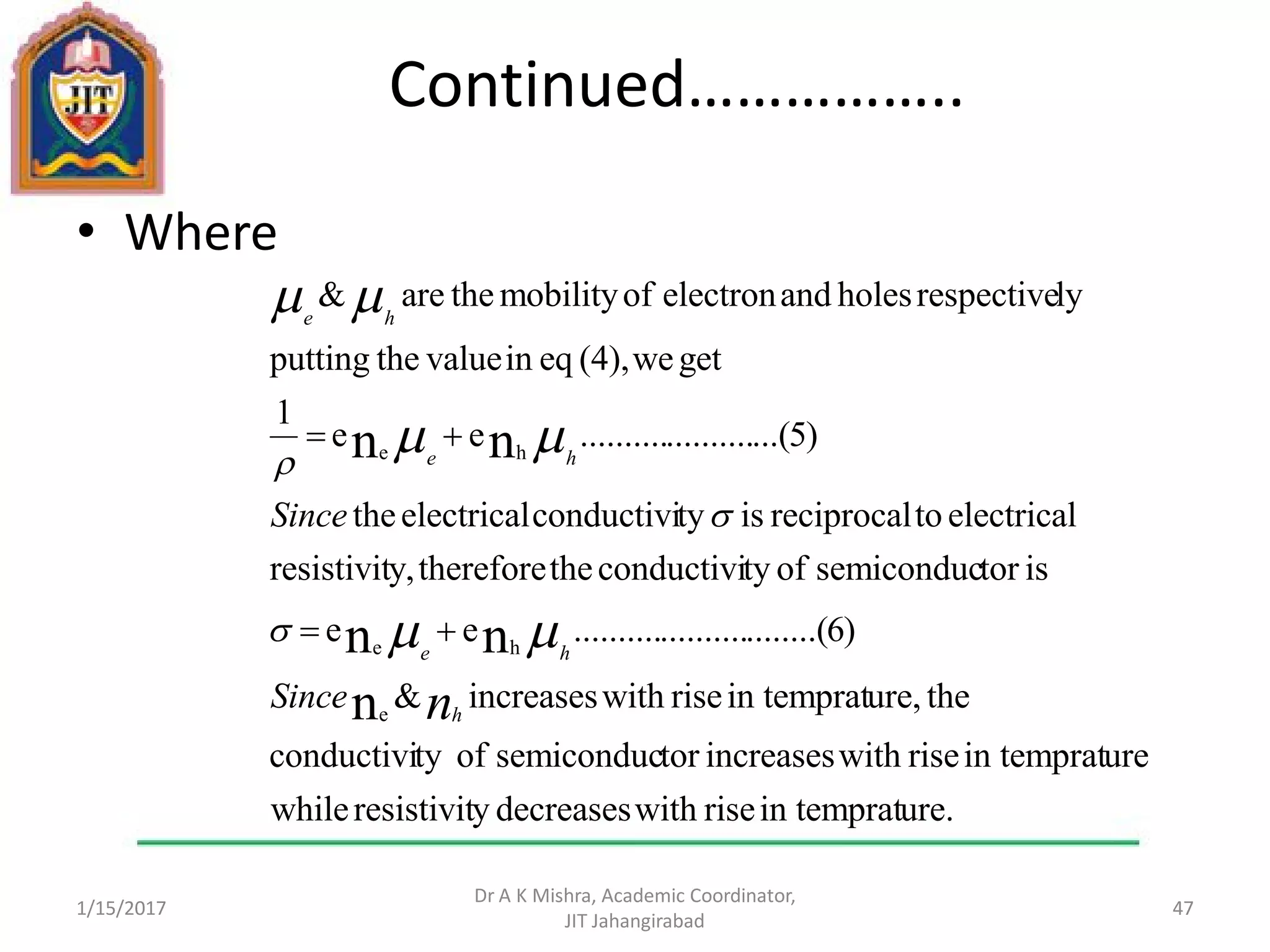
• Where
1/15/2017
Dr A K Mishra, Academic Coordinator,
JIT Jahangirabad
47
ure.in tempratrisewithdecreasesyresistivitwhile
urein tempratrisewithincreasestorsemiconducoftyconductivi
theure,in tempratrisewithincreases&
)6........(....................ee
istorsemiconducoftyconductivithethereforey,resistivit
electricaltoreciprocalistyconductivielectricalthe
)5...(....................ee
1
getwe(4),eqinvaluetheputting
lyrespectiveholesandelectronofmobilitytheare&
n
nn
nn
e
he
he
nh
he
he
he
Since
Since








Temperature dependence of
conductivity in semiconductors
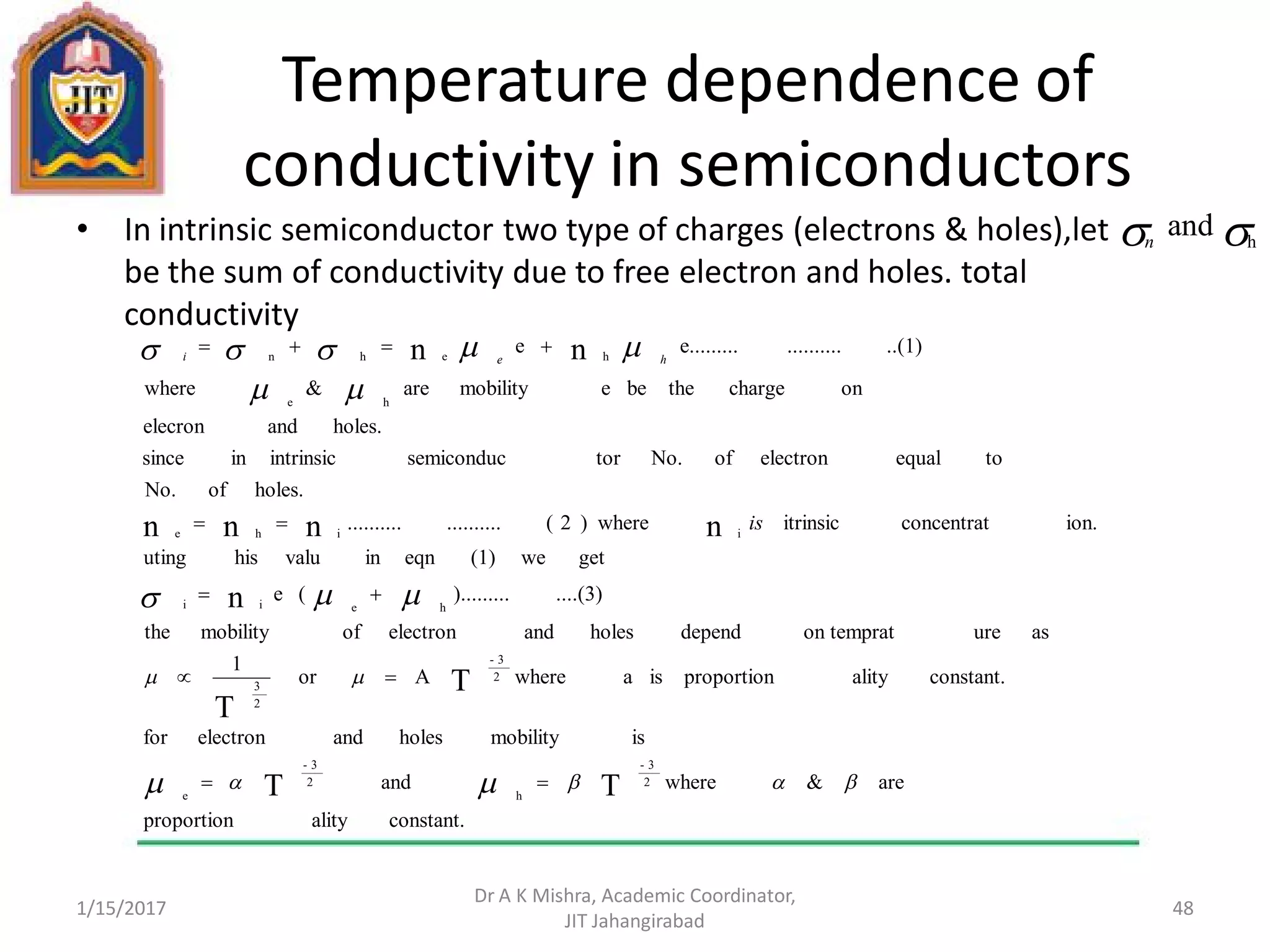
• In intrinsic semiconductor two type of charges (electrons & holes),let
be the sum of conductivity due to free electron and holes. total
conductivity
1/15/2017
Dr A K Mishra, Academic Coordinator,
JIT Jahangirabad
48
 h
andn
constant.alityproportion
are&whereand
ismobilityholesandelectronfor
constant.alityproportionisawhereAor
1
asureon tempratdependholesandelectronofmobilitythe
....(3)).........(e
getwe(1)eqninvaluhisuting
ion.concentratitrinsicwhere)2(....................
holes.ofNo.
toequalelectronofNo.torsemiconducintrinsicinsince
holes.andelecron
onchargethebeemobilityare&where
..(1)..........e.........e
TT
T
T
n
nnnn
nn
2
3-
h
2
3-
e
2
3-
2
3
heii
iihe
he
hehn











is
hei
Continued…………
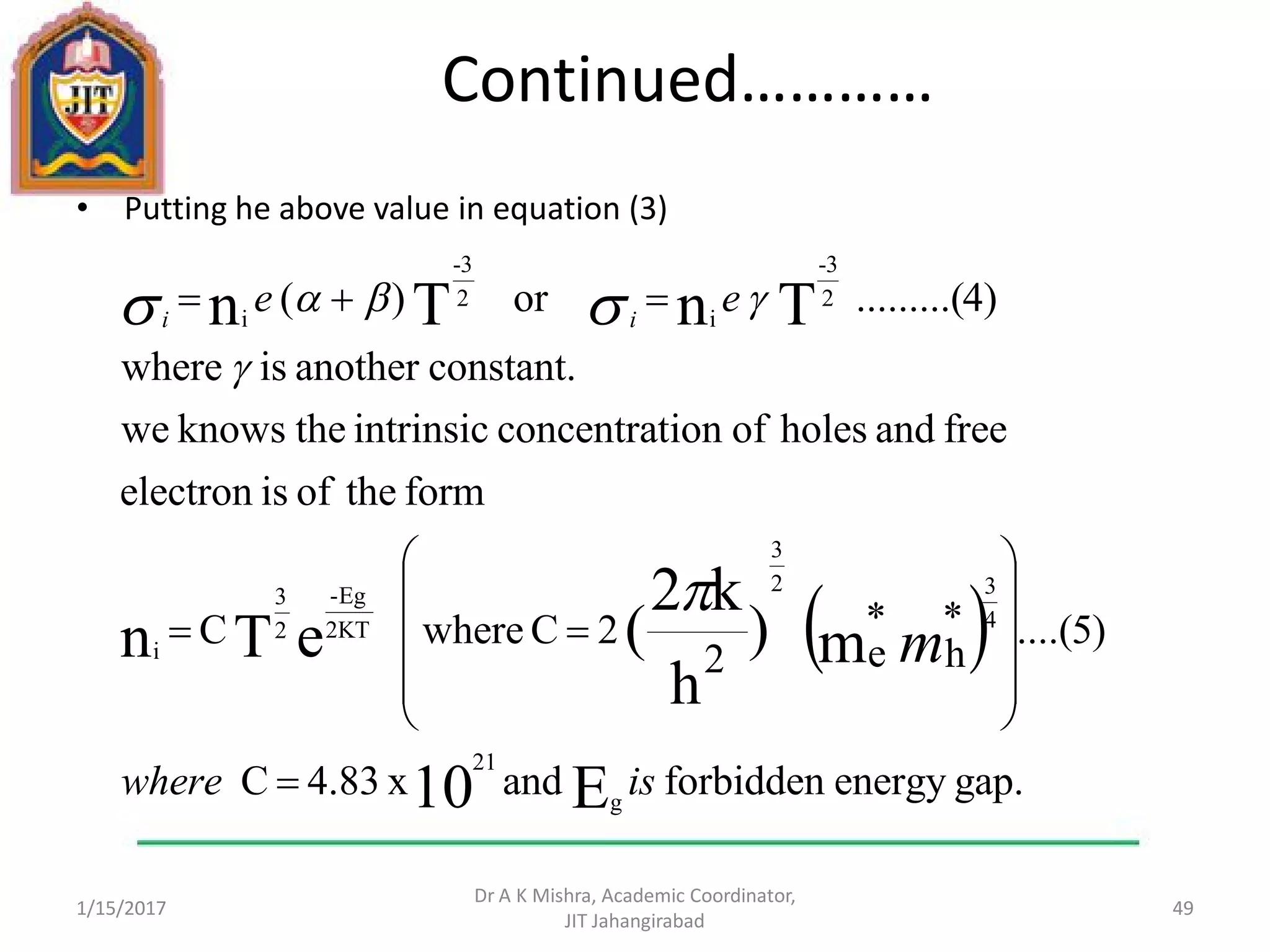
• Putting he above value in equation (3)
1/15/2017
Dr A K Mishra, Academic Coordinator,
JIT Jahangirabad
49
 
gap.energyforbiddenandx4.83C
)5....(*
h
*
e2
2CwhereC
formtheofiselectron
freeandholesofionconcentratintrinsictheknowswe
constant.anotheriswhere
4).........(or)(
E10
m)
h
k2
(eTn
TnTn
g
21
4
32
3
2KT
Eg-
2
3
i
2
-3
i
2
-3
i
iswhere
ee
m
ii

















Continued…………..
• Putting this value of from (5) to (4) we get
1/15/2017
Dr A K Mishra, Academic Coordinator,
JIT Jahangirabad
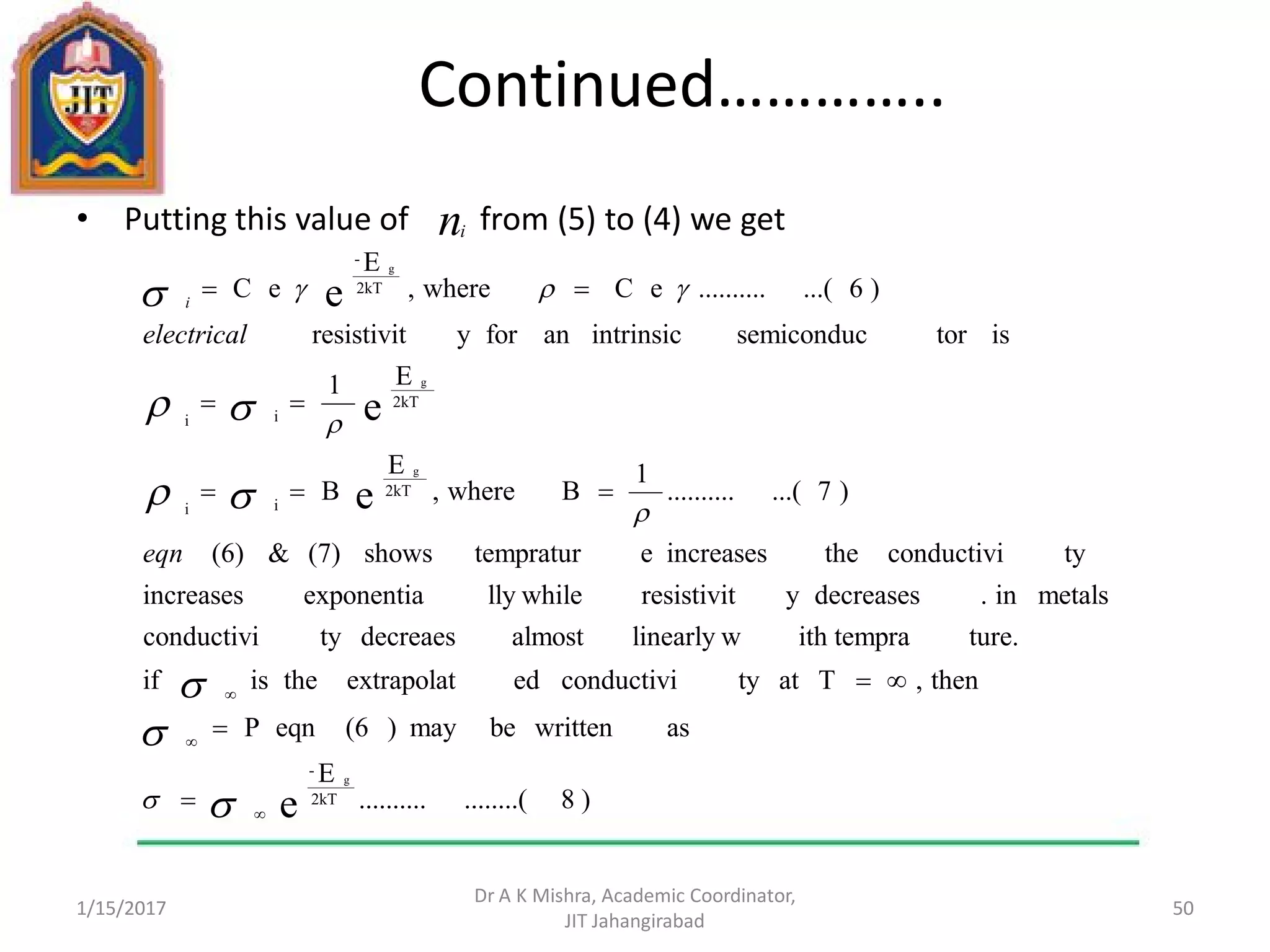
50
ni
)8........(..........
E
aswrittenbemay)(6eqnP
then,Tattyconductiviedextrapolattheisif
ture.ith tempralinearly walmostdecreaestyconductivi
metalsin.decreasesyresistivitlly whileexponentiaincreases
tyconductivitheincreasesetempraturshows(7)&(6)
)7...(..........
1
Bwhere,
E
B
E1
istorsemiconducintrinsicanforyresistivit
)6...(..........eCwhere,
E
eC
e
e
e
e
2kT
-
2kT
ii
2kT
ii
2kT
-
g
g
g
g



















eqn
electrical
i
Continued……………
• Taking log on both side we get
1/15/2017
Dr A K Mishra, Academic Coordinator,
JIT Jahangirabad
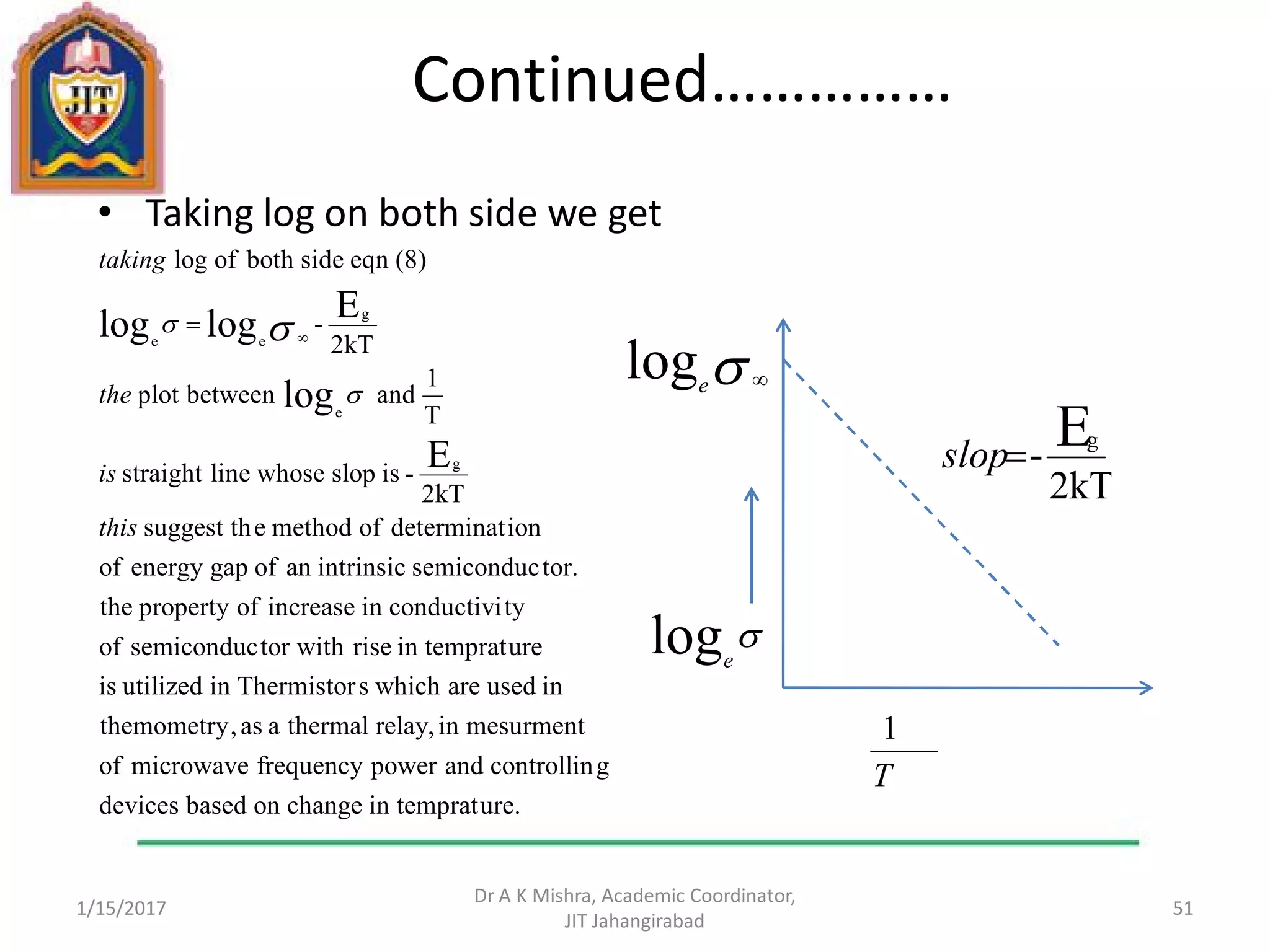
51
loge
loge
2kT
-
Eg
slop
T
1
ure.in tempratchangeonbaseddevices
gcontrollinandpowerfrequencymicrowaveof
mesurmentinrelay,thermalaas,themometry
inusedarewhichsThermistorinutilizedis
urein tempratrisetor withsemiconducof
tyconductiviinincreaseofpropertythe
tor.semiconducintrinsicanofgapenergyof
iondeterminatofmethodesuggest th
2kT
-isslopwhoselinestraight
T
1
andbetweenplot
2kT
-
(8)eqnsidebothoflog
E
log
Eloglog
g
e
g
ee
this
is
the
taking

  


SEMICONDUCTORS,BAND THEORY OF SOLIDS,FERMI-DIRAC PROBABILITY,DISTRIBUTION FUNCTION

  • 1.
    1/15/2017 1 Dr AK Mishra, Academic Coordinator, JIT Jahangirabad Engineering Physics II Unit IV Presentation By Dr.A.K.Mishra Associate Professor Jahangirabad Institute of Technology, Barabanki Email: akmishra.phy@gmail.com Arun.Kumar@jit.edu.in
  • 2.
    SEMICONDUCTOR • The branchof engineering which deals with current con-duction through a vacuum or gas or semiconductor is known as electronics. • Electronics essentially deals with electronic devices and their utilization. • An electronic device is that in which current flows through a vacuum or gas or semiconductor. • Principles of Electronics • The last orbit cannot have more than 8 electrons. • The last but one orbit cannot have more than 18 electrons Structure of Elements • Atoms are made up of protons, neutrons and electrons. • The difference between various types of elements is due to the different number and arrangement. 1/15/2017 Dr A K Mishra, Academic Coordinator, JIT Jahangirabad 2
  • 3.
    Continued…………. • The structureof copper atom is different from that of carbon atom and hence the two elements have different properties. • The atomic structure can be easily built up according to atomic weight and atomic number of the element. Taking the case of copper atom, • Atomic weight = 64 • Atomic number = 29 ∴ No. of protons = No. of electrons = 29 No. of neutrons = 64 −29 = 35 It has 29 electrons which are arranged in different orbits. 1/15/2017 Dr A K Mishra, Academic Coordinator, JIT Jahangirabad 3 P=29 N=35
  • 4.
    Continued…………….. • An electronis a negatively charged particle having negligible mass. Some of the important properties of an electron are • Charge on an electron= 1.602 ×10⁻¹⁹coulomb • Mass of an electron= 9.0 ×10⁻³¹kg • Radius of an electron= 1.9 ×10⁻¹⁵metre • The ratio e/m of an electron is 1.77 ×10¹¹coulombs/kg. • This means that mass of an electron is very small as compared to its charge • The total energy of the electron is the sum of (KE +PE ). • The energy of an electron increases as its distance from the nucleus increases. 1/15/2017 Dr A K Mishra, Academic Coordinator, JIT Jahangirabad 4
  • 5.
    Continued…………… • 1/15/2017 Dr A KMishra, Academic Coordinator, JIT Jahangirabad 5 Energy levels increase as the distance from the nucleus increases.  v v v v v v v v v v v v v v v              Energy level Nucleus Shell 1
  • 6.
    Valence Electrons • Theelectrons in the outermost orbit of an atom are known as valence electrons. • The outermost orbit can have a maximum of 8 electrons i.e.the maximum number of valence electrons can be 8. • The valence electrons determine the physical and chemical properties of a material. • These electrons also determine the electrical properties of a material. • On the basis of electrical conductivity, materials are generally classified into Conductors insulators and semi-conductors. • the number of valence electrons of an atom is less than 4 (i.e.half of the maximum eight electrons), the material is usually a metal and a conductor Examples are sodium, magnesium and aluminum which have 1, 2 and 3 valence electrons respectively. 1/15/2017 Dr A K Mishra, Academic Coordinator, JIT Jahangirabad 6
  • 7.
    Continued…………….. 1/15/2017 Dr A KMishra, Academic Coordinator, JIT Jahangirabad 7
  • 8.
    Band Theory ofSolids Band Theory: 1/15/2017 Dr A K Mishra, Academic Coordinator, JIT Jahangirabad 8 No.1 No.2 No.3 No.4 No.5 Electron energy Nucleus containing Positively charge proton v v Orbital electron Negatively charge In isolated atoms the electrons are arranged in energy levels Isolated atom Energylevel
  • 9.
    Band Theory ofSolids • A useful way to visualize the difference between conductors, insulators and semiconductors is to plot the available energies for electrons in the materials. Instead of having discrete energies as in the case of free atoms, the available energy states form bands. • Conduction process is whether or not there are electrons in the conduction band. • In insulators the electrons in the valence band are separated by a large gap from the conduction band. • in conductors like metals the valence band overlaps the conduction band, and in semiconductors there is a small enough gap between the valence and conduction bands that thermal or other excitations can bridge the gap. With such a small gap, the presence of a small percentage of a doping material can increase conductivity dramatically. 1/15/2017 Dr A K Mishra, Academic Coordinator, JIT Jahangirabad 9
  • 10.
    Continued…………………… 1/15/2017 Dr A KMishra, Academic Coordinator, JIT Jahangirabad 10 Insulator (a) Semiconductor (b) Conductor (c) Valance Band Conduction Band Large energy gap In Insulators, at ordinary Temperature no electron Reach the conduction band Valance Band Conduction Band Conduction Band Valance Band Energy of Electron In semiconductor the energy gap Small the thermal energy can bridge The gap for a small fraction. In conductor there Is no gap in valance and conduction band, they Almost overlap each other.
  • 11.
    Insulators, Conductors, andSemiconductors materials are made up of atoms. These atoms contribute to the electrical properties of a material, including its ability to conduct electrical current. For purposes of discussing electrical properties, an atom can be represented by the valence shell and a core that consists of all the inner shells and the nucleus. This concept can be understand as Carbon is used in some types of electrical resistors. Notice that the carbon atom has four electrons in the valence shell and two electrons in the inner shell. The nucleus consists of six protons and six neutrons, so the 6 indicates the positive charge of the six protons. The core has a net charge of 4 (6 for the nucleus and for the two inner-shell electrons). 1/15/2017 Dr A K Mishra, Academic Coordinator, JIT Jahangirabad 11
  • 12.
    • Insulators: Aninsulators a material that does not conduct electrical current under normal conditions. Most good insulators are compounds rather than single-element materials and have very high resistivity's. Valence electrons are tightly bound to the atoms; therefore, there are very few free electrons in an insulator. Examples of insulators are rubber, plastics, glass, mica, and quartz. • Conductors A conductor is a material that easily conducts electrical current. Most metals are good conductors. The best conductors are single- element materials, such as copper (Cu), silver (Ag), gold (Au), and aluminum (Al), which are characterized by atoms with only one valence electron very loosely bound to the atom. These loosely bound valence electrons become free electrons. Therefore, in a conductive material the free electrons are valence electrons. 1/15/2017 Dr A K Mishra, Academic Coordinator, JIT Jahangirabad 12
  • 13.
    • Semiconductors Asemiconductor is a material that is between conductors and insulators in its ability to conduct electrical current. A semiconductor in its pure (intrinsic) state is neither a good conductor nor a good insulator. Single-element semiconductors are antimony (Sb), arsenic (As), astatine (At), boron (B), polonium (Po), tellurium (Te), silicon (Si), and germanium (Ge). Compound semiconductors such as gallium arsenide, indium phosphide, gallium nitride, silicon carbide, and silicon germanium are also commonly used. The single- element semiconductors are characterized by atoms with four valence electrons. Silicon is the most commonly used semiconductor. 1/15/2017 Dr A K Mishra, Academic Coordinator, JIT Jahangirabad 13
  • 14.
    Valence band,condunction band andForbidden Bands • Due intermixing of neighboring electron energy levels the permissible energy level increases. the splitting are so closely space, they form a virtual continuum which s called an energy band. • The band of energy develop by the splitting of valence electron and occupied by the valence electrons is called valence energy band or Valence Band. may be completely/partially filled at any temperature. • The permitted energy band next higher to the valence band is called Conduction band (lowest unfilled energy band).may be empty or partially filled. • In between the conduction band and valence band there is a region of energy gap known as Forbidden band or Band gap. formed by a series of close levels above the top level of valence band and below he bottom of conduction band ,forbidden band is free from electrons i.e. electron can not exist in this band. 1/15/2017 Dr A K Mishra, Academic Coordinator, JIT Jahangirabad 14
  • 15.
    Empty or Partiallyfilled 1/15/2017 Dr A K Mishra, Academic Coordinator, JIT Jahangirabad 15 Valence band Conduction band Forbidden Energy gap 0.1 - 1 eV Fully or Partially filled Energy(eV) Energy(eV) Valence band Conduction band Forbidden Energy gap Energy Gap semiconductors silicon germanium 0.1 – 1 eV 1.1 eV 0.7 eV (1s,2s,2p,3s) (3s + 3p) 3,3,2,2,1 22622      pspss 4,4,3,3,3,2,2,1 221062622      psdpspss
  • 16.
    Band Gap • Whenan electron acquires enough additional energy, it can leave the valence shell, become a free electron, and exist in the conduction band. The difference in energy between the valence band and the conduction band is called an energy gap or band gap. This is the amount of energy that a valence electron must have in order to jump from the valence band to the conduction band. Once in the conduction band, the electron is free to move throughout the material and is not tied to any given atom. 1/15/2017 Dr A K Mishra, Academic Coordinator, JIT Jahangirabad 16
  • 17.
    Comparison of aSemiconductor Atom to a Conductor Atom • Silicon is a semiconductor and copper is a conductor Silicon have +4 valance electron and copper has +1 means silicon atom want more energy to become free Than copper. Since copper atom has more energy Than silicon because it is far From nucleus than silicon. easy to become free for copper Atom by acquiring additional Energy ,even at room temperature they become free. 1/15/2017 Dr A K Mishra, Academic Coordinator, JIT Jahangirabad 17 +14 +29 Silicon (a) Valance Valance Copper (b) 29
  • 18.
    Covalent Bonds • Asilicon (Si) atom with its four valence electrons shares an electron with each of its four neighbors • This effectively creates eight shared valence electrons for each atom and produces a state of chemical stability. • this sharing of valence electrons produces the covalent bonds that hold the atoms together. each valence electron is attracted equally by the two adjacent atoms which share it. 1/15/2017 Dr A K Mishra, Academic Coordinator, JIT Jahangirabad 18 v - - - - 4 4 4 4 4 - - - - - - v - - - - - - - - - - - - - - - - - - - -- - - - v - - - - v - - - - v - - - - v - - - - v - - - - v - - - v - - - - v - - - - v - -
  • 19.
    Density of states Sincemaximum spacing between consecutive energy level in solid is > eV. Large number of discrete energy levels exist in a small interval of energy dE. Each energy level consist two state and each state have only one electron. The energy levels are filled as per paulis exclusion principle according to which energy level can accommodate two electrons, one with Spin up and other with Spin down. The density of state shows the number of states within a given interval of energy that the electron may possess. If f(E) denote the average number of electrons that occupy a single quantum state of energy E. Let g(E) dE be the number of quantum state of the system whose energy lies in the range dE, the the number of electrons of the system whose energy in the range dE is given by, N(E) dE = f(E) g(E) dE 1/15/2017 Dr A K Mishra, Academic Coordinator, JIT Jahangirabad 19 10 6
  • 20.
    Continue……………. • The f(E)defined as distribution function depend on the probabilities of the distribution of electron available n quantum state. • The g(E) depend on the quantum state of the system in energy and can be calculated using Schrödinger equation. • Let each point with integer values of coordinate represents an energy state. 1/15/2017 Dr A K Mishra, Academic Coordinator, JIT Jahangirabad 20 n E E + dE nx ny nz
  • 21.
    Continued…………… • A sphericalsurface of radius n centered on origin known as radius vector. • All point have equal energy known a constant energy space. • Thus n represent the number of state is equal to the numerical value of volume expressed in unit cubes of lattice parameter. therefore the number of available state in this shell of octant enclosed between E and E+ dE is obtained by dividing ,the volume of octant of the shell by the volume associated with single state i.e, Where V is the volume of single state.the correct number of possible state is twice because orbital have two electron with opposite spin ( ). 1/15/2017 Dr A K Mishra, Academic Coordinator, JIT Jahangirabad 21 )nnn(,, 2 z 2 y 2 x 2 y nn nn zx ) V dn4 ( 8 1 2  2 1 
  • 22.
    Continued………. • Two electronin orbital are in different state, therefore if g(E) denotes the density of state, then 1/15/2017 Dr A K Mishra, Academic Coordinator, JIT Jahangirabad 22 asexpressedisasideofboxrigidainbem,electron theofmassbox.letldimentionaoneinparticlenapplicatio usinganalyzedbecanlatticeionicithin theelectron wan 1).........(....................dE)( V dm)(4 8 1 2dE)( n n 2 2 dn V Eg Eg    
  • 23.
    Continued…………….. • We get 1/15/2017 DrA K Mishra, Academic Coordinator, JIT Jahangirabad 23 dE But dE dE dEdE E h h h E h 22 dEg(E) V 2 2 2V dEg(E) 4m 2 2 V dEg(E) getwe(1)in(3)(2)equaionfromvaluestheputting ...(3).......... 4m ndnor 8m 2ndn givesationdifferenti (2).......... E8m or 8m E) 8m ( a E)a8m ( h a)a8m ( h aa h an a hn 2 1 2 3 3 2 1 2 3 2 22 1 2 2 2 2 2 2 2 2 22         
  • 24.
    Fermi-Dirac distribution • Theyderived an equation in 1926 independently called Fermi- Dirac probability distribution function F(E),is govern the distribution of electron among the energy level as a function of temperature is given by 1/15/2017 Dr A K Mishra, Academic Coordinator, JIT Jahangirabad 24 levelenergyemptyfor,0F(E) electronbyfilledislevelenergyif,1F(E) meanselectronanbyoccupiedElevel energyparticularatyprobabilittheindicateF(E)functionthe compared. becanenergyotheerh thewith whicreferenceaastakenbecan energyFermitheisandconstant,Boltzmantheisk E 1 1 (E) E e F ) KT -E ( F     where F
  • 25.
    Continued……….. • At T=0 K ,lower energy level of conduction band are occupied by electrons wile upper level is unoccupied in Fig (a). 1/15/2017 Dr A K Mishra, Academic Coordinator, JIT Jahangirabad 25 Distance (b)(a) Energy(E) Fermi-functionF(E) Energy(E) T = 0 K EF 1 0
  • 26.
    Continued……….. • It isclear that energy level below are occupied while above are unoccupied. So is the maximum energy of the filled level. Fermi level is defined as the highest filled energy level in a conductor at o K and Fermi level is maximum energy that an electron can have in a conductor at absolute zero temperature. 1/15/2017 Dr A K Mishra, Academic Coordinator, JIT Jahangirabad 26 EF EF EF EF unfilled.levelenergymeans0 1 1 1 1 F(E) therefore.toequalbecomes KT/)-(Efunctiontheandpositiveis-E,Ewhen electrons.by occupiedarebelowlevelenergytheallmeans1F(E) 1 01 1 1 1 F(E) .-toequalbecomesKT/)-(Efunctionlexponentia andnegativeis-E,EforandKoT e EEE e E EE FFF F - F FF                  E therefore At
  • 27.
    Charge carrier density(electrons and Holes)in intrinsic semiconductor •Charge carrier concentration is an important tool for the knowledge of conductivity in semiconductor. In diagram intrinsic semiconductor superimposed with Fermi-Dirac distribution function. At room temperature few electron in valence band excited, cross the forbidden energy gap and enter Into the conduction band as a result Some of the bottom filled near . some of the state near are filled with holes. 1/15/2017 Dr A K Mishra, Academic Coordinator, JIT Jahangirabad 27 Valence Band TTTa Conduction Band T = O K Eg Ec EF Ev E c E v
  • 28.
    Continued……………… • If theconduction band posses infinite number of energy levels, the density of electron in conduction band whose energy lies between E + dE,is given by 1/15/2017 Dr A K Mishra, Academic Coordinator, JIT Jahangirabad 28 constant. planksishandelectronofmasseffectivetheis )2.......(..........c * e 4 (E)Z bygivenisZ(E),statedensityenergyThe electron.ofyprobabilitgivesfunctionfermiis(E)F )........(1..........(E)dE.....F(E) m )E-(E)m2( h e 2 1 2 3 3 C where where E Zne     
  • 29.
    Continued……… • The Fermidistribution function is given by 1/15/2017 Dr A K Mishra, Academic Coordinator, JIT Jahangirabad 29 constant.is )4.....(/x6.82*4 but E 1 E 1 1 xc *4 1 E 1 1 xc *4 getwe(1),equns.in (3)and(2)equnsfromf(E)andZ(E)ofvaluesthePutting ......(3).................... 1 E 1 )( (eV)m10)2( h e )E-(E)2( h e )E-(E)2( e 2 3 3272 3 3 ) KT -E ( 2 1 2 3 3 ) KT -E ( 2 1 2 3 3 ) KT -E ( c F F c F      where e dE e dE e E EF m mn m h n e e           
  • 30.
    Continued……… • therefore 1/15/2017 Dr AK Mishra, Academic Coordinator, JIT Jahangirabad 30         E 1 Ec (5).Henceequationinneglectcanweso 1 E ,-E,EFor .(5).................... E 1 E c c F F c F e )E-(E eE e )E-(E ) KT -E ( 2 1 ) KT -E ( FF ) KT -E ( 2 1 dE thereforeKT dE n E n e e  
  • 31.
    Continued……………. • Hence 1/15/2017 Dr AK Mishra, Academic Coordinator, JIT Jahangirabad 31 getwe(6),equationindxKTdEandx KT E)-( putting ....(6).......... E E c EE E EEEc E EEEc E e)E-(Ee ee )E-(E e )E-(E c KT E)-( 2 1 ) KT -( ( KT E)-( ) KT -( ( 2 1 ) KT E)-(-( ( 2 1 c c cF c ccF c ccF            dE dE dE n n n e e e   
  • 32.
    Continued……………. • We get 1/15/2017 DrA K Mishra, Academic Coordinator, JIT Jahangirabad 32 tor.semiconducintrinsic anofbandconductionindensityelectronfreeis )8.(.......... EE 2 * KTe2 EE 2 * e 4 get,we7equnsin4equnsfromofvaluetheputting ...(7).......... 2 EE integral)(stadard 2 EE x,Ewhenand0x,E, E EE e) h m2 ( e)()m(2 h n e(KT)n ex exe(KT)n E e(KTx)e ) KT -( ( 2 3 ) KT -( (2 1 2 3 2 3 2e ) KT -( ( 2 3 e 2 1 x- 0 2 1 x- 0 2 1 ) KT -( ( 2 3 e c 2 1 ) KT -( ( cF cF cF cF c cF this dxbut dx When dx n KT n e xKT e                       
  • 33.
    Position of Fermilevel in intrinsic semiconductors • Width of conduction band and valence band is small as compared to forbidden energy gap. • All energy level in one band is same energy. • At o k no conduction because at o k valence band is completely filled while conduction band empty and semiconductor behave as insulator. let at any temperature T K, the number of electron in conduction band is and in valence band is . total no. the number of conduction band is is given by 1/15/2017 Dr A K Mishra, Academic Coordinator, JIT Jahangirabad 33 nc nv .....(1)..........).........NF(Ec nc vn vc N
  • 34.
    Continued……………… • Where F(Ec) is the probability of electron having energy Ec. • According o Fermi-Dirac ,the probability distribution function F(Ec) is given by 1/15/2017 Dr A K Mishra, Academic Coordinator, JIT Jahangirabad 34 EE 1 N EE 1 N N ......(4).......... EE 1 N is)(bandin valenceelectronofnumberthesimilarly ......(3).......... EE 1 N get)we(1in(2)from)F(ofvaluethePutting constant.BoltzmantheisKandkelvin inetempraturisTlevel,fermiofenergytheiswhere ..(2).................... EE 1 1 )( ee nn e n n e n E E e E KT )-( KT )-(vc KT )-(v v KT )-(c c F KT )-(c FvFc Fv Fc Fc          F
  • 35.
    Continued……………… • now 1/15/2017 Dr AK Mishra, Academic Coordinator, JIT Jahangirabad 35 eeeee eeee ee ee KT )-( KT )-( KT )-( KT )-( KT )-()-( KT )-( KT )-( KT )-( KT )-( KT )-( KT )-( KT )-( KT )-( EEEE 21 EEEEEEEE EEEE 2 EE 1 EE 1 EE 1 EE 1 EE 1 EE 1 1 FvFcFvFcFvFc FvFcFvFc FvFc FvFc                                       
  • 36.
    Continued……………… • Now 1/15/2017 Dr AK Mishra, Academic Coordinator, JIT Jahangirabad 36 band.conductionandband lencebetween vagapenergyforbiddenofmiddlein the exactelyliestorsemiconducintrinsicinlevelFermi )5...(.................... 2 ) 0)2- llogKTlog)2- getwesides,bothoflogarithmTaking 1 EEEE E(E E EE(E EE(E e vc F Fvc Fvc KT )--( FvFc Hence e      
  • 37.
    Position of Fermilevel in extrinsic semiconductors • Here the situation is different due to impurity of trivalent and pentavalent. the number of free electron depend on the impurity atom added. Extrinsic semiconductors are two types: n-type and p-type Position due to n-type: Let Ed and Nd be the energy and number of electron of the donor level respectively. 1/15/2017 Dr A K Mishra, Academic Coordinator, JIT Jahangirabad 37 Valence Band Donor energy level Conduction Band Ed Ec Ev
  • 38.
    Continued……………. • The numberof vacancies per unit volume in the donor level is 1/15/2017 Dr A K Mishra, Academic Coordinator, JIT Jahangirabad 38                                                                                 e e e eN e N 1 KT - KT - 1 KT - 1-1 KT - d 1 KT -d EE EE donoremptyofDensity EE EE donoremptyofDensity electronsby occupiedbetoEstateenergyofprobabiltyis(E)F EE 1 -1EF-1 Fd Fd Fd Fd Fd N N d d where
  • 39.
    Continued…………….. • Now 1/15/2017 Dr AK Mishra, Academic Coordinator, JIT Jahangirabad 39 .lawondistributiDirac-Fermithefollow bandvalencein theholesandbandconductionin theelectron )3.........(.......... EE i.e(2)equationofrdenominato eneglect thcanwesoi.e,leveldonor theaboveKTfewthanmoreliesthatassumebe )2......(.......... EE 1 eNn E E e N KT - dd F F KT - d Fd Fd The KT can E n d d                    
  • 40.
    Continued…………….. • The densityof the electron in conduction band can be expressed as 1/15/2017 Dr A K Mishra, Academic Coordinator, JIT Jahangirabad 40       )5....(.......... EEEE 2 * e2 (3)&(2)frolevel,donorineunit volumpervacanciesof numbertoequalisbandconductionineunit volumperelectronof numbertheband.in theelectronofmasstheis )4(.................... EE 2 * e2 eNe h KTm2 m e h KTm2 KT - d KT - 2 3 * e KT - 2 3 FdcF cF                 where ne
  • 41.
    • Taking logon both side, we get 1/15/2017 Dr A K Mishra, Academic Coordinator, JIT Jahangirabad 41                                          h KTm2 NlogEEE h KTm2 logNlogEEE ENEE h KTm2 2 * e2 KT --2 2 * e2- KT - - KT - KT - log KT - 2 * e2log 2 3 d e cdF 2 3 ede FcF F d cF 2 3    E E d d ee
  • 42.
    Continued……….. 1/15/2017 Dr A KMishra, Academic Coordinator, JIT Jahangirabad 42 level.donorandbandconductiontheofbottom ebetween thini.e,gapenergytheofmiddletheabovelies torsemiconductype-ninlevelFermiclear thatis(6) )6.......( 2 * e2 2 KT KT h KTm2 NlogEE 2 3 d e cd Equation EF                              
  • 43.
    Position due top-type 1/15/2017 Dr A K Mishra, Academic Coordinator, JIT Jahangirabad 43 level.accepterandbandValencetheoftop ebetween thini.e,gapenergytheofmiddlethebelowlies torsemiconductype-pinlevelFermiclear thatis(7) )7.......( 2 * h2 2 KT KT h KTm2 NlogEE 2 3 a e vd Equation Similarely E F                              
  • 44.
    Conductivity of semiconductors •When a potential difference is applied across the semiconductor block of length l, then electron in conduction band and holes in valence band move in mutually opposite directions with velocity respectively. • If be the electron and hole currents then total current 1/15/2017 Dr A K Mishra, Academic Coordinator, JIT Jahangirabad 44 vh &ve Ih &I e hole.&electrobothonchargetheisewhere 2).........().........(AeIorI and thenband,valence andconductionineunit volumperholeandelectronofnumberthebe& )1.....(.................... nnnn nInI n II hehe hhee e he vvvAvA vAvA n heheee heee h if I   
  • 45.
    Continued…………. • If bethe resistivity of the material then the resistance offered to flow current is, . 1/15/2017 Dr A K Mishra, Academic Coordinator, JIT Jahangirabad 45  A l R  e  e   V A l
  • 46.
    Continued…………….. • Since V=IRequation (2) becomes 1/15/2017 Dr A K Mishra, Academic Coordinator, JIT Jahangirabad 46 )(and)(therefore mobility,asdefinedisfieldelectricunitpercitydrift velo )4.....(..........).........(e)(e 1 )(e E )(e V E bygivenisblock torsemiconducacrossupsetfieldelectricthetherefore ....(3))(leVor)(Ae A l V he he he he hehe nn nn nn nnnn            EE but EE l vv vv vv vv vvvv he he he he hehe
  • 47.
    Continued…………….. • Where 1/15/2017 Dr AK Mishra, Academic Coordinator, JIT Jahangirabad 47 ure.in tempratrisewithdecreasesyresistivitwhile urein tempratrisewithincreasestorsemiconducoftyconductivi theure,in tempratrisewithincreases& )6........(....................ee istorsemiconducoftyconductivithethereforey,resistivit electricaltoreciprocalistyconductivielectricalthe )5...(....................ee 1 getwe(4),eqinvaluetheputting lyrespectiveholesandelectronofmobilitytheare& n nn nn e he he nh he he he Since Since        
  • 48.
    Temperature dependence of conductivityin semiconductors • In intrinsic semiconductor two type of charges (electrons & holes),let be the sum of conductivity due to free electron and holes. total conductivity 1/15/2017 Dr A K Mishra, Academic Coordinator, JIT Jahangirabad 48  h andn constant.alityproportion are&whereand ismobilityholesandelectronfor constant.alityproportionisawhereAor 1 asureon tempratdependholesandelectronofmobilitythe ....(3)).........(e getwe(1)eqninvaluhisuting ion.concentratitrinsicwhere)2(.................... holes.ofNo. toequalelectronofNo.torsemiconducintrinsicinsince holes.andelecron onchargethebeemobilityare&where ..(1)..........e.........e TT T T n nnnn nn 2 3- h 2 3- e 2 3- 2 3 heii iihe he hehn            is hei
  • 49.
    Continued………… • Putting heabove value in equation (3) 1/15/2017 Dr A K Mishra, Academic Coordinator, JIT Jahangirabad 49   gap.energyforbiddenandx4.83C )5....(* h * e2 2CwhereC formtheofiselectron freeandholesofionconcentratintrinsictheknowswe constant.anotheriswhere 4).........(or)( E10 m) h k2 (eTn TnTn g 21 4 32 3 2KT Eg- 2 3 i 2 -3 i 2 -3 i iswhere ee m ii                 
  • 50.
    Continued………….. • Putting thisvalue of from (5) to (4) we get 1/15/2017 Dr A K Mishra, Academic Coordinator, JIT Jahangirabad 50 ni )8........(.......... E aswrittenbemay)(6eqnP then,Tattyconductiviedextrapolattheisif ture.ith tempralinearly walmostdecreaestyconductivi metalsin.decreasesyresistivitlly whileexponentiaincreases tyconductivitheincreasesetempraturshows(7)&(6) )7...(.......... 1 Bwhere, E B E1 istorsemiconducintrinsicanforyresistivit )6...(..........eCwhere, E eC e e e e 2kT - 2kT ii 2kT ii 2kT - g g g g                    eqn electrical i
  • 51.
    Continued…………… • Taking logon both side we get 1/15/2017 Dr A K Mishra, Academic Coordinator, JIT Jahangirabad 51 loge loge 2kT - Eg slop T 1 ure.in tempratchangeonbaseddevices gcontrollinandpowerfrequencymicrowaveof mesurmentinrelay,thermalaas,themometry inusedarewhichsThermistorinutilizedis urein tempratrisetor withsemiconducof tyconductiviinincreaseofpropertythe tor.semiconducintrinsicanofgapenergyof iondeterminatofmethodesuggest th 2kT -isslopwhoselinestraight T 1 andbetweenplot 2kT - (8)eqnsidebothoflog E log Eloglog g e g ee this is the taking     