FERRITES
SUDESH
18001551056
CONTENTS
• INTRODUCTION
NANOSCIENCE AND NANOTECHNOLOGY
• Nanoscience is study of particles or objects, and its
phenomena at a very small scale ranging (1-100nm).
• “Nano” in the word nanotechnology means a
billionth(1*10-9
)
• Nanotechnology deals with various structures of matter
having dimensions of the order of billionth of a matter.
NANOMATERIALS
❖ Nanomaterials is the set of substances , in
which at least one dimension is less than
100nm.Examples: fullerene, carbon nanotubes,
and graphene etc.
Fig 1: size comparsions of objects and nanomaterials [kumar,2016]
CLASSIFICATION OF
NANOMATERIALS
On the based on dimensionality:-
• 0D NMs :- clusters and particles
• 1D NMs :- nanotubes and nanowires
• 2D NMs :- Nanoplates and layers
• 3D NMs :- Nanodiamond
Fig 2 :-(a)fullerene; (b)quantumdot;(c)metalcluster;
(d)carbonnanotube;(e)metaloxidenanotube;
(f)graphene; (g) metal oxide nanobelts;
(h) nanodiamond [kumar ,2016]
FERRITES
❑ Ferrites are the unique magnetic that show both
electrical and magnetic properties
❑ Ferrites are the modified structures of iron with no
carbon and these are a combination of two or more
sets of different transitions metals.
❑ generally expressed :- X2+
Fe3+
2
O4-
2-
❑ examples:- Barium , manganese, nickel, zinc etc.
CLASSIFICATION OF FERRITES
Based on magnetic materials Based on structures
1. Soft ferrites (MO.Fe2
O3.
)
• Soft ferrites are the ferromagnetic
material with cubic crystal structure.
• Soft ferrites are easily magnetized
and demagnetized. Example: NiZn
2 Hard ferrites
• Hard ferrites are composed of
iron and barium oxides.
• This types of ferrites are high
coercivity and high remanece
after magnetization.
Example: barrium ferrite(BaFe12
O19
)
1. Spinel ferrites(M2
Fe2
3+
O4
)
• Normal spinel ferrites :(M)A
[Fe2
]B
O4
• Inverse spinel ferrites (Fe)A
[MFe]B
O4
• Mixed spinel ferrites
(M1-x
Fe)[Fe2-x
Mx
]O4
2 Garnetferrites (R3
3+
Fe5
3+
O12
)
3 Ortho Ferrite
4 Hexa Ferrite : MFe12
O19
▪ When x=0 then form of normal spinel
▪ When x=1 then form of inverse spinel
▪ When 0<x<1 then form of random and mixed spinel ferrite.
APPLICATIONS OF FERRITES
Ferrites are used in digital computers and data
processing units.
Inductor, transformer , and electromagnet
Data storage
Absorbing materials.
Microwave Device
Energy storage
Catalyst
Electromagnetic interference shielding
Magnetic carrier
Synthesis Techniques
SYNTHESIS OF FERRITE
NANOPARTICLES
• A large number of techniques used to synthesized different types of
nanoparticles in the form cluster, colloids, powder, tubes, tubes
, rods, thin –film and wires etc.
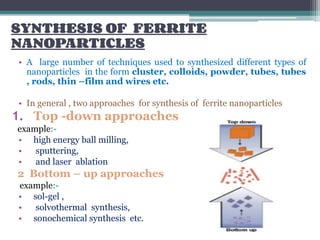
• In general , two approaches for synthesis of ferrite nanoparticles
1. Top -down approaches
example:-
• high energy ball milling,
• sputtering,
• and laser ablation
2 Bottom – up approaches
example:-
• sol-gel ,
• solvothermal synthesis,
• sonochemical synthesis etc.
HIGH ENERGY BALL MILLING
o It is also known as mechanical attrition or mechanical alloying .
o It used in powder metallurgy .
o This process is way of making nanoparticles of some metal and
alloys in the form of powder
o Generally, 2:1 mass ratio of balls to materials is advisable
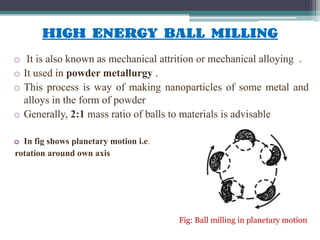
o In fig shows planetary motion i.e.
rotation around own axis
Fig: Ball milling in planetary motion
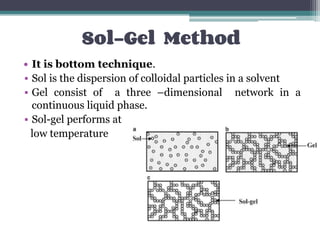
Sol-Gel Method
• It is bottom technique.
▪ Sol is the dispersion of colloidal particles in a solvent
▪ Gel consist of a three –dimensional network in a
continuous liquid phase.
▪ Sol-gel performs at
low temperature
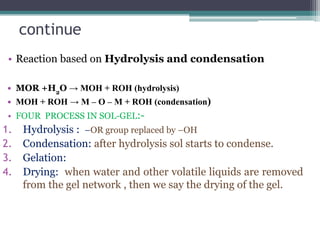
continue
• Reaction based on Hydrolysis and condensation
• MOR +H2
O → MOH + ROH (hydrolysis)
• MOH + ROH → M – O – M + ROH (condensation)
• FOUR PROCESS IN SOL-GEL:-
1. Hydrolysis : –OR group replaced by –OH
2. Condensation: after hydrolysis sol starts to condense.
3. Gelation:
4. Drying: when water and other volatile liquids are removed
from the gel network , then we say the drying of the gel.
HYDROTHERMAL
METHOD
• The term ‘hydrothermal’ comes from the Greek word
“hydrous”which means water and “thermal” means
heat
• Hydrothermal process occurs above the (200°C)
temperature, and pressure more than 100 bars.
• Al(OH)3
+ OH-
→[AlO(OH)2
)-
+ H2
O]
• AlOOH+OH-
→ [ AlO(OH)2
]
CO-PRECIPITATION
METHOD
▪ It is very widely used process because in this process
less chances of contamination , and less time required as
compared to other technique.
▪ Various process occur during the precipitation:-
1. Liquid mixing /saturation
2. Nucleation
3. Crystal growth to form primary products
4. aggregation
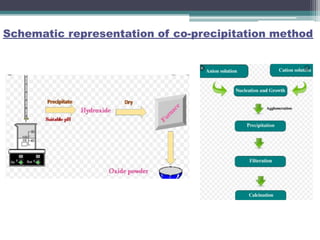
Schematic representation of co-precipitation method
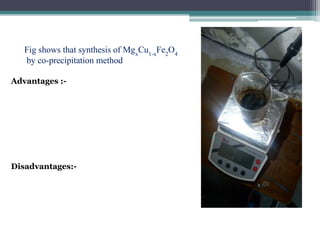
Fig shows that synthesis of Mgx
Cu1-x
Fe2
O4
by co-precipitation method
Advantages :-
Disadvantages:-
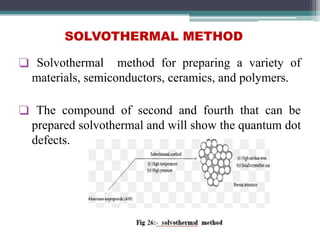
SOLVOTHERMAL METHOD
❑ Solvothermal method for preparing a variety of
materials, semiconductors, ceramics, and polymers.
❑ The compound of second and fourth that can be
prepared solvothermal and will show the quantum dot
defects.
o Nuclei formation and growth are the two key steps
in this technique.
o The nanomaterials involve ZnS,ZnTe, CdS,HgS these
are the elements of the second and fourth groups.
SOLID STATE REACTION
METHOD
• The solid state reaction method is the most widely used for the
preparation of polycrystalline solids.
CHARACTERIZATION
TECHNIQUES
• For better understanding , the nanostructure at the
molecular level uses the characterization techniques.
• Two basic methods :- Direct method and Indirect method for
determining the size, morphology, and composition .
• Some basic characterization techniques like
XRD,SEM,TEM,FTIR,VSM etc.
• Here we discuss only XRD,FTIR, VSM
X - RAY DIFFRACTION METHOD
(XRD):
▪ X rays are electromagnetic radiation with photon energy
100ev to 100 kev.
▪ In XRD monochromatic beam of x rays is used with ranging
from 0.7 to 2Å .
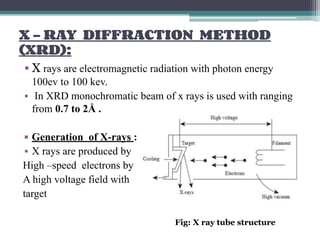
▪ Generation of X-rays :
▪ X rays are produced by
High –speed electrons by
A high voltage field with
target
Fig: X ray tube structure
BASIC PRINCIPLE OF
XRD
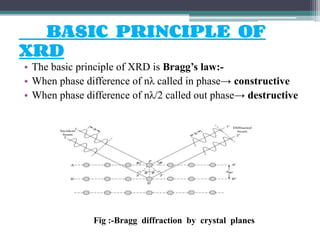
• The basic principle of XRD is Bragg’s law:-
• When phase difference of nλ called in phase→ constructive
• When phase difference of nλ/2 called out phase→ destructive
Fig :-Bragg diffraction by crystal planes
WORKING OF
INSTRUMENT
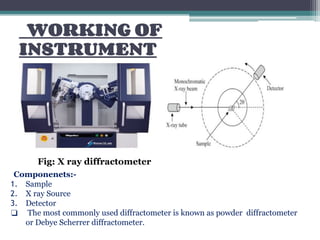
Fig: X ray diffractometer
Componenets:-
1. Sample
2. X ray Source
3. Detector
❑ The most commonly used diffractometer is known as powder diffractometer
or Debye Scherrer diffractometer.
RESULT AND DISCUSSION:-
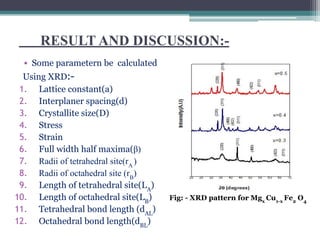
▪ Some parametern be calculated
Using XRD:-
1. Lattice constant(a)
2. Interplaner spacing(d)
3. Crystallite size(D)
4. Stress
5. Strain
6. Full width half maxima(β)
7. Radii of tetrahedral site(rA
)
8. Radii of octahedral site (rB
)
9. Length of tetrahedral site(LA
)
10. Length of octahedral site(LB
)
11. Tetrahedral bond length (dAL
)
12. Octahedral bond length(dBL
)
Fig: - XRD pattern for Mgx
Cu1-x
Fe2
O4
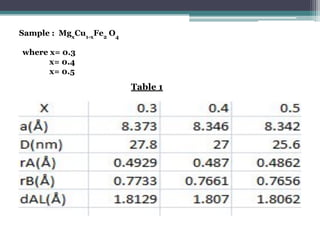
Table 1
Sample : Mgx
Cu1-x
Fe2
O4
where x= 0.3
x= 0.4
x= 0.5
FOURIER TRANSFORM INFRARED SPECTROSCOPY (FTIR)
▪ For detection of the functional group in pure compounds and
mixtures , fourier transform infrared spectroscopy (FTIR) is one
of the most used tools.
▪ FTIR ranges : 4000-400cm-1
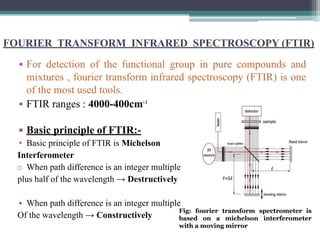
▪ Basic principle of FTIR:-
• Basic principle of FTIR is Michelson
Interferometer
o When path difference is an integer multiple
plus half of the wavelength → Destructively
▪ When path difference is an integer multiple
Of the wavelength → Constructively
Fig: fourier transform spectrometer is
based on a michelson interferometer
with a moving mirror
INSTRUMENT PART
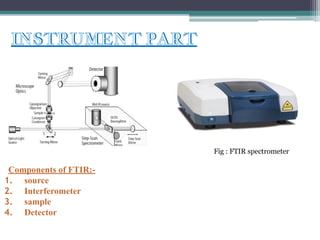
Fig : FTIR spectrometer
Components of FTIR:-
1. source
2. Interferometer
3. sample
4. Detector

ferrites ppt.ppt

  • 1.
  • 2.
  • 3.
    NANOSCIENCE AND NANOTECHNOLOGY •Nanoscience is study of particles or objects, and its phenomena at a very small scale ranging (1-100nm). • “Nano” in the word nanotechnology means a billionth(1*10-9 ) • Nanotechnology deals with various structures of matter having dimensions of the order of billionth of a matter.
  • 4.
    NANOMATERIALS ❖ Nanomaterials isthe set of substances , in which at least one dimension is less than 100nm.Examples: fullerene, carbon nanotubes, and graphene etc. Fig 1: size comparsions of objects and nanomaterials [kumar,2016]
  • 5.
    CLASSIFICATION OF NANOMATERIALS On thebased on dimensionality:- • 0D NMs :- clusters and particles • 1D NMs :- nanotubes and nanowires • 2D NMs :- Nanoplates and layers • 3D NMs :- Nanodiamond Fig 2 :-(a)fullerene; (b)quantumdot;(c)metalcluster; (d)carbonnanotube;(e)metaloxidenanotube; (f)graphene; (g) metal oxide nanobelts; (h) nanodiamond [kumar ,2016]
  • 6.
    FERRITES ❑ Ferrites arethe unique magnetic that show both electrical and magnetic properties ❑ Ferrites are the modified structures of iron with no carbon and these are a combination of two or more sets of different transitions metals. ❑ generally expressed :- X2+ Fe3+ 2 O4- 2- ❑ examples:- Barium , manganese, nickel, zinc etc.
  • 7.
    CLASSIFICATION OF FERRITES Basedon magnetic materials Based on structures 1. Soft ferrites (MO.Fe2 O3. ) • Soft ferrites are the ferromagnetic material with cubic crystal structure. • Soft ferrites are easily magnetized and demagnetized. Example: NiZn 2 Hard ferrites • Hard ferrites are composed of iron and barium oxides. • This types of ferrites are high coercivity and high remanece after magnetization. Example: barrium ferrite(BaFe12 O19 ) 1. Spinel ferrites(M2 Fe2 3+ O4 ) • Normal spinel ferrites :(M)A [Fe2 ]B O4 • Inverse spinel ferrites (Fe)A [MFe]B O4 • Mixed spinel ferrites (M1-x Fe)[Fe2-x Mx ]O4 2 Garnetferrites (R3 3+ Fe5 3+ O12 ) 3 Ortho Ferrite 4 Hexa Ferrite : MFe12 O19
  • 8.
    ▪ When x=0then form of normal spinel ▪ When x=1 then form of inverse spinel ▪ When 0<x<1 then form of random and mixed spinel ferrite.
  • 9.
    APPLICATIONS OF FERRITES Ferritesare used in digital computers and data processing units. Inductor, transformer , and electromagnet Data storage Absorbing materials. Microwave Device Energy storage Catalyst Electromagnetic interference shielding Magnetic carrier
  • 10.
  • 11.
    SYNTHESIS OF FERRITE NANOPARTICLES •A large number of techniques used to synthesized different types of nanoparticles in the form cluster, colloids, powder, tubes, tubes , rods, thin –film and wires etc. • In general , two approaches for synthesis of ferrite nanoparticles 1. Top -down approaches example:- • high energy ball milling, • sputtering, • and laser ablation 2 Bottom – up approaches example:- • sol-gel , • solvothermal synthesis, • sonochemical synthesis etc.
  • 12.
    HIGH ENERGY BALLMILLING o It is also known as mechanical attrition or mechanical alloying . o It used in powder metallurgy . o This process is way of making nanoparticles of some metal and alloys in the form of powder o Generally, 2:1 mass ratio of balls to materials is advisable o In fig shows planetary motion i.e. rotation around own axis Fig: Ball milling in planetary motion
  • 13.
    Sol-Gel Method • Itis bottom technique. ▪ Sol is the dispersion of colloidal particles in a solvent ▪ Gel consist of a three –dimensional network in a continuous liquid phase. ▪ Sol-gel performs at low temperature
  • 14.
    continue • Reaction basedon Hydrolysis and condensation • MOR +H2 O → MOH + ROH (hydrolysis) • MOH + ROH → M – O – M + ROH (condensation) • FOUR PROCESS IN SOL-GEL:- 1. Hydrolysis : –OR group replaced by –OH 2. Condensation: after hydrolysis sol starts to condense. 3. Gelation: 4. Drying: when water and other volatile liquids are removed from the gel network , then we say the drying of the gel.
  • 15.
    HYDROTHERMAL METHOD • The term‘hydrothermal’ comes from the Greek word “hydrous”which means water and “thermal” means heat • Hydrothermal process occurs above the (200°C) temperature, and pressure more than 100 bars. • Al(OH)3 + OH- →[AlO(OH)2 )- + H2 O] • AlOOH+OH- → [ AlO(OH)2 ]
  • 16.
    CO-PRECIPITATION METHOD ▪ It isvery widely used process because in this process less chances of contamination , and less time required as compared to other technique. ▪ Various process occur during the precipitation:- 1. Liquid mixing /saturation 2. Nucleation 3. Crystal growth to form primary products 4. aggregation
  • 17.
    Schematic representation ofco-precipitation method
  • 18.
    Fig shows thatsynthesis of Mgx Cu1-x Fe2 O4 by co-precipitation method Advantages :- Disadvantages:-
  • 19.
    SOLVOTHERMAL METHOD ❑ Solvothermalmethod for preparing a variety of materials, semiconductors, ceramics, and polymers. ❑ The compound of second and fourth that can be prepared solvothermal and will show the quantum dot defects.
  • 20.
    o Nuclei formationand growth are the two key steps in this technique. o The nanomaterials involve ZnS,ZnTe, CdS,HgS these are the elements of the second and fourth groups.
  • 21.
    SOLID STATE REACTION METHOD •The solid state reaction method is the most widely used for the preparation of polycrystalline solids.
  • 22.
  • 23.
    • For betterunderstanding , the nanostructure at the molecular level uses the characterization techniques. • Two basic methods :- Direct method and Indirect method for determining the size, morphology, and composition . • Some basic characterization techniques like XRD,SEM,TEM,FTIR,VSM etc. • Here we discuss only XRD,FTIR, VSM
  • 24.
    X - RAYDIFFRACTION METHOD (XRD): ▪ X rays are electromagnetic radiation with photon energy 100ev to 100 kev. ▪ In XRD monochromatic beam of x rays is used with ranging from 0.7 to 2Å . ▪ Generation of X-rays : ▪ X rays are produced by High –speed electrons by A high voltage field with target Fig: X ray tube structure
  • 25.
    BASIC PRINCIPLE OF XRD •The basic principle of XRD is Bragg’s law:- • When phase difference of nλ called in phase→ constructive • When phase difference of nλ/2 called out phase→ destructive Fig :-Bragg diffraction by crystal planes
  • 26.
    WORKING OF INSTRUMENT Fig: Xray diffractometer Componenets:- 1. Sample 2. X ray Source 3. Detector ❑ The most commonly used diffractometer is known as powder diffractometer or Debye Scherrer diffractometer.
  • 27.
    RESULT AND DISCUSSION:- ▪Some parametern be calculated Using XRD:- 1. Lattice constant(a) 2. Interplaner spacing(d) 3. Crystallite size(D) 4. Stress 5. Strain 6. Full width half maxima(β) 7. Radii of tetrahedral site(rA ) 8. Radii of octahedral site (rB ) 9. Length of tetrahedral site(LA ) 10. Length of octahedral site(LB ) 11. Tetrahedral bond length (dAL ) 12. Octahedral bond length(dBL ) Fig: - XRD pattern for Mgx Cu1-x Fe2 O4
  • 28.
    Table 1 Sample :Mgx Cu1-x Fe2 O4 where x= 0.3 x= 0.4 x= 0.5
  • 29.
    FOURIER TRANSFORM INFRAREDSPECTROSCOPY (FTIR) ▪ For detection of the functional group in pure compounds and mixtures , fourier transform infrared spectroscopy (FTIR) is one of the most used tools. ▪ FTIR ranges : 4000-400cm-1 ▪ Basic principle of FTIR:- • Basic principle of FTIR is Michelson Interferometer o When path difference is an integer multiple plus half of the wavelength → Destructively ▪ When path difference is an integer multiple Of the wavelength → Constructively Fig: fourier transform spectrometer is based on a michelson interferometer with a moving mirror
  • 30.
    INSTRUMENT PART Fig :FTIR spectrometer Components of FTIR:- 1. source 2. Interferometer 3. sample 4. Detector