Seminar on
Energy band and gap
Submitted By:
Pratimesh Umesh Pathak
Submitted To:
Prof. G.R.Jadhao Sir
Prof. S.S.Nimje Mam
I have made this presentation file on the topic
Energy band and gap. I have tried my best to present all
the details Information about this topic.
In the beginning I have tried to give you general information on
this topic.
I express my sincere gratitude to Prof .G.R. Jadhao sir
& Prof. S.S.Nimje Mam who assisting me throughout the
preparation of this topic. I Thanks to our Laboratory attendant
Shri. D.S.More Sir. I also thank to all for providing me the
confidence , performing act and most importantly the track of
the topic whenever I needed it.
 Defination :- Energy Band
 Defination :- Energy Gap
 Important energy bands:-
 Valence Band .
 Conduction Band
 Forbidden Band.
 Direct & Indirect band gap.
 Conclusion.
 Energy Band :- An energy band is a range of electron
energy in a solid so dense with electron states that it
appears to be continuous. Energy bands are at the heart
of electronic band structure which holds that there are
stationary states of electrons in a solid with well defined,
constant (quantized) energy.
 Energy Gap :- Energy gap or bandgap, is an energy range
in a solid where no electron states can exist. The band gap
generally refers to the energy difference between the top of
the valence band and the bottom of the conduction band. It
is the energy required to promote a valence electron bound
to an atom to become a conduction electron, which is free
to move within the crystal lattice and serve as a charge
carrier to conduct electric current.
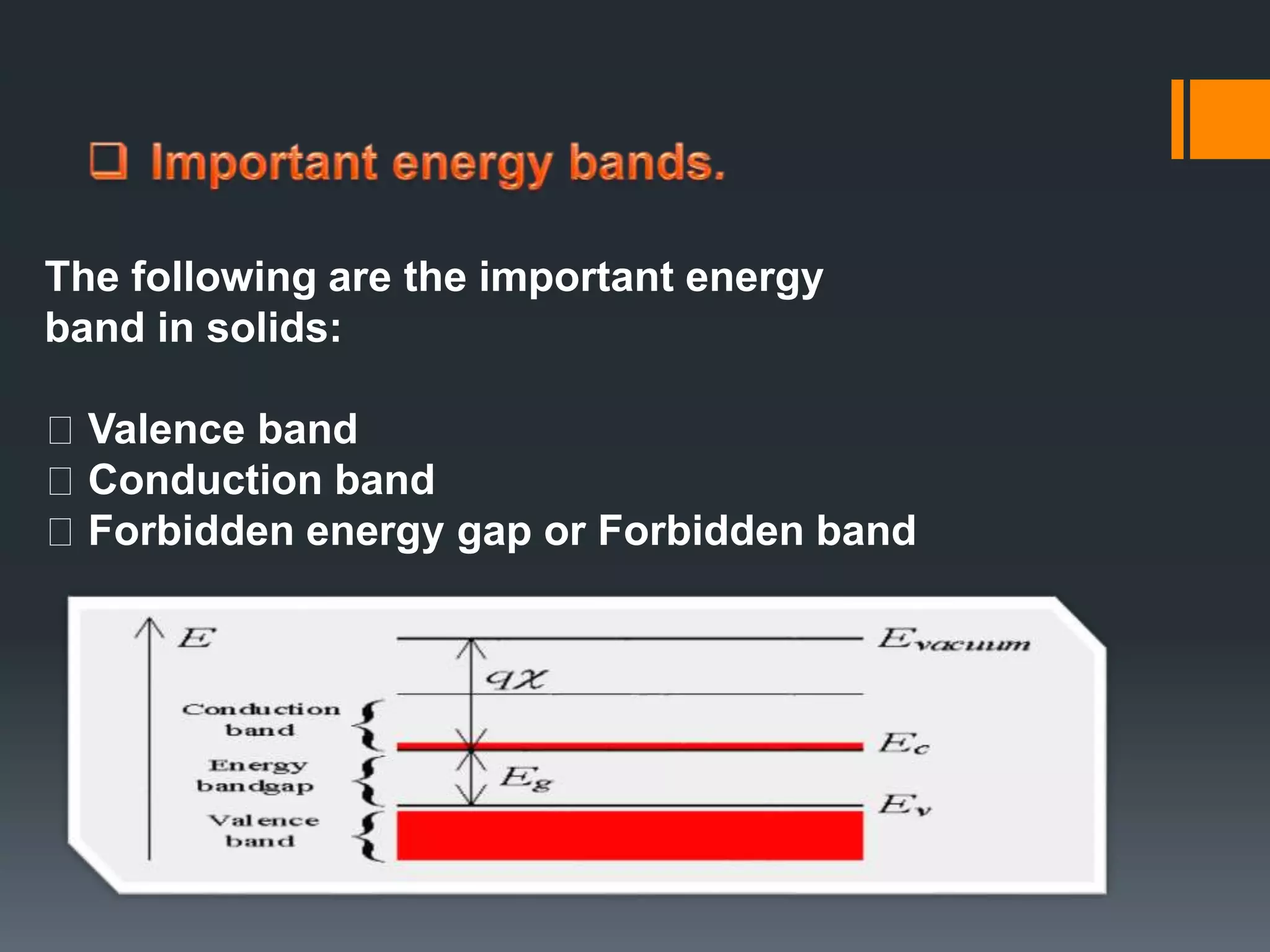
The following are the important energy
band in solids:
Valence band
Conduction band
Forbidden energy gap or Forbidden band
 Band of energy level which are closer to
nucleolus.
 An e- in valence band, expenses strong force
of attraction from nucleolus.
 And it can’t move freely when extrenal
electric field is applied.
 It is called bounded electron
 Bond of energy levels which are far away from the
nucleolus.
 The conduction band is the band of orbitals that are
high in energy and are generally empty.
 An e- in Conduction band has weak influence of
nucleolus and hence it can move free under the
effect of applied electric field and thus it produces
current, it is called free electrons
 In solid-state physics, an energy gap or bandgap,
is an energy range in a solid where
no electron states can exist.
 It generally refers to the energy difference
(in electron volts) between the top of the valence
band and the bottom of the conduction
band in insulators and semiconductors
.
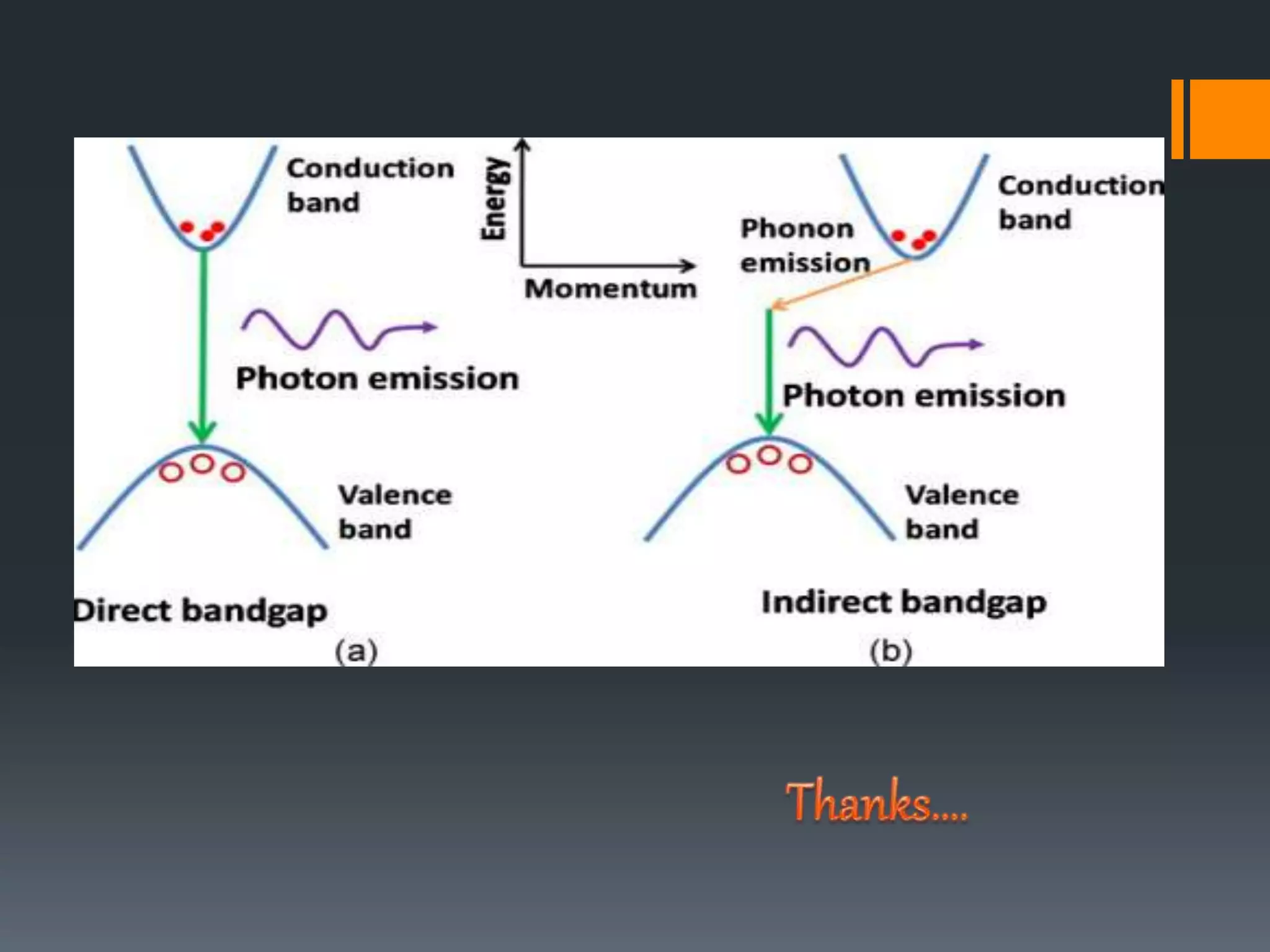
 For these SC , Conduction band minima and valence band maxima
occurs at same value of momentum.
 An e- from CB directly return to VB without changing It’s
momentum. And releases energy in the form of light (photon hv).
 Ex: GaAS, Gap.GaAsP
 CB minima and VB maxima occurs at different value of
momentum.
 When e- from CB returns VB after changing its momentum is called
indirect band gap sc.
 E- changes its momentum by releasing phonon which is a
heat particle.
 Ex: Si, Ge
Energy band and energy gap by Pratimesh pathak

Energy band and energy gap by Pratimesh pathak

  • 1.
    Seminar on Energy bandand gap Submitted By: Pratimesh Umesh Pathak Submitted To: Prof. G.R.Jadhao Sir Prof. S.S.Nimje Mam
  • 2.
    I have madethis presentation file on the topic Energy band and gap. I have tried my best to present all the details Information about this topic. In the beginning I have tried to give you general information on this topic. I express my sincere gratitude to Prof .G.R. Jadhao sir & Prof. S.S.Nimje Mam who assisting me throughout the preparation of this topic. I Thanks to our Laboratory attendant Shri. D.S.More Sir. I also thank to all for providing me the confidence , performing act and most importantly the track of the topic whenever I needed it.
  • 3.
     Defination :-Energy Band  Defination :- Energy Gap  Important energy bands:-  Valence Band .  Conduction Band  Forbidden Band.  Direct & Indirect band gap.  Conclusion.
  • 4.
     Energy Band:- An energy band is a range of electron energy in a solid so dense with electron states that it appears to be continuous. Energy bands are at the heart of electronic band structure which holds that there are stationary states of electrons in a solid with well defined, constant (quantized) energy.  Energy Gap :- Energy gap or bandgap, is an energy range in a solid where no electron states can exist. The band gap generally refers to the energy difference between the top of the valence band and the bottom of the conduction band. It is the energy required to promote a valence electron bound to an atom to become a conduction electron, which is free to move within the crystal lattice and serve as a charge carrier to conduct electric current.
  • 5.
    The following arethe important energy band in solids: Valence band Conduction band Forbidden energy gap or Forbidden band
  • 6.
     Band ofenergy level which are closer to nucleolus.  An e- in valence band, expenses strong force of attraction from nucleolus.  And it can’t move freely when extrenal electric field is applied.  It is called bounded electron
  • 7.
     Bond ofenergy levels which are far away from the nucleolus.  The conduction band is the band of orbitals that are high in energy and are generally empty.  An e- in Conduction band has weak influence of nucleolus and hence it can move free under the effect of applied electric field and thus it produces current, it is called free electrons
  • 8.
     In solid-statephysics, an energy gap or bandgap, is an energy range in a solid where no electron states can exist.  It generally refers to the energy difference (in electron volts) between the top of the valence band and the bottom of the conduction band in insulators and semiconductors
  • 9.
    .  For theseSC , Conduction band minima and valence band maxima occurs at same value of momentum.  An e- from CB directly return to VB without changing It’s momentum. And releases energy in the form of light (photon hv).  Ex: GaAS, Gap.GaAsP  CB minima and VB maxima occurs at different value of momentum.  When e- from CB returns VB after changing its momentum is called indirect band gap sc.  E- changes its momentum by releasing phonon which is a heat particle.  Ex: Si, Ge