BAND THEORY
29-10-2022 1
Content
• Introduction
• Free Electron Theory
• Behaviour of an Electron in Periodic Potential
• Kronig-Penney Potential
• Band Theory
• Band Formation in Silicon
• Classification of Materials based on Energy Band
• Conclusion
• References
29-10-2022 2
Introduction
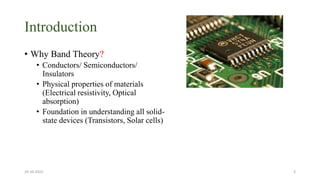
• Why Band Theory?
• Conductors/ Semiconductors/
Insulators
• Physical properties of materials
(Electrical resistivity, Optical
absorption)
• Foundation in understanding all solid-
state devices (Transistors, Solar cells)
29-10-2022 3
Free Electron Theory
• Classical free electron theory
(Macroscopic)
• Proposed by Paul Drude in 1900 and
elaborated (after the discovery of electron by
J J Thomson) by Lorentz in 1909.
• Drude and Lorentz theory.
• Metals contains free electrons which are
responsible for the electrical conductivity in
metals and obeys the laws of classical
mechanics.
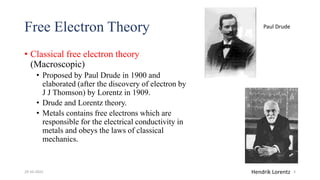
Paul Drude
Hendrik Lorentz
29-10-2022 4
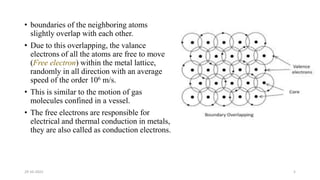
• boundaries of the neighboring atoms
slightly overlap with each other.
• Due to this overlapping, the valance
electrons of all the atoms are free to move
(Free electron) within the metal lattice,
randomly in all direction with an average
speed of the order 106 m/s.
• This is similar to the motion of gas
molecules confined in a vessel.
• The free electrons are responsible for
electrical and thermal conduction in metals,
they are also called as conduction electrons.
29-10-2022 5
• Assumptions
• All metals contain large number of free electrons.
• The free electrons are treated as equivalent to gas molecules; the laws of
classical kinetic theory of gases can be applied to them. Therefore these
electrons have mean free path (Îť), mean collision time (T), average speed (v).
• Since the motion of the electrons is random, the net current is zero in the
absence of electric field. But when an electric field is applied, current is
produced due to the drift velocity of the electrons.
• The electric field (or Potential) due to positive ionic cores is considered to be
uniform throughout the metal and hence neglected.
• The force of attraction between the electrons & lattice ions and the force of
repulsion between the electrons themselves are considered to be negligible.
29-10-2022 6
• Success of classical free electron theory
• It verifies Ohm’s law
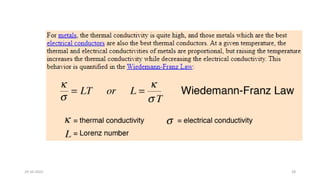
• It derives Wiedemann-Frenz theory
• It explains Electrical and Thermal conductivity of metals
• It explains optical properties of metals
• Drawbacks
• According to classical free electron theory Cv is independent of temperature, but the
experimental value of Cv is directly proportional to temperature
• Experimental value of mean free path (λ) is found to be 0.285 nm, which is 10 times
less than the value obtained from classical free electron theory
• The actual relationship between Temperature and thermal conductivity deviates from
classical free electron theory
• According to classical free electron theory; bivalent & trivalent metals should posses
much higher electrical conductivity than monovalent metals. This is contrary to the
experimental observations that the monovalent element metals such as silver is more
conducting than Zinc (bivalent) & aluminum (trivalent)
29-10-2022 7
Free Electron Theory
• Quantum free electron theory
(microscopic)
• Developed by Sommerfeld in 1928.
• Free electrons move with a constant potential
obeys quantum laws
• Electron as a quantum particle
• Retains the vital features of classical free
electron theory and included the Pauli
Exclusion Principle & Fermi-Dirac statistics
Arnold Sommerfeld
29-10-2022 8
• The free electrons in a metal can have only discrete energy values. Thus the
energies are quantized
• The electrons obey Pauli’s Exclusion Principle, which states that there cannot be
more than two electrons in any energy level
• The distribution of electrons in various energy levels obey the Fermi-Dirac
quantum statistics
• Free electrons have the same potential energy everywhere within the metal,
because the potential due to ionic cores is uniform throughout the metal
• The force of attraction between electrons & lattice ions and the force of repulsion
between electrons can be neglected
• Electrons are treated as wave-like particles
29-10-2022 9
• Success of Quantum free electron theory
• The predicted value of specific heat capacity agrees well with the experimental
results
• Thus quantum free electron theory properly explains the dependence of
Thermal Conductivity on Temperature
• Electrical conductivity depends on electron concentration, mean free path and
Fermi velocity, Explains why the conductivity of Copper is higher than
Aluminum
• Drawback
• In real case, electron moves as a periodic potential function.
29-10-2022 10
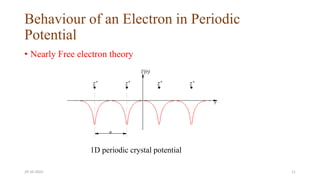
Behaviour of an Electron in Periodic
Potential
• Nearly Free electron theory
29-10-2022 11
1D periodic crystal potential
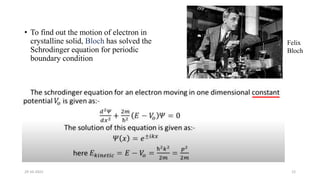
• To find out the motion of electron in
crystalline solid, Bloch has solved the
Schrodinger equation for periodic
boundary condition
29-10-2022 12
Felix
Bloch
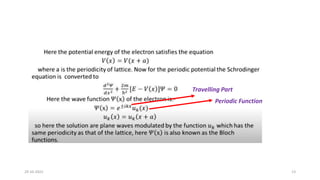
29-10-2022 13
Travelling Part
Periodic Function
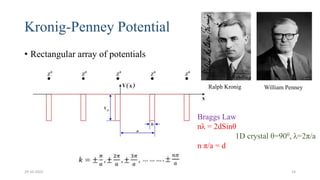
Kronig-Penney Potential
• Rectangular array of potentials
29-10-2022 14
Ralph Kronig William Penney
Braggs Law
nΝ = 2dSinθ
1D crystal θ=900, λ=2π/a
n π/a = d
29-10-2022 15
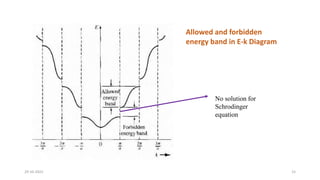
Allowed and forbidden
energy band in E-k Diagram
No solution for
Schrodinger
equation
29-10-2022 16
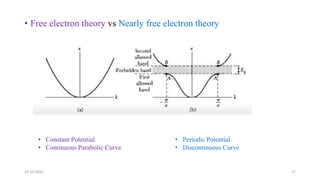
• Free electron theory vs Nearly free electron theory
29-10-2022 17
• Constant Potential
• Continuous Parabolic Curve
• Periodic Potential
• Discontinuous Curve
29-10-2022 18
29-10-2022 19
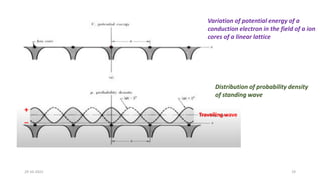
Variation of potential energy of a
conduction electron in the field of a ion
cores of a linear lattice
Distribution of probability density
of standing wave
+
_
Travelling wave
Band Theory
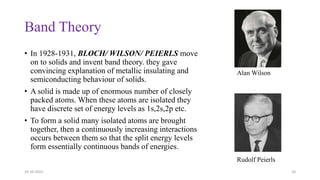
• In 1928-1931, BLOCH/ WILSON/ PEIERLS move
on to solids and invent band theory. they gave
convincing explanation of metallic insulating and
semiconducting behaviour of solids.
• A solid is made up of enormous number of closely
packed atoms. When these atoms are isolated they
have discrete set of energy levels as 1s,2s,2p etc.
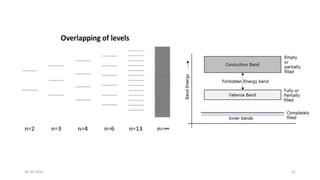
• To form a solid many isolated atoms are brought
together, then a continuously increasing interactions
occurs between them so that the split energy levels
form essentially continuous bands of energies.
29-10-2022 20
Rudolf Peierls
Alan Wilson
29-10-2022 21
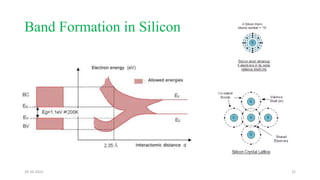
Band Formation in Silicon
29-10-2022 22
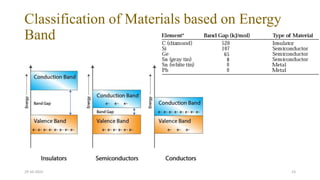
Classification of Materials based on Energy
Band
29-10-2022 23
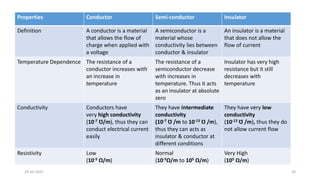
Properties Conductor Semi-conductor Insulator
Definition A conductor is a material
that allows the flow of
charge when applied with
a voltage
A semiconductor is a
material whose
conductivity lies between
conductor & insulator
An insulator is a material
that does not allow the
flow of current
Temperature Dependence The resistance of a
conductor increases with
an increase in
temperature
The resistance of a
semiconductor decrease
with increases in
temperature. Thus it acts
as an insulator at absolute
zero
Insulator has very high
resistance but it still
decreases with
temperature
Conductivity Conductors have
very high conductivity
(10-7 Ćą/m), thus they can
conduct electrical current
easily
They have intermediate
conductivity
(10-7 Ćą /m to 10-13 Ćą /m),
thus they can acts as
insulator & conductor at
different conditions
They have very low
conductivity
(10-13 Ćą /m), thus they do
not allow current flow
Resistivity Low
(10-5 Ί/m)
Normal
(10-5Ί/m to 105 Ί/m)
Very High
(105 Ί/m)
29-10-2022 24
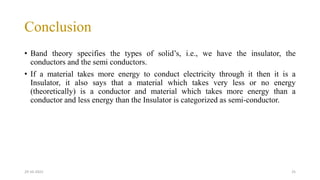
Conclusion
• Band theory specifies the types of solid’s, i.e., we have the insulator, the
conductors and the semi conductors.
• If a material takes more energy to conduct electricity through it then it is a
Insulator, it also says that a material which takes very less or no energy
(theoretically) is a conductor and material which takes more energy than a
conductor and less energy than the Insulator is categorized as semi-conductor.
29-10-2022 25
THANK YOU
29-10-2022 26
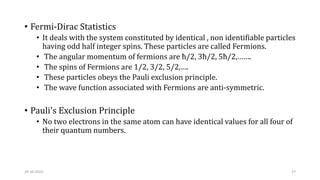
• Fermi-Dirac Statistics
• It deals with the system constituted by identical , non identifiable particles
having odd half integer spins. These particles are called Fermions.
• The angular momentum of fermions are ħ/2, 3ħ/2, 5ħ/2,…….
• The spins of Fermions are 1/2, 3/2, 5/2,….
• These particles obeys the Pauli exclusion principle.
• The wave function associated with Fermions are anti-symmetric.
• Pauli's Exclusion Principle
• No two electrons in the same atom can have identical values for all four of
their quantum numbers.
29-10-2022 27
29-10-2022 28

Band Theory1234.pptx

  • 1.
  • 2.
    Content • Introduction • FreeElectron Theory • Behaviour of an Electron in Periodic Potential • Kronig-Penney Potential • Band Theory • Band Formation in Silicon • Classification of Materials based on Energy Band • Conclusion • References 29-10-2022 2
  • 3.
    Introduction • Why BandTheory? • Conductors/ Semiconductors/ Insulators • Physical properties of materials (Electrical resistivity, Optical absorption) • Foundation in understanding all solid- state devices (Transistors, Solar cells) 29-10-2022 3
  • 4.
    Free Electron Theory •Classical free electron theory (Macroscopic) • Proposed by Paul Drude in 1900 and elaborated (after the discovery of electron by J J Thomson) by Lorentz in 1909. • Drude and Lorentz theory. • Metals contains free electrons which are responsible for the electrical conductivity in metals and obeys the laws of classical mechanics. Paul Drude Hendrik Lorentz 29-10-2022 4
  • 5.
    • boundaries ofthe neighboring atoms slightly overlap with each other. • Due to this overlapping, the valance electrons of all the atoms are free to move (Free electron) within the metal lattice, randomly in all direction with an average speed of the order 106 m/s. • This is similar to the motion of gas molecules confined in a vessel. • The free electrons are responsible for electrical and thermal conduction in metals, they are also called as conduction electrons. 29-10-2022 5
  • 6.
    • Assumptions • Allmetals contain large number of free electrons. • The free electrons are treated as equivalent to gas molecules; the laws of classical kinetic theory of gases can be applied to them. Therefore these electrons have mean free path (λ), mean collision time (T), average speed (v). • Since the motion of the electrons is random, the net current is zero in the absence of electric field. But when an electric field is applied, current is produced due to the drift velocity of the electrons. • The electric field (or Potential) due to positive ionic cores is considered to be uniform throughout the metal and hence neglected. • The force of attraction between the electrons & lattice ions and the force of repulsion between the electrons themselves are considered to be negligible. 29-10-2022 6
  • 7.
    • Success ofclassical free electron theory • It verifies Ohm’s law • It derives Wiedemann-Frenz theory • It explains Electrical and Thermal conductivity of metals • It explains optical properties of metals • Drawbacks • According to classical free electron theory Cv is independent of temperature, but the experimental value of Cv is directly proportional to temperature • Experimental value of mean free path (λ) is found to be 0.285 nm, which is 10 times less than the value obtained from classical free electron theory • The actual relationship between Temperature and thermal conductivity deviates from classical free electron theory • According to classical free electron theory; bivalent & trivalent metals should posses much higher electrical conductivity than monovalent metals. This is contrary to the experimental observations that the monovalent element metals such as silver is more conducting than Zinc (bivalent) & aluminum (trivalent) 29-10-2022 7
  • 8.
    Free Electron Theory •Quantum free electron theory (microscopic) • Developed by Sommerfeld in 1928. • Free electrons move with a constant potential obeys quantum laws • Electron as a quantum particle • Retains the vital features of classical free electron theory and included the Pauli Exclusion Principle & Fermi-Dirac statistics Arnold Sommerfeld 29-10-2022 8
  • 9.
    • The freeelectrons in a metal can have only discrete energy values. Thus the energies are quantized • The electrons obey Pauli’s Exclusion Principle, which states that there cannot be more than two electrons in any energy level • The distribution of electrons in various energy levels obey the Fermi-Dirac quantum statistics • Free electrons have the same potential energy everywhere within the metal, because the potential due to ionic cores is uniform throughout the metal • The force of attraction between electrons & lattice ions and the force of repulsion between electrons can be neglected • Electrons are treated as wave-like particles 29-10-2022 9
  • 10.
    • Success ofQuantum free electron theory • The predicted value of specific heat capacity agrees well with the experimental results • Thus quantum free electron theory properly explains the dependence of Thermal Conductivity on Temperature • Electrical conductivity depends on electron concentration, mean free path and Fermi velocity, Explains why the conductivity of Copper is higher than Aluminum • Drawback • In real case, electron moves as a periodic potential function. 29-10-2022 10
  • 11.
    Behaviour of anElectron in Periodic Potential • Nearly Free electron theory 29-10-2022 11 1D periodic crystal potential
  • 12.
    • To findout the motion of electron in crystalline solid, Bloch has solved the Schrodinger equation for periodic boundary condition 29-10-2022 12 Felix Bloch
  • 13.
  • 14.
    Kronig-Penney Potential • Rectangulararray of potentials 29-10-2022 14 Ralph Kronig William Penney Braggs Law nλ = 2dSinθ 1D crystal θ=900, λ=2π/a n π/a = d
  • 15.
    29-10-2022 15 Allowed andforbidden energy band in E-k Diagram No solution for Schrodinger equation
  • 16.
  • 17.
    • Free electrontheory vs Nearly free electron theory 29-10-2022 17 • Constant Potential • Continuous Parabolic Curve • Periodic Potential • Discontinuous Curve
  • 18.
  • 19.
    29-10-2022 19 Variation ofpotential energy of a conduction electron in the field of a ion cores of a linear lattice Distribution of probability density of standing wave + _ Travelling wave
  • 20.
    Band Theory • In1928-1931, BLOCH/ WILSON/ PEIERLS move on to solids and invent band theory. they gave convincing explanation of metallic insulating and semiconducting behaviour of solids. • A solid is made up of enormous number of closely packed atoms. When these atoms are isolated they have discrete set of energy levels as 1s,2s,2p etc. • To form a solid many isolated atoms are brought together, then a continuously increasing interactions occurs between them so that the split energy levels form essentially continuous bands of energies. 29-10-2022 20 Rudolf Peierls Alan Wilson
  • 21.
  • 22.
    Band Formation inSilicon 29-10-2022 22
  • 23.
    Classification of Materialsbased on Energy Band 29-10-2022 23
  • 24.
    Properties Conductor Semi-conductorInsulator Definition A conductor is a material that allows the flow of charge when applied with a voltage A semiconductor is a material whose conductivity lies between conductor & insulator An insulator is a material that does not allow the flow of current Temperature Dependence The resistance of a conductor increases with an increase in temperature The resistance of a semiconductor decrease with increases in temperature. Thus it acts as an insulator at absolute zero Insulator has very high resistance but it still decreases with temperature Conductivity Conductors have very high conductivity (10-7 ƹ/m), thus they can conduct electrical current easily They have intermediate conductivity (10-7 ƹ /m to 10-13 ƹ /m), thus they can acts as insulator & conductor at different conditions They have very low conductivity (10-13 ƹ /m), thus they do not allow current flow Resistivity Low (10-5 Ί/m) Normal (10-5Ί/m to 105 Ί/m) Very High (105 Ί/m) 29-10-2022 24
  • 25.
    Conclusion • Band theoryspecifies the types of solid’s, i.e., we have the insulator, the conductors and the semi conductors. • If a material takes more energy to conduct electricity through it then it is a Insulator, it also says that a material which takes very less or no energy (theoretically) is a conductor and material which takes more energy than a conductor and less energy than the Insulator is categorized as semi-conductor. 29-10-2022 25
  • 26.
  • 27.
    • Fermi-Dirac Statistics •It deals with the system constituted by identical , non identifiable particles having odd half integer spins. These particles are called Fermions. • The angular momentum of fermions are ħ/2, 3ħ/2, 5ħ/2,……. • The spins of Fermions are 1/2, 3/2, 5/2,…. • These particles obeys the Pauli exclusion principle. • The wave function associated with Fermions are anti-symmetric. • Pauli's Exclusion Principle • No two electrons in the same atom can have identical values for all four of their quantum numbers. 29-10-2022 27
  • 28.