Brillouin Zone and Wigner- Seitz Cell
NAME – VINOD KUMAR
ROLL NO: 2662
Introduction:
Wigner-Seitz Cell named after Eugene Wigner and
Frederick Seitz is a type of voronoi cell used in the
study of crystalline material in solid state physics.
The concept of brillouin zone was developed by
French physicist Leon Brillouin
Wigner-Seitz cell
The Wigner–Seitz cell around a lattice point is defined as the locus of
points in space that are closer to that lattice point than to any of the
other lattice points.
It can be shown mathematically that a Wigner–Seitz cell is a primitive
cell spanning the entire direct space without leaving any gaps or holes.
The Wigner–Seitz cell in the reciprocal space is known as the
first Brillouin zone. It is made by drawing planes normal to the segments
joining nearest lattice points to a particular lattice point, through the
midpoints of such segments.
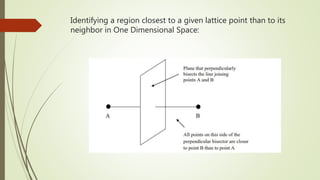
Identifying a region closest to a given lattice point than to its
neighbor in One Dimensional Space:
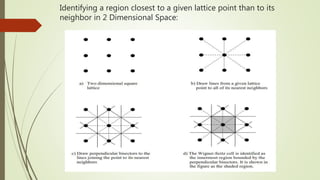
Identifying a region closest to a given lattice point than to its
neighbor in 2 Dimensional Space:
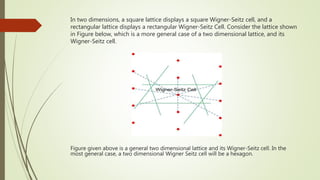
In two dimensions, a square lattice displays a square Wigner-Seitz cell, and a
rectangular lattice displays a rectangular Wigner-Seitz Cell. Consider the lattice shown
in Figure below, which is a more general case of a two dimensional lattice, and its
Wigner-Seitz cell.
Figure given above is a general two dimensional lattice and its Wigner-Seitz cell. In the
most general case, a two dimensional Wigner Seitz cell will be a hexagon.
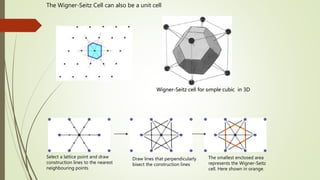
The Wigner-Seitz Cell can also be a unit cell
Wigner-Seitz cell for sımple cubic in 3D
Select a lattice point and draw
construction lines to the nearest
neighbouring points
Draw lines that perpendicularly
bisect the construction lines
The smallest enclosed area
represents the Wigner-Seitz
cell. Here shown in orange.
Brillouin zone
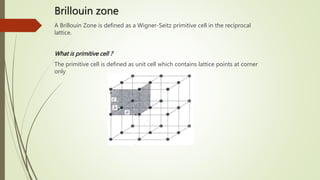
A Brillouin Zone is defined as a Wigner-Seitz primitive cell in the reciprocal
lattice.
What is primitive cell ?
The primitive cell is defined as unit cell which contains lattice points at corner
only
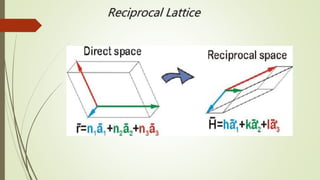
Reciprocal Lattice
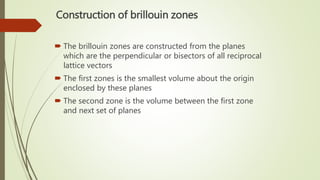
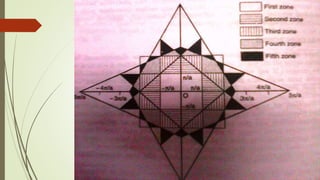
Construction of brillouin zones
 The brillouin zones are constructed from the planes
which are the perpendicular or bisectors of all reciprocal
lattice vectors
 The first zones is the smallest volume about the origin
enclosed by these planes
 The second zone is the volume between the first zone
and next set of planes
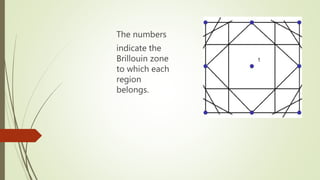
The numbers
indicate the
Brillouin zone
to which each
region
belongs.
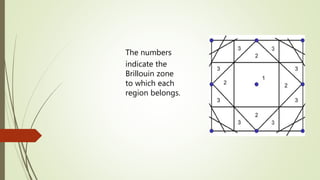
The numbers
indicate the
Brillouin zone
to which each
region belongs.
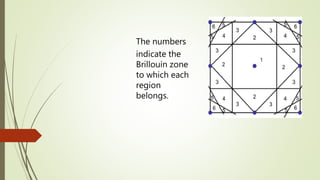
The numbers
indicate the
Brillouin zone
to which each
region
belongs.
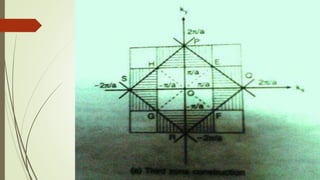
Identification of the first and higher order Brillouin Zones for a
two dimensional from above figures
1. Only the first Brillouin Zone is identified; in
2. First, second and third Brillouin zones are identified; and in
3. First second, third, fourth, fifth and sixth Brillouin zones
have been identified.
All the zones identified are only within the context of the figure
drawn, i.e.
there are other regions which will correspond to the fourth, fifth,
and sixth Brillouin zones, which do not show up in the region
shown above.
Thank You

Brillouin zone and wigner seitz cell

  • 1.
    Brillouin Zone andWigner- Seitz Cell NAME – VINOD KUMAR ROLL NO: 2662
  • 2.
    Introduction: Wigner-Seitz Cell namedafter Eugene Wigner and Frederick Seitz is a type of voronoi cell used in the study of crystalline material in solid state physics. The concept of brillouin zone was developed by French physicist Leon Brillouin
  • 3.
    Wigner-Seitz cell The Wigner–Seitzcell around a lattice point is defined as the locus of points in space that are closer to that lattice point than to any of the other lattice points. It can be shown mathematically that a Wigner–Seitz cell is a primitive cell spanning the entire direct space without leaving any gaps or holes. The Wigner–Seitz cell in the reciprocal space is known as the first Brillouin zone. It is made by drawing planes normal to the segments joining nearest lattice points to a particular lattice point, through the midpoints of such segments.
  • 4.
    Identifying a regionclosest to a given lattice point than to its neighbor in One Dimensional Space:
  • 5.
    Identifying a regionclosest to a given lattice point than to its neighbor in 2 Dimensional Space:
  • 6.
    In two dimensions,a square lattice displays a square Wigner-Seitz cell, and a rectangular lattice displays a rectangular Wigner-Seitz Cell. Consider the lattice shown in Figure below, which is a more general case of a two dimensional lattice, and its Wigner-Seitz cell. Figure given above is a general two dimensional lattice and its Wigner-Seitz cell. In the most general case, a two dimensional Wigner Seitz cell will be a hexagon.
  • 7.
    The Wigner-Seitz Cellcan also be a unit cell Wigner-Seitz cell for sımple cubic in 3D Select a lattice point and draw construction lines to the nearest neighbouring points Draw lines that perpendicularly bisect the construction lines The smallest enclosed area represents the Wigner-Seitz cell. Here shown in orange.
  • 8.
    Brillouin zone A BrillouinZone is defined as a Wigner-Seitz primitive cell in the reciprocal lattice. What is primitive cell ? The primitive cell is defined as unit cell which contains lattice points at corner only
  • 9.
  • 10.
    Construction of brillouinzones  The brillouin zones are constructed from the planes which are the perpendicular or bisectors of all reciprocal lattice vectors  The first zones is the smallest volume about the origin enclosed by these planes  The second zone is the volume between the first zone and next set of planes
  • 13.
    The numbers indicate the Brillouinzone to which each region belongs.
  • 14.
    The numbers indicate the Brillouinzone to which each region belongs.
  • 15.
    The numbers indicate the Brillouinzone to which each region belongs.
  • 16.
    Identification of thefirst and higher order Brillouin Zones for a two dimensional from above figures 1. Only the first Brillouin Zone is identified; in 2. First, second and third Brillouin zones are identified; and in 3. First second, third, fourth, fifth and sixth Brillouin zones have been identified. All the zones identified are only within the context of the figure drawn, i.e. there are other regions which will correspond to the fourth, fifth, and sixth Brillouin zones, which do not show up in the region shown above.
  • 17.