Electronic Band Structures:
Bloch's Theorem
Bloch's Theorem
Ipsita Mandal
References
Introduction to Solid State Physics
by Charles Kittel, Chapter 7
Solid-State Physics: An Introduction to Principles of
Materials Science
by Harald & Ibach, Harald, Hans Lüth, Chapter 7
Solid State Physics
by Neil W. Ashcroft & N. David Mermin, Chapter 8
Recap: Free Electron Model
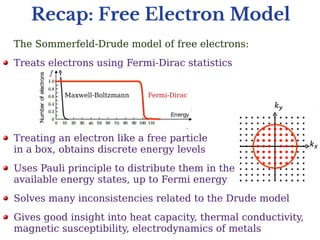
The Sommerfeld-Drude model of free electrons:
Treats electrons using Fermi-Dirac statistics
Treating an electron like a free particle
in a box, obtains discrete energy levels
Uses Pauli principle to distribute them in the
available energy states, up to Fermi energy
Solves many inconsistencies related to the Drude model
Gives good insight into heat capacity, thermal conductivity,
magnetic susceptibility, electrodynamics of metals
Fermi-Dirac
Maxwell-Boltzmann
Drawbacks of Free Electron Model
It fails in explaining:
Distinction between metals, semimetals, semiconductors,
insulators
Occurrence of positive values of Hall coefficient
Relation of conduction electrons in metals to valence
electrons of free atoms
Many transport properties, particularly magnetotransport
Band Structures
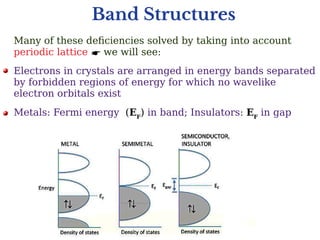
Many of these deficiencies solved by taking into account
periodic lattice ☛ we will see:
Electrons in crystals are arranged in energy bands separated
by forbidden regions of energy for which no wavelike
electron orbitals exist
Metals: Fermi energy (EF
) in band; Insulators: EF
in gap
Crystalline Potential
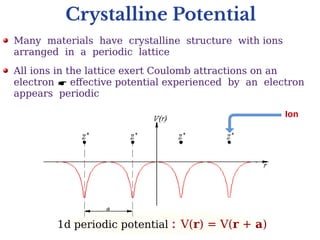
Many materials have crystalline structure with ions
arranged in a periodic lattice
All ions in the lattice exert Coulomb attractions on an
electron ☛ effective potential experienced by an electron
appears periodic
1d periodic potential : V(r) = V(r + a)
Ion
Effect of Periodic Potential
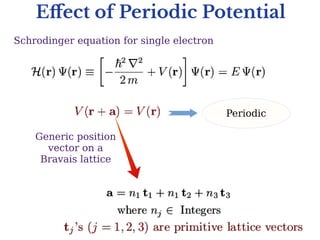
Schrodinger equation for single electron
Periodic
Generic position
vector on a
Bravais lattice
Bloch’s Theorem
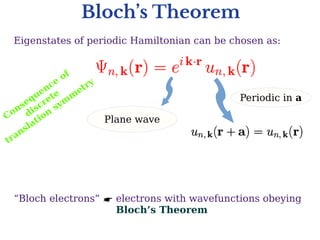
Eigenstates of periodic Hamiltonian can be chosen as:
“Bloch electrons” ☛ electrons with wavefunctions obeying
Bloch’s Theorem
Plane wave
Periodic in a
Consequence
of
discrete
translation
sym
m
etry
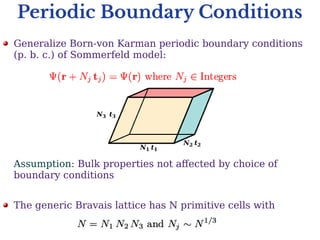
Periodic Boundary Conditions
Generalize Born-von Karman periodic boundary conditions
(p. b. c.) of Sommerfeld model:
Assumption: Bulk properties not affected by choice of
boundary conditions
The generic Bravais lattice has N primitive cells with
N1 t1
N2 t2
N3 t3
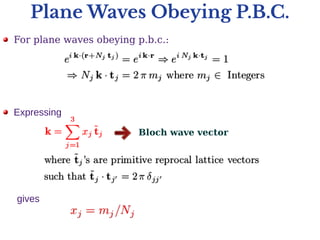
Plane Waves Obeying P.B.C.
For plane waves obeying p.b.c.:
Expressing
gives
Bloch wave vector
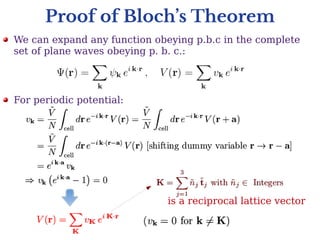
Proof of Bloch’s Theorem
We can expand any function obeying p.b.c in the complete
set of plane waves obeying p. b. c.:
For periodic potential:
is a reciprocal lattice vector
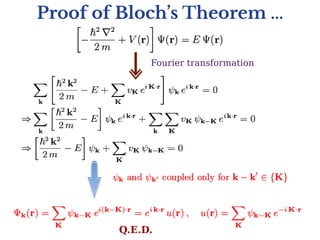
Proof of Bloch’s Theorem ...
Fourier transformation
Q.E.D.
Emergence of Energy Bands
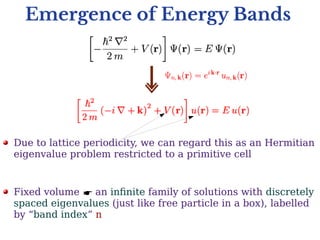
Due to lattice periodicity, we can regard this as an Hermitian
eigenvalue problem restricted to a primitive cell
Fixed volume ☛ an infinite family of solutions with discretely
spaced eigenvalues (just like free particle in a box), labelled
by “band index” n
Emergence of Energy Bands ...
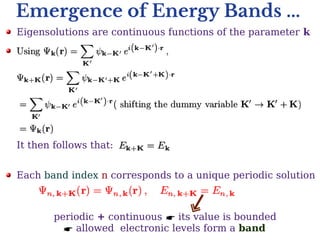
Eigensolutions are continuous functions of the parameter k
It then follows that:
Each band index n corresponds to a unique periodic solution
periodic + continuous ☛ its value is bounded
☛ allowed electronic levels form a band
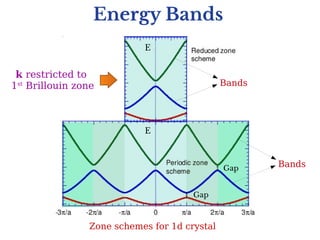
Energy Bands
E
E
Gap
Gap
Zone schemes for 1d crystal
Bands
Bands
k restricted to
1st
Brillouin zone
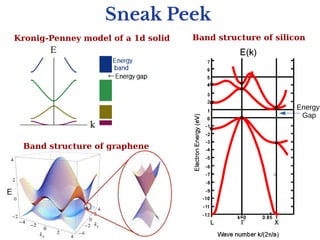
Sneak Peek
Band structure of silicon
Kronig-Penney model of a 1d solid
Energy
Gap
Band structure of graphene
E
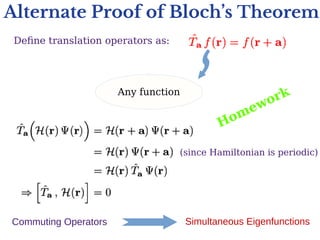
Alternate Proof of Bloch’s Theorem
Define translation operators as:
Any function
Simultaneous Eigenfunctions
Commuting Operators
(since Hamiltonian is periodic)
Homework
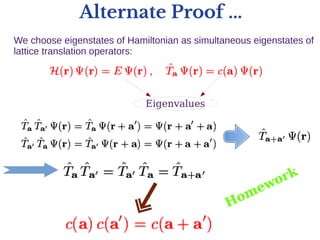
Alternate Proof ...
We choose eigenstates of Hamiltonian as simultaneous eigenstates of
lattice translation operators:
Eigenvalues
Homework
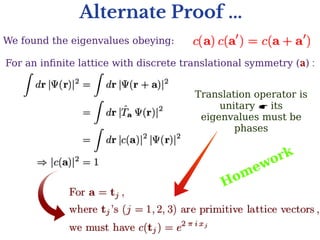
Alternate Proof ...
We found the eigenvalues obeying:
For an infinite lattice with discrete translational symmetry (a) :
Translation operator is
unitary ☛ its
eigenvalues must be
phases
Homework
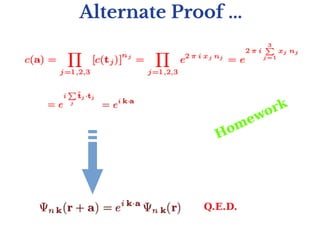
Alternate Proof ...
Q.E.D.
Homework
Q.E.D.
Insights from Bloch’s Theorem
Concept of band structures can be understood as we observe
emergence of allowed & forbidden energy ranges
Bloch’s theorem guarantees that any single-electron
eigenstate = (plane wave) ⨯ (some periodic function)
When electrons move in a periodic potential, gaps arise in
their dispersion relation at Brillouin zone boundaries: we will
see this next by solving the simple Kronig–Penney model

bloch.pdf

  • 1.
    Electronic Band Structures: ElectronicBand Structures: Bloch's Theorem Bloch's Theorem Ipsita Mandal
  • 2.
    References Introduction to SolidState Physics by Charles Kittel, Chapter 7 Solid-State Physics: An Introduction to Principles of Materials Science by Harald & Ibach, Harald, Hans Lüth, Chapter 7 Solid State Physics by Neil W. Ashcroft & N. David Mermin, Chapter 8
  • 3.
    Recap: Free ElectronModel The Sommerfeld-Drude model of free electrons: Treats electrons using Fermi-Dirac statistics Treating an electron like a free particle in a box, obtains discrete energy levels Uses Pauli principle to distribute them in the available energy states, up to Fermi energy Solves many inconsistencies related to the Drude model Gives good insight into heat capacity, thermal conductivity, magnetic susceptibility, electrodynamics of metals Fermi-Dirac Maxwell-Boltzmann
  • 4.
    Drawbacks of FreeElectron Model It fails in explaining: Distinction between metals, semimetals, semiconductors, insulators Occurrence of positive values of Hall coefficient Relation of conduction electrons in metals to valence electrons of free atoms Many transport properties, particularly magnetotransport
  • 5.
    Band Structures Many ofthese deficiencies solved by taking into account periodic lattice ☛ we will see: Electrons in crystals are arranged in energy bands separated by forbidden regions of energy for which no wavelike electron orbitals exist Metals: Fermi energy (EF ) in band; Insulators: EF in gap
  • 6.
    Crystalline Potential Many materialshave crystalline structure with ions arranged in a periodic lattice All ions in the lattice exert Coulomb attractions on an electron ☛ effective potential experienced by an electron appears periodic 1d periodic potential : V(r) = V(r + a) Ion
  • 7.
    Effect of PeriodicPotential Schrodinger equation for single electron Periodic Generic position vector on a Bravais lattice
  • 8.
    Bloch’s Theorem Eigenstates ofperiodic Hamiltonian can be chosen as: “Bloch electrons” ☛ electrons with wavefunctions obeying Bloch’s Theorem Plane wave Periodic in a Consequence of discrete translation sym m etry
  • 9.
    Periodic Boundary Conditions GeneralizeBorn-von Karman periodic boundary conditions (p. b. c.) of Sommerfeld model: Assumption: Bulk properties not affected by choice of boundary conditions The generic Bravais lattice has N primitive cells with N1 t1 N2 t2 N3 t3
  • 10.
    Plane Waves ObeyingP.B.C. For plane waves obeying p.b.c.: Expressing gives Bloch wave vector
  • 11.
    Proof of Bloch’sTheorem We can expand any function obeying p.b.c in the complete set of plane waves obeying p. b. c.: For periodic potential: is a reciprocal lattice vector
  • 12.
    Proof of Bloch’sTheorem ... Fourier transformation Q.E.D.
  • 13.
    Emergence of EnergyBands Due to lattice periodicity, we can regard this as an Hermitian eigenvalue problem restricted to a primitive cell Fixed volume ☛ an infinite family of solutions with discretely spaced eigenvalues (just like free particle in a box), labelled by “band index” n
  • 14.
    Emergence of EnergyBands ... Eigensolutions are continuous functions of the parameter k It then follows that: Each band index n corresponds to a unique periodic solution periodic + continuous ☛ its value is bounded ☛ allowed electronic levels form a band
  • 15.
    Energy Bands E E Gap Gap Zone schemesfor 1d crystal Bands Bands k restricted to 1st Brillouin zone
  • 16.
    Sneak Peek Band structureof silicon Kronig-Penney model of a 1d solid Energy Gap Band structure of graphene E
  • 17.
    Alternate Proof ofBloch’s Theorem Define translation operators as: Any function Simultaneous Eigenfunctions Commuting Operators (since Hamiltonian is periodic) Homework
  • 18.
    Alternate Proof ... Wechoose eigenstates of Hamiltonian as simultaneous eigenstates of lattice translation operators: Eigenvalues Homework
  • 19.
    Alternate Proof ... Wefound the eigenvalues obeying: For an infinite lattice with discrete translational symmetry (a) : Translation operator is unitary ☛ its eigenvalues must be phases Homework
  • 20.
  • 21.
    Insights from Bloch’sTheorem Concept of band structures can be understood as we observe emergence of allowed & forbidden energy ranges Bloch’s theorem guarantees that any single-electron eigenstate = (plane wave) ⨯ (some periodic function) When electrons move in a periodic potential, gaps arise in their dispersion relation at Brillouin zone boundaries: we will see this next by solving the simple Kronig–Penney model