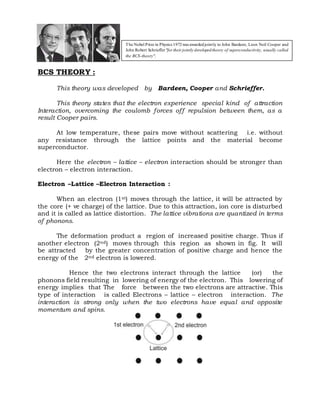
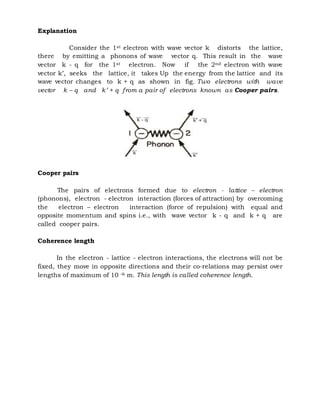
This theory, developed by Bardeen, Cooper and Schrieffer, states that electrons experience an attractive interaction through the lattice that overcomes their normal repulsive interaction, forming Cooper pairs. At low temperatures, these pairs move without resistance through the lattice, causing the material to become a superconductor. The electron-lattice-electron interaction must be stronger than the direct electron-electron interaction for superconductivity to occur.