Presented by:
Mr. Manjunath. beth
associate Professor
&
hod of Msn
dePartMent
Types of research
• Research can be classified on several criteria
• Approach of the studying variable (qualitative
and quantitative research)
• Purpose of conducting research (basic and
applied research)
 Quantitative research :
“It is an enquire into an identified problem, based on
testing a theory composed of variables, measured with
numbers and analyzed using statistical techniques. Here
data is collected in numerical form and analyzed by
using descriptive and inferential statistics.”
Evidences are evaluated, theories and hypothesis are
tested.
Cause and effect interactions among variables.
Major types of Quantitative research are :
Experimental
Quasi- experimental
non experimental designs
Qualitative research
“It is a systematic, interactive, subjective
approach used to describe life experience and
give them meaning. It involves in depth
understanding of human behavior and the
reason that govern human behavior.”
Here the data is collected in descriptive
form rather than numerical form. The data is
analyzed by descriptive coding, indexing and
narrations.
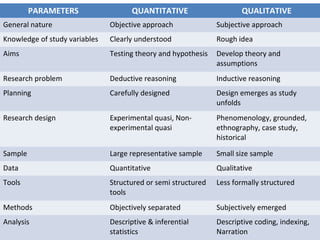
PARAMETERS QUANTITATIVE QUALITATIVE
General nature Objective approach Subjective approach
Knowledge of study variables Clearly understood Rough idea
Aims Testing theory and hypothesis Develop theory and
assumptions
Research problem Deductive reasoning Inductive reasoning
Planning Carefully designed Design emerges as study
unfolds
Research design Experimental quasi, Non-
experimental quasi
Phenomenology, grounded,
ethnography, case study,
historical
Sample Large representative sample Small size sample
Data Quantitative Qualitative
Tools Structured or semi structured
tools
Less formally structured
Methods Objectively separated Subjectively emerged
Analysis Descriptive & inferential
statistics
Descriptive coding, indexing,
Narration
2. Control :
 it refers to the use of control group and controlling
the effect of extraneous variable on the dependent
variable. Subjects are similar in number and
characteristics in both experimental and control group
but the experimental group receives the intervention
and a comparison is made with the control group to
observe the effect of this intervention.
3. Randomization:
 Means that every subject has an equal chance of
being assigned to experimental or control group.
 It is used to minimize the threat of internal validity of
the study.
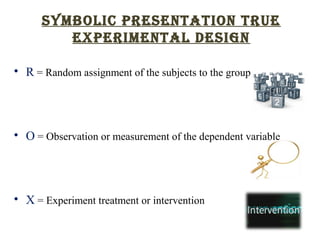
Symbolic preSentation true
experimental deSign
• R = Random assignment of the subjects to the group
• O = Observation or measurement of the dependent variable
• X = Experiment treatment or intervention
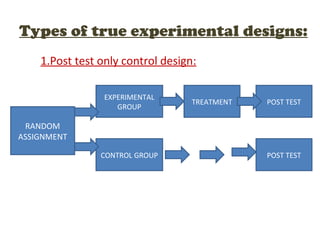
Types of true experimental designs:
1.Post test only control design:
RANDOM
ASSIGNMENT
EXPERIMENTAL
GROUP
TREATMENT POST TEST
POST TESTCONTROL GROUP
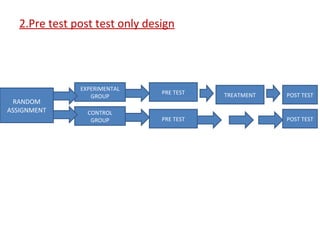
2.Pre test post test only design
RANDOM
ASSIGNMENT
EXPERIMENTAL
GROUP TREATMENT
CONTROL
GROUP
PRE TEST
PRE TEST
POST TEST
POST TEST
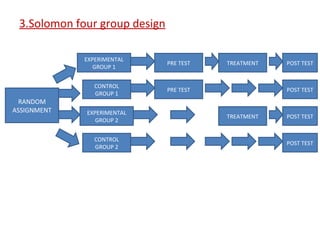
3.Solomon four group design
RANDOM
ASSIGNMENT
EXPERIMENTAL
GROUP 1
TREATMENT
CONTROL
GROUP 1
PRE TEST
PRE TEST
POST TEST
POST TEST
EXPERIMENTAL
GROUP 2
TREATMENT
CONTROL
GROUP 2
POST TEST
POST TEST
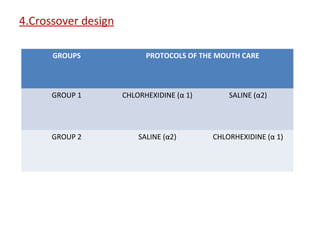
4.Crossover design
GROUPS PROTOCOLS OF THE MOUTH CARE
GROUP 1 CHLORHEXIDINE (α 1) SALINE (α2)
GROUP 2 SALINE (α2) CHLORHEXIDINE (α 1)
Quasi experimental design
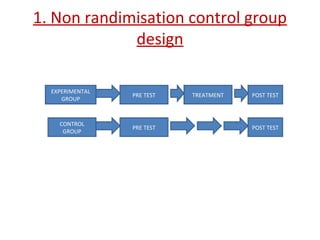
“It involves the manipulation of independent
variable to observe the effect on dependent
variable, but it lacks at least one of the two
characteristics of true experimental design i.e.
randomization or control group.”
1. Non randimisation control group
design
EXPERIMENTAL
GROUP
TREATMENT
CONTROL
GROUP
PRE TEST
PRE TEST
POST TEST
POST TEST
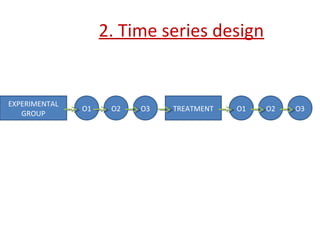
2. Time series design
EXPERIMENTAL
GROUP
TREATMENTO1 O2 O3 O1 O2 O3
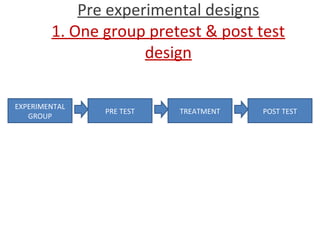
Pre experimental designs
1. One group pretest & post test
design
EXPERIMENTAL
GROUP
PRE TEST TREATMENT POST TEST
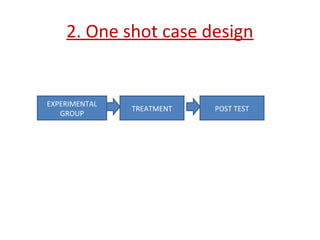
2. One shot case design
EXPERIMENTAL
GROUP
TREATMENT POST TEST
“It is a design in which variables are not
deliberately manipulated, nor is the setting
controlled.”
Data is collected through questionnaires,
interviews, observation and literature reviews.
1. Descriptive research design
I.Univariant
I uu.
It is undertaken to describe the frequency
of occurrence of a phenomenon.
Ex- researcher is interested in assessing the
experiences of patient suffering from
rheumatoid arthritis and the researcher may
describe the frequency of different
symptoms experienced by the patient and
the type of treatment received.
II . Exploratory design
used to identify, explore and describe the
existing phenomenon and its related factors.
It is in depth exploration and a study of its
related factor to improve further
understanding about a less understood
phenomenon.
III . comparative design
It includes comparing and contrasting two or
more samples of the study subjects on one or
more variables, often at a single point of time.
Ex- A comparative study on the health problems
among rural and urban older people in district
Kolhapur, Maharashtra.
2. Co-relational/ ex post facto research design.
In this researcher examines the
relationship between two or more variables in
a natural setting without manipulation or
control.
No intervention is given.
Ex- A correlation study on the effect of
smoking on lung cancer among people in New
Delhi.
a. Prospective research design
In this design the researcher relates the
present to the future.
It start with a presumed cause and then go to
the presumed effect.
Ex- a prospective co-relational study on the
effect of maternal infection during pregnancy on
fetal development and pregnancy outcome.
b. Retrospective research design
In this researcher studies the current
phenomenon by seeking information from the
past.
• It has a backward approach to study a
phenomenon i.e. effect to the cause.
3. Developmental research design
This design examines the phenomenon with reference to
time.
A. Cross sectional design – in this design researcher collects
data at particular point of time.
Ex- researcher is interested in assessing the awareness on
swine flu among peoples of an area.
B. Longitudinal design- this design is used to collect data over
an extended time period (long time study).
Ex- perception of nursing students towards nursing
profession from the beginning of nursing program to its
end.
4. Epidemiological research design
“It is used to investigate the distribution and causes of
the disease in population.”
To investigate cause of different disease in either
prospective or retrospective approach.
1.Cohort study– a researcher longitudinally observes the
smokers for development of lung cancer.
2. Case control – a researcher investigates the history of
smoking in patients diagnosed with lung cancer.
5. Survey Research Design
This is a design which is used to collect
information from different subjects within a
given population having same characteristics of
interest.
1.If survey is conducted on sample ----- Survey
sample
2.If survey is conducted on population ------
Population survey e.g. CENSUS
• Information is collected regarding
Prevalence, Distribution, interrelationship of
variables within population.
• Wide range of data like actions, attitudes,
opinions, perceptions, behaviors, awareness,
practices.
Main features
• Data is collected to get new information.
• Data is collected from of subjects.
• Various types of survey research based on
nature of phenomenon.
• Data is collected in number of ways.
• Questionnaires.
• Interview schedule.
• Personal interviews.
TYPES OF SURVEY RESEARCH
DESIGN
1.Depending on nature of phenomenon
 a. Descriptive
 b. Exploration
 c. Comparative
 d. Co-relational survey
2.Based on methods of data collection
a. Written survey - Questionnaires
b. Oral survey - Interview
c. Electronic survey - Emails , web sites , sms.
QUALITATIVE RESEARCH
1.Phenomenological Research
This type of research is done for
understanding of the relationship between
status of individual consciousness & social life.
E.g. A phenomenological study on live
experience of Tsunami victims in selected
villages of Tamil Nadu.
2.Ethonographic Research
It is associated with field of anthropology, which
focuses on the culture of a group of people with an
effort to understand their worldview.
E.g. An ethnographic study on socio-cultural beliefs of
the people about antenatal, natal& postnatal care of
women in selected tribal communities of Rajasthan.
3.Grounded theory
It emerged from the discipline of sociology. The
term grounded theory means that the theory
developed from the research is ‘grounded’ or has its
roots in the data from which it was derived.
E.g. A study on the response & adaptation process of
patients diagnosed with Cancer in Nehru Hospital,
Chandigarh.
4.Historical Research Design
History gives an exact Knowledge of the past and
enables one to interpret the future.
Scientific method of inquiry of historical problems.
Methodological approach is ‘HISTORIOGRAPHY’
Historical research is viewed in three different way
1.Historical approach; organization of historical facts in
support to develop new concepts.
2.Historical subjects; biographies of great men,
monographs of places and sketches of ideas thoughts
and trends.
3.Historical technique; conducted on the basis of
historical records and documents.
• Primary sources ; fossils, skeleton, tools,
weapons, utensils, clothing's, buildings, pictures,
paintings.
• Oral and written testimony[ witness of the
same]- consciously used for the purpose of
transmitting information to be used in future.
• Laws, official records, letters, diaries, contracts,
wills, maps, books, research reports.
• Secondary sources; Most of history Books and
encyclopedias.
It includes systemic collection & critical
evaluation of data relating to past
occurrences of a particular phenomenon.
E.g. A historical research on the
development of nursing in INDIA.
5.Action Research
This research tries to find practical solutions to
problems existing in the framework of an
organization.
E.g. An action research on the practicability of western
nursing practice protocols in public & private Indian
healthcare organization.
6.Case study
Case studies are in depth examination of people,
places or institutions.
“Robson defines case study as the development of
detailed , intensive knowledge about a single ‘case’ or
a small no of related cases.”
E.g. A case study on availability & utilization of the
emergency services in civil hospital , Kolhapur.
Types  of research   copy

Types of research copy

  • 1.
    Presented by: Mr. Manjunath.beth associate Professor & hod of Msn dePartMent
  • 3.
    Types of research •Research can be classified on several criteria • Approach of the studying variable (qualitative and quantitative research) • Purpose of conducting research (basic and applied research)
  • 4.
     Quantitative research: “It is an enquire into an identified problem, based on testing a theory composed of variables, measured with numbers and analyzed using statistical techniques. Here data is collected in numerical form and analyzed by using descriptive and inferential statistics.” Evidences are evaluated, theories and hypothesis are tested. Cause and effect interactions among variables.
  • 5.
    Major types ofQuantitative research are : Experimental Quasi- experimental non experimental designs
  • 6.
    Qualitative research “It isa systematic, interactive, subjective approach used to describe life experience and give them meaning. It involves in depth understanding of human behavior and the reason that govern human behavior.” Here the data is collected in descriptive form rather than numerical form. The data is analyzed by descriptive coding, indexing and narrations.
  • 7.
    PARAMETERS QUANTITATIVE QUALITATIVE Generalnature Objective approach Subjective approach Knowledge of study variables Clearly understood Rough idea Aims Testing theory and hypothesis Develop theory and assumptions Research problem Deductive reasoning Inductive reasoning Planning Carefully designed Design emerges as study unfolds Research design Experimental quasi, Non- experimental quasi Phenomenology, grounded, ethnography, case study, historical Sample Large representative sample Small size sample Data Quantitative Qualitative Tools Structured or semi structured tools Less formally structured Methods Objectively separated Subjectively emerged Analysis Descriptive & inferential statistics Descriptive coding, indexing, Narration
  • 11.
    2. Control : it refers to the use of control group and controlling the effect of extraneous variable on the dependent variable. Subjects are similar in number and characteristics in both experimental and control group but the experimental group receives the intervention and a comparison is made with the control group to observe the effect of this intervention. 3. Randomization:  Means that every subject has an equal chance of being assigned to experimental or control group.  It is used to minimize the threat of internal validity of the study.
  • 12.
    Symbolic preSentation true experimentaldeSign • R = Random assignment of the subjects to the group • O = Observation or measurement of the dependent variable • X = Experiment treatment or intervention
  • 13.
    Types of trueexperimental designs: 1.Post test only control design: RANDOM ASSIGNMENT EXPERIMENTAL GROUP TREATMENT POST TEST POST TESTCONTROL GROUP
  • 14.
    2.Pre test posttest only design RANDOM ASSIGNMENT EXPERIMENTAL GROUP TREATMENT CONTROL GROUP PRE TEST PRE TEST POST TEST POST TEST
  • 15.
    3.Solomon four groupdesign RANDOM ASSIGNMENT EXPERIMENTAL GROUP 1 TREATMENT CONTROL GROUP 1 PRE TEST PRE TEST POST TEST POST TEST EXPERIMENTAL GROUP 2 TREATMENT CONTROL GROUP 2 POST TEST POST TEST
  • 16.
    4.Crossover design GROUPS PROTOCOLSOF THE MOUTH CARE GROUP 1 CHLORHEXIDINE (α 1) SALINE (α2) GROUP 2 SALINE (α2) CHLORHEXIDINE (α 1)
  • 17.
    Quasi experimental design “Itinvolves the manipulation of independent variable to observe the effect on dependent variable, but it lacks at least one of the two characteristics of true experimental design i.e. randomization or control group.”
  • 18.
    1. Non randimisationcontrol group design EXPERIMENTAL GROUP TREATMENT CONTROL GROUP PRE TEST PRE TEST POST TEST POST TEST
  • 19.
    2. Time seriesdesign EXPERIMENTAL GROUP TREATMENTO1 O2 O3 O1 O2 O3
  • 20.
    Pre experimental designs 1.One group pretest & post test design EXPERIMENTAL GROUP PRE TEST TREATMENT POST TEST
  • 21.
    2. One shotcase design EXPERIMENTAL GROUP TREATMENT POST TEST
  • 22.
    “It is adesign in which variables are not deliberately manipulated, nor is the setting controlled.” Data is collected through questionnaires, interviews, observation and literature reviews.
  • 23.
    1. Descriptive researchdesign I.Univariant I uu. It is undertaken to describe the frequency of occurrence of a phenomenon. Ex- researcher is interested in assessing the experiences of patient suffering from rheumatoid arthritis and the researcher may describe the frequency of different symptoms experienced by the patient and the type of treatment received.
  • 24.
    II . Exploratorydesign used to identify, explore and describe the existing phenomenon and its related factors. It is in depth exploration and a study of its related factor to improve further understanding about a less understood phenomenon.
  • 25.
    III . comparativedesign It includes comparing and contrasting two or more samples of the study subjects on one or more variables, often at a single point of time. Ex- A comparative study on the health problems among rural and urban older people in district Kolhapur, Maharashtra.
  • 26.
    2. Co-relational/ expost facto research design. In this researcher examines the relationship between two or more variables in a natural setting without manipulation or control. No intervention is given. Ex- A correlation study on the effect of smoking on lung cancer among people in New Delhi.
  • 27.
    a. Prospective researchdesign In this design the researcher relates the present to the future. It start with a presumed cause and then go to the presumed effect. Ex- a prospective co-relational study on the effect of maternal infection during pregnancy on fetal development and pregnancy outcome.
  • 28.
    b. Retrospective researchdesign In this researcher studies the current phenomenon by seeking information from the past. • It has a backward approach to study a phenomenon i.e. effect to the cause.
  • 29.
    3. Developmental researchdesign This design examines the phenomenon with reference to time. A. Cross sectional design – in this design researcher collects data at particular point of time. Ex- researcher is interested in assessing the awareness on swine flu among peoples of an area. B. Longitudinal design- this design is used to collect data over an extended time period (long time study). Ex- perception of nursing students towards nursing profession from the beginning of nursing program to its end.
  • 30.
    4. Epidemiological researchdesign “It is used to investigate the distribution and causes of the disease in population.” To investigate cause of different disease in either prospective or retrospective approach. 1.Cohort study– a researcher longitudinally observes the smokers for development of lung cancer. 2. Case control – a researcher investigates the history of smoking in patients diagnosed with lung cancer.
  • 31.
    5. Survey ResearchDesign This is a design which is used to collect information from different subjects within a given population having same characteristics of interest. 1.If survey is conducted on sample ----- Survey sample 2.If survey is conducted on population ------ Population survey e.g. CENSUS
  • 32.
    • Information iscollected regarding Prevalence, Distribution, interrelationship of variables within population. • Wide range of data like actions, attitudes, opinions, perceptions, behaviors, awareness, practices. Main features • Data is collected to get new information. • Data is collected from of subjects.
  • 33.
    • Various typesof survey research based on nature of phenomenon. • Data is collected in number of ways. • Questionnaires. • Interview schedule. • Personal interviews.
  • 34.
    TYPES OF SURVEYRESEARCH DESIGN 1.Depending on nature of phenomenon  a. Descriptive  b. Exploration  c. Comparative  d. Co-relational survey 2.Based on methods of data collection a. Written survey - Questionnaires b. Oral survey - Interview c. Electronic survey - Emails , web sites , sms.
  • 35.
    QUALITATIVE RESEARCH 1.Phenomenological Research Thistype of research is done for understanding of the relationship between status of individual consciousness & social life. E.g. A phenomenological study on live experience of Tsunami victims in selected villages of Tamil Nadu.
  • 36.
    2.Ethonographic Research It isassociated with field of anthropology, which focuses on the culture of a group of people with an effort to understand their worldview. E.g. An ethnographic study on socio-cultural beliefs of the people about antenatal, natal& postnatal care of women in selected tribal communities of Rajasthan.
  • 37.
    3.Grounded theory It emergedfrom the discipline of sociology. The term grounded theory means that the theory developed from the research is ‘grounded’ or has its roots in the data from which it was derived. E.g. A study on the response & adaptation process of patients diagnosed with Cancer in Nehru Hospital, Chandigarh.
  • 38.
    4.Historical Research Design Historygives an exact Knowledge of the past and enables one to interpret the future. Scientific method of inquiry of historical problems. Methodological approach is ‘HISTORIOGRAPHY’ Historical research is viewed in three different way 1.Historical approach; organization of historical facts in support to develop new concepts. 2.Historical subjects; biographies of great men, monographs of places and sketches of ideas thoughts and trends. 3.Historical technique; conducted on the basis of historical records and documents.
  • 39.
    • Primary sources; fossils, skeleton, tools, weapons, utensils, clothing's, buildings, pictures, paintings. • Oral and written testimony[ witness of the same]- consciously used for the purpose of transmitting information to be used in future. • Laws, official records, letters, diaries, contracts, wills, maps, books, research reports. • Secondary sources; Most of history Books and encyclopedias.
  • 40.
    It includes systemiccollection & critical evaluation of data relating to past occurrences of a particular phenomenon. E.g. A historical research on the development of nursing in INDIA.
  • 41.
    5.Action Research This researchtries to find practical solutions to problems existing in the framework of an organization. E.g. An action research on the practicability of western nursing practice protocols in public & private Indian healthcare organization.
  • 42.
    6.Case study Case studiesare in depth examination of people, places or institutions. “Robson defines case study as the development of detailed , intensive knowledge about a single ‘case’ or a small no of related cases.” E.g. A case study on availability & utilization of the emergency services in civil hospital , Kolhapur.