Qualitative Research,
Types,
Data Collection and Analysis
M. Vijayalakshmi
M.Sc., M.Phil. (Life Sciences), M.Ed., M.Phil. (Education), NET (Education), PGDBI
Assistant Professor (Former),
Sri Ramakrishna Mission Vidyalaya College of Education (Autonomous),
Coimbatore – 641020.
Qualitative Research
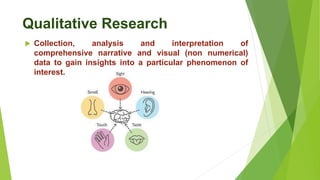
 Collection, analysis and interpretation of
comprehensive narrative and visual (non numerical)
data to gain insights into a particular phenomenon of
interest.
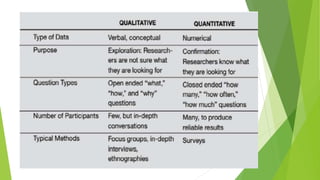
QUANTITATIVE RESEARCH QUALITATIVE RESEARCH
Type of data collected Numerical data Non numerical narrative
and visual data
Research problem Hypothesis and research
procedures stated before
beginning the study
Research problems and
methods evolve as
understanding of topic
deepens
Manipulation of context Yes No
Sample size Larger Smaller
Research procedures Statistical procedures Categorizing & organizing
data into patterns to
produce a descriptive,
narrative synthesis
Participant interaction Little Extensive
Underlying belief We live in a stable &
predictable world that we
can measure, understand
and generalize about
Meaning is situated in a
particular
perspective/context that is
different for people &
groups; therefore the world
has many meanings.
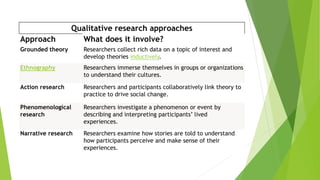
Qualitative research approaches
Approach What does it involve?
Grounded theory Researchers collect rich data on a topic of interest and
develop theories inductively.
Ethnography Researchers immerse themselves in groups or organizations
to understand their cultures.
Action research Researchers and participants collaboratively link theory to
practice to drive social change.
Phenomenological
research
Researchers investigate a phenomenon or event by
describing and interpreting participants’ lived
experiences.
Narrative research Researchers examine how stories are told to understand
how participants perceive and make sense of their
experiences.
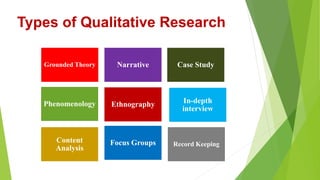
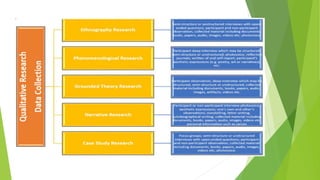
Types of Qualitative Research
In-depth
interview
Focus Groups
Narrative
Phenomenology Ethnography
Case Study
Content
Analysis
Grounded Theory
Record Keeping
Grounded Theory
 Grounded theory is a systematic procedure of data
analysis, typically associated with qualitative research,
that allows researchers to develop a theory that
explains a specific phenomenon.
 Grounded theory was developed by Glaser and Strauss
and is used to conceptualize phenomenon using
research
 The unit of analysis in grounded theory is a specific
phenomenon or incident, not individual behaviors.
Grounded theory commonly uses the
following data collection methods:
 Interviewing participants with open-ended
questions.
 Participant Observation (fieldwork) and/or
focus groups.
 Study of Artifacts and Texts
Narrative research
 Encompass the study of the experiences of a
single individual embracing stories of the life and
exploring the learned significance of those
individual experiences.
 Focus on the lives of individuals as told through
their own stories.
 Means by which we systematically gather, analyse,
and represent people’s stories as told by them.
Case study
 Unlike grounded theory, the case study model
provides an in-depth look at one test subject.
 The subject can be a person, family, organization,
school etc.
Case studies are to be used when
 The researcher wants to focus on how and why,
the behavior is to be observed, not manipulated,
to further understand a given phenomenon
 Multiple methods can be used to gather data,
including interviews, observation, and historical
documentation.
Steps in Case study method
 Identification of the problem
 Diagnosis of the problem
 Collection and Analysis of the data
 Suggesting Remedial Measures
 Follow up
Characteristics of a Good Case-study
 Completeness of data
 Validity of data
 Continuity
 Confidential recording
 Scientific synthesis
Merits
 To study rare and useful case of human behaviour
 Some of the case study data cannot be obtained by any other
technique
 In education, it may be highly useful in Guidance and Counselling
Limitations
 Human behaviour cannot be explained without thoroughly examining
environmental factors in relation to the individual
 Elements of Subjectivity
 Errors of perception, faulty memory, unconscious bias, etc
 Expensive
Refer following link for further details
 https://www.slideshare.net/hinanwr/case-study-final-14970834
Ethnographic Research
 Study of cultural patterns and perspectives of participants in
their natural settings.
 To describe, analyze and interpret a culture’s
characteristics.
 Developed in the 19th and 20th centuries and used by
anthropologists to explore primitive cultures different from
their own; it originated from Anthropology.
Describe and interpret culture- the set
of attitudes, values, concepts, beliefs
and practices shared by members of a
group.
 The primary data collection method is through
participant observation over an extended
period of time.
 Field notes, interview and examination of
artifacts are also used
 Studies on tribes, marginalized groups, women,
culture of a school, work culture of a particular
institution etc.
Steps of Conducting Ethnographic Research
 Identify research question
 Determine location(s) for research
 Formulate presentation method
 Acquire permissions and access
 Observe and participate
 Interview
 Collect archival data
 Code and analyse data
Four main elements of Ethnographic
Research
 Phenomenology
 Holison
 Non- Judgemental orientation
 Contextualisation
Approaches
 Linguistic Approach
 Situational Approach
Techniques (Methods)
 Experience
 Enquiry
 Examination
Key notes
 Ethnographic research has an interest in culture and cultural meanings
with an emphasis on the ‘emic’ or ‘the insider’ view.
 Ethnographies are based on fieldwork among the people whose culture
is under study.
 Ethnography focuses on interpretation, understanding and
representation.
 Methodological principles such as naturalism, understanding and
induction draw on different philosophical backgrounds and, therefore,
produce different types of ethnography.
 Collect data from different perspectives and different sources, write
field notes that are descriptive and rich in detail, and represent
participants in their own terms by using quotations and short stories.
 Write rich description followed by analysis and interpretation, and
situate yourself in your writing. The narrative form of writing works
well.
Strength and weaknesses
 Pros of Ethnography
 It helps people know more about other cultures
 It helps businesses learn more about their target market
 It helps increase scientists’ understanding of human behaviour
 It can easily evolve and discover new things
 Cons of Ethnography
 It can be difficult to choose a representative sample
 It takes a lot of time
 It depends on the ethnographer’s relationship with his subjects
 It depends on people’s openness and honesty
 It can lead to cultural bias
Phenomenology
 To identify phenomena and focus on subjective
experiences and understanding the structure of
those lived experiences.
 To describe how human beings experience a
certain phenomenon.
 It was founded in the early 20thcentury by Edmund
Husserl and Martin Heidegger and originated
from philosophy.
 Set aside biases and preconceived assumptions
about human experiences, feelings, and responses
to a particular situation.
 To explore the perceptions, perspectives,
understandings, and feelings of those people who
have actually experienced or lived the phenomenon
or situation of interest.
 The direct investigation and description of
phenomena as consciously experienced by people
living those experiences.
 The primary data collection method is
through in-depth interviews.
 Participant observation
Nature of qualitative data
 ‘Detailed descriptions’ of situations, events, people,
interactions, observed behaviours, still or moving
images and artifacts.
 ‘Direct quotations’ from people about their attitudes,
beliefs and thoughts;
 ‘Excerpts’ or ‘entire passages’ from documents,
correspondence records and case histories.
 Verbal data gathered through open ended
questionnaires, observations, and interviews are also
mostly qualitative in nature.
 All these data are not usually immediately
accessible for analysis, but require some
processing.
 Raw field notes needs to be corrected, edited,
typed; tape recordings need to be transcribed
and corrected; video filming needs to be
technically edited, and so on.
Process of Observation
 Qualitative Observation is a process of research that
uses subjective methodologies to gather systematic
information or data. Since, the focus on qualitative
observation is the research process of using subjective
methodologies to gather information or data.
Qualitative observation is primarily used to equate
quality differences.
 Qualitative observation deals with the 5 major
sensory organs and their functioning – sight, smell,
touch, taste, and hearing. This doesn’t involve
measurements or numbers but instead characteristics.
Qualitative research data collection
methods
 Each of the research approaches involve using one or more data
collection methods. These are some of the most common
qualitative methods:
• Observations: recording what you have seen, heard, or encountered
in detailed field notes.
• Interviews: personally asking people questions in one-on-one
conversations.
• Focus groups: asking questions and generating discussion among a
group of people.
• Surveys: distributing questionnaires with open-ended questions.
• Secondary research: collecting existing data in the form of texts,
images, audio or video recordings, etc.
Qualitative Data Analysis
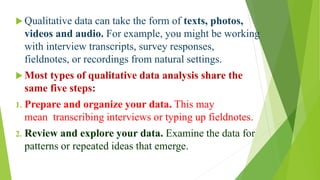
 Qualitative data can take the form of texts, photos,
videos and audio. For example, you might be working
with interview transcripts, survey responses,
fieldnotes, or recordings from natural settings.
 Most types of qualitative data analysis share the
same five steps:
1. Prepare and organize your data. This may
mean transcribing interviews or typing up fieldnotes.
2. Review and explore your data. Examine the data for
patterns or repeated ideas that emerge.
3. Develop a data coding system. Based on your initial ideas,
establish a set of codes that you can apply to categorize your
data.
4. Assign codes to the data. For example, in qualitative survey
analysis, this may mean going through each participant’s
responses and tagging them with codes in a spreadsheet. As you
go through your data, you can create new codes to add to your
system if necessary.
5. Identify recurring themes. Link codes together into
cohesive, overarching themes.
 There are several specific approaches to analyzing qualitative
data. Although these methods share similar processes, they
emphasize different concepts.
Data Analysis
 Organising the data
 Transcribe data
 Interim Analysis
 Segmenting
 Memoing
 Coding
 Categorizing
 Making connections /
Establishing relations
 Interpreting and reporting
Qualitative Data Analysis
Approach When to use Example
Content Analysis To describe and categorize
common words, phrases, and ideas
in qualitative data.
A market researcher could perform content analysis
to find out what kind of language is used in
descriptions of therapeutic apps.
Thematic Analysis To identify and interpret patterns
and themes in qualitative data.
A psychologist could apply thematic analysis to
travel blogs to explore how tourism shapes self-
identity.
Textual Analysis To examine the content, structure,
and design of texts.
A media researcher could use textual analysis to
understand how news coverage of celebrities has
changed in the past decade.
Discourse Analysis To study communication and how
language is used to achieve effects
in specific contexts.
A political scientist could use discourse analysis to
study how politicians generate trust in election
campaigns.
Advantages of Qualitative Research
 Qualitative research often tries to preserve the voice and perspective of
participants and can be adjusted as new research questions arise.
Qualitative research is good for:
• Flexibility
 The data collection and analysis process can be adapted as new ideas or
patterns emerge. They are not rigidly decided beforehand.
• Natural settings
 Data collection occurs in real-world contexts or in naturalistic ways.
• Meaningful insights
 Detailed descriptions of people’s experiences, feelings and perceptions
can be used in designing, testing or improving systems or products.
• Generation of new ideas
 Open-ended responses mean that researchers can uncover novel
problems or opportunities that they wouldn’t have thought of otherwise.
Disadvantages of Qualitative Research
 Researchers must consider practical and theoretical limitations in
analyzing and interpreting their data. Qualitative research suffers
from:
• Unreliability - The real-world setting often makes qualitative research
unreliable because of uncontrolled factors that affect the data.
• Subjectivity - Due to the researcher’s primary role in analyzing and
interpreting data, qualitative research cannot be replicated. The
researcher decides what is important and what is irrelevant in data
analysis, so interpretations of the same data can vary greatly.
• Limited generalizability - Small samples are often used to gather
detailed data about specific contexts. Despite rigorous analysis
procedures, it is difficult to arise generalizable conclusions because the
data may be biased and unrepresentative of the wider population.
 Labor-intensive - Although software can be used to manage and
record large amounts of text, data analysis often has to be checked or
performed manually.
Qualitative data analysis
Data Reduction
Data Display, and
Drawing Conclusion & Verification
Data Reduction
Data reduction is a form of analysis that
sharpens, sorts, focuses, discards, and
organizes data in such a way that
meaningful conclusions can be drawn
and verified.
Data display
 A display is an organized, compressed
assembly of information that permits conclusion
drawing and action.
 Looking at display helps us to understand what
is happening and to do something – either
analyze further or take action – based on that
understanding.
Designing a display – deciding on the
rows and columns of a matrix for
qualitative data and deciding which
data, in which form, should be entered
in the cells – are analytic activities.
Drawing conclusion and verification
 From the start of data collection, the researcher in the
field makes notes about the activities and their
explanations.
 Subsequently these notes reveal some possible
configurations from where tentative conclusions are
drawn and they are verified and cross checked, while in
the field, to check about the credibility of those
conclusions.
Coding
 Setting up proper codes for the collected data
takes you a step ahead.
 Coding is one of the best ways to compress a
huge amount of information collected.
 Coding of qualitative data simply means
categorizing and assigning properties and patterns
to the collected data.
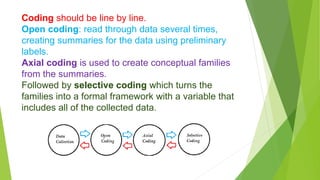
Coding should be line by line.
Open coding: read through data several times,
creating summaries for the data using preliminary
labels.
Axial coding is used to create conceptual families
from the summaries.
Followed by selective coding which turns the
families into a formal framework with a variable that
includes all of the collected data.
Types of Coding
 Open coding: Basically, you read through your
data several times and then start to create
tentative labels for chunks of data that summarize
what you see happening (not based on existing
theory – just based on the meaning that emerges
from the data).
 Record examples of participants’ words and
establish properties of each code.
 Axial coding: Axial coding consists of
identifying relationships among the open codes.
What are the connections among the codes?
 Selective coding: Figure out the core variable
that includes all of the data. Then reread the
transcripts and selectively code any data that
relates to the core variable you identified.
Categorisation
 It is a process of identifying patterns in the
data; recurring ideas, themes, perspectives
and descriptions that depict the social world
you are studying.
 Example: studying social skills of students
involved in collaborative learning
Classification
 Classification is a way of knowing the
attributes of a phenomenon and be able to
group them. A key element of many social
science endeavours is the systematic
classification of different phenomena or
items in a domain area.
Basic requirements for classification
 Identify, generate and develop categories
 Judge the categories for Internal Homogeneity and
External Heterogeneity
IH - the extent to which the data that belong in a
certain category hold together in a meaningful way.
EH - the extent to which differences among categories
are bold and clear
 Arrange or sort out the data as per the
developed categories
 There might be possibility of some data
remaining out of the categories
 Check, recheck and verify the meaningfulness
and accuracy of the categories
Content analysis
 Content analysis is concerned with the classification,
organization and comparison of content of the document
or communication.
 Documentary data (textual data, interview transcripts,
excerpts from people’s speech, case histories, field
notes or diary, biographies and observation records)
TECHNIQUES OF QUALITATIVE CONTENT
ANALYSIS
(i) Summarizing Content Analysis
(ii) Explicative Content Analysis, and
(iii)Structuring Content Analysis
Summarizing
 In this the material is paraphrased, which
means that the less relevant passages and
paraphrases with the same meanings are
skipped (first reduction) and similar
paraphrases are bundled and summarized
(second reduction).
Explicative
 It clarifies ambiguous or contradictory
passages by involving context material in the
analysis. Definitions taken from dictionaries
or based on grammar are used or
formulated.
Structuring content analysis
 Looks for types or formal structures in the
material.
 The analyst looks for a single salient feature
that describes more exactly the internal
structure.
For doing such a type of content
analysis, no general rule can be
defined.
It depends on the respective
research question and the
analytical power of the analyst.
Triangulation
“Triangulation or the use of multiple
methods, is a plan of action that will raise
sociologists above the personalistic biases
that stem from single methodologies”
(Denzin, 1978)
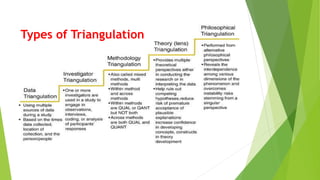
Types of Triangulation
Denzin (1978) has identified four basic types of
triangulation:
Data Triangulation – the use of a variety of
data sources in a study;
Investigator Triangulation – the use of several
different researchers;
Cont..
Theory Triangulation - the use of multiple
perspectives to interpret a single set of
data; and
Methodological Triangulation – the use of
multiple methods to study a single
problem.
Types of Triangulation
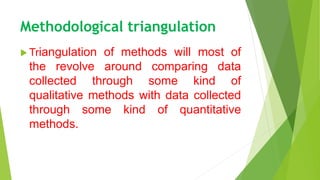
Methodological triangulation
 Triangulation of methods will most of
the revolve around comparing data
collected through some kind of
qualitative methods with data collected
through some kind of quantitative
methods.
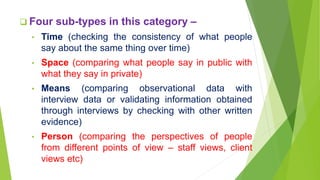
Data triangulation
This allows a researcher to cross
check the consistency of
information derived at different
times and by different means
within qualitative methods.
 Four sub-types in this category –
• Time (checking the consistency of what people
say about the same thing over time)
• Space (comparing what people say in public with
what they say in private)
• Means (comparing observational data with
interview data or validating information obtained
through interviews by checking with other written
evidence)
• Person (comparing the perspectives of people
from different points of view – staff views, client
views etc)
Investigator/Analyst triangulation
Using multiple observers or analysts.
The rationale is to reduce bias and
increase reliability – that is the extent
to which a research tool produces the
same results irrespective of when,
where or by whom it is conducted.
Theory Triangulation
 Theory triangulation is the use of
multiple theories or hypotheses when
examining a situation or phenomenon. The
idea is to look at a situation/phenomenon from
different perspectives, through different lenses,
with different questions in mind.
References
 An introduction to qualitative research. Retrieved July 20, 2020 from
https://www.scribbr.com/methodology/qualitative-research/
 QUALITATIVE RESEARCH: DEFINITION, TYPES, METHODS AND
EXAMPLES. Retrieved July 20, 2020 from
https://www.questionpro.com/blog/qualitative-research-methods/
 Internet Sources – Images and Contents
Qualitative research, types, data collection and analysis