Introduction to Research:
Introduction to Research: General
Concepts
 What is research?
 Characteristics of the Scientific Method
 Characteristics of Scientific Knowledge
 General Approaches to Research
 Types of Research in Public
Administration
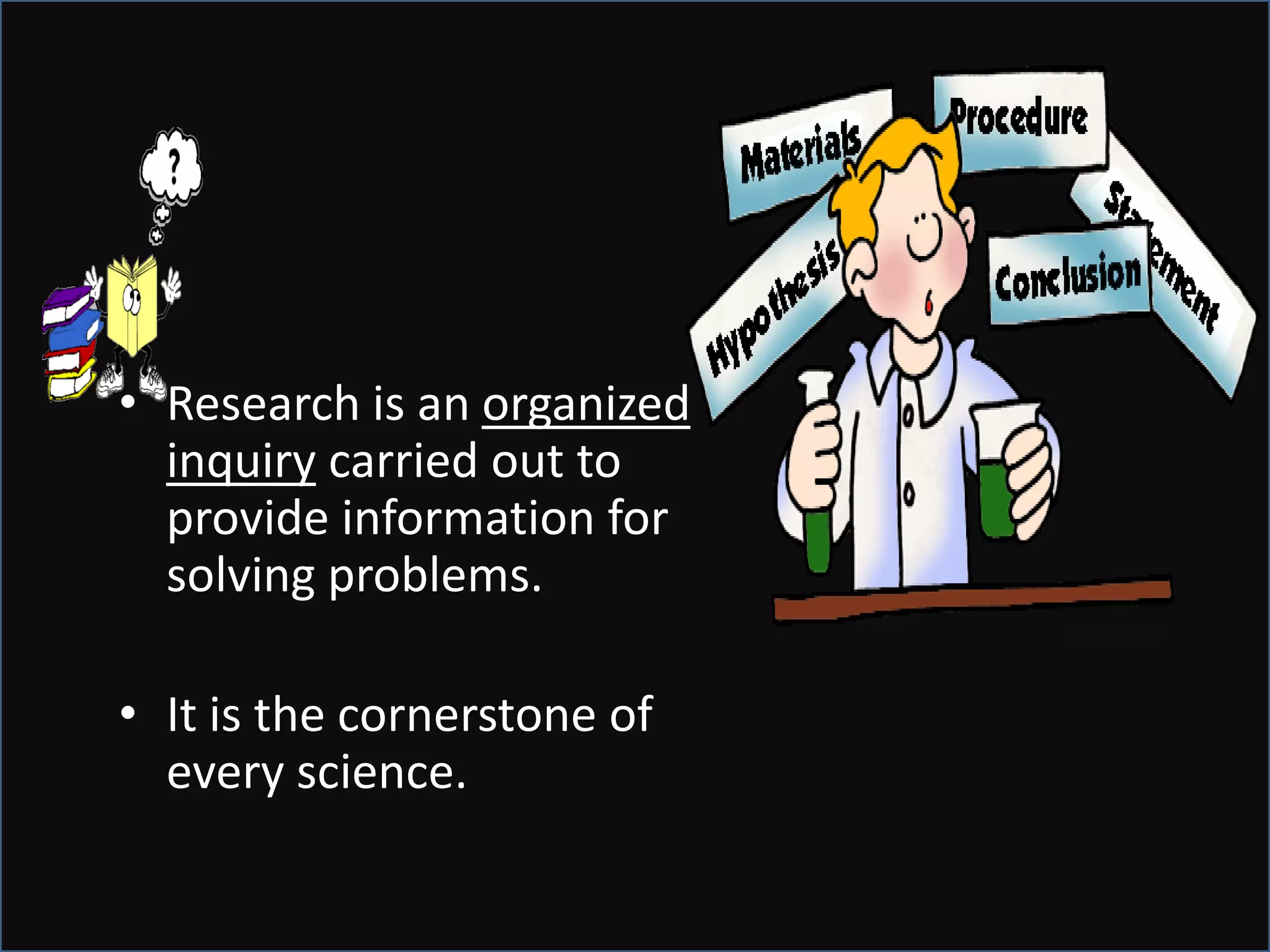
• Research is an organized
inquiry carried out to
provide information for
solving problems.
• It is the cornerstone of
every science.
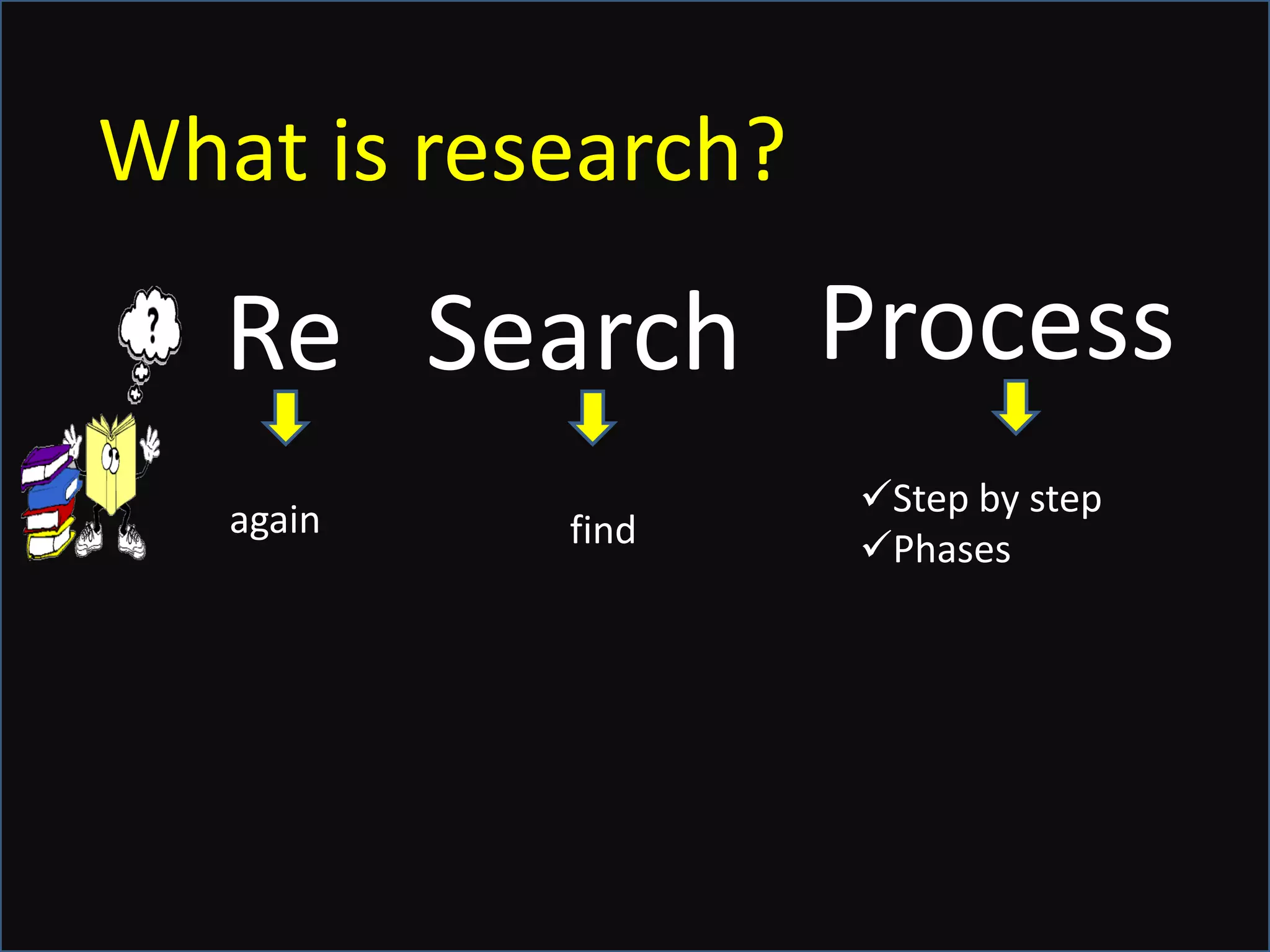
What is research?
Re Search Process
again find
Step by step
Phases
Research
formal
informal
I will find
what you
need
Is a process in looking at solution of a
given problem which can be used as
basis for :
 policy formulation
 policy enhancement or
improvements
But before you can come up
with POLICY, it should be
back up with empirical
(observed) data which
requires the process of
research
`
Research is the systematic process of
collecting and analyzing
information to increase our
understanding of the world in
general and of the phenomenon
under study in particular.
What is research?
Why conduct research?
Students, professors, researchers, research
centers, government, practitioners, newspaper
people, TV networks, market research firms,
schools, hospitals, social service, political parties,
consulting firms, HR departments, public interest
organizations, insurance, law firms conduct research
as part of their jobs, to be better informed, less
biased decisions, in contrast to guessing,
hunches, intuition, and other personal
experience.
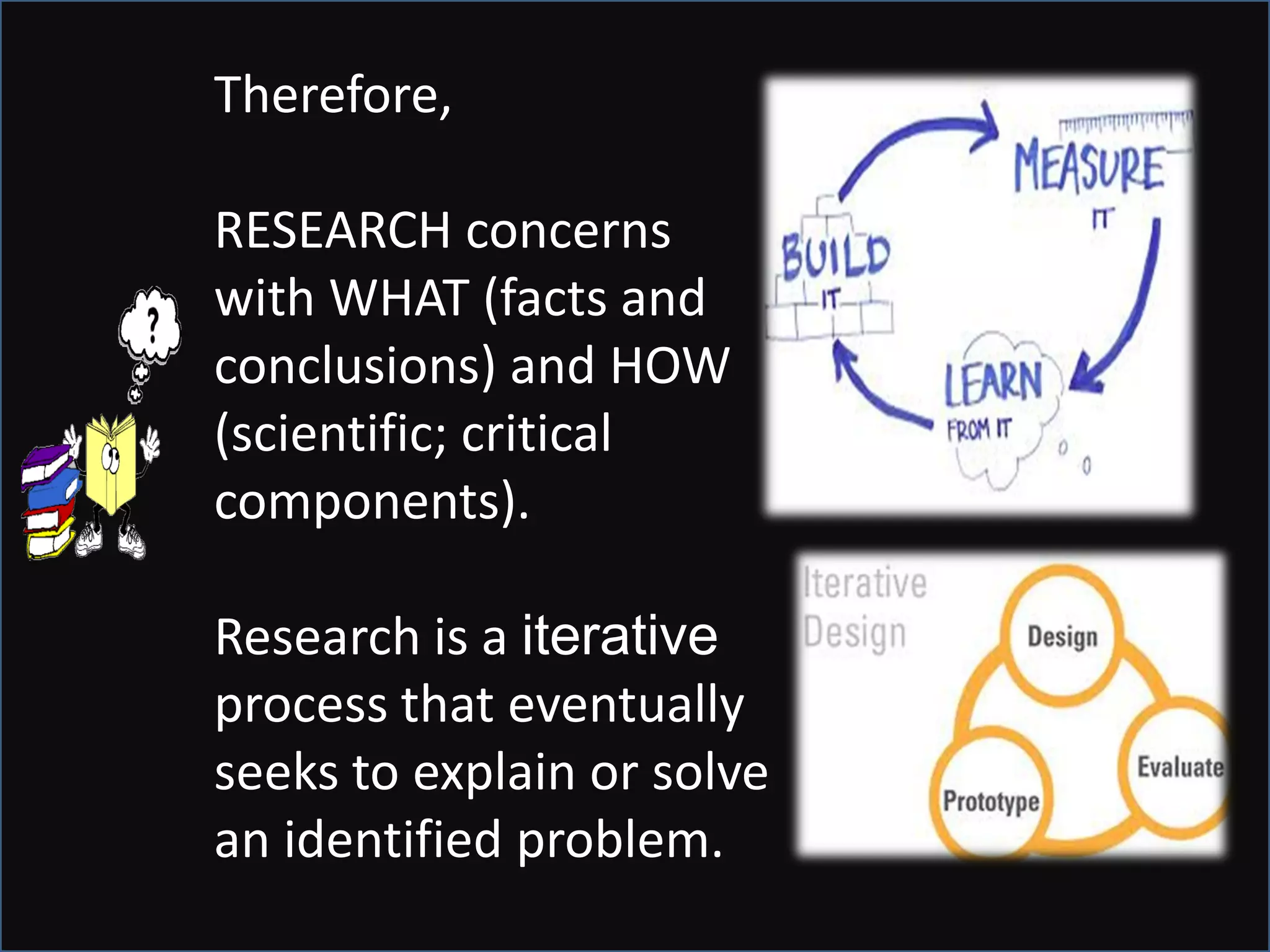
Therefore,
RESEARCH concerns
with WHAT (facts and
conclusions) and HOW
(scientific; critical
components).
Research is a iterative
process that eventually
seeks to explain or solve
an identified problem.
Characteristics of the Scientific Method
1.Tentative (constant review)
2. Empirically verifiable (researchable)
3. Ethically neutral (what harm or risk
involved to respondents, confidentiality
and privacy?)
4. Shared and made public
Purpose of Research
 explore
 describe
 explain
Types of Research
1. According to Purpose
 Fundamental/Pure/Basic
- Lab research
 Applied
- evaluation
- action
- social impact
– starting point for the search of
new knowledge.
- provides a foundation for knowledge
and foundations that are generalizable
to many policy areas, problems or area
of study
- Source of the tools – methods,
theories, ideas
Basic
• research is driven by a scientist's curiosity or
interest in a scientific question. The main
motivation is to expand man's knowledge, not
to create or invent something. There is no
obvious commercial value to the discoveries
that result from basic research.
 For example, basic science investigations probe for answers to questions
such as:
 How did the universe begin?
 What are protons, neutrons, and electrons composed of?
 How do slime molds reproduce?
 What is the specific genetic code of the fruit fly?
Applied Research
• refers to scientific study and research that
seeks to solve practical problems. Applied
research is used to find solutions to everyday
problems, cure illness, and develop innovative
technologies, rather than to acquire
knowledge for knowledge's sake.
• For example, applied researchers may investigate ways to:
Improve agricultural crop production
• Treat or cure a specific disease
• Improve the energy efficiency of homes, offices, or modes of
transportation
– application of the methods, ideas,
theories from basic research
-Want to apply and tailored knowledge to
address a specific practical issue;
- towards development of more efficient
technologies or particular way of doing
things.
- Address issue of application
- It asks “does it work”
– advances the aims of basic and applied research
to the point of utilization.
-concerned with the production of results for
immediate application or utilization.
-it improves practices and methods and generates
technologies and innovations for application to
specific technological situations.
-the emphasis is here and now
Action
Correlational Research
– refers to the systematic investigation or statistical study of relationships
among two or more variables, without necessarily determining cause and
effect.
– It Seeks to establish a relation/association/correlation between two or
more variables that do not readily lend themselves to experimental
manipulation.
– For example, to test the hypothesis “ Listening to music lowers blood
pressure levels” there are 2 ways of conducting research
• Experimental – group samples and make one group listen to music and
then compare the bp levels
• Survey – ask people how they feel ? How often they listen? And then
compare
Historical – The purpose is to collect,
verify, synthesize evidence to establish
facts that defend or refute your
hypothesis. It uses primary sources,
secondary sources, and lots of
qualitative data sources such as logs,
diaries, official records, reports, etc. The
limitation is that the sources must be
both authentic and
According to Methods
Historical Research
• Historical
research is
research
involving analysis
of events that
occurred in the
remote or recent
past
Application
• Historical research can show patterns that
occurred in the past and over time which can
help us to see where we came from and what
kinds of solutions we have used in the past.
• Understanding this can add perspective on how
we examine current events and educational
practices.
The steps involved in the conduct of historical
research
Here are the five steps:
1. Identification of the research topic and
formulation of the research problem or
question.
2. Data collection or literature review
3. Evaluation of materials
4. Data synthesis
5. Report preparation or preparation of the
narrative exposition
Descriptive
Research
• refers to research that provides an accurate
portrayal of characteristics of a particular
individual, situation, or group. Descriptive
research, also known as statistical research.
• These studies are a means of discovering new
meaning, describing what exists, determining
the frequency with which something occurs,
and categorizing information.
Descriptive – It attempts to
describe and explain conditions of the
present by using many subjects and
questionnaires to fully describe a
phenomenon. Survey research design
/survey methodology is one of the most
popular for thesis/dissertation
• In short descriptive research deals with
everything that can be counted and studied,
which has an impact of the lives of the people
it deals with.
For example:
• finding the most frequent disease that affects
the children of a town. The reader of the
research will know what to do to prevent that
disease thus, more people will live a healthy
life.
Case and Field Research Design
• Also called ethnographic research, it uses
direct observation to give a complete
snapshot of a case that is being studied. It is
useful when not much is known about a
phenomenon. Uses few subjects.
Developmental or Time Series
Research Design
• Data are collected at certain
points in time going forward.
There is an emphasis on time
patterns and longitudinal growth
or change.
- This research design approximates the
experimental design but does not have a
control group. There is more error possible in
the results.
Quasi Experimental
Research Design
Experimental Research
is an objective, systematic, controlled
investigation for the purpose of predicting and
controlling phenomena and examining
probability and causality among selected
variables.
• Experimental Research Design - This design is
most appropriate in controlled settings such
as laboratories. The design assumes random
assignment of subjects and random
assignment to groups (E and C). It attempts to
explore cause and affect relationships where
causes can be manipulated to produce
different kinds of effects. Because of the
requirement of random assignment, this
design can be difficult to execute in the real
world (non laboratory) setting.
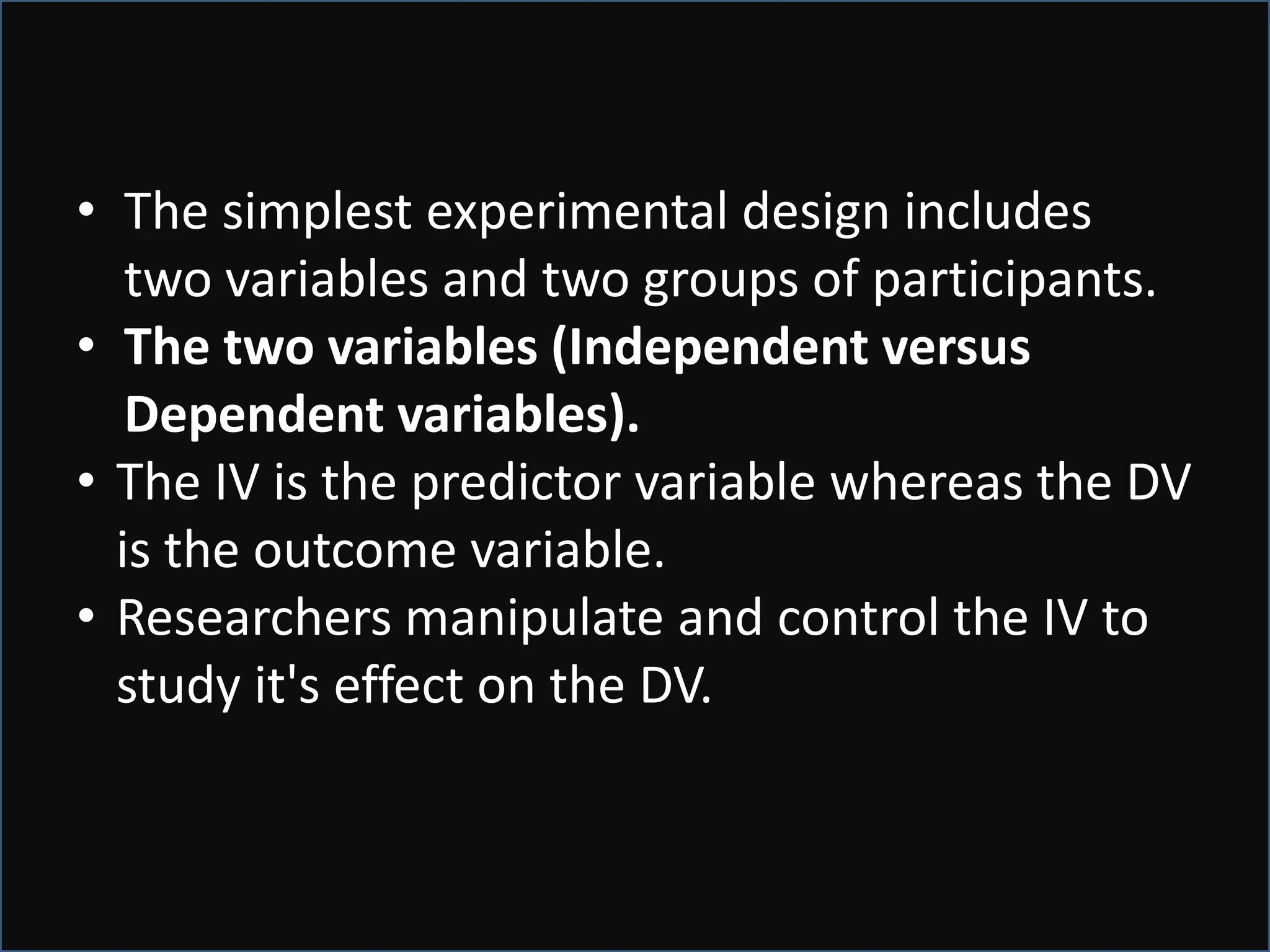
• The simplest experimental design includes
two variables and two groups of participants.
• The two variables (Independent versus
Dependent variables).
• The IV is the predictor variable whereas the DV
is the outcome variable.
• Researchers manipulate and control the IV to
study it's effect on the DV.
• The two groups of participants (Control
versus Experimental group).
• Before beginning the experiment, the
researcher (randomly) assigns his/her sample
to two different groups: the control group and
the experimental (treatment group or clinical
group).
• The control group receives no manipulation of
the IV (no treatment), whereas the
experimental group receives the manipulation
of the IV
Causal Comparative or Ex Post
Facto Research Design
- This research design attempts to
explore cause and affect relationships
where causes already exist and cannot
be manipulated. It uses what already
exists and looks backward to explain
why
Correlational or Prospective Research Design -
It attempts to explore relationships to make
predictions. It uses one set of subjects with
two or more variables for each.
Correlational or
Prospective Research
Design
• Exploratory research can be quite informal,
relying on secondary research such as
reviewing available literature and/or data,
or qualitative approaches such as informal
discussions with consumers, employees,
management or competitors, and more formal
approaches through in-depth interviews, focus
groups, projective methods, case studies or
pilot studies.
Exploratory Research
• is a type of research conducted for a problem
that has not been clearly defined. Exploratory
research helps determine the
best research design, data collection method
and selection of subjects.
• The results of exploratory research are not
usually useful for decision-making by
themselves, but they can provide significant
insight into a given situation
Phenomenological Research
• an inductive, descriptive research approach
developed from phenomenological
philosophy; its aim is to describe an
experience as it is actually lived by the person
• Phenomenologyis concerned with the study
of experience from the perspective of the individual,
‘bracketing’ taken-for-granted assumptions and usual
ways of perceiving.
• They are based in a paradigm of personal knowledge
and subjectivity, and emphasise the importance of
personal perspective and interpretation.
• As such they are powerful for understanding subjective
experience, gaining insights into people’s motivations
and actions, and cutting through the clutter of taken-
for-granted assumptions and conventional wisdom.
Purpose of Research
 explore
 describe
 explain
General Approaches
to Research
1. Qualitative
2. Quantitative
3. Mixed Method
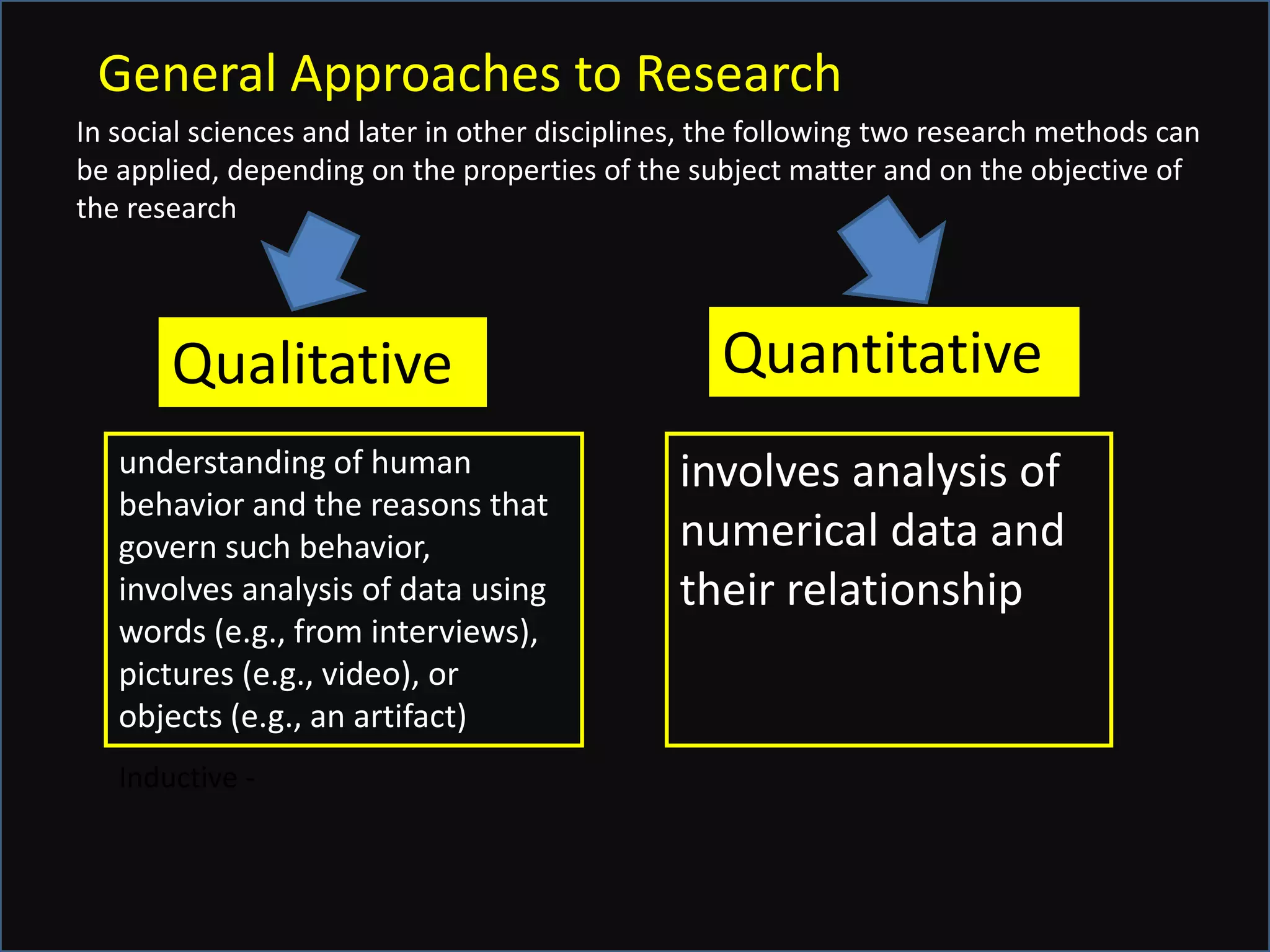
General Approaches to Research
Qualitative Quantitative
understanding of human
behavior and the reasons that
govern such behavior,
involves analysis of data using
words (e.g., from interviews),
pictures (e.g., video), or
objects (e.g., an artifact)
involves analysis of
numerical data and
their relationship
In social sciences and later in other disciplines, the following two research methods can
be applied, depending on the properties of the subject matter and on the objective of
the research
Inductive -
Qualitative research is research dealing with
phenomena that are difficult or impossible to
quantify mathematically, such as beliefs, meanings,
attributes, and symbols
Qualitative researchers aim to gather an in-
depth understanding of human behaviour and
the reasons that govern such behavior. The
qualitative method investigates the why and how
of decision making, not just what, where, when.
• Quantitative research is generally made
using scientific methods, which can include:
• The generation of models, theories and
hypotheses
• The development of instruments and methods
for measurement
• Experimental control and manipulation
of variables
• Collection of empirical data
• Modelling and analysis of data
• Evaluation of results
Inductive -
1. Qualitative
- inductive- from fact to theory
- explore factors that could explain why
a given event occurs
- establish patterns/develop theory for
understanding how and why an event occur
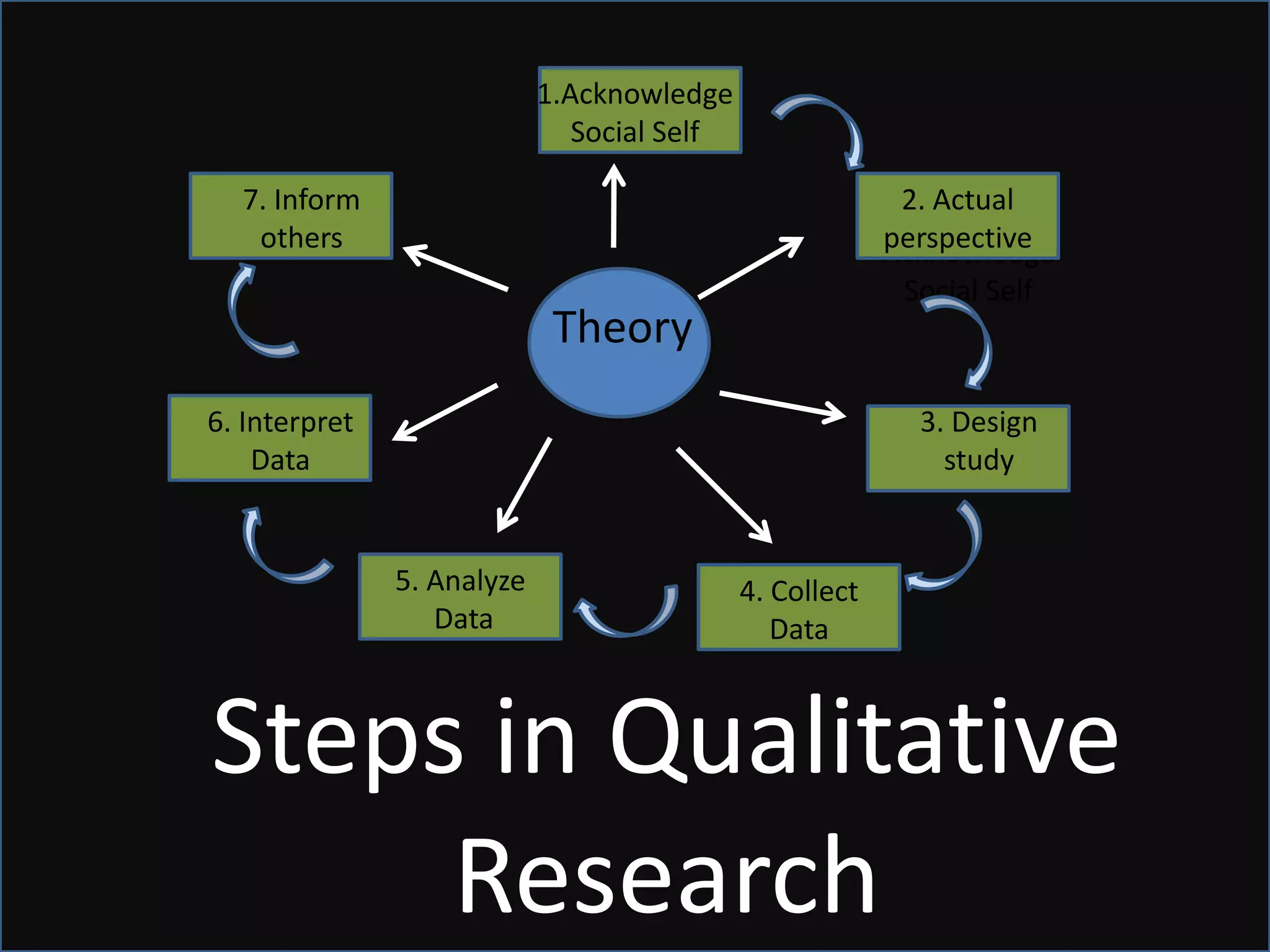
1.Acknowledge
Social Self
Acknowledge
Social Self
2. Actual
perspective
3. Design
study
4. Collect
Data
5. Analyze
Data
6. Interpret
Data
7. Inform
others
Steps in Qualitative
Research
Theory
2. Quantitative
- deductive – from theory to fact
- establish cause-effect relationship
- relate occurrence of a variable with other
variables
- Establish generalizations for prediction and
control
Quantitative Research
• refers to the systematic empirical
investigation of any phenomena via
statistical, mathematical or
computational techniques. The objective
of quantitative research is to develop
and employ mathematical
models, theories and/or hypotheses
pertaining to phenomena
1. Select
Topic
Acknowledge
Social Self
2. Focus
Question
3. Design
study
4. Collect
Data
5. Analyze
Data
6. Interpret
Data
7. Inform
others
Steps in Qualitative
Research
Theory
General Approaches
to Research
Mixed Method Approach
Qualitative + Quantitative
Types of Research in Public Administration
Social sciences – anthropology (the study
of humankind, in particular.
the comparative study of human
societies and cultures and their
development), psychology (study of the
mind and behavior), Ex.
The 7 habit of emotionally Intelligent
People?
Situational theory of Leadership?
political science, and sociology, involving
the study of people, their belief, behavior,
interaction, institutional, etc.
Types of Research in Public Administration
political science, and sociology, involving
the study of people, their belief, behavior,
interaction, institutional, etc.
Comparative politics studies the politics, governments and cultures of
different countries and focuses on how government and politics actually
operate
examines the country's system of government, including
its presidents, cabinets, parliament, political parties, voting
systems, elections, coalitions, policy issues and problems
The development of the “rule of law” in pre-modern
China and Korea
Types of Research in Public Administration
Policy and program
 Needs assessment
 Process evaluations
 Outcome evaluations
Workshop # 1: Brainstorming
& Mind-mapping
identify issues/concerns/problems in
their community and identify
appropriate type of research that can be
used to answer or solve the problem
Difference Between Issues and Problems
for instance, forgetting your lunch is an issue,
but losing your job a problem.
issue, you generally can readily come up with the solution. A
problem, on the other hand, is not something that you can solve
without forethought, and even a certain amount of guesswork.
An issue is smaller, not life altering, and it doesn’t present such a degree of
difficulty that you have to seek out the counsel of others in order to figure
out the impact of the issue. A problem is larger in scale, often large enough
to alter your life either temporarily or permanently. A problem can easily
require the advice and guidance of those around you, in order to solve it.
On a corporate or governmental level, an issue is something that can be
handled behind closed doors, impacting no one but the people of highest
authority in the situation. A problem involves information that must be
released, because there will be cause to involve employees, or citizens, in
the solution to the problem.
Issues
/concerns
/problems
Type of
research
Issues &
Concerns
Type of Research
1. Tardiness of
councilmen
Applied (Action)
Problems Research design
1. Poverty Applied (evaluation)
2. Service Delivery Applied ( social impact)
1. Dr Ruby Cruz - Lecture on Research & Statistics 2011
PSU, Urdaneta City, Pangasinan
2. Asian review of Public Administration
EROPA, UP Diliman, Quezon City Philippines
Volume XiX, 2007
3. W. Lawrence Newman
Social Research Methods 6th Ed
University of Wisconsin at Whitewater 2006
4. UP IMRI Manila
Lecture on Doing Research
PUNP, 2011
5. Vaisali K B070225AR. Methods of Research
www.slideshare.net/Vaisali
Dr. Susan Carroll
http://www.dissertation-
statistics.com/research-designs.html
Reference:
Reporting
one hour

Introduction to Research

  • 1.
  • 2.
    Introduction to Research:General Concepts  What is research?  Characteristics of the Scientific Method  Characteristics of Scientific Knowledge  General Approaches to Research  Types of Research in Public Administration
  • 3.
    • Research isan organized inquiry carried out to provide information for solving problems. • It is the cornerstone of every science.
  • 4.
    What is research? ReSearch Process again find Step by step Phases
  • 5.
  • 6.
    Is a processin looking at solution of a given problem which can be used as basis for :  policy formulation  policy enhancement or improvements
  • 7.
    But before youcan come up with POLICY, it should be back up with empirical (observed) data which requires the process of research
  • 8.
    ` Research is thesystematic process of collecting and analyzing information to increase our understanding of the world in general and of the phenomenon under study in particular. What is research?
  • 9.
    Why conduct research? Students,professors, researchers, research centers, government, practitioners, newspaper people, TV networks, market research firms, schools, hospitals, social service, political parties, consulting firms, HR departments, public interest organizations, insurance, law firms conduct research as part of their jobs, to be better informed, less biased decisions, in contrast to guessing, hunches, intuition, and other personal experience.
  • 10.
    Therefore, RESEARCH concerns with WHAT(facts and conclusions) and HOW (scientific; critical components). Research is a iterative process that eventually seeks to explain or solve an identified problem.
  • 11.
    Characteristics of theScientific Method 1.Tentative (constant review) 2. Empirically verifiable (researchable) 3. Ethically neutral (what harm or risk involved to respondents, confidentiality and privacy?) 4. Shared and made public
  • 12.
    Purpose of Research explore  describe  explain
  • 13.
    Types of Research 1.According to Purpose  Fundamental/Pure/Basic - Lab research  Applied - evaluation - action - social impact
  • 14.
    – starting pointfor the search of new knowledge. - provides a foundation for knowledge and foundations that are generalizable to many policy areas, problems or area of study - Source of the tools – methods, theories, ideas Basic
  • 15.
    • research isdriven by a scientist's curiosity or interest in a scientific question. The main motivation is to expand man's knowledge, not to create or invent something. There is no obvious commercial value to the discoveries that result from basic research.  For example, basic science investigations probe for answers to questions such as:  How did the universe begin?  What are protons, neutrons, and electrons composed of?  How do slime molds reproduce?  What is the specific genetic code of the fruit fly?
  • 17.
    Applied Research • refersto scientific study and research that seeks to solve practical problems. Applied research is used to find solutions to everyday problems, cure illness, and develop innovative technologies, rather than to acquire knowledge for knowledge's sake. • For example, applied researchers may investigate ways to: Improve agricultural crop production • Treat or cure a specific disease • Improve the energy efficiency of homes, offices, or modes of transportation
  • 19.
    – application ofthe methods, ideas, theories from basic research -Want to apply and tailored knowledge to address a specific practical issue; - towards development of more efficient technologies or particular way of doing things. - Address issue of application - It asks “does it work”
  • 20.
    – advances theaims of basic and applied research to the point of utilization. -concerned with the production of results for immediate application or utilization. -it improves practices and methods and generates technologies and innovations for application to specific technological situations. -the emphasis is here and now Action
  • 21.
    Correlational Research – refersto the systematic investigation or statistical study of relationships among two or more variables, without necessarily determining cause and effect. – It Seeks to establish a relation/association/correlation between two or more variables that do not readily lend themselves to experimental manipulation. – For example, to test the hypothesis “ Listening to music lowers blood pressure levels” there are 2 ways of conducting research • Experimental – group samples and make one group listen to music and then compare the bp levels • Survey – ask people how they feel ? How often they listen? And then compare
  • 23.
    Historical – Thepurpose is to collect, verify, synthesize evidence to establish facts that defend or refute your hypothesis. It uses primary sources, secondary sources, and lots of qualitative data sources such as logs, diaries, official records, reports, etc. The limitation is that the sources must be both authentic and According to Methods
  • 24.
    Historical Research • Historical researchis research involving analysis of events that occurred in the remote or recent past Application • Historical research can show patterns that occurred in the past and over time which can help us to see where we came from and what kinds of solutions we have used in the past. • Understanding this can add perspective on how we examine current events and educational practices. The steps involved in the conduct of historical research Here are the five steps: 1. Identification of the research topic and formulation of the research problem or question. 2. Data collection or literature review 3. Evaluation of materials 4. Data synthesis 5. Report preparation or preparation of the narrative exposition
  • 25.
    Descriptive Research • refers toresearch that provides an accurate portrayal of characteristics of a particular individual, situation, or group. Descriptive research, also known as statistical research. • These studies are a means of discovering new meaning, describing what exists, determining the frequency with which something occurs, and categorizing information.
  • 26.
    Descriptive – Itattempts to describe and explain conditions of the present by using many subjects and questionnaires to fully describe a phenomenon. Survey research design /survey methodology is one of the most popular for thesis/dissertation
  • 27.
    • In shortdescriptive research deals with everything that can be counted and studied, which has an impact of the lives of the people it deals with. For example: • finding the most frequent disease that affects the children of a town. The reader of the research will know what to do to prevent that disease thus, more people will live a healthy life.
  • 28.
    Case and FieldResearch Design • Also called ethnographic research, it uses direct observation to give a complete snapshot of a case that is being studied. It is useful when not much is known about a phenomenon. Uses few subjects.
  • 29.
    Developmental or TimeSeries Research Design • Data are collected at certain points in time going forward. There is an emphasis on time patterns and longitudinal growth or change.
  • 30.
    - This researchdesign approximates the experimental design but does not have a control group. There is more error possible in the results. Quasi Experimental Research Design
  • 31.
    Experimental Research is anobjective, systematic, controlled investigation for the purpose of predicting and controlling phenomena and examining probability and causality among selected variables.
  • 32.
    • Experimental ResearchDesign - This design is most appropriate in controlled settings such as laboratories. The design assumes random assignment of subjects and random assignment to groups (E and C). It attempts to explore cause and affect relationships where causes can be manipulated to produce different kinds of effects. Because of the requirement of random assignment, this design can be difficult to execute in the real world (non laboratory) setting.
  • 33.
    • The simplestexperimental design includes two variables and two groups of participants. • The two variables (Independent versus Dependent variables). • The IV is the predictor variable whereas the DV is the outcome variable. • Researchers manipulate and control the IV to study it's effect on the DV.
  • 34.
    • The twogroups of participants (Control versus Experimental group). • Before beginning the experiment, the researcher (randomly) assigns his/her sample to two different groups: the control group and the experimental (treatment group or clinical group). • The control group receives no manipulation of the IV (no treatment), whereas the experimental group receives the manipulation of the IV
  • 35.
    Causal Comparative orEx Post Facto Research Design - This research design attempts to explore cause and affect relationships where causes already exist and cannot be manipulated. It uses what already exists and looks backward to explain why
  • 36.
    Correlational or ProspectiveResearch Design - It attempts to explore relationships to make predictions. It uses one set of subjects with two or more variables for each. Correlational or Prospective Research Design
  • 37.
    • Exploratory researchcan be quite informal, relying on secondary research such as reviewing available literature and/or data, or qualitative approaches such as informal discussions with consumers, employees, management or competitors, and more formal approaches through in-depth interviews, focus groups, projective methods, case studies or pilot studies.
  • 38.
    Exploratory Research • isa type of research conducted for a problem that has not been clearly defined. Exploratory research helps determine the best research design, data collection method and selection of subjects. • The results of exploratory research are not usually useful for decision-making by themselves, but they can provide significant insight into a given situation
  • 39.
    Phenomenological Research • aninductive, descriptive research approach developed from phenomenological philosophy; its aim is to describe an experience as it is actually lived by the person
  • 40.
    • Phenomenologyis concernedwith the study of experience from the perspective of the individual, ‘bracketing’ taken-for-granted assumptions and usual ways of perceiving. • They are based in a paradigm of personal knowledge and subjectivity, and emphasise the importance of personal perspective and interpretation. • As such they are powerful for understanding subjective experience, gaining insights into people’s motivations and actions, and cutting through the clutter of taken- for-granted assumptions and conventional wisdom.
  • 41.
    Purpose of Research explore  describe  explain
  • 42.
    General Approaches to Research 1.Qualitative 2. Quantitative 3. Mixed Method
  • 43.
    General Approaches toResearch Qualitative Quantitative understanding of human behavior and the reasons that govern such behavior, involves analysis of data using words (e.g., from interviews), pictures (e.g., video), or objects (e.g., an artifact) involves analysis of numerical data and their relationship In social sciences and later in other disciplines, the following two research methods can be applied, depending on the properties of the subject matter and on the objective of the research Inductive -
  • 44.
    Qualitative research isresearch dealing with phenomena that are difficult or impossible to quantify mathematically, such as beliefs, meanings, attributes, and symbols Qualitative researchers aim to gather an in- depth understanding of human behaviour and the reasons that govern such behavior. The qualitative method investigates the why and how of decision making, not just what, where, when.
  • 45.
    • Quantitative researchis generally made using scientific methods, which can include: • The generation of models, theories and hypotheses • The development of instruments and methods for measurement • Experimental control and manipulation of variables • Collection of empirical data • Modelling and analysis of data • Evaluation of results
  • 46.
    Inductive - 1. Qualitative -inductive- from fact to theory - explore factors that could explain why a given event occurs - establish patterns/develop theory for understanding how and why an event occur
  • 47.
    1.Acknowledge Social Self Acknowledge Social Self 2.Actual perspective 3. Design study 4. Collect Data 5. Analyze Data 6. Interpret Data 7. Inform others Steps in Qualitative Research Theory
  • 48.
    2. Quantitative - deductive– from theory to fact - establish cause-effect relationship - relate occurrence of a variable with other variables - Establish generalizations for prediction and control
  • 49.
    Quantitative Research • refersto the systematic empirical investigation of any phenomena via statistical, mathematical or computational techniques. The objective of quantitative research is to develop and employ mathematical models, theories and/or hypotheses pertaining to phenomena
  • 50.
    1. Select Topic Acknowledge Social Self 2.Focus Question 3. Design study 4. Collect Data 5. Analyze Data 6. Interpret Data 7. Inform others Steps in Qualitative Research Theory
  • 51.
    General Approaches to Research MixedMethod Approach Qualitative + Quantitative
  • 52.
    Types of Researchin Public Administration Social sciences – anthropology (the study of humankind, in particular. the comparative study of human societies and cultures and their development), psychology (study of the mind and behavior), Ex. The 7 habit of emotionally Intelligent People? Situational theory of Leadership? political science, and sociology, involving the study of people, their belief, behavior, interaction, institutional, etc.
  • 53.
    Types of Researchin Public Administration political science, and sociology, involving the study of people, their belief, behavior, interaction, institutional, etc. Comparative politics studies the politics, governments and cultures of different countries and focuses on how government and politics actually operate examines the country's system of government, including its presidents, cabinets, parliament, political parties, voting systems, elections, coalitions, policy issues and problems The development of the “rule of law” in pre-modern China and Korea
  • 54.
    Types of Researchin Public Administration Policy and program  Needs assessment  Process evaluations  Outcome evaluations
  • 55.
    Workshop # 1:Brainstorming & Mind-mapping identify issues/concerns/problems in their community and identify appropriate type of research that can be used to answer or solve the problem
  • 56.
    Difference Between Issuesand Problems for instance, forgetting your lunch is an issue, but losing your job a problem. issue, you generally can readily come up with the solution. A problem, on the other hand, is not something that you can solve without forethought, and even a certain amount of guesswork. An issue is smaller, not life altering, and it doesn’t present such a degree of difficulty that you have to seek out the counsel of others in order to figure out the impact of the issue. A problem is larger in scale, often large enough to alter your life either temporarily or permanently. A problem can easily require the advice and guidance of those around you, in order to solve it. On a corporate or governmental level, an issue is something that can be handled behind closed doors, impacting no one but the people of highest authority in the situation. A problem involves information that must be released, because there will be cause to involve employees, or citizens, in the solution to the problem.
  • 57.
  • 58.
    Issues & Concerns Type ofResearch 1. Tardiness of councilmen Applied (Action)
  • 59.
    Problems Research design 1.Poverty Applied (evaluation) 2. Service Delivery Applied ( social impact)
  • 60.
    1. Dr RubyCruz - Lecture on Research & Statistics 2011 PSU, Urdaneta City, Pangasinan 2. Asian review of Public Administration EROPA, UP Diliman, Quezon City Philippines Volume XiX, 2007 3. W. Lawrence Newman Social Research Methods 6th Ed University of Wisconsin at Whitewater 2006 4. UP IMRI Manila Lecture on Doing Research PUNP, 2011 5. Vaisali K B070225AR. Methods of Research www.slideshare.net/Vaisali
  • 61.
  • 62.