Presented by:
Amandeep Kaur
Assistant Professor of teaching in Mathematics,
Shaheed Baba Deep Singh College of Education,
Aherwan
Fatehabad (Haryana)
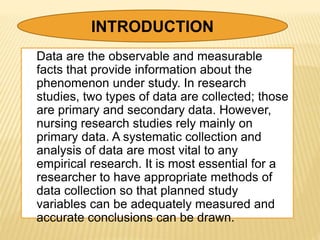
Data are the observable and measurable
facts that provide information about the
phenomenon under study. In research
studies, two types of data are collected; those
are primary and secondary data. However,
nursing research studies rely mainly on
primary data. A systematic collection and
analysis of data are most vital to any
empirical research. It is most essential for a
researcher to have appropriate methods of
data collection so that planned study
variables can be adequately measured and
accurate conclusions can be drawn.
INTRODUCTION
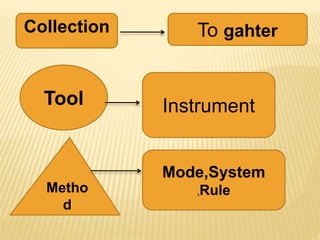
Collection To gahter
Tool Instrument
Metho
d
Mode,System
,Rule
DATA :Is factual information which is methodically
collected in the course of the research study that is
needed to answer the question posed in research
problem
DEFENITION OF DATA :It is defined as
the facts or
Information which is systematically collected;
carefully
Organized ;methodically classified and tabulated
and
finally factual data is converted to numerical data
for
Statistical measurement and analysis.
The word data is plural form of “ DATUM’
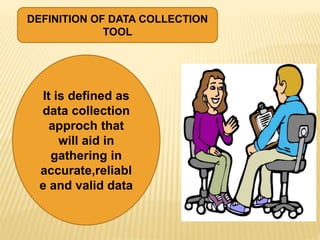
DEFINITION OF DATA COLLECTION
TOOL
It is defined as
data collection
approch that
will aid in
gathering in
accurate,reliabl
e and valid data
 .
CONCEPT OF DATA
COLLECTION
There is a pertinent question
that always strikes the
researchers mind:
how to determine what data
are to be collected. The
following discussion provides
the answer of this question
•What data is to be collected?
•From whom data is to be collected?
•Who will collect data?
•From where the data will be
collected?
•When is the data to be collected?
Primary Source :Primary data are directly
collected from the research units.
People, objects, programmes,
institutions, etc. (Primary data
are collected through interviews,
questioning,observation,
biochemical measurements,
and psychosocial measurement
scales)
Sources of data collection
 )

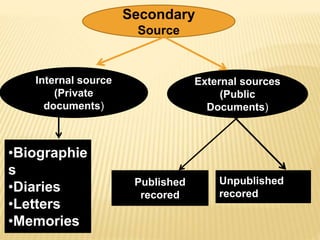
External sources
(Public
Documents)
Internal source
(Private
documents)
•Biographie
s
•Diaries
•Letters
•Memories
Published
recored
Unpublished
recored
Secondary
Source
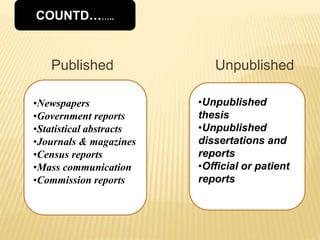
Published Unpublished
•Newspapers
•Government reports
•Statistical abstracts
•Journals & magazines
•Census reports
•Mass communication
•Commission reports
•Unpublished
thesis
•Unpublished
dissertations and
reports
•Official or patient
reports
COUNTD……..
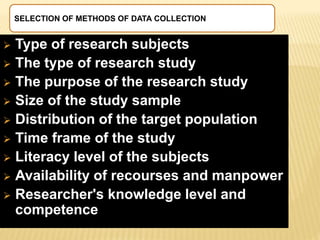
 Type of research subjects
 The type of research study
 The purpose of the research study
 Size of the study sample
 Distribution of the target population
 Time frame of the study
 Literacy level of the subjects
 Availability of recourses and manpower
 Researcher's knowledge level and
competence
SELECTION OF METHODS OF DATA COLLECTION
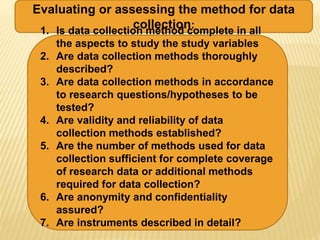
Evaluating or assessing the method for data
collection:
1. Is data collection method complete in all
the aspects to study the study variables
2. Are data collection methods thoroughly
described?
3. Are data collection methods in accordance
to research questions/hypotheses to be
tested?
4. Are validity and reliability of data
collection methods established?
5. Are the number of methods used for data
collection sufficient for complete coverage
of research data or additional methods
required for data collection?
6. Are anonymity and confidentiality
assured?
7. Are instruments described in detail?
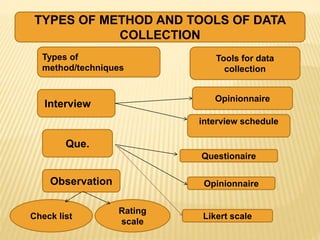
TYPES OF METHOD AND TOOLS OF DATA
COLLECTION
Types of
method/techniques
Tools for data
collection
Interview
Opinionnaire
interview schedule
Que.
Questionaire
Opinionnaire
Likert scale
Observation
Check list
Rating
scale
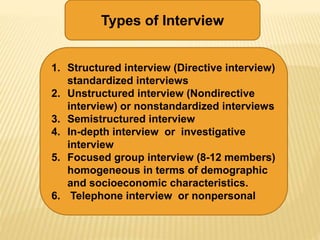
Types of Interview
1. Structured interview (Directive interview)
standardized interviews
2. Unstructured interview (Nondirective
interview) or nonstandardized interviews
3. Semistructured interview
4. In-depth interview or investigative
interview
5. Focused group interview (8-12 members)
homogeneous in terms of demographic
and socioeconomic characteristics.
6. Telephone interview or nonpersonal
QUESTIONNAIRE
A questionnaire is a
structured instrument
consisting of a series of
questions prepared by
researcher that a
research subject is asked
to complete, to gather
data from individuals
about
knowledge,attitude,
beliefs and feelings.
Definition
Guidelines for Designing a Good
Questionnaire
1. The questionnaire must be developed exactly in accordance
with study objectives.
2. The questionnaire should begin with the instructions for the
respondents to provide the responses.
3. The drafting of the questionnaire should be concise, precise,
and brief, because lengthy questionnaires may lead to
boredom among respondents.
4. The language of the questionnaire should be according to the
respondents' knowledge about a particular language.
5. Questions outside the respondents' experience should not be
asked.
6. In asking questions about past events, too much reliance
should not be placed on the respondents' memory.
7. Questions which are likely to lead to bias in the respondents
should be avoided.
8. Questions should be very clear and simple. Avoid professional
jargons.
9. As far as possible, open-ended questions should be avoided.
10. Avoid questions with difficult concepts, which are not easily
understandable for respondents.
Question
construction
1. Use statements where persons that have
different opinions or traits will give
different answers.
2. Use only one aspect of the construct in
which you are interested.
3. Avoid asking double-barrelled questions
which contain two distinct ideas or
concepts. For example, are you satisfied
with pay and fringe benefits?
4. Avoid leading, loaded, ambiguous, and
long questions.
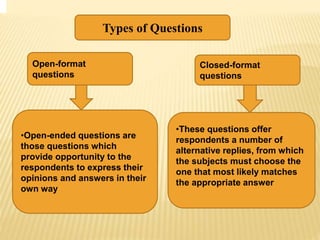
Types of Questions
Open-format
questions
Closed-format
questions
•Open-ended questions are
those questions which
provide opportunity to the
respondents to express their
opinions and answers in their
own way
•These questions offer
respondents a number of
alternative replies, from which
the subjects must choose the
one that most likely matches
the appropriate answer
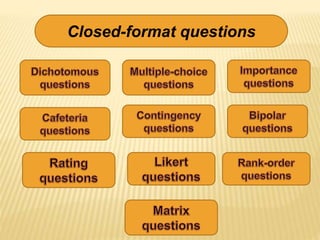
Closed-format questions
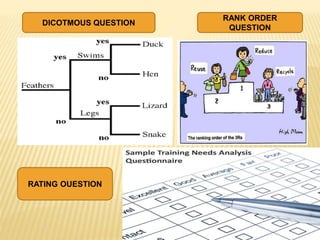
RANK ORDER
QUESTION
RATING OUESTION
DICOTMOUS QUESTION
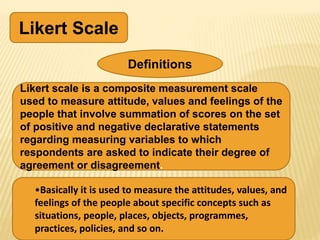
Likert Scale
Definitions
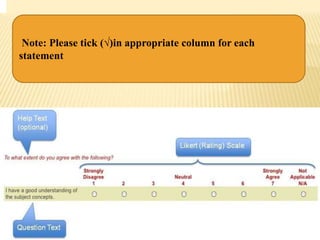
Likert scale is a composite measurement scale
used to measure attitude, values and feelings of the
people that involve summation of scores on the set
of positive and negative declarative statements
regarding measuring variables to which
respondents are asked to indicate their degree of
agreement or disagreement.
•Basically it is used to measure the attitudes, values, and
feelings of the people about specific concepts such as
situations, people, places, objects, programmes,
practices, policies, and so on.
Note: Please tick (√)in appropriate column for each
statement
Characteristics of Likert
Scale
Advantages of Likert
Scale
 Psychological measurement tool:
 Illustrative in nature
 Neutral statements
 Bipolar scaling method
 It is relatively easy to construct this scale.
 Likert scale is considered as more reliable and
valid tool to measure the psychosocial
variables.
 It is easy to administer, since respondents
only have to tick in spaces provided against of
each statement.
 It is less time consuming during construction
OBSERVATION
Definition
s Observation is a technique
for collecting all the data or
acquiring information
through occurrences that
can be observed through
senses with or without
mechanical devices.
It is a two part process to
collect data for study that
includes an observer
(someone who is observing)
and the observed (there is
something to observe).
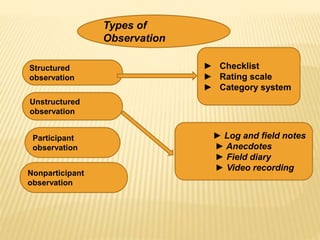
Types of
Observation
Structured
observation
Unstructured
observation
Participant
observation
Nonparticipant
observation
► Checklist
► Rating scale
► Category system
► Log and field notes
► Anecdotes
► Field diary
► Video recording
 .









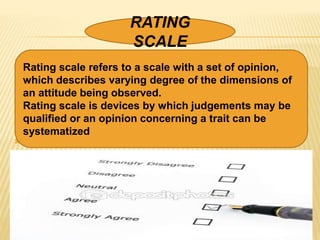
RATING
SCALE
Rating scale refers to a scale with a set of opinion,
which describes varying degree of the dimensions of
an attitude being observed.
Rating scale is devices by which judgements may be
qualified or an opinion concerning a trait can be
systematized
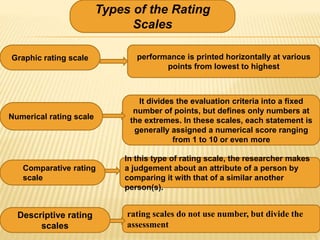
Descriptive rating
scales
Numerical rating scale
Comparative rating
scale
Graphic rating scale
Types of the Rating
Scales
performance is printed horizontally at various
points from lowest to highest
rating scales do not use number, but divide the
assessment
It divides the evaluation criteria into a fixed
number of points, but defines only numbers at
the extremes. In these scales, each statement is
generally assigned a numerical score ranging
from 1 to 10 or even more
In this type of rating scale, the researcher makes
a judgement about an attribute of a person by
comparing it with that of a similar another
person(s).
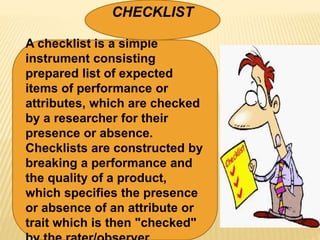
A checklist is a simple
instrument consisting
prepared list of expected
items of performance or
attributes, which are checked
by a researcher for their
presence or absence.
Checklists are constructed by
breaking a performance and
the quality of a product,
which specifies the presence
or absence of an attribute or
trait which is then "checked"
CHECKLIST
THANK YOU

Data collection tools and techniques

  • 1.
    Presented by: Amandeep Kaur AssistantProfessor of teaching in Mathematics, Shaheed Baba Deep Singh College of Education, Aherwan Fatehabad (Haryana)
  • 2.
    Data are theobservable and measurable facts that provide information about the phenomenon under study. In research studies, two types of data are collected; those are primary and secondary data. However, nursing research studies rely mainly on primary data. A systematic collection and analysis of data are most vital to any empirical research. It is most essential for a researcher to have appropriate methods of data collection so that planned study variables can be adequately measured and accurate conclusions can be drawn. INTRODUCTION
  • 3.
    Collection To gahter ToolInstrument Metho d Mode,System ,Rule
  • 4.
    DATA :Is factualinformation which is methodically collected in the course of the research study that is needed to answer the question posed in research problem DEFENITION OF DATA :It is defined as the facts or Information which is systematically collected; carefully Organized ;methodically classified and tabulated and finally factual data is converted to numerical data for Statistical measurement and analysis. The word data is plural form of “ DATUM’
  • 5.
    DEFINITION OF DATACOLLECTION TOOL It is defined as data collection approch that will aid in gathering in accurate,reliabl e and valid data
  • 6.
     . CONCEPT OFDATA COLLECTION There is a pertinent question that always strikes the researchers mind: how to determine what data are to be collected. The following discussion provides the answer of this question •What data is to be collected? •From whom data is to be collected? •Who will collect data? •From where the data will be collected? •When is the data to be collected?
  • 7.
    Primary Source :Primarydata are directly collected from the research units. People, objects, programmes, institutions, etc. (Primary data are collected through interviews, questioning,observation, biochemical measurements, and psychosocial measurement scales) Sources of data collection
  • 8.
     )  External sources (Public Documents) Internalsource (Private documents) •Biographie s •Diaries •Letters •Memories Published recored Unpublished recored Secondary Source
  • 9.
    Published Unpublished •Newspapers •Government reports •Statisticalabstracts •Journals & magazines •Census reports •Mass communication •Commission reports •Unpublished thesis •Unpublished dissertations and reports •Official or patient reports COUNTD……..
  • 10.
     Type ofresearch subjects  The type of research study  The purpose of the research study  Size of the study sample  Distribution of the target population  Time frame of the study  Literacy level of the subjects  Availability of recourses and manpower  Researcher's knowledge level and competence SELECTION OF METHODS OF DATA COLLECTION
  • 11.
    Evaluating or assessingthe method for data collection: 1. Is data collection method complete in all the aspects to study the study variables 2. Are data collection methods thoroughly described? 3. Are data collection methods in accordance to research questions/hypotheses to be tested? 4. Are validity and reliability of data collection methods established? 5. Are the number of methods used for data collection sufficient for complete coverage of research data or additional methods required for data collection? 6. Are anonymity and confidentiality assured? 7. Are instruments described in detail?
  • 12.
    TYPES OF METHODAND TOOLS OF DATA COLLECTION Types of method/techniques Tools for data collection Interview Opinionnaire interview schedule Que. Questionaire Opinionnaire Likert scale Observation Check list Rating scale
  • 13.
    Types of Interview 1.Structured interview (Directive interview) standardized interviews 2. Unstructured interview (Nondirective interview) or nonstandardized interviews 3. Semistructured interview 4. In-depth interview or investigative interview 5. Focused group interview (8-12 members) homogeneous in terms of demographic and socioeconomic characteristics. 6. Telephone interview or nonpersonal
  • 14.
    QUESTIONNAIRE A questionnaire isa structured instrument consisting of a series of questions prepared by researcher that a research subject is asked to complete, to gather data from individuals about knowledge,attitude, beliefs and feelings. Definition
  • 15.
    Guidelines for Designinga Good Questionnaire 1. The questionnaire must be developed exactly in accordance with study objectives. 2. The questionnaire should begin with the instructions for the respondents to provide the responses. 3. The drafting of the questionnaire should be concise, precise, and brief, because lengthy questionnaires may lead to boredom among respondents. 4. The language of the questionnaire should be according to the respondents' knowledge about a particular language. 5. Questions outside the respondents' experience should not be asked. 6. In asking questions about past events, too much reliance should not be placed on the respondents' memory. 7. Questions which are likely to lead to bias in the respondents should be avoided. 8. Questions should be very clear and simple. Avoid professional jargons. 9. As far as possible, open-ended questions should be avoided. 10. Avoid questions with difficult concepts, which are not easily understandable for respondents.
  • 16.
    Question construction 1. Use statementswhere persons that have different opinions or traits will give different answers. 2. Use only one aspect of the construct in which you are interested. 3. Avoid asking double-barrelled questions which contain two distinct ideas or concepts. For example, are you satisfied with pay and fringe benefits? 4. Avoid leading, loaded, ambiguous, and long questions.
  • 17.
    Types of Questions Open-format questions Closed-format questions •Open-endedquestions are those questions which provide opportunity to the respondents to express their opinions and answers in their own way •These questions offer respondents a number of alternative replies, from which the subjects must choose the one that most likely matches the appropriate answer
  • 18.
  • 19.
  • 20.
    Likert Scale Definitions Likert scaleis a composite measurement scale used to measure attitude, values and feelings of the people that involve summation of scores on the set of positive and negative declarative statements regarding measuring variables to which respondents are asked to indicate their degree of agreement or disagreement. •Basically it is used to measure the attitudes, values, and feelings of the people about specific concepts such as situations, people, places, objects, programmes, practices, policies, and so on.
  • 21.
    Note: Please tick(√)in appropriate column for each statement
  • 22.
    Characteristics of Likert Scale Advantagesof Likert Scale  Psychological measurement tool:  Illustrative in nature  Neutral statements  Bipolar scaling method  It is relatively easy to construct this scale.  Likert scale is considered as more reliable and valid tool to measure the psychosocial variables.  It is easy to administer, since respondents only have to tick in spaces provided against of each statement.  It is less time consuming during construction
  • 23.
    OBSERVATION Definition s Observation isa technique for collecting all the data or acquiring information through occurrences that can be observed through senses with or without mechanical devices. It is a two part process to collect data for study that includes an observer (someone who is observing) and the observed (there is something to observe).
  • 24.
    Types of Observation Structured observation Unstructured observation Participant observation Nonparticipant observation ► Checklist ►Rating scale ► Category system ► Log and field notes ► Anecdotes ► Field diary ► Video recording
  • 25.
     .          RATING SCALE Rating scalerefers to a scale with a set of opinion, which describes varying degree of the dimensions of an attitude being observed. Rating scale is devices by which judgements may be qualified or an opinion concerning a trait can be systematized
  • 26.
    Descriptive rating scales Numerical ratingscale Comparative rating scale Graphic rating scale Types of the Rating Scales performance is printed horizontally at various points from lowest to highest rating scales do not use number, but divide the assessment It divides the evaluation criteria into a fixed number of points, but defines only numbers at the extremes. In these scales, each statement is generally assigned a numerical score ranging from 1 to 10 or even more In this type of rating scale, the researcher makes a judgement about an attribute of a person by comparing it with that of a similar another person(s).
  • 27.
    A checklist isa simple instrument consisting prepared list of expected items of performance or attributes, which are checked by a researcher for their presence or absence. Checklists are constructed by breaking a performance and the quality of a product, which specifies the presence or absence of an attribute or trait which is then "checked" CHECKLIST
  • 28.