What are the strengths
and weaknesses of
Quantitative Research?
A. Strengths of Quantitative Research
• 1. Quantitative Research allows you to reach a higher
sample size. This leads to an easier way to reach an
accurate generalized conclusion. The additional data gives
you greater creditability because it has more depth to
review.
• 2. You can collect more information quickly when using
quantitative research. Experiments, surveys and interviews
provide immediate answers that become useful from a
data-centered approach.
• 3. Quantitative Research uses randomized samples in collecting
information. This excludes bias from appearing in most situations. It
provides an advantage in the fact that the data can then get the rest
of the demographic being studied.
• 4. Results duplication is possible. Quantitative research only
focuses on the actual data. The work validates itself because the
results always points towards the same data even though
randomized conditions exist.
• 5. Quantitative research can focus on facts or a series of
information. Researchers can use quantitative approach to focus on
a specific fact that they want to study in a given population.
• 6. Quantitative approach does not require direct observation.
Study can be done without the need of someone. This advantage
creates a better response rate because people have more time and
less pressure to complete the work.
B. Weakness of Quantitative Research
• 1. This method does not consider the meaning behind
social phenomenon. It does not care about the
motives that people have when sharing an opinion or
making decisions.
• 2. Quantitative research studies can be very
expensive. The money that could be spent is a
significant barrier to consider in conducting
quantitative research.
• 3. There is no access to specific feedback in
quantitative research. The statistics that researchers
gather are useful for generalization but could not
produce specific feedback incidents that allows
positive refinement.
• 4. Some efforts at randomization will not create
usable information. Quantitative approach doesn't
look for the reason why variables exist in specific
environments.
• 5. Quantitative research requires a large sample that
makes it difficult to gather data and makes this kind of
research costly.
What are the kinds of quantitative research designs?
• Research design is considered as the framework of research. It
is termed as the "GLUE" that holds each of the elements of
research as one. In other words, it is the plan of the proposed
research work. It is the overall strategy that is being integrated
in the different components of the study in a coherent and
logical way.
• The function of the research design is to assure that evidence
obtained enables the researcher to effectively address the
problem as unambiguously as possible. The problem that will
be answered in the research determines the kind of research
that should be used in the study.
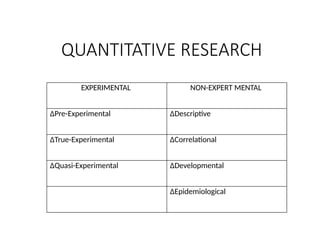
QUANTITATIVE RESEARCH
EXPERIMENTAL NON-EXPERT MENTAL
∆Pre-Experimental ∆Descriptive
∆True-Experimental ∆Correlational
∆Quasi-Experimental ∆Developmental
∆Epidemiological
What is Experimental Research?
• Experimental Research is a quantitative research
dealing with the object or subject of a research in
an exact manner and look into the extent of the
effects or influence of the treatment on the subject,
then discovers the cause of such effect. There are
two groups involved in any experimental research;
the experimental group, the one in which the
treatment is applied and the control group, which
does not receive any treatment
A. Pre-Experimental Research Design:
• A group or various groups are kept under
observation after implementing factors of cause
and effect. This research is done to understand
whether further investigations are necessary for
particular groups.
B. True Experimental Research Design: This type of
research design relies on statistical analysis to prove or
disprove a hypothesis, making it the most accurate type
of research. This type of disprove a hypothesis,ause-effect
relationship with-in a group. In a true experiment, there
are factors need to be considered:
• 1. There is a control group which won't be subjected to
changes and an experimental group which will
experience the changed variables
• 2. A variable that could be manipulated by the
researcher
• 3. Random Distribution
• C. Quasi- Experimental Research Design: The word
"quasi" indicates similarity. In this research, an
independent variable is manipulated but the participants
of the group are not randomly assigned. Quasi-research
is used in field settings where random assignment is
either irrelevant or not required.
What is Non-Experimental Research Design?
• Non-Experimental research design is one of the
broad categories of research designs in which the
researcher observes the phenomena as they occur
naturally and no external variables are introduced.
• It is a research design in which variables are not
deliberately manipulated nor is the setting is
controlled. Data is collected without introducing
changes and making treatments.
a. Descriptive Research Design
• The purpose of descriptive studies is to observe, describe
and document aspects of a situation as it naturally occurs
and sometimes to serve as a starting point for hypothesis
generation or theory development.
• It is used in observing, documenting and describing a
phenomenon occurring in natural setting without any
manipulation or control. It is designed to gain more
information about characteristics within a particular field
in real world.
Types of Descriptive Research Design
• 1. Univarient descriptive design- This design is used to
describe the frequency of occurrence of phenomenon. It
does not necessarily focus on the on a single variable;
there maybe one or more variables involved in the
study.
• 2. Exploratory Design-This design is used to identify,
explore and describe the existing phenomenon and its
related factors. It is not simply a description or the
frequency of phenomenon but its in depth exploration
of its related factors to improve further understanding of
a phenomenon.
• 3. Comparative Design- This design involves comparing
and contrasting two or more samples of study subjects
on one or more variables. It is used to compare two
distinct groups in terms of knowledge, perceptions,
attitudes and physical of psychological symptoms.
Correlational Design
• In a correlational design, the researcher examines the
relationship between two or more variables in a natural
setting without manipulation of the control. In other
words, it is a study conducted to determine the
relationship of two or more variables without any
intervention.
Types of Correlational Research Design
• 1. Prospective Research Design- A design that lets the
researcher connect the present to the future. It starts
with the cause and arrive with a presumed effects.
• 2.Retrospective Research Design- A design where the
researcher studies the current situation by seeking facts
and figures from the past.
c. Developmental Research Design
• In a developmental research design, the researcher
examines the phenomenon with reference to time.
It is generally used as aide research design with
other designs.
Types of Developmental Research Design
• 1. Cross-sectional Design- In this research design,
the researcher collects data at a particular point of
time (one period data collection).
• 2. Longitudinal Design- Designed to collect data
over an extended period (long-term study). Its
value is in its ability to demonstrate change over a
period of time.
d. Epidemiological Research Design
• A study done to investigate the distribution and
causes of the disease in a population. Generally, it is
conducted to investigate causes of different
diseases in either prospective approach or
retrospective design.
Types of Epidemiological Research Design
• 1. Cohort Studies- In this design, a longitudinal
approach is used to investigate the occurrence of a
disease in existing presumed causes.
• 2.Case-control Studies In this design, the cause of
the disease is investigated after the occurrence of
the disease.

PR2 quantitative reserch-WPS Office.pptx

  • 1.
    What are thestrengths and weaknesses of Quantitative Research?
  • 2.
    A. Strengths ofQuantitative Research • 1. Quantitative Research allows you to reach a higher sample size. This leads to an easier way to reach an accurate generalized conclusion. The additional data gives you greater creditability because it has more depth to review. • 2. You can collect more information quickly when using quantitative research. Experiments, surveys and interviews provide immediate answers that become useful from a data-centered approach.
  • 3.
    • 3. QuantitativeResearch uses randomized samples in collecting information. This excludes bias from appearing in most situations. It provides an advantage in the fact that the data can then get the rest of the demographic being studied. • 4. Results duplication is possible. Quantitative research only focuses on the actual data. The work validates itself because the results always points towards the same data even though randomized conditions exist. • 5. Quantitative research can focus on facts or a series of information. Researchers can use quantitative approach to focus on a specific fact that they want to study in a given population. • 6. Quantitative approach does not require direct observation. Study can be done without the need of someone. This advantage creates a better response rate because people have more time and less pressure to complete the work.
  • 4.
    B. Weakness ofQuantitative Research • 1. This method does not consider the meaning behind social phenomenon. It does not care about the motives that people have when sharing an opinion or making decisions. • 2. Quantitative research studies can be very expensive. The money that could be spent is a significant barrier to consider in conducting quantitative research. • 3. There is no access to specific feedback in quantitative research. The statistics that researchers gather are useful for generalization but could not produce specific feedback incidents that allows positive refinement.
  • 5.
    • 4. Someefforts at randomization will not create usable information. Quantitative approach doesn't look for the reason why variables exist in specific environments. • 5. Quantitative research requires a large sample that makes it difficult to gather data and makes this kind of research costly.
  • 6.
    What are thekinds of quantitative research designs? • Research design is considered as the framework of research. It is termed as the "GLUE" that holds each of the elements of research as one. In other words, it is the plan of the proposed research work. It is the overall strategy that is being integrated in the different components of the study in a coherent and logical way. • The function of the research design is to assure that evidence obtained enables the researcher to effectively address the problem as unambiguously as possible. The problem that will be answered in the research determines the kind of research that should be used in the study.
  • 7.
    QUANTITATIVE RESEARCH EXPERIMENTAL NON-EXPERTMENTAL ∆Pre-Experimental ∆Descriptive ∆True-Experimental ∆Correlational ∆Quasi-Experimental ∆Developmental ∆Epidemiological
  • 8.
    What is ExperimentalResearch? • Experimental Research is a quantitative research dealing with the object or subject of a research in an exact manner and look into the extent of the effects or influence of the treatment on the subject, then discovers the cause of such effect. There are two groups involved in any experimental research; the experimental group, the one in which the treatment is applied and the control group, which does not receive any treatment
  • 9.
    A. Pre-Experimental ResearchDesign: • A group or various groups are kept under observation after implementing factors of cause and effect. This research is done to understand whether further investigations are necessary for particular groups.
  • 10.
    B. True ExperimentalResearch Design: This type of research design relies on statistical analysis to prove or disprove a hypothesis, making it the most accurate type of research. This type of disprove a hypothesis,ause-effect relationship with-in a group. In a true experiment, there are factors need to be considered: • 1. There is a control group which won't be subjected to changes and an experimental group which will experience the changed variables • 2. A variable that could be manipulated by the researcher • 3. Random Distribution
  • 11.
    • C. Quasi-Experimental Research Design: The word "quasi" indicates similarity. In this research, an independent variable is manipulated but the participants of the group are not randomly assigned. Quasi-research is used in field settings where random assignment is either irrelevant or not required.
  • 12.
    What is Non-ExperimentalResearch Design? • Non-Experimental research design is one of the broad categories of research designs in which the researcher observes the phenomena as they occur naturally and no external variables are introduced. • It is a research design in which variables are not deliberately manipulated nor is the setting is controlled. Data is collected without introducing changes and making treatments.
  • 13.
    a. Descriptive ResearchDesign • The purpose of descriptive studies is to observe, describe and document aspects of a situation as it naturally occurs and sometimes to serve as a starting point for hypothesis generation or theory development. • It is used in observing, documenting and describing a phenomenon occurring in natural setting without any manipulation or control. It is designed to gain more information about characteristics within a particular field in real world.
  • 14.
    Types of DescriptiveResearch Design • 1. Univarient descriptive design- This design is used to describe the frequency of occurrence of phenomenon. It does not necessarily focus on the on a single variable; there maybe one or more variables involved in the study. • 2. Exploratory Design-This design is used to identify, explore and describe the existing phenomenon and its related factors. It is not simply a description or the frequency of phenomenon but its in depth exploration of its related factors to improve further understanding of a phenomenon.
  • 15.
    • 3. ComparativeDesign- This design involves comparing and contrasting two or more samples of study subjects on one or more variables. It is used to compare two distinct groups in terms of knowledge, perceptions, attitudes and physical of psychological symptoms.
  • 16.
    Correlational Design • Ina correlational design, the researcher examines the relationship between two or more variables in a natural setting without manipulation of the control. In other words, it is a study conducted to determine the relationship of two or more variables without any intervention.
  • 17.
    Types of CorrelationalResearch Design • 1. Prospective Research Design- A design that lets the researcher connect the present to the future. It starts with the cause and arrive with a presumed effects. • 2.Retrospective Research Design- A design where the researcher studies the current situation by seeking facts and figures from the past.
  • 18.
    c. Developmental ResearchDesign • In a developmental research design, the researcher examines the phenomenon with reference to time. It is generally used as aide research design with other designs.
  • 19.
    Types of DevelopmentalResearch Design • 1. Cross-sectional Design- In this research design, the researcher collects data at a particular point of time (one period data collection). • 2. Longitudinal Design- Designed to collect data over an extended period (long-term study). Its value is in its ability to demonstrate change over a period of time.
  • 20.
    d. Epidemiological ResearchDesign • A study done to investigate the distribution and causes of the disease in a population. Generally, it is conducted to investigate causes of different diseases in either prospective approach or retrospective design.
  • 21.
    Types of EpidemiologicalResearch Design • 1. Cohort Studies- In this design, a longitudinal approach is used to investigate the occurrence of a disease in existing presumed causes. • 2.Case-control Studies In this design, the cause of the disease is investigated after the occurrence of the disease.